🖍️Shop Flower Coloring Books –>




Fill an entire paper garden with color with our collection of 10 free printable flower coloring pages, featuring roses, tulips, sunflower-inspired designs, spring blossoms, orchids, daisies, butterflies, birds, a hedgehog, and peaceful pond scenery.
This larger floral collection offers plenty of variety. Some pages focus almost entirely on flowers, while others combine blossoms with wildlife and seasonal scenes. You can color a romantic rose bouquet, wander through a field of tulips, decorate an intricate sunflower mandala, create pastel cherry-blossom-inspired branches for spring birds, or turn a butterfly-and-orchid design into a brilliant rainbow pattern.
There is no need to make every flower botanically realistic. Use photographs and gardens for inspiration when you want natural colors, then print another page and invent turquoise roses, purple sunflowers, rainbow daisies, or orchids that glow beneath a midnight sky.
Grab your crayons, markers, or colored pencils and explore ten different ways to make a garden bloom on paper.
🌸 Explore Our 10 Flower Coloring Pages
This collection includes ten different designs:
- Butterflies with flowers
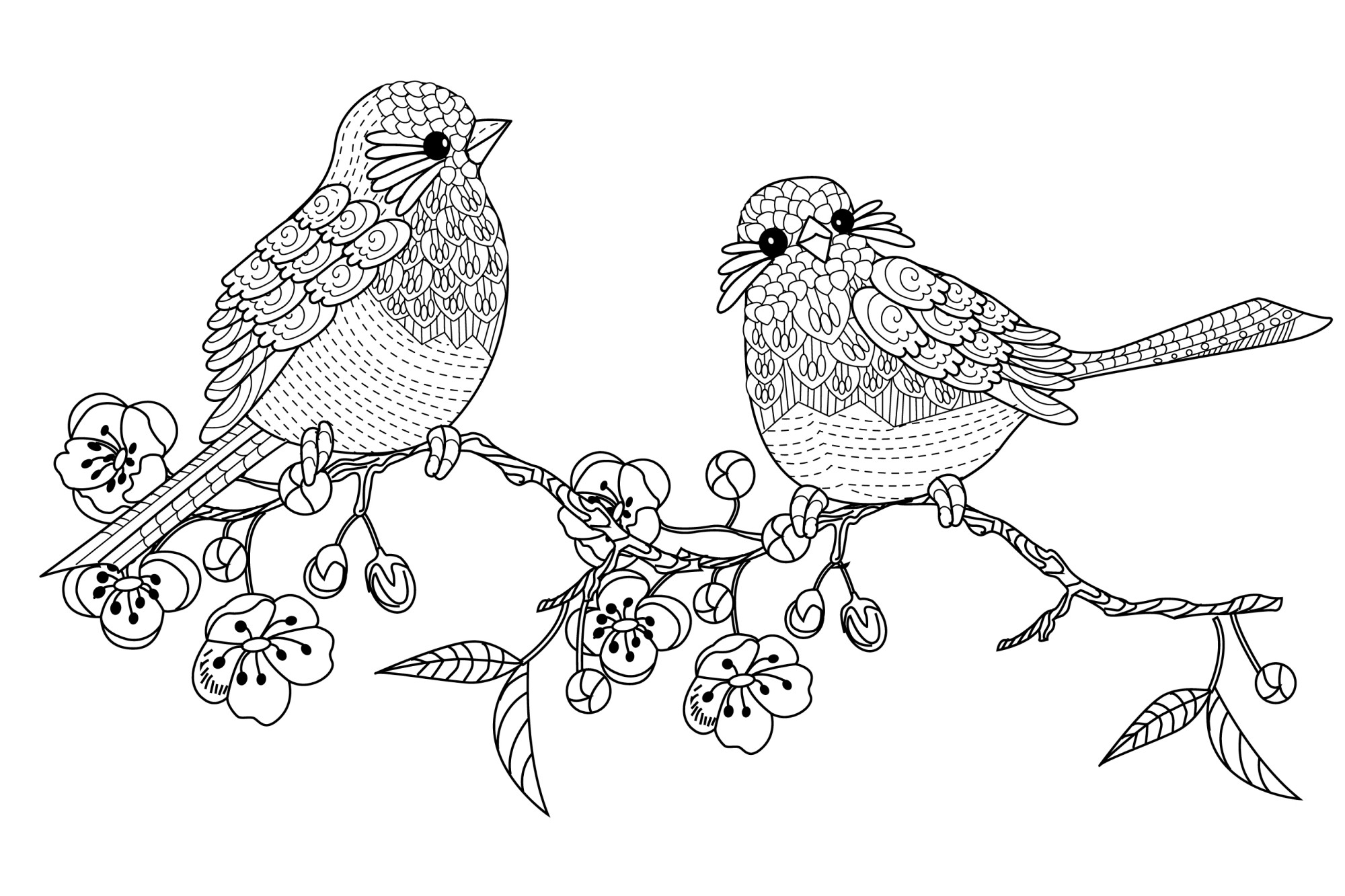
- Spring birds sitting on flowering branches
- Rose bouquet
- Sunflower mandala with butterflies
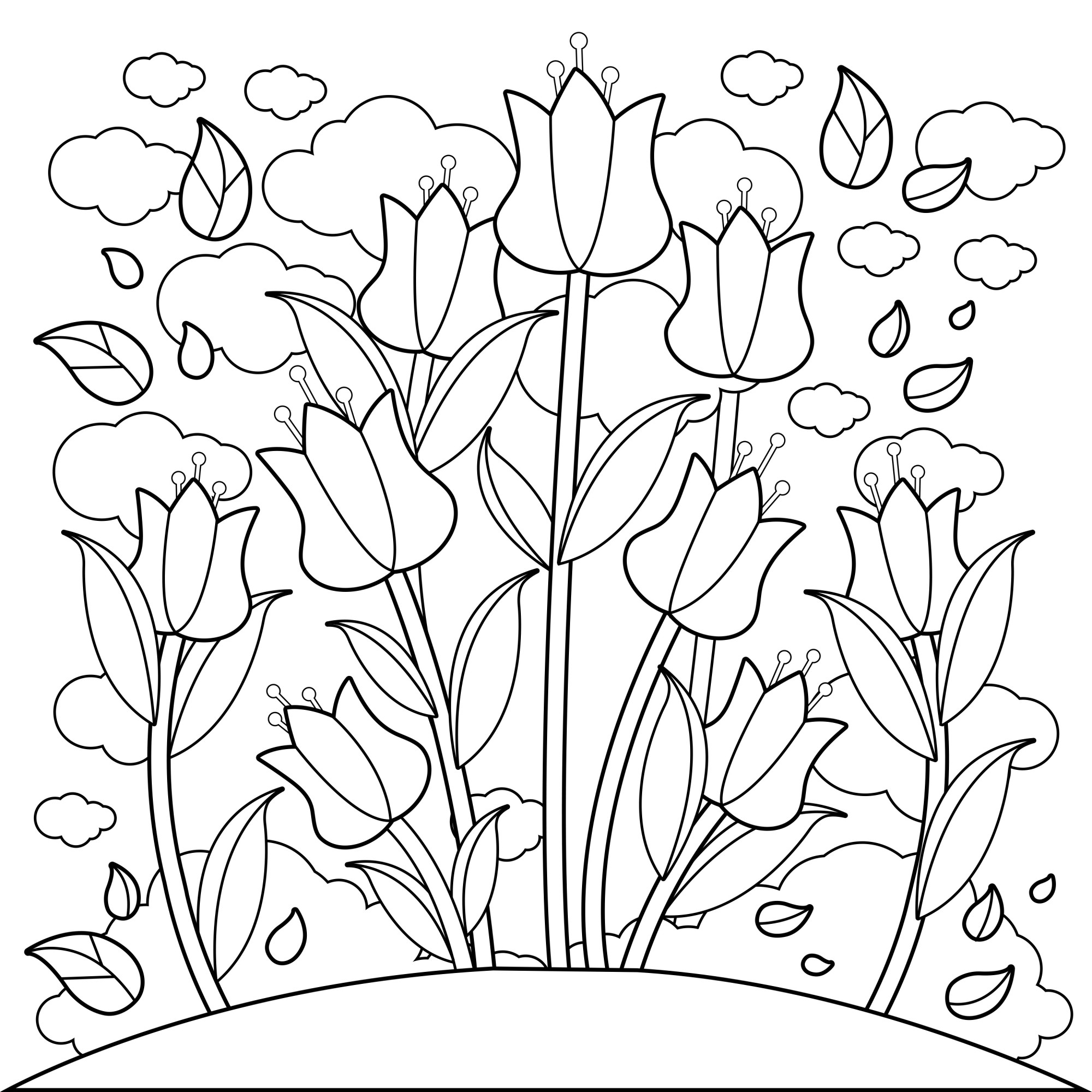
- Tulip field
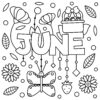
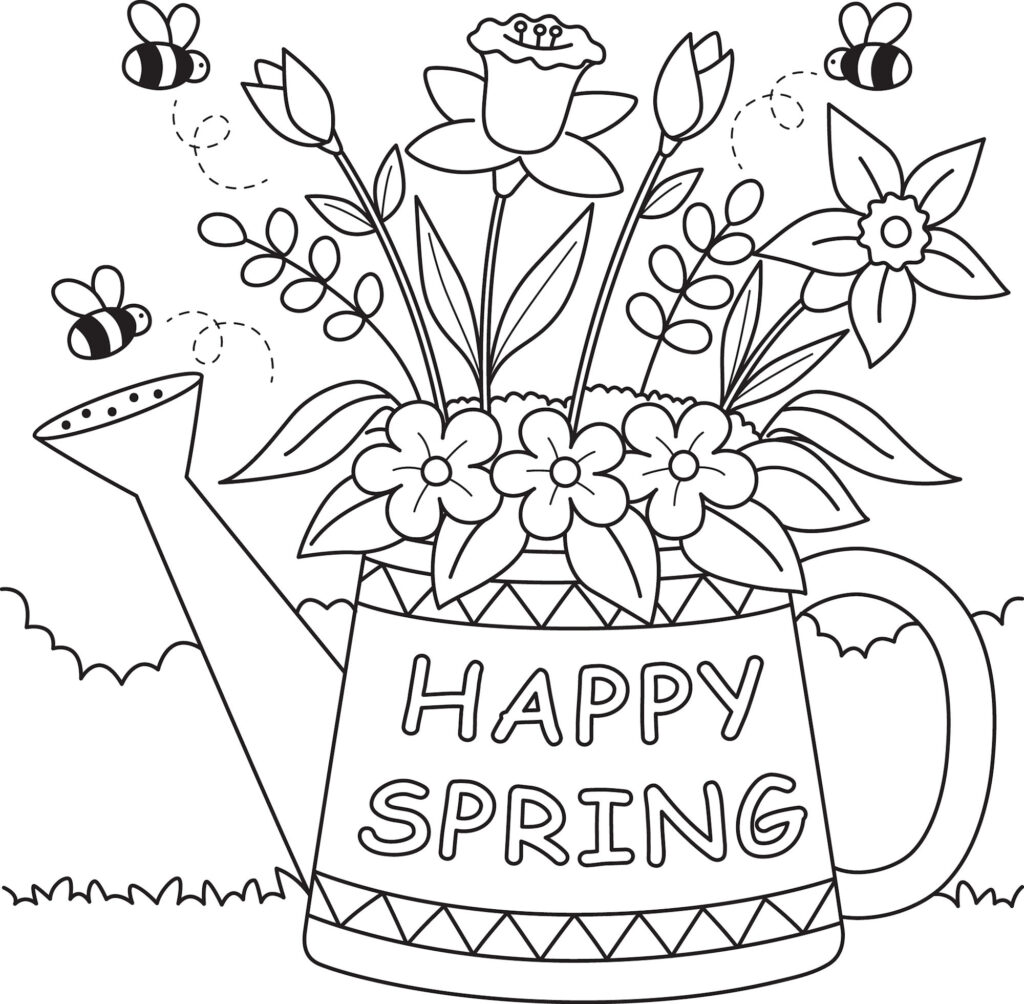
- Happy Spring flower design
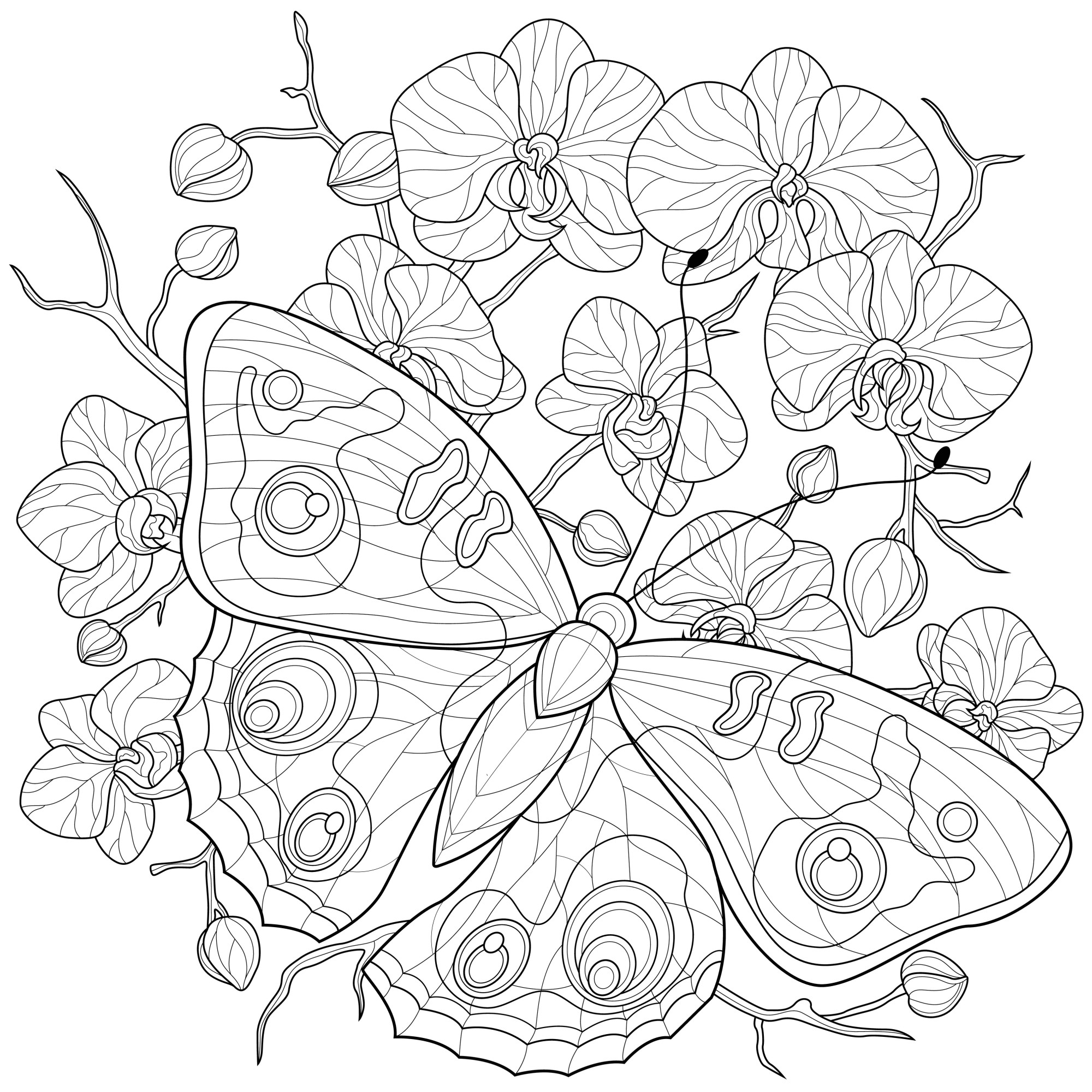
- Butterfly with orchids in a detailed zentangle-style design
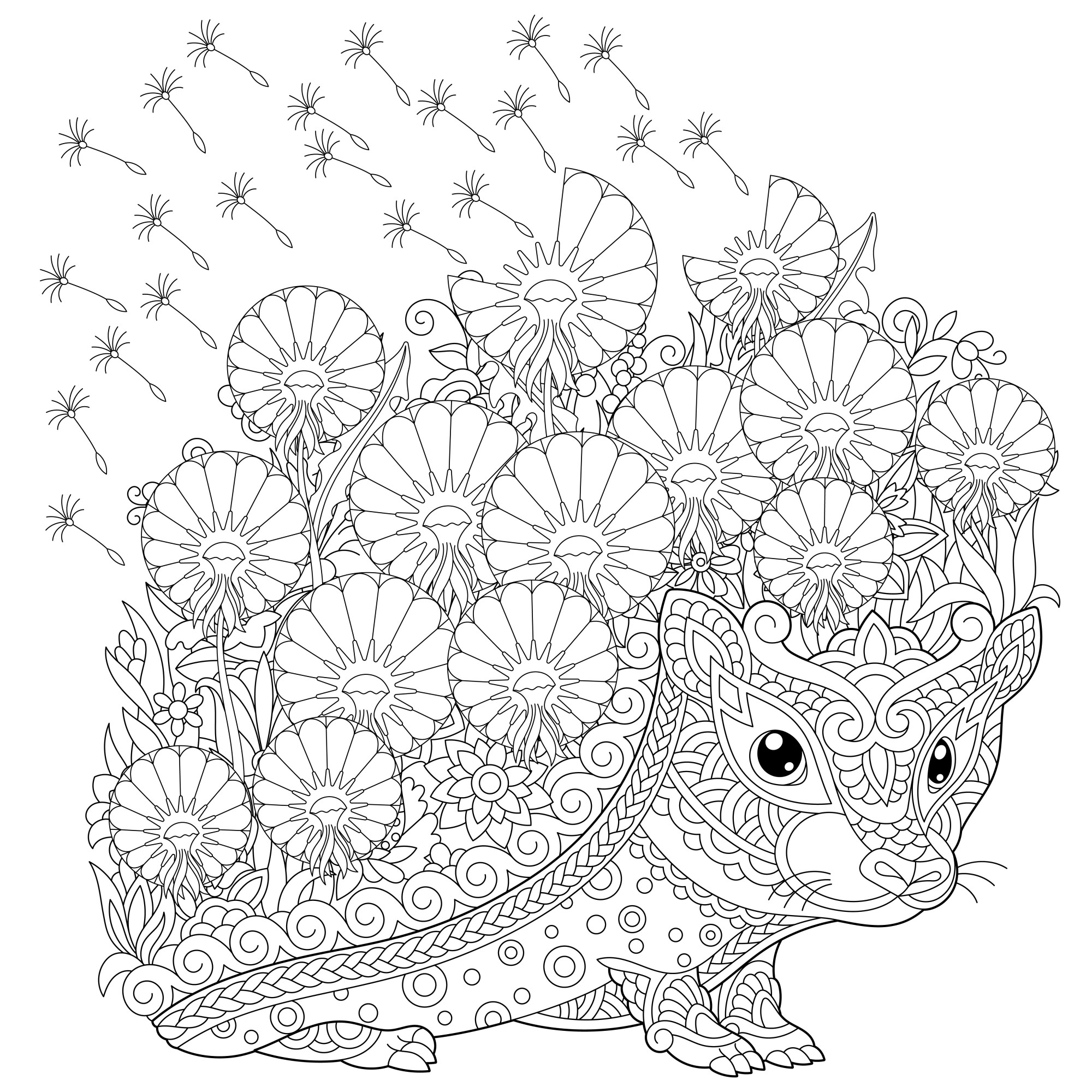
- Hedgehog with spring flowers
- Repeating daisy pattern
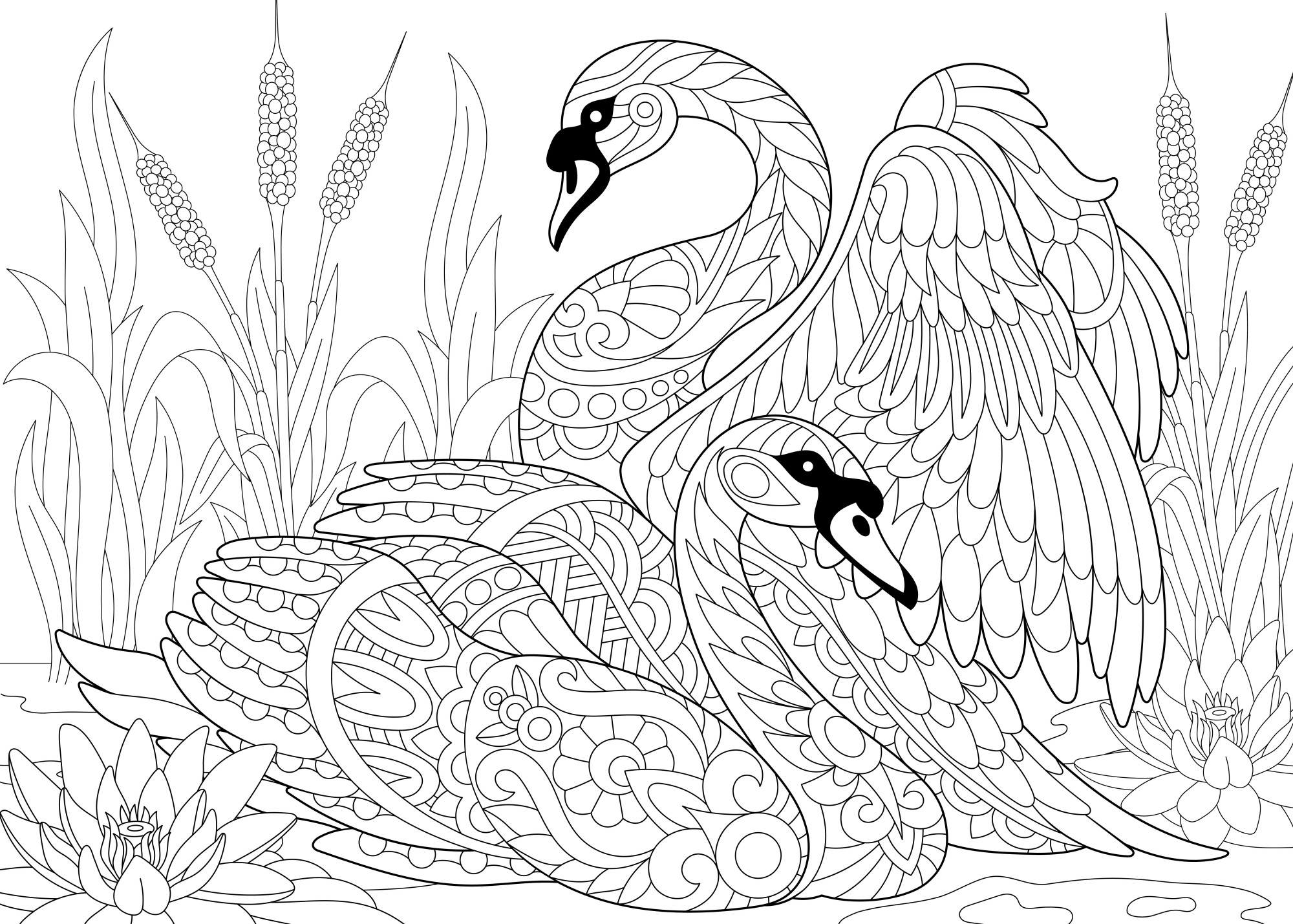
- Two swans among decorative pond flowers and aquatic plants
That makes this page especially useful when you want variety rather than one particular flower.
For a smaller mixed floral collection featuring tulips, spring flowers, butterflies, and a sunflower mandala, visit our Flower Coloring Pages.
🎨 Choose a Flower Color Palette
Before starting, choose a few colors you would like to repeat across the page.
A soft Spring Garden palette might include:
- Blush pink
- Lavender
- Pale yellow
- Mint
- Baby blue
- Peach
For something brighter, try:
- Hot pink
- Orange
- Sunshine yellow
- Emerald
- Turquoise
- Purple
A Cottage Garden palette could use dusty rose, cream, sage, lavender, soft blue, and warm brown.
Or create a dramatic Jewel Garden with ruby, sapphire, emerald, plum, and gold.
Repeating a limited group of colors can help even the most detailed floral page feel connected.
🦋 1. Butterflies With Flowers Coloring Page
The first design combines two colorful garden favorites: butterflies and flowers.
Start with the flowers.
Try:
- Pink
- Purple
- Yellow
- Blue
- Orange
Then choose butterfly colors that stand out against them.
For example:
Flowers: Pink and lavender
Butterfly: Orange and yellow
or:
Flowers: Yellow and orange
Butterfly: Blue and turquoise
Repeating one flower color inside the butterfly wings can help tie the entire picture together.
🦋 Create Symmetrical Butterfly Wings
Many butterflies have broadly symmetrical wing patterns.
Color one side first.
Then repeat similar colors on the opposite wing.
Try:
- Purple spots
- Yellow border
- Blue center
on both sides.
You can also do the opposite and deliberately make each wing different.
Coloring pages are art rather than scientific illustrations, so either approach works.
For a dedicated butterfly design, continue with our Butterfly Coloring Page.
🌺 Why Do Butterflies Visit Flowers?
Many adult butterflies visit flowers to drink nectar.
As they move between blossoms, they can also carry pollen.
Butterflies are only part of a much larger pollinator community that may include:
- Bees
- Beetles
- Moths
- Birds
- Bats
Different flowers interact with different pollinators.
Add several imaginary garden visitors around the page and decide which flowers they are visiting.
🌸 2. Spring Birds on Flowering Branches
The second design features spring birds perched among flowering branches.
The original artwork evokes the look of cherry blossoms, making soft pink and white natural choices.
Try:
Flowers: Pale pink and white
Branches: Brown or gray-brown
Leaves: Fresh green
Sky: Pale blue
Then make the birds the boldest part of the picture.
Use:
- Blue
- Yellow
- Brown
- Red
- Gray
or completely imaginary colors.
🌸 Create a Pink Blossom Tree
Blend several shades:
- Nearly white
- Pale blush
- Rose
- Raspberry
Keep some petals very light.
Add darker pink toward flower centers.
Use brown and gray throughout the branches.
The contrast between dark branches and delicate blossoms can create a very springlike scene.
🐦 Create Rainbow Spring Birds
There is no need to identify the illustrated birds as exact species.
Instead, create decorative spring birds.
Try:
Bird 1: Blue and turquoise
Bird 2: Yellow and orange
Bird 3: Pink and purple
Maybe every bird has a different color palette.
Draw tiny musical notes around them to suggest a lively spring morning.
🌳 Add More Blossoming Branches
Expand the picture beyond the original design.
Draw:
- More branches
- Buds
- New leaves
- Additional flowers
Some blossoms can be fully open.
Others can remain small buds.
This creates a simple way to show different stages of flowering on one branch.
🌹 3. Rose Bouquet Coloring Page
The rose bouquet gives you a classic floral subject with plenty of room for shading and color blending.
Try familiar rose-inspired colors such as:
- Red
- Pink
- Yellow
- Cream
- White
- Peach
Then print another copy and create:
- Blue roses
- Rainbow roses
- Turquoise roses
- Black-and-gold fantasy roses
A bouquet does not have to contain identical flowers.
Give every rose its own color.
❤️ Create Classic Red Roses
Start with scarlet.
Add deeper crimson or burgundy where petals overlap.
Keep the outer edges slightly lighter.
Use several greens throughout the leaves.
A few dark shadows between petals can help the flower shapes become much easier to see.
🩷 Create a Pink Rose Bouquet
Try:
- Pale blush
- Rose
- Raspberry
Use different shades on different flowers.
Maybe one rose is nearly white.
Another can be deep magenta.
Add cream ribbon around the stems.
🌈 Create a Rainbow Rose Bouquet
Give every rose a different color.
Try:
Red
Orange
Yellow
Green
Blue
Purple
Use dark green leaves to keep the flowers visually connected.
Maybe the bouquet came from an imaginary greenhouse where every rose grows in impossible colors.
For more dedicated rose designs, explore our Rose Coloring Pages.
💐 Design the Bouquet Wrapping
Do not stop with the blossoms.
Add:
- Ribbon
- Paper wrap
- Bow
- Gift tag
Choose colors that complement the flowers.
Maybe the bouquet is for:
- Birthday
- Thank-you
- Mother’s Day
- Friend
- Teacher
Write a tiny message on the card.
🌻 4. Sunflower Mandala With Butterflies
The sunflower-inspired mandala combines a familiar garden flower with a repeating decorative pattern.
A traditional-inspired palette might use:
- Lemon yellow
- Golden yellow
- Brown
- Green
But mandalas are perfect for experimenting with completely different colors.
Try:
- Purple and gold
- Turquoise and orange
- Pink and green
- Rainbow
Work gradually from the center outward.
🌻 A Sunflower Is More Than One Flower
What looks like one sunflower is actually a flower head containing many individual florets.
The showy structures around the outside are associated with ray florets, while the center contains many disk florets.
Sunflowers belong to the plant family Asteraceae, which also includes daisies and many other familiar flowering plants.
That makes the intricate center of a sunflower particularly fitting for a detailed mandala.
🌀 Create a Repeating Sunflower Pattern
Choose three colors.
For example:
Yellow → Orange → Brown
Repeat the sequence around the center.
Then choose another three for the next ring:
Purple → Pink → Blue
Keeping a consistent rule can turn a complicated design into a manageable pattern.
🌈 Create a Rainbow Sunflower
Start in the center with purple.
Move outward through:
Blue
Green
Yellow
Orange
Red
Or reverse the sequence.
Give the butterflies complementary colors.
A blue-and-purple butterfly can look especially bright against yellow and orange petals.
🌷 5. Tulip Field Coloring Page
The tulip field is one of the best pages for experimenting with lots of flower colors at once.
Garden tulips are grown in many shades, including:
- Red
- Pink
- Yellow
- Orange
- White
- Purple
Color each row differently.
Maybe:
Row 1: Red
Row 2: Yellow
Row 3: Purple
Row 4: Pink
Then fill the field with fresh green stems and leaves.
🌷 Create a Rainbow Tulip Field
Arrange the flowers by color.
Move through:
Red → Orange → Yellow → Purple → Pink
Or create a complete rainbow.
Another option is to mix everything randomly, as though dozens of tulip varieties were planted together.
🌅 Create Tulips at Sunset
Color the flowers brightly, then give the sky:
- Pale yellow
- Peach
- Pink
- Lavender
Add long shadows across the field.
A simple change in background can make the same tulip design look completely different from a midday spring scene.
🪻 Invent Fantasy Tulips
Create:
- Blue tulips
- Striped tulips
- Polka-dot tulips
- Rainbow tulips
Maybe the flowers glow.
Perhaps each one changes color depending on the weather.
Give your imaginary tulip variety a name.
Try:
Rainbow Flame
Moonlight Tulip
Blueberry Stripe
🌼 6. Happy Spring Flower Coloring Page
The cheerful Happy Spring design is perfect for celebrating the season with a bright mixed garden.
Try:
- Pink
- Yellow
- Lavender
- Peach
- Green
- Blue
Add a sunny sky.
Draw butterflies or bees.
Maybe tiny raindrops still cling to the petals after a spring shower.
🌧️ Add an April Shower
Draw gray-blue clouds.
Add raindrops around the flowers.
Keep the blossoms bright so they stand out.
Then draw a rainbow appearing beyond the clouds.
Spring does not need to mean perfect sunshine.
Changing weather is part of the season.
☀️ Create a Sunny May Garden
Use:
- Blue sky
- Bright green leaves
- Yellow sunlight
- Deep pink and purple flowers
Add butterflies.
Maybe the scene represents a later part of spring when gardens look fuller and warmer.
🌱 Spring Looks Different Everywhere
Spring does not arrive in exactly the same way across the United States—or across the world.
A March garden in Minnesota can look very different from one in Florida.
Flowering times depend on factors such as:
- Climate
- Local weather
- Plant species
- Elevation
So use the spring scene as inspiration rather than as a rule for what the season “should” look like.
🦋🌺 7. Butterfly With Orchids Coloring Page
This detailed design pairs a butterfly with orchid-inspired flowers in an intricate zentangle-like pattern.
That gives you two good options.
You can choose nature-inspired orchid colors such as:
- White
- Pink
- Purple
- Yellow
or treat every small shape as a decorative coloring space and use any colors you like.
The detailed design is especially well suited to colored pencils or fine-tip markers.
🌺 Orchids Are an Enormous Plant Family
Orchids belong to the family Orchidaceae, one of the largest families of flowering plants.
Thousands of orchid species grow around the world in an extraordinary variety of shapes, sizes, habitats, and colors.
Some grow on the ground.
Others grow on trees without being parasites.
Their relationships with pollinators can also be remarkably specialized.
That variety means there is no single “orchid look” or standard orchid palette.
🐝 Orchid Pollination Can Be Surprisingly Complicated
Different orchids attract different pollinators.
Some provide nectar.
Others use scent, shape, or color.
Certain orchid species have developed highly specialized relationships with particular insects or other pollinators.
Smithsonian researchers continue studying orchid-pollinator relationships because many remain incompletely documented.
That makes a butterfly-and-orchid coloring page a nice starting point for exploring how diverse flower-pollinator relationships can be.
🌈 Create Fantasy Orchids
Give every orchid a different palette.
Try:
- Pink and purple
- Yellow and orange
- Turquoise and blue
- Black and gold
Make the butterfly rainbow-colored.
The detailed lines can become decorative patterns rather than realistic botanical markings.
🦔 8. Hedgehog With Spring Flowers
The eighth printable combines an adorable hedgehog with spring flowers.
Use nature-inspired brown and cream across the hedgehog.
Try:
- Tan
- Chestnut
- Chocolate
- Cream
Use darker shades across the spiny coat.
Then make the surrounding flowers much brighter.
🦔 Create a Cute Woodland Hedgehog
Try:
Spines: Brown and dark brown
Face: Tan
Nose: Black
Flowers: Pink, yellow, and purple
Add green grass underneath.
Maybe the hedgehog has wandered into a spring meadow.
🌈 Create a Fantasy Hedgehog
Try:
- Purple spines
- Pink face
- Turquoise flowers
Maybe the hedgehog lives in a storybook garden.
Draw tiny mushrooms around it.
Add butterflies and fireflies.
🌼 Build a Spring Meadow
Expand the original flowers with:
- Grass
- Clover-inspired shapes
- Butterflies
- Small blossoms
Add a winding path.
Maybe the hedgehog has a little home hidden beneath a hedge beyond the picture.
For many more adorable animal designs, explore our Cute Animal Coloring Pages.
🌼 9. Daisy Pattern Coloring Page
The repeating daisy design is especially good for experimenting with color patterns.
A classic daisy-inspired palette can use:
- White petals
- Yellow centers
- Green leaves
But a repeating design is much more interesting when you experiment.
Try:
Flower 1: Pink
Flower 2: Purple
Flower 3: Blue
Then repeat.
🌼 Daisies & Sunflowers Are Relatives
The familiar daisy shape and sunflower head share an interesting botanical connection.
Both belong to the enormous Asteraceae family.
What appears to be one simple “flower” in many members of this family is actually a head made from multiple florets.
That helps explain why sunflower and daisy designs work so naturally as repeating patterns and mandalas.
🔄 Create an Alternating Daisy Pattern
Try:
Pink → Blue → Pink → Blue
Or:
Yellow → Purple → Green → Yellow → Purple → Green
Continue the rule throughout the page.
Patterns can become as simple or complicated as you want.
🌈 Create Rainbow Daisies
Give every flower:
- Red petals
- Orange petals
- Yellow petals
- Green petals
- Blue petals
- Purple petals
Or make each daisy a single different color.
Keep the centers golden yellow.
The repeated shapes make an ideal rainbow experiment.
🖤 Create a Dramatic Daisy Pattern
Try:
- Black background
- White petals
- Gold centers
or:
- Navy background
- Pale blue flowers
- Silver-gray centers
A flower coloring page does not always need soft spring pastels.
Strong contrast can completely transform the design.
🦢 10. Swans Among Pond Flowers
The final page moves away from the garden and onto the water, featuring two swans surrounded by decorative pond flowers and aquatic plants.
This is one page where I would avoid trying to identify every illustrated flower too precisely.
The original caption calls them “lotus flowers (water lilies),” but lotuses and true water lilies are not simply two names for the same plant.
For coloring purposes, treating them as decorative pond flowers keeps the artwork flexible and botanically safer.
🤍 Color White Swans
For familiar white swans, keep most feathers white.
Add very pale:
- Gray
- Blue
- Lavender
around shaded areas.
Use darker gray around overlapping feathers.
Color the water blue-green.
Then make the flowers:
- Pink
- Purple
- White
The pale birds will stand out against the darker pond.
🖤 Create Black Swans
Not every swan is white.
The black swan, native to Australia, has predominantly dark plumage.
If you want a black-swan-inspired fantasy version, use:
- Black
- Charcoal
- Dark gray
with a bright red or pink bill.
Because the coloring-page species may not be identifiable from stylized art alone, treat this as a color inspiration rather than a precise species identification.
🌸 Color the Pond Flowers
Try:
- Pink
- White
- Lavender
- Pale yellow
Use broad green leaves.
Add darker green around the edges.
Keep the water blue or turquoise.
Maybe sunlight reflects around the flowers.
🪷 Lotus vs. Water Lily
Lotus and water lilies are both beautiful aquatic plants, but they have important differences.
True water lilies belong primarily to the genus Nymphaea, while familiar sacred lotuses belong to Nelumbo.
One easy visual clue is that lotus flowers and leaves commonly rise above the water, while many water-lily leaves float on the surface.
A stylized coloring page may not provide enough botanical detail to identify one confidently.
So enjoy the pond scene without forcing a precise label.
🌅 Create a Swan Sunset
Use:
- Gold
- Orange
- Pink
- Purple
across the sky.
Reflect those colors in the water.
Keep the swans pale.
Add deep green aquatic leaves.
The pond can look dramatically different from a bright daytime garden.
🌙 Create a Moonlit Pond
Use navy and indigo throughout the water.
Add:
- Moon
- Stars
- Silver reflections
Make the flowers pale blue, white, and lavender.
Perhaps the swans are swimming through a magical nighttime garden.
🌈 Try One Palette Across All 10 Pages
Want to turn the entire collection into a coordinated set?
Choose six colors.
For example:
- Pink
- Lavender
- Yellow
- Turquoise
- Green
- Navy
Use those same shades on every page.
The rose bouquet, tulip field, orchids, daisies, and pond scene will remain completely different subjects, but the shared palette will make them look like one collection.
🎯 Try a Different Palette for Every Page
Or do the exact opposite.
Try:
Butterflies: Rainbow
Birds & blossoms: Pastel
Roses: Red and cream
Sunflower: Gold and brown
Tulips: Bright rainbow
Happy Spring: Pink and green
Orchids: Jewel tones
Hedgehog: Earth tones
Daisies: Blue and white
Swans: Moonlight
The ten pages can become ten separate color experiments.
🔍 Create a Flower I Spy Activity
Choose one page and add hidden details.
Find:
- 5 butterflies
- 4 bees
- 3 hearts
- 2 birds
- 1 tiny ladybug
Color everything.
Then give the finished page to someone else.
Can they find all the hidden objects?
🔢 Count the Flowers
Choose the tulip field, daisy pattern, or floral bouquet.
Count a small section.
Then sort by color.
For example:
Pink flowers: ______
Yellow flowers: ______
Purple flowers: ______
Which color appears most often?
The exact answers will depend on how you color the page.
🌈 Create a Color-Wheel Flower Garden
Experiment with color relationships.
Try complementary pairs such as:
- Yellow and purple
- Blue and orange
Or use neighboring colors:
- Yellow, orange, red
- Blue, turquoise, green
- Pink, purple, blue
The ten designs give you plenty of room to see how the same flowers feel different when the palette changes.
🔤 F Is for Flower
Write a large:
F
Practice:
F is for Flower.
Think of more F words:
- Frog
- Fish
- Forest
- Feather
Decorate the letter with petals and leaves.
For more alphabet activities, visit our Educational Coloring Pages & Activities.
🌷 T Is for Tulip
Write:
T is for Tulip.
Draw three tulips.
Color them:
- Red
- Yellow
- Purple
Add green stems.
🌹 R Is for Rose
Write:
R is for Rose.
Think of other R words:
- Rainbow
- Rabbit
- Rain
Draw a rose beside the R.
Maybe the stem curves around the letter.
🌻 S Is for Sunflower
Write:
S is for Sunflower.
Add a yellow flower at the end of the S.
Think of more spring and summer S words:
- Sun
- Seed
- Sky
📖 Write a Flower-Garden Story
Choose one of the ten designs.
Try:
The flowers in the garden changed color overnight because…
or:
The butterfly landed on the only flower that nobody had ever seen before…
or:
The birds discovered a secret hidden among the blossoms…
or:
The hedgehog followed the flower path until…
Use the finished coloring page as your first illustration.
🌷 The Endless Tulip Field
Imagine the tulip field has no end.
The path winds through thousands of flowers.
At the center is:
- Tiny cottage
- Castle
- Giant butterfly
- Secret door
Draw the destination.
Write what happens there.
🌹 The Mysterious Rose Bouquet
Someone leaves a bouquet at the door.
No card.
No name.
Only one unusual blue rose sits in the center.
What does it mean?
Write the mystery.
🌻 The Sunflower That Followed the Moon
Imagine one sunflower does not turn toward daylight.
Instead, it waits for night.
Why?
Perhaps it is magical.
Maybe it belongs to a moon garden.
Draw the flower beneath a starry sky.
🦔 The Hedgehog’s Flower Garden
Imagine the hedgehog cares for the entire spring garden.
Each morning it checks:
- Roses
- Tulips
- Daisies
One day, one plant begins growing impossibly fast.
What happens next?
🦢 The Secret Swan Pond
The two swans discover a hidden passage beneath the pond flowers.
Where does it lead?
Maybe:
- Underwater garden
- Mermaid palace
- Crystal cave
Draw the next scene.
🌼 Learn the Basic Parts of a Flower
Flowers vary enormously, but many include structures such as:
- Petals
- Sepals
- Stamens
- Carpels
Stamens include pollen-producing anthers.
Female flower structures can include the stigma, style, and ovary.
Not every coloring-page flower is detailed enough to identify these structures.
For a simple observation activity, look at a real flower or clear photograph and compare it with one of the illustrated designs.
🔎 Look Closely at a Real Flower
Choose a flower outside, at a garden, or in a photograph.
Notice:
- Petal color
- Petal shape
- Flower center
- Leaves
- Stem
Then choose one coloring page.
Use the real plant as inspiration.
You do not need to pick wildflowers to study them. A photograph or sketch can preserve the observation while leaving the plant where it grows.
🐝 Build a Pollinator Garden on Paper
Choose one floral page.
Add:
- Bees
- Butterflies
- Beetles
- Hummingbirds
Research which visitors might actually interact with particular flowers if you want a science extension.
Or simply create a decorative fantasy garden.
Keep the distinction clear between researched nature observations and imaginative additions.
🏫 10 Flower Coloring Pages for the Classroom
This collection works naturally with:
- Spring units
- Flower lessons
- Plant studies
- Pollinator themes
- Color-pattern activities
- Creative writing
- Nature observation
- Early finishers
- Indoor recess
- Art centers
The different detail levels also make the collection flexible.
Some children may prefer the straightforward tulip field or Happy Spring design.
Others may enjoy spending much longer on the orchid or sunflower mandala.
🌼 Create a Classroom Flower Gallery
Let each student choose one floral design.
Display the finished artwork beneath:
OUR GARDEN OF COLOR
or:
CREATIVITY IS BLOOMING
Because the collection includes ten different designs, the display can have much more visual variety than a class set using only one printable.
🦋 Create a Pollinator Display
Use the butterfly-and-flower and orchid pages.
Add separate drawings of:
- Bees
- Beetles
- Moths
- Birds
Write one short researched fact under each.
The finished display can connect colorful artwork with real flower-animal relationships.
📓 Make a Flower Nature Journal
Use one coloring page as the cover.
Inside, record flowers you observe.
Try:
Date: ______
Flower color: ______
Where I saw it: ______
Visitors: ______
Add a sketch.
Check again later.
Has the flower changed?
💐 Create a Paper Bouquet
Color several flowers from different pages.
With age-appropriate supervision, cut around selected designs or redraw favorite blossoms on separate paper.
Arrange them together.
Add a ribbon.
Maybe your bouquet combines:
- Roses
- Tulips
- Daisies
- Sunflowers
The real plants would not necessarily all bloom together in the same garden or season, but a paper bouquet can contain anything.
💌 Make Floral Greeting Cards
The flower collection can work for many occasions.
Add messages such as:
Happy Birthday
Thank You
Thinking of You
Happy Spring
For You
Use the rose bouquet for a classic floral card or the hedgehog page for something playful.
🖼️ Create Flower Wall Art
Choose one of the more detailed designs.
Color it with a limited palette.
Mount the finished page on:
- Navy
- Lavender
- Sage
- Cream
cardstock.
The sunflower mandala, orchids, daisies, and swan pond are especially suited to decorative display.
🌺 How This Top 10 Collection Differs From Our Other Flower Pages
Fun Free Coloring Pages now has several floral collections, and each can serve a different purpose.
10 Flower Coloring Pages — the larger curated gallery with roses, tulips, sunflower art, orchids, daisies, birds, butterflies, hedgehog, and swans.
Flower Coloring Pages — the smaller four-design mixed flower collection with tulips, spring blossoms, butterfly-and-flower art, and a sunflower mandala.
Rose Coloring Pages — the dedicated rose collection.
Garden Coloring Pages — full outdoor garden scenes and gardening activities.
Coloring Pages of Plants — a broader botanical collection extending beyond flowers.
That gives each page a reason to exist without making them all compete for exactly the same purpose.
🌷 Explore More Spring Coloring
Many of these ten flower pages have a strong spring identity.
Continue with our Spring Coloring Pages for:
- Flowers
- Butterflies
- Animals
- Rain
- Gardens
- Seasonal scenery
You can also pair the floral pages with our Spring Bicycle With Flowers Coloring Page to create a complete paper spring garden.
🌿 Explore More Nature Coloring Pages
Flowers are one part of a much larger natural world.
Our Nature Coloring Pages connect them with:
- Plants
- Gardens
- Insects
- Birds
- Animals
- Landscapes
- Beaches
- Weather
Start with the flower gallery.
Then color some of the animals and landscapes that share the outdoors with real flowering plants.
🖍️ Best Supplies for These Flower Coloring Pages
Crayons work well for large tulip fields, spring scenes, and younger colorists.
Colored pencils are particularly useful for:
- Rose petals
- Sunflower mandala details
- Orchid patterns
- Daisy designs
- Butterfly wings
- Bird feathers
Fine-tip markers can create bold colors on intricate pages, although slightly heavier paper may help if marker ink tends to bleed through ordinary printer paper.
You can also combine materials.
Try markers for flowers and colored pencils for leaves, shading, and smaller details.
🖨️ How to Use These Free Flower Coloring Pages
Choose one of the ten designs and print it.
Decide whether you want:
- Nature-inspired colors
- Pastel spring palette
- Rainbow design
- Dramatic jewel tones
- Fantasy garden
Color the main flowers first.
Then move into:
- Leaves
- Butterflies
- Birds
- Animals
- Background
Add any details you want.
Maybe:
- Bees
- Garden path
- Sunshine
- Rain
- Rainbow
- Extra flowers
You can color one page in a few favorite shades or turn all ten into a complete floral coloring book.
🌸 Let All 10 Paper Gardens Bloom
With butterflies and flowers, birds on blossom-covered branches, roses, sunflowers, tulips, orchids, spring flowers, a hedgehog, daisies, and swans among pond plants, these ten free printable flower coloring pages offer much more than one style of floral art.
Create a classic red rose bouquet.
Fill a tulip field with rainbow rows.
Turn a sunflower mandala purple and gold.
Give orchids jewel-toned petals.
Color a hedgehog wandering through a pastel spring meadow.
Or create a moonlit pond filled with pale flowers and graceful swans.
Real flowers display extraordinary variation in color, structure, pollination strategies, habitat, and season.
A coloring page can borrow from that natural diversity without needing to reproduce it perfectly.
Look at real flowers when you want inspiration.
Then invent something nature has never grown.
Choose a page, choose a palette, and let another paper garden bloom.
Happy coloring!
🔗 Related Articles
- Flower Coloring Pages
- Rose Coloring Pages
- Garden Coloring Pages
- Coloring Pages of Plants
- Spring Coloring Pages
- Spring Bicycle With Flowers Coloring Page
- Butterfly Coloring Page
- Cute Animal Coloring Pages
- Nature Coloring Pages
- Insect Coloring Pages
📚 Sources
- Smithsonian National Museum of Natural History — Precious Pollinators
- Smithsonian Institution — Five Things to Know About Orchids
- Smithsonian Gardens — Collaborations With Pollinators
- Smithsonian Environmental Research Center — Orchid Pollinator Diversity
- Missouri Botanical Garden — Lotus
🖍️Shop Flower Coloring Books –>