🖍️Shop Plant Coloring Books –>



Plants surround us almost everywhere. They grow in forests and gardens, sit on sunny windowsills, climb fences, fill flowerpots, produce fruits and vegetables, change color with the seasons, and provide some of nature’s most beautiful shapes and patterns. That variety makes plants wonderful subjects for coloring because no two pages have to look quite the same.
Our Coloring Pages of Plants collection brings together a wide variety of botanical scenes for kids, teens, and adults. You’ll find rubber boots overflowing with autumn flowers and leaves, cheerful flowers surrounded by butterflies, a potted plant with branches and leaves, children planting a young tree, floral lettering, autumn foliage, repeating botanical patterns, a cat curled up inside a flowerpot, a cozy plant on a windowsill beside a cup of coffee, pumpkins and sunflowers with a bird, a Hawaiian hibiscus, an abstract tree, a woman surrounded by sunflowers and a bird, and an intricate botanical mandala filled with leaves.
Some designs are simple and cheerful enough for younger children, while others contain plenty of detail for older colorists. You can follow colors found in nature, create a fantasy garden filled with blue leaves and purple sunflowers, learn a little about how plants grow, or simply enjoy turning black-and-white leaves and flowers into something colorful.
Grab your crayons, markers, or colored pencils and step into the garden.
🌱 Explore the Wonderful Variety of Plant Life
A plant-themed coloring collection can include much more than flowers. Trees, leaves, stems, roots, houseplants, fruits, vegetables, vines, grasses, shrubs, and flowering plants all provide different shapes and textures to explore.
That diversity is easy to see in these pages. One design centers on a tiny tree being planted, another focuses on a potted houseplant, while others feature sunflowers, hibiscus, autumn leaves, pumpkins, and decorative botanical patterns.
Younger children can begin by simply naming what they see. Is it a tree, flower, leaf, pumpkin, or plant in a pot? Older children can look more closely at individual plant structures such as stems, leaves, flowers, branches, and roots.
The Smithsonian’s botanical collections contain millions of preserved plant specimens, while Smithsonian Gardens maintains extensive living plant collections. That enormous diversity is a useful reminder that the handful of plants we encounter in our own neighborhoods represent only a tiny fraction of the plant life found around the world.
A coloring page doesn’t need to become a formal botany lesson, but it can encourage children to look more carefully at real plants the next time they go outside.
🥾 Fill the Autumn Boots With Flowers and Leaves
One of the collection’s coziest pages features rubber boots filled with an autumn bouquet of flowers and leaves. It’s a wonderful design for using the warm colors associated with late summer and fall.
Try shades such as rust, burnt orange, mustard yellow, burgundy, olive green, brown, and deep red. The boots can coordinate with the bouquet or provide a bold contrast. Forest-green boots filled with orange and yellow leaves create a classic outdoor look, while turquoise or purple boots make the scene much more playful.
Autumn leaves offer especially interesting coloring possibilities because they often contain several shades at once. Instead of filling an entire leaf with one color, blend yellow into orange or add red around the edges. Some leaves can remain partly green while others become gold, crimson, bronze, or brown.
The changing colors of many deciduous leaves are connected with changes in plant pigments as the growing season ends. Chlorophyll, which contributes to the familiar green color of leaves, breaks down as autumn progresses, allowing yellows and oranges from other pigments to become more visible. Red and purple colors in some species involve pigments called anthocyanins.
Children don’t need to remember the pigment names to enjoy the activity. A simpler observation works just as well: one autumn tree can contain many different colors at the same time.
For more seasonal leaves, pumpkins, mushrooms, acorns, and harvest scenes, continue with our 54 Coloring Sheets for Autumn.
🦋 Color Flowers With Butterflies
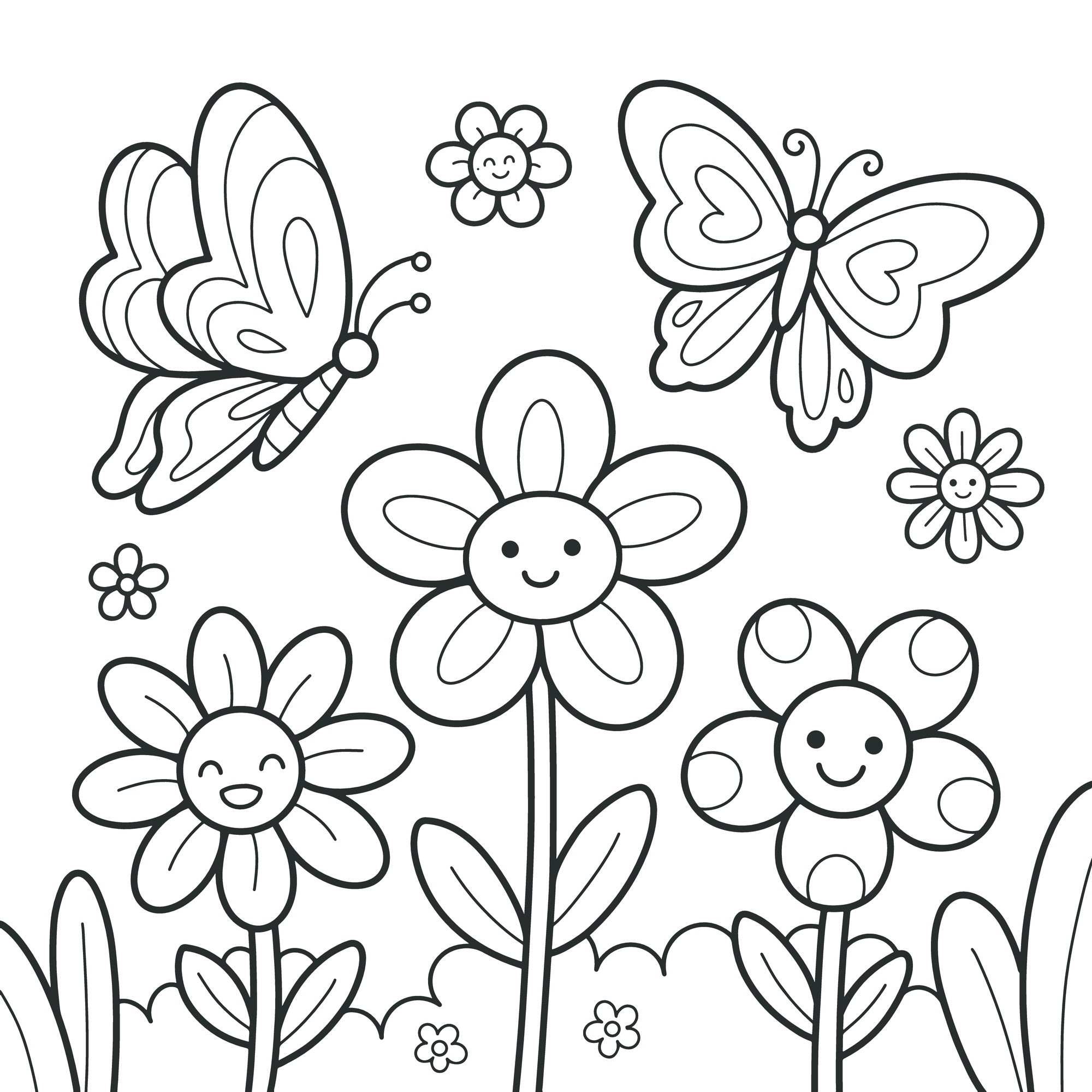
Another design brings together two natural garden companions: flowers and butterflies.
This page can become a celebration of bright spring and summer colors. Flowers might be yellow, pink, purple, red, orange, or blue, while the leaves provide several greens to balance the picture.
Butterfly wings offer even more freedom. Real butterflies display an astonishing range of patterns, but coloring pages don’t need to represent a particular species. Try orange and black, blue and purple, yellow and brown, or an entire rainbow.
Rather than coloring every flower differently, choose three or four flower colors and repeat them across the page. That creates enough variety without making the picture feel chaotic.
You can also use the page to talk about pollination. Many flowering plants rely on animals—including insects such as butterflies and bees—to move pollen between flowers. Not every flower is pollinated by butterflies, and different plants have different relationships with pollinators, but a flower-and-butterfly picture provides an easy introduction to the idea that plants and animals often interact.
For more blossoms to color, visit our Coloring Pages of Flowers.
🪴 Create a Collection of Beautiful Houseplants
Several pages move the plant theme indoors, including a potted plant with branches and leaves and a cozy flowerpot sitting on a windowsill beside a cup of coffee.
Houseplants are wonderful coloring subjects because green isn’t a single color. A plant can contain mint, lime, olive, emerald, forest green, blue-green, and yellow-green all at once.
Try using a lighter shade along one side of each leaf and a darker green near the center or where leaves overlap. That simple change can make a flat plant illustration feel much fuller.
The pot provides another creative opportunity. Terracotta orange and brown create a familiar clay-pot look, but ceramic planters can be almost any color or pattern. Add stripes, flowers, checkerboards, dots, or little stars.
For the windowsill scene, think about the entire atmosphere. A warm brown mug, sage-green plant, cream pot, pale curtains, and golden sunlight can create a cozy morning mood. A night version might use navy outside the window with moonlight blue and lavender on the leaves.
This page pairs naturally with our Aesthetic Coloring Pages, which include cozy interiors filled with plants, comfortable furniture, and peaceful decorative details.
🐈 Meet the Cat Sleeping in the Flowerpot
One of the cutest images in the collection features a cat curled up inside a flowerpot beneath a plant or flower.
The picture invites a combination of botanical colors and animal creativity. The cat can be orange, gray, black, white, brown, calico-inspired, or completely fantastical. Lavender cats are perfectly acceptable in a coloring book.
Then color the plant growing around the sleepy visitor. Use several greens and choose a flower color that stands out against the cat.
You can also imagine how the cat ended up there. Perhaps it discovered the warmest sunny spot in the house. Maybe the pot was supposed to contain a new plant but the cat claimed it first. Perhaps the plant itself has become accustomed to sharing its home.
Children can add a window, rug, watering can, or additional plants around the picture and turn it into an entire indoor garden.
This scene also fits beautifully alongside our 24 Adorable Coloring Pages, which feature plenty of cute animals in cozy and imaginative settings.
🌳 Help the Children Plant a Tree
The page showing children planting a young tree gives the collection an especially useful nature-and-gardening theme.
Start by coloring the young tree. The leaves can be bright spring green, deeper summer green, or even autumn shades if you want to imagine the scene later in the year. Use warm brown and tan for the soil, then give the children’s clothes bright colors that stand out against the earth and foliage.
After coloring, talk about what a newly planted tree needs. Water is essential, and an appropriate planting location, soil conditions, climate, and ongoing care all matter. Different tree species have different requirements, so gardening isn’t as simple as putting any tree into any patch of ground.
Kids can draw what the same tree might look like years later. Add a broad trunk, spreading branches, a bird nest, shade beneath the canopy, or people sitting nearby.
That makes a fun two-picture activity: the tree today and the tree in the future.
Children can also observe a real tree outdoors and notice features that aren’t obvious on the coloring page. How does the bark feel? Are the leaves smooth or jagged? Do the branches grow upward or outward? Is anything living on or around the tree?
Botanical observation begins with noticing details.
🌳 Turn the Abstract Tree Into a Color Experiment
Another page features a more decorative abstract tree, providing a different experience from the realistic young tree.
Because an abstract design doesn’t have to represent one specific species, the colors can be much more imaginative. Give the trunk deep purple, navy, or turquoise instead of brown. Make every branch a different shade or fill the canopy with rainbow leaves.
A four-seasons version can be particularly fun. Divide the tree mentally into four sections. Use fresh greens and blossoms for spring, deep green for summer, orange and red for autumn, and cool blues or bare branches for winter.
You could also color the tree as if different times of day meet in one picture. One side might show sunrise colors while the other moves into night.
Abstract plant coloring is less about identifying what grows in nature and more about experimenting with shape, line, pattern, and color.
That makes the tree a particularly good page for older children who want to try shading or adults who prefer decorative botanical designs.
🌺 Bring the Hawaiian Hibiscus to Life
The Hawaiian hibiscus adds a tropical flower to the collection and gives you an opportunity to concentrate on a large, dramatic bloom.
Hibiscus flowers can inspire brilliant yellows, reds, pinks, oranges, and other shades. If you’d like a Hawaiʻi connection, the yellow hibiscus known as maʻo hau hele is Hawaiʻi’s official state flower.
Begin with pale yellow across the petals and deepen the color toward the center with golden yellow or orange. The leaves can use rich greens that help the flower stand out.
Or ignore botanical realism and create a dramatic blue-and-purple hibiscus, a pink flower with turquoise leaves, or petals that shift through an entire rainbow.
Large flower pages are particularly useful for practicing gradients because the broad petals provide more room to move from light to dark.
For more island-inspired plants, landscapes, surfboards, and cultural imagery, explore our Coloring Pages of Hawaii.
🌻 Color Sunflowers, Pumpkins, and a Curious Bird
Another detailed scene combines pumpkins, sunflowers, and a bird, bringing plants, wildlife, and harvest imagery together.
Sunflowers are commonly associated with bright yellow petals and dark centers, but their cultivated varieties can include different shades. For a familiar coloring-page version, use golden yellow, mustard, orange-yellow, brown, and green.
Pumpkins can be classic orange, but real cultivated pumpkins and winter squash come in a much broader range of colors and shapes. Try pale cream, green, golden yellow, orange, or blue-gray.
The bird can become the contrasting focal point. Give it browns and grays for a natural woodland look or introduce brighter blue, red, or yellow.
Because pumpkins and sunflowers strongly suggest late summer and autumn, warm background colors work especially well. Add falling leaves, a wooden fence, or a harvest basket if the page leaves enough room.
This design pairs naturally with our Coloring Pages of Vegetables and 54 Coloring Sheets for Autumn.
🌻 Step Into the Sunflower Scene
A second sunflower-themed page features a woman with a bird surrounded by tall sunflowers, giving the collection a more detailed and peaceful botanical scene.
Start with the flowers and repeat several yellows instead of filling every petal identically. Lemon yellow can create highlights, while golden yellow and orange add depth toward the centers.
The leaves can range from light green to deep forest green. If many flowers fill the page, repeating the same few shades throughout helps the composition remain balanced.
Then choose colors for the woman’s clothing that either blend with the garden or stand apart from it. Blue, lavender, or burgundy can contrast beautifully with yellow sunflowers, while cream, olive, and rust create a warmer natural palette.
The bird provides one final accent. It might be brown and gray, but a bright fantasy bird can become the most colorful object on the page.
More detailed botanical scenes like this can be enjoyable when colored gradually. There’s no need to complete dozens of leaves and petals in one sitting. Work on one section, stop whenever you like, and return later.
💚 Spell “LOVE” With Plants and Flowers
The floral LOVE design combines lettering with botanical decoration, creating a page that can work as artwork, a card, or a gift.
Begin by deciding whether the word or the plants should be the main focus. Bold lettering in dark green, pink, purple, or red will stand out strongly against softer flowers. Alternatively, keep the letters simple and fill the botanical details with bright colors.
A coordinated palette might use sage, dusty pink, lavender, peach, and cream. For something stronger, try burgundy, emerald, gold, coral, and navy.
The finished page can be attached to cardstock and turned into a handmade card. It doesn’t have to be reserved for Valentine’s Day. Give it to a parent, grandparent, friend, teacher, or anyone who loves flowers.
For another floral message page, visit our Inspirational Coloring Pages, which combine encouraging words with plants, flowers, animals, and decorative lettering.
🍃 Experiment With Autumn Leaves and Botanical Patterns
Some of the collection’s designs focus almost entirely on leaves and repeating floral patterns, making them useful for colorists who enjoy pattern more than character scenes.
Autumn foliage provides an obvious warm palette: red, orange, yellow, rust, burgundy, brown, and olive. But you can also create a spring version with fresh green, pink, lavender, and yellow, or a fantasy pattern using blue, purple, turquoise, and silver-gray.
Repeating designs are easier to color when you establish a simple pattern before beginning. Perhaps every large leaf is dark green, every small leaf is mint, and flowers alternate between yellow and lavender.
Another approach is to avoid repetition completely. Make every leaf different and turn the entire page into a botanical patchwork.
Both methods work. One emphasizes pattern and consistency; the other celebrates variety.
Colored pencils are particularly useful here because small leaf shapes can require more precision than a large crayon allows.
🌀 Color the Intricate Botanical Mandala
The botanical mandala is one of the more detailed designs in the collection and is likely to appeal especially to teens and adults.
The pattern is built from repeating leaves and plant-inspired shapes arranged around a central point. Instead of thinking about each tiny section separately, choose a limited palette and repeat it outward.
For example, try sage, forest green, lavender, pale yellow, and cream. Another version might use turquoise, navy, emerald, and gold. Autumn colors such as rust, mustard, burgundy, olive, and brown can produce a completely different effect.
Work from the center toward the outside or begin with the largest shapes and fill smaller details afterward. Either approach makes a complex page feel more manageable.
The symmetrical design can certainly be enjoyed as a quiet coloring activity, but there is no need to make strong claims that coloring a mandala automatically produces meditation, mindfulness, or stress relief. Some people find detailed coloring relaxing, while others simply enjoy the patterns and creative challenge.
If intricate designs are your favorite, continue with our Mandala Coloring Pages.
🔍 Look Closely at Real Plants for Color Inspiration
One of the easiest ways to make plant coloring more interesting is to spend a few minutes observing a real plant before you begin.
Look at a leaf closely. Is it actually one flat green? Often you’ll notice lighter veins, darker edges, yellow-green new growth, spots, shadows, or even several colors on the same leaf.
Look at a flower. The center may be darker than the petals, and individual petals can change color from base to tip.
Tree bark may contain gray, tan, brown, reddish, or greenish tones. Soil can range from pale sandy brown to almost black.
Children can take a coloring page outdoors and search for similar colors, or collect observations in a simple nature notebook. There is no need to pick or remove plants. Drawing or photographing what you see can provide plenty of reference material without disturbing anything.
Smithsonian Gardens’ Plant Explorer provides another way to look at real trees, orchids, and other plants when you want botanical color inspiration from home.
🌱 Learn the Basic Parts of a Plant
Plant coloring pages can also support a simple introduction to plant structure.
Many familiar flowering plants have roots, stems, leaves, and flowers, although plants are extremely diverse and not every plant has the same structures or life cycle.
Roots often anchor a plant and absorb water and minerals. Stems support leaves and other structures while helping transport materials through the plant. Leaves are major sites of photosynthesis in many plants, while flowers are reproductive structures of flowering plants.
The United States Botanic Garden uses roots, leaves, stems, flowers, fruits, and other plant structures as part of its educational resources for children because looking closely at plant parts is a useful way to begin understanding how plants function.
Turn the coloring page into a simple observation activity. Can you find a stem? A leaf? A flower? Does the picture show roots, or are they hidden beneath the soil?
Then compare it with a real plant.
The goal isn’t to memorize vocabulary all at once. It’s to discover that every visible part of a plant has a story.
🌼 Make a Plant Observation Journal
Children who enjoy plants can turn the coloring collection into the beginning of a nature journal.
Choose a real plant in the yard, park, classroom, or home. Draw it or color a similar page and then write down a few observations.
You might record the date, plant color, approximate size, shape of the leaves, whether flowers are present, and anything else that stands out.
Return later.
Has anything changed?
A bud may have opened. New leaves might have appeared. A flower could have faded, or autumn foliage may be starting to change color.
Botanists and horticulturists record observations carefully because details matter when identifying and studying plants. A child’s notebook obviously doesn’t need to meet scientific collection standards, but the habit of looking closely is the same useful starting point.
🎨 Choose a Botanical Color Palette
Plants work with almost every color palette, which makes them especially versatile coloring subjects.
For a fresh spring garden, try mint, leaf green, pale pink, lavender, yellow, and sky blue. A summer botanical palette might use emerald, turquoise, coral, bright yellow, and purple. For autumn plants, combine rust, orange, burgundy, mustard, olive, and brown.
A cozy houseplant palette can use sage, cream, terracotta, dusty pink, and warm brown, while a tropical palette might combine deep green, lime, hibiscus pink, orange, turquoise, and yellow.
For a more imaginative design, create a moonlight garden with navy, violet, blue-green, silver-gray, and lavender.
You can also print the same design twice and compare realistic and fantasy versions. Color the first using shades you might see outdoors, then make the second completely imaginary.
A blue sunflower may never appear in the garden, but it can look wonderful on paper.
🏡 Design Your Own Garden
After coloring several plant pages, create a garden of your own on a blank sheet of paper.
Decide what belongs in it. You might include trees, flowers, vegetables, herbs, shrubs, vines, a path, birdbath, bench, or little pond.
A fantasy garden can go much further. Add enormous mushrooms, rainbow flowers, glowing leaves, tiny houses, or plants taller than the people visiting them.
Children can also create a simple map of the garden. Draw paths and decide where different kinds of plants grow.
The activity pairs especially well with our Coloring Pages of Gardens, which expands the botanical theme into full outdoor spaces.
For a more specific flower garden, our Coloring Pages of Roses and Coloring Pages of Flowers offer even more choices.
🏫 Plant Coloring Activities for Kids and Classrooms
Plant pages fit naturally into spring units, nature studies, gardening themes, seasons, life science, art centers, and homeschool activities.
Younger children can simply identify leaves, flowers, trees, and colors. Older students might label visible plant parts, compare leaf shapes, design a garden, or observe how plants change through the seasons.
The children-planting-a-tree page can accompany a gardening or tree lesson, while autumn foliage works well for seasonal science. The hibiscus can lead into a Hawaii-themed activity, and the houseplant pages offer an easy way to discuss plants growing indoors.
A classroom can also create a giant paper garden. Give every student a different plant page, color and cut out selected flowers or leaves with appropriate adult supervision, and arrange them together on a bulletin board.
Add butterflies, birds, insects, and garden signs to complete the scene.
The result doesn’t need to resemble one real ecosystem. It can simply celebrate the enormous range of shapes and colors found in plants.
✋ Coloring and Fine Motor Practice
The different levels of detail in this collection make the pages suitable for a broad range of colorists.
Young children may prefer large leaves, flowers, pumpkins, and tree shapes, while older kids can work on floral patterns, sunflower petals, branches, and botanical mandalas.
Using crayons, pencils, markers, paintbrushes, and similar art materials gives children opportunities to practice controlling small hand movements. The National Association for the Education of Young Children specifically includes drawing, scribbling, and writing with crayons, pencils, and markers among everyday fine-motor activities.
That doesn’t mean children need to stay perfectly within every outline.
A plant page with green extending beyond the leaves is still a successful creative activity. Control develops gradually, and enjoyment should not disappear beneath constant corrections.
🌿 Explore More Nature Coloring Pages
Plant lovers have plenty of directions to continue exploring.
Head to our Coloring Pages of Gardens for full garden scenes, or concentrate on blossoms with Coloring Pages of Flowers and Coloring Pages of Roses.
If autumn leaves, pumpkins, and sunflowers are your favorite part of this collection, try our 54 Coloring Sheets for Autumn. For a tropical direction, Coloring Pages of Hawaii includes hibiscus, tropical leaves, beaches, and island scenery.
You can also browse all of our Nature Coloring Pages and gradually build a homemade coloring book filled with plants, landscapes, animals, flowers, and changing seasons.
🌱 Let Your Botanical Coloring Collection Grow
These Coloring Pages of Plants show just how many different directions a botanical coloring collection can take.
Fill rain boots with glowing autumn leaves and flowers, surround butterflies with a colorful garden, decorate houseplants and cozy windowsills, help children plant a young tree, and give the sleepy cat the most comfortable flowerpot in the house.
Color pumpkins and sunflowers for autumn, bring a Hawaiian hibiscus to life, experiment with an abstract tree, or settle into the smaller details of a botanical mandala.
Follow nature closely when you want to. Study a real leaf and discover how many greens it contains. Notice the colors hidden in tree bark, flower centers, soil, and fading autumn foliage.
Then forget realism completely when imagination takes over.
Create turquoise leaves, purple sunflowers, rainbow trees, pink pumpkins, and gardens that could never grow anywhere except a coloring page.
Plants are remarkably diverse in the real world, and they’re even less restricted on paper.
Choose a page, pick your first green—or decide you don’t need green at all—and let your garden grow.
Happy coloring!
🔗 Related Coloring Pages
- Coloring Pages of Gardens
- Coloring Pages of Flowers
- Coloring Pages of Roses
- 54 Coloring Sheets for Autumn
- Coloring Pages of Hawaii
- Coloring Pages of Vegetables
- Aesthetic Coloring Pages
- Inspirational Coloring Pages
- Mandala Coloring Pages
- Nature Coloring Pages
📚 Sources
- Smithsonian Institution — Plant Collections
- Smithsonian Gardens — Living Plant Collections
- Smithsonian Gardens — Plant Explorer
- United States Botanic Garden — On-Site Plant Activity Resources
- U.S. Forest Service — Why Leaves Change Color
- NAEYC — Help Your Child Build Fine Motor Skills
🖍️Shop Plant Coloring Books –>