

Let your creativity bloom with our collection of free printable flower coloring pages, featuring tulips, sunflowers, spring blossoms, butterflies, decorative floral patterns, and plenty of petals waiting for color.
This small but varied collection includes four different designs: a magical butterfly-and-flower page, a cute pot filled with tulips, a cheerful Happy Spring flower scene, and a detailed sunflower mandala. Some are simple and playful enough for younger colorists, while the more intricate floral patterns give older kids and adults plenty of small details to explore.
Flowers are also wonderfully forgiving subjects to color. You can recreate familiar red tulips, golden sunflowers, pink spring blossoms, and green leaves—or turn your paper garden into a fantasy landscape filled with turquoise petals, purple stems, rainbow butterflies, and flowers that could never grow anywhere except your imagination.
Print one favorite or color all four as a miniature garden collection.
Grab your crayons, colored pencils, or markers and let the flowers begin to bloom.
🌸 Explore Our Flower Coloring Pages
This collection currently includes four different floral designs:
- A magical butterfly-and-flower design
- A kawaii flowerpot filled with tulips
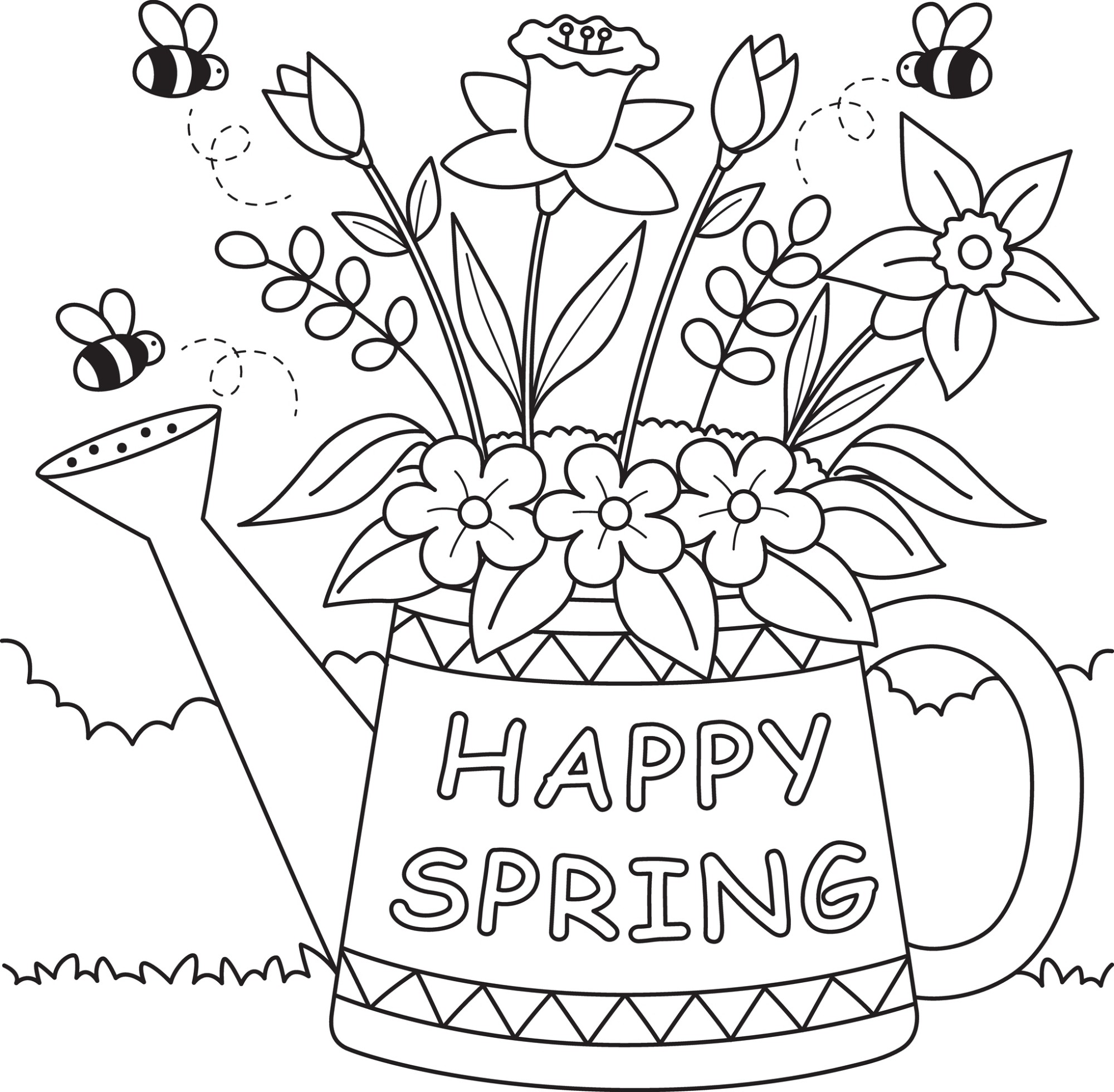
- A Happy Spring flower coloring page
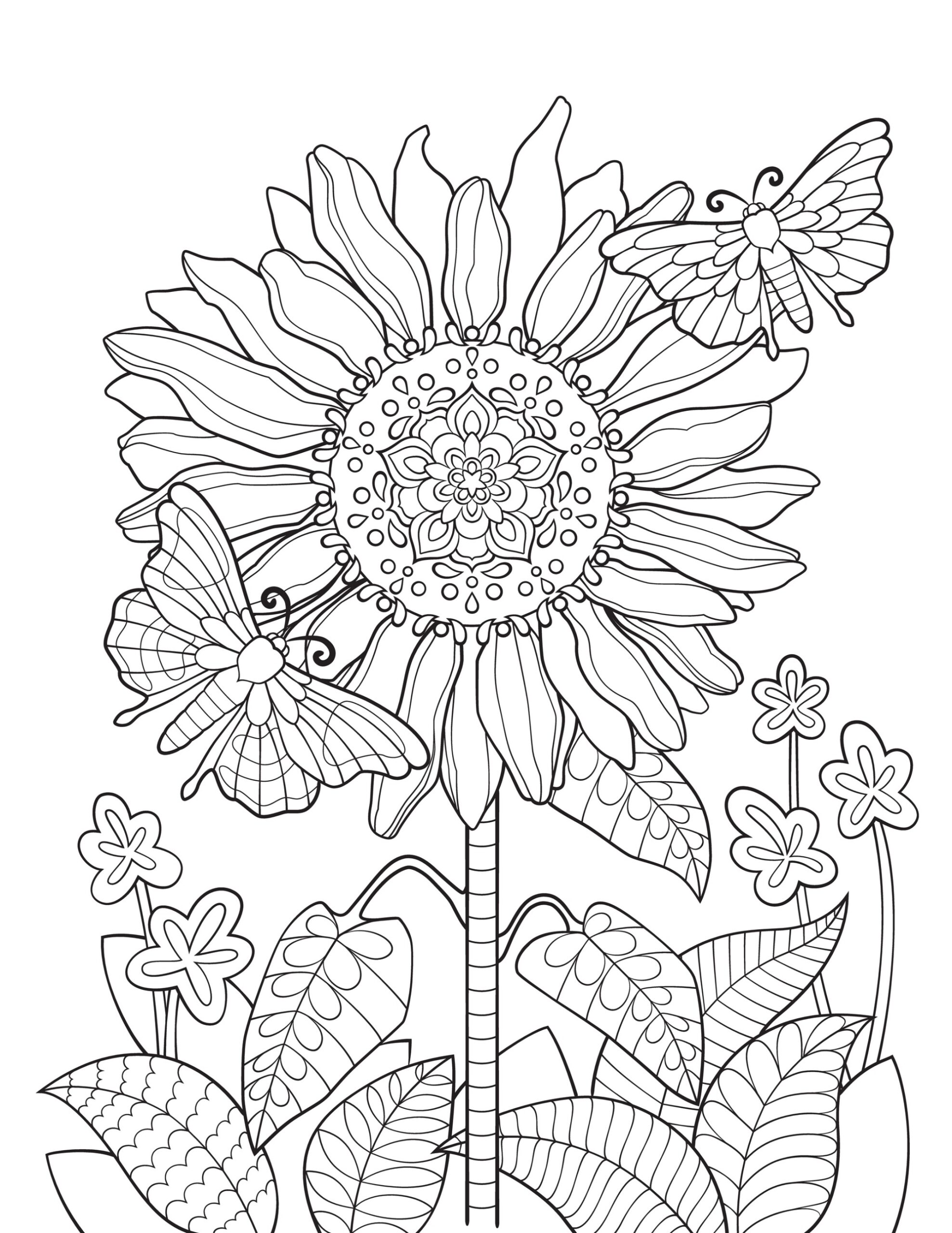
- A detailed sunflower mandala
The variety gives each printable a slightly different purpose.
The butterfly page mixes flowers with a colorful pollinator. The tulip pot is especially cute and approachable. The Happy Spring design fits naturally into seasonal coloring, while the sunflower mandala is a more decorative choice for anyone who enjoys repeating shapes and smaller spaces.
For complete outdoor scenes with pathways, watering cans, children planting, birds, butterflies, and established gardens, continue with our Garden Coloring Pages.
🎨 Choose a Flower Color Palette
A flower page can contain almost any combination of colors.
For a familiar spring garden, try:
- Blush pink
- Lavender
- Pale yellow
- Fresh green
- Sky blue
- Peach
For something brighter, use hot pink, orange, sunshine yellow, turquoise, purple, and lime green.
A cottage-garden palette might combine dusty rose, sage, cream, violet, soft blue, and warm brown.
Or choose rich jewel tones such as ruby, emerald, sapphire, plum, and gold.
Repeating the same five or six colors across an entire page can make even a busy floral design look beautifully coordinated.
🌈 Create Rainbow Flowers
There is no need for every petal to match.
Choose one blossom and work through:
Red
Orange
Yellow
Green
Blue
Purple
You can arrange the rainbow around the flower or blend one color gradually into the next.
Another option is to give every flower on the page its own rainbow-inspired palette.
Maybe one is warm red and orange while another uses turquoise, blue, and violet.
The result may not resemble a real garden, but a coloring page does not have to.
🩷 Create a Pastel Flower Garden
For something softer, gather:
- Blush
- Peach
- Lavender
- Mint
- Baby blue
- Pale yellow
Use light pencil pressure and allow some white paper to remain visible.
Keep leaves sage or mint instead of dark green.
Add pale blue around the background.
This palette works especially well with the kawaii tulips and Happy Spring design.
❤️ Create a Bold Flower Garden
Prefer stronger colors?
Try:
- Crimson
- Orange
- Golden yellow
- Emerald
- Royal blue
- Violet
Use deep green on leaves and stems.
A dark background can make bright petals stand out even more dramatically.
Try coloring the space around a yellow sunflower navy or deep purple.
🌷 Color the Kawaii Pot of Tulips
One of the cutest pages in the collection features a flowerpot filled with tulips.
Tulips are particularly fun because the individual flowers can all be different.
Try:
Tulip 1: Red
Tulip 2: Pink
Tulip 3: Yellow
Tulip 4: Purple
Keep the leaves and stems green, or make them blue and turquoise for a fantasy bouquet.
Then choose a completely separate palette for the pot.
🌷 Try Classic Tulip Colors
Garden tulips are grown in an enormous range of colors.
A coloring page can draw inspiration from:
- Red
- Pink
- Yellow
- White
- Orange
- Purple
Use several shades inside one bloom.
For a red tulip, begin with scarlet and add burgundy near the base of the petals.
For yellow, use pale lemon toward the top and gold near the bottom.
For purple, layer lavender and violet.
Tiny color changes can make simple petal shapes look much more dimensional.
🌈 Create Rainbow Tulips
Give every tulip a different color.
Maybe:
Red
Orange
Yellow
Pink
Purple
Or create striped flowers.
Try a white tulip with purple edges.
Make another yellow with red streaks.
One can be turquoise with silver spots simply because you like the combination.
Your paper flowerpot can hold varieties that do not exist anywhere else.
🪴 Design the Flowerpot
Do not let the flowers get all the attention.
Turn the pot into a miniature art project.
Decorate it with:
- Polka dots
- Stripes
- Hearts
- Stars
- Checkerboard
- Tiny flowers
Try a terracotta-inspired orange-brown pot for a familiar look.
Or make it lavender, turquoise, pink, or rainbow.
Maybe the pot has a smiling face.
Give it a name.
🌱 Where Do Tulips Grow From?
Tulips grow from bulbs, which are underground storage structures containing the beginnings of future growth.
A tulip bulb planted at the appropriate season can produce roots, leaves, and eventually a flowering stem.
Different tulip species and cultivated varieties grow in many colors and forms.
The genus Tulipa naturally occurs across a broad region extending through parts of Europe, the Mediterranean, Central Asia, and toward Mongolia.
That history is much broader than the flower’s modern association with Dutch gardens.
🌷 Draw a Tulip From Bulb to Flower
Divide a sheet into four boxes.
Draw:
- A bulb underground
- A green shoot appearing
- Leaves and a flower bud
- A blooming tulip
Add soil underneath each stage.
Use arrows to show the sequence.
This does not need to become a detailed plant-science project. It is simply a way to connect the pretty flower above ground with the plant structure that helped it grow.
🌻 Color the Sunflower Mandala
The sunflower mandala is the most detailed design in the collection.
A familiar sunflower-inspired palette might use:
- Bright yellow
- Golden yellow
- Brown
- Green
But because this is a decorative mandala rather than a botanical illustration, almost any palette works.
Try:
- Purple and gold
- Turquoise and orange
- Pink and green
- Burgundy and cream
- Rainbow
Work from the center outward and repeat colors as the design expands.
💛 Create a Classic Sunflower Palette
For a traditional sunflower-inspired design, begin with several yellows.
Use pale yellow on some petals.
Add golden yellow toward their bases.
Use orange sparingly where you want deeper shadows.
Color the central area with several browns:
- Tan
- Chestnut
- Chocolate
Then add green around leaves or botanical details.
This keeps the picture recognizable while still giving you plenty of variation.
🌻 A Sunflower Is More Complicated Than It Looks
What looks like one enormous sunflower is actually an inflorescence made from many individual flowers, called florets.
The large structures around the outside are ray florets, while the center is packed with many disk florets.
Sunflowers belong to the enormous plant family Asteraceae, which also includes daisies and many other familiar flowers.
So when you color all those tiny sections in the center of the sunflower mandala, you can imagine the many individual florets that make a real sunflower head so intricate.
🌀 Turn the Sunflower Into a Color Pattern
Because the design repeats around a center, choose a simple rule.
For example:
Yellow → Orange → Yellow → Orange
Or:
Purple → Blue → Green → Purple → Blue → Green
Continue the same sequence around the flower.
Another option is to create concentric rings.
Keep the center dark.
Make the next ring gold.
Then yellow.
Then orange.
Finally add green around the outside.
🌈 Create a Rainbow Sunflower Mandala
Start in the center with purple.
Move outward into:
Blue
Green
Yellow
Orange
Red
Or reverse the order.
Because the design radiates from one center point, a color gradient can make the finished page look especially striking.
You could also create four different color zones around the sunflower rather than keeping everything symmetrical.
🦋 Color the Butterfly & Flower Design
Another page combines butterflies with floral imagery, giving you two naturally colorful subjects on one page.
Color the flowers first and then choose wing colors that contrast.
For example:
Flowers: Pink and purple
Butterfly: Orange and yellow
Or:
Flowers: Yellow and orange
Butterfly: Blue and turquoise
Repeating one flower color inside the butterfly wings can help connect the entire design.
🦋 Create Symmetrical Butterfly Wings
Butterflies make a natural symmetry activity.
Color one side of the wings.
Then copy the colors and patterns onto the opposite side.
If one wing has:
- Three purple dots
- Yellow border
- Blue center
repeat those same details on the other side.
Afterward, try another butterfly where the two wings deliberately do not match.
Both approaches can create beautiful designs.
For a page completely devoted to butterfly wings, visit our Butterfly Coloring Page.
🌸 Why Do Butterflies Visit Flowers?
Many adult butterflies visit flowers to drink nectar, a sugary liquid produced by plants.
They use a long feeding structure called a proboscis, which can uncoil when the butterfly feeds.
As butterflies travel between blossoms, pollen can sometimes move with them.
That makes butterflies one of many animals that can contribute to pollination.
Add several butterflies around your flowers.
Maybe each one visits a different blossom.
🐝 Add Bees to the Flowers
Butterflies are not the only flower visitors.
Draw a few bees.
A simple cartoon bee can begin with:
- Oval body
- Black and yellow stripes
- Two wings
- Antennae
Place the bees near the flower centers.
You can also draw beetles, moths, or hummingbirds.
Many different animals can move pollen between flowers, and different flowers attract different visitors.
🌺 What Is Pollination?
Pollination is part of the reproductive process of flowering plants.
Pollen must move from the pollen-producing parts of a flower to a receptive part of a flower.
That movement can happen in different ways.
Depending on the plant, pollen may be carried by:
- Bees
- Butterflies
- Beetles
- Birds
- Bats
- Wind
- Other agents
The exact relationship differs from plant to plant.
You do not need to label every flower on a coloring page.
Simply drawing a butterfly or bee visiting a blossom gives you an easy starting point for talking about how flowers interact with other living things.
🌼 Look at the Parts of a Flower
Many flowers include structures such as:
- Petals
- Sepals
- Stamens
- Pistil or carpels
The exact form varies enormously among flowering plants.
Petals are often the most obvious part because they can be large and colorful.
Stamens include pollen-producing anthers.
The flower’s female structures include a stigma and ovary.
Try looking closely at a real flower or a clear photograph.
Can you see more than just petals?
🔍 Draw a Giant Flower for Observation
On a blank sheet, draw one enormous simple flower.
Add:
- Petals
- Center
- Stem
- Leaves
Older children can add and label structures such as:
- Anther
- Filament
- Stigma
- Style
- Ovary
Younger kids can simply identify petals, stem, and leaves.
The goal is observation, not memorizing every botanical term.
🌼 Color the Happy Spring Flower Page
The Happy Spring flower design naturally works with a bright seasonal palette.
Try:
- Pink
- Yellow
- Lavender
- Peach
- Fresh green
- Sky blue
Add butterflies or bees around the flowers.
Draw sunshine behind them.
Maybe the page represents the first warm day after winter.
Or create a rainy spring garden with gray clouds and colorful flowers beneath them.
🌧️ Add a Spring Shower
Draw:
- Clouds
- Raindrops
- Puddles
Use gray-blue and lavender in the sky.
Keep flowers bright enough to stand out.
Add a rainbow after the storm.
Maybe one flower bends under the weight of raindrops while another remains upright.
For more rain, blossoms, butterflies, mushrooms, birds, and seasonal scenes, continue with our Spring Coloring Pages.
🌱 Create an Early-Spring Garden
Use more green than flowers.
Draw:
- New shoots
- Small buds
- Bare branches beginning to leaf out
Maybe only a few blossoms have opened.
Use pale yellow, soft pink, and white.
This creates a very different spring picture from a garden at peak bloom.
☀️ Create a Summer Flower Garden
Transform the same pages into summer.
Use stronger colors:
- Bright yellow
- Orange
- Magenta
- Deep green
- Turquoise
Add a brilliant blue sky.
Draw butterflies and bees moving between blossoms.
Maybe the tulip pot sits on a sunny porch while the sunflower grows tall outside.
🍂 Create an Autumn Flower Palette
Flower coloring is not limited to spring.
Try:
- Burgundy
- Rust
- Gold
- Orange
- Olive
Use the sunflower mandala especially for an autumn palette.
Add falling leaves around the border.
Maybe the flowerpot is surrounded by pumpkins.
The floral line art stays the same, but changing the colors can shift the entire season.
❄️ Create Winter Flowers
Try a frosty palette:
- White
- Pale blue
- Lavender
- Silver
- Navy
Color flower petals as though they were made from ice.
Add snowflakes.
Make leaves blue instead of green.
Perhaps these magical flowers bloom only in winter.
🌹 Explore Rose Coloring Pages
The old version of this flower article mentions roses, but the current gallery is not actually a dedicated rose collection.
If roses are what you want to color, head to our Rose Coloring Pages.
That collection focuses specifically on roses, bouquets, decorative floral designs, and rose-inspired artwork.
Use this page when you want a mixed flower collection.
Use the Rose page when you specifically want to explore one famous flower in much greater detail.
🌹 Experiment With Rose Colors
Roses are useful for comparing familiar and fantasy palettes.
Try:
- Red
- Pink
- Yellow
- Cream
- White
- Purple
Then print another copy and create:
- Blue
- Turquoise
- Rainbow
Look at how completely the mood changes.
A deep burgundy rose may feel dramatic while pale pink feels much softer.
🌿 Explore More Plant Coloring Pages
Flowers are only one part of plant life.
Our Coloring Pages of Plants expand into houseplants, leaves, trees, planting scenes, decorative botanical designs, and other growing things.
Use the flower collection when blossoms are the focus.
Use Plants when you want to explore more of the leaves, stems, pots, trees, and other botanical shapes surrounding them.
🌳 Build a Complete Garden
A flower by itself can become the beginning of an entire scene.
Draw:
- Garden path
- Fence
- Trees
- Bench
- Watering can
- Flowerpots
Add birds and butterflies.
Maybe there is a tiny pond.
Our Garden Coloring Pages take that idea much further with complete gardening and garden-landscape scenes.
🪴 Design Your Dream Flower Garden
Decide what your imaginary garden needs.
Maybe:
Front: Tulips
Middle: Daisies and roses
Back: Sunflowers
Add a pathway between them.
Draw a bench.
Include a birdbath.
You do not have to worry about whether every plant would realistically bloom at the same time or thrive in the same growing conditions.
This is your paper garden.
🏡 Create a Cottage Garden
Use:
- Dusty pink
- Lavender
- Cream
- Sage
- Soft blue
Draw a little cottage behind the flowers.
Add vines around the door.
Make the garden look overflowing rather than perfectly organized.
Maybe butterflies flutter above the path.
✨ Create a Magical Garden
Forget real botany entirely.
Draw:
- Glowing flowers
- Giant mushrooms
- Tiny fairy doors
- Rainbow butterflies
- Purple grass
Maybe the flowers bloom under moonlight.
Perhaps one plant grows little stars instead of petals.
Use the floral printables as the entrance to a completely imaginary world.
🌙 Create a Moon Garden
Choose flowers in:
- White
- Cream
- Pale blue
- Lavender
- Silver
Color the background navy.
Add a large moon.
Use tiny pale highlights on the petals.
Maybe the garden only opens after sunset.
🐞 Add Garden Visitors
A flower garden can contain much more than blossoms.
Draw:
- Ladybugs
- Butterflies
- Bees
- Beetles
- Birds
Hide some among the leaves.
Maybe one ladybug sits on a tulip.
A butterfly rests on the sunflower.
A bee flies toward the spring blossoms.
For an entire collection of tiny garden creatures, visit our Insect Coloring Pages.
🐞 Create a Ladybug & Flower Scene
Draw a small beetle on a leaf.
Give it:
- Red wing covers
- Black spots
- Black head
Or invent:
- Blue ladybug
- Purple ladybug
- Rainbow spots
Count the spots.
Then add a second ladybug with a different number.
🐦 Add Birds to the Garden
Draw a small bird perched on the flowerpot.
Use realistic-inspired brown, gray, yellow, red, or blue—or create a rainbow bird.
Maybe it is visiting the garden for seeds.
Perhaps it is simply resting.
Add a nest in a nearby tree.
💐 Create a Flower Bouquet
Choose several flower shapes from the coloring pages.
Draw them together on a separate sheet.
Add:
- Stems
- Leaves
- Ribbon
Make the bouquet for:
- Birthday
- Thank-you
- Mother’s Day
- Friendship
- Just because
Use one coordinated palette.
Maybe everything is pink and lavender.
Or make every flower different.
💌 Make a Flower Greeting Card
Color your favorite design.
Mount part of it onto folded cardstock.
Write inside:
Thinking of You
Happy Birthday
Thank You
Happy Spring
or simply:
For You
A floral page works for many occasions because it does not have to be tied to one holiday.
🎂 Create Birthday Flowers
Add:
- Balloons
- Cake
- Presents
around the floral design.
Write:
HAPPY BIRTHDAY
across the top.
The tulip pot can become a birthday gift.
The spring blossoms might decorate the cake.
For even more celebration designs, visit our Happy Birthday Coloring Pages.
❤️ Create Valentine’s Flowers
Use:
- Red
- Pink
- Purple
- White
throughout the flowers.
Add hearts.
Maybe the sunflower mandala becomes a heart-and-flower pattern.
Draw a ribbon reading:
BE MINE
or:
HAPPY VALENTINE’S DAY
Flowers can easily move from a general nature page into a holiday craft.
🌷 Make a Mother’s Day Flower Picture
Color the tulip pot.
Add:
HAPPY MOTHER’S DAY
or another personal message.
Decorate the pot with hearts.
Write the recipient’s name underneath.
You can make similar floral gifts for grandparents, teachers, friends, or anyone who enjoys flowers.
🔠 F Is for Flower
Write a large:
F
Practice:
F is for Flower.
Think of more F words:
- Frog
- Forest
- Fish
- Feather
Decorate the F with tiny petals.
For more alphabet activities, explore our Coloring Pages of Letters.
🌷 T Is for Tulip
Write:
T is for Tulip.
Draw three tulips underneath.
Color them:
- Red
- Yellow
- Purple
Think of more T words:
- Tree
- Turtle
- Tiger
Maybe the stem of the T becomes a flower stem.
🌻 S Is for Sunflower
Write:
S is for Sunflower.
Color the S golden yellow.
Add small brown circles inside it.
Draw green leaves around the outside.
Then think of more S words:
- Sun
- Star
- Sky
- Seed
🔢 Count the Petals
Choose one simple flower.
Count its visible petals.
Then draw a new flower with exactly:
- 5 petals
- 6 petals
- 8 petals
Real flowers show enormous variation in their structures, so do not use a coloring page to make rigid rules about how many petals all flowers “should” have.
The counting activity is simply a game with shapes.
🎲 Play Flower Roll-and-Color
Grab one six-sided die.
Assign:
1 — Pink
2 — Purple
3 — Yellow
4 — Orange
5 — Blue
6 — Your choice
Roll.
Color one flower using the matching shade.
Continue until the page is finished.
Use green for stems and leaves, or let the die decide those too.
You may end up with a garden that looks nothing like nature.
🎯 Try a Five-Color Flower Challenge
Choose only five colors.
For example:
- Lavender
- Pink
- Yellow
- Sage
- Blue
Use them throughout one page.
You may use lighter and darker pressure, but do not introduce another main color.
This works especially well on the sunflower mandala because repeating a limited palette can make a detailed design feel organized.
🔍 Create a Flower I Spy Page
Add hidden objects around the flowers.
Find:
- 5 butterflies
- 4 bees
- 3 ladybugs
- 2 birds
- 1 watering can
Color everything.
Then give the page to someone else.
Can they find every hidden object?
📖 Write a Flower-Garden Story
Try:
The flowers in the garden only opened when…
or:
One morning, every tulip had changed color because…
or:
The butterfly landed on the sunflower and whispered…
Maybe the flowers can talk.
Perhaps the garden contains a hidden door.
Use the coloring page as the first illustration.
🌷 The Missing Tulip Mystery
One flower disappears from the pot overnight.
What happened?
Possible clues:
- Petal on the ground
- Tiny footprints
- Butterfly nearby
- Open garden gate
Maybe nobody stole it at all.
Perhaps the magical tulip walked away.
Draw the clues and write the solution.
🌻 The Giant Sunflower Story
Imagine the sunflower grows overnight until it is taller than the house.
What is at the top?
Maybe:
- Bird nest
- Tiny castle
- Cloud garden
- Secret world
Draw the next scene.
🦋 The Butterfly’s Favorite Flower
Imagine the butterfly must choose one flower in the entire garden.
Which will it visit?
Color several flowers differently.
Then decide.
Write:
The butterfly chose the ______ flower because ______.
There is no right answer.
👀 Take a Flower Observation Walk
If flowers are blooming nearby, go outside with an adult and look closely.
Notice:
- Color
- Number and shape of petals
- Leaf shape
- Stem
- Flower center
- Insects visiting
You do not need to pick the flower.
A photograph, sketch, or simple observation is enough.
Return home and use the colors you actually saw on one of the printables.
📓 Make a Flower Nature Journal
Choose one flower you see outside.
Write:
Date: ______
Color: ______
Where I saw it: ______
Visitors: ______
Draw the flower.
Check the same plant again later if possible.
Has it changed?
Maybe the flower has faded.
Perhaps another bud has opened.
🌼 Look Without Picking
Wildflowers can be enjoyed without removing them.
When visiting parks, trails, or natural areas, follow local rules and leave wild plants where they are unless picking is specifically allowed.
Flowers may provide food or habitat for insects and other animals.
A photograph or drawing lets you remember the bloom without taking it home.
On a coloring page, however, you can collect as many imaginary flowers as you want.
🐝 Watch for Pollinators
If a bee, butterfly, or other insect visits a flower, give it space.
Watch from a comfortable distance.
Ask:
- Which flower did it visit?
- How long did it stay?
- Did it visit another flower?
- What color was the flower?
You do not need to touch the insect or flower.
Observation alone can reveal a surprising amount.
🏫 Flower Coloring Pages for the Classroom
These printables can fit naturally into:
- Spring units
- Plant lessons
- Garden themes
- Pollinator activities
- Art centers
- Early finishers
- Indoor recess
- Creative writing
- Pattern activities
The different designs also give students a choice between simple and more detailed coloring.
One child may prefer the kawaii tulips.
Another might spend much longer on the sunflower mandala.
🌸 Create a Classroom Flower Garden
Let each student color or draw one flower.
Cut the finished flowers out with age-appropriate supervision and display them on a large sheet of green or blue paper.
Add:
- Stems
- Leaves
- Bees
- Butterflies
Possible headings include:
Our Garden of Color
Creativity Is Blooming
Watch Our Garden Grow
Every flower can be different.
🌻 Create a Flower Fact Display
Pair each colored flower with one short fact.
For example:
Tulips grow from bulbs.
A sunflower head contains many small florets.
Pollination helps flowering plants reproduce.
Butterflies can visit flowers for nectar.
Keep facts concise.
The artwork should remain the main attraction.
🎨 Compare Real & Fantasy Flowers
Divide a classroom board into:
INSPIRED BY NATURE
and:
IMAGINARY FLOWERS
On one side, use colors based on real flowers.
On the other, create:
- Rainbow sunflowers
- Blue tulips
- Polka-dot petals
- Golden leaves
This is an easy way to separate observation from imagination without treating one as better than the other.
🌿 Explore More Nature Coloring Pages
Flowers are only one part of the natural world.
Our Nature Coloring Pages connect floral pages with:
- Plants
- Gardens
- Butterflies
- Birds
- Mushrooms
- Rainbows
- Volcanoes
- Beaches
- Animals
Use this Flower collection when blossoms are the main focus.
Use Nature when you want a much broader selection of outdoor subjects.
🌷 Explore More Spring Coloring Pages
Flowers appear throughout our Spring Coloring Pages, but that collection covers much more than blossoms.
It includes spring animals, butterflies, mushrooms, weather, gardens, and seasonal scenes.
Use Flowers for a botanical coloring session.
Use Spring when you want to celebrate the whole season.
🌹 How This Flower Collection Differs From the Others
The floral pages on Fun Free Coloring Pages each have a different role.
These Flower Coloring Pages are the mixed floral collection, currently featuring:
- Butterfly-and-flower art
- Tulips in a pot
- Happy Spring blossoms
- Sunflower mandala
Rose Coloring Pages focus specifically on roses and bouquets.
Garden Coloring Pages show larger garden scenes, gardening activities, paths, tools, birds, and outdoor spaces.
Coloring Pages of Plants expand beyond flowers into leaves, houseplants, trees, planting scenes, and other botanical designs.
And Spring Coloring Pages place flowers within a much broader seasonal collection.
Keeping those roles distinct makes it easier to choose exactly what you feel like coloring.
🖍️ Best Supplies for Flower Coloring Pages
Crayons work well for younger children and broad petals, pots, and backgrounds.
Colored pencils are especially useful for:
- Petal shading
- Leaves
- Tulip details
- Sunflower mandala
- Small butterfly patterns
Markers create strong, bright flower colors. Slightly heavier paper can be helpful if marker ink tends to bleed through ordinary printer paper.
Gel pens can add small metallic or sparkling details to flower centers, butterfly wings, and decorative patterns.
Combining several supplies can work beautifully too.
🖨️ How to Use These Free Flower Coloring Pages
Choose one of the four designs and print it.
Decide whether you want to follow nature or invent a completely new garden.
Maybe you will create:
- Red and yellow tulips
- Golden sunflower mandala
- Pastel spring flowers
- Rainbow butterfly garden
- Purple fantasy flowers
- Autumn botanical palette
Color the main design first.
Then add your own:
- Bees
- Butterflies
- Ladybugs
- Birds
- Flowerpots
- Garden path
- Sunshine
- Rain
You can turn the finished page into wall art, a greeting card, nature-journal cover, classroom display, or the beginning of a flower story.
🌸 Let Your Paper Garden Bloom
With a butterfly-and-flower design, a kawaii pot of tulips, cheerful spring blossoms, and a detailed sunflower mandala, these free printable flower coloring pages offer four very different ways to fill a garden with color.
Recreate familiar tulips and sunflowers, explore petal shading, create symmetrical butterfly wings, build a pollinator garden, design rainbow flowers, make a greeting card, keep a flower journal, or invent a magical garden where every blossom glows after dark.
Real flowers are wonderfully diverse. Their colors, shapes, structures, relationships with pollinators, and growing habits vary enormously from one plant to another.
A coloring page can borrow from that real-world variety without needing to become a perfect botanical illustration.
Look closely at nature when you want inspiration.
Then change everything when imagination takes over.
Choose a flower.
Choose a color.
And let your garden grow across the page.
Happy coloring!
🔗 Related Articles
- Rose Coloring Pages
- Garden Coloring Pages
- Coloring Pages of Plants
- Butterfly Coloring Page
- Spring Coloring Pages
- Nature Coloring Pages
- Insect Coloring Pages
- Educational Coloring Pages & Activities
📚 Sources
- USDA Forest Service — The Beauty of Wildflowers: Wildflowers, Pollinators & Flower Parts
- Smithsonian Gardens — The Why, What, When, Where, Who, How of Pollination
- Smithsonian Gardens — Pollination Investigation
- Smithsonian National Museum of Natural History — Origin and Diversification of the Sunflower Family
- Royal Botanic Gardens, Kew — Tulipa
- U.S. Botanic Garden — From Flower to Seed