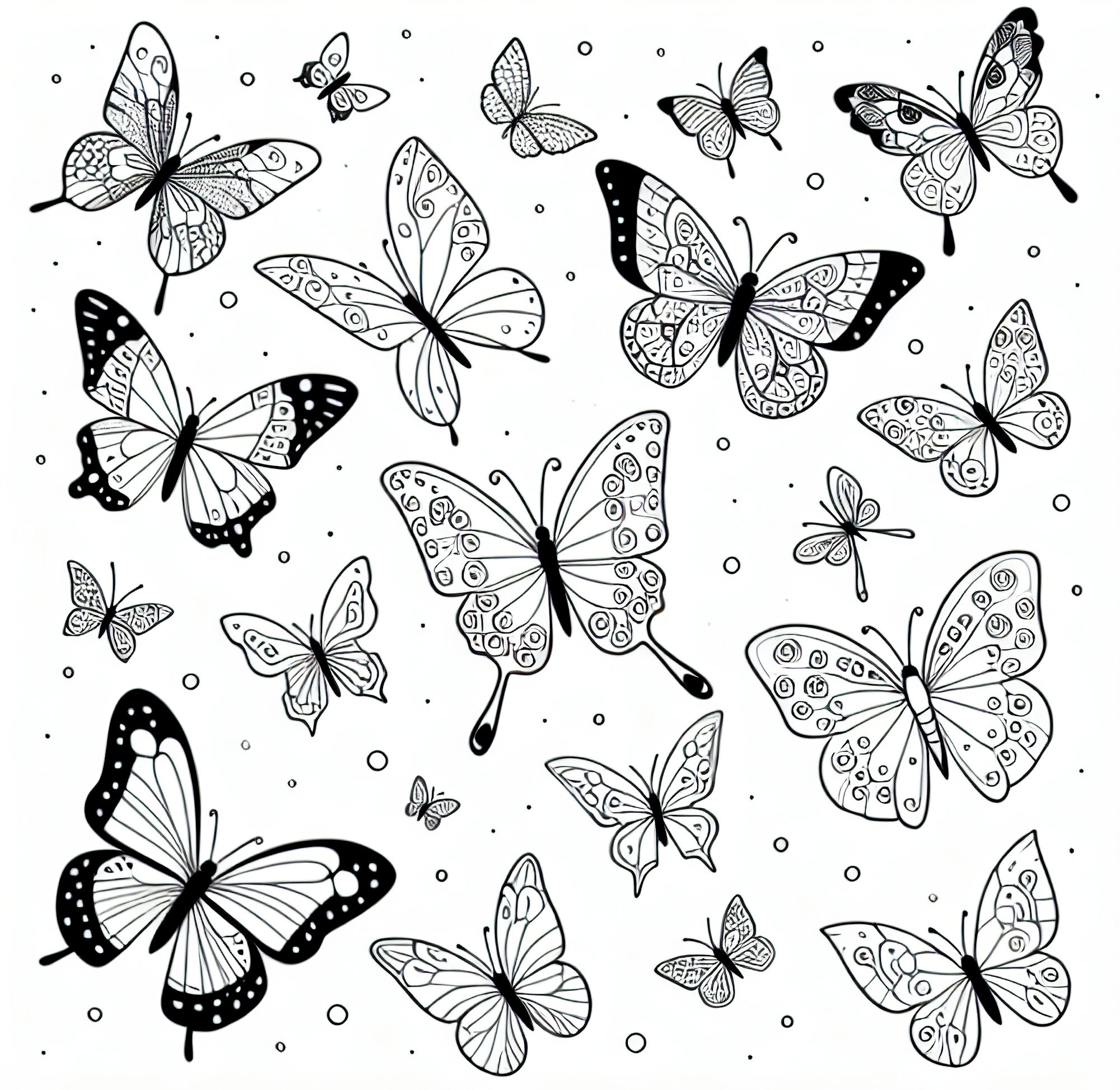
Let your creativity take flight with our free printable butterfly coloring page! Butterflies are some of nature’s most colorful creatures, making them perfect subjects for crayons, colored pencils, markers, and every imaginative shade in the art box.
Butterfly wings can be bright orange and black, brilliant blue, sunny yellow, soft white, earthy brown, or covered in intricate patterns. On a coloring page, though, there are no limits at all. Your butterfly can have rainbow wings, pastel spots, shimmering purple patterns, or colors that have never appeared on a real butterfly.
This printable is perfect for a spring afternoon, nature lesson, classroom activity, homeschool project, or simply a quiet moment of creative fun.
Grab your favorite coloring supplies and let your butterfly flutter into a world of color.
🦋 Color Your Butterfly Any Way You Like
Butterflies offer almost endless possibilities because their wings are naturally filled with shapes, lines, spots, bands, and patterns.
You could begin with realistic butterfly colors such as:
- Orange and black
- Yellow and brown
- Blue and black
- White and gray
- Red and black
- Green and brown
Or forget realism entirely.
Try a butterfly with turquoise and purple wings, pink and orange spots, a rainbow border, or gold-and-silver patterns.
One of the best things about butterfly coloring is that even the same outline can look completely different depending on the colors you choose.
Print the page more than once and see how many different butterflies you can create.
🌈 Create a Rainbow Butterfly
Butterfly wings are ideal for rainbow coloring because they contain so many individual sections.
Try using:
Red
Orange
Yellow
Green
Blue
Purple
You can arrange the colors from the butterfly’s body outward or give every wing section its own shade.
Another idea is to make the left and right wings match exactly.
If the upper left wing has a red section, color the same area on the upper right wing red too.
This turns the page into a simple exercise in symmetry while still feeling like creative play.
🪞 Experiment With Butterfly Symmetry
Butterflies have a body running down the center with wings extending from either side, making them a wonderful subject for exploring symmetry.
Try coloring one side of the butterfly first.
Then copy those colors and patterns onto the other side.
You could create:
- Matching dots
- Matching stripes
- Matching hearts
- Matching zigzags
- Matching rainbow sections
- Matching flower patterns
Afterward, try the exact opposite.
Color each wing completely differently and create an intentionally asymmetrical fantasy butterfly.
Which version do you like better?
🎨 Try Warm and Cool Butterfly Colors
Butterfly wings are also useful for experimenting with warm and cool colors.
Warm colors include:
- Red
- Orange
- Yellow
- Warm pink
Cool colors include:
- Blue
- Green
- Purple
- Turquoise
Try coloring one butterfly entirely with warm shades.
Then print another copy and use only cool colors.
The warm butterfly might feel sunny, energetic, and fiery, while the cool butterfly may feel calmer or more mysterious.
A third version could combine both palettes.
💜 Create a Pastel Butterfly
For a softer spring look, choose gentle pastel shades.
Try:
- Lavender
- Mint green
- Blush pink
- Peach
- Baby blue
- Pale yellow
Use colored pencils lightly so plenty of white paper shows through.
This palette works especially well if you plan to draw flowers around the butterfly afterward.
Add pale green leaves, pink blossoms, and a soft blue sky to create a peaceful spring garden.
✨ Design a Magical Butterfly
Butterflies already look a little magical, so it is easy to push the idea into fantasy.
Create wings covered in:
- Stars
- Moons
- Hearts
- Flowers
- Swirls
- Sparkles
- Rainbows
- Tiny clouds
- Polka dots
Maybe your butterfly only appears at night and has dark blue wings covered with silver stars.
Perhaps another lives in a magical garden and has pink wings that glow in the sunshine.
Give your imaginary butterfly a name and decide where it lives.
🌸 Put Your Butterfly in a Flower Garden
Butterflies and flowers naturally belong together, so add a garden around your finished butterfly.
Draw:
- Daisies
- Sunflowers
- Tulips
- Roses
- Wildflowers
- Lavender
- Vines
- Flowering bushes
Then fill the scene with several shades of green.
You can make the garden realistic or create flowers in colors that would never grow in nature.
A blue sunflower or rainbow daisy looks perfectly at home in an imaginary butterfly garden.
Continue the floral fun with our Coloring Pages of Flowers.
🌻 Design a Butterfly Garden
Take the idea one step further and imagine an entire garden designed especially for butterflies.
Draw flowers of different heights and shapes.
Add sunny places where butterflies can warm themselves and leafy plants where caterpillars might find food.
You can also include:
- A garden path
- A birdbath
- Stones
- Trees
- A bench
- Flowerpots
- A watering can
Then decide which part of your garden the butterfly likes best.
For more outdoor inspiration, visit our Nature Coloring Pages.
🌺 Why Do Butterflies Visit Flowers?
Adult butterflies commonly visit flowers to drink nectar.
They use a long feeding structure called a proboscis, which works somewhat like a flexible drinking straw. When it is not being used, the proboscis can coil up near the butterfly’s head.
As butterflies travel between flowers looking for food, pollen can sometimes be carried from one flower to another.
That makes butterflies part of the larger group of animals that can help pollinate flowering plants.
The next time you see a butterfly visiting a flower, watch carefully.
How long does it stay?
Does it visit several flowers of the same kind?
What colors seem to attract it?
🐛 A Butterfly Begins as a Caterpillar
A butterfly doesn’t begin life with wings.
Its life cycle includes four dramatically different stages:
Egg → Caterpillar → Chrysalis → Adult Butterfly
A female butterfly lays eggs, usually on or near plants suitable for the caterpillars that will hatch.
The caterpillar stage is devoted largely to eating and growing.
Eventually, the caterpillar becomes a pupa, commonly called a chrysalis in butterflies. Inside, enormous changes take place before the adult butterfly finally emerges.
This process is called complete metamorphosis.
🥚 Draw the Butterfly Life Cycle
Turn the coloring page into a larger science project by drawing the butterfly life cycle around it.
Divide a sheet of paper into four sections.
Draw:
- Eggs on a leaf
- A caterpillar
- A chrysalis
- An adult butterfly
Add arrows showing how one stage leads to the next.
Color each part and write its name underneath.
Younger children can simply learn the four stages, while older kids can add descriptions of what happens during each one.
For more activities that combine art and learning, explore our Educational Coloring Pages & Activities.
🐛 Design a Colorful Caterpillar
What do you think your butterfly looked like when it was a caterpillar?
Draw one underneath the adult butterfly.
Perhaps it was green with yellow stripes.
Maybe it had orange spots or black-and-white bands.
Or make it completely imaginative with rainbow segments and tiny purple feet.
Then try designing a caterpillar whose colors give a hint about the butterfly it will become.
A blue-and-purple caterpillar might transform into a blue-and-purple butterfly.
🌿 Caterpillars Need Plants Too
Butterflies depend on plants during more than just the adult nectar-feeding stage.
Caterpillars eat plant material, and different butterfly species can depend on particular host plants during their larval stage.
This means a butterfly-friendly habitat needs more than colorful flowers for adult butterflies. It also needs appropriate plants for caterpillars.
A garden that looks slightly nibbled around the leaves isn’t necessarily a bad garden.
Sometimes those chewed leaves are evidence that a caterpillar has found exactly the food it needs.
🥬 Draw a Caterpillar Lunch
Create a silly caterpillar restaurant beside your butterfly.
Draw a big leaf on a plate.
Add a menu that says:
Today’s Special: Fresh Leaves
Then draw several tiny caterpillars sitting around a table.
Kids can invent the rest of the menu.
Maybe it includes Leaf Salad, Milkweed Surprise, Garden Greens, or Caterpillar Crunch.
It is a playful way to remember that caterpillars and adult butterflies eat very differently.
🦋 Butterfly or Moth?
Butterflies and moths are closely related. Together they belong to the insect order Lepidoptera, a name connected with the tiny scales covering their wings.
There are some general differences people often notice. Many butterflies are active during the day and typically have antennae ending in clubs, while many moths have differently shaped antennae and are more active at night.
However, nature does not always follow perfectly simple rules, so there are exceptions.
The next time you see a fluttering insect outdoors, look at its antennae and behavior and see whether you think it is a butterfly or moth.
🔍 Look Closely at Butterfly Wings
Butterfly wings may look smooth from a distance, but they are actually covered with countless tiny scales.
Those scales help create many of the colors and patterns we see.
Some butterfly colors come from pigments, while others are structural colors produced when microscopic structures interact with light.
That is why some butterflies appear almost metallic or seem to change color as you move.
You can imitate that effect on a coloring page with metallic pencils, gel pens, or several layers of blue, green, and purple.
💎 Create Shimmering Butterfly Wings
To make your butterfly look almost iridescent, begin with one main color.
For example, start with blue.
Then lightly add:
- Turquoise
- Purple
- Green
- Silver
Blend the shades rather than keeping each one in a separate section.
If you have metallic gel pens, add a few small highlights after the pencil coloring is finished.
The result can give the impression that the wings are catching the light.
👀 Butterflies See the World Differently
Butterflies have compound eyes made from many individual visual units.
Their vision differs from ours, and some butterflies can detect ultraviolet wavelengths that people cannot see.
That means the colors and patterns butterflies notice on flowers and on one another may include details completely invisible to human eyes.
Imagine what a garden might look like if you could see those hidden colors.
Then color your butterfly garden based on that idea.
Maybe ordinary-looking flowers suddenly glow with purple or blue patterns.
🌎 There Are Thousands of Butterfly Species
Butterflies are far more diverse than the handful of familiar species most people see regularly.
Scientists recognize roughly 20,000 butterfly species worldwide.
Some are tiny and subtle.
Others have enormous, dramatically patterned wings.
Butterflies live in many different habitats, from tropical forests and mountain regions to grasslands, wetlands, gardens, and neighborhoods.
That diversity gives colorists an endless supply of inspiration.
🧡 Try Monarch Butterfly Colors
The Monarch is one of North America’s most recognizable butterflies.
Its familiar orange wings are divided by strong black veins and bordered with black areas dotted with white spots.
To create a monarch-inspired coloring page:
- Color the main wing sections orange.
- Keep the veins and borders dark.
- Add small white spots along the darker edges.
- Use black for the body.
You don’t need your butterfly outline to match a Monarch perfectly. Simply borrowing the orange-black-white palette can create a dramatic design.
💙 Create a Blue Butterfly
Blue butterflies can look almost jewel-like.
Start with pale sky blue near the middle of the wing and gradually add turquoise, royal blue, and deep navy toward the edges.
Add black or dark gray along some wing sections for contrast.
A few pale highlights can make the blue appear brighter.
Then surround the butterfly with yellow or orange flowers so the colors pop against one another.
💛 Make a Sunny Yellow Butterfly
Yellow butterflies look especially cheerful against green leaves and colorful spring flowers.
Use pale lemon yellow for the main wings and add gold or orange around the borders.
Black or brown markings can provide contrast.
Place the butterfly in a garden filled with pink, purple, and blue flowers for a bright spring palette.
🖤 Try a Dramatic Black Butterfly
Dark butterflies can be just as beautiful as brightly colored ones.
Begin with charcoal or black, then add deep blue, burgundy, violet, or dark green highlights.
Leave small sections white or bright-colored so the design does not disappear.
A dark butterfly can look especially striking against pale flowers and a light blue sky.
🦋 Go on a Butterfly-Watching Walk
After coloring, head outside and see if you can find a real butterfly.
Try a garden, park, meadow, schoolyard, or another place with flowering plants.
Watch without chasing or touching.
Notice:
- Wing color
- Wing shape
- Size
- Flight pattern
- Flowers visited
- Where it lands
- How long it stays
If you see several butterflies, compare them.
Do they all fly the same way?
Are some much smaller than others?
Do they visit the same flowers?
📓 Start a Butterfly Observation Journal
Turn a finished coloring sheet into the cover of a simple butterfly journal.
Whenever you spot a butterfly, record:
- Date
- Location
- Weather
- Main colors
- Flower or plant it visited
- Approximate size
Add a quick drawing if you like.
You don’t need to know the species.
Simply noticing details can help children become more observant outdoors.
Later, you can use a field guide or trusted nature resource to see if you can identify what you found.
📷 Use a Butterfly Photo for Color Inspiration
If a butterfly lands nearby, observe it from a respectful distance or take a photograph without disturbing it.
Then compare the photograph with your coloring page.
Look for colors you didn’t notice at first.
Are the wings one solid shade or many?
Are there tiny spots near the edges?
Does the underside look different from the top?
Recreate those details on a fresh copy of the printable.
🌷 Celebrate Spring With Butterflies
Butterflies fit especially well with spring coloring because warmer weather, growing plants, flowers, and increasing insect activity all make nature feel busy again.
Pair this printable with our Coloring Pages of Spring for an entire afternoon of seasonal creativity.
The larger spring collection includes flowers, gardens, mushrooms, birds, and other nature-inspired scenes that pair beautifully with butterfly colors.
🌼 Pair Butterflies With the May Garden
Our May Coloring Page is another natural companion.
It features daisies, a little bird, a watering can, and cheerful garden details.
Color the May garden first, then use the same palette on your butterfly.
Perhaps the butterfly has pink and yellow wings to match the flowers.
Or make it the brightest creature in the garden with blue, purple, and turquoise.
Displaying the two pages together creates an easy spring nature scene.
🌺 Add Butterflies to Flower Pages
Butterflies also make wonderful additions to flower coloring pages.
After coloring one of our Coloring Pages of Flowers, draw a few tiny butterflies hovering above the petals.
Make each butterfly match a flower.
A red flower could have an orange butterfly nearby.
A purple blossom might attract a blue one.
Or create contrasting colors so every butterfly stands out.
🐝 Explore More Insect Coloring
Butterflies belong to the enormous and fascinating world of insects.
Once you’ve finished this page, explore our Insect Coloring Pages to meet even more small creatures that crawl, buzz, flutter, and fly.
You can compare butterflies with bees, ladybugs, cicadas, and other insects.
Ask children what all insects have in common and which features make each one look different.
🐞 Butterfly vs. Ladybug
A butterfly and ladybug look extremely different, but both are insects.
Try drawing one of each on the same page.
Compare:
- Wings
- Antennae
- Body shape
- Legs
- Colors
- Movement
Then give them completely imaginary colors.
Maybe the butterfly gets red-and-black ladybug spots while the ladybug receives rainbow butterfly patterns.
It’s a fun way to mix nature observation with creativity.
🐝 Add Bees to the Butterfly Garden
A butterfly garden can have other visitors too.
Draw bees buzzing between the flowers.
Give them yellow-and-black stripes or create fantasy bees in blue, orange, pink, and purple.
Then add ladybugs, beetles, and other tiny creatures.
The result becomes a whole insect habitat rather than a picture of just one butterfly.
✏️ Write a Butterfly Adventure
A butterfly picture can become the beginning of a story.
Try prompts such as:
The butterfly landed on a flower and discovered…
One morning, a caterpillar woke up and…
The rainbow butterfly was the only one that could…
Hidden inside the butterfly garden was…
A butterfly flew through my window and said…
Younger children can tell their story aloud.
Older kids can write several paragraphs and use the finished coloring sheet as an illustration.
🧚 Create a Magical Butterfly Story
Butterflies fit naturally into fairy-tale and fantasy worlds.
Imagine a butterfly large enough to carry a fairy.
Maybe butterflies deliver messages between magical kingdoms.
Perhaps one special butterfly appears only when someone needs help.
Draw a tiny fairy, castle, mushroom village, or secret doorway beside your butterfly and invent the rest of the world.
A single nature coloring page can easily turn into an entire fantasy adventure.
🔤 B Is for Butterfly
Butterfly coloring also works well with early alphabet practice.
Write a large B beside the picture.
Then practice:
B is for Butterfly
Think of other B words:
- Bee
- Bird
- Blue
- Bear
- Ball
- Book
- Bunny
- Boat
Younger children can draw a few of those objects around the page or simply practice saying the beginning sound.
🔢 Count the Butterfly Wing Shapes
Butterfly patterns can also become simple counting practice.
Count:
- Spots
- Stripes
- Wing sections
- Circles
- Repeated shapes
Children can assign numbers to different sections and color them in a particular order.
For example:
1 = red
2 = orange
3 = yellow
4 = green
5 = blue
6 = purple
This creates an easy homemade color-by-number activity.
🎲 Play a Butterfly Roll-and-Color Game
Grab a six-sided die and turn the coloring page into a game.
Assign each number a color:
1 — Red
2 — Orange
3 — Yellow
4 — Green
5 — Blue
6 — Purple
Roll the die and color one wing section using the matching shade.
Keep rolling until the butterfly is finished.
Because the colors are chosen randomly, every game produces a different butterfly.
🏫 Butterfly Coloring Page for the Classroom
Butterflies are useful classroom subjects because they connect naturally with spring, insects, life cycles, plants, pollination, symmetry, and art.
Teachers can use this printable for:
- Morning work
- Early finishers
- Spring units
- Insect lessons
- Life-cycle lessons
- Art centers
- Nature studies
- Symmetry activities
- Indoor recess
- Bulletin boards
Students could all color the same butterfly differently and then display the results together.
The variety will show just how many possibilities one outline can inspire.
🪞 Try a Classroom Symmetry Activity
For a simple art-and-math activity, have students color only one side of the butterfly.
Then challenge them to copy the design onto the opposite wing as closely as possible.
Older students can create increasingly complicated patterns.
Younger children can simply match the main colors.
Display the finished butterflies together under a heading such as:
Beautiful Symmetry
or
Our Butterfly Garden
🌷 Create a Classroom Butterfly Garden
Give each student a butterfly coloring page.
After coloring, cut out the butterflies with age-appropriate supervision and arrange them on a large bulletin board.
Add paper flowers, leaves, grass, sunshine, and clouds.
Students can also make caterpillars and chrysalises to show different life-cycle stages.
By the time the project is finished, the classroom has its own giant spring butterfly habitat.
📚 Turn It Into a Butterfly Research Project
Older children can choose a real butterfly species and learn a few facts about it.
Find:
- Common name
- Scientific name
- Main colors
- Geographic range
- Habitat
- Caterpillar host plant
- Adult food sources
Then color the printable using that species as inspiration.
The outline may not match the real butterfly exactly, but the colors can still create a recognizable tribute.
🌿 Create a Butterfly-Friendly Garden Plan
Children interested in gardening can design a pretend butterfly habitat.
Draw a garden map showing:
- Sunny areas
- Flowers
- Host plants
- Paths
- Shrubs
- Water
- Places protected from strong wind
Which plants are best depends on where you live, so adults can help children research native plants appropriate for the local region.
The finished butterfly coloring page can become the cover of the garden plan.
🌎 Why Butterfly Habitat Matters
Butterflies depend on suitable habitat throughout their life cycle.
Adult butterflies may need nectar sources, while caterpillars often depend on particular host plants. They also need places where they can complete their development and survive seasonal conditions.
Habitat loss and other environmental pressures can make life more difficult for some butterfly populations.
Learning about butterflies can therefore lead naturally to a broader lesson: even small animals depend on functioning ecosystems.
🌱 Start Small With Native Plants
Families interested in helping local butterflies don’t necessarily need a huge garden.
Even a small area planted with appropriate native flowering and host plants can provide useful resources.
Which plants are best varies widely from place to place.
Instead of simply choosing plants labeled “butterfly flowers,” look for trustworthy regional guidance about native species.
Kids can then draw those plants around their coloring-page butterfly and imagine the garden they might someday grow.
☀️ Create a Summer Butterfly Scene
Butterflies aren’t only a spring subject.
Many species remain active through summer, making this page easy to pair with our seasonal collections.
Turn the background into a sunny meadow with tall grasses, wildflowers, blue skies, and warm sunshine.
For more warm-weather coloring, explore our Seasonal Coloring Pages.
🍂 Create an Autumn Butterfly Scene
You can even take the same butterfly into fall.
Replace fresh spring greens with golden grasses and leaves in orange, rust, red, and brown.
Color the butterfly in warm orange and black to make it stand out among the autumn foliage.
One printable can look completely different simply by changing the season around it.
✂️ Turn the Butterfly Into a Craft
A finished butterfly coloring page can become more than a picture.
Use it to create:
- Spring wall art
- A greeting card
- A bookmark
- A nature-journal cover
- A classroom decoration
- A scrapbook page
- A garden poster
- A butterfly mobile
Cut out the butterfly with age-appropriate supervision and glue it onto colored construction paper.
Add flowers, leaves, clouds, or other insects around it.
🧵 Make a Butterfly Garland
Print several copies and color every butterfly differently.
Cut them out and attach them to string or ribbon.
Hang the finished garland across a classroom, bedroom, playroom, or spring party table.
Try arranging the butterflies in rainbow order for an especially colorful display.
💌 Make a Butterfly Greeting Card
Butterflies work beautifully on homemade cards.
After coloring, cut out the butterfly and glue it onto folded cardstock.
Add a message such as:
Happy Spring!
Thinking of You
Have a Beautiful Day
You Make My Heart Flutter
Decorate the remaining space with flowers, hearts, or tiny butterflies.
📓 Start a Spring Nature Notebook
Use the finished butterfly picture as the cover of a nature notebook.
Behind it, record spring observations such as:
- Butterflies
- Caterpillars
- Birds
- Flowers
- Bees
- Leaves
- Weather
Add dates and drawings throughout the season.
Over time, children may begin noticing relationships between blooming plants, warmer weather, and the insects they see.
🖍️ Best Supplies for Butterfly Coloring
Butterfly designs work well with almost any coloring supplies.
Crayons are excellent for younger children and bold blocks of color.
Colored pencils are particularly useful for detailed wing patterns, shading, and blending several colors together.
Markers create vivid butterfly wings but may work best on slightly heavier paper if the ink tends to bleed through.
Gel pens or metallic markers are fun for adding final touches such as tiny dots, highlights, and shimmering wing patterns.
Try combining materials for an even more colorful result.
🖨️ How to Use This Butterfly Coloring Page
Print the butterfly coloring sheet and gather your favorite art supplies.
Then choose your approach.
You might create a butterfly inspired by a real Monarch.
Perhaps you’ll use soft pastels for a spring garden.
Maybe you want jewel-toned wings filled with blue, turquoise, purple, and silver.
Or forget nature entirely and create a magical rainbow butterfly covered in stars.
Once the butterfly is finished, add flowers, a garden, a caterpillar, or an entire nature scene around it.
The outline is only the beginning.
🦋 Let Your Creativity Take Flight
Butterflies combine color, symmetry, science, flowers, and a remarkable life cycle into one beautiful subject.
Our free printable butterfly coloring page can become a simple afternoon art activity, a spring classroom project, a lesson about metamorphosis, a nature-journal cover, or the beginning of an imaginary garden filled with colorful wings.
Experiment with realistic butterfly patterns, invent a fantasy species, draw the life cycle, add a flower garden, or take the finished page outside and look for real butterflies.
Pick your colors and let your imagination flutter wherever it wants to go.
🔗 Related Articles
- Nature Coloring Pages
- Coloring Pages of Spring
- Coloring Pages of Flowers
- May Coloring Page
- Animal Coloring Pages
- Insect Coloring Pages
- Educational Coloring Pages & Activities
- Seasonal Coloring Pages
📚 Sources
- Smithsonian Gardens — About Butterflies
- Smithsonian National Museum of Natural History — Butterflies and Beyond
- Smithsonian Institution — Butterflies
- Smithsonian Q?rius — Butterflies and Moths: Life Cycle