

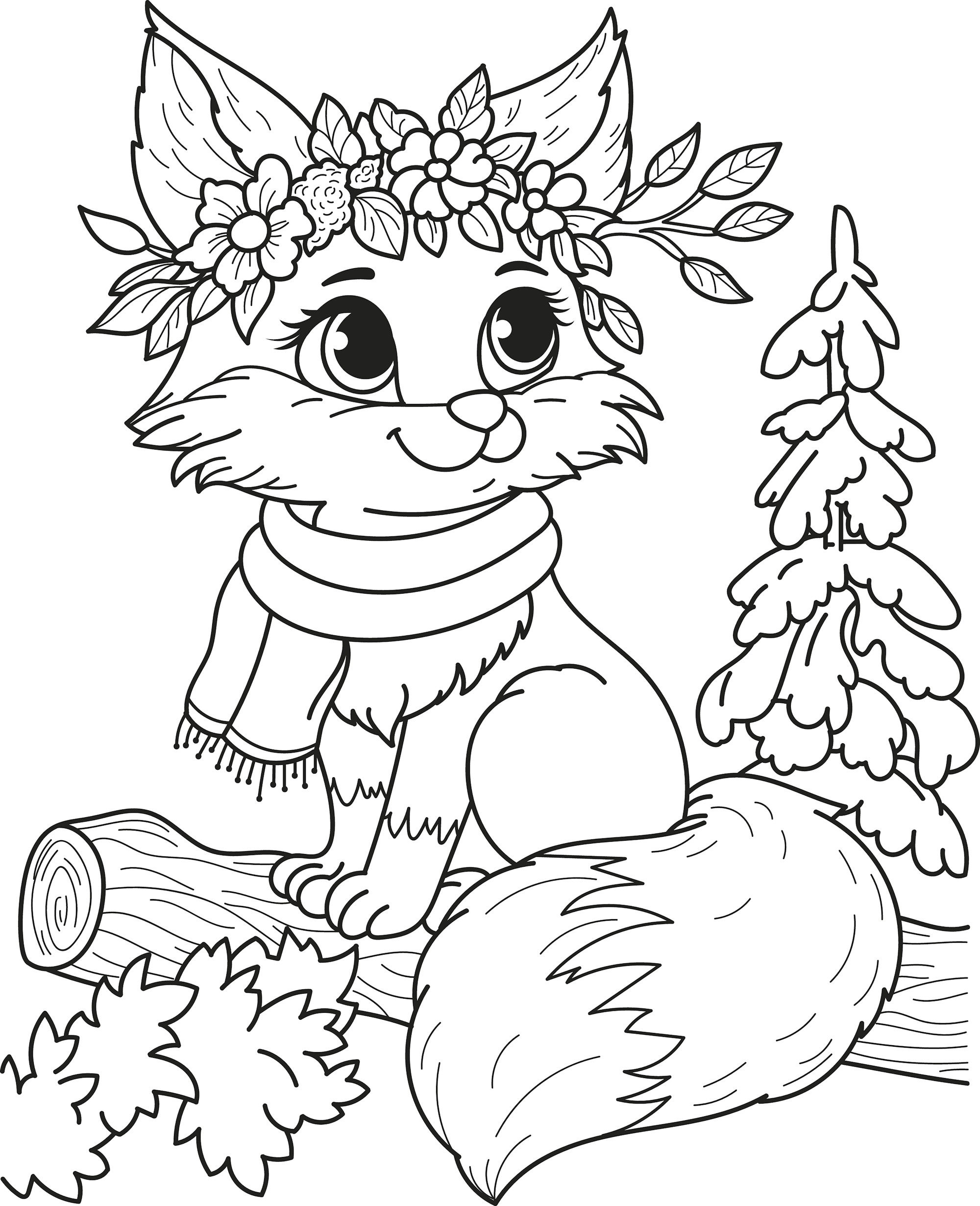
Get ready for an overload of adorable with our collection of cute animal coloring pages, filled with sweet baby animals, kawaii families, playful pets, woodland friends, ocean creatures, farm animals, and cuddly wildlife.
This collection brings together 24 wonderfully cheerful designs. You can color a frog resting on a lotus leaf, a dog and puppy, mouse and baby, kangaroo and joey, duck family, fluffy sheep, deer and fawn, playful cats, an underwater turtle, goats, leopards, a giant panda, birds and owls with their babies, a lion family, dolphin, polar bears, a silly goose, and a smiling fox surrounded by flowers.
Some pages feature parent-and-baby pairs that are perfect for younger children, while others include flowers, forests, meadows, ocean scenery, and other details for kids who want a little more to color. Natural colors are always fun, but kawaii animals are also perfect candidates for pink fur, purple feathers, rainbow spots, and completely imaginary habitats.
Choose the animal that makes you smile the most, grab your crayons, markers, or colored pencils, and start bringing this adorable animal world to life.
🖍️ Shop Cute Animal Coloring Books
🐾 Explore Our Cute Animal Coloring Pages
One of the best things about this collection is its variety.
There are familiar pets, including dogs and cats, alongside farm animals such as sheep, goats, and ducks. Woodland wildlife appears through deer, foxes, owls, and other birds, while lions, leopards, pandas, and kangaroos take the coloring adventure farther around the world.
You can even head underwater with a turtle and dolphin or travel north into snowy polar-bear country.
Many of the designs pair an adult animal with a baby, making this an especially sweet collection for children who love animal families.
For an even larger tour through the animal kingdom, explore our Animal Coloring Pages.
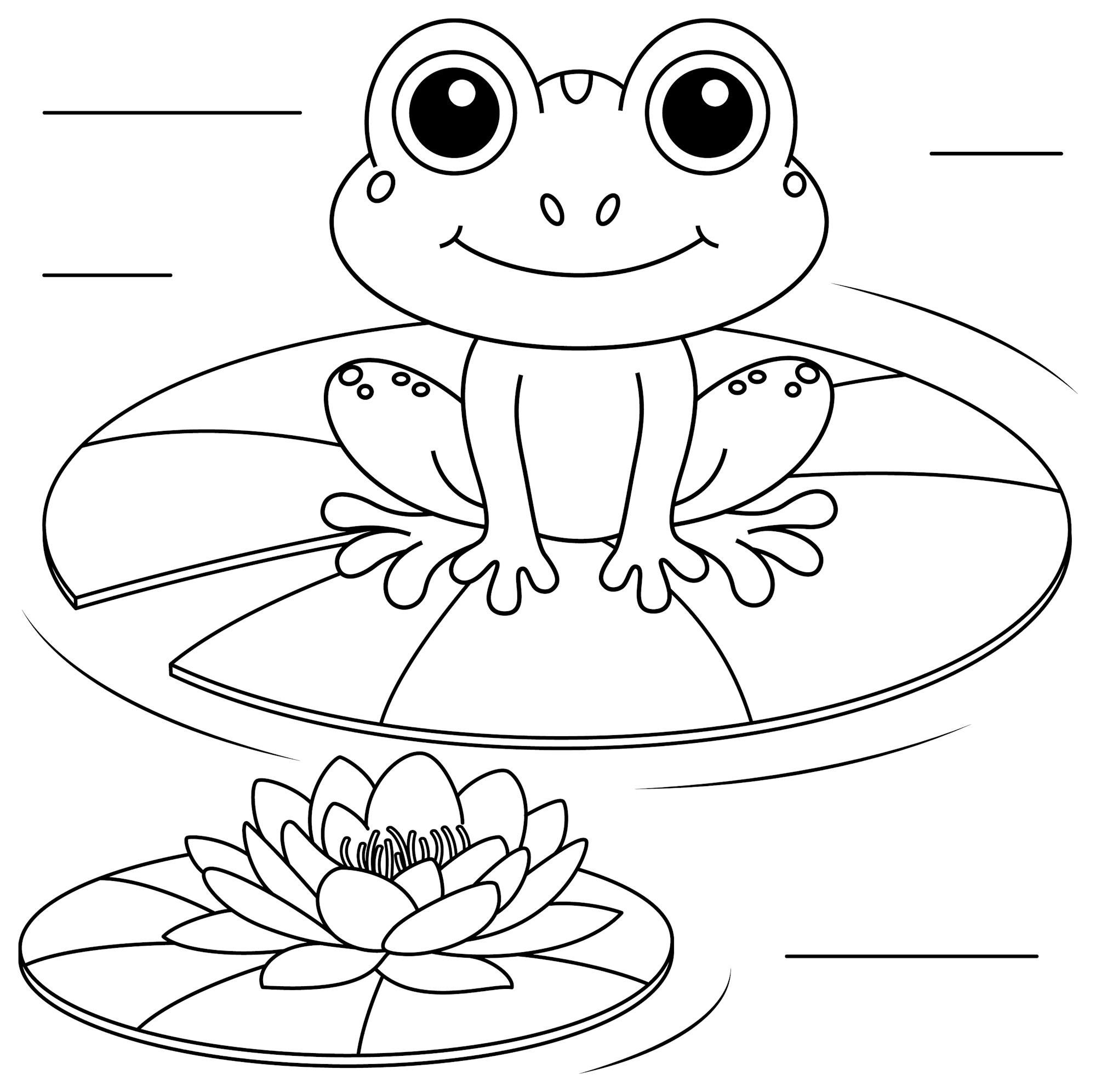
🐸 Cute Frog on a Lotus Leaf
The collection begins with an adorable frog sitting on a lotus leaf.
Green is the obvious starting point, but real frogs occur in an extraordinary range of colors. Depending on the species, frogs can be green, brown, gray, yellow, red, blue, orange, or combinations of several colors.
Try a simple nature palette with:
- Leaf green
- Lime
- Yellow-green
- Brown
- Pale cream
Then make the lotus leaf a slightly different green so the frog remains easy to see.
Add pink or purple lotus flowers around the water and use blue, aqua, or turquoise underneath.
Or create a fantasy frog in electric blue with purple spots.
🌈 Design a Rainbow Frog
Frogs are perfect for imaginative coloring because some real species are already surprisingly bright.
Divide your frog into several sections and try:
Back: Turquoise
Legs: Purple
Feet: Orange
Belly: Yellow
Add pink spots or tiny stars.
The lotus leaf could become lavender instead of green, while the water turns pale pink.
Give your imaginary species a name such as the Rainbow Lotus Frog and decide where it lives.
💦 Build a Frog Pond
Expand the frog page into an entire pond habitat.
Draw:
- Lily pads
- Cattails
- Dragonflies
- Water lilies
- Reeds
- Fish
- Tadpoles
- Rocks
Use several shades of green around the pond and blues or turquoise through the water.
You can even draw several tiny tadpoles beneath the frog.
That creates an easy connection with one of the most fascinating animal life cycles.
🥚 From Tadpole to Frog
Most familiar frogs begin life very differently from the adults.
A simplified frog life cycle can be shown as:
Eggs → Tadpole → Tadpole with legs → Froglet → Adult frog
Draw those stages around your coloring page.
Children can number them from 1 to 5 or arrange separate drawings in the correct order.
The cute frog suddenly becomes both an art project and an introduction to amphibians.
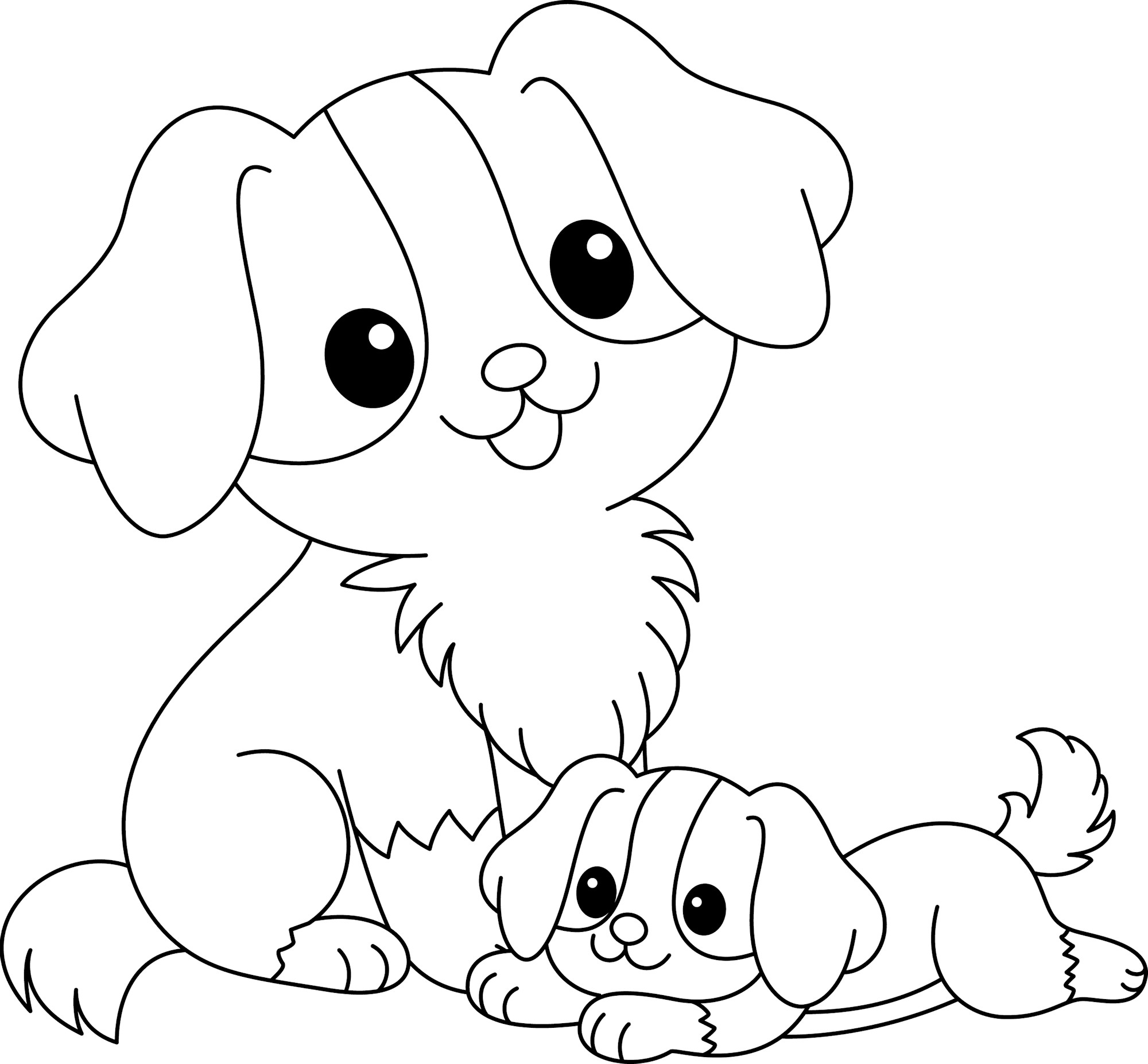
🐶 Cute Kawaii Dog and Baby
The kawaii dog and puppy page is a wonderful choice for children who love pets.
Try coloring the pair like a favorite breed or family pet.
Dog coats can be:
- Black
- White
- Brown
- Golden
- Cream
- Gray
- Red
- Spotted
- Multicolored
Make the puppy slightly lighter than the adult or give them matching markings.
You could also add collars in coordinating colors so everyone knows they belong together.
🦴 Design a Puppy Playroom
Draw some favorite dog toys around the pair.
Add:
- Ball
- Bone
- Rope toy
- Bed
- Water bowl
- Stuffed toy
Then add a patterned rug beneath them.
Perhaps the puppy has scattered toys all over the room while the older dog looks patiently on.
Give both animals names and write them above the picture.
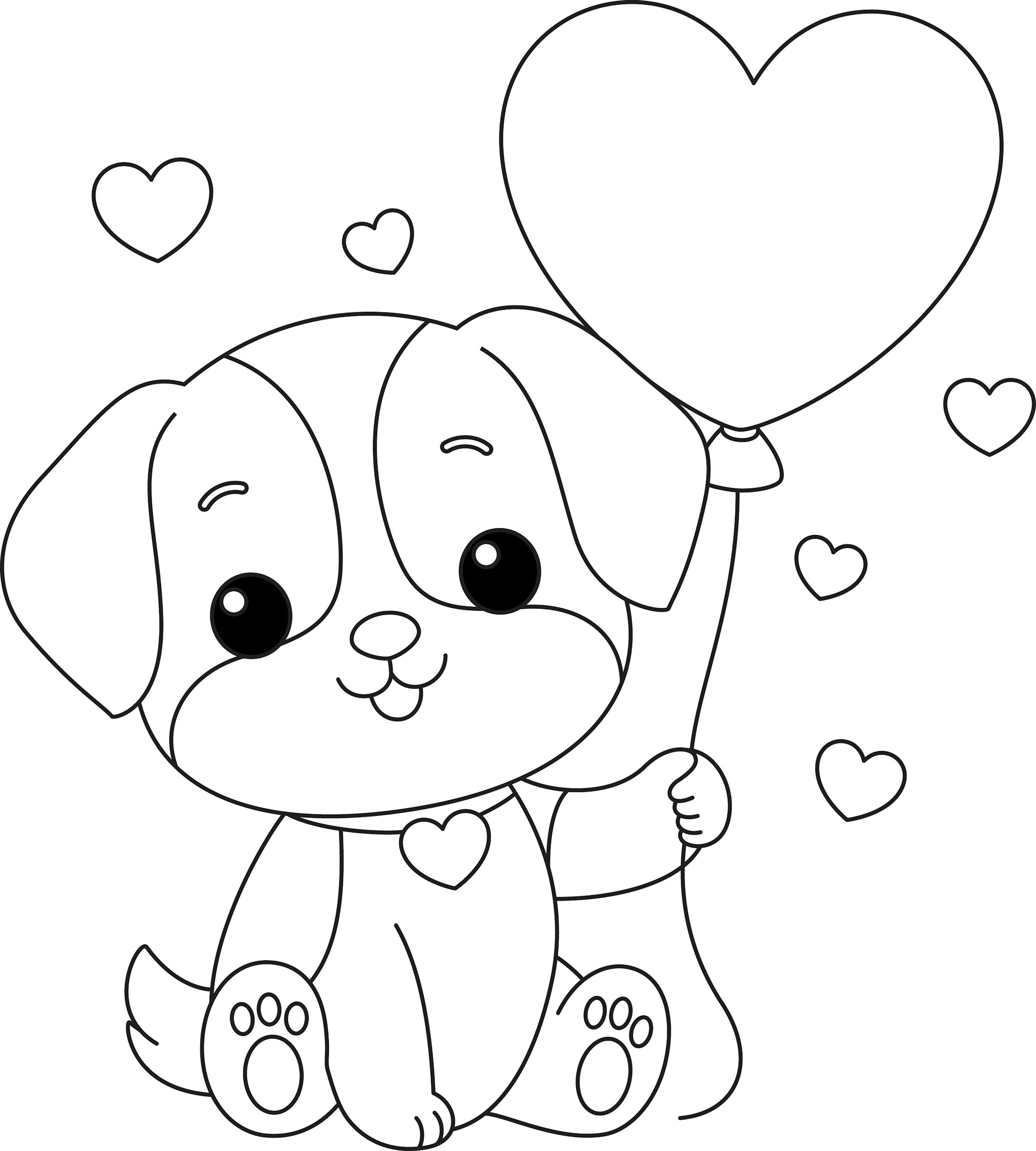
❤️ Dog With a Heart-Shaped Balloon
Another dog in the collection is holding a heart-shaped balloon, making this page especially useful for Valentine’s Day, birthdays, friendship themes, or simply an extra-sweet coloring session.
Try red, pink, or purple for the balloon.
Or make it rainbow-striped.
The dog’s collar can match the balloon while the fur stays in softer browns, golds, creams, or gray.
Add additional hearts around the page and write a little message such as:
You’re Pawsome!
or
Best Friends Fur-ever!
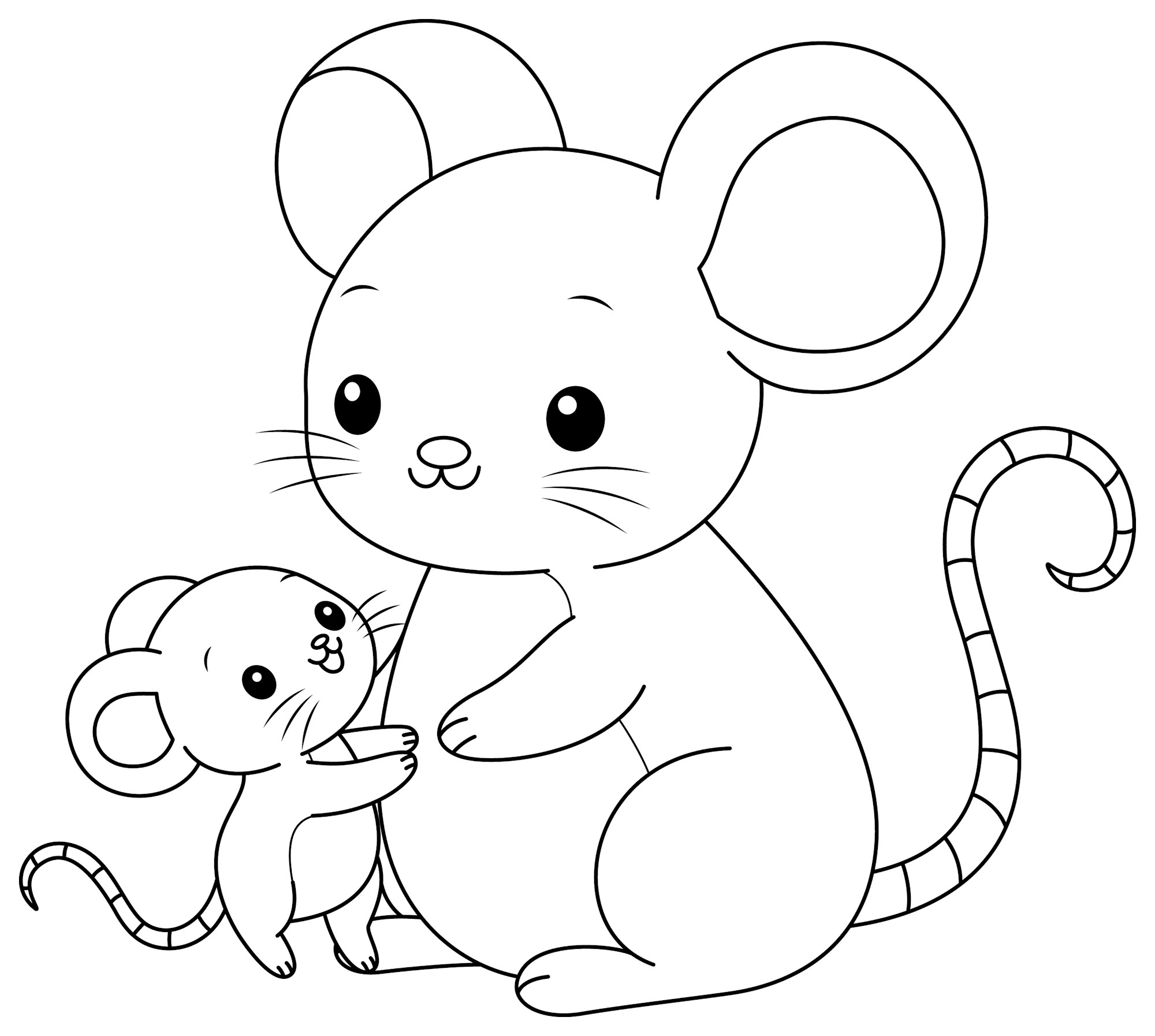
🐭 Cute Mouse and Baby
The kawaii mouse and baby are tiny animals with plenty of cute potential.
Try soft gray, warm brown, cream, or pale tan.
Keep the inner ears and noses pale pink.
Then add tiny woodland details around them.
You might draw:
- Flowers
- Acorns
- Berries
- Mushrooms
- Leaves
- Seeds
A fantasy mouse family could live inside a hollow tree with miniature furniture and tiny teacups.
🧀 Create a Mouse Picnic
Draw a picnic blanket beside the mice.
Add tiny foods that would look enormous next to them:
- Strawberry
- Berry
- Apple slice
- Cracker
- Seed
- Cupcake
Then imagine how large each food would seem if you were mouse-sized.
A strawberry might be almost as big as the baby mouse.
This can become a fun exercise in scale as well as storytelling.
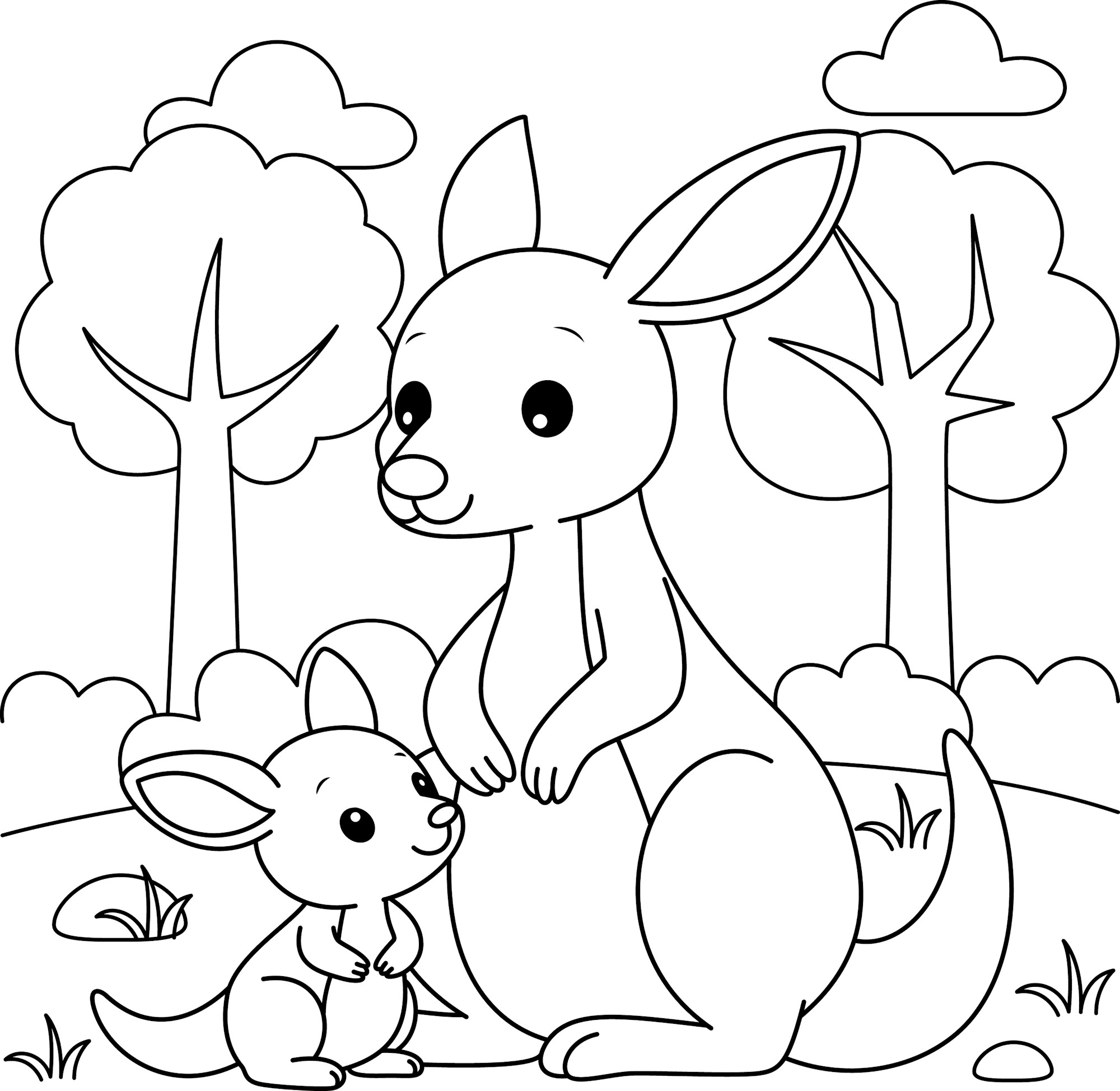
🦘 Cute Kangaroo and Baby
The kawaii kangaroo and baby page introduces one of Australia’s most recognizable animals.
A baby kangaroo is called a joey.
Try warm nature-inspired shades such as:
- Tan
- Golden brown
- Rust
- Gray-brown
- Cream
Red kangaroos can show reddish coloration, while eastern gray kangaroos tend toward softer gray-brown shades.
Then add Australian scenery around the pair with grasses, rocks, trees, and a huge blue sky.
Kangaroos are marsupials, and young joeys spend an important part of their early development in their mother’s pouch.
🍼 What Is a Joey?
A young kangaroo is commonly called a joey.
Kangaroo babies are born extremely small and continue developing inside the mother’s pouch.
Turn this into a simple vocabulary activity:
Adult: Kangaroo
Baby: Joey
Then compare that with other animals in the collection:
Lion → Cub
Deer → Fawn
Dog → Puppy
Sheep → Lamb
Learning baby-animal names is an easy activity to build around these parent-and-young coloring pages.
🦘 How Do Kangaroos Move?
Kangaroos are famous for hopping using their large, powerful hind legs.
Their muscular tails also play important roles in balance and movement.
Draw several kangaroo tracks leading away from your coloring page.
Then have children try a few gentle kangaroo-style hops themselves.
How many hops does it take to cross the room?
Count them together.
🦆 Cute Kawaii Duck Family
The kawaii duck family makes a cheerful pond scene.
A traditional duckling palette might include pale yellow, golden yellow, orange, brown, and cream.
Adult ducks vary enormously in real life, so there are plenty of natural colors to choose from.
Add blue water, green reeds, lily pads, and flowers around the family.
You could even draw a little trail of ducklings following the adult across the pond.
Continue the waterfowl fun with our Coloring Pages of Ducks.
🐥 Count the Ducklings
Duck-family pictures are perfect for counting.
Count the ducks already in the scene, then draw some extra ducklings.
Try:
“Add two ducklings.”
“Draw three lily pads.”
“Add four flowers.”
“Put five bubbles in the water.”
Young children can practice numbers while still concentrating mainly on coloring and drawing.
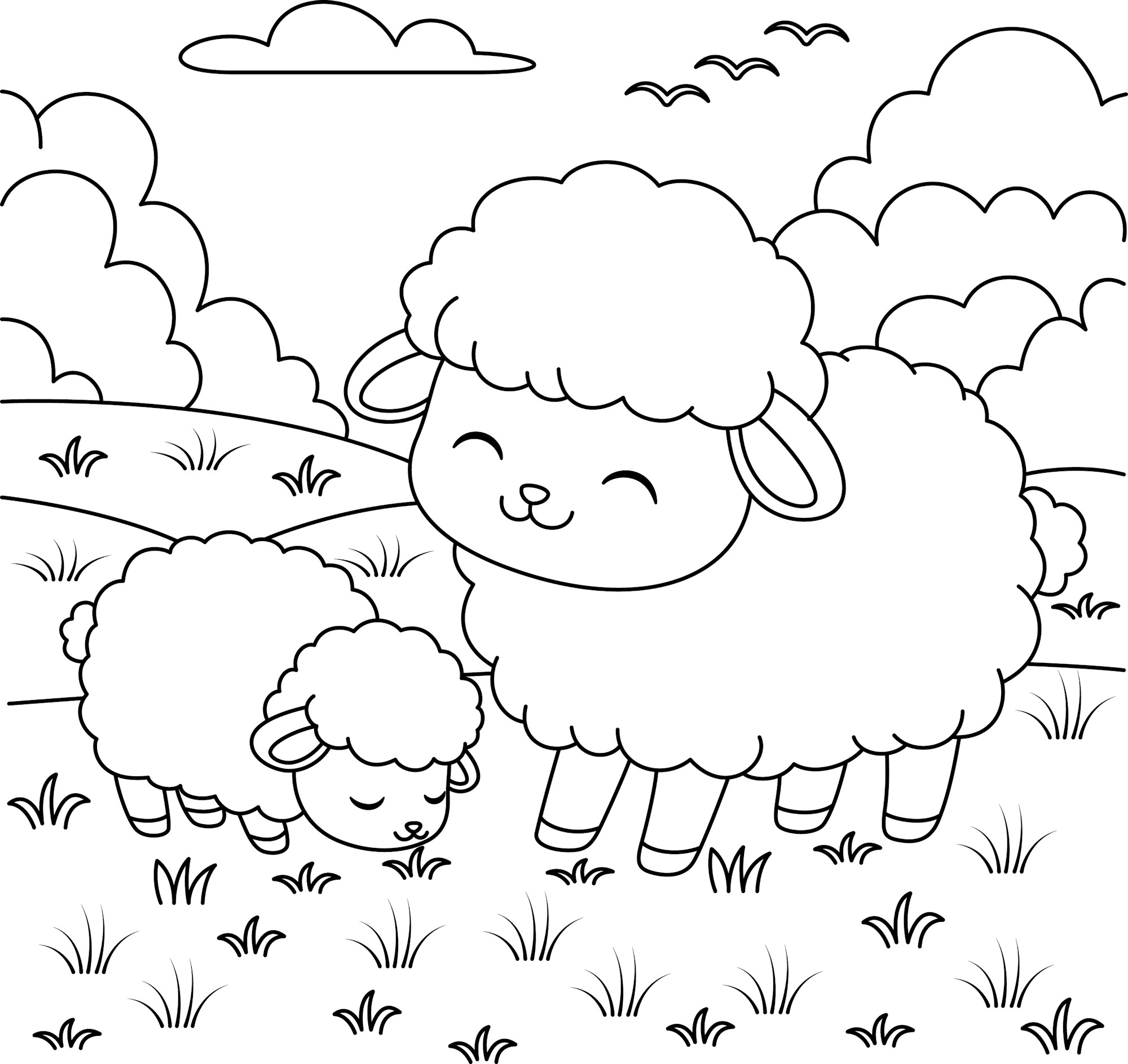
🐑 Cute Sheep Grazing in the Meadow
The kawaii sheep in a meadow is perfect for a soft countryside palette.
Sheep wool can be white, cream, tan, brown, gray, black, or combinations of these colors depending on breed.
For a classic fluffy sheep, leave much of the wool pale and add very light gray or cream shadows around the curls.
Then make the meadow much more colorful.
Use green grass, yellow dandelions, pink flowers, blue sky, and perhaps distant hills.
☁️ Color Fluffy Sheep Wool
Instead of coloring the entire sheep one flat shade, use curved little strokes to follow the fluffy wool.
Try:
- White
- Cream
- Pale beige
- Light gray
Add slightly darker shading underneath the belly and around places where the wool overlaps.
For a kawaii version, make the sheep pink or lavender.
You could even give it rainbow wool and imagine it growing naturally colored yarn.
🐏 Sheep, Lambs & Wool
A young sheep is called a lamb.
Domestic sheep have been raised by people for thousands of years for products that can include wool, milk, and meat, depending on breed and farming tradition.
Turn the coloring page into a simple texture activity.
Glue small pieces of cotton onto the sheep’s body after coloring the rest of the picture.
The finished page will have soft three-dimensional “wool.”
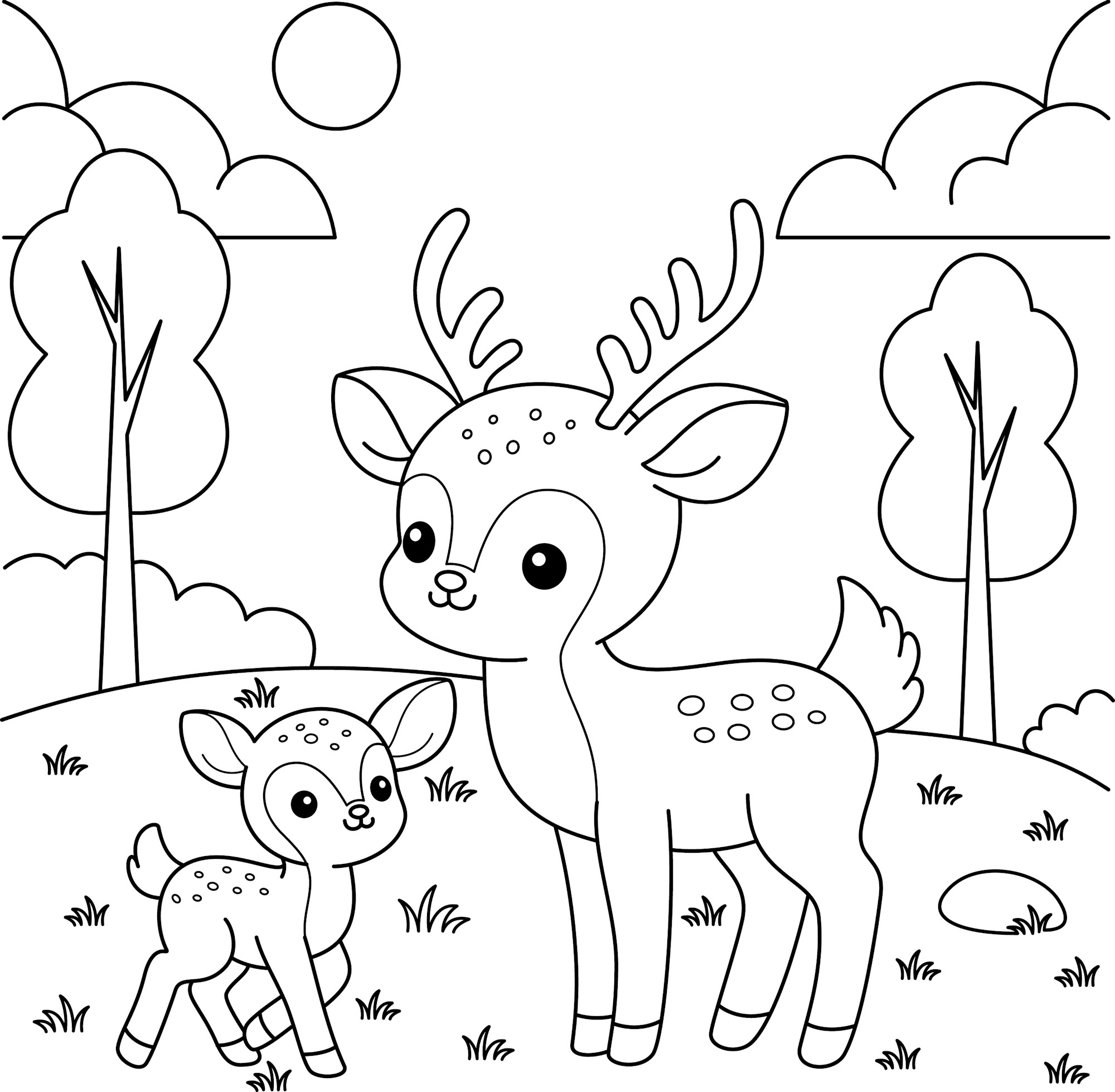
🦌 Cute Deer and Baby
The kawaii deer and baby bring gentle woodland charm to the collection.
A baby deer is called a fawn.
Try warm tan, golden brown, rust, and cream across the adults.
Young fawns of many deer species have pale spots that help break up their outline in vegetation, so add tiny white or cream spots across the baby’s back.
Surround the pair with grass, trees, flowers, and fallen leaves.
🌲 Create a Woodland Home
Turn the deer page into a complete forest.
Add:
- Tall trees
- Ferns
- Mushrooms
- Wildflowers
- Birds
- Butterflies
- Fallen logs
Then choose a season.
Spring can be bright green and floral.
Summer can use deep forest greens.
Fall can bring orange, gold, red, and burgundy.
Winter can transform the same forest into pale blue and white.
For more outdoor inspiration, explore our Nature Coloring Pages.
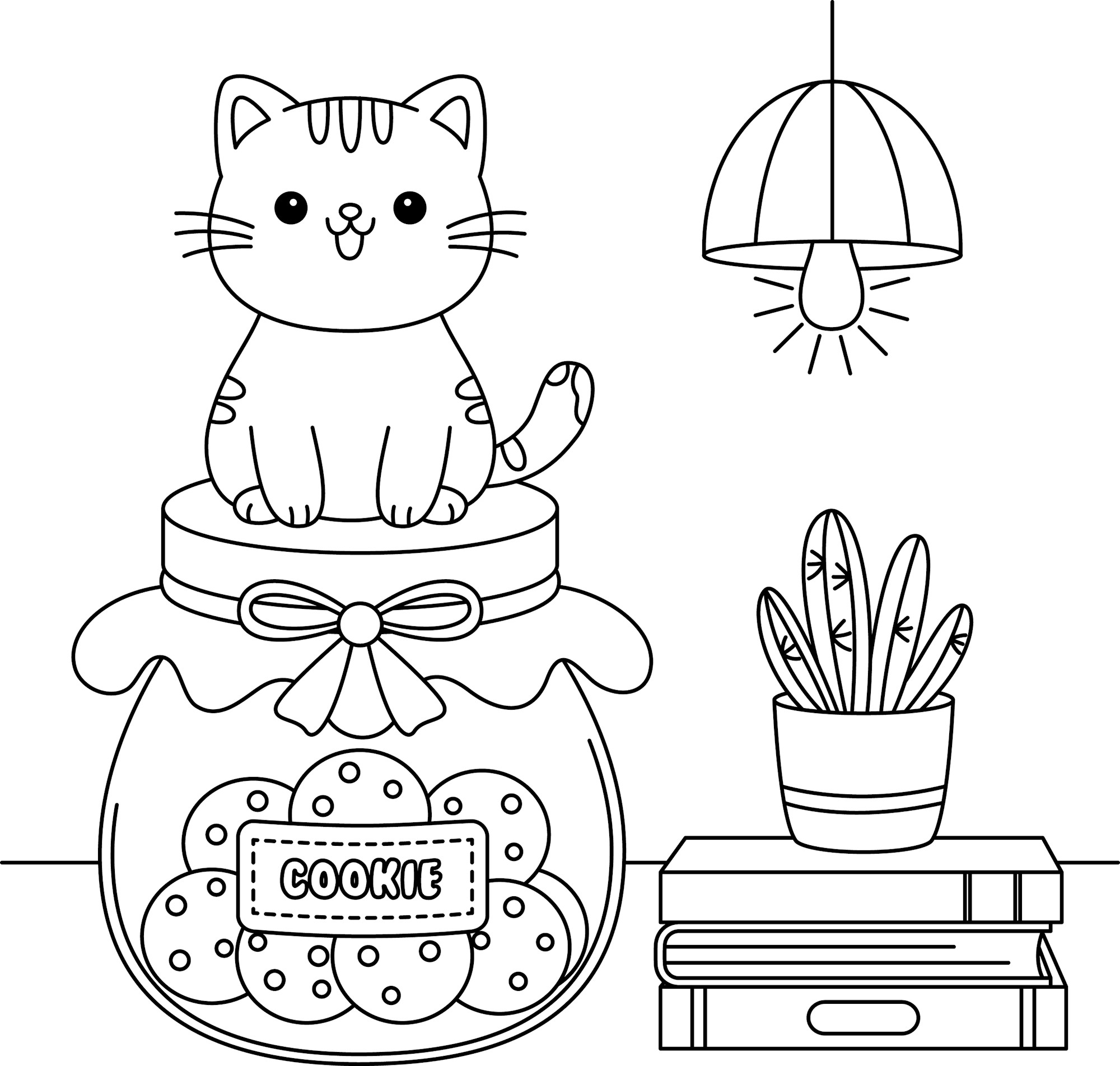
🐱 Cute Cat Sitting on a Cookie Jar
A cat sitting on a cookie jar sounds like the beginning of trouble.
Color the cat first.
Try:
- Orange tabby
- Gray
- Black
- White
- Calico
- Tortoiseshell
- Cream
Then decorate the cookie jar.
Add stripes, flowers, polka dots, hearts, or tiny paw prints.
The cookies themselves can become chocolate chip, sugar cookies, rainbow cookies, or whatever imaginary flavor you like.
Then decide why the cat is sitting there.
Is it guarding the cookies—or trying to steal them?
🍪 Design a Kawaii Cookie Jar
Draw another cookie jar beside the cat and give it a face.
Add:
- Big eyes
- Smile
- Rosy cheeks
- Decorative lid
Fill it with cookies in different shapes:
- Stars
- Hearts
- Cats
- Circles
- Flowers
Color every cookie differently.
The original cat page suddenly becomes a miniature bakery scene.
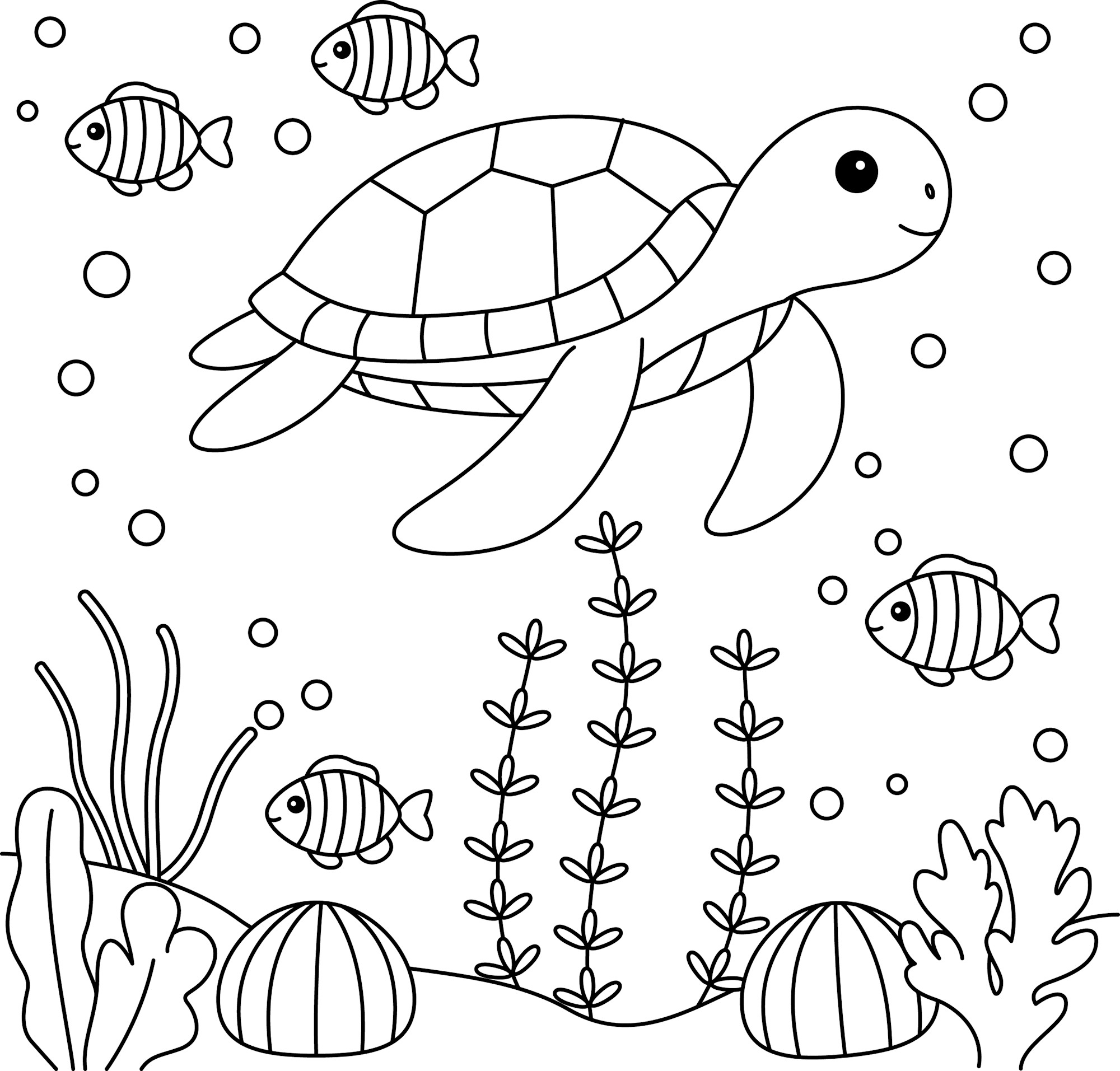
🐢 Cute Turtle Under the Sea
The cute underwater turtle takes this animal collection beneath the waves.
A nature-inspired turtle might use olive, brown, tan, cream, and green.
But the shell is also a perfect place for imagination.
Turn each section into a different color or pattern.
Try:
- Rainbow
- Stars
- Hearts
- Flowers
- Waves
- Dots
Then fill the surrounding ocean with turquoise, teal, royal blue, and navy.
For an entire turtle collection, explore our Coloring Pages of Turtles.
🪸 Create a Coral Reef
Draw a colorful reef around the turtle.
Add:
- Coral
- Fish
- Seaweed
- Seashells
- Crabs
- Sea stars
- Bubbles
Use bright pink, orange, purple, turquoise, yellow, and green.
The turtle can remain relatively natural so it stands out against the colorful habitat—or become equally rainbow-colored.
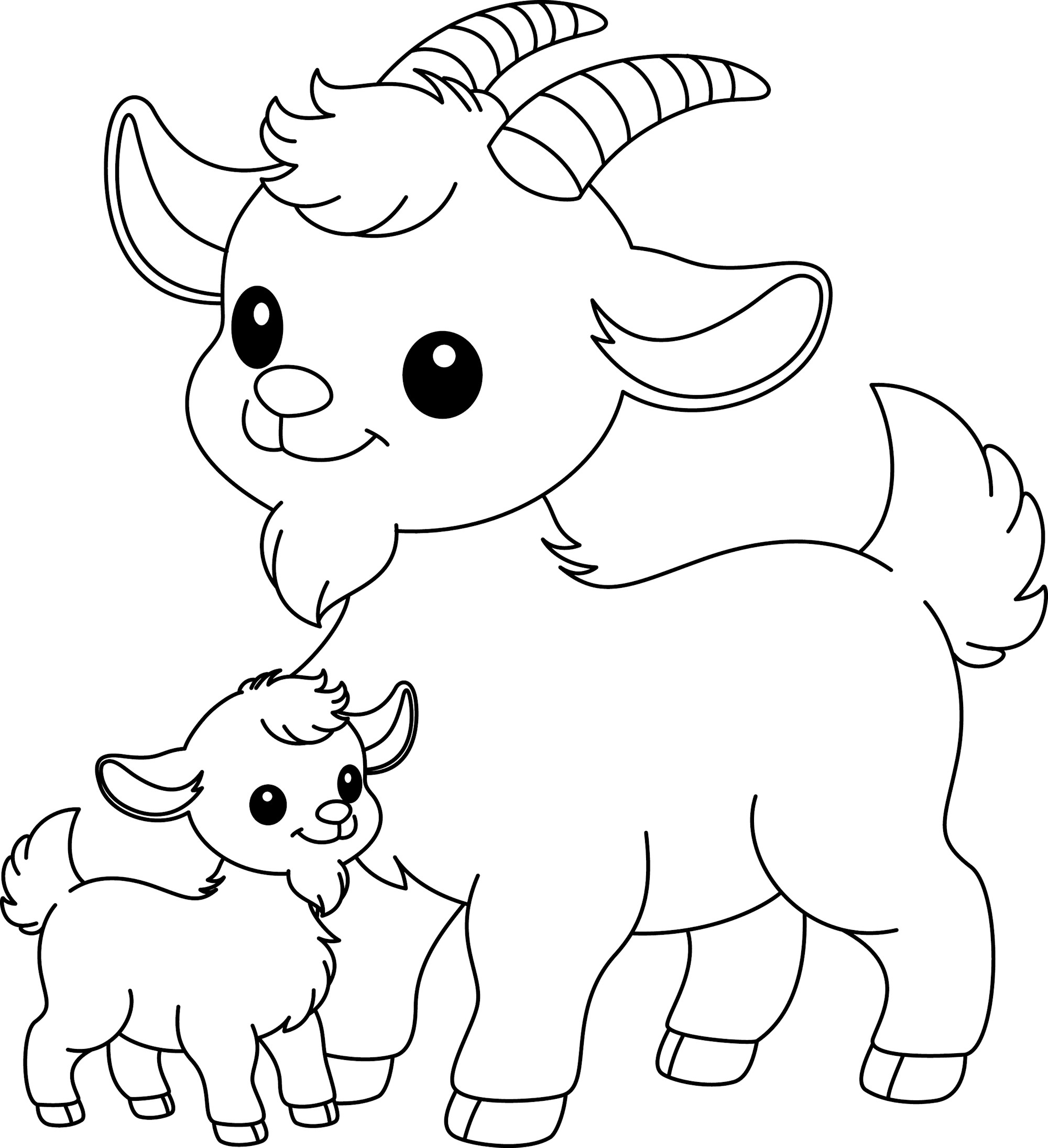
🐐 Cute Goat and Baby
The kawaii goat and baby add another farm favorite.
A young goat is called a kid.
Goat coats can be white, black, brown, tan, gray, reddish, spotted, or patterned.
Give the adult and baby matching markings or make them completely different.
Then create a farm or mountain background.
Add grass, fences, flowers, rocks, and perhaps a barn in the distance.
🐐 What Is a Baby Goat Called?
One of the most entertaining baby-animal words is:
Goat → Kid
That gives children an easy matching activity.
Try:
Goat → Kid
Sheep → Lamb
Deer → Fawn
Lion → Cub
Dog → Puppy
Duck → Duckling
Write the adult animals on one side of a sheet and the baby names on the other.
Draw lines to match them.
⛰️ Goats Are Amazing Climbers
Wild goats and their relatives can live in steep, rocky habitats where sure-footed climbing is essential.
Turn your cute goat into a mountain adventurer.
Draw:
- Rocky ledges
- Mountain peaks
- Clouds
- Alpine flowers
Place the little kid on a lower rock and the adult higher above.
The cuddly cartoon page now becomes a dramatic mountain scene.
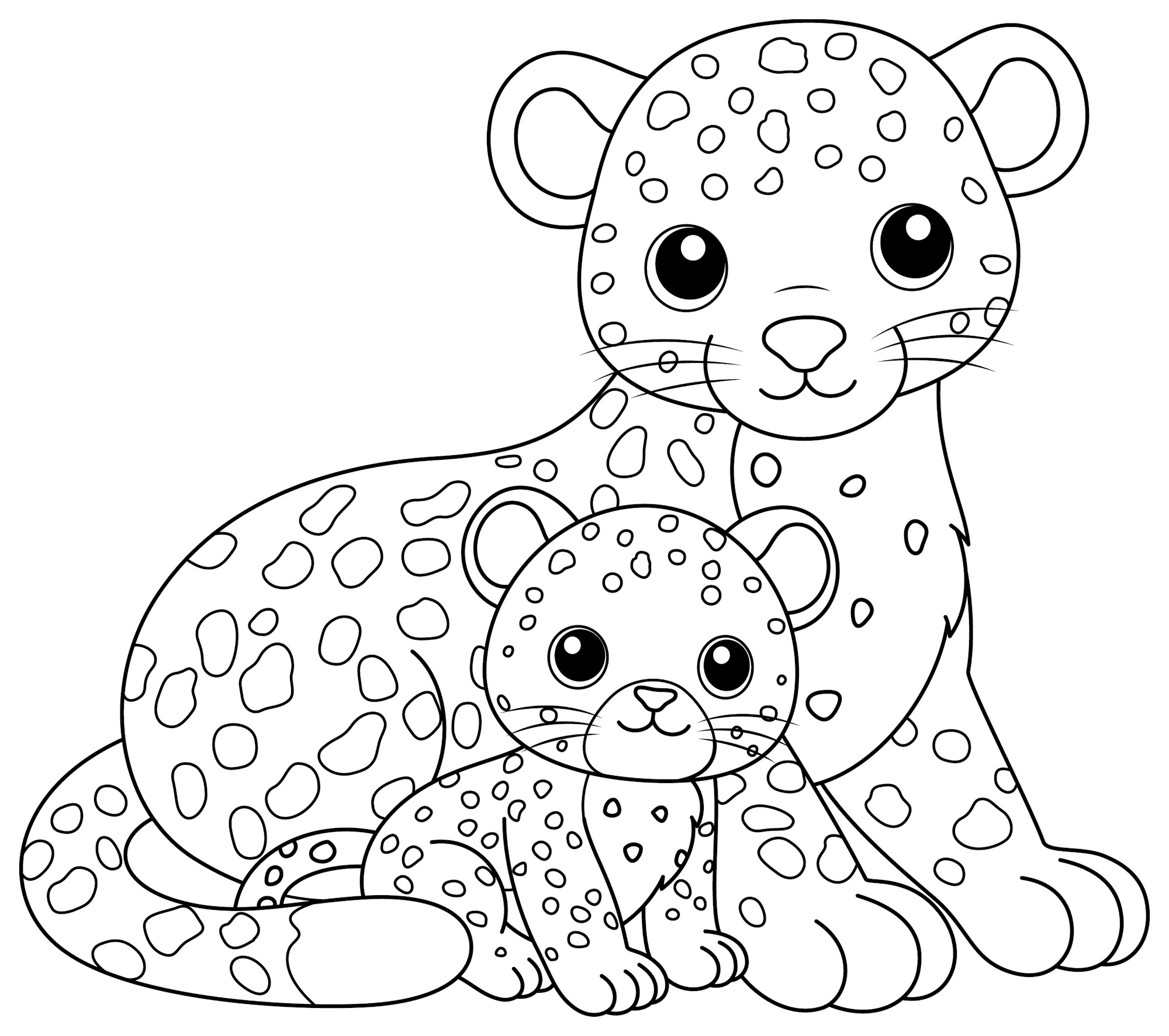
🐆 Cute Leopard and Baby
The kawaii leopard and baby are perfect for anyone who likes animal patterns.
Leopards usually have golden or tawny coats covered with dark markings called rosettes.
Try a warm body color such as:
- Golden yellow
- Tan
- Caramel
- Light brown
Then use dark brown or black for the rosettes.
Keep the belly and muzzle lighter.
The cub can have the same markings as the adult or a slightly softer version.
🎨 Design Leopard Spots
Leopard spots offer a wonderful pattern activity.
Color the cat naturally first.
Then print another copy and redesign the rosettes.
Try:
- Pink hearts
- Purple flowers
- Blue stars
- Rainbow circles
- Golden swirls
Perhaps you have discovered a new species called the Rainbow Rosette Leopard.
Where does it live?
What does its colorful coat help it do?
🌳 Leopards Are Excellent Climbers
Real leopards are powerful cats and capable tree climbers. Their spotted coats can help break up their outlines against complex backgrounds.
Draw a tree around your leopard.
Add a large branch and imagine the cat resting above the ground.
Use tan, brown, olive, and green throughout the habitat so the animal’s coat begins to blend into its surroundings.
Then print another version and see how much easier it is to spot a neon-pink leopard.
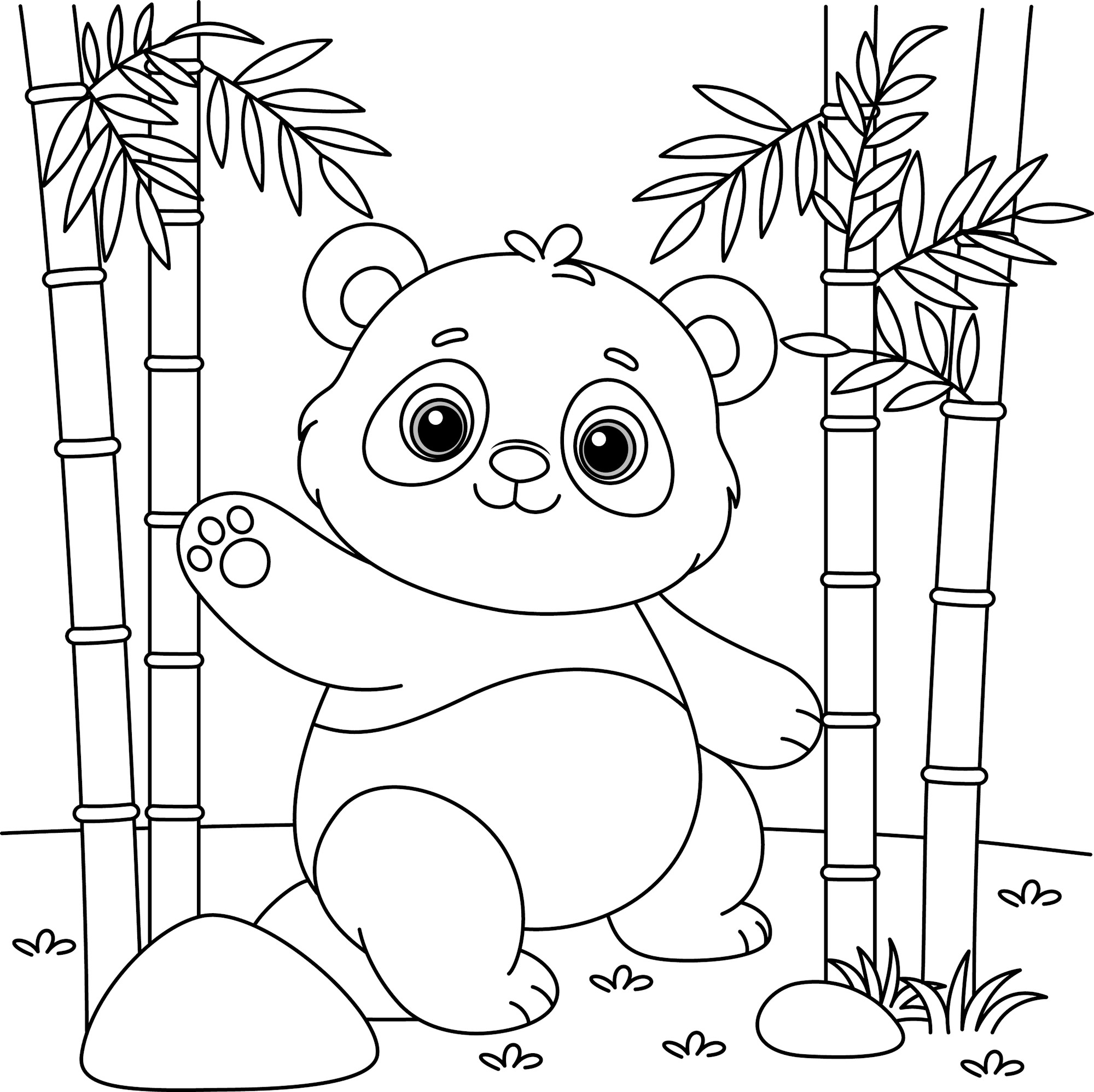
🐼 Cute Kawaii Panda
Few animals lend themselves to cute coloring quite as naturally as the giant panda.
The familiar color pattern is simple:
White: much of the body
Black: ears, eye patches, shoulders, and legs
Add pale gray or cream shadows to the white sections to keep them from looking completely blank.
Then surround the panda with several greens.
Bamboo can use sage, lime, emerald, olive, and forest green.
The strong black-and-white panda will stand out beautifully against the greenery.
🎋 Create a Panda Bamboo Forest
Draw tall bamboo stems behind the panda.
Add lots of long narrow leaves.
Use stronger greens in the foreground and paler blue-green shades farther away.
You might also add rocky mountains or mist behind the forest.
Giant pandas are native to mountain forests in south-central China, where bamboo is an extremely important part of their lives and diet.
🐼 Pandas Really Are Bears
Despite some historical confusion over classification, giant pandas belong to the bear family Ursidae.
They have powerful jaws and teeth for dealing with tough bamboo and a specialized wrist bone that functions somewhat like a “pseudo-thumb,” helping them grasp stems.
That gives kids an observation activity.
Look at the panda’s front paws.
Then imagine how useful it would be to hold bamboo for many hours each day.
For more cuddly-looking members of the bear family, visit our Coloring Pages of Bears.
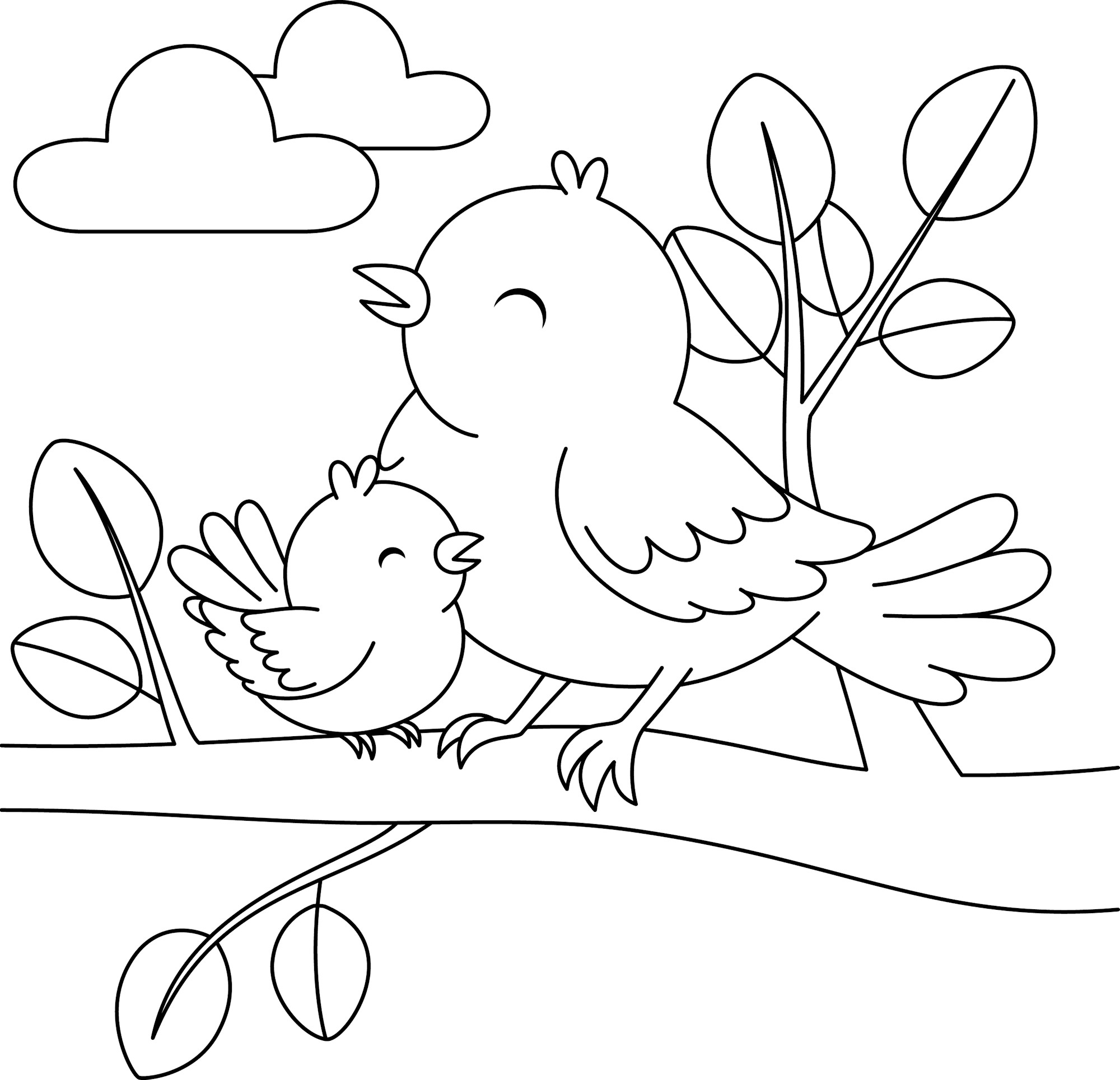
🐦 Cute Bird and Baby on a Branch
The kawaii bird and baby sitting together on a branch offers endless color choices.
Real birds occur in almost every imaginable shade.
Try a coordinated parent-and-baby pair.
Maybe the adult is bright blue while the younger bird is pale blue.
Or use:
- Red and pink
- Yellow and cream
- Brown and tan
- Green and mint
Add leaves, blossoms, berries, clouds, or a nest around the branch.
For even more feathered friends, explore our Coloring Pages of Birds.
🪶 Design Colorful Feathers
Create patterns across the wings.
Try:
- Stripes
- Dots
- Hearts
- Scallops
- Rainbow feathers
Keep the body simple and make the wings extremely decorative.
You could also create matching parent-and-baby plumage with slightly different shades.
Then give your imaginary bird species a name.
🦉 Cute Kawaii Owl and Baby
The owl and baby make another adorable parent-and-young pair.
Natural owl colors often include brown, cream, gray, white, rust, and black.
For a woodland look, combine several browns and creams across the feathers.
For a kawaii night scene, make the adult lavender and the owlet pale pink.
Then draw a dark blue sky filled with stars and a large moon.
🌙 Create a Moonlit Owl Forest
Build a nighttime world around the owl family.
Use:
- Navy
- Indigo
- Purple
- Dark blue
- Silver
Add dark tree branches and a glowing pale moon.
Fireflies, stars, and clouds can fill the remaining space.
Keep the owls relatively light so they stand out against the night.
👶 What Is a Baby Owl Called?
A young owl can be called an owlet.
The collection even includes a separate owlet coloring page, giving children a chance to color both a family scene and an individual baby bird.
Add the word:
OWLET
beneath the finished picture.
Then practice:
O is for owl.
For a full alphabet activity, visit our Coloring Pages of Letters.
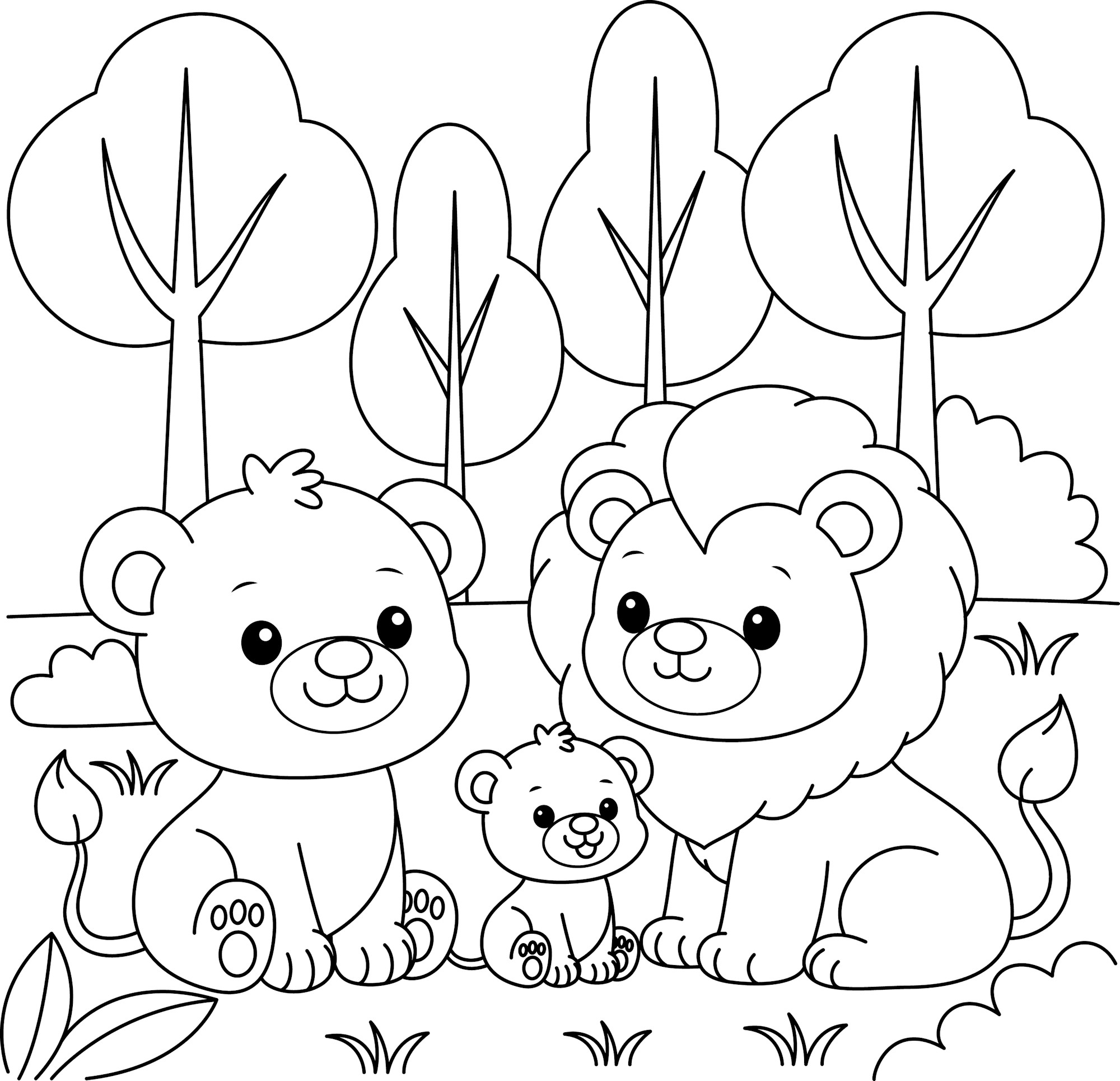
👑 Cute Kawaii Lion Family
The kawaii lion family brings an entire pride of cuteness to the page.
Use golden yellow, tan, cream, caramel, and brown.
If the adult male has a mane, make it darker with:
- Chestnut
- Rust
- Chocolate
- Deep gold
Cubs can be slightly paler.
Then add golden grass, distant trees, and warm blue sky to create an African-inspired landscape.
For an entire collection of big cats, visit our Coloring Pages of Lions.
🌈 Give the Lion a Rainbow Mane
A lion’s mane is already a dramatic feature, so it makes a perfect fantasy canvas.
Try:
Red → Orange → Yellow → Green → Blue → Purple
Or make it look like a sunset with orange, coral, pink, violet, and gold.
Keep the body golden so the colorful mane becomes the focus.
Children can also add a tiny matching rainbow mane to a cub.
🦁 Lions Live in Social Groups
Lions are unusual among cats because they live in social groups commonly called prides.
Lionesses raise cubs and play important roles in hunting and pride life.
That makes the family picture a natural way to talk about animal social groups.
Other groups have their own names too.
Can children find out what we call a group of:
- Ducks?
- Sheep?
- Dolphins?
- Geese?
Turn the answers into an animal-vocabulary poster.
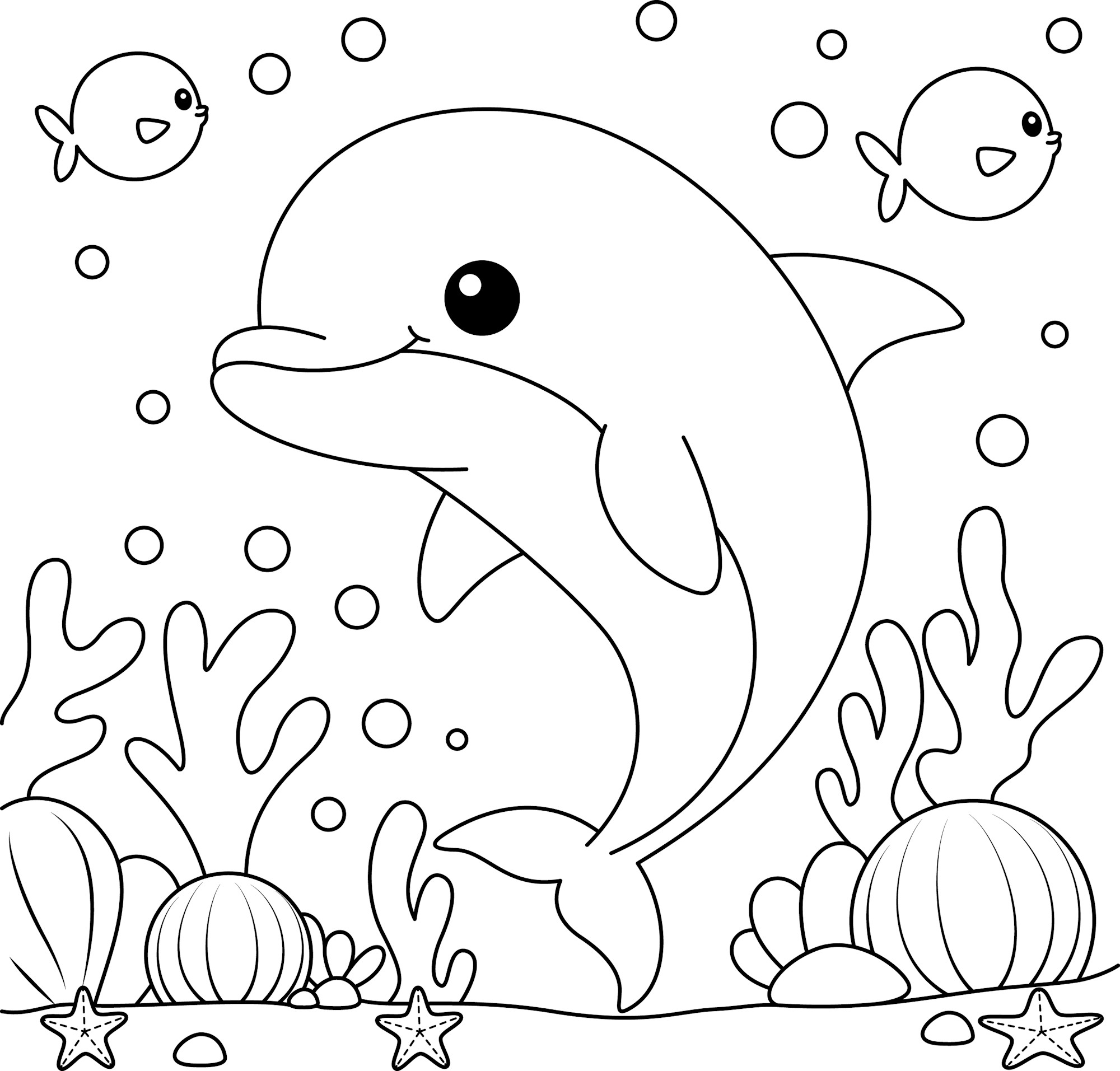
🐬 Cute Dolphin Coloring Page
The cute dolphin brings a cheerful marine mammal into the collection.
Try gray, blue-gray, or pale blue across the body, keeping the underside lighter.
Then surround the dolphin with:
- Turquoise water
- Bubbles
- Fish
- Waves
- Coral
- Seashells
Or turn it into a fantasy dolphin covered with stars and rainbow stripes.
For more, visit our Coloring Pages of Dolphins.
🌊 Dolphin or Fish?
A dolphin may live in the ocean and have fins, but it is not a fish.
Dolphins are mammals.
They breathe air with lungs and must return to the surface to breathe.
Fish generally extract oxygen from water using gills.
Create a simple comparison:
Dolphin → Mammal
Shark → Fish
Turtle → Reptile
The animal collection becomes an easy introduction to classification.
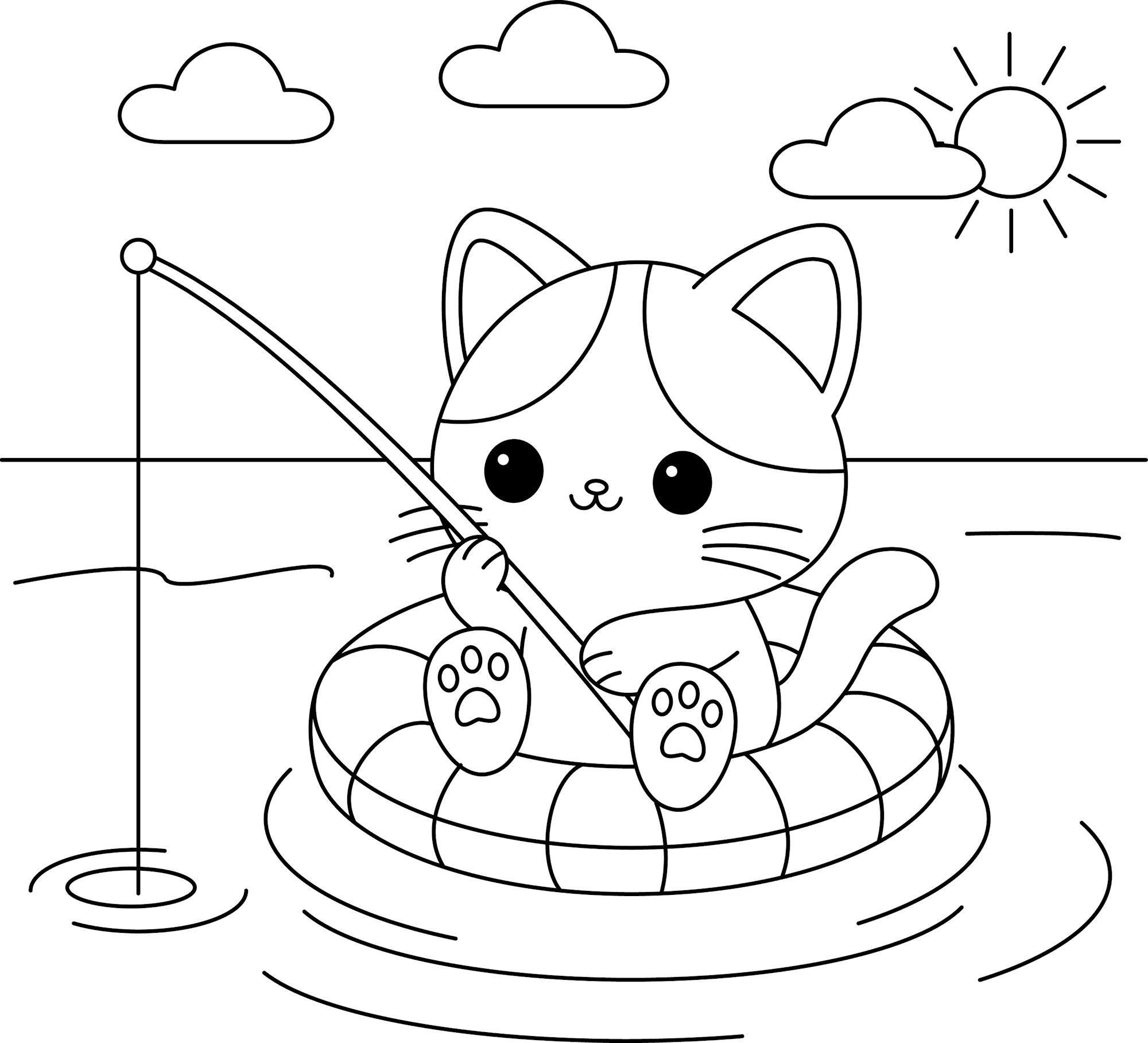
🐱 Cat Fishing From a Float
One wonderfully silly page shows a cute cat sitting on a float and fishing.
Color the cat first, then design the float.
Make it:
- Rainbow-striped
- Pink and purple
- Watermelon-themed
- Donut-shaped
- Covered with stars
Add blue water and perhaps some curious fish underneath.
Then decide whether the cat is actually trying to catch dinner or simply enjoying a quiet afternoon.
🎣 What Will the Cat Catch?
Add something unexpected to the fishing line.
Maybe the cat catches:
- Fish
- Old boot
- Treasure key
- Tiny octopus
- Seashell
- Message in a bottle
Then write a sentence explaining what happens.
The stranger the catch, the better the story.
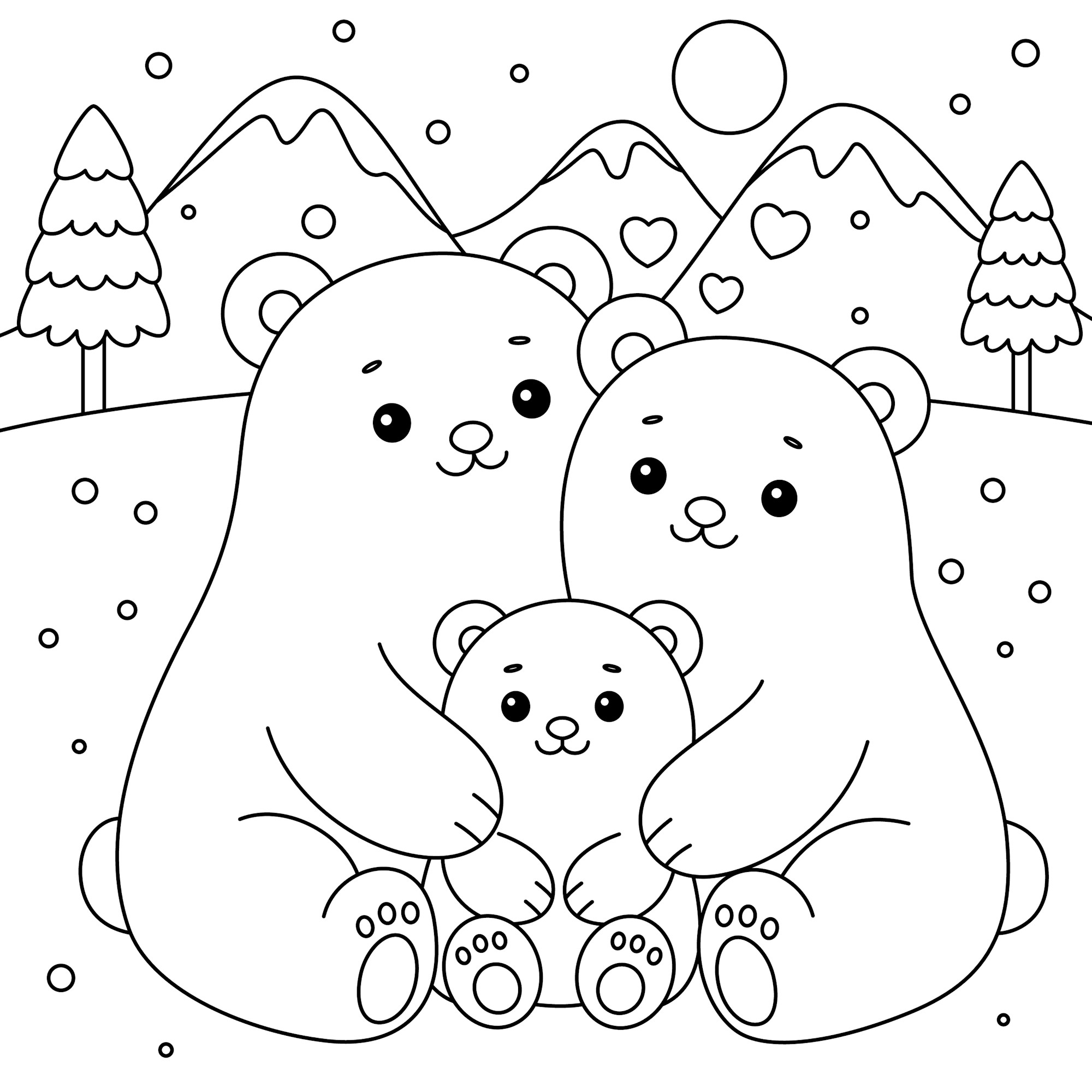
🐻❄️ Cute Polar Bear Family
The polar bear family offers a completely different environment from the sunny lion pride.
Polar bears appear white, but a coloring page looks more dimensional if you add extremely pale shading.
Try:
- Light gray
- Blue-gray
- Cream
- Pale lavender
Keep most of the animal white.
Then color the surrounding Arctic environment with blue, turquoise, navy, gray, and white.
Polar bears depend strongly on sea-ice habitats and are classified as marine mammals.
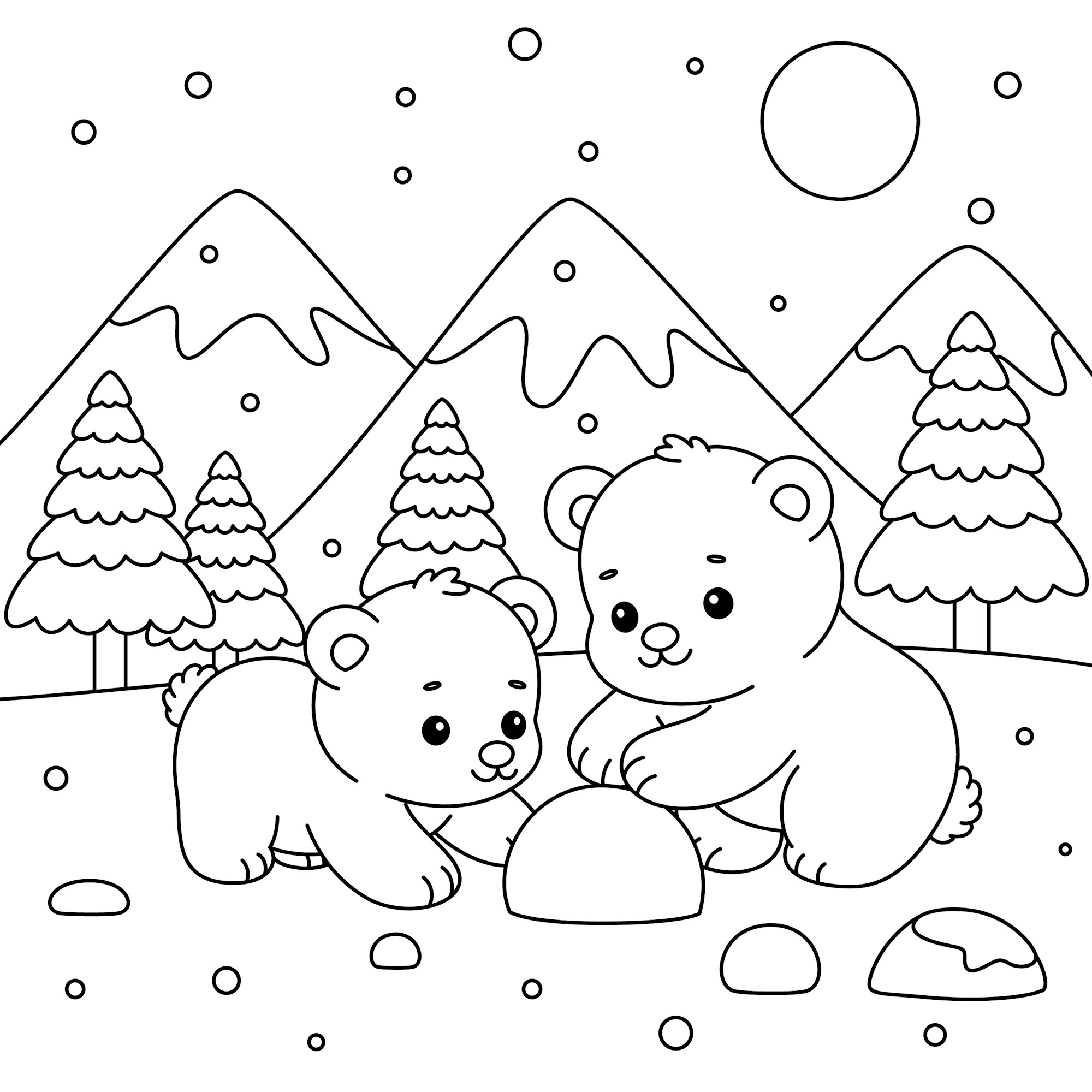
❄️ Baby Polar Bears Playing in the Snow
The collection also includes baby polar bears playing with snow, which is perfect for a playful winter scene.
Add pale blue shadows beneath the cubs and around snowbanks.
Draw:
- Snowflakes
- Ice
- Clouds
- Footprints
A colorful sunset can prevent the page from becoming too pale.
Try peach, pink, lavender, and gold behind the snowy landscape.
🌌 Add Northern Lights
Turn the polar-bear scene into a fantasy Arctic night.
Color the sky deep navy or black.
Then add sweeping bands of:
- Green
- Turquoise
- Pink
- Purple
- Blue
Keep the snow and bears pale.
The glowing sky becomes the brightest part of the scene.
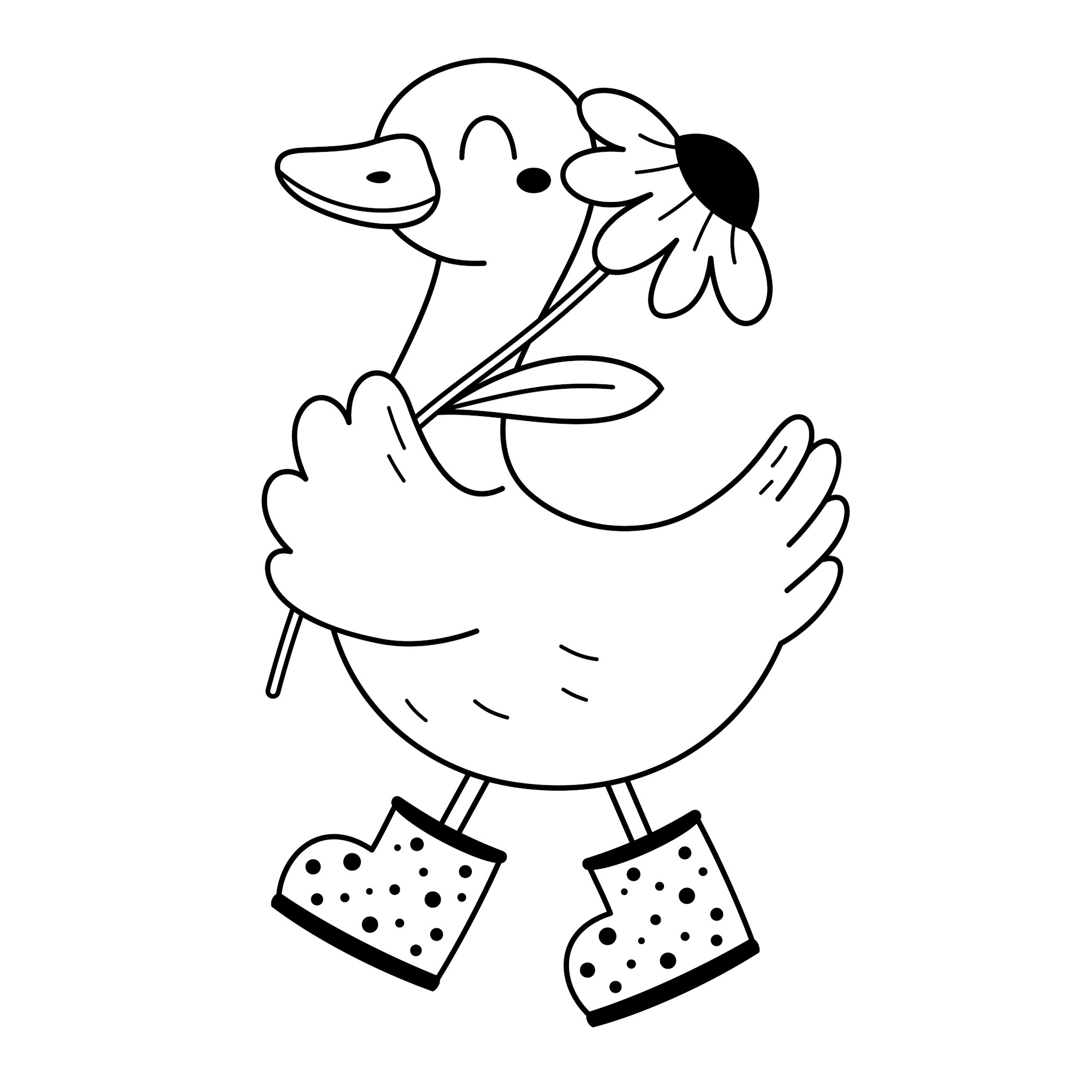
🪿 Silly Goose Coloring Page
The silly goose is one of those pictures that does not need much explanation.
Its entire job is to be silly.
Try white, cream, gray, or brown feathers for a nature-inspired goose.
Use orange or yellow on the beak and feet.
Then make everything else ridiculous.
Give it a hat.
Add sunglasses.
Draw balloons.
Maybe the goose is running away with someone’s sandwich.
Write:
SILLY GOOSE
above the page in large colorful letters.
🎩 Make the Goose Even Sillier
Add:
- Bow tie
- Crown
- Roller skates
- Giant glasses
- Party hat
Maybe it is attending a very important goose meeting.
Perhaps it is the mayor.
Children can invent a title such as:
Sir Goose-a-Lot
or
Professor Honk
Then write one sentence about its latest adventure.
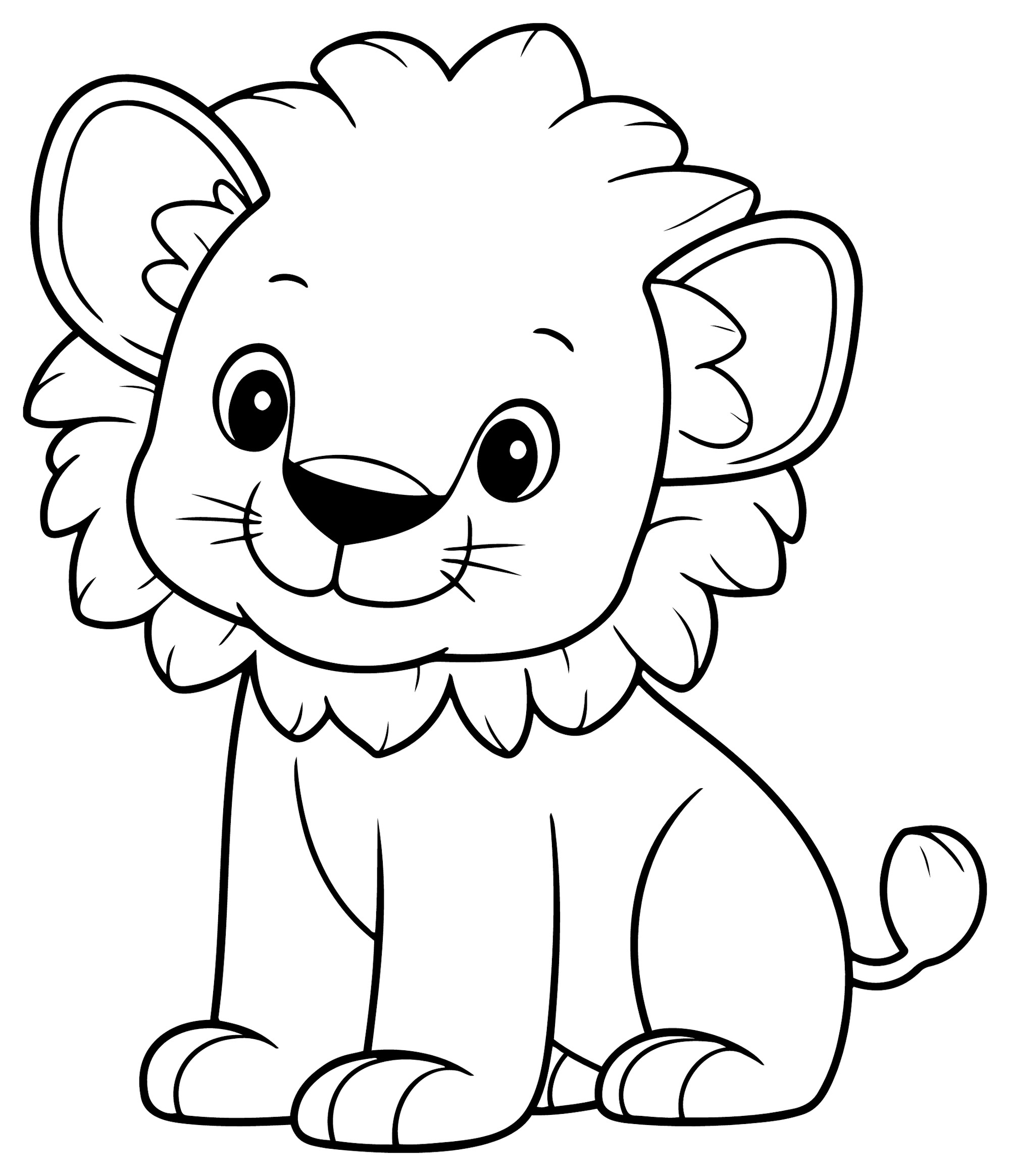
🦁 Detailed Lion Coloring Page
The collection also includes another lion illustration beyond the kawaii family.
Use this one for a more nature-inspired approach.
Layer golden tan across the body.
Add darker brown through the mane and cream around the muzzle.
Use short pencil strokes to suggest fur.
Then draw tall grass or a sunset behind the animal.
This makes a nice comparison with the kawaii family page: one lion can be cute and stylized while another leans closer to wildlife art.
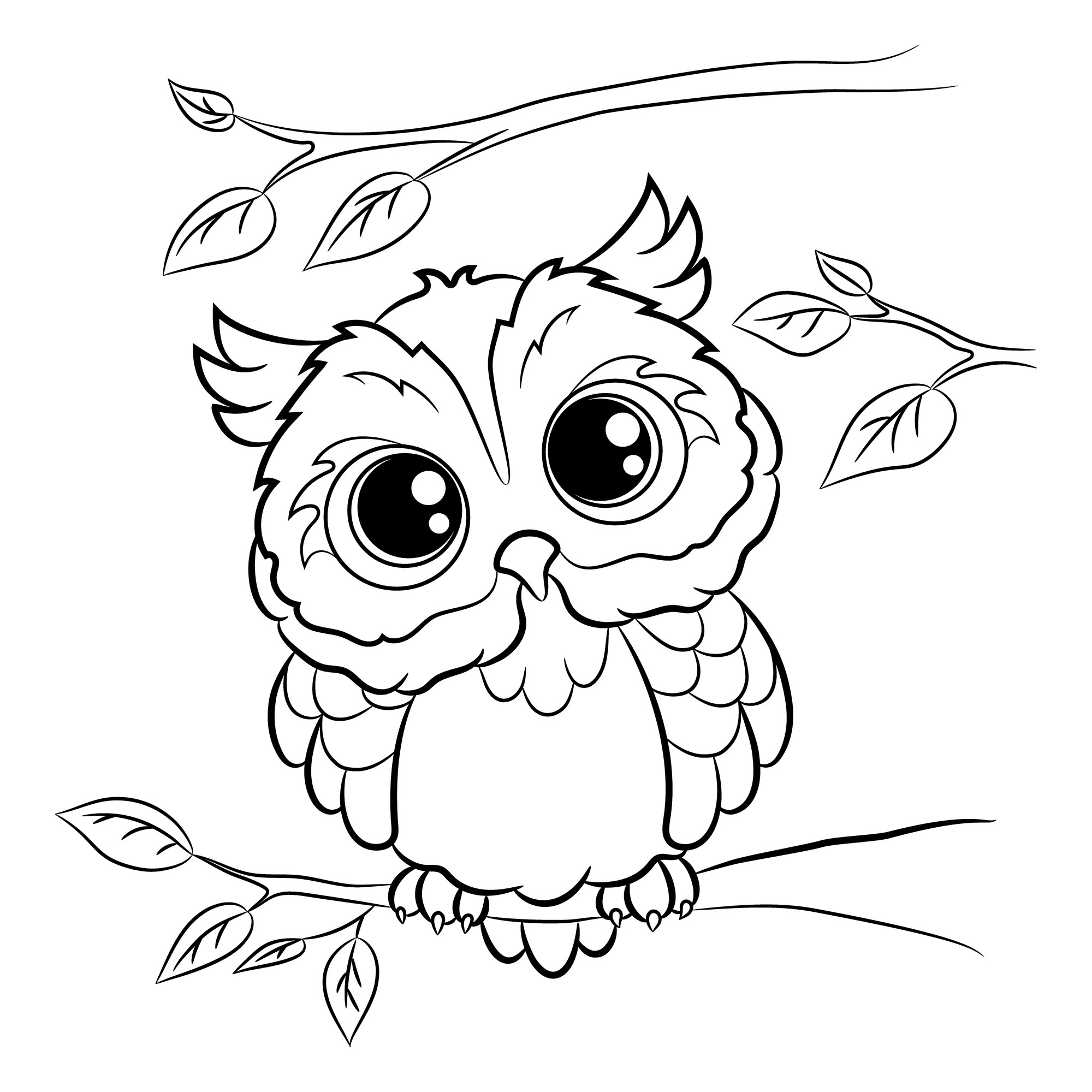
🦉 Owlet Coloring Page
The individual owlet is a wonderful page for soft feather colors.
Try cream, tan, brown, gray, or white.
Keep the face slightly lighter and add darker markings around the wings.
Then place the little owl on a branch.
Add leaves during summer or falling snow for winter.
A fantasy owlet could be pale lavender with silver wings beneath a star-filled sky.
🦊 Smiling Fox With Flowers
The smiling fox surrounded by flowers makes a beautiful ending to the collection.
A classic red fox palette might use:
- Rust
- Red-orange
- Golden brown
- Cream
- Black
Keep the lower legs and ears darker and the muzzle, chest, and tail tip pale.
Red foxes can actually occur in several coat-color forms, including red, darker cross forms, black, and silver variations, so even nature gives you more choices than the name might suggest.
Then make the flowers bright pink, purple, yellow, blue, and coral.
🌸 Turn the Fox Into a Flower Garden
Use the floral fox page to experiment with a coordinated palette.
Spring Fox
Rust, pink, lavender, yellow, and fresh green
Autumn Fox
Orange, burgundy, gold, brown, and olive
Moonlight Fox
Blue-gray, navy, lavender, silver, and turquoise
Fantasy Fox
Pink, purple, aqua, yellow, and mint
Repeating the flower colors throughout the picture can make the entire page feel beautifully connected.
🌈 What Colors Should Cute Animals Be?
There are two perfectly good approaches.
Nature-Inspired
Use colors associated with the real animal.
A panda can be black and white.
A fox can be orange and cream.
A lion might be golden.
A polar bear can be white with pale gray shadows.
Imagination-Inspired
Ignore all of that.
Make the panda purple.
Give the lion rainbow fur.
Create a turquoise deer.
Color the dolphin pink.
A coloring page is not a wildlife identification test. Children can learn what animals really look like while also having complete freedom with their artwork.
🎨 Try a Kawaii Pastel Palette
These designs are especially suited to soft pastel colors.
Try:
- Blush pink
- Lavender
- Mint
- Peach
- Pale yellow
- Baby blue
- Soft turquoise
Use two or three colors repeatedly across the animal and background.
A pastel dog, mouse, panda, and frog can look like members of the same imaginary kawaii world even though they are completely different species.
🌈 Try a Rainbow Animal Challenge
Choose six colors:
Red
Orange
Yellow
Green
Blue
Purple
Use all six somewhere on one animal page.
Maybe the lion’s mane becomes rainbow-colored.
Perhaps every turtle-shell section gets a different shade.
The leopard’s spots could change color.
The ducklings might each become a different part of the rainbow.
There are no rules except using every color.
🎲 Roll-and-Color Animal Game
Assign a color to each side of a die:
1 — Red
2 — Orange
3 — Yellow
4 — Green
5 — Blue
6 — Purple
Roll the die and use the matching color somewhere in the picture.
Keep rolling until the animal is finished.
The result may not look anything like nature, but that is part of the fun.
🍼 Match the Animal With Its Baby
Because so many designs feature families, this page is excellent for baby-animal vocabulary.
Try matching:
Dog → Puppy
Deer → Fawn
Goat → Kid
Sheep → Lamb
Lion → Cub
Kangaroo → Joey
Duck → Duckling
Children can write each pair on a card.
Mix the cards and try to match them again.
👨👩👧 Create an Animal Family Book
Choose all the parent-and-baby pages and turn them into a homemade book.
Each spread could include:
Adult: Kangaroo
Baby: Joey
or
Adult: Deer
Baby: Fawn
Color the picture and add one sentence about the animal.
Staple all the pages together and create a cover:
Cute Animal Families
This makes a particularly nice preschool or homeschool project.
🌍 Animals Around the World
These 24 designs represent animals from very different parts of the world.
For example:
Kangaroos: Australia
Giant pandas: China
Lions: Africa, plus the remaining wild Asiatic lion population in India
Polar bears: Arctic regions
Leopards: Parts of Africa and Asia
Dolphins: Oceans around the world
Older children can find these broad regions on a globe or map.
Then place a little animal picture beside each one.
🗺️ Create a Cute Animal World Map
Print or draw a world map.
Add small pictures or labels for:
- Kangaroo
- Panda
- Lion
- Leopard
- Polar bear
- Dolphin
You do not have to map every species exactly.
For younger kids, identifying major continents and broad regions is enough.
Older children can choose one animal and research its range more carefully.
🌳 Match Each Animal With a Habitat
Animals need different surroundings.
Try matching:
Frog → Pond
Deer → Forest or meadow
Turtle → Water
Panda → Bamboo forest
Lion → Grassland or savanna
Dolphin → Ocean
Polar bear → Arctic marine environment
Sheep → Pasture
Then choose one coloring page and draw the habitat around it.
The activity helps transform isolated cartoon characters into animals that belong somewhere.
🌊 Land, Water or Both?
Sort some of the animals into broad groups.
Mostly Land
Dog
Mouse
Kangaroo
Sheep
Deer
Goat
Leopard
Panda
Lion
Fox
Water
Dolphin
Animals Closely Associated With Water
Frog
Duck
Turtle
The exact ecological details vary by species, but this provides younger children with a simple starting point for thinking about habitats.
🐾 Mammal, Bird, Reptile or Amphibian?
The collection also contains several major animal groups.
Mammals
Dog, mouse, kangaroo, sheep, deer, cat, goat, leopard, panda, lion, dolphin, polar bear, fox
Birds
Duck, bird, owl, goose
Reptiles
Turtle
Amphibians
Frog
Create four labeled areas and sort animal cards into the correct groups.
This is a nice reminder that “cute animal” describes an artistic style—not a scientific category.
🦘 Meet the Marsupial
The kangaroo stands out from most of the mammals here because it is a marsupial.
Marsupial young are born at an early developmental stage, and in kangaroos the joey continues developing while attached to a teat inside the mother’s pouch. Kangaroos are among Australia’s most recognizable marsupials.
Draw a little pouch on a blank kangaroo picture and place a tiny joey peeking out.
Then compare it with the lion or deer family.
Animal parents can care for young in very different ways.
🐼 Compare a Panda and Polar Bear
Both pandas and polar bears belong to the bear family, but their lives could hardly look more different.
Giant Panda
Mountain forests
Bamboo-rich diet
Black-and-white coat
Polar Bear
Arctic marine environment
Strongly dependent on sea ice
Primarily carnivorous
Color one of each and create matching backgrounds.
The exercise shows how members of one animal family can adapt to dramatically different habitats.
🐆 Compare a Lion and Leopard
Both are members of the cat family.
But their appearance is easy to distinguish.
Lion
Mostly plain tawny coat
Adult males can have large manes
Highly social compared with most cats
Leopard
Rosette-patterned coat
Strong climber
Usually more solitary
Color one of each.
Then invent an imaginary cat that combines a lion’s mane with leopard rosettes.
🐬 Ocean Animal Day
Combine the dolphin and turtle pages for an ocean-themed coloring session.
Add more creatures from:
Create one large underwater mural.
Put dolphins near the surface, turtles around seagrass, sharks farther out, and jellyfish drifting through the water.
Suddenly the cute-animal collection connects with an entire ocean world.
🐬 Dolphins Are Mammals
The dolphin page gives children a useful animal-classification surprise.
Dolphins live in water but are mammals rather than fish. They breathe air, and mothers nurse their calves.
Bottlenose dolphins can occur in both coastal and offshore waters and are highly social animals.
Draw a dolphin at the surface with its blowhole above the water.
Then draw a fish beneath it using gills.
🐦 Create a Bird Day
Combine the duck, goose, owl, owlet, and parent-and-baby bird pages.
Look at how different the birds appear.
Some swim.
Some perch.
Some are active mainly at night.
All have feathers.
For even more feathered designs, explore our Coloring Pages of Birds.
Children can arrange the finished pictures into their own mini bird book.
🐑 Create a Farm Animal Day
The sheep, goat, duck, dog, and cat designs can all become part of a pretend farm.
Draw a large farm background with:
- Barn
- Fence
- Pond
- Meadow
- Tractor
- Garden
Cut out the finished animals and place each one where you think it belongs.
Then add more farm favorites from the Animal Coloring Pages collection.
🦁 Create a Zoo Animal Day
The lion, leopard, panda, polar bear, and kangaroo fit naturally into a zoo-themed project.
Color each animal and create a pretend habitat.
Then add an information card:
Animal name
Where it lives
What it eats
One fun fact
Arrange the pages around the room and let children take a pretend zoo tour.
🏷️ Make Cute Animal Fact Cards
Turn any finished page into a simple animal card.
For a kangaroo:
Animal: Kangaroo
Group: Mammal
Special group: Marsupial
Baby: Joey
Region: Australia
For a lion:
Animal: Lion
Group: Mammal
Family: Cat
Baby: Cub
Group of lions: Pride
Younger children can use only two or three facts.
Older kids can research more.
🔤 Practice Animal Letters
The collection provides easy alphabet connections.
B is for Bird
C is for Cat
D is for Dog
D is for Duck
F is for Frog
F is for Fox
G is for Goat
K is for Kangaroo
L is for Lion
M is for Mouse
O is for Owl
P is for Panda
S is for Sheep
T is for Turtle
Write a large letter beside each finished picture.
For an entire A–Z collection, explore our Coloring Pages of Letters.
🔢 Count the Cute Animals
Turn the collection into an enormous counting game.
Count:
- Animals
- Babies
- Paws
- Wings
- Tails
- Flowers
- Spots
- Bubbles
Then add instructions to individual pages.
“Draw three butterflies.”
“Add four flowers.”
“Give the leopard five rainbow spots.”
“Draw six bubbles around the turtle.”
“Add seven stars over the owl.”
Coloring becomes a simple early-math activity.
🔎 Cute Animal Scavenger Hunt
See if children can find:
- An animal with wings
- An animal with spots
- An animal that swims
- An animal with a pouch
- An animal with hooves
- An animal that lives in the Arctic
- An animal with a mane
- An animal with a shell
- An animal sitting on a cookie jar
- An animal holding a balloon
The answers are all hidden somewhere in the collection.
👀 Compare Ears, Tails & Feet
Animals have very different body shapes.
Compare the:
Long kangaroo feet
Webbed duck feet
Lion paws
Goat hooves
Turtle flippers or feet
Bird wings
Then look at tails.
Which animal has the fluffiest?
Which has the longest?
Which barely has a visible tail at all?
Observation is one of the easiest ways to add learning to a coloring activity.
👂 Animal Sounds
What sounds might these animals make?
Try:
Dog: Woof
Duck: Quack
Sheep: Baa
Goat: Bleat
Lion: Roar
Goose: Honk
Owl: Hoot
Some animals, such as dolphins and frogs, can produce a variety of sounds that do not fit neatly into one familiar children’s word.
Draw speech bubbles around the characters and fill them with their sounds.
🎭 Pretend to Be an Animal
Take a movement break between pages.
Hop like the kangaroo.
Paddle like the duck.
Leap like the frog.
Stomp like the lion.
Flap like the owl.
Swim your arms like the dolphin.
Crawl slowly like the turtle.
Young children can turn animal identification into a whole-body activity.
😀 Give Every Animal a Personality
The cute expressions make these animals ideal story characters.
Choose three adjectives for each one.
Maybe the:
Frog: Curious, cheerful, adventurous
Panda: Sleepy, gentle, hungry
Goose: Silly, noisy, confident
Fox: Friendly, clever, artistic
Lion cub: Playful, brave, energetic
Then write or tell a story using those personalities.
📖 Turn the Animals Into a Story
What would happen if all 24 animals met?
Perhaps the frog throws a party on its lotus leaf.
The dog brings balloons.
The kangaroo carries supplies in its pouch.
The duck family arrives by pond.
The panda brings bamboo decorations.
The lion thinks it is in charge.
The goose disagrees loudly.
And the dolphin has absolutely no idea how it ended up at a forest party.
Choose five characters and create your own story.
📕 Make a Cute Animal Storybook
Print several pages and color them.
Add one sentence beneath each animal.
Then arrange them into an adventure.
Possible title:
The Cutest Animal Adventure
or
The Day All the Animals Met
Create a cover and staple the pages together.
Children who are not ready to write can dictate their sentences to an adult.
🏫 Cute Animal Coloring Pages for Preschool
The parent-and-baby scenes and friendly kawaii faces make this collection especially suitable for young animal lovers.
Preschool activities might include:
- Naming animals
- Naming colors
- Counting babies
- Matching parents and young
- Practicing animal sounds
- Identifying body parts
- Learning simple letters
- Telling short stories
For more beginner-friendly designs, visit our Preschool Coloring Pages.
🎒 Cute Animal Coloring Pages for the Classroom
Teachers and homeschool families can use this collection for:
- Animal units
- Mammal lessons
- Habitat activities
- Parent-and-baby matching
- Farm themes
- Zoo themes
- Ocean lessons
- Arctic studies
- Alphabet practice
- Counting
- Geography
- Creative writing
- Early finishers
- Classroom displays
Because the collection contains so many different kinds of animals, children can each select a favorite and still participate in the same larger activity.
For more learning-oriented printables, explore our Educational Coloring Pages & Activities.
🌎 Learning About Wildlife
Cute illustrations make animals look wonderfully friendly, but many of the creatures in this collection are wild animals with very specific habitat needs.
Lions, leopards, pandas, polar bears, deer, foxes, and kangaroos belong in their natural environments rather than being treated like oversized pets.
Use coloring as an opportunity to talk about respecting wildlife.
A simple rule for children is:
Enjoy wild animals from a safe distance and let them stay wild.
🌳 Animals Need Habitats
Every animal needs a suitable place to live.
A habitat can provide important resources such as:
- Food
- Water
- Shelter
- Space
Choose one picture and draw everything the animal needs.
A panda might need a bamboo forest.
A frog needs an appropriate wet habitat.
A dolphin belongs in the ocean.
A polar bear’s life is closely tied to the Arctic marine environment and sea ice.
The simple kawaii character becomes part of a much larger ecosystem.
🌿 Create a Protect Animals Poster
Choose your favorite wildlife page and turn it into a poster.
Add a message such as:
Protect Wildlife
Animals Need Healthy Habitats
Keep Nature Wild
Learn About Animals
or
Wild Places Matter
Draw the animal’s habitat around it.
Older children can add one researched fact beneath the picture.
✂️ Cute Animal Coloring Page Crafts
Finished pages can become:
- Animal puppets
- Wildlife posters
- Homemade books
- Baby-animal cards
- Classroom decorations
- Zoo exhibits
- Habitat collages
- Bookmarks
- Alphabet pages
- Story characters
Children can cut out several animals with age-appropriate supervision and combine them on a large sheet of construction paper.
They do not even have to remain in their correct habitats.
A polar bear can visit the frog pond if the story requires it.
🧩 Make Animal Matching Cards
Create two sets of cards.
On one set, draw or write the adult animal.
On the other, write the baby.
Examples:
Kangaroo / Joey
Deer / Fawn
Sheep / Lamb
Goat / Kid
Lion / Cub
Dog / Puppy
Mix them facedown and turn the activity into a memory game.
🖼️ Create a Cute Animal Gallery
Color several pages and give each picture a title.
Try:
The Frog Prince of the Pond
The Great Panda Picnic
Goose on the Loose
Rainbow Lion Family
The Fox Flower Garden
Mount the finished pages around the room and create a mini art gallery.
Children can even make tiny title cards to display underneath.
🎨 Coloring Tips for Cute Animals
Start with the animal first and choose the background afterward.
For realistic coloring, layer related shades instead of using only one.
A fox can combine orange, rust, cream, and brown.
A lion might use gold, tan, caramel, and chocolate.
A deer can blend tan, chestnut, and cream.
For kawaii versions, try pastels or bold rainbow colors.
Colored pencils work well for fur and shading, while crayons and markers are excellent for simpler pages with larger spaces.
🖍️ Coloring Fur
Use short strokes that follow the direction the fur might grow.
Begin lightly.
Then layer darker shades around:
- Ears
- Legs
- Back
- Tail
- Areas beneath the body
Keep the face and chest slightly lighter when appropriate.
Do not worry about drawing individual hairs. A few variations in color can already make a big difference.
🪶 Coloring Feathers
For ducks, owls, and other birds, use small overlapping strokes.
Try two or three related colors.
A brown owl might combine tan, cream, chestnut, and gray.
A fantasy bird could combine turquoise, purple, pink, and blue.
Keep feather edges slightly different in color to emphasize their shapes.
🌊 Coloring Ocean Scenes
Begin with pale aqua near the surface.
Then gradually deepen the water through:
Turquoise → Blue → Royal blue → Navy
Use green, teal, or purple for sea plants.
Keep bubbles white or pale blue.
The turtle and dolphin will stand out more if their colors differ from the water around them.
🌲 Coloring Woodland Scenes
For deer, foxes, owls, and other forest animals, try layering:
- Sage
- Emerald
- Forest green
- Olive
- Brown
- Tan
Flowers, berries, and mushrooms can add brighter accents.
For fall, replace much of the green with orange, rust, gold, burgundy, and brown.
🖨️ How to Use Your Cute Animal Coloring Pages
Choose your favorite animal, print the page, and gather crayons, markers, colored pencils, or other favorite art supplies.
Regular printer paper works well for everyday coloring. Heavier paper may be useful if you plan to add markers, paint, cotton, yarn, glue, or other craft materials.
Then decide what kind of animal you want to create.
Maybe you will color a realistic panda eating bamboo, a warm golden lion family, a red fox surrounded by flowers, a snowy polar-bear family, or a turquoise frog sitting on a purple lotus leaf.
You could also make every animal rainbow-colored.
There is plenty of room in this collection for both wildlife learning and completely impossible imagination.
🐾 Find Your Cutest Animal Friend
From frogs, dogs, mice, kangaroos, ducks, sheep, deer, cats, turtles, goats, and leopards to pandas, birds, owls, lions, dolphins, polar bears, geese, and foxes, these cute animal coloring pages bring together an enormous variety of adorable creatures.
Color parent-and-baby pairs, create habitats, practice animal names, learn what babies are called, compare mammals with birds and reptiles, make a pretend zoo, build an ocean mural, or invent a rainbow species that could exist only on your coloring table.
With 24 different designs, the hardest part may simply be deciding which animal is the cutest.
Choose your favorite, grab your colors, and start creating.
🖍️ Shop Cute Animal Coloring Books
🔗 Related Articles
- Animal Coloring Pages
- Cute Coloring Pages
- 24 Adorable Coloring Pages
- Coloring Pages of Birds
- Coloring Pages of Ducks
- Turtle Coloring Pages
- Dolphin Coloring Pages
- Coloring Pages of Lions
- Coloring Pages of Bears
- Preschool Coloring Pages
- Nature Coloring Pages
- Educational Coloring Pages & Activities
📚 Sources
- Smithsonian’s National Zoo — Giant Panda
- Smithsonian’s National Zoo — Lion
- San Diego Zoo Wildlife Alliance — Kangaroo and Wallaby
- Australian Museum — Eastern Grey Kangaroo
- San Diego Zoo Wildlife Alliance — Leopard
- San Diego Zoo Wildlife Alliance — Goat and Sheep
- NOAA Fisheries — Common Bottlenose Dolphin
- U.S. Fish & Wildlife Service — Polar Bear
- National Park Service — Red Fox
- Smithsonian’s National Zoo — Gray Tree Frog
🖍️Shop Cute Animal Coloring Books –>