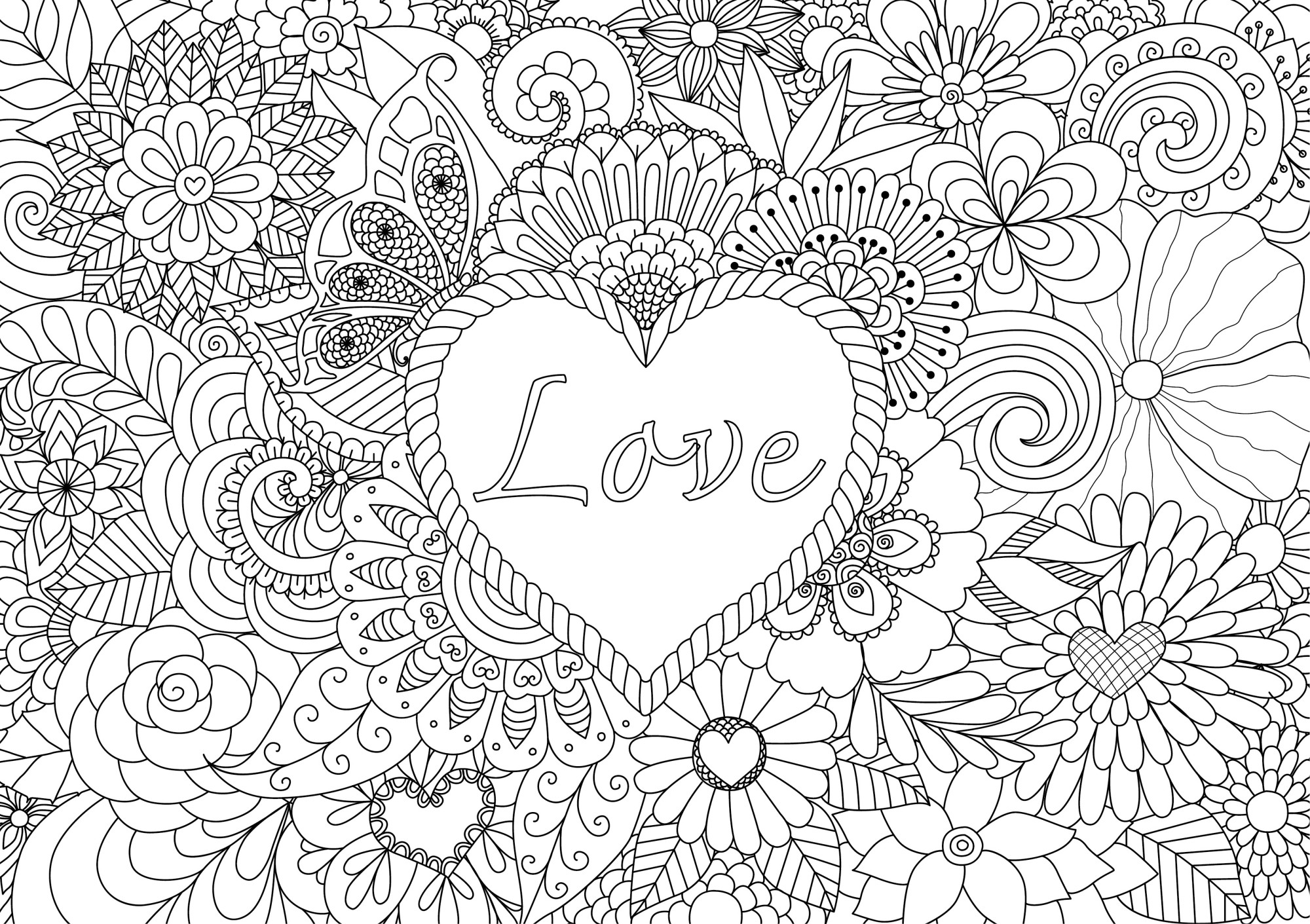
Celebrate love with flowers, hearts, beautiful lettering, and as much color as you can imagine. This “Love” Heart & Flowers Coloring Page combines romantic floral details with decorative heart imagery and the word LOVE, creating an intricate printable that works beautifully for adults, teens, older kids, or anyone who enjoys taking a little more time with a detailed coloring project.
Traditional Valentine colors such as red, pink, burgundy, and purple are natural choices, but this design can take on an entirely different personality depending on your palette. Try dusty rose and sage for a botanical look, jewel tones for something dramatic, soft pastels for a romantic spring feeling, or deep navy and gold for a more elegant interpretation.
Once finished, the page can become Valentine wall art, a handmade card, a journal page, a thoughtful gift, or simply a creative project you enjoyed making.
Choose a few favorite colors, settle in with your pencils or markers, and make the word LOVE completely your own.
❤️ Make the Word “LOVE” the Centerpiece
Before coloring the flowers and hearts, decide how much you want the word LOVE to stand out.
One approach is to use a bold color for the lettering while keeping the surrounding flowers softer. Deep burgundy letters surrounded by blush pink and cream flowers can create strong contrast without overwhelming the botanical design.
You could also reverse the idea. Keep the letters cream, white, pale gray, or another quiet shade and fill the surrounding flowers with rich reds, purples, greens, and gold.
Another option is to give every letter its own color.
Try:
- L — Red
- O — Pink
- V — Purple
- E — Burgundy
Or move through an entire rainbow.
The lettering can be subtle or dramatic—it simply depends on which part of the design you want people to notice first.
🌸 Bring the Flowers to Life
The intricate floral details surrounding the heart and lettering give you lots of room to experiment.
You can recreate flowers using colors found in nature or invent an imaginary bouquet.
Try:
- Rose pink
- Crimson
- Lavender
- Violet
- Peach
- Coral
- Pale yellow
- Cream
- Blue
- Burgundy
Instead of coloring every flower alike, vary the palette throughout the page.
One blossom might have pale pink petals with a deeper raspberry center. Another could be lavender fading into dark violet. A cream flower can provide a quiet break between brighter colors.
Using several flower colors helps the details remain easy to distinguish within a busy design.
For even more floral inspiration, explore our Coloring Pages of Flowers.
🌹 Try a Classic Red-Rose Palette
If you want the page to feel unmistakably Valentine-inspired, red flowers are a beautiful place to begin.
Use several reds rather than just one.
Start with scarlet or cherry red, then add crimson, burgundy, or wine-colored shading toward petal folds and flower centers.
Pair the flowers with dark green leaves and cream or white lettering.
Small gold-colored accents can make the finished page feel especially rich.
You can also explore our Rose Coloring Pages if you enjoy working with romantic floral palettes.
🌷 Create a Dusty Botanical Valentine
Not every Valentine coloring page needs bright red and hot pink.
A muted botanical palette can make the design feel calm and sophisticated.
Try:
- Dusty rose
- Sage
- Mauve
- Cream
- Muted peach
- Olive
- Soft burgundy
Use sage and olive for leaves, dusty pink and mauve for blossoms, and cream for some of the smaller background areas.
Make the word LOVE burgundy or deep forest green.
This combination works especially well if you plan to frame the finished picture or turn it into a handmade card.
💕 Try a Pink-and-Purple Valentine
Pink and purple create an easy Valentine palette that still offers plenty of variety.
Use blush pink, rose, raspberry, lavender, violet, plum, and magenta.
Some flowers can gradually change from pale pink at the edges to deep raspberry near the center.
Others can blend lavender into dark purple.
Keep the leaves green for contrast or create a completely imaginative version with teal and blue-green foliage.
The word LOVE can be filled with one of the darkest shades so it anchors the entire design.
🌈 Create a Rainbow LOVE Design
For something completely different, use a rainbow.
Color the lettering in a gradual sequence:
Red → Orange → Yellow → Green → Blue → Purple.
Repeat those colors throughout the flowers and hearts.
You could make one flower completely red, another orange, another yellow, and continue across the page until the whole design feels like an elaborate rainbow garden.
Or give individual petals different rainbow colors.
The result may be far removed from a traditional Valentine palette, but that is exactly what makes coloring pages so flexible.
🖤 Try Black, White, Red & Gold
A limited dramatic palette can work beautifully with an intricate design.
Use black or charcoal for some of the lettering and decorative outlines.
Add rich red flowers and gold-colored hearts.
Leave selected areas white or cream.
Dark green can be introduced sparingly for leaves if you want a more botanical appearance.
The contrast between dark areas and bright red or gold details can make the finished picture feel more like decorative artwork than a conventional coloring page.
💎 Use a Jewel-Tone Palette
Deep jewel colors are another wonderful option for adult coloring.
Try:
- Ruby
- Emerald
- Sapphire
- Amethyst
- Garnet
- Deep turquoise
- Gold
Use the darkest shades around overlapping petals and leaves.
Keep a few areas lighter to prevent the design from becoming too heavy.
Jewel tones can transform the floral Valentine into something almost tapestry-like, especially when repeated across small decorative details.
🌸 Create a Soft Pastel Version
For a gentler interpretation, choose:
- Blush pink
- Lavender
- Mint
- Peach
- Pale yellow
- Baby blue
- Cream
Keep the colors light and leave plenty of white space.
The word LOVE could be pale pink with lavender shading or soft gray surrounded by pastel flowers.
Pastels work especially well if you plan to turn the finished design into a Valentine card.
💚 Use Several Greens in the Foliage
The leaves and botanical details deserve just as much attention as the flowers.
Instead of one green, experiment with:
- Sage
- Olive
- Mint
- Emerald
- Forest green
- Blue-green
- Yellow-green
Use lighter greens on smaller or imaginary new leaves and deeper greens around overlapping foliage.
You can also add fine pencil lines to suggest leaf veins.
The variety of greens helps separate the leaves from one another and makes the floral portions look much more layered.
For more botanical coloring, explore our Coloring Pages of Plants.
✏️ Add Shading to the Flower Petals
Detailed floral pages are ideal for experimenting with simple shading.
Begin with your lightest color across the petal.
Then gradually add a darker version near the base, around folds, or where petals overlap one another.
For a pink flower, you might begin with blush and deepen it with raspberry.
For purple petals, move from lavender into plum.
You do not need advanced art techniques. Even a slight difference between the lightest and darkest sections can create more dimension.
Colored pencils are especially useful because you can build the color gradually.
🌺 Blend Two Colors in One Flower
Try giving some blossoms two colors instead of one.
Possible combinations include:
- Pink + Purple
- Yellow + Orange
- Blue + Violet
- Peach + Pink
- Red + Burgundy
- Turquoise + Blue
Start with one color at the flower center and gradually blend into another toward the petal tips.
Or reverse the transition.
If blending feels difficult, simply overlap the two colors lightly where they meet.
Each flower can become its own miniature color experiment.
✨ Make the Hearts Sparkle
The heart details provide opportunities for a completely different texture from the flowers.
Color some solid red or pink.
Give others stripes, dots, stars, or tiny floral patterns.
Metallic-looking gold or silver hearts can add contrast.
If you have gel pens or metallic pencils, use them sparingly on tiny highlights.
Regular yellow and ochre can also imitate gold, while pale gray and charcoal can suggest silver.
For more heart-filled designs, visit our Coloring Pages of Hearts.
💗 Fill Every Heart Differently
Challenge yourself to avoid repeating the same design.
One heart might contain:
- Polka dots
Another:
- Diagonal stripes
Another:
- Tiny flowers
Another:
- Checkerboards
Others could have:
- Stars
- Spirals
- Leaves
- Rainbow bands
- Smaller hearts
This works particularly well on detailed coloring pages because the small repeated motifs gradually become part of the overall pattern.
🖋️ Experiment With Lettering Effects
The word LOVE gives you an opportunity to treat lettering like artwork.
Try an ombre effect by gradually moving from light to dark across each letter.
Add tiny dots around the inside edges.
Fill one letter with stripes and another with flowers.
Create a faux metallic look using yellow, ochre, brown, and white highlights.
Or make the letters look like they are covered in vines.
You could even leave the letters mostly white and outline them with a narrow band of color so the surrounding floral details remain the focus.
🌿 Turn the Letters Into a Garden
Imagine that the word itself is growing.
Add tiny vines curling around the letters.
Draw leaves emerging from the edges.
Add small flowers, buds, or berries.
Perhaps the O becomes a floral wreath.
The L might support a climbing vine.
The V could have flowers spilling from the top.
The original coloring page then becomes the starting point for your own botanical lettering design.
🌼 Add More Flowers to the Border
If you enjoy detailed coloring, extend the floral artwork into any open areas.
Add roses, daisies, tulips, anemones, or imaginary blossoms around the border.
Repeat some of the colors already used in the main design.
For a more intricate flower project, pair this page with our Anemone Flowers Coloring Page.
You can color the two pages using matching palettes and display them together as a botanical pair.
🎨 Try the Five-Color Challenge
Choose only five colors for the entire design.
For example:
Dusty Rose + Burgundy + Sage + Cream + Gold
or:
Lavender + Plum + Mint + Pink + Navy
or:
Red + Black + White + Green + Gold
Now find ways to repeat those colors across every heart, flower, leaf, and letter.
The challenge forces you to think about light and dark shades, repetition, and contrast.
A limited palette often makes a complicated design look surprisingly cohesive.
🖍️ Mix Colored Pencils, Markers & Gel Pens
You do not have to use only one coloring tool.
Colored pencils work particularly well for petals, leaves, and detailed shading.
Markers can create bold lettering or solid heart colors.
Gel pens can add tiny dots, highlights, or metallic-looking accents.
Crayons can still work beautifully, especially if you prefer a softer texture.
Try mixing materials intentionally.
For example, color the flowers with pencils, the word LOVE with markers, and tiny gold details with a gel pen.
If using markers, place an extra sheet underneath the printable in case the ink bleeds through.
🌙 Create a Midnight Valentine
Turn the page into a dramatic nighttime design.
Use navy, indigo, charcoal, or dark purple in background areas.
Keep the flowers pale pink, lavender, cream, and white so they stand out.
Add gold or silver-colored hearts.
Make LOVE deep burgundy or metallic-looking gold.
Tiny white dots can suggest stars.
A moonlit palette can make the same Valentine artwork feel entirely different from a traditional daytime floral design.
🌱 Turn LOVE Into a Botanical Theme
This page does not have to be used only for Valentine’s Day.
The combination of flowers and the word LOVE also works beautifully as year-round botanical artwork.
Use sage, olive, terracotta, cream, dusty pink, and muted gold.
Skip the traditional Valentine reds entirely.
The finished piece could become:
- Journal art
- Bedroom décor
- A friendship card
- A Mother’s Day gift
- A thank-you note
- A framed botanical print
- A scrapbook page
A message about love can fit many occasions beyond February 14.
💌 Make a Handmade Valentine Card
The original design is already especially well suited to becoming a Valentine card.
Color the page carefully, then add the recipient’s name.
You might write:
Happy Valentine’s Day
With Love
Thinking of You
For Someone Special
or simply leave LOVE as the entire message.
A smaller printed copy can be mounted onto folded cardstock, while the full-size page can become a poster-style Valentine.
Hand-colored cards have the advantage of being completely unique.
✉️ Add a Personal Message
The detailed artwork may be the main feature, but a few handwritten words can make the finished piece more meaningful.
Write a message on the back or in an open area.
It does not need to be elaborate.
A simple:
I’m glad you’re in my life.
Thinking of you.
Happy Valentine’s Day.
or:
Made with love for you.
can be enough.
Use the recipient’s favorite colors rather than automatically choosing red and pink if you want the page to feel especially personal.
❤️ Continue a Handmade Valentine Tradition
Valentine messages have been exchanged for centuries.
Handmade valentines appeared long before the modern greeting-card aisle, and elaborate historical cards often incorporated flowers, hearts, ribbons, decorative papers, and other ornamentation.
That makes a hand-colored floral Valentine an especially fitting project.
Instead of simply purchasing a finished card, you become part of the design process by choosing every color and adding your own message.
The result does not have to be perfect.
The handmade quality is part of what makes it personal.
🌸 Hearts and Flowers Have a Long Valentine Connection
Hearts and flowers may feel like obvious Valentine imagery today, but they also appear frequently in historical Valentine cards.
Surviving examples held by museums include elaborate floral decoration, hearts, lace-like motifs, ribbons, and other romantic imagery.
That makes the combination on this coloring page especially appropriate.
You can follow the traditional visual language with red flowers and hearts or reinterpret it completely with modern colors.
A turquoise-and-lavender Valentine is still yours.
🧘 Enjoy a Slower Coloring Session
Because this design contains more detail than a simple children’s coloring page, there is no reason to rush.
Choose one flower or heart and finish it.
Then move to another.
You could work on the page for twenty minutes, put it away, and return later.
Some people find detailed coloring enjoyable because it gives their attention somewhere simple and visual to go for a while. Research on adult coloring has also explored its potential as a relaxing activity, although individual experiences vary and coloring does not need to be treated as therapy to be worthwhile.
It can simply be something creative you enjoy doing.
☕ Create a Cozy Coloring Break
Turn coloring into a small personal ritual.
Find a comfortable place, choose a few favorite pencils, put on music or an audiobook, and work through the flowers slowly.
You could color one flower during a coffee break or spend an entire evening building a detailed palette.
There is no deadline.
The page does not even have to be finished.
Sometimes experimenting with color for a while is enough.
📓 Add It to a Journal
A finished LOVE page can make a beautiful journal insert or divider.
Trim the edges if needed and attach it to a larger page.
Add the date and a few notes about the colors you used.
You could also write about something you appreciated that day, someone you care about, or simply why you chose that particular palette.
The coloring page does not need to become a deeply meaningful exercise, but the combination of artwork and words can make an attractive journal spread.
🖼️ Frame Your Finished Coloring Page
Intricate floral designs can look surprisingly polished when framed.
Choose a palette that works with the room where you plan to display it.
For a botanical space, try sage, dusty rose, cream, and terracotta.
For dramatic décor, use burgundy, navy, black, and gold.
For a bright craft room, try rainbow colors.
A simple white, black, or natural wood frame can turn the completed coloring sheet into personal wall art.
🎁 Give It as a Handmade Gift
The finished design can also become a small handmade gift.
Color it with someone specific in mind.
Use their favorite flower colors or decorating palette.
Add their initials subtly among the leaves or hearts.
Frame the page or attach it to sturdy cardstock.
It could work for:
- Valentine’s Day
- An anniversary
- A birthday
- Mother’s Day
- Friendship
- A thank-you
- Just because
The word LOVE is broad enough to fit many different relationships.
🌹 Create Matching Floral Artwork
Use the same palette on several flower coloring pages.
Start with this LOVE design, then color our Anemone Flowers Coloring Page and pages from our Coloring Pages of Flowers.
For example, use dusty pink, lavender, sage, cream, and burgundy across all three.
Display them side by side.
Even though the drawings are different, the repeated palette can make them look like a coordinated collection.
💕 Pair It With Other Valentine Pages
This detailed design works especially well alongside the lighter, cuter pages in the Valentine collection.
Color the Happy Valentine’s Day Coloring Page with the same floral palette.
Then add the Cute Owls Valentine’s Day Coloring Page and Valentine’s Day Coloring Page for Kids.
Using the same colors across all of them can create a complete February display that mixes detailed artwork with adorable characters.
📚 Make an Adult Valentine Coloring Collection
If you enjoy more intricate coloring, combine several detailed pages into your own collection.
Include this LOVE design, floral pages, mandalas, inspirational quotes, plants, and other patterns.
Browse our Coloring Pages for Adults for more detailed printables.
Add a homemade cover and keep the pages together in a folder or binder.
You can work through the collection whenever you feel like coloring something with a little more detail.
🌿 Explore More Botanical Coloring
Flower lovers can continue with our Coloring Pages of Plants.
That collection includes botanical artwork, leafy designs, floral lettering, and other plant-inspired pages.
You can also explore our Inspirational Coloring Pages, which combine words with flowers, plants, animals, and decorative lettering.
If the combination of text and botanical details is what you enjoy most about this LOVE page, those designs are a natural next choice.
💖 Color LOVE Your Way
The “Love” Heart & Flowers Coloring Page gives you an intricate mixture of lettering, flowers, hearts, and botanical details that can be interpreted in countless ways.
Keep it traditional with red roses and pink hearts, create a dusty botanical palette, experiment with jewel tones, color every detail in rainbow shades, or use only a handful of carefully chosen colors.
Add patterns to the hearts, shade the flower petals, decorate the letters, draw extra vines, or turn the completed artwork into a handmade card or framed gift.
You can finish every tiny section or leave some areas white. You can spend ten minutes on it or return over several evenings.
There is no correct way to color love.
Choose the colors that appeal to you and let the design grow from there.
Happy coloring! ❤️🌸
🔗 Related Articles
- Coloring Pages of Hearts
- Happy Valentine’s Day Coloring Page
- Valentine’s Day Coloring Page for Kids
- Cute Owls Valentine’s Day Coloring Page
- Valentine’s Day Coloring Pages
- Coloring Pages of Flowers
- Coloring Pages of Plants
- Anemone Flowers Coloring Page
- Inspirational Coloring Pages
- Coloring Pages for Adults
- Holiday Coloring Pages
📚 Sources
- Library of Congress — Today in History: February 14, Valentine’s Day
- Library of Congress — Crafting from the Collections: Sweet Ideas for Valentine’s Day
- Smithsonian Institution — Sending the Very Best for Valentine’s Day
- National Postal Museum — Coal and Valentines: An Unlikely Pair With a Rich Philatelic History
- Cleveland Clinic — 3 Reasons Adult Coloring Can Actually Relax Your Brain
- PubMed — Randomized Controlled Trial of Adult Therapeutic Coloring for the Management of Significant Anxiety in the Emergency Department
🖍️Shop Valentine’s Day Coloring Books –>