Spring is bursting into color, and our collection of spring coloring pages is ready to celebrate every flower, butterfly, mushroom, rainy-day adventure, and whimsical creature that comes with the season.
This collection offers much more than a few simple flowers. You can color a butterfly made entirely from blossoms, cheerful smiling flowers growing beside mushrooms, delicate butterflies fluttering among blooms, rain boots overflowing with spring flowers, a detailed woodland mushroom scene, a capybara relaxing in a flower-filled clearing with watermelon, wild plants and grasses, and even a magical cat created from flowers, leaves, and tiny ladybugs.
Whether you love soft spring pastels, realistic nature colors, bright rainbows, or completely imaginative palettes, there is plenty here to explore.
Grab your crayons, colored pencils, or markers and let your creativity bloom!
🌷 Explore Our Spring Coloring Pages
Spring is one of the most colorful seasons of the year, and the designs in this collection capture that variety beautifully.
You will find pages inspired by:
- Flowers and gardens
- Butterflies
- Mushrooms
- Wild plants and grasses
- Rain boots and watering cans
- Birds
- Ladybugs
- Woodland nature
- Cute animals
- Fantasy creatures
Some designs are playful and simple, while others contain enough botanical detail to keep older kids and adults busy for much longer.
That makes this collection useful for a rainy spring afternoon, classroom activity, homeschool nature lesson, seasonal art center, or simply a relaxing coloring session at home.
For an even wider tour through the natural world, explore our Nature Coloring Pages.
🦋 Color the Butterfly Made of Flowers
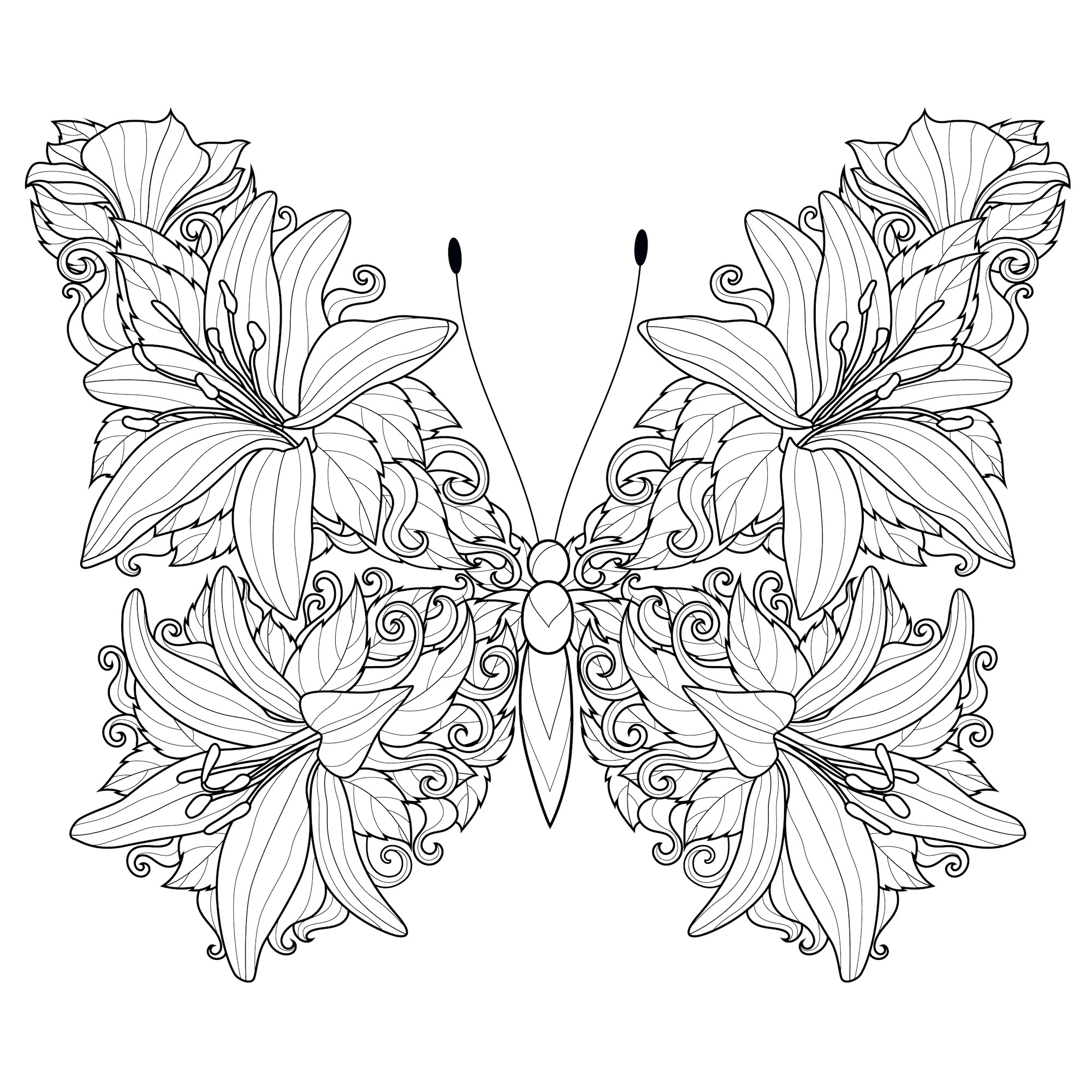
One of the most imaginative designs in the collection transforms a butterfly into a piece of living floral art.
Instead of ordinary patterned wings, flowers become part of the butterfly itself.
This page is perfect for experimenting with several colors at once.
Try a classic spring palette using:
- Pink
- Lavender
- Yellow
- Pale blue
- Fresh green
- Peach
Or make every flower on the wings different.
One blossom could be orange and red, another blue and purple, and another completely rainbow-colored.
Keep the butterfly’s body darker so the floral wings become the focus of the picture.
🌈 Create a Rainbow Flower Butterfly
For a bolder version, turn the floral butterfly into a rainbow.
Begin with red and orange flowers near the upper wings.
Move through yellow and green toward the center.
Finish with blue and purple along the lower wings.
Add green leaves between the blossoms and use dark outlines where you want the shapes to stand out.
You can also create a symmetrical design by repeating the same colors on both sides.
Or deliberately make each wing completely different.
One butterfly can become two different spring gardens joined together.
🪞 Experiment With Butterfly Symmetry
Butterflies are naturally well suited to symmetry activities because their wings extend from opposite sides of the body.
Choose one butterfly page and color only the left wing first.
Then try to reproduce the same colors and patterns on the right.
Match:
- Flowers
- Dots
- Stripes
- Shapes
- Color sequences
Younger children can simply match the major colors, while older kids can try to copy much smaller details.
Then print another butterfly and do the opposite—make the wings completely different.
For a full butterfly-focused activity, visit our Butterfly Coloring Page.
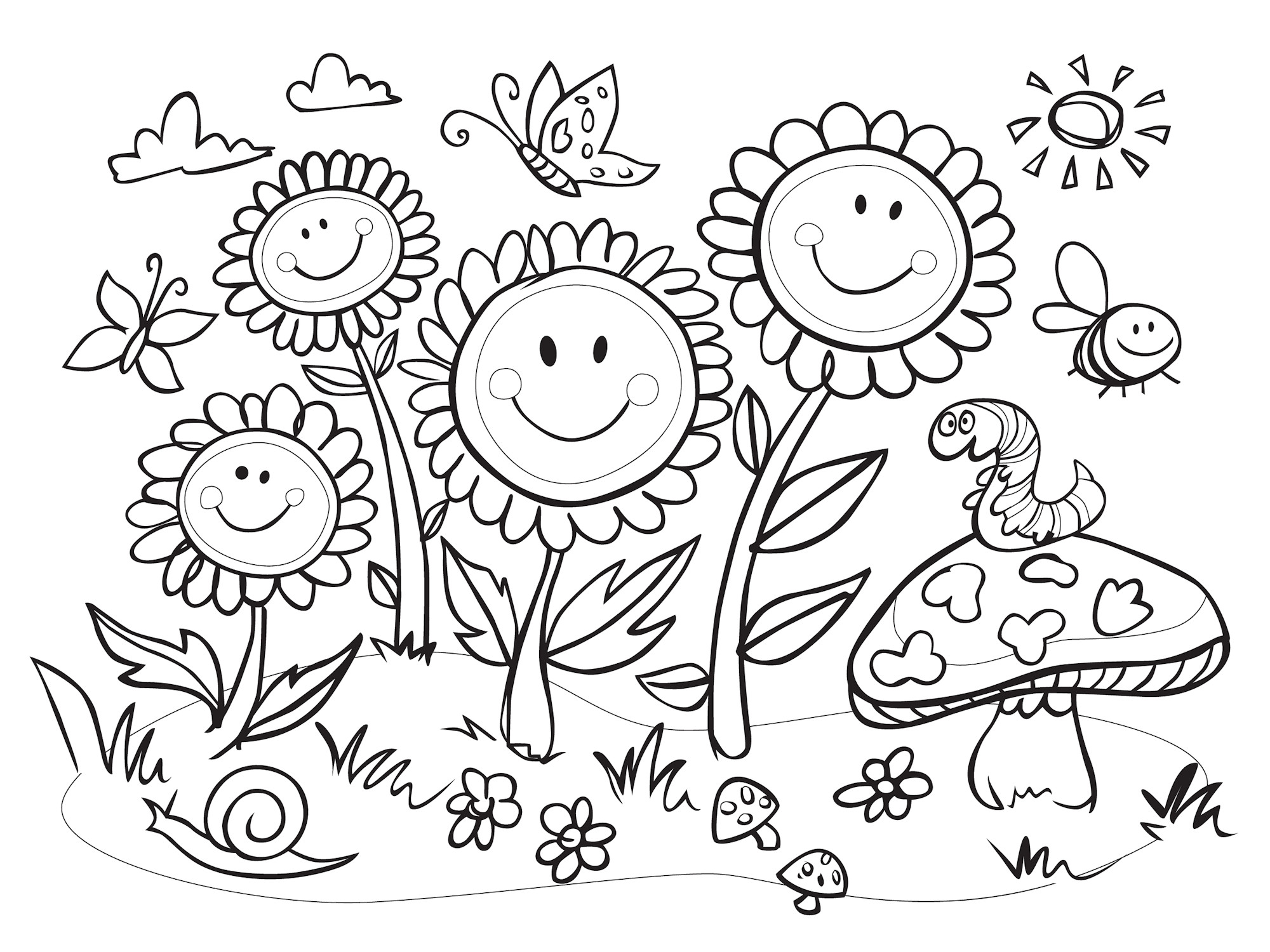
😊 Meet the Smiling Spring Flowers
Another page takes flowers in a much sillier direction.
These aren’t ordinary garden plants—they have cheerful faces and plenty of personality.
That makes them perfect for bright colors.
Give each flower its own combination.
One might have pink petals and a yellow center.
Another could be turquoise and purple.
A third might have every color of the rainbow.
Then decide what kind of personality belongs to each face.
Maybe one flower is always laughing.
Another is shy.
One is very sleepy.
Another thinks it is the funniest flower in the garden.
🍄 Color the Mushrooms Beside the Flowers
The smiling flower scene also includes mushrooms, giving you another set of shapes and textures to explore.
Traditional mushroom colors might include:
- Brown
- Tan
- Cream
- Rust
- Red
- Gray
But whimsical mushrooms are perfect for imaginative coloring.
Try caps covered with:
- Rainbow spots
- Pink hearts
- Purple stars
- Blue stripes
- Yellow swirls
The mushrooms can become tiny houses, hiding places, or characters of their own.
Perhaps a whole little spring village exists beneath the smiling flowers.
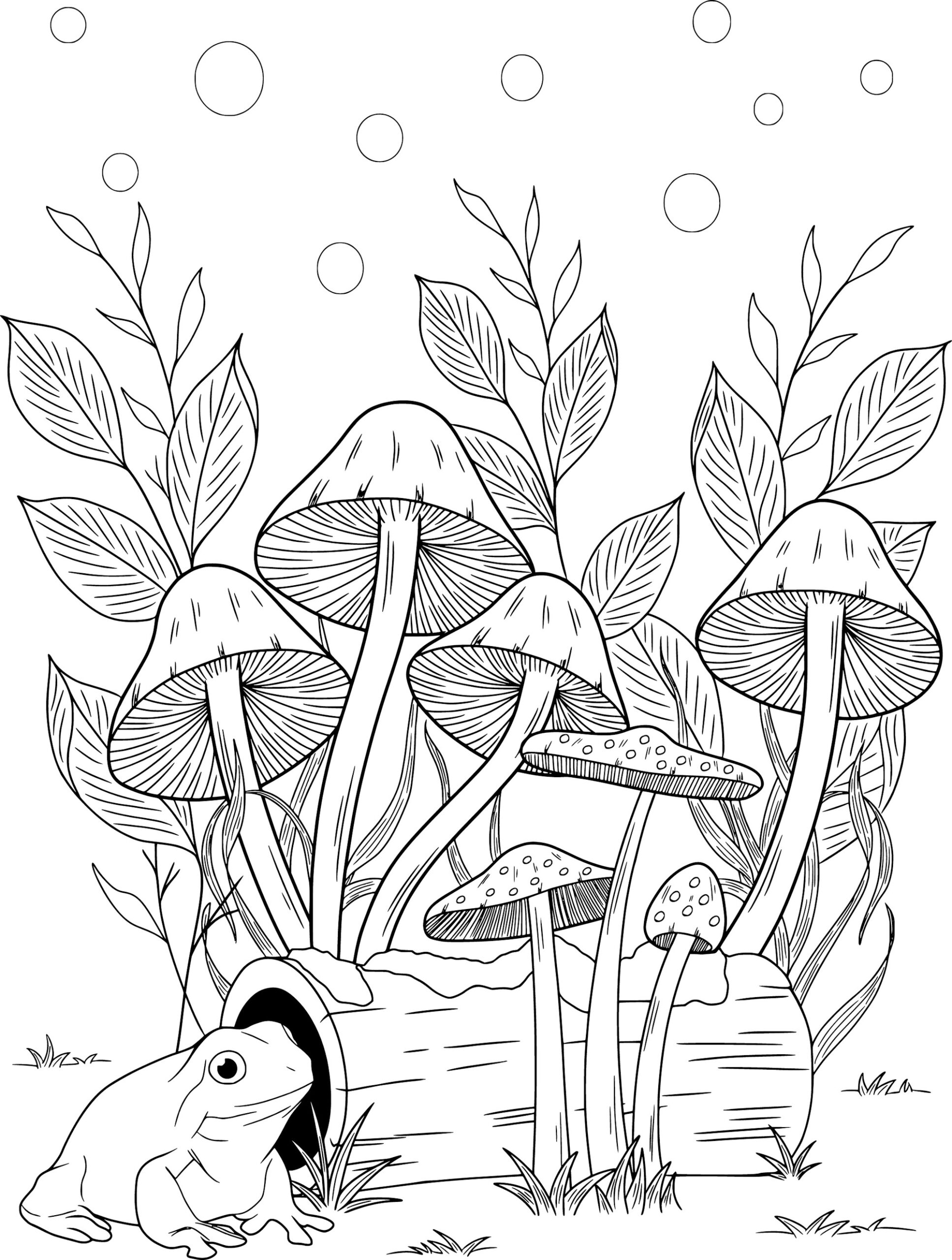
🍄 Explore the Detailed Wild Mushroom Scene
The collection also contains a much more intricate mushroom design set in nature.
This one is especially well suited to colored pencils because the smaller details make it possible to layer several shades.
Try earthy forest colors such as:
- Moss green
- Olive
- Chestnut
- Rust
- Cream
- Bark brown
- Golden yellow
Use several greens throughout the surrounding plants.
Then make the mushrooms stand out with warmer colors.
Or turn the entire woodland into fantasy.
Purple mushrooms, blue leaves, glowing flowers, and golden grass can transform an ordinary forest floor into an enchanted one.
🌧️ Mushrooms and Spring Rain
Mushrooms can sometimes appear after periods of rain when temperature and moisture conditions are suitable.
Different fungi produce many different kinds of fruiting bodies, from familiar cap-and-stem mushrooms to shelves, cups, balls, and other surprising shapes.
That makes mushrooms a fun nature-observation subject.
After a rainy spring day, take a walk with an adult and see whether you notice any mushrooms growing in a yard, park, or woodland.
Observe them without eating them. Wild mushroom identification can be difficult even for experienced people, and some species are poisonous.
Use the colors and shapes you noticed as inspiration when you return to the coloring page.
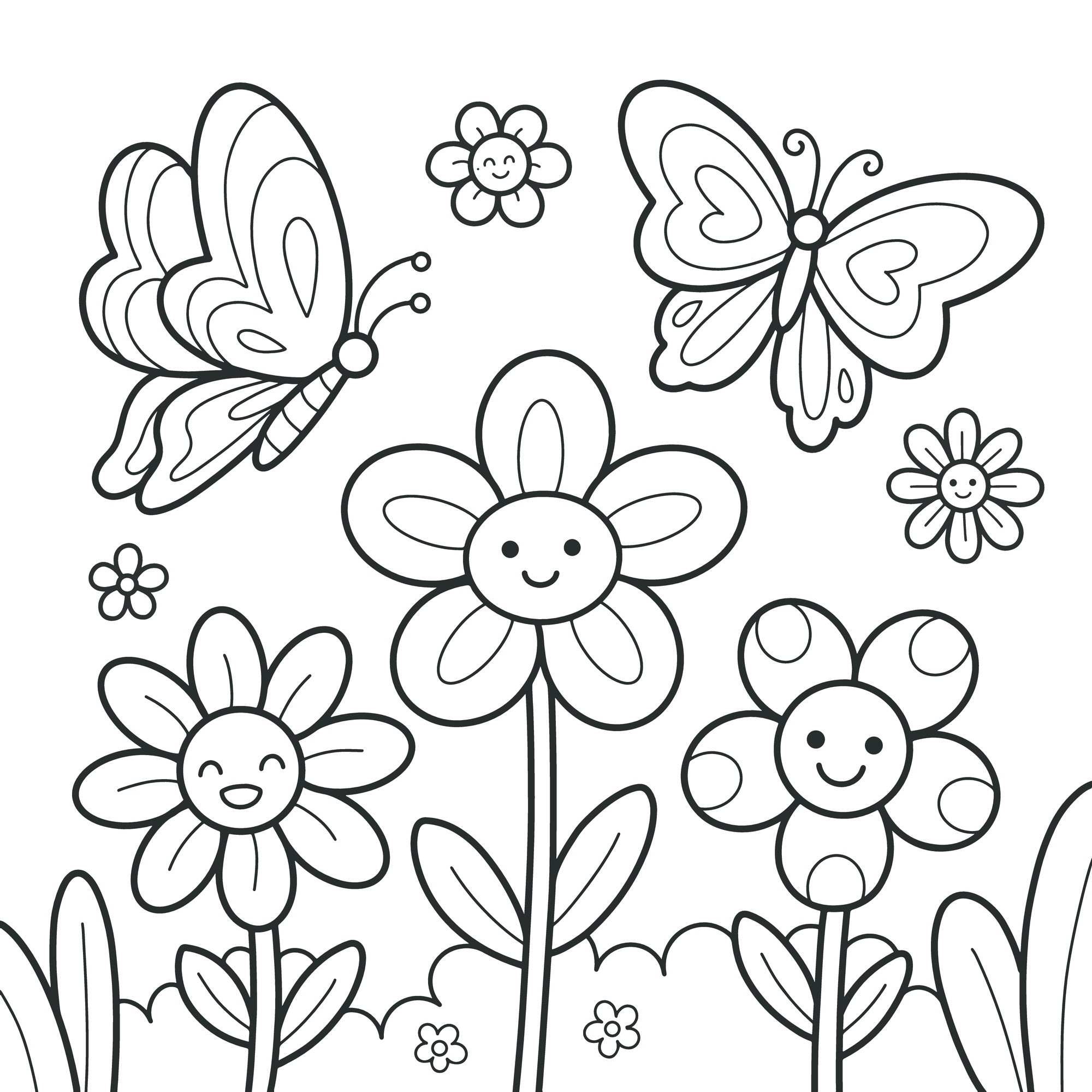
🌸 Color the Flowers and Butterflies Together
Several designs pair flowers with butterflies, creating some of the most classic spring scenes in the collection.
Try coordinating the colors.
If your flowers are pink and yellow, give the butterfly blue and purple wings so it stands out.
Or repeat the same shades across both.
For example:
Flowers: Pink, lavender, yellow
Butterfly: Lavender, yellow, turquoise
Leaves: Several greens
Sky: Pale blue
Repeating a few colors throughout the whole picture can make a detailed page feel connected rather than chaotic.
🌺 Why Do Butterflies Visit Flowers?
Many adult butterflies visit flowers to drink nectar.
As butterflies move among blossoms, pollen can sometimes travel with them, making butterflies part of the diverse community of animals that pollinate flowering plants.
That connection makes the butterfly-and-flower designs useful for a simple spring nature lesson.
Ask children:
Why might a butterfly land on a flower?
What other animals visit flowers?
What colors do you see in a real garden?
Then use those observations in the picture.
For even more floral designs, explore our Coloring Pages of Flowers.
🌻 Build a Butterfly Garden
Extend one of the flower-and-butterfly pages into a whole garden.
Draw additional:
- Flowers
- Shrubs
- Grasses
- Trees
- Stones
- Paths
- Butterflies
- Bees
Perhaps the garden has a bench or little fountain.
Maybe a birdbath stands between the flowers.
Children can also research plants that are native to their own area and draw a few around the coloring page.
A spring garden does not look exactly the same everywhere, so local nature can provide even more interesting ideas than a generic picture.
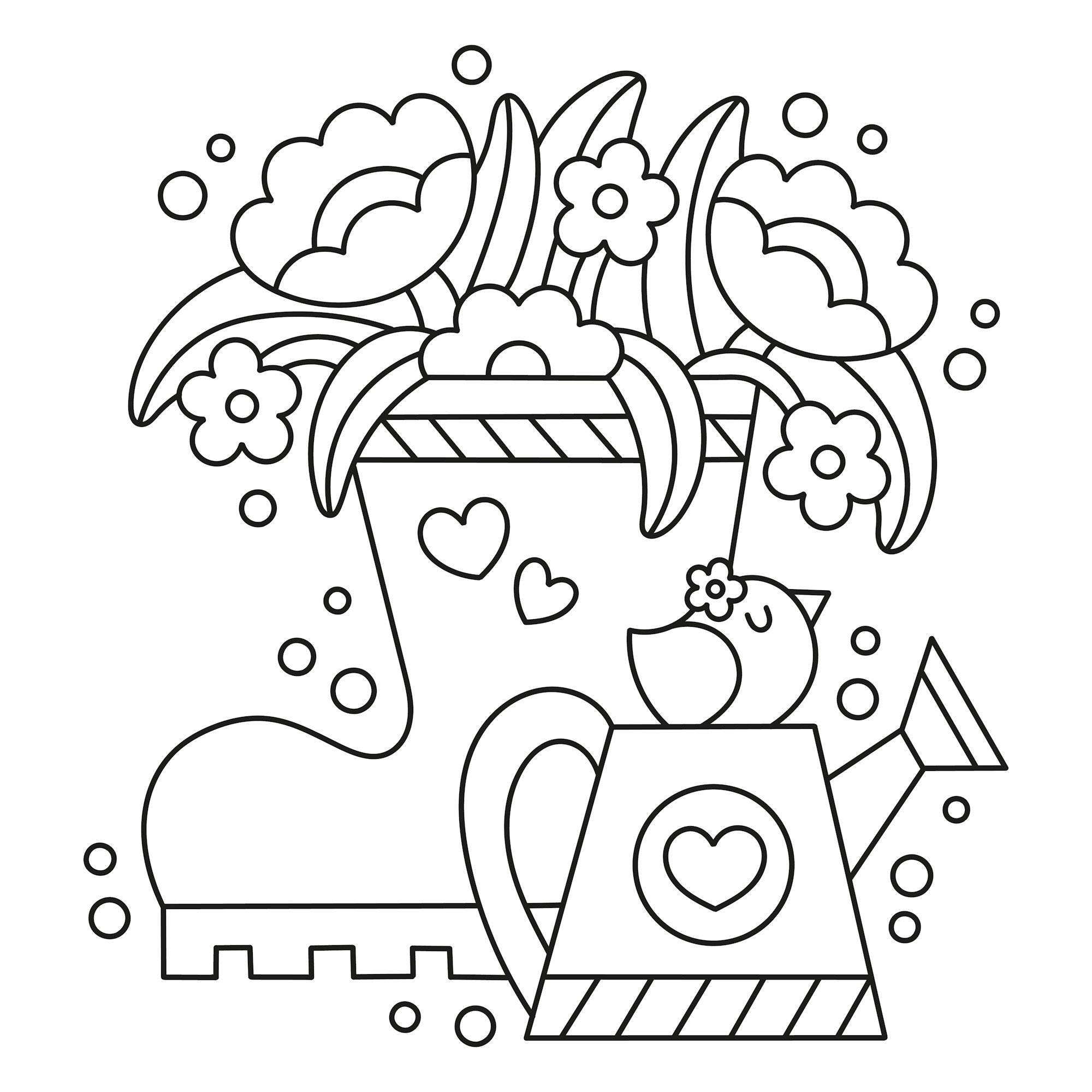
👢 Color the Spring Rain Boots
One of the collection’s most charming pages features rubber boots overflowing with spring flowers, along with a watering can and a cute bird.
This design brings together two familiar sides of spring: flowers and rainy weather.
Start with the boots.
Try:
Classic yellow for a bright rainy-day look.
Red with white polka dots for something playful.
Turquoise with flowers for a garden theme.
Rainbow stripes for maximum color.
You can also make each boot different.
Perhaps they belong to someone who refuses to wear matching shoes.
💧 Decorate the Watering Can
The watering can gives you another large area to customize.
A traditional metal watering can could be gray or silver, but spring coloring calls for a little creativity.
Try:
- Mint green
- Lavender
- Coral
- Sky blue
- Sunny yellow
Add patterns such as flowers, hearts, butterflies, dots, or stripes.
Maybe this watering can has magical powers and whatever it waters grows into rainbow flowers overnight.
🐦 Color the Little Garden Bird
The bird near the spring flowers can become realistic or completely imaginary.
Try natural combinations of:
- Brown
- Gray
- Red
- Blue
- Yellow
- Black
- White
Or make the bird pink with turquoise wings.
Give it a purple tail and golden beak.
Then imagine why it has come to the garden.
Perhaps it is searching for food.
Maybe it is gathering material for a nest.
Or perhaps it simply likes listening to the flowers talk.
For more feathered designs, explore our Coloring Pages of Birds.
🌧️ Create an April Showers Scene
Rain boots and watering cans make this page especially easy to turn into a rainy spring afternoon.
Add:
- Clouds
- Raindrops
- Puddles
- An umbrella
- A rainbow
Color the sky pale gray, blue-gray, or lavender.
Then keep the flowers and boots especially bright.
The contrast between a soft rainy sky and colorful garden details can make the whole page stand out.
Pair it with our April Coloring Page for even more rainy-day spring fun.
🌈 Add a Rainbow After the Rain
Once the shower ends, draw a rainbow.
Use the familiar sequence:
Red
Orange
Yellow
Green
Blue
Purple
Or create a soft pastel rainbow with peach, yellow, mint, baby blue, lavender, and pink.
Add fluffy clouds at each end.
Perhaps the little garden bird is watching the rainbow appear.
Continue the colorful sky theme with our Coloring Pages of Rainbows.
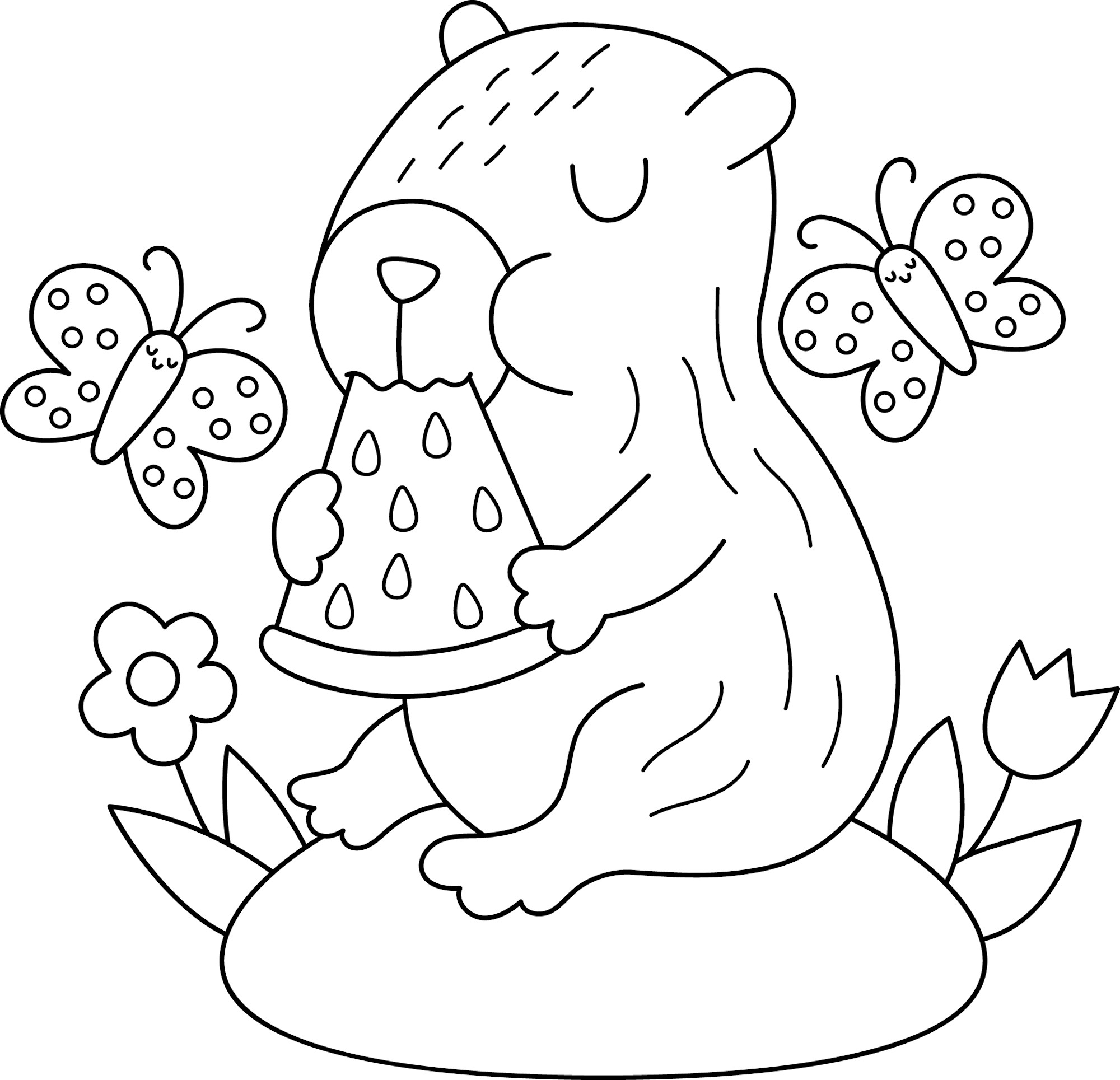
🐹 Color the Capybara in the Flower Clearing
One of the most wonderfully unexpected designs in this spring collection features a capybara sitting among flowers with a butterfly while eating watermelon.
It combines animals, spring nature, and summer fruit in one very cute scene.
For a natural-looking capybara, try:
- Warm brown
- Tawny brown
- Golden brown
- Gray-brown
Use lighter shades around the face and darker strokes along the body if you want to suggest fur.
Then surround the animal with bright flowers and green grass.
Of course, a purple capybara sitting in a rainbow garden is also completely acceptable.
🍉 Color the Watermelon
The watermelon gives this spring page an early taste of summer.
Use bright green for the rind, pale green or white for the inner rind, and red or pink for the fruit.
Add black or dark brown seeds where appropriate.
Or invent a fantasy watermelon.
Maybe the inside is:
- Blue
- Purple
- Rainbow
- Golden yellow
Our Watermelon Coloring Pages offer even more fruity coloring fun as spring begins moving toward summer.
🦋 Give the Capybara a Butterfly Friend
The butterfly beside the capybara can become a tiny but important character.
Maybe the two are friends.
Perhaps the butterfly visits every afternoon while the capybara eats watermelon.
Give the butterfly colors that contrast with the animal’s brown fur.
Bright blue, pink, yellow, or purple will help it stand out.
Then add more butterflies and turn the clearing into a lively spring meadow.
📖 Write a Capybara Spring Story
This unusual design is perfect for creative writing.
Try:
The capybara was eating watermelon when the butterfly whispered…
Hidden beneath the flowers was…
Every spring, the capybara visited one very special meadow because…
The watermelon was no ordinary watermelon…
Younger children can tell the story aloud.
Older children can write several paragraphs and use the completed coloring page as the first illustration.
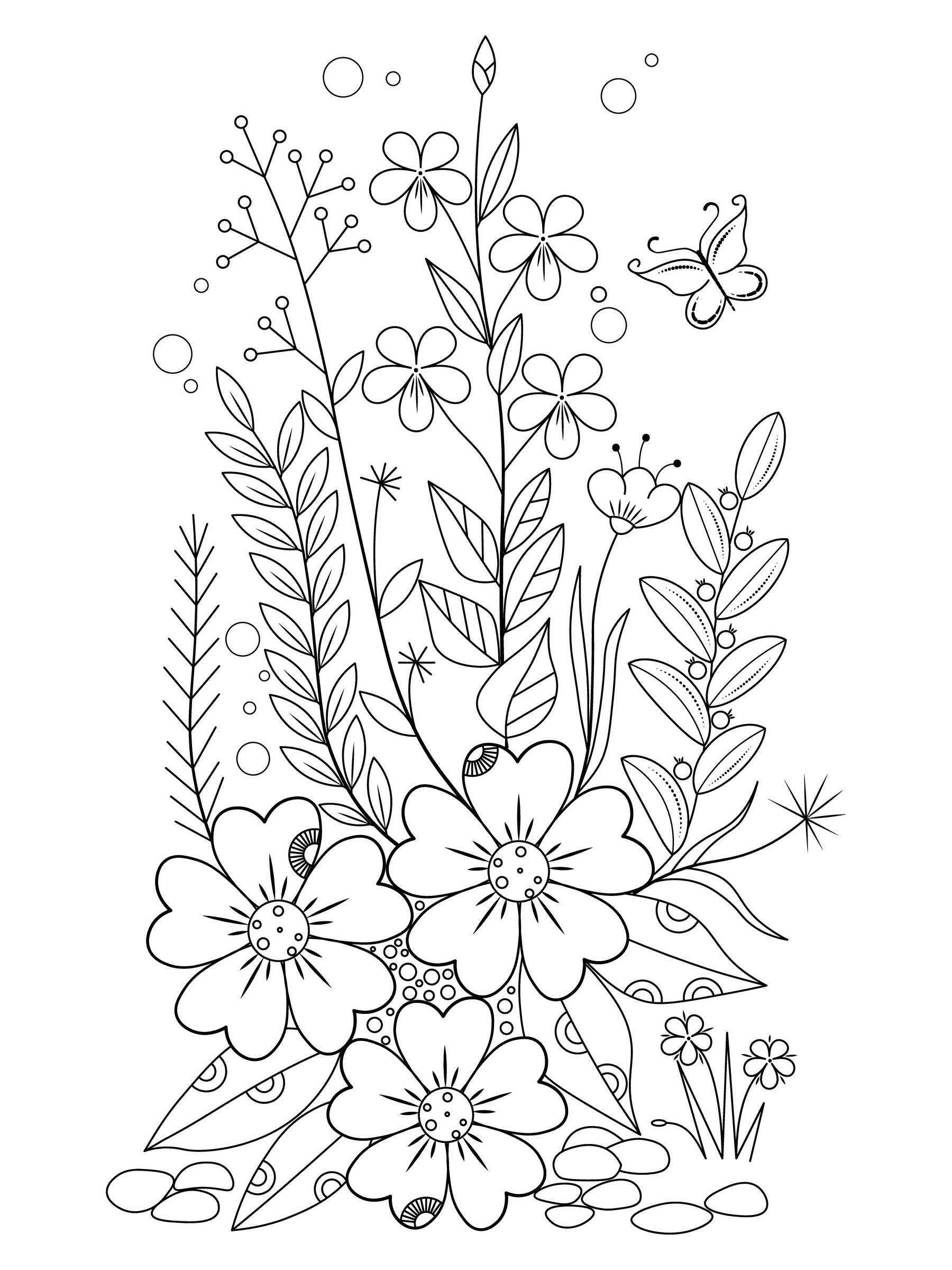
🌿 Color the Wild Plants and Grasses
Another page focuses on wild plants, flowers, grasses, and a butterfly.
This is a lovely opportunity to explore just how many shades of green exist.
Instead of coloring every leaf the same, try:
- Lime
- Yellow-green
- Olive
- Emerald
- Forest green
- Blue-green
- Sage
Make some stems lighter and others darker.
Then add flower colors throughout the picture.
Even a mostly green scene can contain enormous variety.
🌱 Look Closely at Leaves
Plants don’t all have identical leaves.
Some are:
- Round
- Pointed
- Long and narrow
- Heart-shaped
- Smooth-edged
- Jagged-edged
Look at the leaves in the coloring page and compare them with plants outdoors.
How many different shapes can you find?
Then use shading to make each plant slightly different.
Our Coloring Pages of Plants offer even more opportunities to explore leaves, stems, houseplants, flowers, and botanical patterns.
🌾 Create a Wild Spring Meadow
The wild plant page can easily become a larger meadow scene.
Add tall grasses across the background.
Draw several small wildflowers.
Include:
- Bees
- Butterflies
- Ladybugs
- Birds
- Clouds
Perhaps a path winds through the meadow.
Maybe mountains rise in the distance.
Or add a picnic blanket and imagine spending a quiet spring afternoon surrounded by flowers.
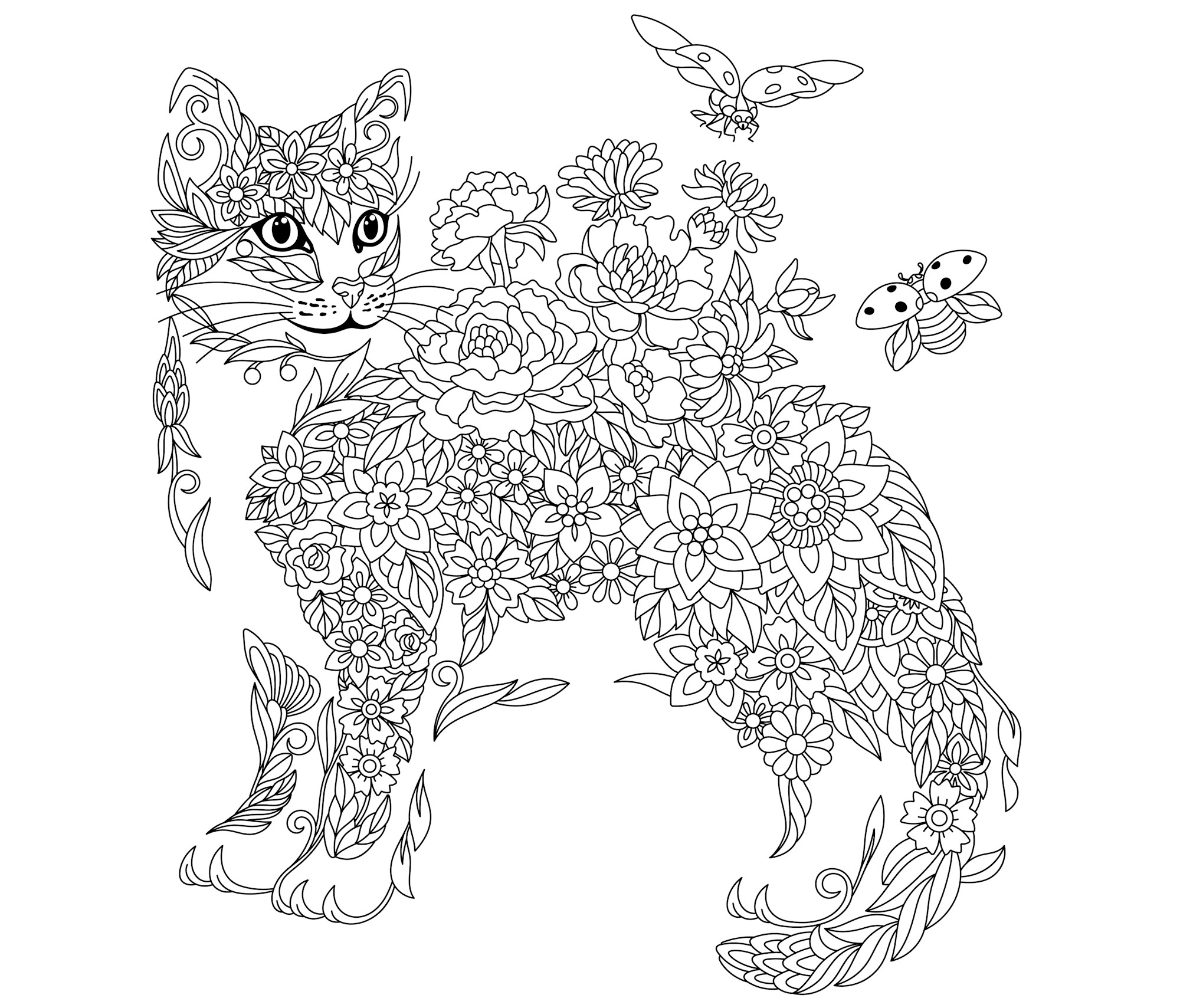
🐞 Color the Ladybugs
Ladybugs appear in the collection’s magical floral cat design, adding tiny spots of color among the leaves and blossoms.
A familiar coloring-book ladybug might have red wing covers with black spots.
But there is no reason every ladybug has to match.
Try:
- Orange
- Yellow
- Pink
- Purple
- Blue
Count the spots as you color.
Then add several more tiny ladybugs around the picture.
🐱 Meet the Fairy-Tale Floral Cat
Perhaps the most imaginative page in the entire collection is the fantasy cat made from flowers, leaves, and ladybugs.
Rather than simply coloring fur, you get to transform an animal into a living garden.
Choose one overall palette or give every floral section different colors.
A soft fairy-tale palette might include:
- Lavender
- Blush pink
- Sage green
- Pale blue
- Cream
- Gold
For something bolder, use jewel tones such as emerald, sapphire, ruby, turquoise, and deep purple.
🌸 Turn the Cat Into a Living Garden
Imagine that the cat is actually made from spring plants.
Perhaps flowers bloom wherever it walks.
Maybe butterflies follow it through the forest.
Draw vines extending from its body or add more blossoms around the paws.
Give the leaves several shades of green and make the flowers especially bright.
You can even change the eyes to emerald, turquoise, violet, or gold.
Then decide what magical power your garden cat has.
✨ Build a Fantasy Spring World
The floral cat can become the beginning of an entire magical landscape.
Add:
- Giant flowers
- Fairy houses
- Mushrooms
- Crystal ponds
- Butterflies
- Rainbows
- Tiny doors in trees
- Sparkling vines
Maybe the smiling flowers from another page live in the same world.
Perhaps the flower butterfly is the cat’s friend.
Connecting different coloring pages through stories is a fun way to turn a collection into something larger.
For more magical designs, explore our Fantasy Coloring Pages.
🍄 Create a Tiny Mushroom Village
The mushroom pages also lend themselves naturally to fantasy.
Draw tiny windows and doors into the mushroom stems.
Add little pathways between them.
Maybe insects live inside the houses.
Perhaps butterflies deliver mail.
A tiny ladybug might run the village store.
Add signs, lanterns, flower gardens, and miniature furniture.
One detailed mushroom coloring page can become the map of an entire imaginary town.
🌸 Why Spring Looks Different Everywhere
Spring does not arrive in exactly the same way everywhere.
Temperature, latitude, elevation, local weather, and climate all influence when plants emerge, flowers bloom, insects become active, and migrating birds appear.
A child in Florida may see very different signs of spring from a child in Minnesota.
Mountain communities may remain snowy while lower valleys are already flowering.
That makes spring coloring even more interesting when you compare the printed designs with the season outside your own window.
Which parts match?
Which don’t?
🌎 Spring in the Northern and Southern Hemispheres
The seasons are also opposite between Earth’s hemispheres.
When the Northern Hemisphere moves into spring around the March equinox, the Southern Hemisphere moves into autumn.
Later in the year, the pattern reverses.
That means a March flower-and-butterfly scene might feel perfectly seasonal in the United States while someone in Australia is moving toward cooler autumn weather.
Older children can draw two small pictures showing what the same time of year might look like in opposite hemispheres.
🌞 What Is the Spring Equinox?
Astronomical spring in the Northern Hemisphere begins around the March equinox, usually on March 19, 20, or 21 depending on the year.
At an equinox, the Sun is positioned over Earth’s equator, and day and night are relatively close to equal in length around the world.
The term “equinox” is often described as meaning equal night, although actual daylight and darkness are not perfectly equal everywhere because of factors including how sunrise and sunset are measured and the way Earth’s atmosphere bends sunlight.
For kids, the simpler idea is enough: the March equinox marks an important seasonal turning point as the Northern Hemisphere moves into spring.
📅 Follow Spring From March Through May
Spring coloring can become a month-by-month project.
Begin with our March Coloring Page as winter begins giving way to the new season.
Continue with the April Coloring Page for flowers, spring weather, and Easter-season possibilities.
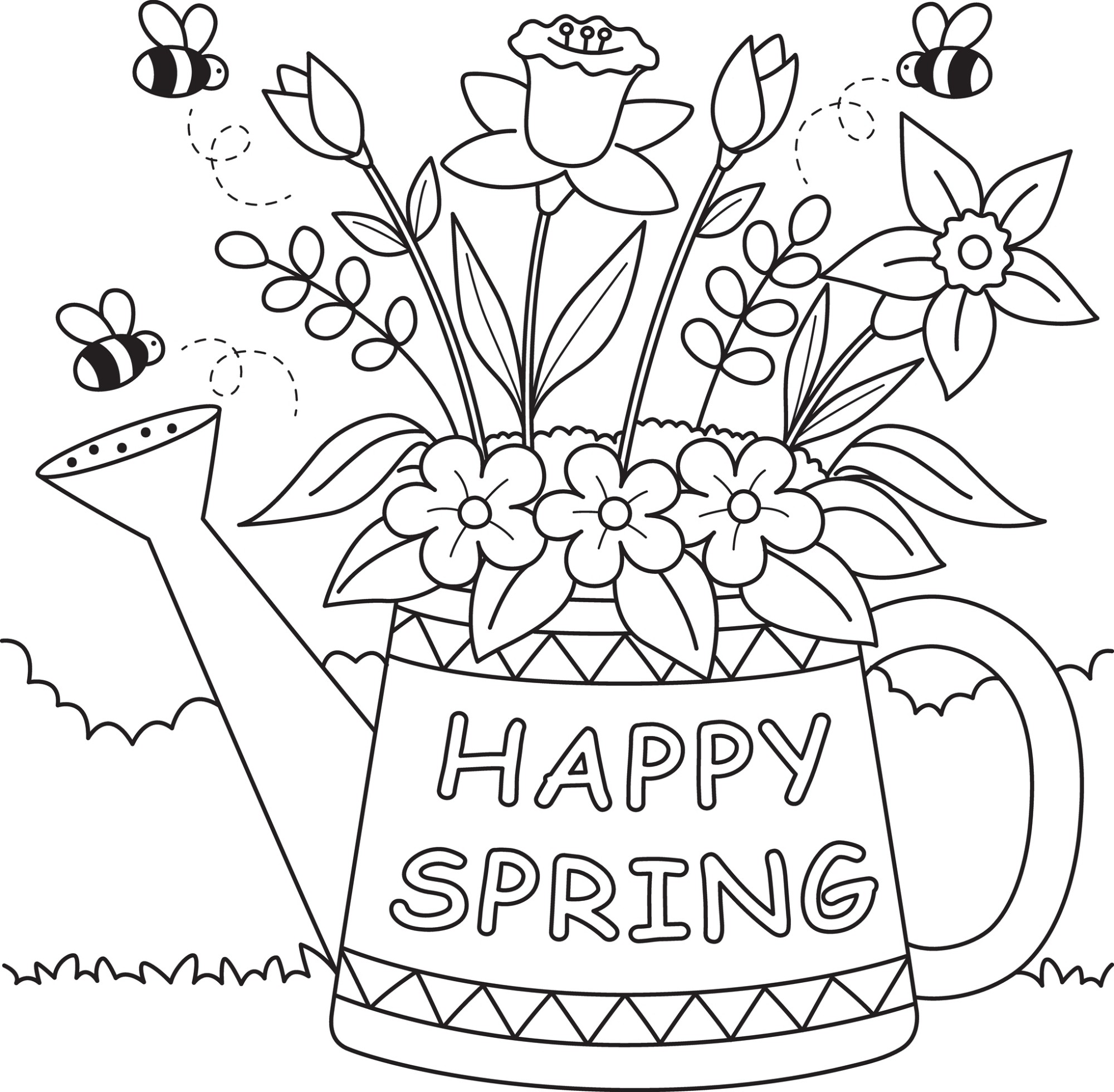
Then move into our May Coloring Page, where daisies, a little bird, leaves, and a watering can capture the feeling of a greener spring garden.
Display all three together and notice how your colors change throughout the season.
☀️ Move From Spring Into June
Spring eventually begins giving way to summer.
Our June Coloring Pages capture that transition with June-themed artwork, a Last Day of School design, and seasonal doodles.
Pair June with the capybara-and-watermelon page from this collection and the warmer-weather shift feels especially natural.
Following the seasons through coloring can create a simple visual record of the year.
🐦 Watch for Spring Bird Migration
Spring is an especially exciting bird-watching season in North America.
Many migratory birds move northward during March, April, and May, although timing varies widely by species and region.
In many parts of the United States, late April and May can bring especially noticeable migration activity.
Take a spring walk and watch for birds in trees, gardens, parks, or schoolyards.
Notice:
- Colors
- Size
- Behavior
- Songs
- Where the bird is perched
You don’t need to identify every species.
Simply paying closer attention is a great beginning.
📓 Start a Spring Nature Journal
Choose your favorite coloring page and use it as the cover of a spring nature notebook.
Inside, record things you notice outdoors.
Draw:
- Flowers
- Birds
- Butterflies
- Mushrooms
- Leaves
- Insects
- Clouds
- Rain
Add dates beside each observation.
Younger children can mostly draw, while older children can include short notes.
By the end of the season, the notebook will show how much the outdoors changed from early spring to almost-summer.
🔍 Go on a Spring Scavenger Hunt
Use the collection as inspiration for a simple outdoor search.
Look for:
- A flower
- A bird
- A butterfly or another insect
- A mushroom
- Something yellow
- Something green
- A new leaf
- A cloud
- A puddle
- A plant with an interesting shape
Depending on your region and the time of spring, you may not find everything.
That’s okay.
The point is to look closely at what actually exists around you.
☔ Take a Rainy-Day Nature Look
If the weather is wet, observe spring from a porch or window.
How does rain change the colors outside?
Are tree trunks darker?
Do leaves look shiny?
Are puddles forming?
Can you hear birds?
Afterward, use those colors in the rain-boot or wild-plant coloring pages.
A gray spring day can contain far more color than it first appears to.
🌱 Design Your Dream Spring Garden
Several of these pages can inspire a larger garden-planning activity.
On blank paper, draw a garden from above.
Include:
- Flower beds
- Paths
- Trees
- Shrubs
- Benches
- Water
- Vegetable plants
- Butterfly areas
Then color the plan.
If you want a real-world connection, research plants appropriate to your region rather than assuming every flower grows well everywhere.
For even more garden scenes, visit our Garden Coloring Pages.
🌼 Create a Pollinator Garden on Paper
Design a pretend garden where butterflies, bees, and other pollinators can find flowers.
Draw a variety of blossoms rather than only one kind.
Use different:
- Colors
- Heights
- Flower shapes
- Blooming areas
Older kids can look up native plants appropriate to their region and add a few to the drawing.
Then place butterflies and bees throughout the garden to show the connection between flowers and their visitors.
🌷 Try a Classic Spring Palette
If you want all of your pages to coordinate, choose a limited spring palette.
Try:
Soft Spring
- Pink
- Lavender
- Mint
- Baby blue
- Pale yellow
- Peach
Use those shades repeatedly across several pages.
The flower butterfly, rain boots, smiling blooms, and fantasy cat will look like parts of one collection even though the designs are completely different.
🌈 Try a Bright Spring Palette
Spring doesn’t have to be pastel.
For something more energetic, use:
- Hot pink
- Orange
- Bright yellow
- Lime
- Turquoise
- Purple
Make the mushrooms orange and purple.
Color the flowers hot pink.
Give the floral cat turquoise leaves.
Turn the butterfly into a rainbow.
Bold colors can make spring feel almost like a celebration.
🌿 Try a Woodland Spring Palette
The mushroom and wild-plant designs look especially beautiful in earthy shades.
Try:
- Moss green
- Olive
- Sage
- Bark brown
- Rust
- Cream
- Golden yellow
Add touches of pink or purple flowers for contrast.
This palette can create a quieter natural look than the brighter spring pages while still feeling richly colorful.
🎨 Compare Warm and Cool Colors
Use the collection for a simple color experiment.
Warm colors include:
- Red
- Orange
- Yellow
- Warm pink
Cool colors include:
- Blue
- Green
- Turquoise
- Purple
Choose one page and use mostly warm colors.
Print another copy and use mostly cool colors.
How does the mood change?
The exact same spring drawing can feel completely different depending on the palette.
🔢 Count the Spring Details
Younger children can turn the pictures into counting activities.
Count:
- Flowers
- Butterflies
- Mushrooms
- Ladybugs
- Leaves
Then add more.
Draw three butterflies.
Add five flowers.
Create two mushrooms.
Put four ladybugs on the leaves.
This keeps the activity playful while giving children another reason to look closely at the illustrations.
🔤 S Is for Spring
Spring pages can also pair with simple alphabet practice.
Write a large S beside the picture.
Practice:
S is for Spring.
Then think of other S words:
- Sun
- Seed
- Star
- Sky
- Snail
- Strawberry
Children can draw a few S objects around the coloring page.
For more letter activities, visit our Educational Coloring Pages & Activities.
✏️ Write a Spring Story
Almost every page in this collection could become a story prompt.
Try:
The butterfly made of flowers suddenly came alive and…
The smiling mushrooms were hiding a secret…
When the child put on the magical rain boots…
The capybara followed the butterfly until…
The flower cat only appeared once every spring because…
Deep inside the mushroom forest was…
The unusual designs make this collection especially good for imaginative writing.
🏫 Spring Coloring Pages for the Classroom
These printables can fit naturally into spring classroom themes.
Teachers might use them for:
- Morning work
- Early finishers
- Spring science
- Nature studies
- Art centers
- Butterfly lessons
- Plant lessons
- Creative writing
- Indoor recess
- Bulletin boards
Because the collection includes both simple and detailed designs, students can choose pages that suit their interests and coloring styles.
🌷 Create a Giant Classroom Spring Garden
Give each student a different spring page.
After coloring, combine elements into one large bulletin-board display.
Add paper:
- Flowers
- Butterflies
- Mushrooms
- Birds
- Ladybugs
- Grass
- Clouds
Possible headings include:
Our Creativity Is Blooming
Spring Into Color
Welcome, Spring!
or
Watch Our Garden Grow
The unusual capybara and flower cat can make especially fun surprise residents of the classroom garden.
🌧️ Spring Coloring for Rainy Days
Spring weather often means outdoor plans can change quickly.
Keep several pages printed and ready for rainy afternoons.
Set out:
- Crayons
- Colored pencils
- Washable markers
- Blank drawing paper
Kids can color one of the existing designs and then create their own spring picture.
The rain-boot page is particularly fitting when drops are actually falling outside.
🚲 Take Spring Coloring Outdoors
When the weather is pleasant, coloring doesn’t have to stay inside.
Pack a clipboard and colored pencils and visit:
- A backyard
- A garden
- A park
- A picnic table
- A porch
Color while looking at the real spring landscape.
Use actual flowers, leaves, birds, and skies for inspiration.
For another charming outdoor design, print our Spring Bike with Flowers Coloring Page for Kids.
🖼️ Make a Spring Art Gallery
Print several designs and give each one a different style.
Try:
Pastel Spring — soft pinks, blues, and lavender.
Rainbow Spring — bright colors everywhere.
Woodland Spring — greens, browns, rust, and gold.
Fantasy Spring — purple plants, glowing mushrooms, and magical animals.
Nature Spring — colors inspired by real plants and wildlife.
Display them together and compare how much the mood changes from one palette to another.
✂️ Turn Spring Coloring Pages Into Crafts
Finished pages can become:
- Spring greeting cards
- Classroom decorations
- Nature-journal covers
- Garland
- Scrapbook pages
- Bookmarks
- Window art
- Bulletin-board pieces
- Story illustrations
Cut out butterflies, flowers, mushrooms, and other individual details with age-appropriate supervision and glue them onto construction paper.
Combining pieces from several designs can create an entirely new spring collage.
🦋 Make a Butterfly Garland
Print several butterfly designs and color each differently.
Cut them out and attach them along a piece of string or ribbon.
Try arranging the butterflies in rainbow order.
Hang the finished garland in a bedroom, classroom, or playroom.
Add paper flowers between the butterflies to make the decoration feel even more like spring.
🌼 Make a Flower Collage
Cut flowers from several finished pages or draw additional ones yourself.
Arrange them on a large piece of paper.
Add green stems and leaves.
Then include:
- Butterflies
- Ladybugs
- Mushrooms
- Birds
Several children can contribute flowers to create one enormous collaborative garden.
💌 Create a Spring Greeting Card
A flower, butterfly, or garden design can become a cheerful card.
Mount the finished picture onto folded cardstock and add a message inside.
Try:
Happy Spring!
Hope Your Day Is Blooming Beautifully
Thinking of You
Have a Wonderful Day
Decorate the card with extra flowers or butterflies.
No special holiday is required for a handmade spring greeting.
📆 Explore More Spring Coloring Pictures
This collection is one of several places on Fun Free Coloring Pages where you can celebrate the season.
Continue with our Coloring Pictures for Spring for another set of spring-inspired scenes and creative possibilities.
The two collections can work together as a larger spring coloring library, especially for classrooms, homeschoolers, or families who want several designs ready for the season.
🌿 Explore More Nature Coloring
Spring is only one part of the natural world.
Our Nature Coloring Pages bring together flowers, plants, gardens, butterflies, birds, landscapes, ocean life, volcanoes, and more.
Start with spring flowers and then branch out into whichever part of nature interests you most.
One coloring page can easily lead to another question, another animal, another plant, or another landscape to explore.
🗓️ Color Your Way Through the Seasons
Once spring ends, you don’t have to stop.
Visit our Seasonal Coloring Pages to follow the changing year.
Spring brings flowers, butterflies, and gardens.
Summer brings beaches, sunshine, and outdoor adventures.
Fall brings colorful leaves and pumpkins.
Winter brings snow and cozy seasonal scenes.
Save one or two favorite pages from every season and build a year-long coloring scrapbook.
🖍️ Best Supplies for Spring Coloring Pages
Crayons work well for younger children and larger spaces.
Colored pencils are especially useful for the more detailed butterfly, mushroom, wild plant, and floral-cat designs because they allow you to layer shades and work inside smaller areas.
Markers create brilliant flowers and bold fantasy colors. Slightly heavier paper can help if marker ink tends to bleed through standard printer paper.
Gel pens are fun for adding tiny finishing touches such as:
- Butterfly spots
- Ladybug details
- Flower centers
- Sparkles
- Mushroom patterns
Use one medium or combine several.
🖨️ How to Use These Free Spring Coloring Pages
Choose the spring design that inspires you most and print your favorite page.
Then decide what kind of spring world you want to create.
Maybe the butterfly will have realistic orange-and-black wings.
Perhaps the rain boots will be covered in rainbow stripes.
The mushrooms might become homes in a magical village.
The capybara can enjoy watermelon in a meadow bursting with color.
Or the floral cat may wander through an enchanted forest filled with butterflies and ladybugs.
Use the existing artwork as your starting point and add as much—or as little—as you like.
🌸 Let Your Creativity Bloom This Spring
From flower-covered butterflies and smiling blossoms to rain boots, mushrooms, wild plants, a watermelon-loving capybara, and an enchanting floral cat, these free printable spring coloring pages celebrate just how colorful and surprising the season can be.
Color realistically, explore spring pastels, create a rainbow garden, learn about butterflies and plants, keep a nature journal, write a fantasy story, or turn the finished artwork into a spring craft.
Then head outside and see what spring actually looks like where you live.
The printed pages provide plenty of inspiration, but the changing natural world can provide even more.
Grab your favorite colors and let your spring creativity grow!
🔗 Related Articles
- Coloring Pictures for Spring
- Spring Bike with Flowers Coloring Page for Kids
- Butterfly Coloring Page
- Coloring Pages of Flowers
- Garden Coloring Pages
- Coloring Pages of Plants
- March Coloring Page
- April Coloring Page
- May Coloring Page
- Nature Coloring Pages
- Seasonal Coloring Pages
📚 Sources
- NOAA National Centers for Environmental Information — Meteorological Versus Astronomical Seasons
- Cornell Lab of Ornithology — When Will Spring Bird Migration Hit Its Peak?
- Cornell Lab of Ornithology — The Basics of Bird Migration
- U.S. Forest Service — Attracting Pollinators to Your Garden Using Native Plants
- National Park Service — Mushrooms and Other Fungi
- National Park Service — Springing Up: Dryad’s Saddle
🖍️Shop Spring Coloring Books –>