
Get ready for a wonderfully wild coloring adventure with our collection of bear coloring pages, featuring cuddly cubs, forest bears, polar bear families, giant pandas, funny cartoon characters, teddy bears, detailed woodland scenes, and intricate zentangle artwork.
Bears are especially fun to color because they come in far more colors and live in more varied habitats than many people realize. A brown bear can range from pale cream to very dark brown, an American black bear might actually be black, cinnamon, blond, or even bluish-gray, and polar bears bring icy Arctic scenes into the collection. Giant pandas add their unmistakable black-and-white markings, while fantasy bears can be pink, purple, rainbow-striped, or covered with flowers.
The collection also includes pages for many different ages. Younger children can enjoy simple baby bears and kawaii characters, while older kids and adults can spend more time on fur texture, forest scenery, flowers, berries, and detailed patterned designs.
Choose your favorite printable, grab your crayons or colored pencils, and head into bear country.
🐻 Explore Our Bear Coloring Pages
There is a huge amount of variety hiding in this bear collection.
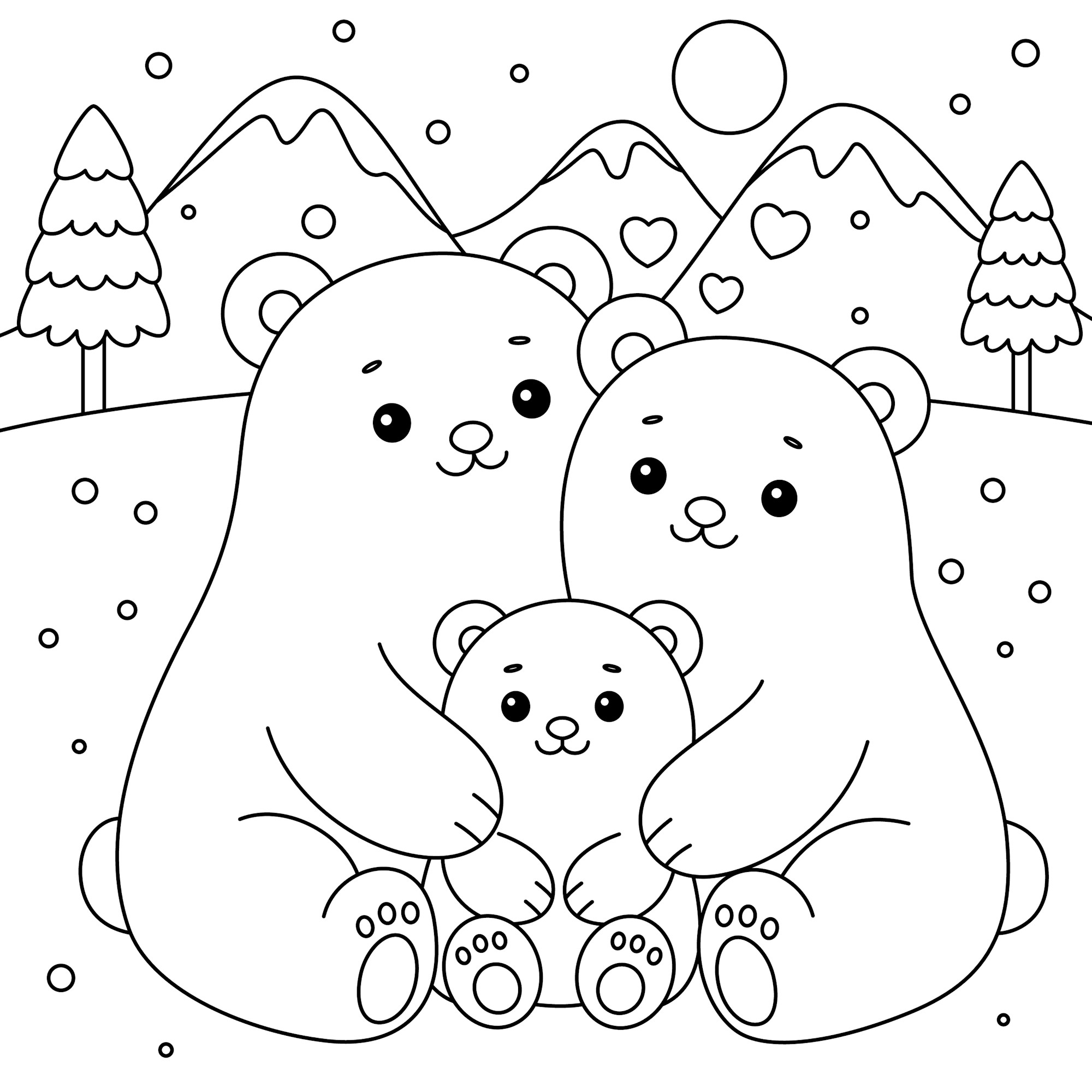
You’ll find a hand-drawn baby bear, a cute kawaii bear in a forest, a teddy-bear family enjoying a picnic, polar bear families, a bear cub exploring a forest clearing, baby polar bears playing in the snow, and a bear sleeping inside a winter den.
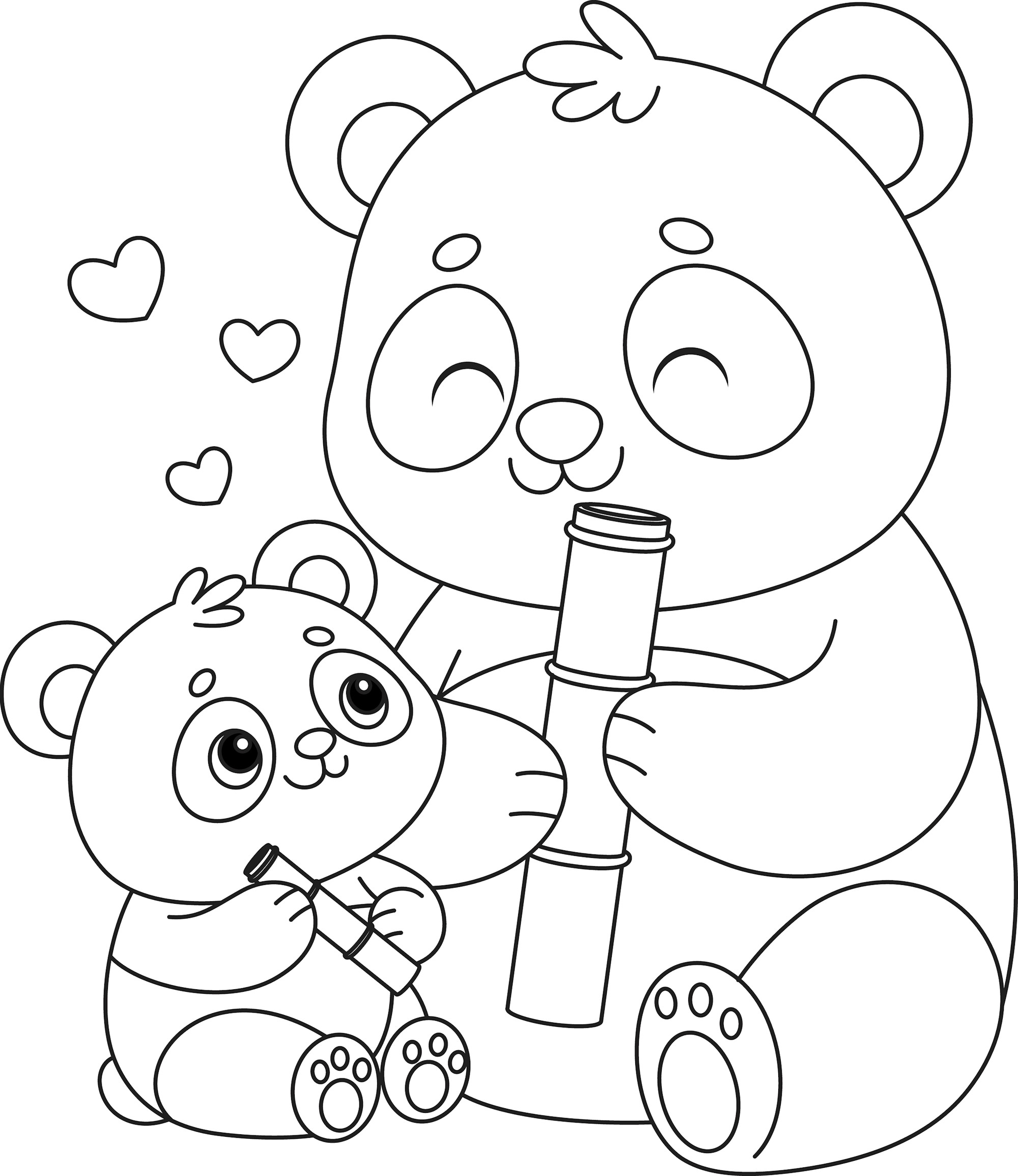
The collection also includes giant panda coloring pages, including a panda mother and baby eating bamboo, plus several cheerful cartoon bears and a funny bear heading to school.
Children who enjoy games can help a hungry bear travel through a maze toward honey, while older colorists can choose a zentangle bear silhouette made from flowers or a detailed grizzly bear surrounded by blackberries or raspberries in a woodland setting.
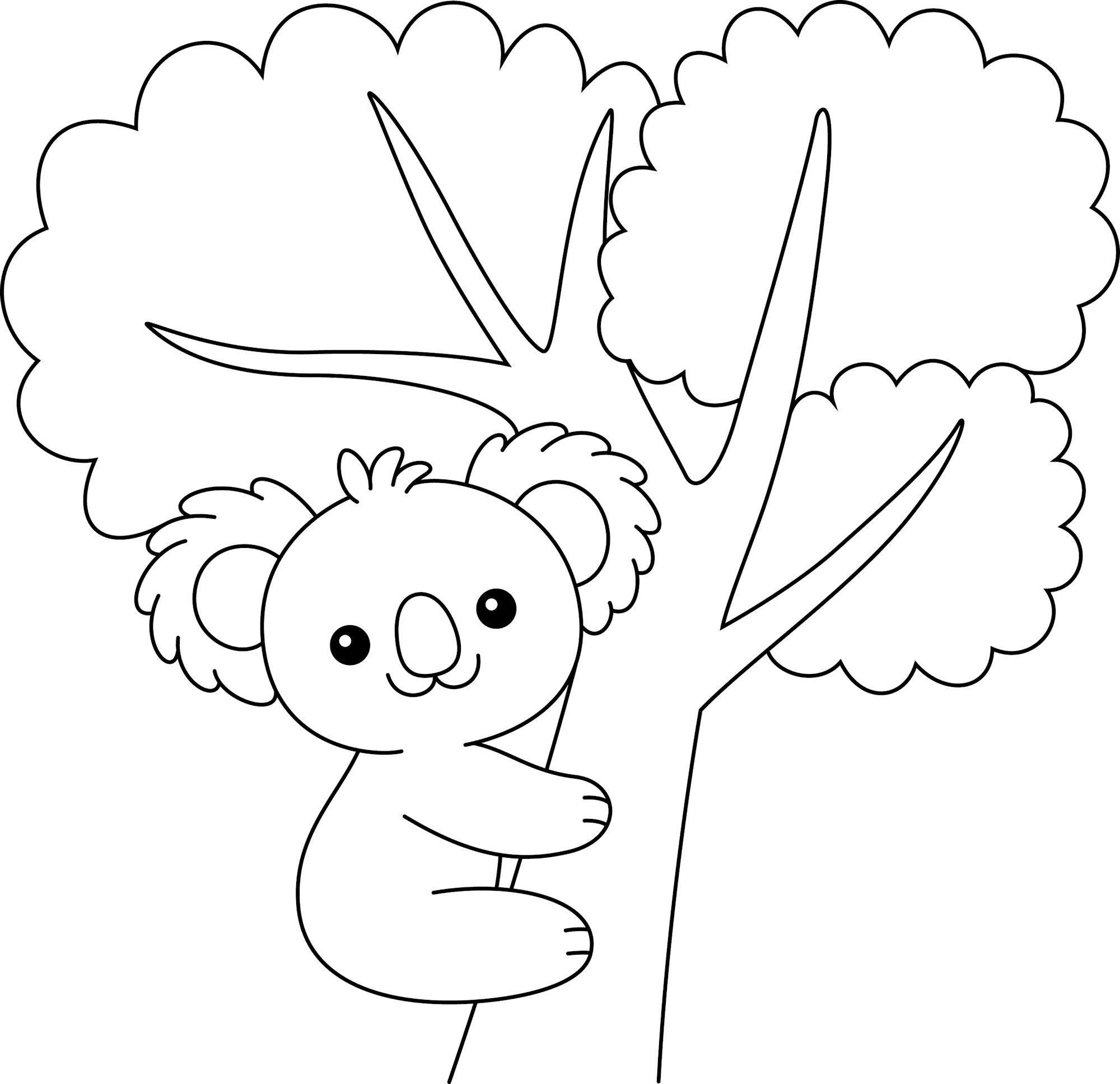
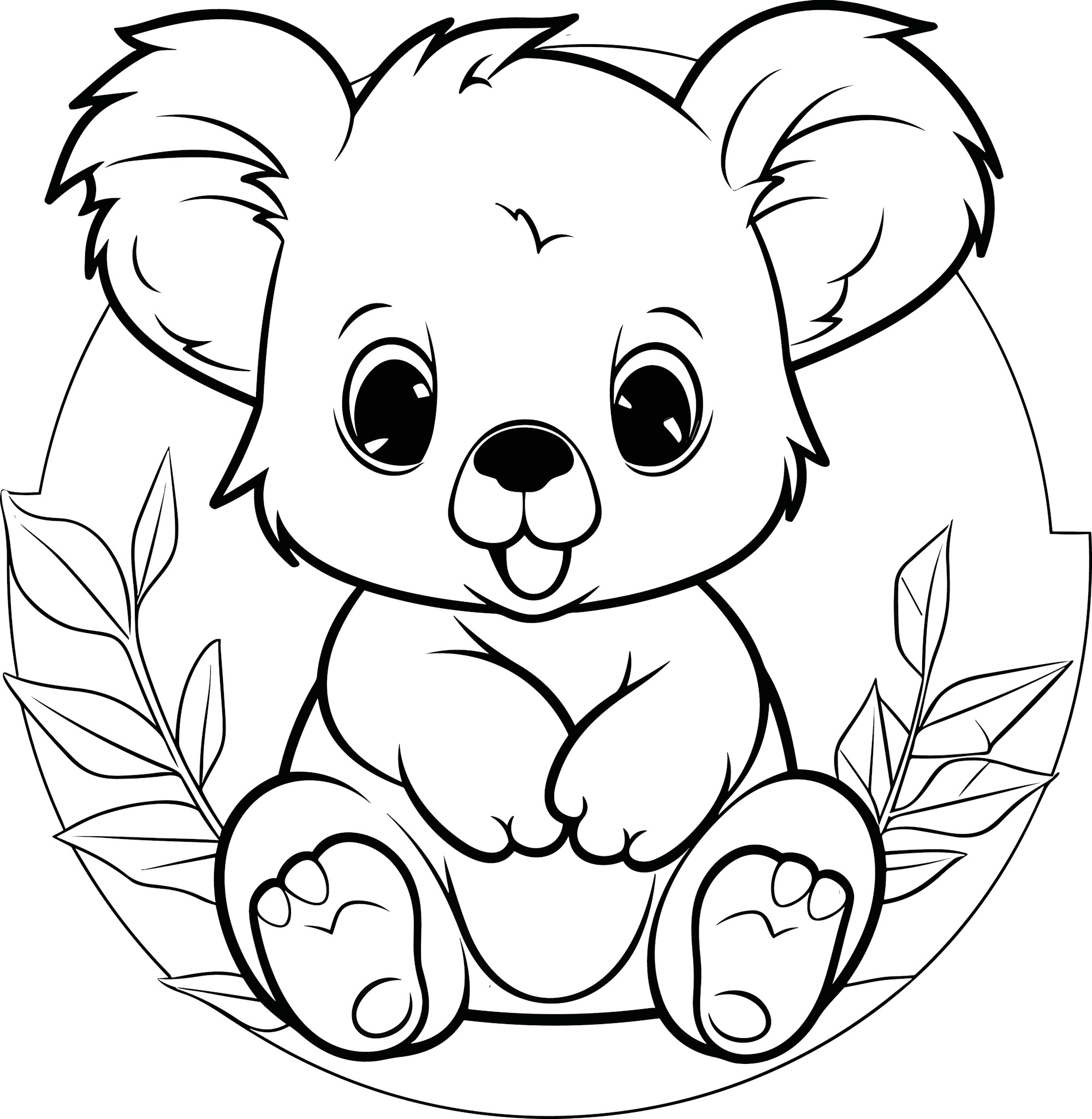
There are even several koala illustrations. Koalas are often casually called “koala bears,” but they are actually marsupials rather than true bears—a fun fact we’ll explore later.
For even more creatures from around the world, visit our Animal Coloring Pages.
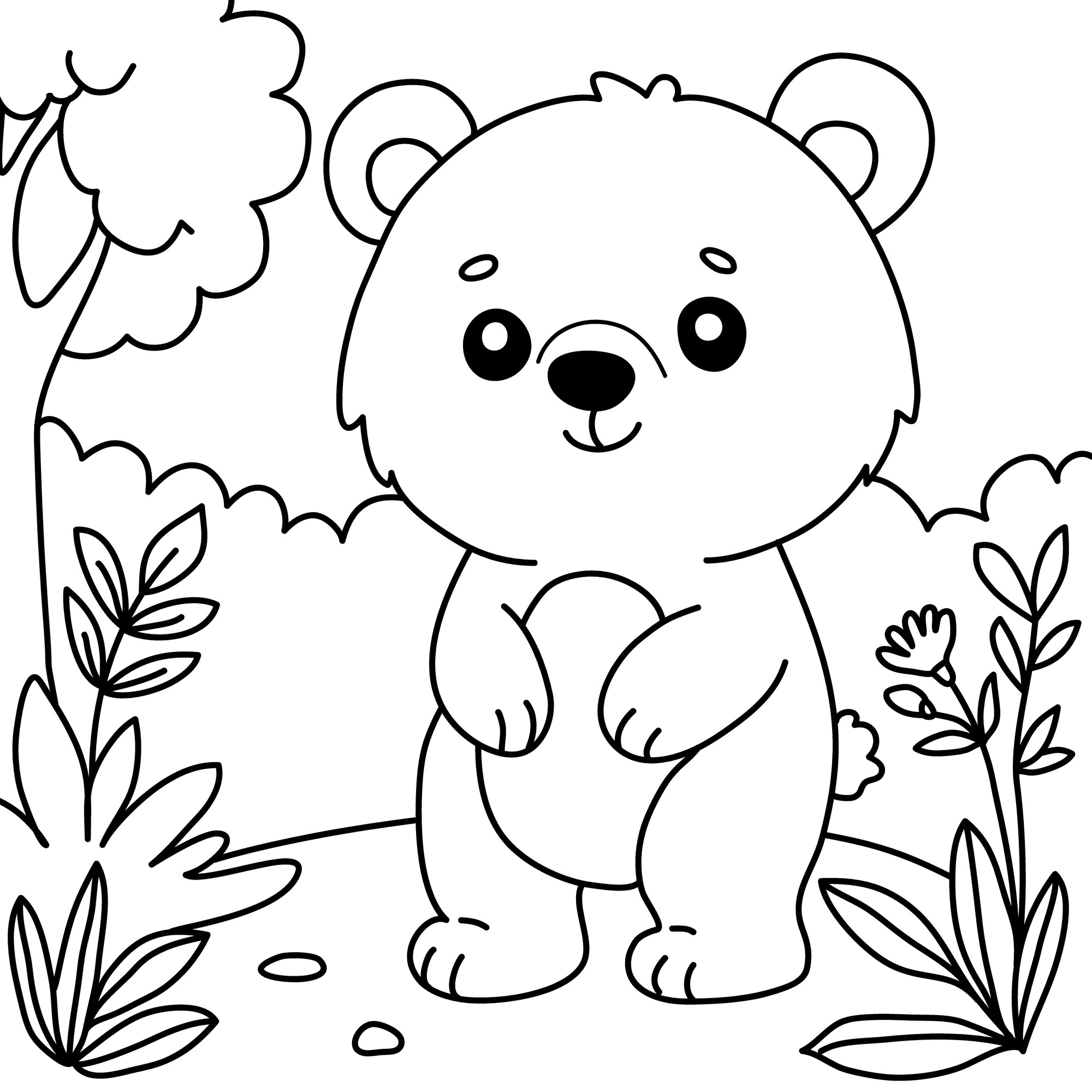
🍼 Cute Baby Bear Coloring Page
The hand-drawn baby bear is a sweet place to begin.
Young bears are called cubs, and a simple cub coloring page works beautifully with warm, soft colors.
Try:
- Golden brown
- Tan
- Cinnamon
- Cream
- Chocolate brown
- Pale gray
Use slightly lighter colors around the muzzle and ears, then add darker brown around the paws or shaded parts of the fur.
For a kawaii cub, forget about realistic colors and try lavender, mint, pale blue, peach, or pink instead.
Add flowers, butterflies, stars, or a favorite toy around the little bear to create an even sweeter scene.
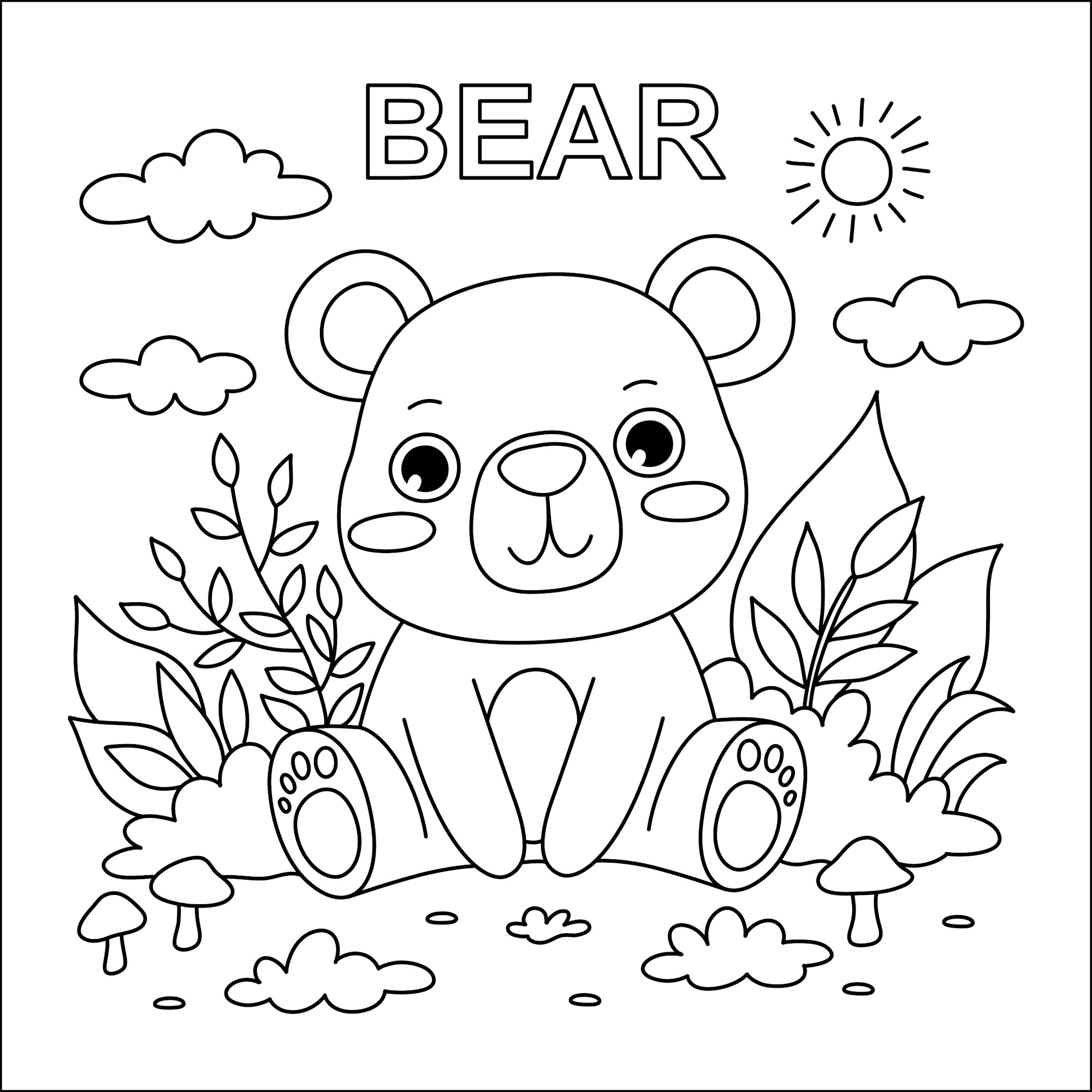
🌲 Kawaii Bear in the Forest
The cute kawaii bear in a woodland setting gives children more than just an animal to color.
Start with the bear, then fill the surrounding forest with several greens.
Try sage, lime, emerald, olive, and forest green rather than using the same shade for every leaf.
Tree trunks can use brown, gray, tan, and reddish tones, while flowers or berries can add brighter colors.
Children can also draw extra forest details such as:
- Mushrooms
- Butterflies
- Birds
- Fallen leaves
- Rocks
- Acorns
- Berries
The result can become an entire woodland habitat.
For more outdoor inspiration, explore our Nature Coloring Pages.
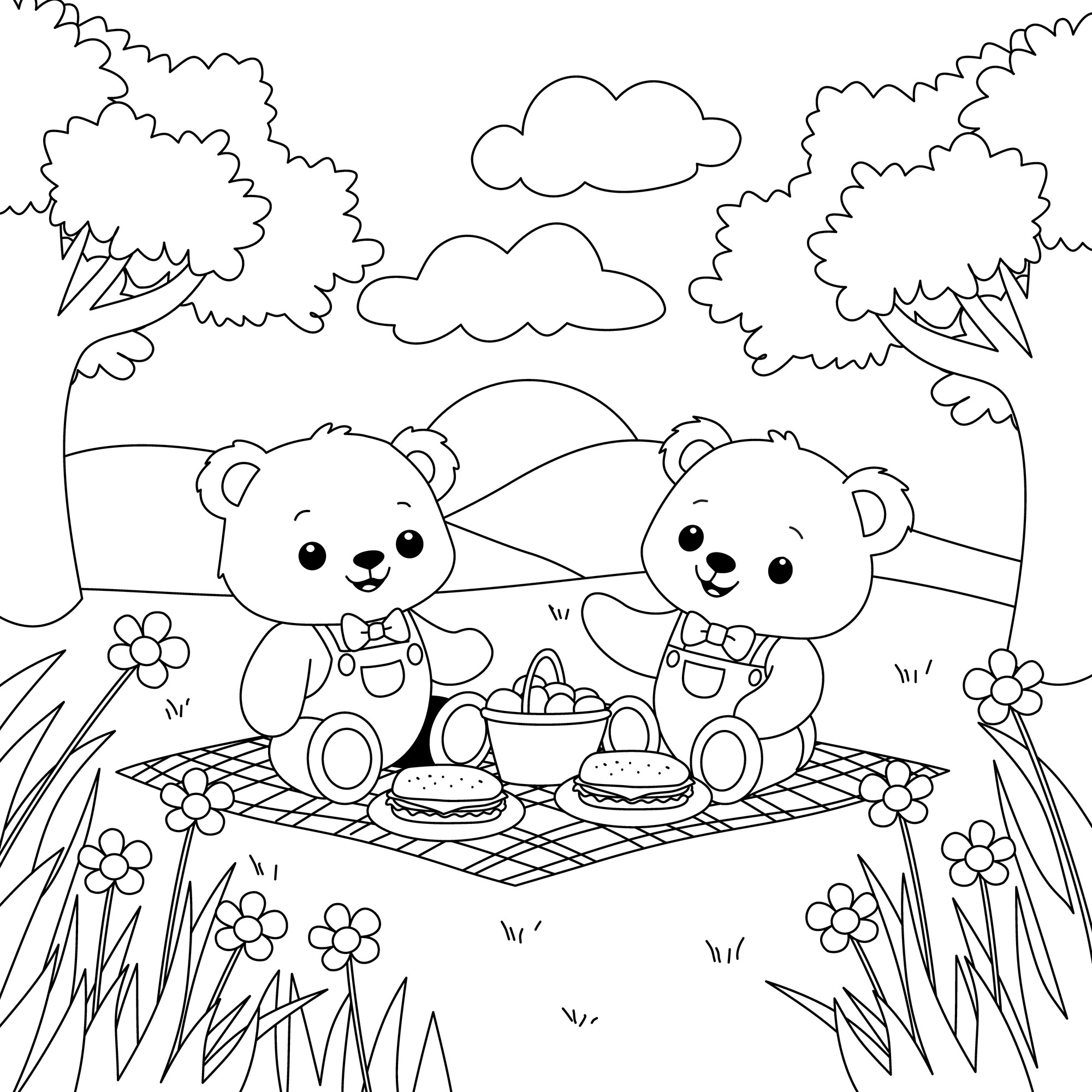
🧸 Teddy Bear Family Picnic
Not every bear in this collection is a wild animal.
The kawaii teddy bear family having a picnic offers a completely different kind of coloring adventure.
Give each teddy bear its own color. One could be traditional brown, while another is cream, pink, lavender, or pale blue.
Then fill the picnic with bright colors.
Add a red-and-white blanket, colorful fruit, sandwiches, cupcakes, flowers, baskets, and sunshine.
Children can even draw their own favorite picnic foods into the scene.
Afterward, ask:
What would you bring to a teddy bear picnic?
A simple coloring page can quickly become a pretend-play activity.
🧸 Real Bear or Teddy Bear?
A teddy bear may look like a bear, but of course it is a toy rather than an animal.
Compare a teddy-bear picture with one of the realistic bear pages.
What is different?
A teddy bear might have:
- Stitched paws
- A bow
- Buttons
- Clothing
- Perfectly round ears
A wild bear has:
- Claws
- Thick fur
- Powerful legs
- A long muzzle
- Adaptations for finding food and surviving outdoors
Children can color one of each and create a simple Real Bear / Toy Bear comparison.
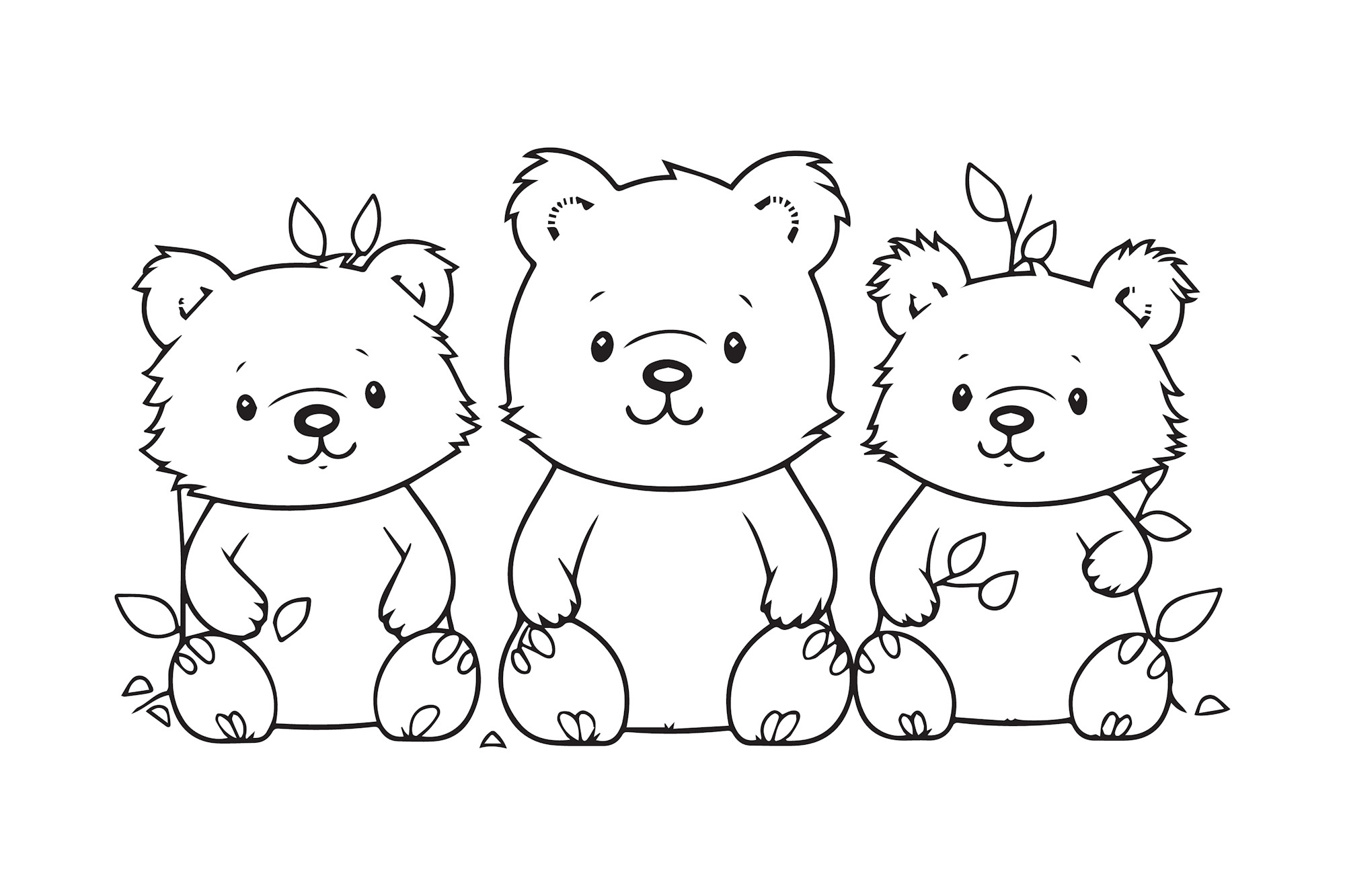
🐻 Cute Bear Coloring Pages
Several pages feature cheerful cartoon bears with simple outlines.
These are excellent choices for younger colorists because the larger spaces are easy to fill with crayons and markers.
Natural bear colors can include brown, black, cinnamon, cream, or white, but cartoon bears can become anything you imagine.
Try a:
Purple Bear with pink paws.
Rainbow Bear with multicolored ears.
Blue Bear beneath a yellow moon.
Flower Bear covered with tiny blossoms.
Candy Bear in mint, peach, lavender, and pink.
Give each character a name and invent a personality to match.
For more adorable printables, explore our Cute Coloring Pages.
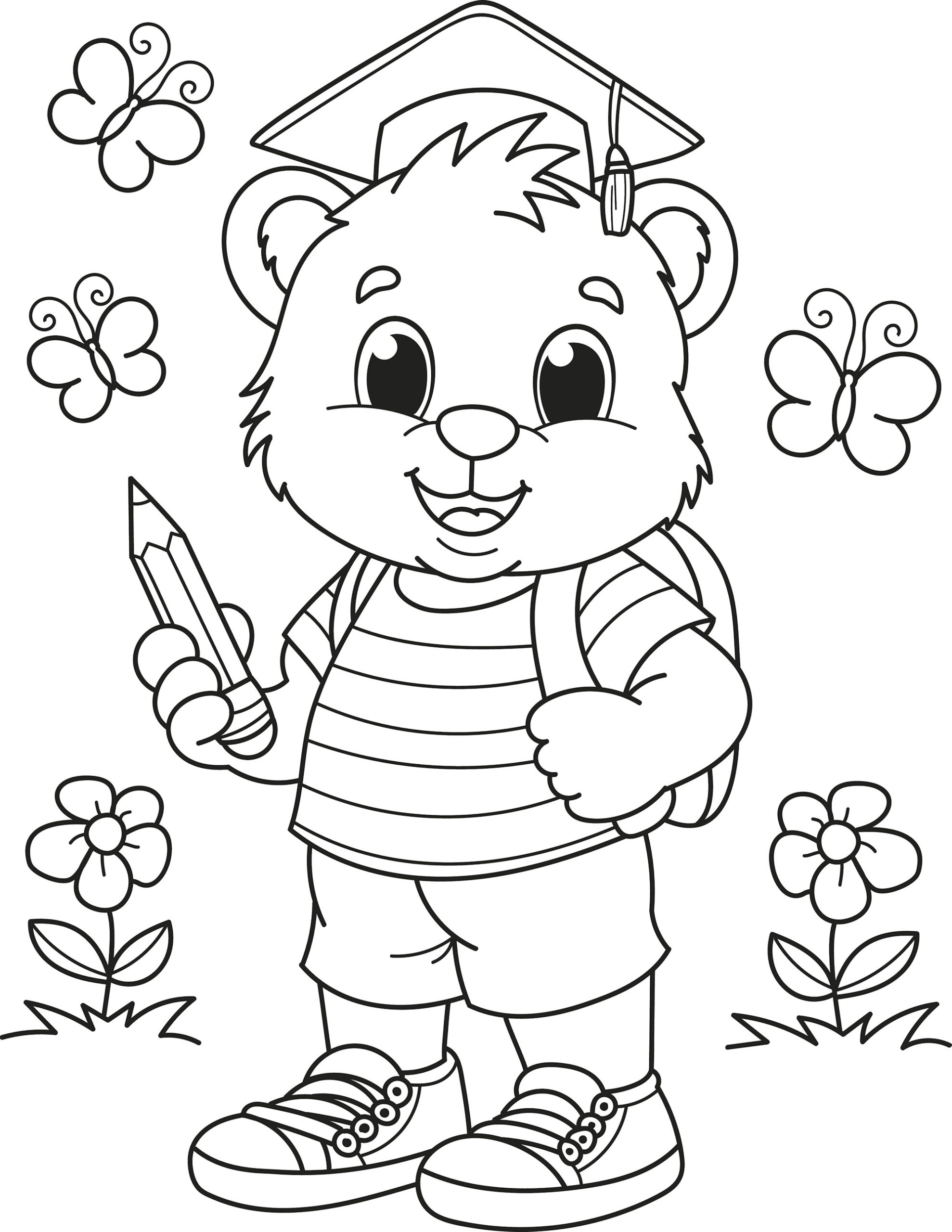
🎒 Cute Bear Goes to School
One of the funniest designs features a cute bear going to school.
This page is perfect for bright backpacks, books, pencils, clothing, and school supplies.
Make the backpack red, turquoise, purple, or rainbow-colored.
Then imagine what classes a bear might take.
Perhaps the school schedule includes:
Berry Finding
Tree Climbing
Cave Building
Fishing
Forest Geography
Children can add books or write pretend subjects on the page.
This makes a fun back-to-school activity as well as an animal coloring page.
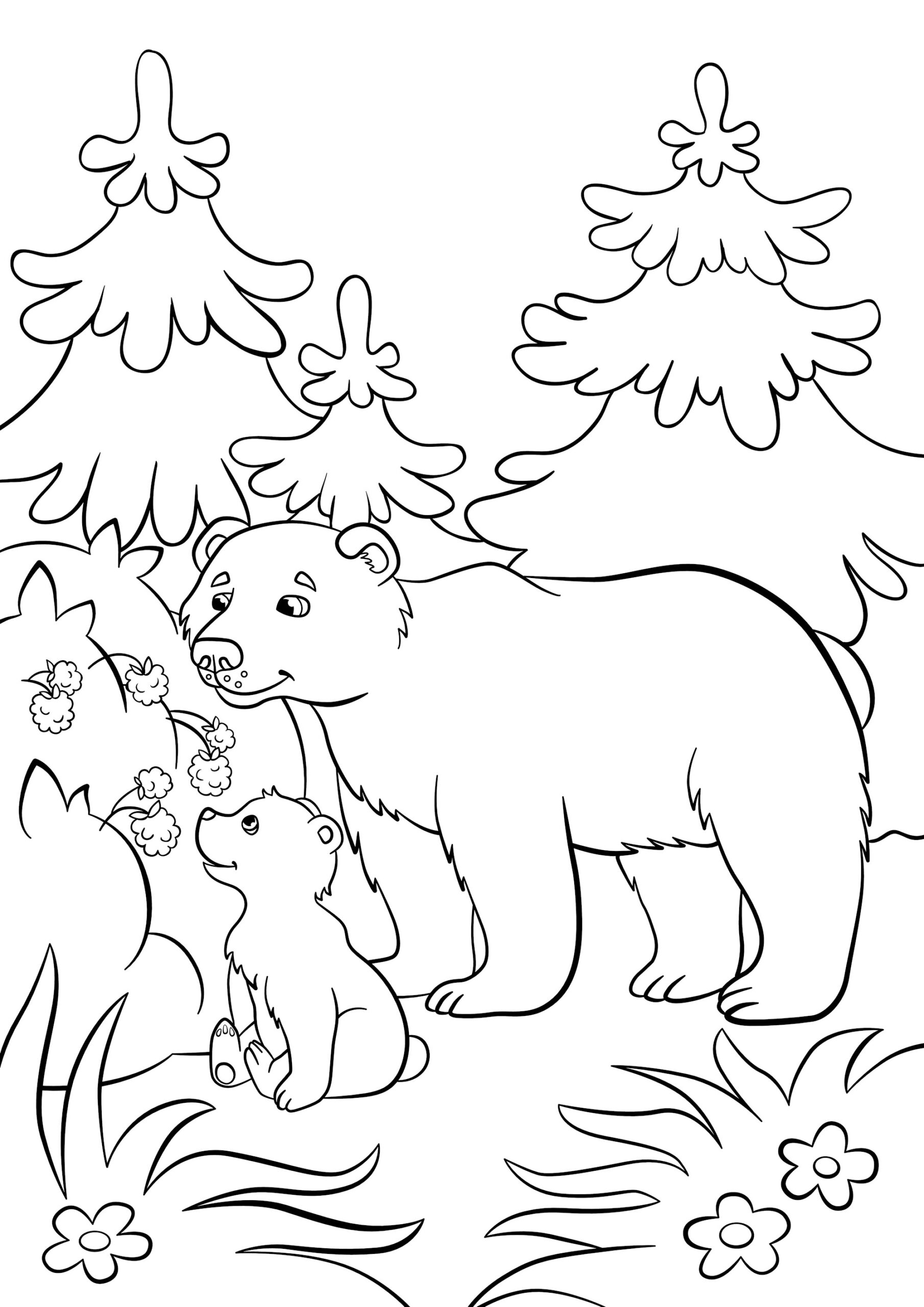
🍓 Bear and Cub With Raspberries
A lovely nature scene shows a kind adult bear and little cub looking at raspberries.
Berries provide a wonderful splash of color against brown fur and green woodland vegetation.
Try red, raspberry pink, burgundy, and purple on the fruit.
Then use several greens for leaves and grasses.
The bears can be tan, brown, cinnamon, or even almost black.
This page also provides a natural way to talk about what bears eat. Many bear species have varied diets, and berries can become an important seasonal food for some populations.
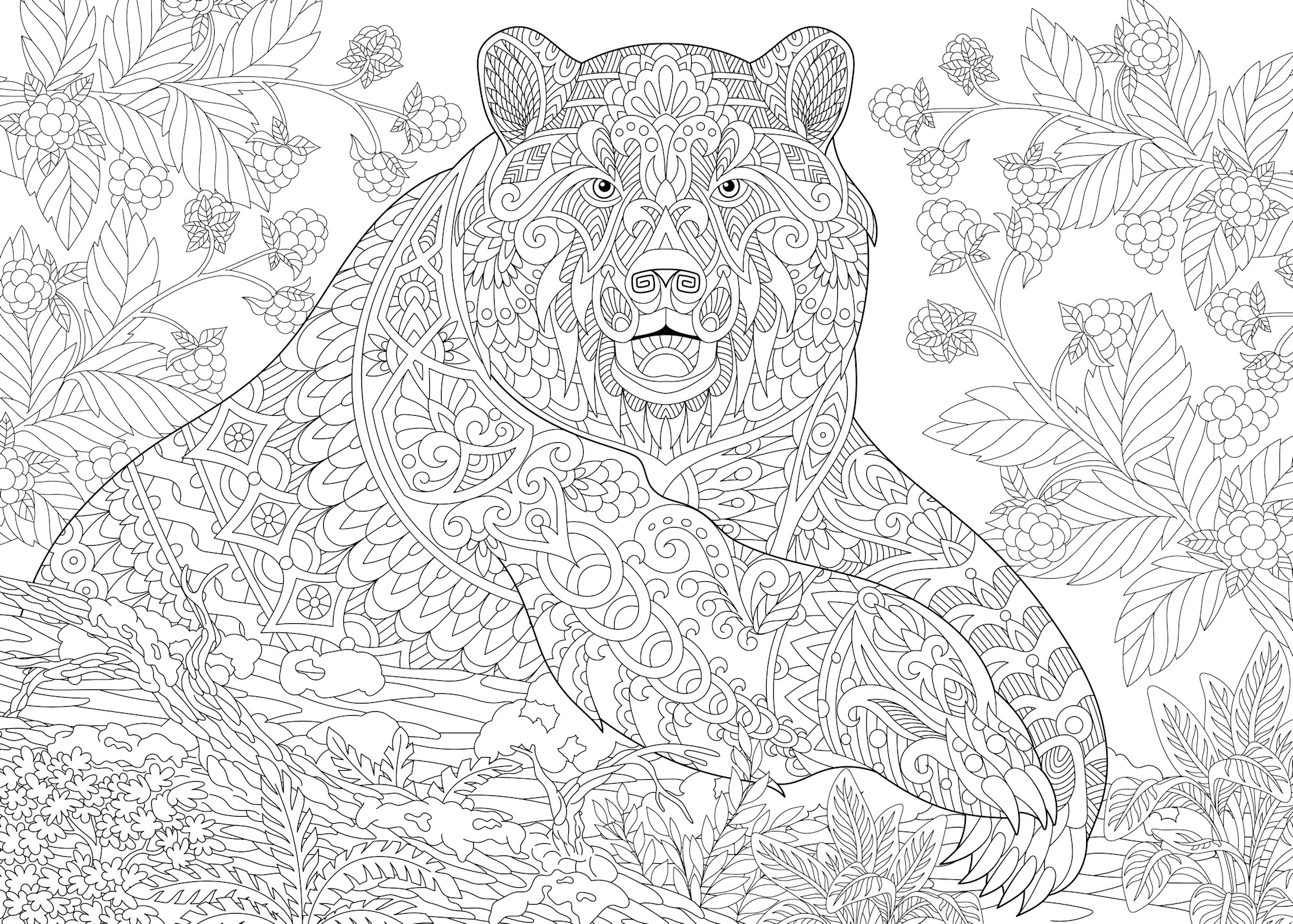
🫐 Grizzly Bear Among Berries
The stylized grizzly bear among blackberries or raspberries is one of the richer woodland designs in the collection.
Begin with the bear using layers of tan, chestnut, chocolate, gray-brown, and cream.
Then make the fruit stand out.
Blackberries can use deep purple, blue-black, burgundy, and dark violet, while raspberries can be red, pink-red, or crimson.
Add lush green leaves around them.
A detailed forest page like this works especially well with colored pencils because small strokes can create both soft fur and leafy textures.
🐻 Brown Bear or Grizzly Bear?
The terms brown bear and grizzly bear can sometimes be confusing.
Both belong to the same species, Ursus arctos. In North America, “grizzly” is commonly used for brown bears living in inland areas, while large coastal populations are often simply called brown bears.
Brown bears can vary considerably in appearance and may range from very light cream or blond through cinnamon and rich brown to almost black.
A nature-inspired coloring page could therefore use several shades rather than one single brown.
Try layering cream, gold, chestnut, gray-brown, and chocolate throughout the fur.
💪 Look for the Brown Bear’s Shoulder Hump
One feature that can help distinguish a brown or grizzly bear from an American black bear is the noticeable shoulder hump on a brown bear.
Brown bears also tend to have long claws and a face that may look somewhat concave in profile.
Look carefully at the realistic bear illustration.
Can you see where the shoulders rise?
Older children can compare a brown bear with a black bear and look for differences in:
- Shoulder shape
- Face profile
- Claws
- Ears
- Body shape
Coloring can become an observation activity simply by looking more closely at the animal.
🖤 Black Bear Coloring Page Ideas
Despite their name, American black bears are not always black.
Their coats may also appear brown, cinnamon, blond, blue-gray, and occasionally even very pale.
That gives you plenty of realistic coloring possibilities.
Try:
Classic Black Bear: charcoal, black, and dark brown
Cinnamon Bear: rust, reddish brown, and cream
Blond Bear: pale gold, tan, and brown
Dark Brown Bear: chocolate, chestnut, and gray-brown
If you color the bear very dark, avoid filling every area with solid black. Add charcoal and gray highlights so the facial features and fur remain visible.
🌈 What Colors Can Bears Be?
Real bears provide more coloring inspiration than you might expect.
Depending on species and individual animal, bear fur can include:
- Black
- Brown
- Cinnamon
- Golden brown
- Cream
- Blond
- Gray
- White
Giant pandas create their own dramatic black-and-white combination, while Andean bears can have pale facial markings against much darker fur.
Fantasy bears can go even further.
Try turquoise, lavender, coral, pink, rainbow, or metallic colors.
A coloring page is the perfect place for a bear species that could exist only in your imagination.
❄️ Polar Bear Family Coloring Page
Several pages focus on polar bear families, giving the collection a completely different habitat.
Polar bear fur may look white, so the surrounding environment becomes especially important.
Instead of leaving the entire bear completely blank, add very pale shadows using:
- Light gray
- Pale blue
- Lavender
- Soft cream
Keep most of the fur light.
Then surround the bears with icy blues, white snow, turquoise water, and deep Arctic sky colors.
A pale bear will stand out beautifully against darker blue water or a navy winter sky.
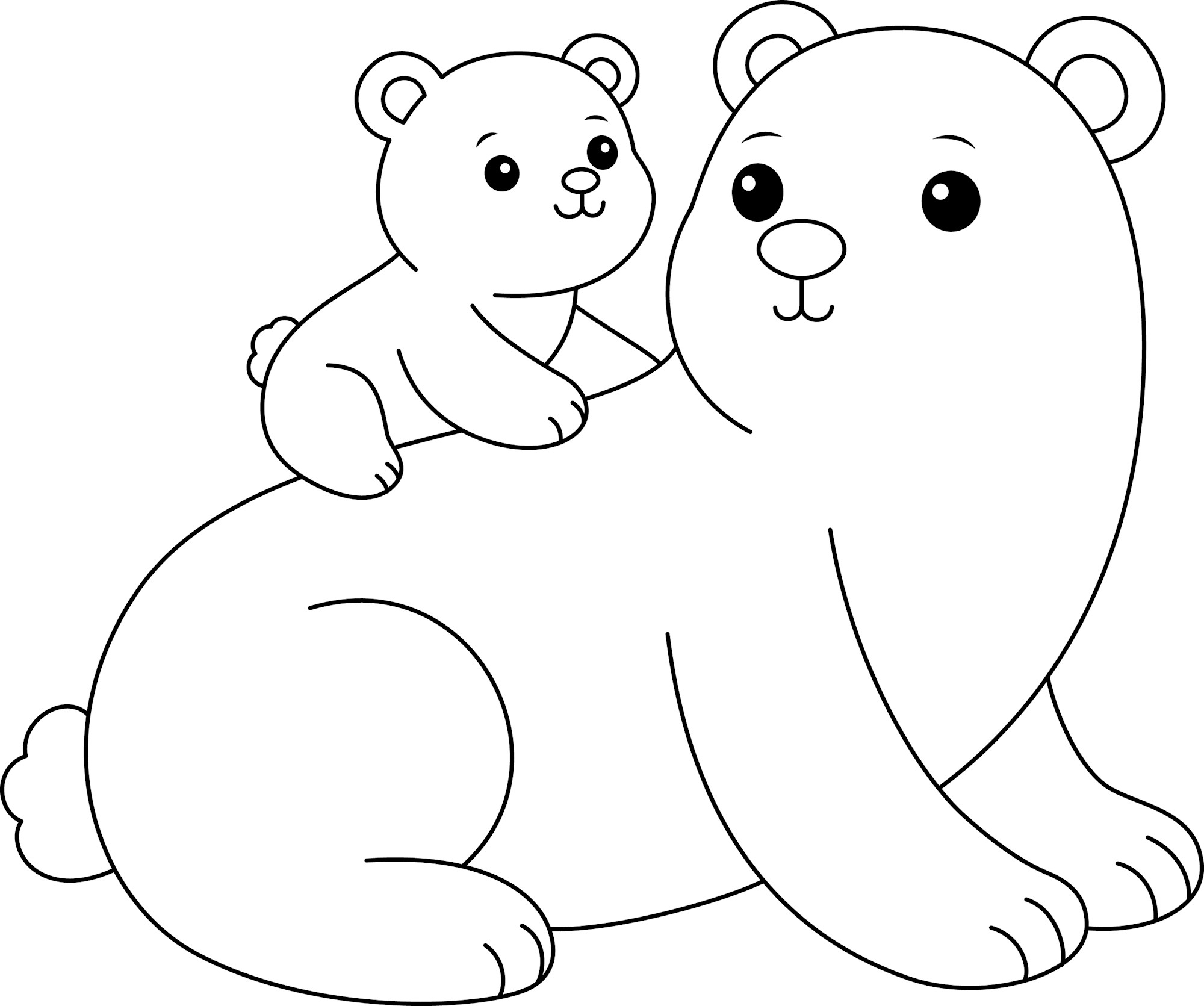
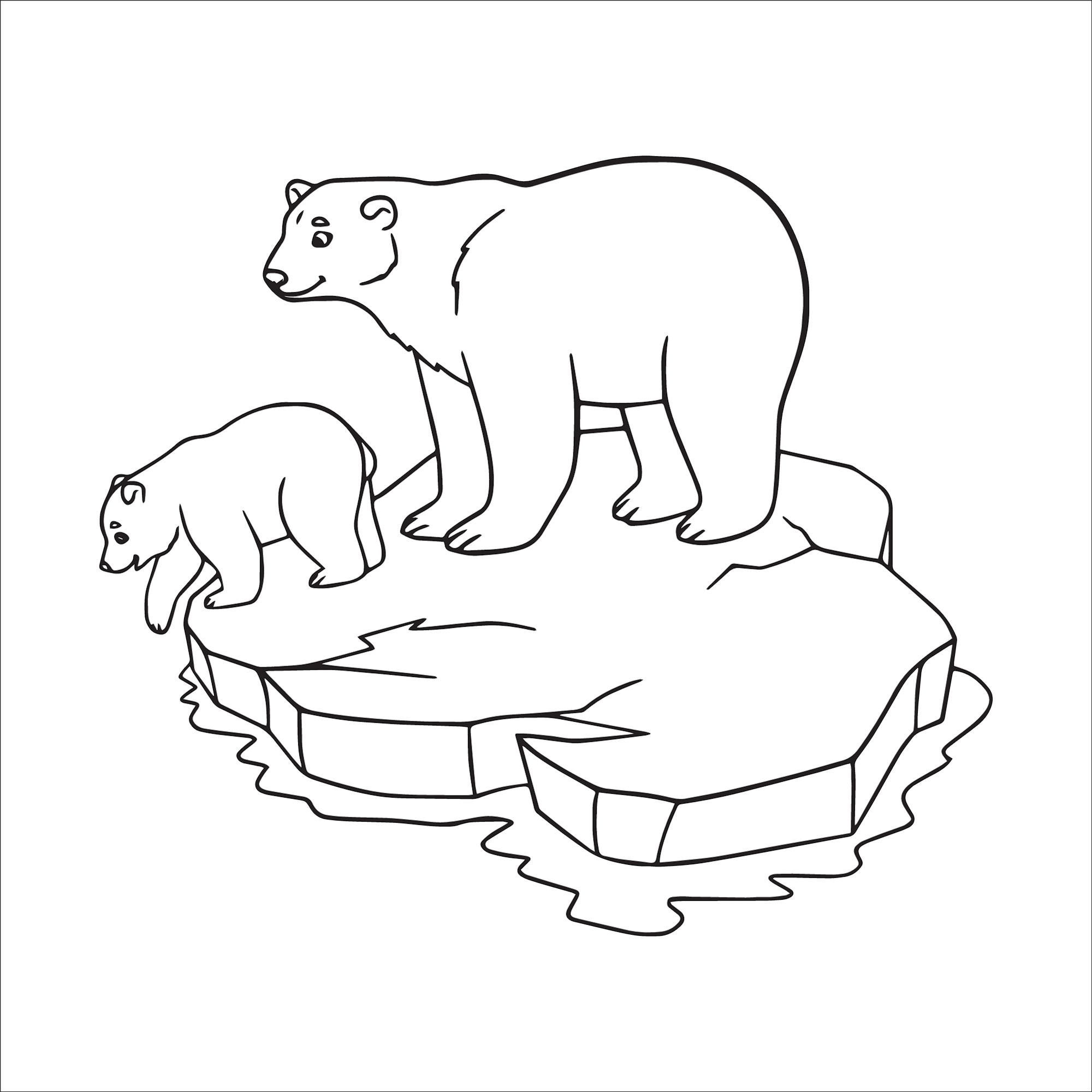
🐻❄️ Polar Bear and Baby Coloring Page
The polar bear and cub page is especially sweet.
Give the adult slightly stronger gray-blue shadows and keep the baby soft and pale.
Then add an Arctic setting around them.
You might draw:
- Snow
- Sea ice
- Water
- Clouds
- Distant ice
- Snowflakes
For a fantasy version, create aurora-like bands of green, turquoise, pink, and purple across the sky.
The white bears will stand out beautifully beneath the colorful lights.
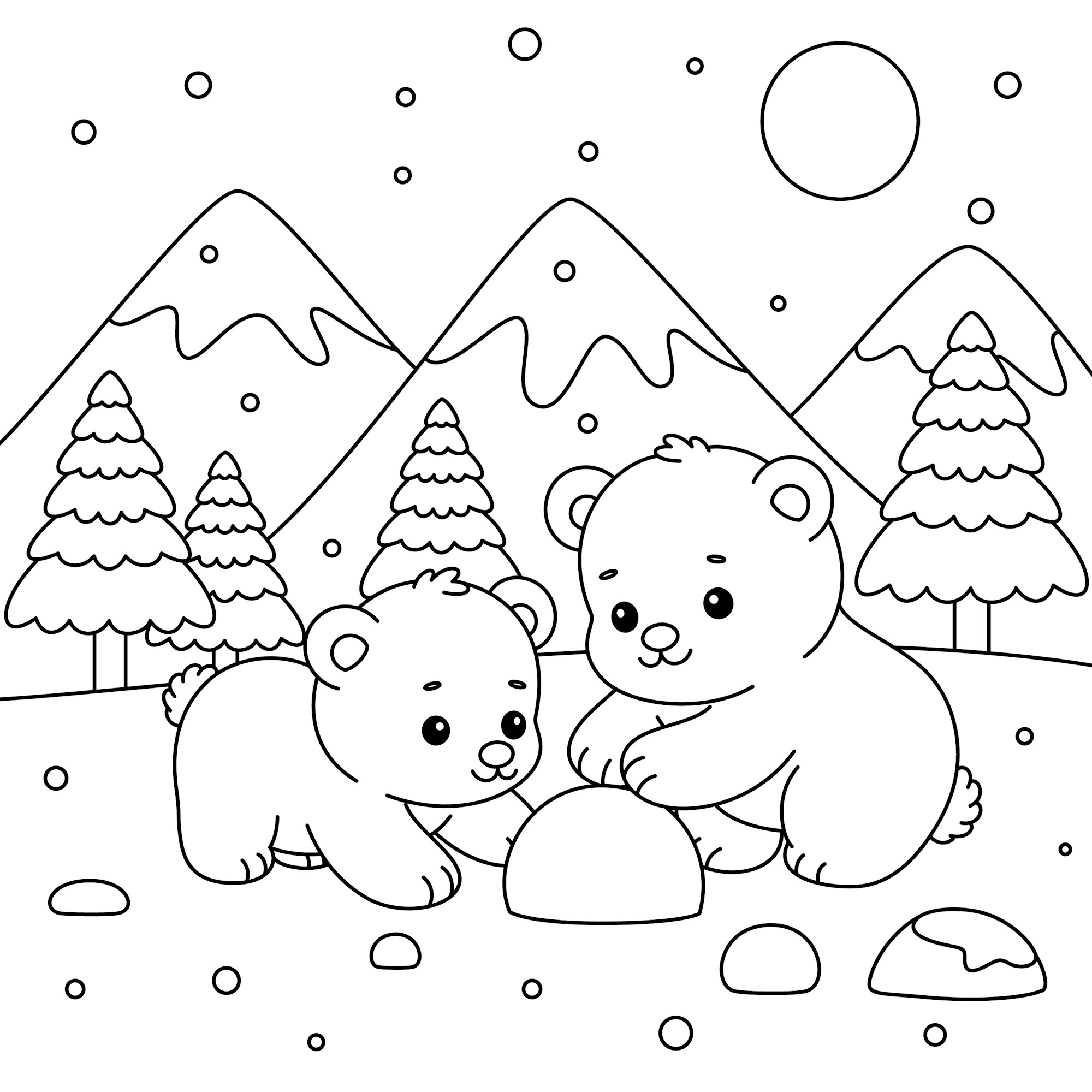
❄️ Baby Polar Bears Playing in Snow
The baby polar bears playing with snow are perfect for a winter coloring activity.
Snow does not need to remain completely white.
Try adding pale blue, lavender, silver-gray, or turquoise shading around snowbanks and footprints.
Then make the sky much stronger.
A bright daytime sky can be clear blue, while sunset can include pink, orange, gold, and purple.
Add falling snowflakes and give each one a slightly different shape.
Children can imagine what the cubs are doing—wrestling, sliding, digging, or simply exploring their icy world.
🌊 Polar Bears Are Marine Mammals
Polar bears are members of the bear family, but they are also classified as marine mammals because of how closely their lives are tied to the Arctic marine environment.
They depend heavily on sea ice and are powerful swimmers.
Their large paws help them travel over snow and ice and move through water.
Turn the polar bear coloring page into an Arctic habitat lesson by adding ocean water beneath the ice.
Then label:
Sea ice
Ocean
Polar bear
Older children can locate the Arctic on a globe or map.
🦭 What Do Polar Bears Eat?
Polar bears are highly carnivorous compared with many other bears and rely heavily on seals.
They hunt mainly from sea ice, making the frozen marine environment extremely important to their way of life.
For young children, the main idea can stay simple:
Polar bears live in the Arctic and eat mostly meat.
Compare this with the giant panda, which has a dramatically different diet even though both animals belong to the bear family.
One coloring collection can show just how different two related animals can be.
🎋 Giant Panda Coloring Page
The giant panda may have one of the easiest natural color schemes to recognize.
Keep most of the animal white and fill the:
- Ears
- Eye patches
- Shoulders
- Legs
with black or charcoal.
Add light gray shadows to the white areas if you want to make the body look more dimensional.
Then surround the panda with green bamboo.
Use lime, sage, emerald, olive, and forest green to create more variety.
Because the panda itself uses very few colors, the habitat can carry much of the brightness.
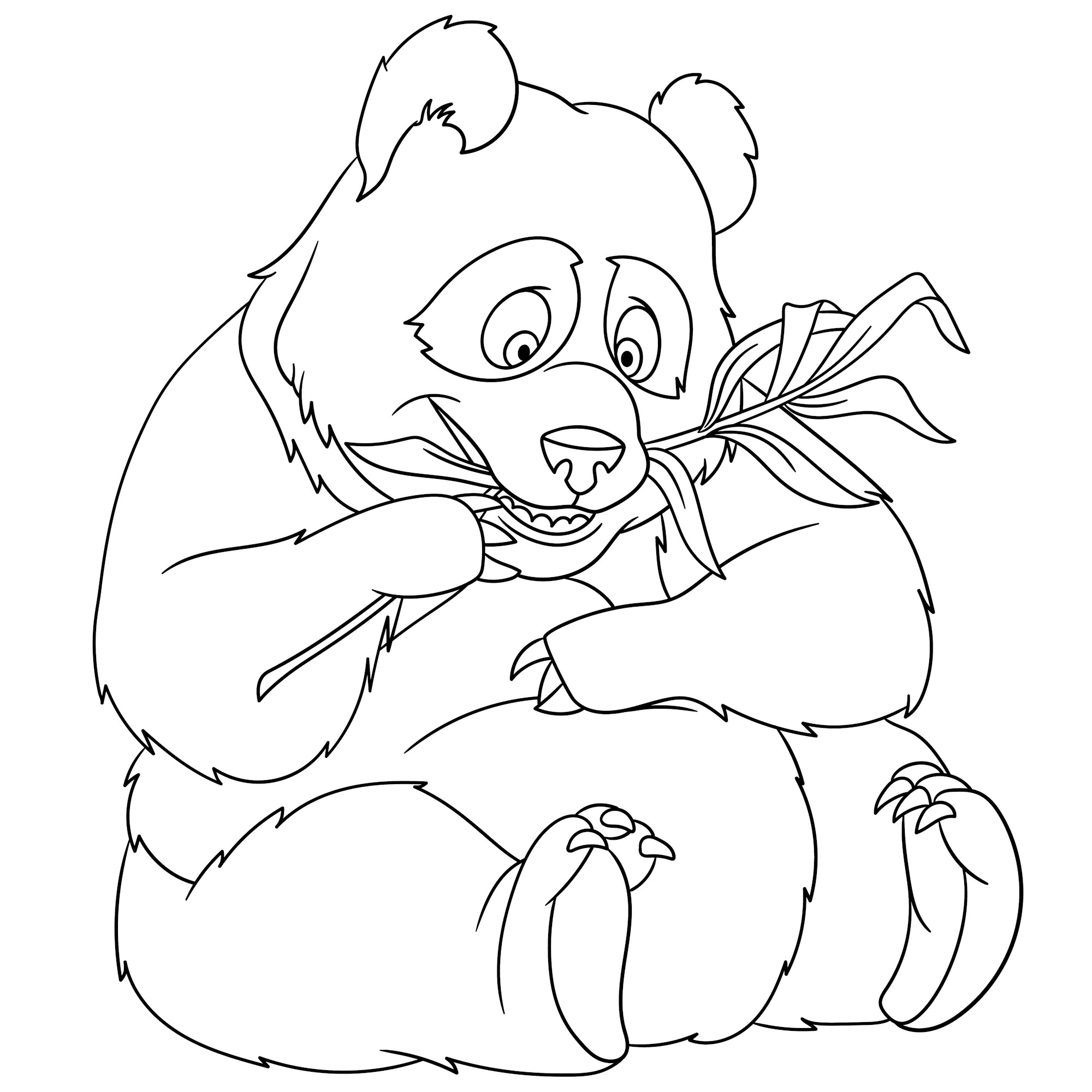
👩👧 Panda and Baby Eating Bamboo
The panda mother and baby chewing bamboo is another especially cute family scene.
Keep the familiar black-and-white markings but make the bamboo lush and colorful.
Try using several greens, with darker stems behind the pandas and lighter leaves closer to them.
Giant pandas are genuine members of the bear family, and bamboo makes up the overwhelming majority of their diet.
They have powerful jaws and teeth adapted for crushing tough plant material, as well as a modified wrist bone that functions rather like a “pseudo-thumb” when grasping bamboo.
🎋 Design a Bamboo Forest
Expand the panda page into an entire mountain forest.
Draw tall bamboo stems rising behind the animals.
Add:
- Rocks
- Mist
- Leaves
- Mountains
- Streams
- More bamboo
Use blue-gray in distant areas and stronger greens in the foreground.
This can help create a sense of depth.
Children can even hide another baby panda somewhere among the bamboo and challenge someone else to find it.
🐨 Wait — Is a Koala Really a Bear?
This collection includes several cute koala designs, but here is an important animal fact:
A koala is not actually a bear.
Koalas are marsupials native to Australia and belong to a completely different branch of the mammal family tree.
They are sometimes informally called “koala bears,” but koala is the more accurate name.
That makes the koala pages an excellent animal-classification activity.
Color the koala, then write:
Koala = marsupial
Brown bear = bear
You can explore more of these lovable Australian animals in our Coloring Pages of Koalas.
🌿 Koala Coloring Ideas
Koalas usually inspire shades of gray, silver-gray, brown-gray, cream, and white.
Use darker gray around the back and limbs, then keep the chest and ear fluff lighter.
Their large dark nose creates a strong contrast with the softer fur.
Surround the koala with eucalyptus-inspired leaves in sage, olive, blue-green, and deep green.
Or turn the whole picture into a kawaii fantasy with a lavender koala hugging a turquoise tree.
🐻 Meet the Eight Living Bear Species
There are eight living species in the bear family Ursidae.
They are:
- American black bear
- Brown bear
- Polar bear
- Giant panda
- Asiatic black bear
- Sloth bear
- Sun bear
- Andean or spectacled bear
They live across very different regions and habitats.
Some inhabit Arctic sea ice, while others live in mountain forests, tropical forests, temperate woodlands, and other environments.
The sun bear is the smallest living bear species, while polar bears are among the largest.
Older children can choose one species and create a separate wildlife fact card.
☀️ Meet the Sun Bear
The sun bear is the world’s smallest bear species.
It lives in tropical forests of Southeast Asia and is known for the pale yellowish or whitish chest marking that often resembles a rising sun.
That marking would be fun to recreate on a coloring page.
Use black or very dark brown for most of the fur and cream or golden yellow across the chest.
Then surround the bear with a lush tropical forest filled with broad green leaves.
The sun bear shows that bear habitats are not limited to cold mountains and snowy forests.
👓 Meet the Spectacled Bear
The Andean bear, also called the spectacled bear, is the only living bear native to South America.
Many have pale markings around their eyes that can look almost like glasses or spectacles.
Try coloring a pretend spectacled bear using black or dark brown fur with cream, beige, or pale yellow markings around the face.
Then add a green mountain-forest habitat.
Every individual can have slightly different facial markings, making the pattern a fun place for creative variation.
🌍 Bears Live in Many Habitats
Different bear species occupy very different parts of the world.
Bear habitats can include:
- Temperate forests
- Mountains
- Arctic sea ice
- Tropical forests
- Bamboo forests
- Grasslands
- Coastal areas
- Tundra
That gives you plenty of background choices.
A black bear might stand in a leafy North American forest.
A brown bear could be beside a salmon stream.
A polar bear can cross sea ice.
A panda belongs among bamboo-covered mountains.
Choose the species first and let its habitat guide your coloring.
🌲 Create a Bear Forest
Choose one of the simple bear pages and build an entire forest around it.
Add:
- Pine trees
- Birch trees
- Berry bushes
- Fallen logs
- Rocks
- Mushrooms
- Flowers
- Streams
Then decide on the season.
Spring: fresh greens and flowers.
Summer: deep green leaves and bright blue sky.
Fall: orange, red, gold, and brown.
Winter: snow, bare branches, and evergreen trees.
The same bear can become four completely different pictures.
🍂 Make an Autumn Bear Scene
Fall is especially fitting for black and brown bears because they may spend much of the season eating heavily before winter.
Use a warm palette of:
- Orange
- Rust
- Gold
- Burgundy
- Brown
- Olive
Cover the ground with leaves.
Add berry bushes, acorns, fallen branches, and perhaps a stream.
Color the bear brown, cinnamon, or black so it stands out against the autumn landscape.
For more seasonal fun, explore our Seasonal Coloring Pages.
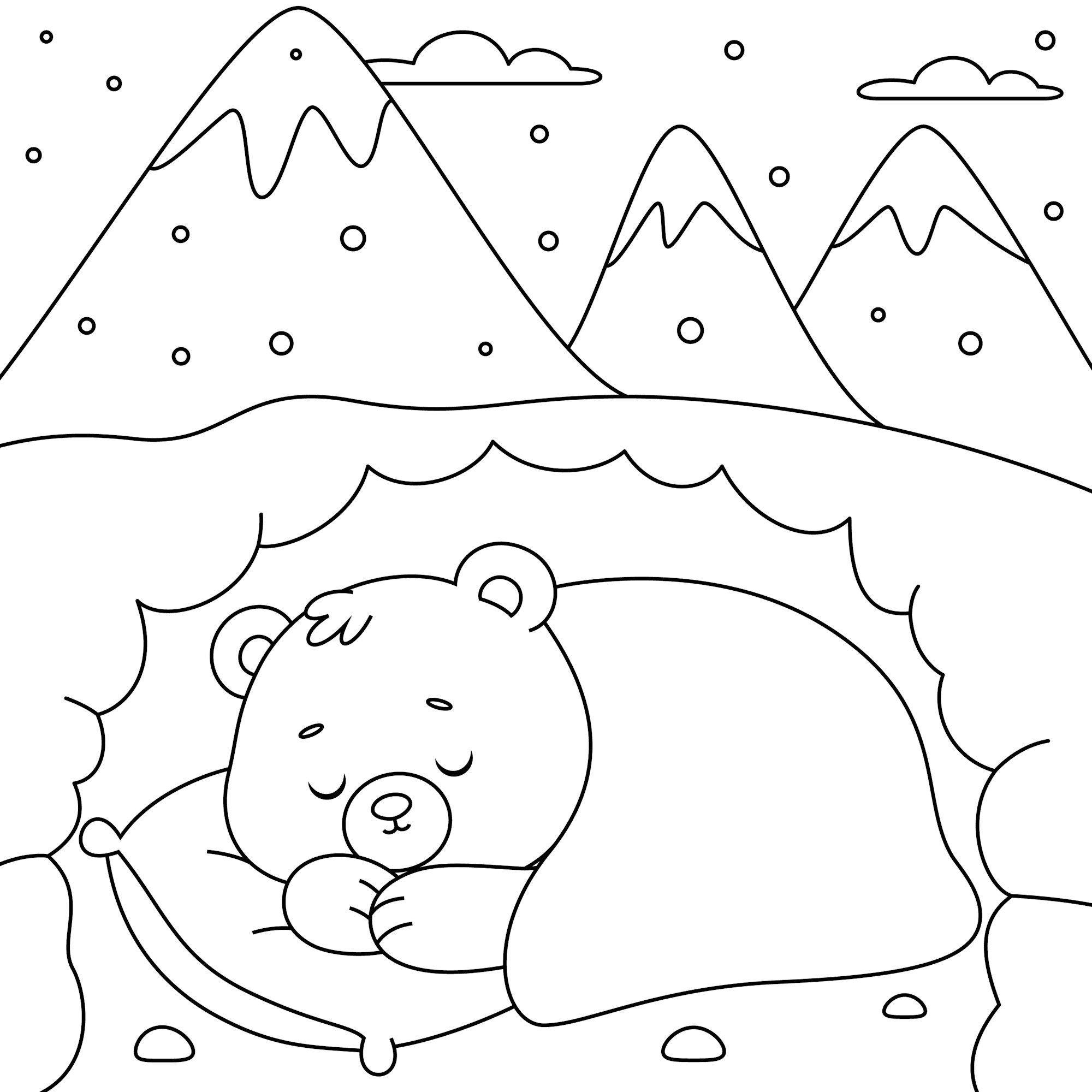
😴 Hibernating Bear in a Cave
One page shows a bear hibernating inside a cave, making it a perfect winter-learning activity.
Use gray and brown for the rock walls, then add darker shadows deeper inside the cave.
Give the sleeping bear a warm brown coat and perhaps place leaves, grass, or other nesting material around it.
Outside the den, draw snow and bare winter trees.
The contrast between the dark, sheltered cave and snowy outside world can create a cozy scene.
💤 Do Bears Hibernate?
Many bears spend part of the winter in dens, although bear winter dormancy is a little more complicated than the simple idea of sleeping continuously for months.
During winter denning, metabolism, heart rate, and breathing slow, allowing bears to rely largely on body fat stored during the warmer months.
The amount of time spent in a den depends on the species, climate, food availability, sex, and location.
Black and brown bears in colder regions may remain denned for months.
Polar bears are different: pregnant females use maternity dens, while most other polar bears remain active through winter.
🍂 Bears Eat a Lot Before Winter
Before denning, bears in seasonal climates can enter a period of intense feeding known as hyperphagia.
They consume large amounts of food to build fat reserves that will help sustain them during winter.
That makes a fall bear coloring page perfect for drawing a woodland feast.
Add:
- Berries
- Nuts
- Plants
- Fruit
- Fish
What foods appear will depend on the species and habitat.
Children can fill the page with things their imaginary bear hopes to find before winter arrives.
🍼 Bear Cubs Can Be Born in Winter Dens
Pregnant black and brown bears can give birth while denned during winter.
Tiny cubs remain protected inside with their mother, nursing and growing until the family eventually emerges.
Turn this into a simple life-cycle drawing.
Create four pictures:
1. Bear preparing a den
2. Mother bear in the den
3. Cubs with their mother
4. Family emerging in spring
Arrange the pictures in order and add arrows between them.
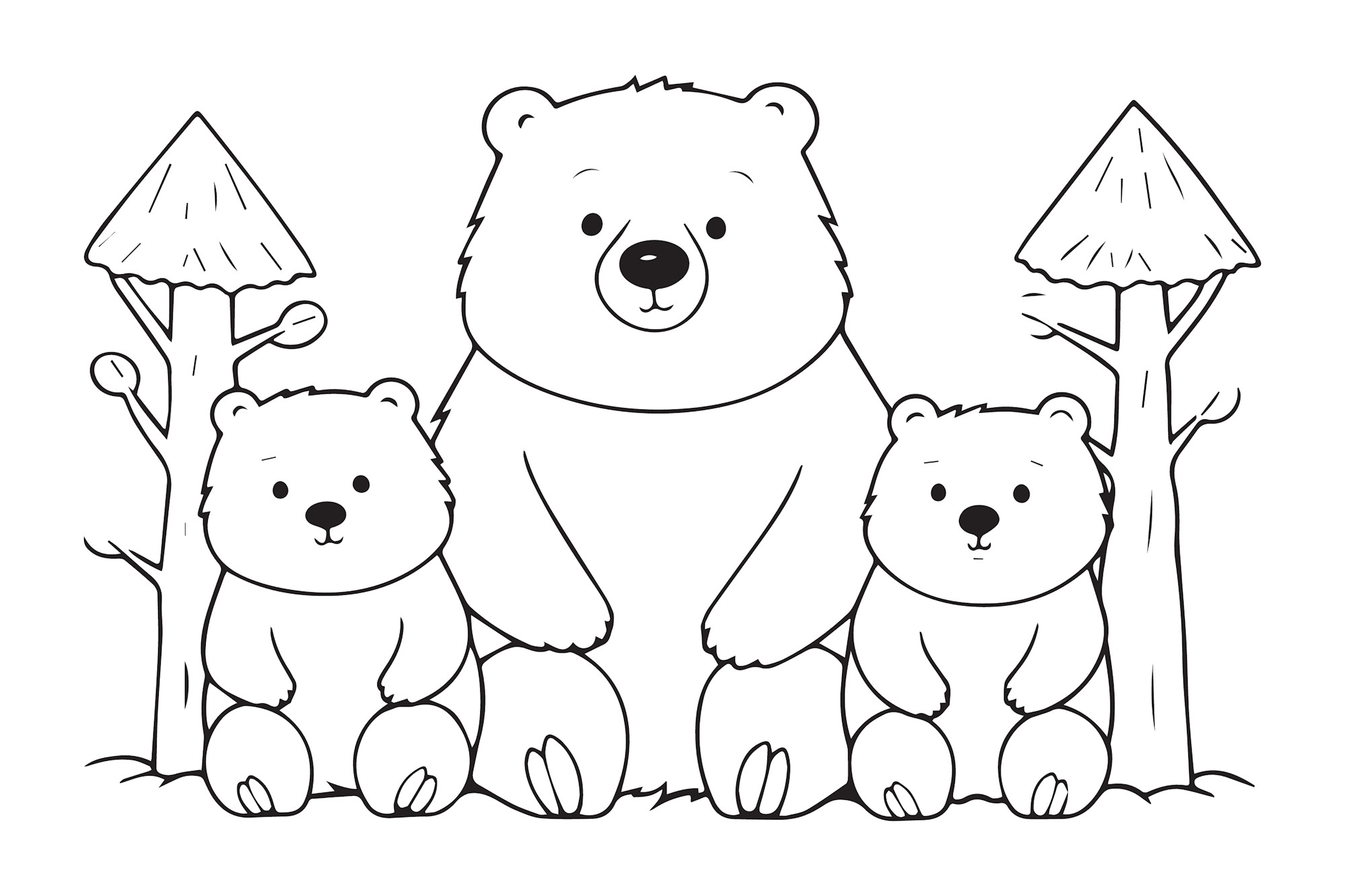
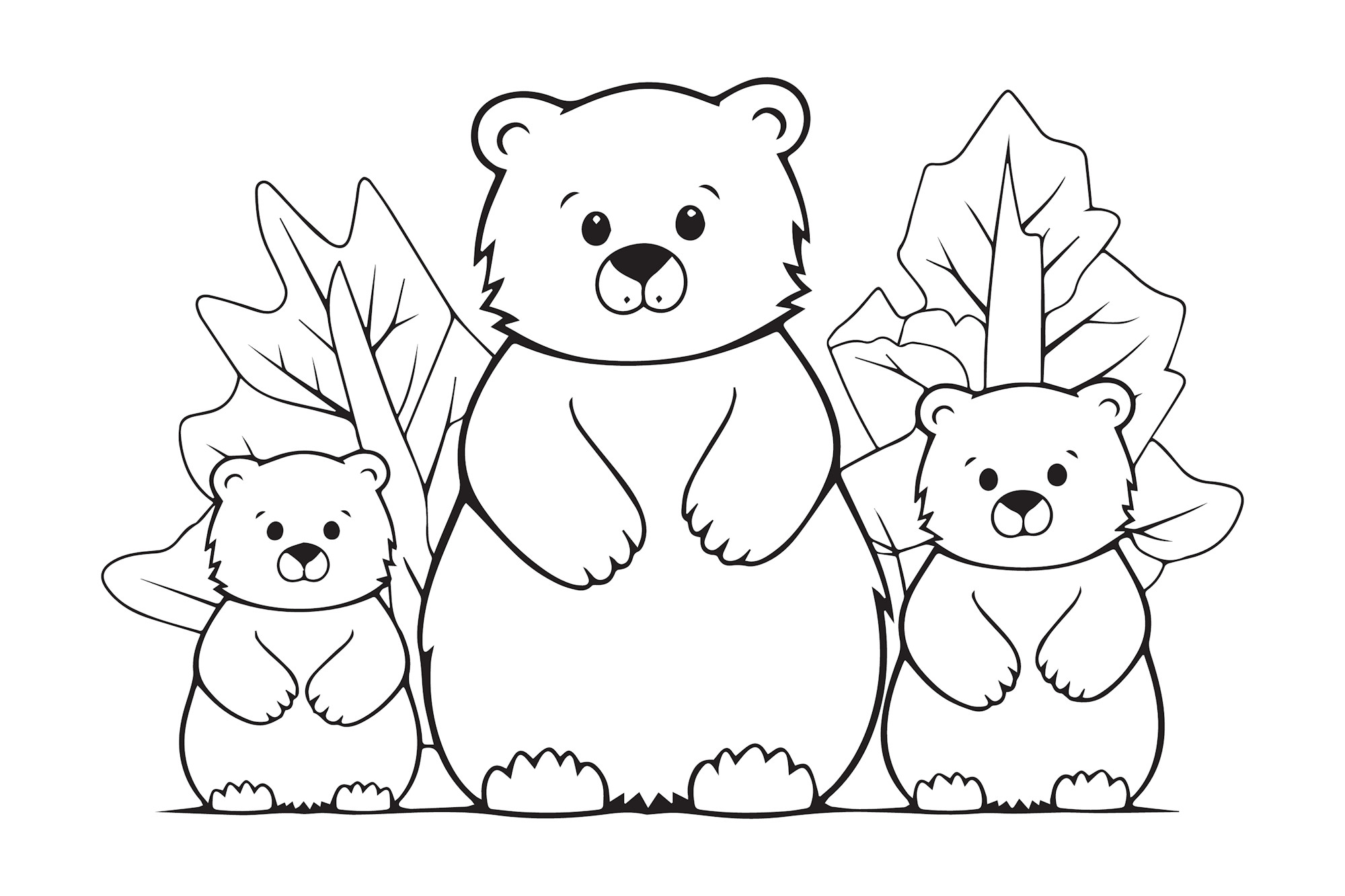
👩👧 Mother Bear and Cubs
Bear cubs depend heavily on their mothers.
Depending on the species, young bears may remain with their mothers for an extended period while they learn how to find food and navigate their environment.
The parent-and-cub pages can therefore become more than cute pictures.
Draw the mother leading her cub through the habitat.
Perhaps she is showing it where berries grow, how to cross a stream, or where to find shelter.
Give the two bears slightly different shades so they are easy to tell apart.
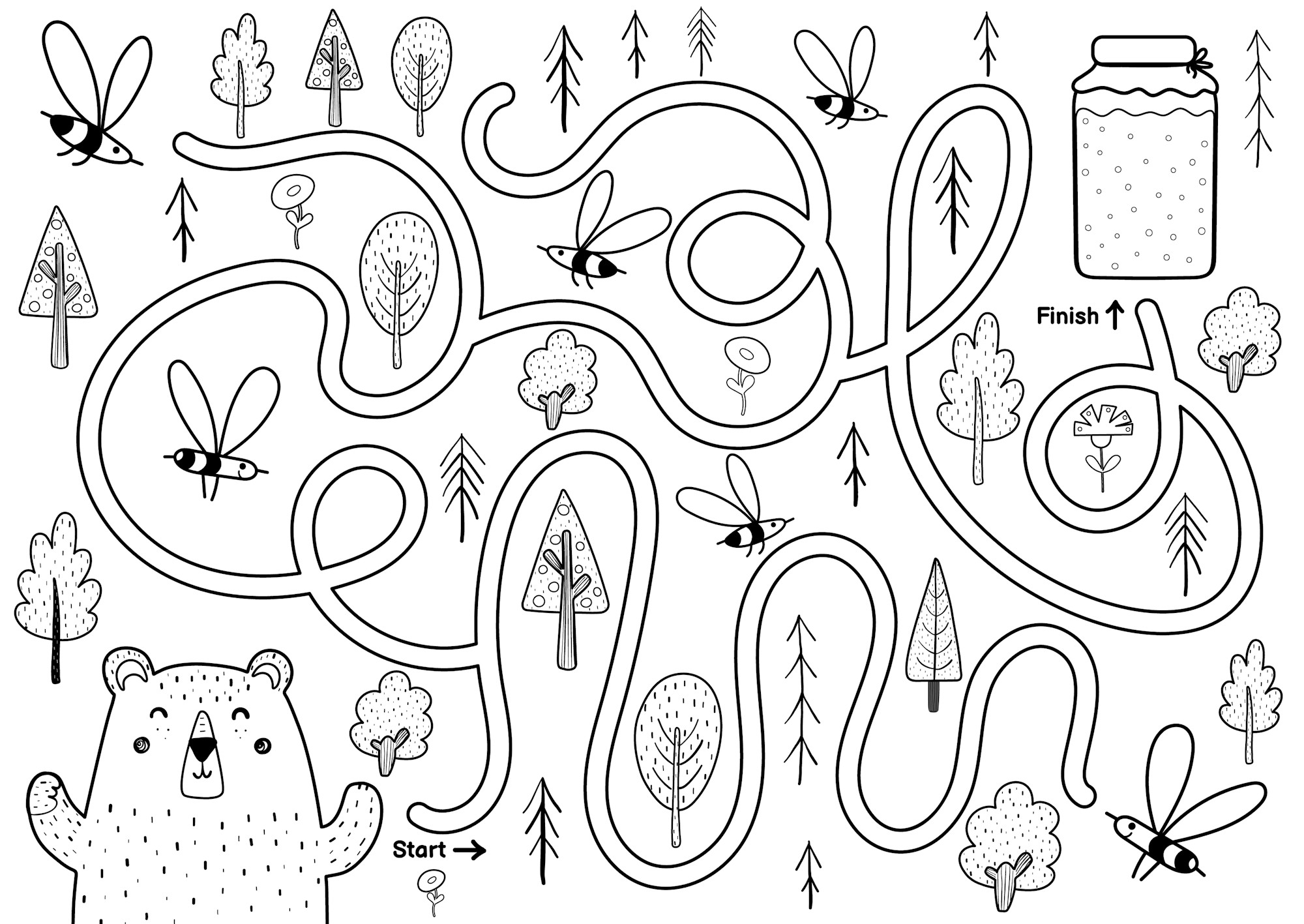
🍯 Bear and Honey Maze
One printable is an interactive maze where children help a hungry bear find its way to honey.
Begin at the bear and trace the route lightly with a finger before using a crayon or pencil.
Once you find the correct path, color it brightly.
Then decorate the rest of the page.
Make the honey golden yellow and add bees, flowers, trees, or a beehive around the maze.
This printable offers a nice change from ordinary coloring because children get a little puzzle to solve too.
🍯 Do Bears Really Love Honey?
The bear-and-honey connection is famous in children’s stories, but a wild bear’s diet is much more varied.
American black bears are omnivores and may eat plant material, berries, nuts, insects, carrion, fish, and other foods depending on what is available.
If a bear finds a bee colony, it may be interested not only in honey but also in the insects and larvae inside.
So a jar of honey is not exactly the typical bear meal shown in cartoons.
After completing the maze, children can draw several more foods a real bear might encounter.
🐟 Create a Salmon-Fishing Bear
Brown bears in some coastal regions have access to salmon runs, producing one of the most famous wildlife scenes associated with bears.
Draw a river beneath your bear.
Add several fish in the water and rocks along the shore.
Use turquoise, blue, gray, and white for moving water.
The bear can be warm brown or golden, creating a strong contrast against the cool-colored river.
Add pine trees or mountains in the distance for a complete wilderness picture.
🍓 What Do Bears Eat?
There is no single bear diet.
Different species and populations may eat very different foods.
Depending on the bear, foods can include:
- Berries
- Grasses
- Roots
- Nuts
- Insects
- Fish
- Other animals
- Bamboo
- Marine prey
Giant pandas specialize heavily on bamboo.
Polar bears depend largely on seals.
Black and brown bears can be much more flexible omnivores.
That makes bears an excellent example of how closely an animal’s diet can be connected with its habitat.
🐾 Bears Have Powerful Paws
Bear paws are useful for walking, digging, climbing, searching for food, and other activities.
Different species have different adaptations.
Black bears are capable climbers and have curved claws.
Brown bears have especially long front claws that are useful for digging.
Polar bears have very large paws suited to their Arctic environment and swimming lifestyle.
Look at the paws on your coloring page.
Then draw three oversized paw prints underneath.
Fill each print with a different pattern or color.
👃 Bears Have an Excellent Sense of Smell
Bears rely heavily on scent to investigate their surroundings.
Turn this into a simple imaginative activity.
Pretend your bear is walking through a forest.
What might it smell?
Perhaps:
- Berries
- Flowers
- Water
- Another bear
- A fallen log
- Food
Draw three things around the bear and connect them to its nose with wavy scent lines.
Children can invent silly smells too. Maybe the cartoon bear discovers a giant birthday cake hidden behind a tree.
🐻 Bears Are Usually Wild Animals, Not Cuddly Pets
Cute coloring pages can make bears look wonderfully huggable, but real bears are powerful wild animals.
When visiting places where bears live, people should observe wildlife responsibly, follow local safety instructions, secure food appropriately, and never approach or feed wild bears.
For younger children, keep the rule easy:
Look from far away and let wild animals stay wild.
A coloring-page bear can be hugged all you like.
A real one needs space.
🌈 Create a Fantasy Bear Species
After learning about real bears, invent one that has never existed.
Maybe you create a:
Rainbow Bear — every section of fur has a different color.
Moon Bear — navy fur with silver stars.
Flower Bear — blossoms grow throughout its coat.
Candy Bear — pink, lavender, mint, and peach.
Autumn Bear — rust, orange, gold, and burgundy.
Ice Bear — turquoise and silver with sparkling paws.
Give your new species a name and decide what it eats and where it lives.
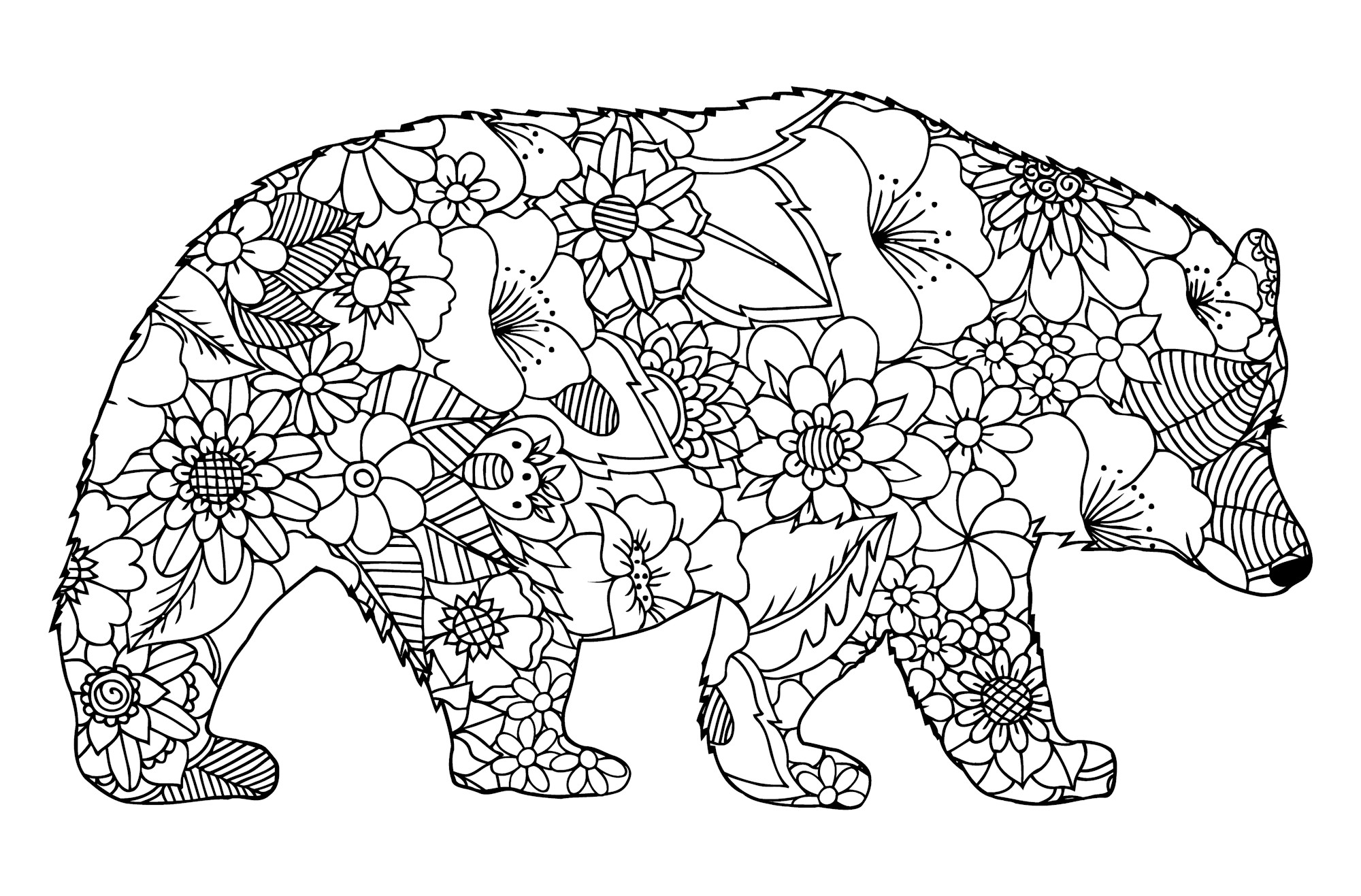
🌀 Floral Zentangle Bear
The bear silhouette created from flowers and zentangle-like details is ideal for older children and adults.
Instead of thinking about natural bear fur, treat every floral section as its own miniature coloring project.
Try:
Wildflower Bear: pink, lavender, yellow, blue, and green
Autumn Bear: burgundy, orange, rust, gold, and olive
Jewel Bear: emerald, sapphire, purple, turquoise, and gold
Moonlight Bear: navy, silver, lavender, teal, and pale blue
Repeating the same small palette throughout the page can make the complicated design feel coordinated.
🌸 Turn the Bear Into a Garden
For a completely imaginative approach, make the floral bear look as though it is made from plants.
Color leaves green, flowers pink and purple, vines teal, and small details gold.
Then draw extra flowers growing around its paws.
Perhaps this magical creature spends winter underground and returns every spring covered with fresh blossoms.
Give it a name such as the Garden Bear or Wildflower Bear and write a short story about it.
🔤 B Is for Bear
Bear pages fit naturally into preschool alphabet practice.
Write:
B b
Then say:
B is for bear.
Think of more B words:
- Ball
- Bird
- Banana
- Butterfly
- Book
- Blue
Children can draw several B objects around the bear.
Maybe a blue bear reads a book beneath a tree while butterflies fly overhead.
For more alphabet practice, visit our Alphabet Letter Coloring Pages.
🔢 Count the Bears
Bear-family pages are perfect for counting.
Ask children to count:
- Bears
- Cubs
- Paws
- Trees
- Berries
- Snowflakes
Then add your own objects.
“Draw three berries.”
“Add four snowflakes.”
“Put two trees behind the bears.”
“Color five flowers.”
The picture becomes a simple math activity without needing a separate worksheet.
🗺️ Put Bears on a World Map
Bear species live across several regions of the world.
Older children can connect coloring with geography by finding:
- North America
- South America
- Europe
- Asia
- Arctic regions
Giant pandas can be connected with China, while Andean bears belong in South America and polar bears occupy the circumpolar Arctic.
Koalas can go on Australia—but remember that they belong in a marsupial category rather than the bear family.
🧩 Bear or Not a Bear?
Use this collection for a fun animal-classification game.
Bears
- Brown bear
- Black bear
- Polar bear
- Giant panda
- Sun bear
Not Bears
- Koala
- Teddy bear
The koala is a real animal but a marsupial.
The teddy bear is a toy.
Children can color pictures from all three categories and sort them afterward.
🦁 Build a Zoo Animal Collection
Bears can become part of a much larger pretend zoo.
Add:
Give each animal its own habitat and information sign.
Then arrange the pages around a room or classroom and take a pretend zoo tour.
You can find even more animals in our Coloring Pages of Zoo Animals.
🏷️ Make a Bear Fact Card
Turn one finished bear into a homemade wildlife card.
For an American black bear, write:
Animal: American Black Bear
Animal group: Mammal
Family: Ursidae
Diet: Omnivore
Young: Cub
Then add one favorite fact.
Older children can make cards for several bear species and compare them.
Soon the coloring pages become an illustrated bear guide.
📖 Turn Your Bear Into a Story
The collection offers plenty of story starters.
Where is the baby bear going?
What is happening at the teddy-bear picnic?
Why is the bear heading to school?
What are the polar bear cubs doing in the snow?
Why has the grizzly discovered the berry patch?
And what happens when the magical flower bear comes to life?
Give a character a name and write several sentences about what happens next.
Children who are not writing yet can tell the story aloud while an adult writes it down.
🏫 Bear Coloring Pages for the Classroom
Bear printables can fit naturally into animal, forest, Arctic, winter, habitat, and mammal lessons.
Teachers and homeschool families can use them for:
- Mammal units
- Forest studies
- Arctic lessons
- Winter themes
- Habitat projects
- Animal classification
- Letter B practice
- Counting
- Mazes
- Creative writing
- Early-finisher activities
- Classroom displays
Different students can choose different bear species and combine their finished work into a display titled:
Bears Around the World
For more learning-focused printables, explore our Educational Coloring Pages & Activities.
🌎 Learning About Bear Conservation
Different bear species face different conservation challenges.
Habitat loss and fragmentation, climate change, conflicts with people, illegal wildlife trade, and other pressures can affect bear populations depending on the species and location.
The polar bear is particularly dependent on Arctic sea ice, while giant panda conservation has focused heavily on protecting and reconnecting mountain bamboo habitat.
For young children, keep the central message simple:
Wild bears need healthy places to live.
Draw everything a bear might need around the finished coloring page—food, water, shelter, space, and a suitable habitat.
🌲 Create a Protect Bears Poster
Turn a completed bear picture into a wildlife poster.
Add a message such as:
Protect Bears
Wildlife Needs Wild Places
Keep Forests Wild
Protect Arctic Wildlife
or
Learn About Bears
Choose a message appropriate for the species you colored.
A polar bear poster can feature sea ice and ocean water, while a black bear poster could be surrounded by forest habitat.
✂️ Bear Coloring Page Crafts
Finished bear pages can become:
- Wildlife posters
- Animal fact cards
- Forest collages
- Winter decorations
- Homemade storybooks
- Puppets
- Bookmarks
- Classroom displays
- Zoo exhibits
- Nature notebooks
For an easy craft, cut out a finished bear and glue it onto a larger sheet of construction paper.
Then build its habitat around it using colored paper, cotton snow, leaves, yarn, or other craft materials.
🧸 Make a Teddy Bear Picnic Collage
Color the teddy-bear family and cut out the characters.
Glue them onto a larger piece of paper and create a picnic using scraps of patterned paper.
Add:
- Picnic blanket
- Basket
- Fruit
- Sandwiches
- Flowers
- Trees
- Sunshine
Children can even glue small pictures of their favorite foods onto the picnic blanket.
The printable becomes the beginning of a larger mixed-media craft.
🖍️ Coloring Tips for Bear Fur
Realistic fur looks best when it includes more than one shade.
For brown bears, try layering:
- Tan
- Golden brown
- Chestnut
- Chocolate
- Gray-brown
- Cream
Use short pencil strokes that follow the direction of the fur.
For black bears, combine charcoal, black, and dark brown so details remain visible.
Polar bears can use pale gray, blue-gray, and lavender shadows.
Pandas need strong black-and-white contrast.
And cartoon bears can ignore all of these suggestions and become whatever color you like.
🖨️ How to Use Your Bear Coloring Pages
Choose your favorite bear design and print it at home or in the classroom.
Regular printer paper works well for crayons and colored pencils. Heavier paper may be useful if you plan to add markers, paint, glue, glitter, cotton snow, or other craft materials.
Then decide what kind of bear adventure you want.
Perhaps a cub explores a green woodland, a polar bear crosses sparkling snow, a panda munches bamboo, a teddy-bear family enjoys a picnic, or a magical floral bear wanders through an enchanted forest.
Every printable can become a completely different story.
🐻 Have a Bear-y Fun Coloring Adventure
From cute baby bears and kawaii forest characters to teddy-bear picnics, polar bear families, giant pandas, hibernating bears, berry-loving grizzlies, mazes, and intricate floral zentangle designs, this collection offers plenty of ways to explore bears through art.
Use realistic browns, blacks, whites, and creams, invent a rainbow bear, learn how different bear species live, create a winter den, solve the honey maze, build a forest habitat, or turn your finished picture into a wildlife story.
And when you reach the koalas, remember the fun classification surprise: they may look wonderfully bear-like, but they are marsupials rather than bears.
Choose your favorite page, gather your colors, and begin your next bear adventure.
🔗 Related Articles
- Animal Coloring Pages
- Cute Coloring Pages
- Coloring Pages of Koalas
- Coloring Pages of Lions
- Coloring Pages of Tigers
- Wolf Coloring Pages
- Coloring Pages of Monkeys
- Coloring Pages of Zoo Animals
- Nature Coloring Pages
- Educational Coloring Pages & Activities
📚 Sources
- National Park Service — Black Bears
- National Park Service — Brown Bears at Lake Clark
- National Park Service — When Bears Prepare for Winter
- U.S. Fish & Wildlife Service — Polar Bear
- Smithsonian’s National Zoo — Giant Panda
- San Diego Zoo Wildlife Alliance — Bears
- Australian Museum — Koala