🖍️Shop Tiger Coloring Books –>

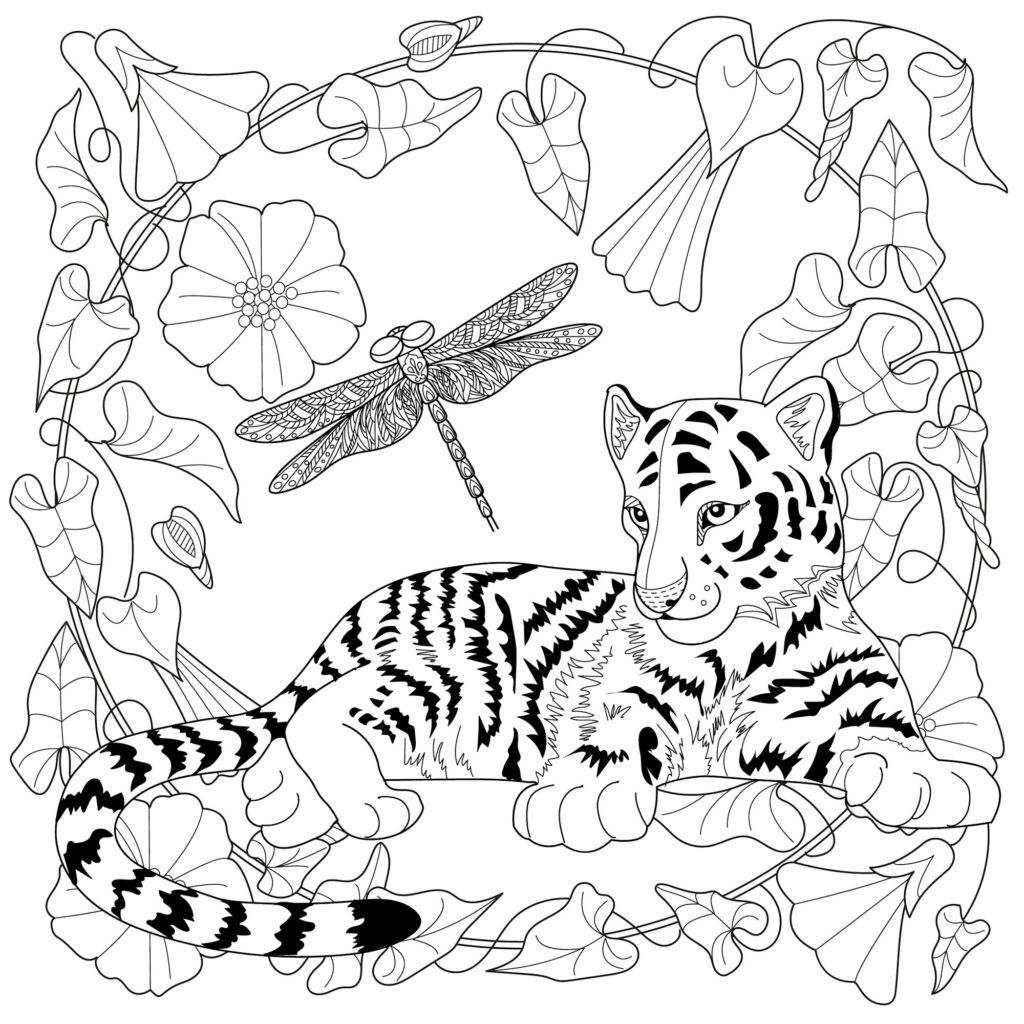

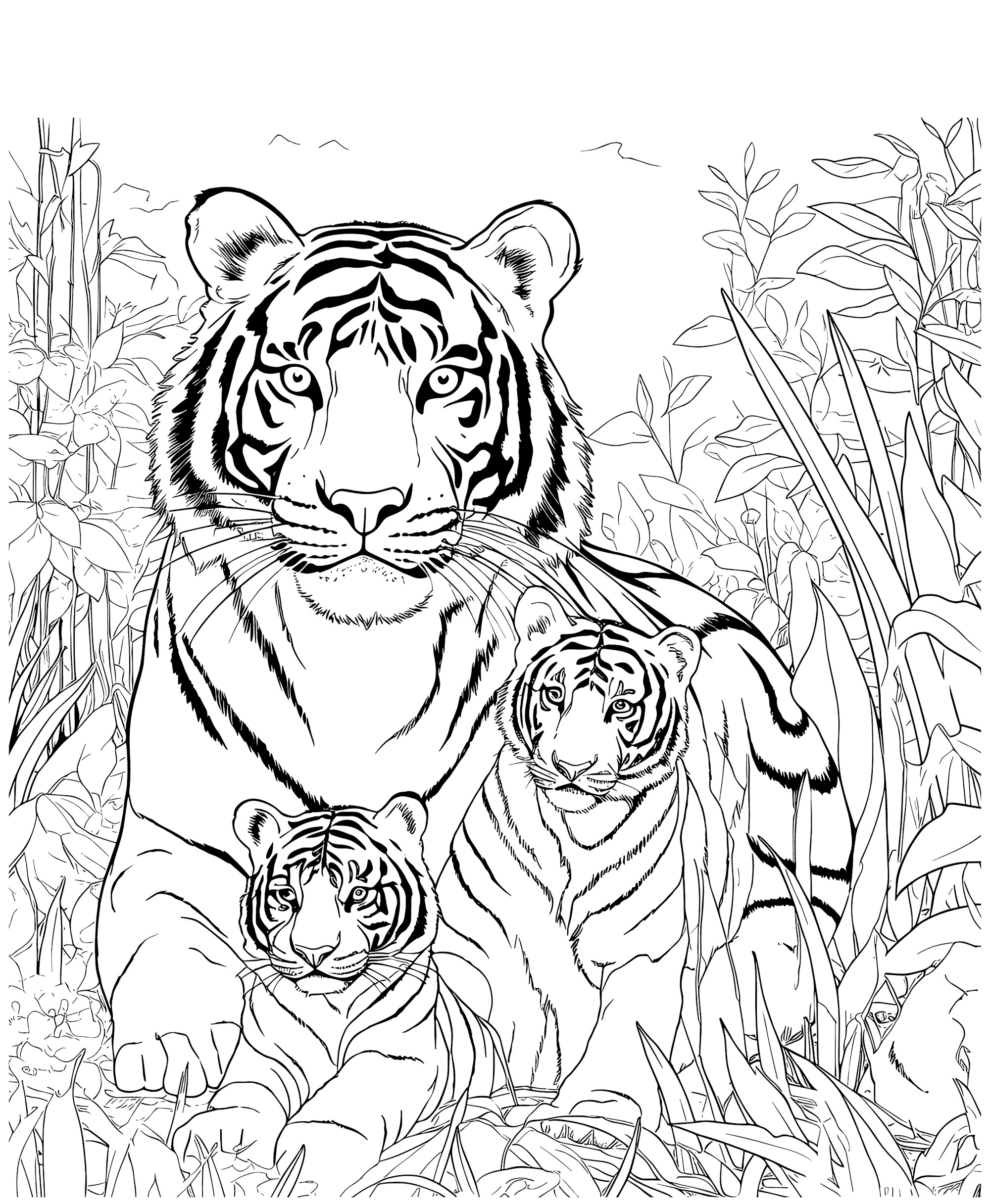
Step into the wild with our collection of tiger coloring pages, featuring adorable tiger cubs, a mother and baby, cute kawaii designs, and detailed doodle artwork for colorists who enjoy something a little more intricate.
Tigers are especially fun to color because their famous stripes create a natural pattern across the entire animal. You can reach for traditional orange, black, and white, experiment with the softer tones of a tiger cub, or forget realism altogether and create a blue tiger, rainbow-striped big cat, or pastel kawaii tiger.
Some of these printable tiger pages are simple enough for younger children, while the more detailed designs offer older kids and adults plenty of tiny patterns to fill. Choose your favorite, grab your crayons, markers, or colored pencils, and let your creativity roar.
🐯 Explore Our Tiger Coloring Pages
Our collection includes several different styles of tiger artwork, allowing children and grown-up colorists to choose a picture that suits them.
You’ll find a cute kawaii tiger with a baby, perfect for anyone who loves sweet animal characters. There is also a tiger mother with her cub, a traditional tiger page designed with younger children in mind, and a detailed tiger-cub illustration filled with doodle and zentangle-inspired patterns.
That combination makes the collection useful for quick coloring sessions as well as longer projects where you want to experiment with shading, patterns, and carefully coordinated colors.
For even more wildlife to color, explore our complete Animal Coloring Pages collection.
🧡 Cute Kawaii Tiger and Baby
Few things are more adorable than a tiger cub, and the kawaii tiger and baby coloring page turns these powerful wild cats into irresistibly cute characters.
Traditional orange and black will always work well, but kawaii artwork is the perfect excuse to experiment with softer colors. Try peach, pale orange, pink, lavender, mint green, or baby blue.
You could give the adult tiger and cub matching colors or make each one completely different. Add rosy cheeks, little hearts, flowers, stars, or a sunny background to make the scene even sweeter.
Kids can also give the two tigers names and imagine what they are doing together. Maybe the cub is learning to explore the forest, practicing a tiny roar, or getting ready for a nap beside its mother.
🐅 Tiger Mom and Baby Coloring Page
The tiger mother and baby scene offers a natural opportunity to talk about how tiger cubs grow.
Young cubs depend on their mothers for protection and food and remain with them while they develop the skills they will eventually need to live independently. A mother-and-cub coloring page can therefore become a gentle introduction to animal families and life cycles.
Try coloring the mother in rich burnt orange, black, cream, and white. Make the cub slightly lighter or give it softer orange tones so the two animals look related without being identical.
Then add a habitat around them. Depending on the picture and your imagination, you might draw tall grasses, forest plants, trees, rocks, a stream, or distant mountains.
🐾 Easy Tiger Coloring Page for Kids
The simpler tiger coloring page for kids is a good choice for younger artists who want to focus on the animal without dealing with lots of tiny patterns.
Tiger stripes make even simple pictures interesting. Children can color the orange areas first and then carefully fill in the darker stripes—or completely reverse the usual colors.
A young artist might create:
- A purple tiger with pink stripes
- A blue tiger with silver stripes
- A red tiger with black stripes
- A rainbow tiger
- A golden tiger
- A pastel tiger
- A tiger covered in stars or dots
The finished tiger does not need to resemble a wildlife photograph. Coloring is a chance to learn about real animals while still letting imagination make the final decisions.
🌀 Zentangle Tiger Cub Coloring Page
The doodle and zentangle-style tiger cub is the most detailed design in the collection and is especially well suited to older children, teens, and adults.
Rather than coloring large sections of fur in a single shade, use the small patterns as individual areas of color.
You could create a traditional tiger palette using orange, rust, brown, cream, and black, or choose a decorative palette such as turquoise, violet, navy, and silver.
For a more coordinated result, select four or five colors before you begin and repeat them throughout the design. This helps a complicated page feel unified without requiring a different color for every tiny shape.
Fine-tip markers and sharpened colored pencils can be particularly helpful with intricate pages.
🎨 What Colors Are Tigers?
The tiger most people picture has reddish-orange fur with dark stripes and lighter or white areas, especially around parts of the face and underside. But even realistic tiger coloring does not require just one orange crayon.
Try combining several shades:
- Pale orange
- Golden orange
- Burnt orange
- Rust
- Brown
- Cream
- White
- Charcoal
- Black
Begin with a lighter orange across the body and add darker orange or brown around the legs, shoulders, and shaded areas. Then color the stripes.
Leaving the muzzle, chest, and some facial areas pale can create more contrast.
🖤 Every Tiger Has Its Own Stripes
One of the most fascinating things about tigers is that their stripe patterns vary from animal to animal. Researchers can use these distinctive markings to help identify individual tigers.
That makes a tiger coloring page a perfect place to experiment with pattern.
Instead of thinking of the stripes as something that must be copied perfectly, encourage children to design their own.
Make some stripes thick and others thin. Add zigzags. Create tiny stripes beside enormous ones. Turn a few into hearts or lightning bolts.
When the page is finished, the coloring-paper tiger will have its own unique pattern too.
🌿 Where Do Tigers Live?
Wild tigers are native to Asia, where they live across a surprisingly wide variety of habitats. Depending on the population, tigers can be found in forests, grasslands, mangrove swamps, and other environments.
This gives kids plenty of possibilities when adding backgrounds to their tiger pictures.
A tiger could walk through:
- Tall grass
- A tropical forest
- A mangrove wetland
- A cool woodland
- A riverbank
- Bamboo and leafy vegetation
Choose one habitat and draw it behind the finished animal.
Older children can take the activity a step further by finding Asia on a world map and learning where wild tiger populations remain today.
🌳 Build a Tiger Habitat
A tiger page with a simple background can easily become an entire habitat project.
Begin by thinking about what the animal needs. Wild animals require access to food, water, shelter, and enough suitable habitat to survive.
Draw trees, grasses, water, rocks, fallen logs, and dense vegetation around your tiger.
You can also add other animals that might share parts of a tiger’s range, but remember that a tiger is a wild predator rather than an animal living happily in a cartoon neighborhood with every creature it encounters.
For more outdoor inspiration, visit our Nature Coloring Pages.
🍖 What Do Tigers Eat?
Tigers are carnivores and powerful predators. In the wild, they hunt other animals, with prey including species such as deer and wild boar.
Their hunting style relies heavily on stealth. A tiger can use vegetation and its striped coat to help break up the outline of its body as it approaches or waits for prey.
That gives children another interesting coloring challenge.
After coloring a tiger, create a forest or grassland background that uses some of the same oranges, browns, greens, and shadows. Then see how much the stripes help the animal blend into the picture.
💦 Tigers Can Swim
Cats are often associated with avoiding water, but tigers are strong swimmers and may readily enter rivers and other bodies of water.
That makes a swimming tiger an especially fun extra drawing project.
Draw your tiger moving through blue-green water with only its head and upper back visible. Add ripples around its body and trees along the shore.
You could also transform an existing tiger page by drawing a river behind the animal.
Use turquoise, navy, aqua, and pale blue for the water, then add white highlights where sunlight catches the ripples.
👶 Tiger Cubs Grow Up With Mom
Tiger cubs generally stay with their mother for an extended period while growing and learning the skills needed for independence.
This makes the mother-and-baby pictures more than simply cute designs.
Ask children what a cub might need to learn.
It could practice:
- Walking quietly
- Exploring its surroundings
- Climbing over logs
- Following its mother
- Swimming
- Recognizing sounds and smells
- Eventually learning to hunt
After coloring the mother-and-cub page, draw another picture showing the cub practicing one of these skills.
😺 Tigers and House Cats
A tiger and a pet cat look very different in size, but both belong to the cat family.
Have kids compare the tiger on the coloring page with a familiar house cat.
Look for similarities such as:
- Whiskers
- Fur
- Paws
- Claws
- Tails
- Pointed canine teeth
- Cat-like ears
Then look at the differences, especially size, markings, behavior, and lifestyle.
This makes a simple coloring activity an easy introduction to comparing animals.
🦁 Tiger vs. Lion
Tigers and lions are two of the world’s most recognizable big cats, but they make very different coloring subjects.
A tiger’s stripes immediately create a strong pattern, while male lions are famous for their large manes. Tigers also generally live more solitary lives, whereas lions are unusually social cats that often live in groups called prides.
Try coloring one tiger and one lion and placing the finished pages side by side.
Children can then make a short list of what the animals have in common and what makes each one different.
Continue your big-cat coloring adventure with our Coloring Pages of Lions.
🌈 Create a Fantasy Tiger
Once you have colored a realistic tiger, print another page and do the complete opposite.
Imagine that the tiger lives in a magical world.
A Moon Tiger might have midnight-blue fur and silver stripes.
A Sunset Tiger could blend orange, coral, magenta, and purple.
A Jungle Magic Tiger might be emerald green with turquoise stripes.
A Candy Tiger could combine pastel pink, lavender, mint, and pale yellow.
You can also add patterns inside the stripes, decorate the fur with stars or flowers, or give the animal a glowing fantasy background.
✏️ Design Your Own Tiger Stripes
Tiger stripes provide an easy drawing activity even without another printable.
Draw a simple tiger outline or large cat shape and leave the body blank.
Then invent a completely original stripe pattern.
Try:
- Traditional curved stripes
- Zigzag stripes
- Wavy stripes
- Lightning bolts
- Tiger spots
- Hearts
- Stars
- Geometric shapes
Children could design several imaginary tiger species, each with a different pattern and name.
Maybe the Rainbow Mountain Tiger has multicolored stripes, while the Midnight Forest Tiger is dark blue with silver markings.
🗺️ Tigers and Geography
Tiger coloring pages can fit naturally into a simple geography activity because wild tigers are native to Asia.
Find Asia on a globe or world map, then locate some of the broad regions associated with tiger populations, including South Asia, Southeast Asia, eastern Russia, China, and the Indonesian island of Sumatra.
Younger children do not need to memorize locations. Simply connecting the animal with a real part of the world is valuable.
Older students can choose one tiger population and create a small fact page showing its location and habitat.
🌏 Learning About Tiger Conservation
Tigers are classified as endangered, and wild populations continue to face serious pressures including habitat loss, poaching, and conflict with people.
For younger children, conservation can be introduced with a very simple idea: wild animals need safe places to live.
Ask what might happen if a forest becomes too small or disconnected for an animal that requires a large territory.
Then invite children to draw a healthy tiger habitat filled with trees, vegetation, water, and plenty of space.
Coloring a favorite animal can become the beginning of understanding why protecting wildlife and habitats matters.
🏫 Tiger Coloring Pages for Classrooms
Tiger printables can fit easily into lessons involving animals, mammals, habitats, Asia, endangered species, patterns, and wildlife.
Teachers and homeschool families might use them for:
- Animal units
- Mammal lessons
- Habitat projects
- Asia geography activities
- Endangered-species lessons
- Zoo units
- Art centers
- Early-finisher activities
- Creative writing
- Wildlife bulletin boards
Children can color a tiger and add three facts underneath it to create an easy animal report.
For more ideas that combine creativity and learning, explore our Educational Coloring Pages & Activities.
🦓 Create a Wildlife Coloring Collection
Tigers can also become part of a much larger collection of wild-animal artwork.
Color a tiger one day and choose another animal the next. Over time, kids can create their own homemade wildlife book containing animals from different habitats and continents.
Try adding:
Lions, Elephants, Zebras, Bears, and Koalas.
Write the animal’s name on every page and add one interesting fact. Staple or bind the finished sheets together to create a personalized animal book.
🦒 Make a Pretend Zoo
Another fun option is to combine tiger coloring with our zoo-themed pages.
Children can color several different animals and arrange the pictures around the room to create a pretend zoo.
Make signs for each animal and include simple information such as:
Animal: Tiger
Scientific name: Panthera tigris
Food: Meat
Animal group: Mammal
Native region: Asia
Add lions, elephants, zebras, giraffes, monkeys, and other favorites until your pretend zoo is complete.
Find more animals in our Zoo Animal Coloring Pages collection.
📖 Turn Your Tiger Into a Story
Every tiger picture can become the beginning of an adventure.
Give the tiger a name and decide what it is doing.
Maybe a cub has wandered slightly farther from its mother than usual and discovers something strange beside a river. Perhaps the kawaii tiger and baby are searching for the perfect sleeping spot.
A fantasy tiger might guard a magical forest where the trees glow at night.
Children can tell their stories aloud, write a few sentences beside the finished picture, or create several drawings that show what happens next.
The detailed zentangle tiger could even inspire a story explaining how the animal got its mysterious patterned coat.
✂️ Tiger Coloring Page Crafts
Finished tiger pictures do not have to disappear into a pile of paper.
Turn them into:
- Wildlife posters
- Animal fact cards
- Classroom displays
- Homemade books
- Story illustrations
- Zoo decorations
- Bookmarks
- Scrapbook pages
- Bedroom artwork
- Habitat collages
Children can also cut out a finished tiger and glue it onto a larger piece of paper, then draw an entire forest habitat around it.
For a group project, assign each child a different wild animal and combine all the completed pictures into one enormous wildlife display.
🖍️ Coloring Tips for Tiger Stripes
A tiger’s stripes are the star of the picture, so take your time with them.
If you are using crayons, color the orange fur first and save the black stripes until later. With colored pencils, try layering lighter and darker oranges to add depth before going over the stripe areas.
For detailed artwork, sharpened pencils or fine-tip markers can make smaller patterns easier to fill.
You can also experiment with highlights. Leave narrow areas of the orange fur lighter where you imagine sunlight hitting the animal, and make shaded areas slightly darker.
Even very simple shading can make a tiger look more three-dimensional.
🖨️ How to Use Your Tiger Coloring Pages
Choose your favorite tiger design, print it, and gather crayons, markers, colored pencils, or whatever coloring tools you enjoy most.
Regular printer paper works well for everyday coloring. Heavier paper may be helpful when using markers, paint, glitter, glue, or other craft supplies.
Then decide which kind of tiger is going to appear on your page.
Will it be a realistic orange-and-black tiger? A soft kawaii cub? A patterned zentangle tiger? A rainbow-striped creature from an imaginary forest?
Every set of stripes can tell a different story.
🐯 Let Your Creativity Roar
From a cute kawaii tiger and baby to a tiger mother with her cub, a simple children’s tiger, and an intricate doodle and zentangle design, these tiger coloring pages offer both easy and detailed ways to explore one of the world’s most striking wild cats.
Use orange and black for a nature-inspired tiger, experiment with shading and patterns, design an imaginary habitat, or create a tiger in colors that have never appeared in the wild.
Choose your favorite printable, gather your art supplies, and let your creativity roar.
🔗 Related Articles
- Animal Coloring Pages
- Lion Coloring Pages: Free Printable Cute Lions, Cubs & Zentangle Designs
- Coloring Pages of Elephants
- Coloring Pages of Zebras
- Bear Coloring Pages: Free Printable Cute Bears, Cubs, Polar Bears & More
- Koala Coloring Pages: Free Printable Cute Koalas, Joeys & Zentangle Designs
- Coloring Pages of Zoo Animals
- Nature Coloring Pages
- Educational Coloring Pages & Activities
📚 Sources
- Smithsonian’s National Zoo — Tiger
- San Diego Zoo Wildlife Alliance — Tiger
- World Wildlife Fund — Tiger