
Step into the wild with our collection of wolf coloring pages, featuring cute cartoon wolves, powerful howling wolves, detailed portraits, floral designs, and intricate zentangle artwork.
Wolves make wonderful coloring subjects because their thick coats can contain many subtle shades of gray, brown, cream, black, and white. Their pointed ears, expressive eyes, bushy tails, and wild forest habitats also give young artists plenty of details to explore.
Some of these printable wolf pages are simple enough for younger children, while others offer smaller patterns and decorative details that older kids and adults can spend much longer coloring. You can create a realistic gray wolf standing beneath pine trees, a white wolf in a snowy landscape, a rainbow-colored fantasy wolf surrounded by flowers, or a midnight-blue wolf howling beneath a glowing moon.
Grab your crayons, markers, or colored pencils and let your creativity run wild.
🐺 Explore Our Wolf Coloring Pages
This collection includes several very different approaches to wolf artwork.
You’ll find a simple cute wolf coloring page, an easy wolf design for kids, traditional line-art illustrations, and a dramatic wolf howling into the distance. These pages are great choices for children who want to concentrate on the animal itself or add their own forest, mountain, snow, or moonlit backgrounds.
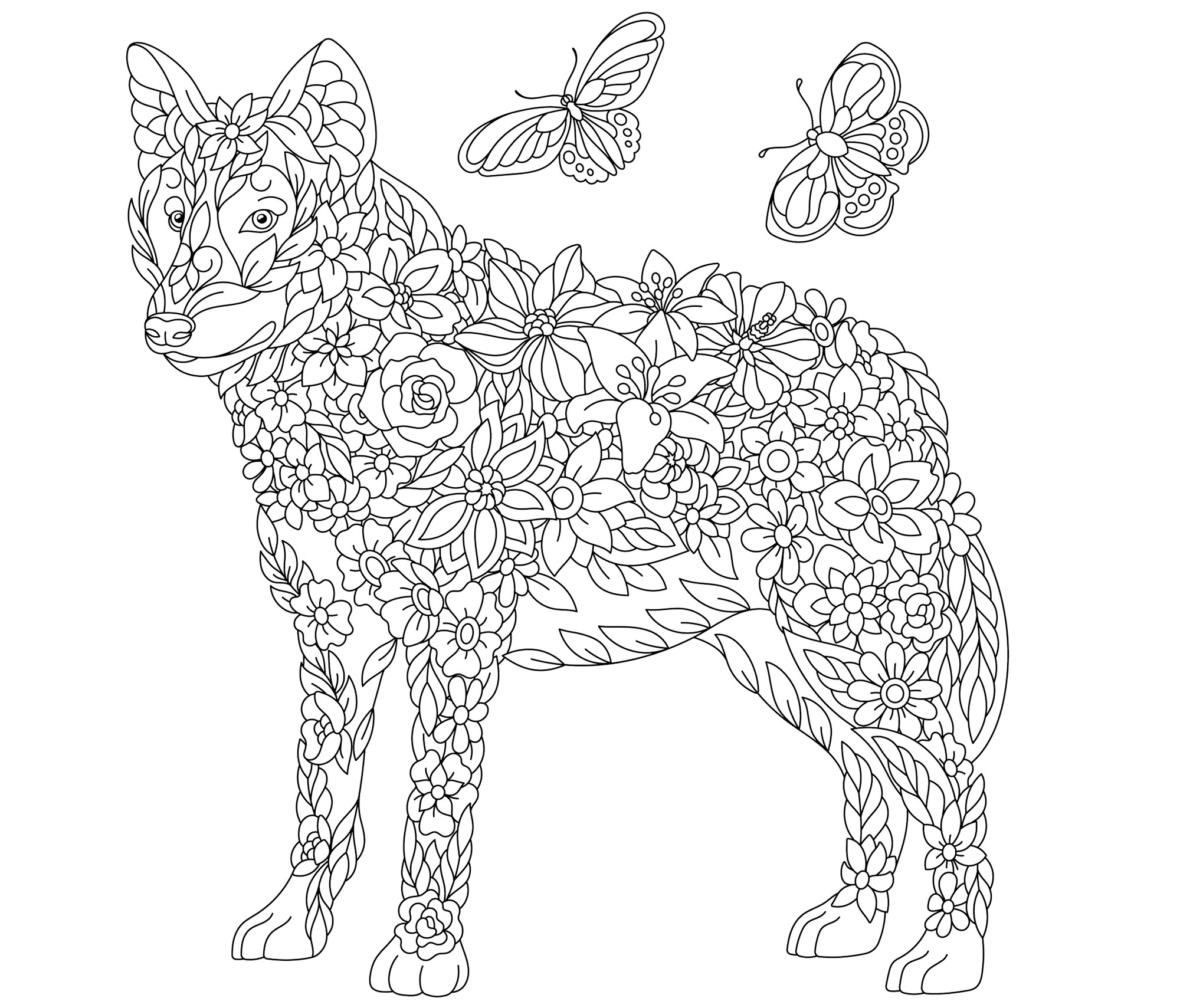
More elaborate designs include a cute wolf surrounded by flowers, a hand-drawn zentangle wolf head, a floral wolf portrait, and an ethereal fairy-tale wolf created from flowers, leaves, and butterflies.
That variety means you can choose a quick afternoon coloring activity or settle in with a detailed wolf design that may take several coloring sessions to complete.
For even more wild animals, explore our Animal Coloring Pages.
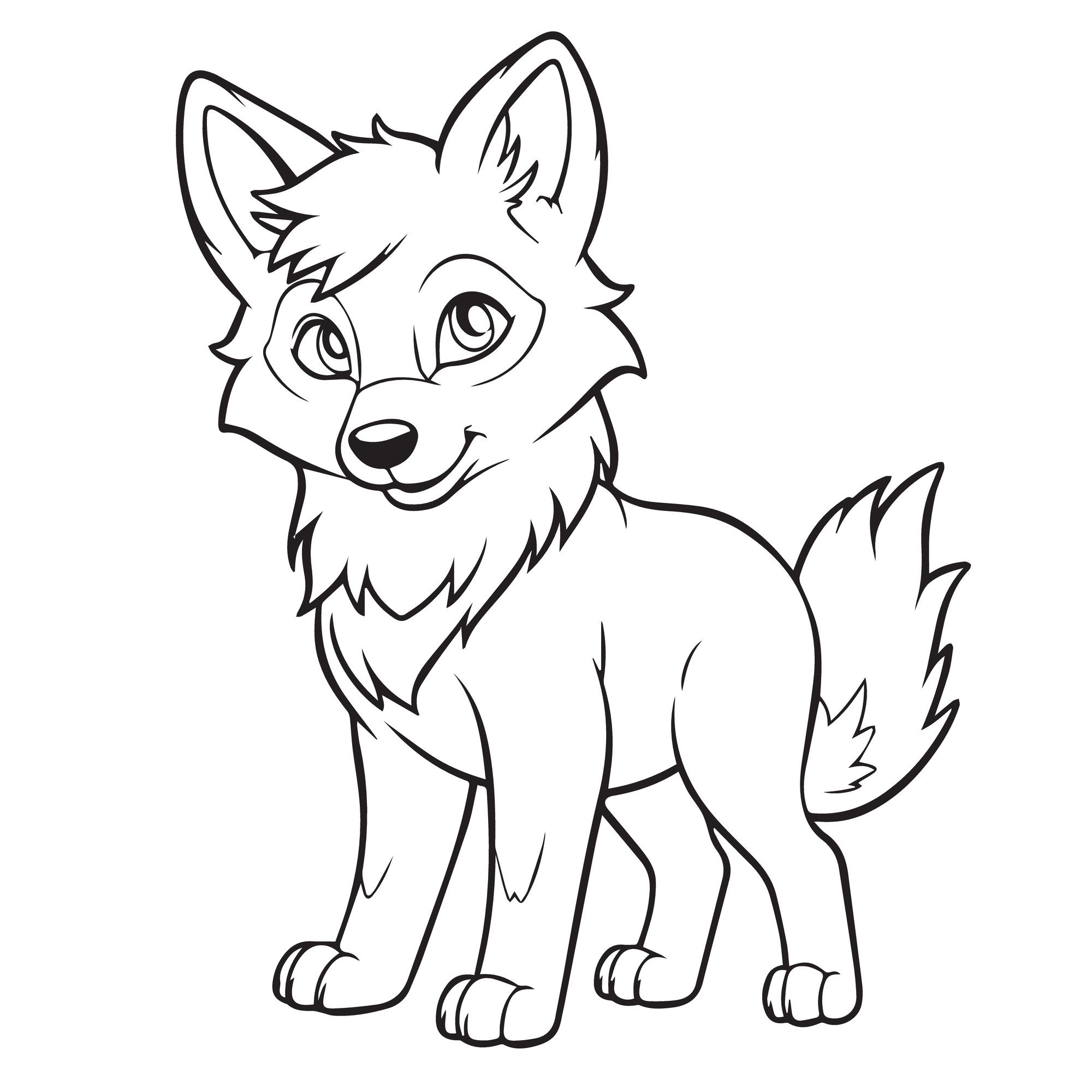
💕 Cute Wolf Coloring Page
The simple cute wolf coloring page is a great starting point for younger artists.
Try pale gray or brown for the fur, creamy white around the muzzle and chest, and darker gray around the ears and tail. A black or charcoal nose will create a little contrast.
Then add a background around your wolf.
You might draw:
- Pine trees
- Mountains
- Snow
- Wildflowers
- Rocks
- Clouds
- A stream
- The moon
Of course, a cute wolf does not need to look realistic. Pastel pink, lavender, turquoise, mint, or rainbow colors can turn the animal into an entirely imaginary character.
Give your wolf a name when you are finished and decide where it lives.
🖍️ Easy Wolf Coloring Page for Kids
The simpler wolf coloring page for kids has larger spaces that are ideal for crayons and broad markers.
Instead of trying to color every bit of fur individually, younger children can choose one or two main colors for the body and another for the face, ears, and tail.
Try combinations such as:
- Light gray and white
- Brown and cream
- Black and gray
- Tan and chocolate brown
- White and pale blue
Children can also use the page to practice identifying basic animal features.
Can they find the wolf’s ears?
Nose?
Tail?
Paws?
Eyes?
Simple questions like these can add a little learning without turning coloring time into a formal lesson.
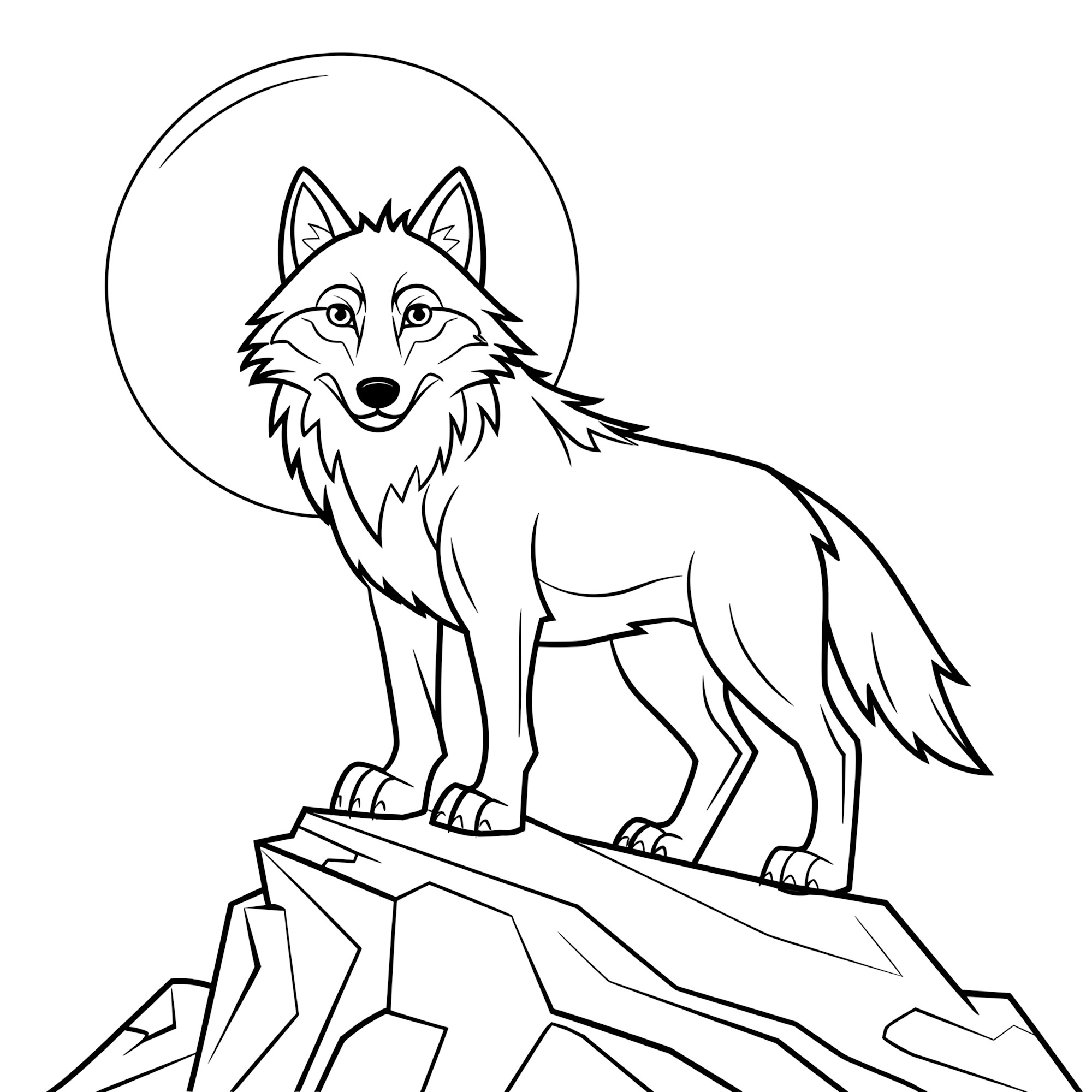
🐺 Realistic Wolf Line Art
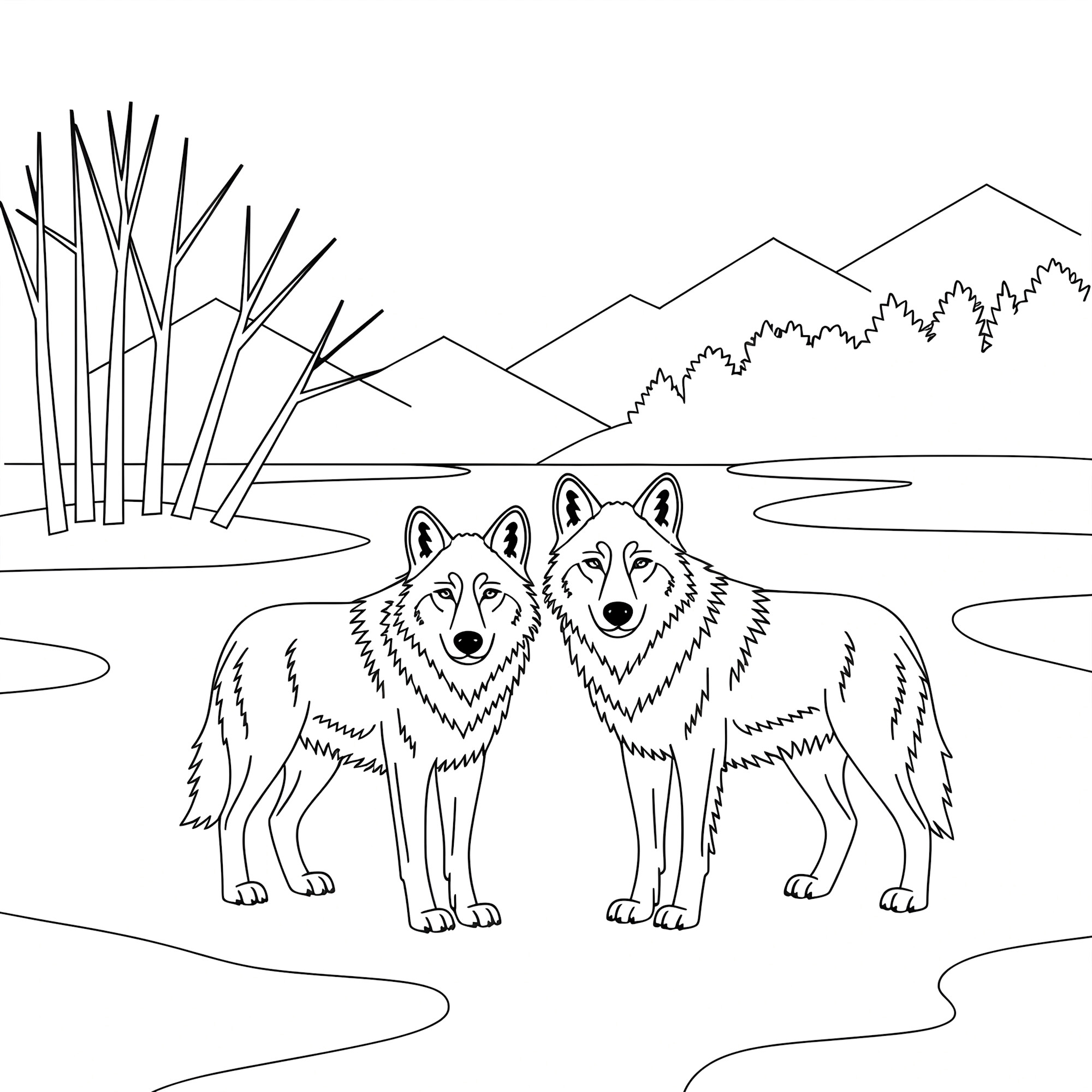
The more traditional wolf line-art illustrations are especially good for children and adults who want to experiment with realistic fur.
Wolf coats rarely look like one solid block of color.
Try layering several shades together:
- Pale gray
- Charcoal
- Brown-gray
- Tan
- Cream
- Black
- White
Colored pencils work especially well because you can build the colors gradually.
Use short strokes that follow the direction of the fur. Keep some areas lighter around the muzzle, cheeks, chest, and underside, then add darker shading around the back, shoulders, and tail.
Even small differences in shade can make a wolf look much more three-dimensional.
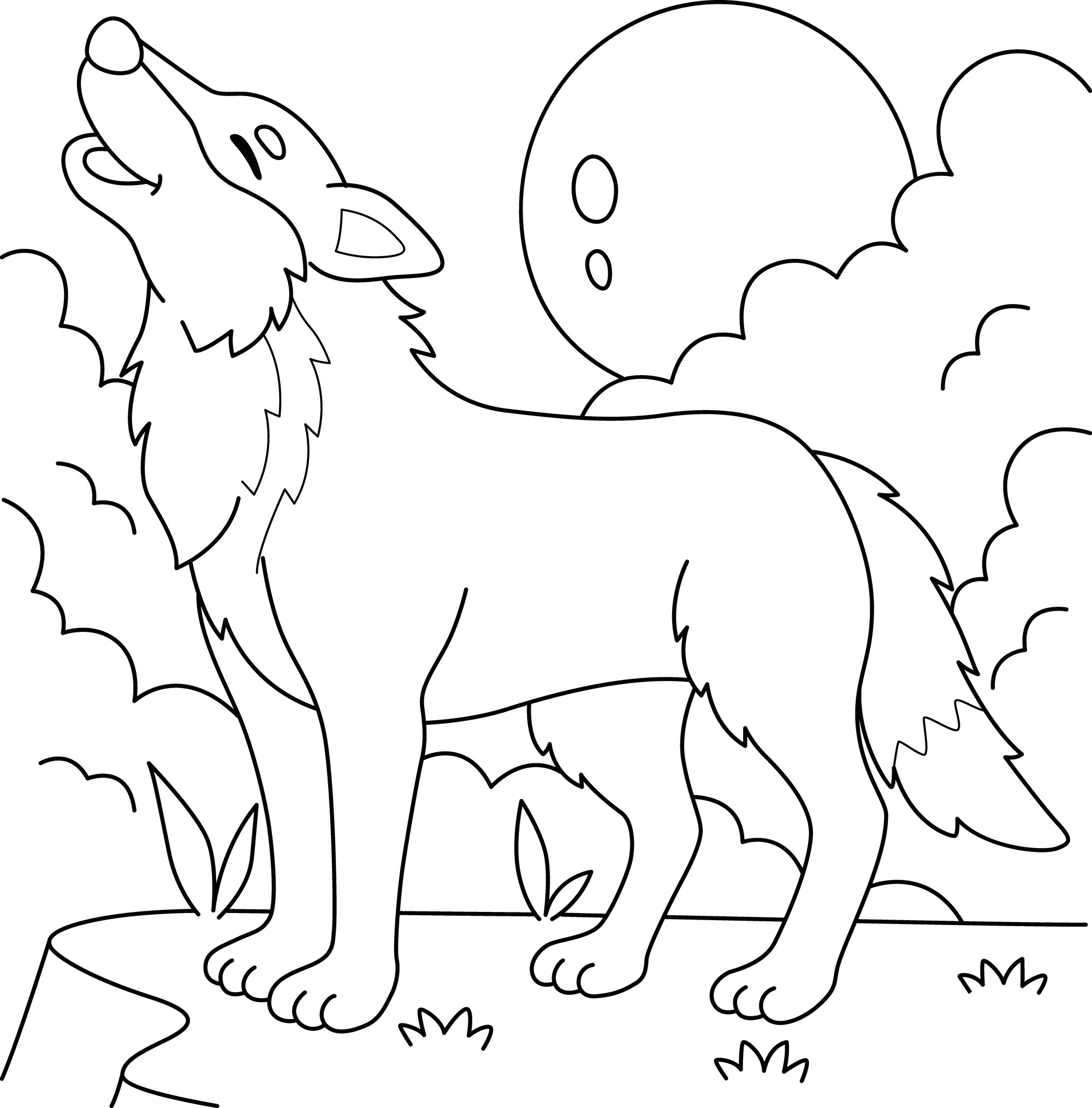
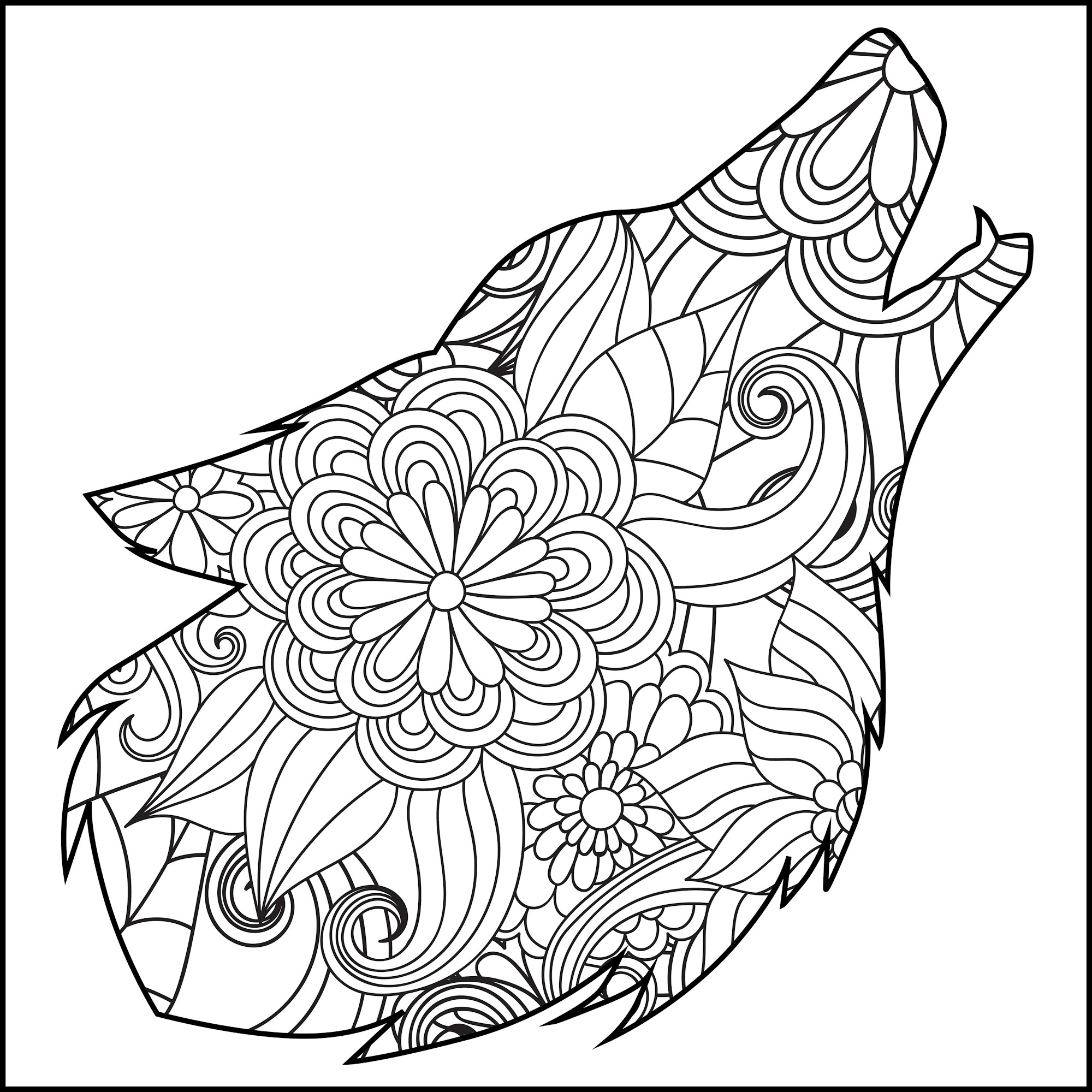
🌕 Wolf Howling Coloring Page
Few wildlife scenes are as recognizable as a wolf howling.
This page is perfect for creating a nighttime landscape.
Color the sky navy, indigo, violet, or deep blue and add a pale yellow or silvery moon. Pine trees can become dark green or almost black silhouettes, while snow-covered mountains can use gray, white, and pale blue.
The wolf itself might be:
- Gray and cream
- Black
- White
- Brown-gray
- Silver
For a fantasy version, create a midnight-blue wolf with silver fur highlights or a purple wolf howling beneath a turquoise moon.
Despite the familiar picture of wolves howling at the moon, wolves are not actually calling to the moon. Howling is one of several ways wolves communicate with one another.
🌙 Do Wolves Really Howl at the Moon?
The classic image of a wolf raising its head toward a full moon has appeared in stories and artwork for generations.
But wolves do not howl specifically because the moon is there.
Howling can help wolves communicate across long distances, locate other pack members, coordinate social activity, and advertise territory.
A wolf may lift its muzzle upward while howling, which helps project the sound—and that dramatic pose happens to look wonderful beneath a moon.
That gives you two directions for your coloring page.
Create a nature-inspired nighttime scene, or lean completely into the fairy-tale image and draw the largest, brightest full moon you can fit behind your wolf.
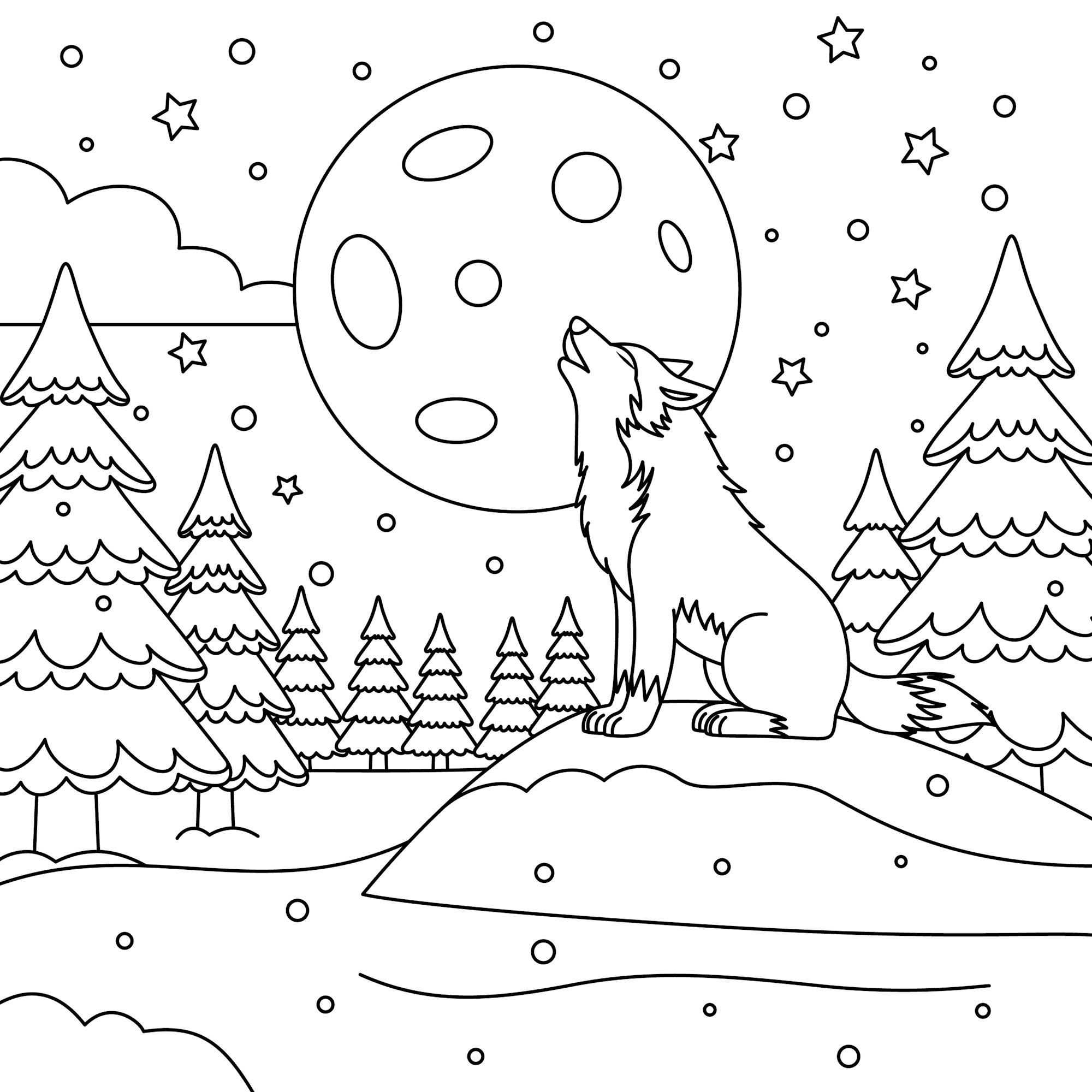
🌲 Create a Moonlit Forest
Take the howling-wolf page a little further by creating a full wilderness landscape.
Start with a dark sky and moon.
Then add layers of pine trees. Trees in the distance can be lighter gray or blue, while trees closer to the wolf can be darker.
Add mountains behind the forest and perhaps a little snow on the peaks.
For a winter scene, use:
- White
- Silver
- Pale blue
- Navy
- Gray
- Evergreen
For autumn, switch to gold, rust, burgundy, brown, and deep green.
One wolf coloring page can look completely different depending on the season.
🌸 Cute Wolf With Flowers
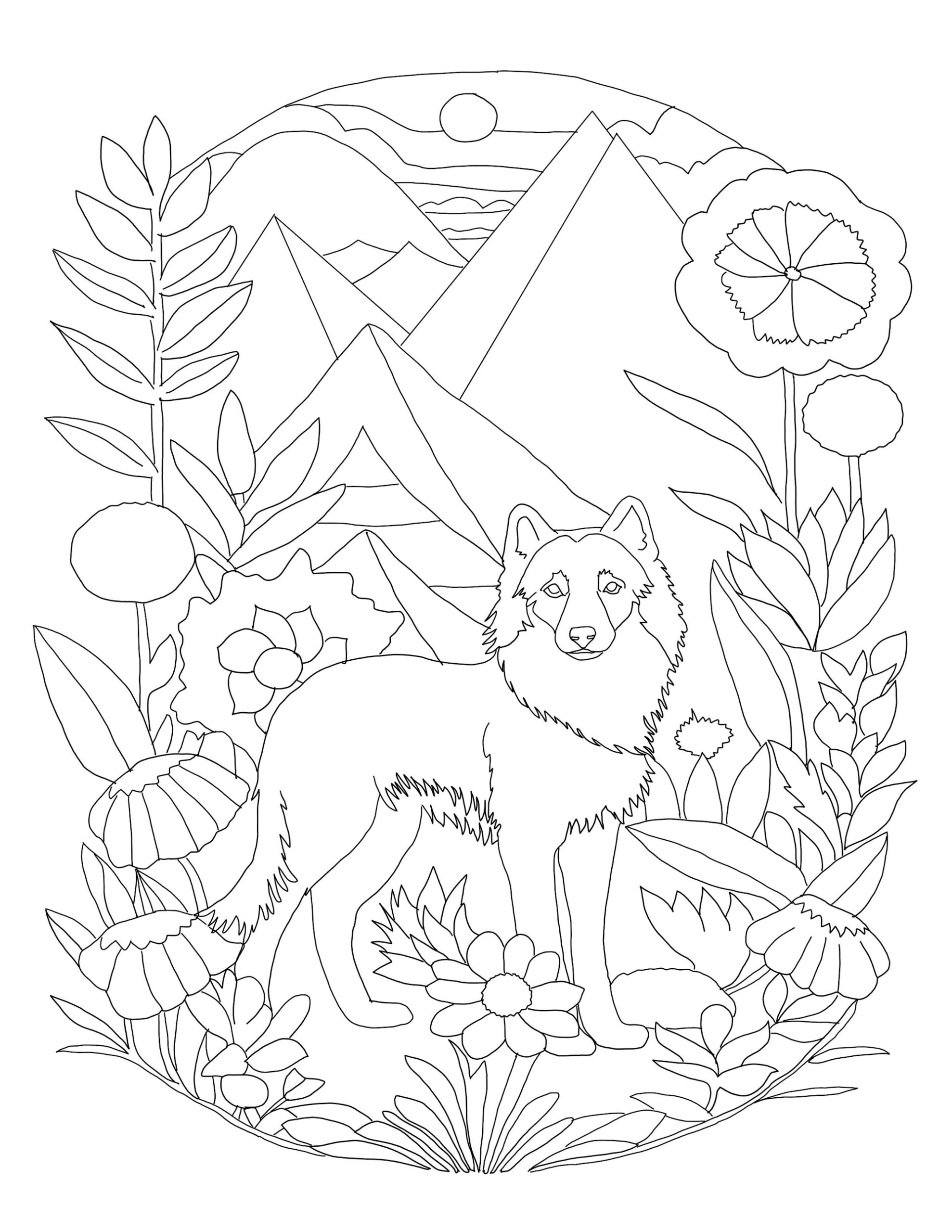
The cute wolf surrounded by beautiful floral details combines wildlife and botanical coloring in one design.
One option is to keep the wolf fairly realistic and let the flowers provide most of the color.
Use gray, brown, cream, and white for the fur, then fill the flowers with:
- Pink
- Purple
- Blue
- Yellow
- Coral
- Red
- Turquoise
This creates a beautiful contrast between the neutral wolf and colorful surroundings.
Or reverse the idea.
Use softer flowers and transform the wolf itself into a bright fantasy animal.
For more botanical coloring, explore our Coloring Pages of Flowers.
🌺 Floral Wolf Head Coloring Page
Another wolf portrait combines the animal with flowers and decorative botanical details.
This page is a natural choice for colorists who enjoy coordinating a complete palette before starting.
Try:
Woodland Palette
Gray, sage, forest green, cream, and burgundy
Wildflower Palette
Pink, lavender, yellow, blue, and green
Autumn Wolf
Rust, gold, burgundy, brown, and olive
Fantasy Wolf
Turquoise, purple, magenta, blue, and silver
Repeating the same colors across both the flowers and the wolf can help the entire design feel connected.
You can also add small highlights with a white pencil or gel pen after the darker colors are finished.
🌀 Zentangle Wolf Head Coloring Page
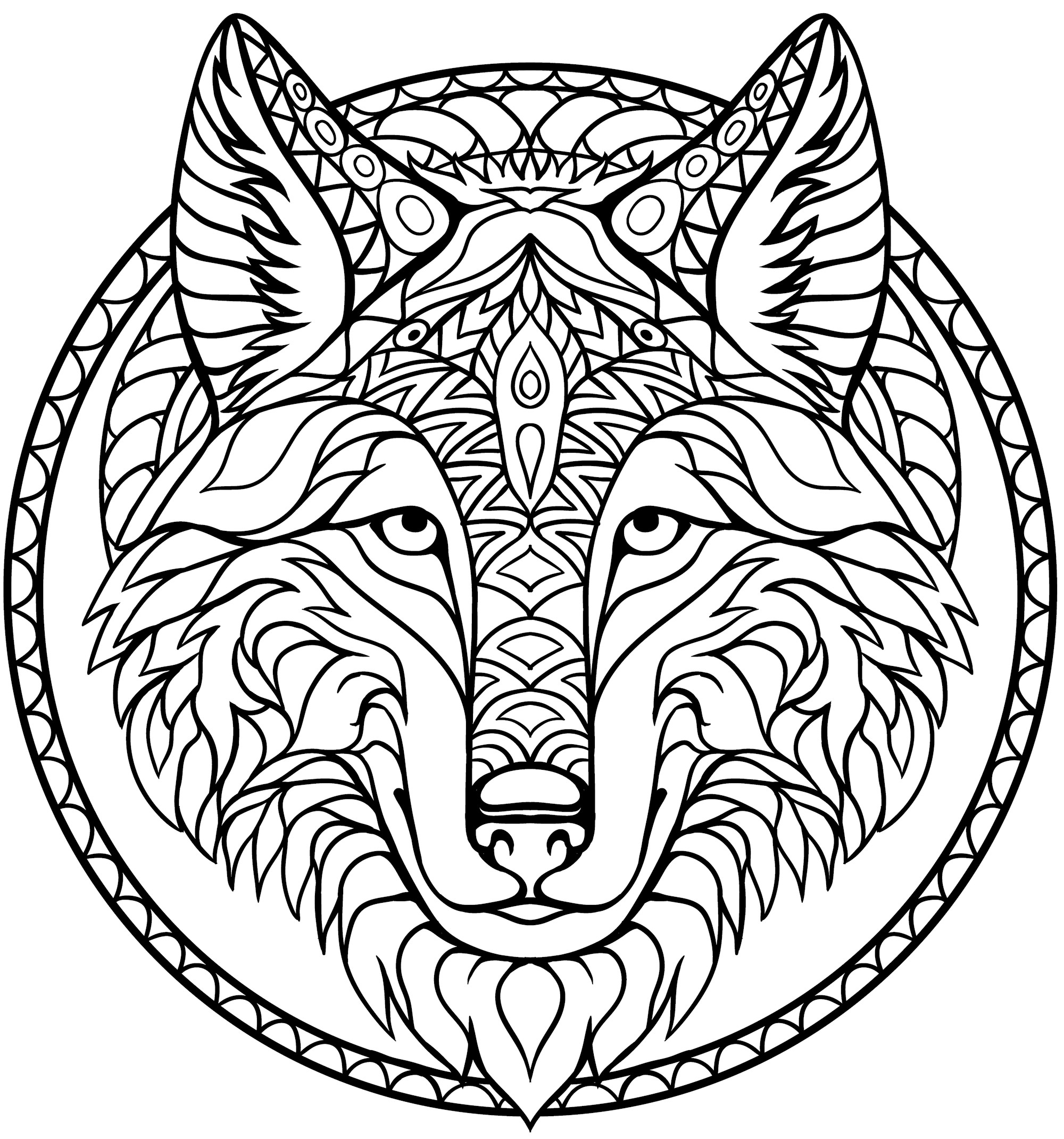
The hand-drawn zentangle wolf head is one of the most detailed designs in the collection.
Instead of trying to recreate realistic fur, treat every patterned section as its own tiny piece of artwork.
Choose four or five colors and repeat them throughout the design.
Try:
Moonlight Wolf
Navy, lavender, turquoise, silver, and gray
Forest Wolf
Emerald, sage, brown, gold, and cream
Jewel Wolf
Purple, sapphire, turquoise, emerald, and gold
Fire Wolf
Red, orange, yellow, burgundy, and black
Rainbow Wolf
Red, orange, yellow, green, blue, and violet
Fine-tip markers and sharpened colored pencils can help with the smaller sections.
There is also no need to finish a detailed zentangle page all at once. Color a section at a time and come back whenever you feel like continuing.
🦋 Fairy-Tale Wolf With Flowers and Butterflies
The ethereal fairy-tale wolf made from flowers, leaves, and butterflies is perhaps the most imaginative design in the entire collection.
This page does not need to resemble a real wolf at all.
Think of it as a magical forest creature.
Perhaps its fur is made of flowers that bloom in spring. Maybe butterflies follow it through the woods wherever it goes. Its leaves might turn orange and gold every autumn before becoming green again in spring.
Try a palette of:
- Turquoise
- Purple
- Pink
- Emerald
- Gold
- Lavender
- Blue
Or choose a different color for every flower and butterfly.
When the page is finished, give your magical wolf a name and invent a story about where it lives.
🌈 Create a Fantasy Wolf
Wolves have inspired folklore, legends, fairy tales, and fantasy stories for centuries, which makes them perfect for imaginative coloring.
Invent your own species.
Perhaps you create a:
Moon Wolf — navy and silver with pale blue eyes.
Forest Wolf — moss green and brown with leafy markings.
Snow Wolf — white, silver, pale blue, and lavender.
Sunset Wolf — orange, coral, pink, and violet.
Rainbow Wolf — every section of fur has a different color.
Flower Wolf — covered in leaves and blossoms.
Then decide what makes your imaginary wolf special.
Maybe it glows beneath moonlight, communicates with butterflies, or leaves flowers growing wherever its paws touch the ground.
🎨 What Colors Are Wolves?
The name gray wolf can be a little misleading because wolves are not always simply gray.
Their coats can include shades of:
- Gray
- Brown
- Tan
- Cream
- Black
- White
- Reddish brown
Individual animals may show several colors at once.
For a realistic wolf, start with a light base color and gradually add darker shades along the back, tail, ears, and legs.
Keep the muzzle and cheeks lighter to create contrast.
A white wolf can still use pale gray and blue-gray shading rather than leaving the entire animal uncolored.
⚪ Create a Snow Wolf
A mostly white wolf is perfect for a winter coloring page.
Use white as the main coat color, but add very light:
- Gray
- Silver
- Pale blue
- Lavender
around the shaded areas.
Then place the wolf in a snowy landscape.
Draw pine trees, falling snow, mountains, and footprints leading across the ground.
The wolf will stand out more clearly if the sky is dark blue or violet.
For a magical version, add sparkling snowflakes and make the animal’s eyes bright blue or turquoise.
⚫ Color a Black Wolf
Some gray wolves have striking black coats.
A black wolf can be challenging to color because filling the entire animal with solid black may hide the drawing’s details.
Instead, use:
- Charcoal
- Dark gray
- Black
- Blue-black
- Small touches of silver
Leave some parts slightly lighter around the face, chest, or edges of the fur.
This preserves the details while still creating the appearance of a very dark animal.
A black wolf against snow or beneath a bright full moon can make an especially dramatic picture.
🐕 Wolves Belong to the Dog Family
Gray wolves belong to the animal family Canidae, the same family that includes domestic dogs, coyotes, foxes, and several other canids.
In fact, wolves are the largest wild members of the dog family.
Look at your wolf coloring page and compare it with a familiar dog.
You may notice similarities in:
- Ears
- Nose
- Paws
- Tail
- Fur
- Teeth
- Overall body shape
There are also important differences in size, behavior, social structure, and the way wild wolves live.
This makes wolf coloring an easy starting point for comparing wild and domestic animals.
🐾 Wolf or Dog?
Try a simple comparison activity.
Draw a line down the middle of a piece of paper.
Label one side:
Wolf
and the other:
Dog
Then think about similarities and differences.
Both are mammals and canids. Both communicate using sounds, scent, and body language.
But wolves are wild animals whose bodies and behaviors are adapted to surviving without human care, while domestic dogs have undergone thousands of years of domestication and selective breeding.
Color a wolf on one side and your favorite type of dog on the other.
👨👩👧👦 Wolves Live in Family Groups
Wolves are highly social animals, and wolf packs are usually best understood as families.
A typical pack often consists of a breeding pair and their offspring from one or more years.
Pack members may travel, rest, hunt, raise pups, and defend territory together.
This is a fun opportunity to expand a single-wolf coloring page.
Draw another adult wolf beside it, then add several pups.
Give each animal slightly different fur markings so you can tell the family members apart.
Soon one wolf can become an entire pack.
🐶 What Is a Baby Wolf Called?
A baby wolf is usually called a pup.
Pups are born in dens and depend entirely on adult wolves when they are very young. As they grow, they begin exploring outside the den and gradually become more involved with the rest of the pack.
Create a wolf-family drawing with:
- Two adults
- Several pups
- A den
- Trees
- Rocks
- Grass
Younger children can count the pups, while older children can create names and markings for each one.
🏡 Create a Wolf Den
Wolf pups are born in dens that provide a protected place during the earliest part of their lives.
Dens can occur in sheltered locations such as burrows, rock crevices, hollow logs, or areas beneath large roots.
Draw a den beside one of your wolves.
Add tiny pups peeking from the entrance and adult wolves nearby.
Then surround the den with a suitable habitat.
A forest den might be hidden among pine trees and rocks, while a tundra scene could be much more open.
🗣️ How Do Wolves Communicate?
Howling gets most of the attention, but wolves communicate in several ways.
They can use:
- Howls
- Growls
- Barks
- Body posture
- Facial expressions
- Scent
A wolf’s ears, tail, and body position can communicate information to other pack members.
Turn this into an expression activity by drawing several wolf faces.
Make one:
- Alert
- Playful
- Curious
- Relaxed
- Surprised
How do the ears and eyes change from picture to picture?
🎵 Create a Wolf Howl
A howl can travel a long distance, making it useful for communicating when wolves are separated.
Turn your howling-wolf coloring page into a sound activity.
Write:
Awooooo!
across the sky in large decorative letters.
Then fill each letter with a different pattern or color.
You could also draw another wolf far in the distance answering the call.
Now the picture becomes a conversation happening across the wilderness.
🌲 Where Do Gray Wolves Live?
Gray wolves are highly adaptable and can live in several different types of habitat across parts of the Northern Hemisphere.
Wolf habitat can include:
- Forests
- Mountains
- Tundra
- Taiga
- Grasslands
- Some desert environments
That gives you plenty of choices when designing a background.
A forest wolf can stand among evergreen trees, while an Arctic-inspired wolf might cross a snowy tundra. A mountain wolf could overlook rocky peaks and valleys.
Choose a habitat before beginning and let it guide your color palette.
🏔️ Design a Wolf Habitat
Choose one of the simple wolf designs and turn the blank background into a complete wilderness habitat.
Add:
- Pine trees
- Mountains
- Grass
- Snow
- Rocks
- Streams
- Wildflowers
- Clouds
Then decide what season it is.
Spring: fresh greens and flowers.
Summer: deep greens and bright blue skies.
Fall: orange, gold, burgundy, and rust.
Winter: white, silver, evergreen, and pale blue.
The same wolf can fit into four completely different pictures.
For more outdoor inspiration, explore our Nature Coloring Pages.
❄️ Create a Winter Wolf Scene
Wolves remain active during winter rather than hibernating.
That makes them excellent subjects for snowy coloring pages.
Draw snow around the paws and cover nearby evergreen branches with white.
Add tracks behind the wolf to show where it has traveled.
A winter palette might include:
- White
- Pale blue
- Navy
- Gray
- Silver
- Dark green
Add a lavender or pink sky to create a winter sunset.
🦌 What Do Wolves Eat?
Gray wolves are carnivores and can hunt a variety of animals depending on where they live.
In North America, prey may include large hoofed animals such as:
- Deer
- Elk
- Moose
- Caribou
- Bison
Wolves may also eat smaller animals and sometimes scavenge food they did not kill themselves.
Rather than drawing a hunting scene, younger children can create a simple woodland food-web page showing wolves, deer, plants, and other animals that share the ecosystem.
🌿 Wolves and Ecosystems
Wolves can play important roles in the ecosystems where they live.
As large predators, they interact with prey populations and other wildlife within complicated food webs.
For younger children, the main idea can stay simple:
Every wild animal is part of a larger habitat.
A wolf needs prey, water, space, and appropriate habitat. The animals it hunts also depend on plants and other resources.
Draw a forest scene containing several parts of the ecosystem instead of showing the wolf by itself.
👃 Wolves Have Powerful Senses
Wolves rely on keen senses to navigate their environment, find food, and communicate.
Their sense of smell is especially important, and they also have strong hearing and good vision adapted to their lives as active predators.
Turn this into a simple observation game.
Imagine you are a wolf walking through the forest.
What might you:
See?
Hear?
Smell?
Children can draw three objects beside the wolf representing each sense.
🦷 Wolves Are Built for a Wild Life
Look closely at a realistic wolf coloring page and notice some of the features suited to its way of life.
Wolves have:
- Strong legs
- Large paws
- Powerful jaws
- Sharp teeth
- Thick fur
- Keen senses
Their long legs help them travel over considerable distances, while thick coats provide protection in cold climates.
Older children can label several of these features on a finished wolf picture.
🌎 Wolves Around the World
Gray wolves historically occupied an enormous portion of the Northern Hemisphere and today occur in parts of North America, Europe, and Asia.
This makes wolf coloring easy to pair with geography.
Find those three broad regions on a world map:
- North America
- Europe
- Asia
Then choose one location for your coloring-page wolf.
What kind of habitat might surround it?
Would there be mountains, forests, tundra, or open grassland?
Older children can research a particular wolf population and create a more specific habitat.
🐺 Gray Wolf and Red Wolf
The gray wolf is not the only animal commonly called a wolf in North America.
The red wolf is a separate canid native to the southeastern United States. Its coat can include reddish, tawny, gray, brown, and black tones.
That gives older children another interesting coloring project.
Draw or print two wolves side by side and label them:
Gray Wolf
Red Wolf
Then use different shades to represent each animal.
The activity is also a good reminder that common animal names sometimes refer to different species rather than simply different colors of the same animal.
📖 Wolves in Fairy Tales
Wolves have appeared in stories and folklore for centuries.
Sometimes they are portrayed as frightening villains, while other stories depict them as mysterious symbols of wilderness, loyalty, strength, or magic.
The floral and fairy-tale wolf pages are perfect for exploring a completely different kind of character from a realistic wildlife picture.
Give your fairy-tale wolf a name.
Does it guard an enchanted forest?
Can it speak?
Does it help lost travelers find their way home?
Maybe the butterflies in its fur carry messages from one part of the forest to another.
The coloring page can become an illustration from a story that has not been written yet.
✏️ Draw Your Own Wolf
After coloring several printable wolves, try drawing one from simple shapes.
Begin with an oval for the body and a smaller shape for the head.
Add:
- Pointed ears
- Long muzzle
- Four legs
- Paws
- Bushy tail
Then add fur around the neck and cheeks.
Your wolf can stand, run, sit, or raise its head to howl.
Do not worry about perfect anatomy. A cartoon wolf can be created from very simple shapes and still have plenty of personality.
🌈 Design Your Own Wolf Markings
Draw a plain wolf silhouette and invent an original coat.
Try:
- Stripes
- Spots
- Stars
- Swirls
- Flowers
- Lightning bolts
- Rainbow sections
Then give the new wolf species a name.
Perhaps the Northern Star Wolf has silver stars across its black coat, while the Autumn Forest Wolf has orange, burgundy, and gold fur.
Write one sentence describing where your imaginary species lives.
🔤 W Is for Wolf
Wolf coloring pages can also become an alphabet activity for preschoolers and kindergarten children.
Write:
W w
Then practice saying:
W is for wolf.
Think of other W words:
- Water
- Winter
- Whale
- Wagon
- Window
- Watermelon
Children can draw a few W objects around the wolf.
Maybe the wolf is walking through winter snow toward a stream of water.
The sillier the picture becomes, the more memorable letter practice can be.
🔢 Count the Wolves
Wolf packs provide an easy counting theme.
Draw several wolves into a landscape and practice:
1, 2, 3, 4, 5!
Then add:
- Three trees
- Four rocks
- Two pups
- Five stars
- One moon
Older children can make simple addition or subtraction problems using the pack.
Coloring pages can become quick math practice without feeling like worksheets.
📚 Create a Wolf Fact Card
Turn a finished wolf picture into a homemade wildlife card.
Write:
Animal: Gray Wolf
Scientific name: Canis lupus
Animal group: Mammal
Family: Canidae
Diet: Carnivore
Young: Pup
Then add one interesting fact.
Older children can create cards for several animals and begin a whole wildlife collection.
🐯 Build a Wild Animal Coloring Book
A wolf can become one page in a much larger homemade animal book.
Add our Coloring Pages of Tigers and other favorites from the Animal Coloring Pages collection.
For every animal, include:
- Name
- Habitat
- Diet
- Continent or region
- One interesting fact
Staple the completed pages together and create a cover.
Over time, children can build their own illustrated wildlife guide.
🏫 Wolf Coloring Pages for the Classroom
Wolf printables fit naturally with lessons about mammals, predators, forests, habitats, animal families, and communication.
Teachers and homeschool families can use them for:
- Animal units
- Mammal lessons
- Forest studies
- Habitat projects
- Food-web lessons
- Letter W practice
- Counting activities
- Creative writing
- Nature studies
- Early-finisher pages
- Classroom displays
Children can color one wolf and add three facts underneath it, while older students can research a particular wolf population and design an appropriate habitat.
For more learning-focused activities, explore our Educational Coloring Pages & Activities.
🌎 Learning About Wolf Conservation
The relationship between people and wolves has a complicated history.
Wolves disappeared from many places where they once lived because of hunting, predator-control programs, habitat changes, declining prey populations, and conflicts with livestock.
Conservation and reintroduction efforts have helped restore gray wolves to some regions, including parts of the northern Rocky Mountains.
For children, the central conservation idea can stay simple:
Wild animals need healthy habitats and enough space to live.
A coloring page can become a habitat poster showing a wolf surrounded by forests, mountains, water, and the other wildlife that shares its ecosystem.
🌲 Make a Protect Wildlife Poster
Turn your completed wolf into a wildlife poster.
Add a message such as:
Protect Wildlife
Wild Places Matter
Keep Forests Wild
or
Learn About Wolves
Surround the wolf with trees, mountains, stars, and other native wildlife.
Older children can add one or two wolf facts beneath the picture.
📖 Turn Your Wolf Into a Story
Almost every picture in this collection has storytelling potential.
Why is the wolf howling?
What is the floral wolf guarding?
Where is the cute wolf going?
Why is the fairy-tale wolf made of flowers and butterflies?
Perhaps the zentangle wolf changes patterns whenever the seasons change.
Give the wolf a name and write several sentences describing its adventure.
Children can use several different pages as illustrations for different chapters of the same story.
✂️ Wolf Coloring Page Crafts
Finished wolf pages can be reused in plenty of creative ways.
Try turning them into:
- Wildlife posters
- Animal fact cards
- Forest collages
- Homemade storybooks
- Bookmarks
- Classroom displays
- Nature notebooks
- Fantasy artwork
- Bedroom decorations
- Puppets
Kids can also cut out a finished wolf and glue it onto a larger sheet of paper.
Add pine trees, mountains, snow, stars, and a huge moon to create a complete wilderness scene.
🖍️ Coloring Tips for Wolf Fur
Wolf fur can look especially good when several related shades are layered together.
Begin lightly with gray, tan, or brown.
Then use short pencil strokes in the direction the fur grows.
Add darker shades:
- Along the back
- Around the ears
- Beneath the neck
- Around the tail
- Behind the legs
Keep the muzzle, cheeks, and chest slightly lighter.
For white wolves, use pale gray and blue-gray shadows rather than leaving every area completely white.
For zentangle and fantasy wolves, ignore these rules entirely and let the patterns determine the colors.
🖨️ How to Use Your Wolf Coloring Pages
Choose your favorite wolf design, print it, and gather crayons, markers, colored pencils, or other art supplies.
Regular printer paper works well for everyday coloring. Heavier paper may be useful if you plan to use paint, wet markers, glitter, glue, or additional craft materials.
Then decide what kind of wolf will appear on your page.
Will it be a realistic gray wolf roaming through the forest? A white wolf crossing the snow? A midnight wolf howling beneath the moon? Or a magical creature covered in flowers and butterflies?
Every page can tell a completely different story.
🐺 Let Your Creativity Run Wild
From simple cute wolves and realistic line art to howling wolves, floral portraits, intricate zentangle designs, and ethereal fairy-tale wolves made from flowers, leaves, and butterflies, this collection offers plenty of ways to explore one of nature’s most fascinating wild canids.
Experiment with realistic fur colors, create a moonlit forest, learn how wolf packs communicate, design a fantasy species, or turn your finished picture into the beginning of a wilderness adventure.
Choose your favorite printable, grab your colors, and let your imagination run wild.
🔗 Related Articles
- Animal Coloring Pages
- Nature Coloring Pages
- Coloring Pages of Tigers
- Cute Coloring Pages
- Educational Coloring Pages & Activities
- Seasonal Coloring Pages
📚 Sources
- Smithsonian’s National Zoo — Gray Wolf
- Smithsonian’s National Zoo — Why Do Wolves Howl? And Other Top Wolf Questions Answered
- U.S. Fish & Wildlife Service — Gray Wolf
- U.S. National Park Service — Yellowstone Wolf Facts