
3… 2… 1… Blast off!
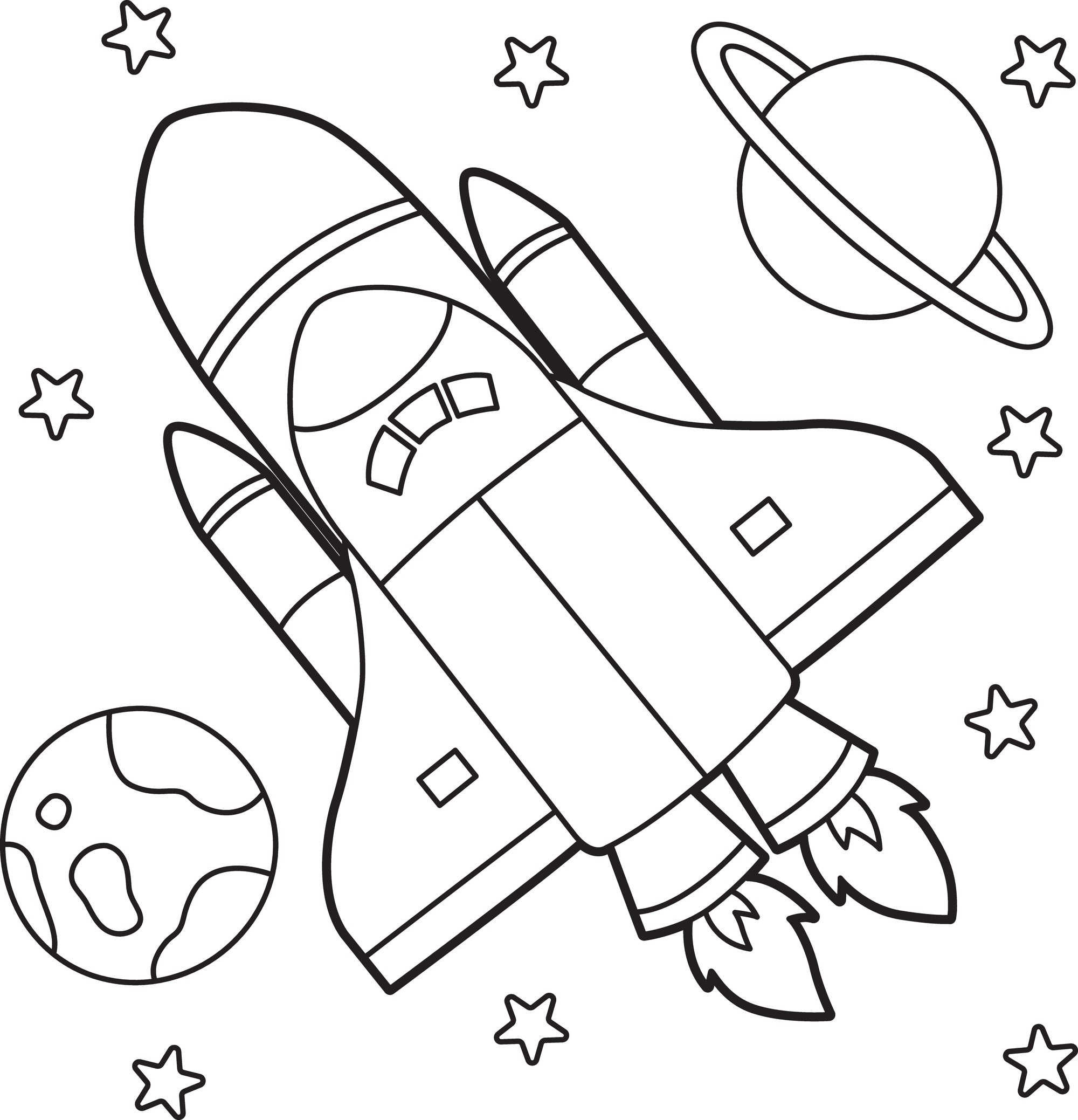
Get ready for an out-of-this-world coloring adventure with our free printable rocket coloring page! This bold, kid-friendly design features a speeding space rocket with a pointed nose, large round window, powerful-looking side sections, and fiery exhaust shooting behind it as it races toward the stars.
The big open spaces make this rocket especially fun for younger children, while older kids can add planets, astronauts, stars, galaxies, launch pads, and their own imaginative space backgrounds.
Will your rocket be silver and white like a futuristic spacecraft? Bright red with blue fins? Purple with rainbow flames? Or covered in stars, stripes, and colors no real rocket has ever worn?
Grab your crayons, markers, or colored pencils, start the countdown, and prepare for liftoff!
🚀 Explore Our Rocket Coloring Page
The rocket in this printable has a wonderful retro space-adventure look.
Its long pointed body stretches diagonally across the page as though it is already speeding through the sky. A large circular porthole dominates the center, while fins and rounded side sections give the spacecraft plenty of interesting areas to color.
At the back, three fiery exhaust trails make it clear that this rocket is going somewhere fast.
The word ROCKET appears in big letters above the picture, giving younger children another area to color and making the page useful for simple reading and letter activities too.
This is a particularly nice choice for kids who love:
- Rockets
- Astronauts
- Space
- Planets
- Science
- Vehicles
- Stars
- Engineering
- Imaginative adventures
🎨 What Colors Should a Rocket Be?
A rocket coloring page gives you plenty of freedom.
Real launch vehicles often feature combinations of white, black, gray, metallic tones, and agency or mission markings, but your rocket doesn’t need to follow any real spacecraft design.
Try a classic space palette with:
- White
- Silver
- Charcoal
- Black
- Red
- Blue
Or create something much brighter.
Your rocket could be:
- Cherry red
- Royal blue
- Bright orange
- Purple
- Turquoise
- Lime green
- Hot pink
- Rainbow-colored
Color each section differently or choose two or three colors and repeat them throughout the design.
🌈 Design a Rainbow Rocket
Want a spacecraft nobody at NASA has ever launched?
Create a rainbow rocket.
Make the nose cone red.
Color the next section orange.
Continue with yellow, green, blue, and purple down the body.
Give the fins completely different colors or repeat the rainbow again.
Then add multicolored flames streaming from the back.
A dark navy or black space background will make all those bright colors stand out even more.
✨ Create a Shiny Silver Spaceship
For a more futuristic look, try turning the rocket into a metallic spacecraft.
Use pale gray or silver across most of the body.
Then add darker gray around:
- Panel lines
- Fins
- Edges
- The porthole
- Engine areas
Leave a few areas white to suggest reflections.
Add blue around the circular window to make it look like glass reflecting the sky or space.
If you have metallic pencils or gel pens, this is a perfect page for using them.
🔴 Try a Classic Red Rocket
Red is one of the most dramatic rocket colors.
Give the main body a bold red finish and combine it with white, silver, or black.
Try:
Main body: Red
Nose: White
Fins: Dark red
Window: Pale blue
Engines: Gray
Flames: Yellow, orange, and red
Then add stars around the spacecraft.
The finished page will have the feel of an old-fashioned science-fiction adventure.
🔥 Color the Rocket Flames
The exhaust trails are some of the most exciting parts of this design.
Try building the flames with several layers of warm color.
Start with yellow closest to the rocket.
Add orange around the yellow.
Finish with red toward the ends.
You can also add tiny touches of white or pale yellow near the engines to make the flames look especially bright.
For a fantasy rocket, forget ordinary fire.
Try:
- Blue flames
- Purple flames
- Green flames
- Rainbow flames
- Pink-and-turquoise flames
Perhaps your imaginary rocket uses an entirely new kind of futuristic propulsion.
💨 Add Rocket Smoke
If your rocket has just lifted off from Earth, draw clouds of smoke behind it.
Use soft gray, blue-gray, white, or pale brown.
Keep the center of each cloud light and shade around the edges.
Draw huge billowing clouds around a launch pad or smaller trails behind the rocket as it rises into the sky.
Once the rocket reaches space, replace the clouds with stars.
🪟 What’s Behind the Rocket Window?
The giant circular porthole on this page is practically begging for a passenger.
Who is flying the rocket?
Draw:
- An astronaut
- A child explorer
- A robot
- A dog
- A cat
- A teddy bear
- A friendly alien
- Yourself!
You could even draw two tiny faces looking out of the window.
Then give your space traveler a name and decide where the mission is going.
👩🚀 Draw Yourself as an Astronaut
Imagine that you are commanding the rocket.
Draw your face in the porthole and add a space helmet around it.
Then write:
Captain __________
beneath the rocket.
What is your mission?
Maybe you are traveling to the Moon.
Perhaps you are exploring Mars.
Maybe you are heading toward Saturn to see its rings.
Or perhaps your rocket is going somewhere no human has ever visited.
🌎 Add Planet Earth
Draw Earth behind the rocket as it climbs into space.
Start with a large circle.
Color the oceans blue and add green or brown land shapes.
Then surround the planet with a thin pale-blue atmosphere.
You do not need to draw continents perfectly. This is an imaginative space scene, not a geography exam.
Add fluffy white cloud shapes over parts of the planet if you want more detail.
🌕 Fly to the Moon
Where is the rocket going?
The Moon is a perfect first destination.
Draw a large circle ahead of the rocket and add craters of different sizes.
Try using:
- Light gray
- Dark gray
- Silver
- Pale blue-gray
Then draw stars around it.
Perhaps the rocket is about to land.
Add a tiny flag, lunar rover, astronaut, or moon base to the surface.
🔴 Imagine a Mission to Mars
Mars makes another wonderful coloring-page destination.
Draw a reddish-orange planet ahead of the rocket.
Use combinations of:
- Rust
- Orange
- Red
- Brown
- Golden tan
Add darker markings and craters to make the surface more interesting.
Then imagine what your crew discovers when it arrives.
Maybe there is a scientific research station.
Perhaps a robot rover is waiting.
Or, in your completely imaginary version of Mars, maybe friendly aliens are throwing a welcome party.
🪐 Visit a Ringed Planet
A ringed planet instantly makes a space picture more dramatic.
Draw a large circle and place a wide oval ring around it.
Color the planet with soft yellows, creams, oranges, browns, or any colors you like.
The rings could alternate:
- Gold
- Cream
- Pink
- Purple
- Blue
Perhaps your rocket is flying around Saturn—or maybe you’ve discovered a completely new ringed planet.
Give it a name.
⭐ Fill Space With Stars
Once your rocket leaves Earth, there is plenty of room for stars.
Draw:
- Tiny stars
- Large stars
- Shooting stars
- Star clusters
- Sparkling dots
Use yellow and gold for a classic coloring-book look.
Or turn the entire galaxy into a rainbow.
Add stars in pink, blue, purple, turquoise, and silver.
A dark navy background will make them especially bright.
☄️ Add a Comet
Draw a comet racing past the rocket.
Start with a rocky circle or oval.
Then add a long glowing tail.
Try yellow near the comet, then orange, red, or even blue farther back.
Where is it heading?
Maybe the rocket’s astronauts are studying it.
Perhaps they have to steer around it.
That simple addition can turn the coloring page into the beginning of an entire space adventure.
👽 Add a Friendly Alien
No imaginary space mission is complete without the possibility of alien life.
Draw a little alien waving from a nearby planet.
It could have:
- One eye
- Three eyes
- Antennae
- Six arms
- Giant ears
- Polka-dot skin
- Rainbow spots
Green is traditional, but there is absolutely no scientific requirement that imaginary aliens be green.
Try purple, blue, orange, pink, or striped.
Give your alien a name and decide what it wants to tell the astronauts.
🤖 Add a Space Robot
A robot makes another fun companion for the mission.
Build one from simple shapes:
Rectangle body.
Square head.
Circle eyes.
Line arms.
Tiny antenna.
Then add buttons and controls.
Your robot might help steer the rocket, collect rocks from distant planets, repair equipment, or translate alien languages.
Give it a name such as R-1, Beep, Astrobot, or Bolt.
🚀 How Does a Rocket Move?
Rockets create thrust, the force that pushes them forward.
A simple way to think about it is that a rocket engine pushes exhaust gases in one direction, and the rocket is pushed in the opposite direction. This reflects Newton’s third law of motion—forces occur in interacting pairs. Rockets also carry the materials needed for propulsion, so unlike jet engines, they do not rely on atmospheric air and can operate in space.
That big fiery trail on the coloring page is therefore more than a dramatic drawing detail—it represents the idea of rocket propulsion.
↔️ Try an Action-and-Reaction Activity
You can explore the same basic idea with a balloon.
Blow up a balloon and hold the end closed without tying it.
Then release it.
Air rushes out in one direction while the balloon moves in another.
A balloon is obviously not a real space rocket, but the activity gives children a simple way to visualize action and reaction.
NASA/JPL uses similar simple demonstrations to introduce young students to rocket motion.
🧩 What Parts Does a Rocket Have?
Real rockets are far more complicated than the cheerful spacecraft on this coloring page.
NASA groups major full-scale rocket systems into four broad categories: structure, payload, guidance, and propulsion.
For younger children, we can simplify that idea.
A rocket needs:
A strong body to hold everything together.
A payload—whatever the rocket is carrying.
Guidance and control to help it travel where it is supposed to go.
Propulsion to create thrust.
Look at the coloring page and imagine where each of those systems might be hidden inside.
📦 What Is the Payload?
A rocket’s payload is the thing it is carrying for its mission.
Depending on the mission, that could include a satellite, scientific spacecraft, robotic probe, cargo, or a crewed spacecraft. Rockets have been used to place satellites in orbit and send spacecraft toward many destinations.
Invent a payload for the rocket on this page.
Maybe it is carrying:
- A weather satellite
- A telescope
- A robot
- Food for astronauts
- Scientific equipment
- A Moon rover
- A Mars probe
Or perhaps your imaginary rocket is carrying a box of cupcakes to an alien birthday party.
🛰️ Add a Satellite
Draw a satellite floating near the rocket.
Start with a rectangular center.
Add long solar-panel shapes on either side.
Then draw an antenna.
Color the solar panels dark blue, black, or purple with lighter grid lines.
Satellites can have many purposes, including communications, weather observation, Earth science, navigation, and scientific research.
Your imaginary satellite can have an entirely new mission.
Maybe it looks for rainbow planets.
🔭 Create a Space Science Mission
Give the rocket a mission name.
Try:
Star Explorer 1
Moonlight Mission
Planet Quest
Galaxy Discovery
Cosmic Voyager
Rainbow Rocket
Then decide what the astronauts or instruments will study.
Perhaps they are looking at:
- The Moon
- Mars
- Asteroids
- Comets
- Stars
- The Sun
- Distant planets
Write the mission name across the side of the rocket.
🛠️ Become a Rocket Engineer
NASA describes rockets as systems made from many parts that must work together, which makes rockets a natural introduction to engineering.
Pretend you’re the engineer responsible for improving this one.
Would you add:
- Bigger fins?
- Another engine?
- Solar panels?
- A larger window?
- Landing legs?
- A robotic arm?
- A cargo door?
- An antenna?
Draw your improvements directly onto the page.
Then explain what each new part does.
✏️ Design Your Own Rocket
After coloring the printable, create a spacecraft from scratch.
Begin with a long central body.
Add a pointed or rounded nose.
Draw fins toward the bottom.
Add windows.
Then design the engine section.
Your rocket doesn’t need to resemble any spacecraft that has actually flown.
Make it:
- Extra tall
- Tiny and fast
- Shaped like a pencil
- Covered in stars
- Built for Mars
- Designed for aliens
- Powered by imagination
Give the rocket a name and mission patch.
🏷️ Create a Rocket Mission Patch
Space missions often use emblems or patches to represent their identity.
Create your own.
Draw a circle and add:
- A rocket
- Stars
- A planet
- The Moon
- Your initials
- A mission number
Choose two or three main colors.
Write the mission name around the outside.
Then display the patch next to your finished coloring page.
🔤 R Is for Rocket
Because ROCKET is printed in large letters above the picture, this page is perfect for early letter practice.
Start with:
R is for Rocket
Then think of other R words:
- Red
- Rainbow
- Robot
- Road
- Rabbit
- Rain
- Ring
- Rock
Color the large R a special color and decorate it with stars.
For more alphabet practice, explore Coloring Pages of Letters.
🔢 Practice a Rocket Countdown
Rockets and counting belong together.
Practice:
10… 9… 8… 7… 6… 5… 4… 3… 2… 1… BLAST OFF!
Younger children can count backward from five.
Older children can start from ten.
Write the numbers around the rocket and color each one differently.
This creates an easy counting activity and makes the page even more exciting.
➕ Try Rocket Math
NASA/JPL even uses rocket pictures in early math lessons for counting, addition, and subtraction activities.
You can make your own simple version.
Draw five tiny rockets.
Then ask:
If two blast off, how many remain?
Or draw three planets and add two more.
How many planets are there altogether?
Coloring and simple math can easily share the same page.
🌌 Create a Galaxy Background
Older children may enjoy turning the blank background into a detailed galaxy.
Use:
- Navy
- Purple
- Black
- Blue
- Magenta
Blend them together.
Then add tiny white or yellow dots for stars.
Draw swirling clouds of color around the rocket to create an imaginary nebula.
The bright rocket will stand out dramatically against the darker space background.
🌠 Draw a Shooting Star
Add a shooting star racing across the page.
Draw a small star and give it a long trailing line.
Use yellow, orange, white, pink, or blue.
Then make a wish.
Maybe the astronaut inside the rocket sees it too.
What would an astronaut wish for while traveling through space?
🌍 Imagine Looking Back at Earth
Picture the rocket already far from home.
Draw a small Earth in the distance.
What would our planet look like from far away?
Maybe all you can see is a blue sphere with white clouds and patches of land.
Then imagine how the astronaut feels.
Excited?
Curious?
A little homesick?
Ready for adventure?
Write one sentence underneath the coloring page describing the view.
👨🚀 Write a Space Adventure
The rocket can become the first illustration of a story.
Try one of these openings:
The countdown reached zero, and suddenly…
When the rocket reached the Moon, the astronauts discovered…
Nobody expected to find a purple planet, but…
The robot looked through the window and shouted…
Just beyond Mars, the crew saw something enormous…
Younger children can tell the story aloud.
Older kids can write several paragraphs and draw another picture showing what happens next.
📓 Start a Space Exploration Notebook
Use the finished coloring page as the cover of a homemade space notebook.
Inside, create pages for:
- The Sun
- Earth
- The Moon
- Mars
- Jupiter
- Saturn
- Comets
- Asteroids
- Rockets
- Astronauts
Draw a picture and write one interesting fact on each page.
For more printables that combine coloring with learning, visit Educational Coloring Pages & Activities.
🧑🏫 Rocket Coloring Page for the Classroom
This printable works especially well with transportation, space, engineering, or science units.
Teachers can use it for:
- Morning work
- Early finishers
- Space lessons
- STEM activities
- Art centers
- Letter R practice
- Counting activities
- Creative writing
- Classroom displays
- International Day of Human Space Flight
Students can color the rocket, name their mission, and write one sentence explaining where they are going.
Display all the rockets together as a classroom space fleet.
🌟 Create a Classroom Rocket Fleet
Print one rocket for each student.
Ask everyone to invent a different spacecraft.
One might be designed for the Moon.
Another travels to Mars.
Someone might create a scientific satellite launcher.
Another child may build a rainbow rocket destined for an imaginary galaxy.
Give every spacecraft a mission name and arrange them together on a dark-blue bulletin board covered in stars.
Add a heading such as:
Our Class Is Out of This World!
or
Ready for Liftoff!
🎉 Celebrate International Day of Human Space Flight
This page was originally created around the International Day of Human Space Flight, observed each year on April 12.
The date commemorates Yuri Gagarin’s historic flight on April 12, 1961, when he became the first human to travel into space and orbit Earth aboard Vostok 1. His flight lasted 108 minutes. The United Nations later designated April 12 as the International Day of Human Space Flight.
That makes this rocket printable especially appropriate for an April space lesson.
🌍 Learn About Yuri Gagarin
Yuri Gagarin was a Soviet cosmonaut who made the first human orbital spaceflight on April 12, 1961.
His journey marked the beginning of the era of human spaceflight.
Older children can use the coloring page as the cover for a short report on early space exploration.
Research:
- Yuri Gagarin
- Vostok 1
- Early rockets
- The first Moon landing
- Modern space missions
Then imagine how different spacecraft might look fifty or one hundred years from now.
🌕 Create a Space History Timeline
For a larger learning activity, make a simple space exploration timeline.
Include important events such as:
1957: Sputnik 1 becomes the first human-made satellite to orbit Earth.
1961: Yuri Gagarin becomes the first human in space.
1969: Apollo 11 astronauts land on the Moon.
Then add later spacecraft, probes, telescopes, and missions that interest you.
Children can draw a tiny rocket beside each event.
🎂 Use Rocket Coloring at a Space Birthday Party
Rocket pages are also easy activities for a space-themed birthday.
Print several copies and create a coloring table with:
- Crayons
- Markers
- Colored pencils
- Star stickers
Let every child design a different rocket.
Add names to the side and display the spacecraft together.
Children could also create astronaut name badges and mission patches.
✂️ Turn Your Rocket Into a Craft
A completed rocket can become:
- Bedroom wall art
- A classroom decoration
- A space-party decoration
- A notebook cover
- A story illustration
- A STEM-project cover
- A greeting card
- A hanging mobile
Cut the rocket out with age-appropriate supervision and glue it onto dark construction paper.
Add paper planets, stars, and a Moon around it.
📏 Build a Paper Rocket Scene
For a simple layered craft, use:
Black or navy paper for space.
Gray paper for the Moon.
Blue and green paper for Earth.
Yellow paper for stars.
Color and cut out the rocket, then glue it on top.
Add cotton or torn white paper behind the engines for smoke.
The flat coloring page suddenly becomes a larger mixed-media space scene.
🎲 Play a Rocket Roll-and-Color Game
Grab a six-sided die.
Assign each number a color:
1 — Red
2 — Orange
3 — Yellow
4 — Green
5 — Blue
6 — Purple
Roll the die and color one rocket section using the corresponding shade.
Continue until the spacecraft is complete.
You may end up with a color combination you never would have planned yourself.
🖍️ Best Supplies for This Rocket Coloring Page
Because this design has large, clear areas, crayons are a particularly good choice for younger children.
Colored pencils make it easier to shade the porthole, fins, body panels, and flames.
Markers produce especially bold rockets and brilliant exhaust colors. Slightly heavier paper may help if markers tend to bleed through regular printer paper.
Gel pens or metallic pencils can be fun for:
- Stars
- Spacecraft highlights
- The window
- Mission markings
- Metallic details
Try combining several supplies for an especially dramatic rocket.
🖨️ How to Use This Free Rocket Coloring Page
Print the rocket page and gather your favorite coloring supplies.
Start with the spacecraft itself.
Then color the word ROCKET at the top.
After that, decide where your mission is taking place.
Maybe the rocket has just launched from Earth.
Perhaps it is heading toward the Moon.
It might be flying past Saturn, racing beside a comet, or approaching a planet nobody has ever discovered.
Add stars, astronauts, planets, aliens, satellites, and anything else your mission needs.
The rocket is already in motion.
You decide where it goes.
🚀 Blast Off Into Creativity
This free printable rocket coloring page is more than a picture of a spacecraft. It can become a science lesson, an alphabet activity, a countdown game, a creative-writing prompt, a classroom STEM project, or the beginning of an imaginary journey across the solar system.
Color the large circular window, decorate the fins, make the flames glow, add an astronaut, draw planets in the background, or invent a spacecraft unlike anything that has ever flown.
Whether you’re celebrating International Day of Human Space Flight on April 12 or simply have a young space fan looking for something fun to color, this rocket is ready for launch.
Count down from ten, grab your brightest crayons, and let your imagination blast off!
🔗 Related Articles
- Color by Number Coloring Pages
- Alphabet Letter Coloring Pages
- Coloring Pages with Numbers
- Educational Coloring Pages & Activities
- World Map Coloring Pages
- Coloring Pages of the USA Map
- Coloring Pages for Kids
- Coloring Games & Activities
📚 Sources
- NASA — What Is a Rocket?
- NASA Glenn Research Center — Guide to Rockets
- NASA Glenn Research Center — Rocket Parts
- NASA Jet Propulsion Laboratory — Simple Rocket Science
- NASA Jet Propulsion Laboratory — Rocket Math
- NASA — Yuri Gagarin: First Human in Space
- United Nations — International Day of Human Space Flight