🖍️Shop Numbers Coloring Books –>
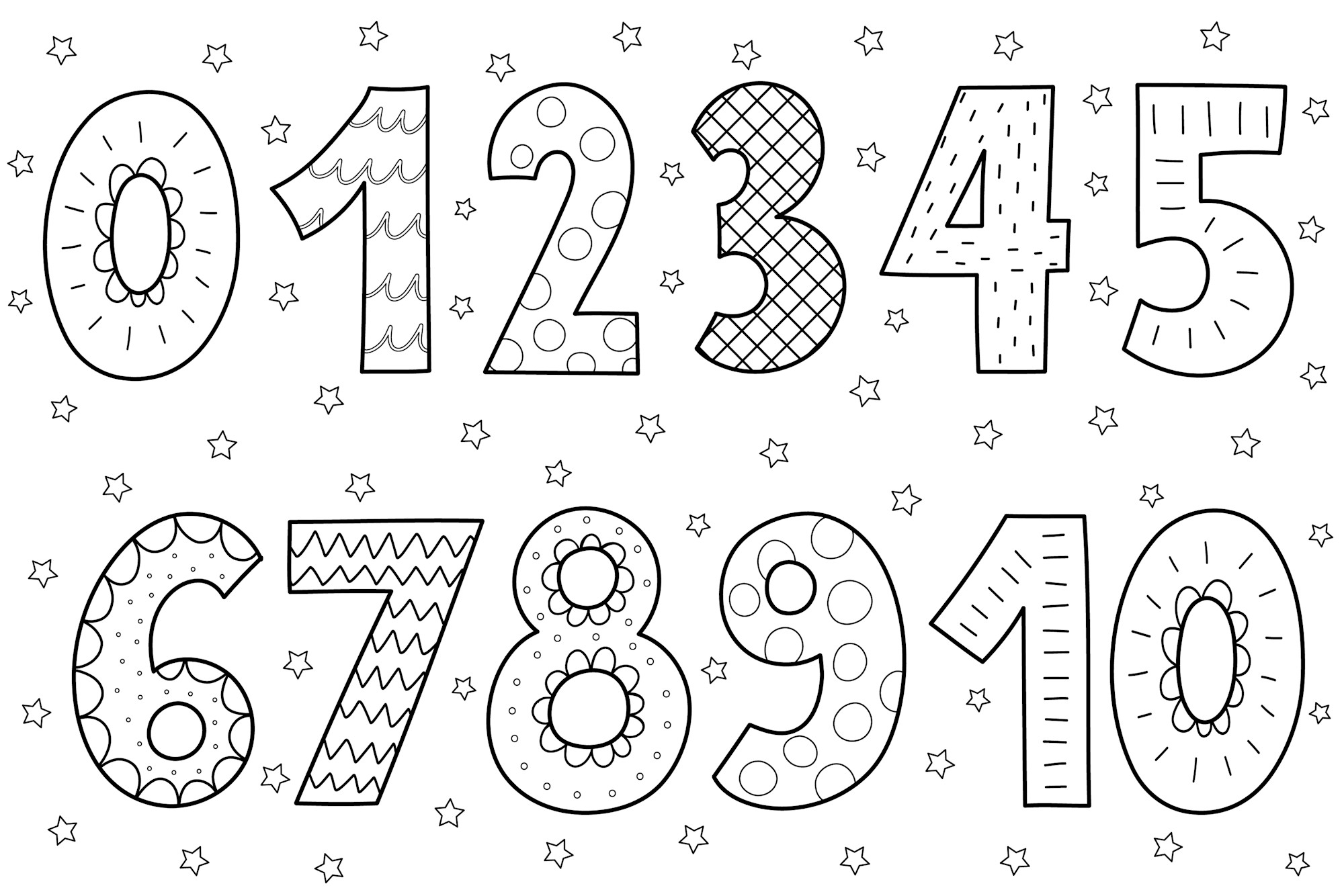
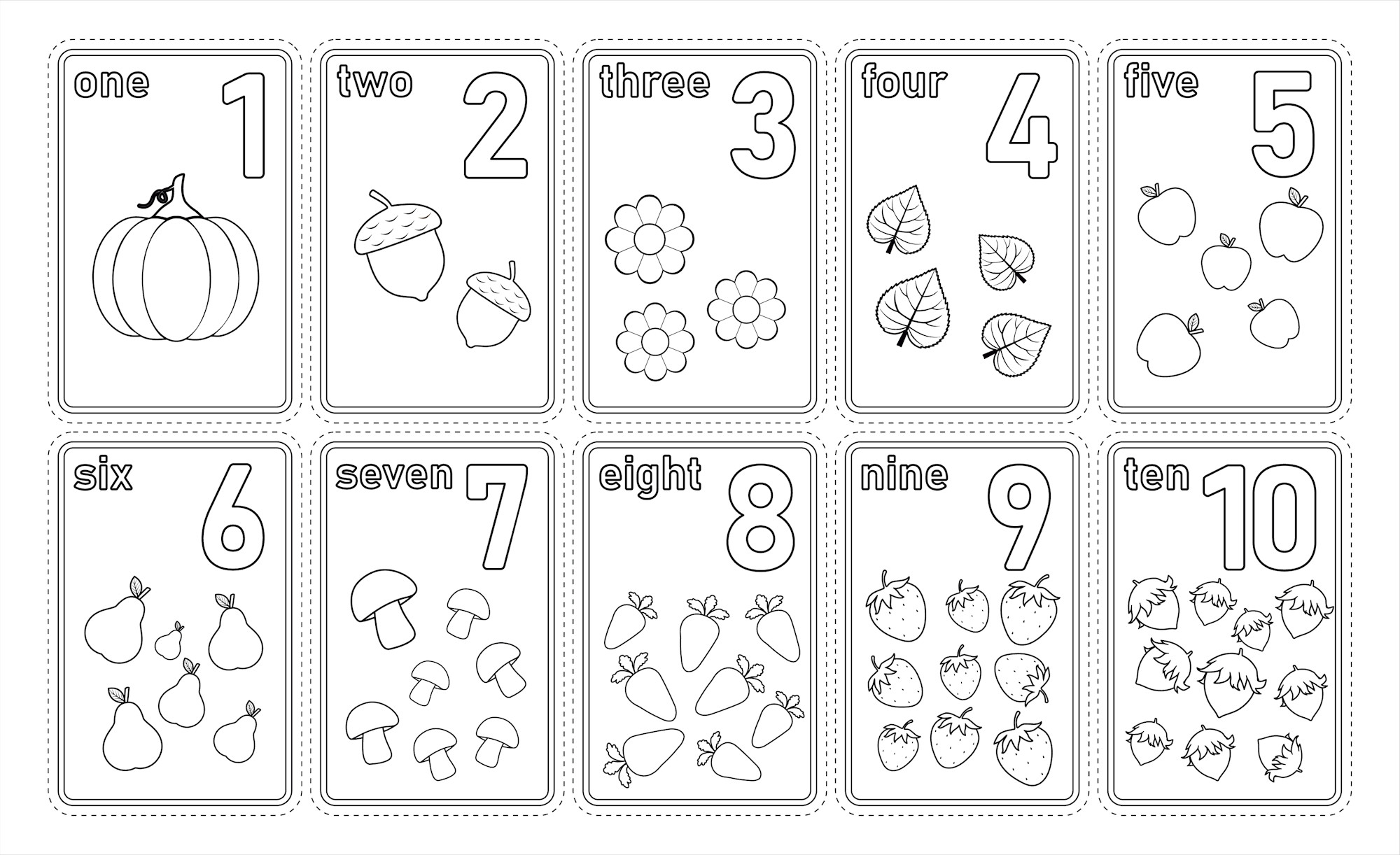
Numbers are everywhere. We use them to count toys, candles, fingers, apples, steps, days, crayons, cookies, and almost everything else around us. For young children who are just beginning to recognize written numerals and connect them with quantities, a little color can make those first number activities much more inviting.
Our Coloring Pages with Numbers combine early math with creative play through cheerful number characters and printable number flashcards featuring colorful fruits and vegetables. Kids can color the numerals, count pictures, match quantities, practice number order, name foods, and turn the finished pages into homemade learning games.
These printables can work well for preschool and kindergarten activities, homeschool learning, classroom math centers, quiet-time activities, or simple practice at home.
Grab the crayons, colored pencils, or markers and get ready to count your way through the coloring box.
🔢 Meet the Happy Numbers
The cheerful number characters in this collection make written numerals feel less like abstract symbols and more like playful characters.
Instead of simply looking at a plain number on a worksheet, children can give each numeral its own personality.
Maybe one number is bright red.
Another could be turquoise.
One might have rainbow colors while another uses pink and purple.
Young children don’t need to worry about choosing the “right” colors because numbers don’t have official colors. The goal is simply to become familiar with their shapes while enjoying the activity.
After coloring each numeral, say its name aloud.
One.
Two.
Three.
Continue at whatever pace is appropriate for the child.
🌈 Give Every Number Its Own Color
Assigning colors to numbers can turn numeral recognition into a simple matching activity.
For example:
1 — Red
2 — Orange
3 — Yellow
4 — Green
5 — Blue
You can continue with any colors you like.
Later, ask:
Which number was green?
Can you find the blue number?
What color did you use for 3?
The colors aren’t teaching the mathematical meaning of the number by themselves, but they can make the activity more memorable and give children another feature to notice.
You could also skip the color system entirely and let every numeral become rainbow-colored.
😊 Turn the Numbers Into Characters
Because the happy-number illustrations already have personality, encourage kids to imagine even more.
Give each number a name.
Maybe Number 2 is always cheerful.
Perhaps Number 5 loves dinosaurs.
Number 7 might be the fastest runner.
Number 9 could tell terrible jokes.
Children can draw:
- Hats
- Shoes
- Glasses
- Bows
- Crowns
- Stars
- Hearts
around their favorite numerals.
Then invent a story about what happens when all the numbers meet.
Math practice suddenly becomes a character adventure.
🔢 Recognizing Numerals Is Different From Counting
Young children often learn to say number words before they fully understand what written numerals represent.
A child may be able to recite:
1, 2, 3, 4, 5
without immediately recognizing the printed symbol 4 or understanding that four objects represent a quantity of four.
Those are related but distinct parts of early mathematics.
Number coloring pages can provide one simple opportunity to connect them.
Point to the numeral.
Say its name.
Then count that many objects.
For example:
3
One crayon.
Two crayons.
Three crayons.
The written symbol begins to connect with an actual quantity.
🍎 Color Number Flashcards With Fruits and Vegetables
The fruit-and-vegetable number flashcards add another layer to the collection.
Now children can work with both a numeral and familiar foods.
Color the pictures first.
Look for different fruits and vegetables and talk about what you see.
You might use shades such as:
- Apple red
- Carrot orange
- Banana yellow
- Broccoli green
- Grape purple
Real produce comes in many colors, so children can also experiment with less obvious choices.
Apples can be red, yellow, or green.
Carrots aren’t limited to orange.
Peppers can be green, yellow, orange, or red.
For even more produce coloring, explore our Coloring Pages of Vegetables.
🥕 Count the Food Pictures
Once the flashcards are colored, use the pictures for counting.
Point to each item one at a time.
Say one number for each object.
Then ask:
How many are there altogether?
For example, if the card shows three vegetables:
One, two, three. There are three vegetables.
This helps connect the counting sequence with the total quantity.
Children may sometimes count all the objects correctly but still recount them when asked, “How many?”
That’s okay. Understanding that the final counting word tells how many objects are in the group develops over time.
Keep the activity playful and repeat it naturally.
🍓 Match the Number to the Quantity
The produce flashcards are especially useful for connecting numerals with quantities.
If a card represents 4, count four objects.
Then point to the written numeral:
4
Say:
There are four. This is the number 4.
You can reinforce the idea with real objects.
Place four crayons beside the card.
Or four toy cars.
Or four blocks.
The object doesn’t matter.
The important connection is:
Numeral → number word → quantity
Young children benefit from seeing those ideas together in many different situations.
🧮 Practice One-to-One Counting
One-to-one correspondence means assigning one number word to each object being counted.
Instead of saying numbers quickly while looking at the whole group, encourage children to touch or point to one picture at a time.
One — touch the first apple.
Two — touch the second.
Three — touch the third.
Each object gets counted once.
For young learners, physically pointing to or moving objects can make counting easier to organize.
The fruit-and-vegetable pictures provide ready-made objects to practice with.
🍇 Count Real Snacks Too
Number learning doesn’t have to stop when the coloring page is put away.
Use snack time.
Count:
- 2 strawberries
- 3 crackers
- 4 grapes
- 5 carrot pieces
Ask children to give you a certain amount.
Can you give me three crackers?
Then count them together.
The coloring flashcards can stay nearby as visual references.
Children begin to see that the number 3 doesn’t mean only three vegetables on one particular card.
It can describe three crackers, three blocks, three toy animals, or three claps.
🥦 Explore More Vegetable Coloring
If kids especially enjoy the produce flashcards, continue with our Coloring Pages of Vegetables.
That collection includes broccoli, tomatoes, mushrooms, carrots, onions, potatoes, pumpkins, peppers, peas, and other foods.
Turn the vegetable pages into a counting game.
Ask:
How many pumpkins can you find?
Can you draw three carrots?
Can you add two peas?
Which group has more?
Combining familiar pictures with numbers keeps the math grounded in objects children can actually see and count.
🍕 Count Your Way Through Food Coloring Pages
Our Coloring Pages of Food provide even more counting possibilities.
That collection includes pancakes, popcorn, tacos, corn, soup, apples, pizza, hot dogs, and burgers.
Add simple number challenges.
Draw:
2 pancakes
3 pieces of popcorn
4 apple leaves
5 pizza toppings
Children can make the pictures silly too.
Maybe a burger needs seven pickles.
Perhaps the pizza gets ten purple mushrooms.
The activity does not need to look like a formal math worksheet to involve meaningful counting.
🍎 Sort Foods by Color
The produce flashcards also work for color sorting.
After coloring, ask children to find foods that are:
Red
Orange
Yellow
Green
Purple
Then count each group.
How many green foods?
How many red ones?
Which color appears most often?
Which appears least often?
This combines classification, counting, color recognition, and food vocabulary in one simple conversation.
🔺 Numbers Are Symbols
A written numeral is a symbol representing a number.
That’s an important distinction.
The numeral 5 isn’t five objects. It’s the written symbol we use to represent the quantity five.
For preschoolers, there is no need to turn this into a vocabulary lesson.
Simply make the connection repeatedly:
This is 5.
Let’s count five dots.
Can you hold up five fingers?
Can you find five crayons?
The more different examples children experience, the less tied the number becomes to one particular set of pictures.
🖐️ Count on Your Fingers
Fingers are one of the simplest math tools available.
Hold up:
One finger.
Then two.
Then three.
Ask the child to copy you.
You can also show a small number of fingers quickly and ask:
How many do you see?
With very small quantities, children may eventually recognize the amount without having to count every finger individually.
This quick recognition of a small quantity is known as subitizing.
There’s no need to make the terminology part of the child’s activity. For them, it can simply be a game of “How many?”
👀 Play “How Many Do You See?”
After children are comfortable counting, try showing very small groups of objects.
Place two crayons on the table.
Ask:
How many?
Try three buttons.
Then four blocks.
Sometimes allow time for counting.
Other times, see whether the child recognizes a small quantity immediately.
Keep the groups small enough to be enjoyable.
The goal isn’t speed or testing.
It’s giving children many playful experiences with quantity.
🔵 Make Dot Cards
Turn your number coloring pages into a homemade math game by creating simple dot cards.
Cut paper or cardstock into squares.
On each card, draw a small group of dots.
For example:
●
● ●
● ● ●
Then use your colored numeral pages or flashcards as matches.
Can the child place the 3 beside the card showing three dots?
Mix the cards and play again.
For more variety, arrange the dots differently so three doesn’t always look exactly the same.
🎲 Roll a Die and Find the Number
If you have a standard die, combine it with your finished number pages.
Roll the die.
Count the dots.
Then find the matching numeral.
If you roll:
⚄
count:
One, two, three, four, five.
Then find 5.
Older preschoolers may begin recognizing familiar die arrangements without counting every dot.
You can also roll and perform an action that many times.
Roll 3?
Jump three times.
Roll 5?
Clap five times.
Math suddenly becomes much more active.
🐰 Count With Toys
Favorite toys can turn number practice into play.
Choose one number card.
If the card shows 4, find four toy animals.
Line them up.
Count them.
Then change the objects.
Four cars.
Four blocks.
Four crayons.
Four stuffed animals.
This helps show that fourness stays the same even when the objects being counted are completely different.
You can even invent a story.
Maybe four toy animals are going to a party and need exactly four chairs.
🧸 Give Every Number a Toy Group
Spread several numeral pages or cards across the floor.
Place different quantities of toys nearby.
Then match each group with the correct number.
One teddy bear goes with 1.
Two cars go with 2.
Three blocks go with 3.
Continue at the child’s comfortable level.
Don’t worry about working with a large range immediately.
Learning a few small numbers thoroughly is more useful than racing through many numbers without understanding the quantities.
🟢 Practice More, Less, and Same
Once a child is comfortable with small quantities, introduce comparison words.
Place two objects beside one number card and four beside another.
Ask:
Which group has more?
Which has less?
Then create two groups with the same number.
Are these the same?
Words such as more, less, and same are useful early-math vocabulary.
Keep the quantities small and use real objects when possible.
Crayons, toy animals, snacks, buttons, and blocks all work.
➕ Find One More
Choose a number card.
Suppose you choose 3.
Place three objects beside it.
Then add one.
Count again.
Three… and one more makes four.
Find the 4 card.
You don’t need to introduce written addition equations immediately.
The idea can begin concretely.
Three bears.
Add one bear.
Now there are four bears.
Young children can explore relationships between quantities long before formal arithmetic notation becomes necessary.
➖ Find One Less
The same game works backward.
Begin with five blocks.
Count them.
Take one away.
Count again.
Now there are four.
Ask:
Which number card matches now?
This helps children notice that numbers have relationships with the numbers before and after them.
Again, keep the activity playful.
If the child would rather build a block tower than complete another subtraction example, build the tower—and count the blocks.
🚂 Put the Numbers in Order
After coloring the happy-number pages or cutting apart the flashcards, arrange the numerals from smallest to largest.
Start with just a few.
For example:
1 — 2 — 3
Mix them up.
Can the child put them back?
Then add another.
1 — 2 — 3 — 4
As confidence grows, continue the sequence.
This helps children see number order visually rather than only reciting the sequence from memory.
🔀 What’s Missing?
Arrange several numbers in order but secretly remove one.
For example:
1 — 2 — __ — 4
Ask:
Which number is missing?
Or:
5 — __ — 7
Older children can create missing-number puzzles for adults or siblings.
Make the gaps more complicated as the activity becomes easier.
↔️ What Comes Before and After?
Choose a numeral and ask:
What comes before 5?
What comes after 5?
If that feels difficult, lay the number cards in order and let the child look.
Eventually, the visual sequence can become more familiar.
You can also use a number path by arranging the cards in one long row.
Move a toy character along the path while counting each space.
🛣️ Build a Number Path
Lay your number cards across the floor or table in order.
This creates a simple number path.
Choose a small toy as the game piece.
Roll a die and move the toy forward one space for every dot.
Say each number as the toy moves.
For example:
Roll two.
Move:
1… 2.
Where did the toy land?
Number-path games can give children practice with numeral recognition, counting, number order, and ideas such as before and after.
For even more printable play, explore our Coloring Pages of Games.
🎮 Combine Numbers With Printable Games
Our Coloring Pages of Games include mazes, dot-to-dot activities, I Spy games, word searches, find-the-difference puzzles, and other printable challenges.
Several of those activities naturally involve numbers.
Dot-to-dot pages require following a number sequence.
I Spy games can involve counting objects.
Tic-tac-toe introduces simple patterns and strategy.
Mazes can become counting games if children count steps or turns.
Using different activities helps numbers appear in playful contexts instead of only on traditional worksheets.
🧜 Count Through a Dot-to-Dot
Dot-to-dot activities are especially useful companions to numeral coloring.
Children follow numbers in order to reveal the picture.
Say each numeral aloud as the pencil moves.
If the line suddenly jumps somewhere unexpected, check the sequence.
Did a number get skipped?
The mermaid dot-to-dot in our game collection offers one example of how number order can become part of an art activity.
Once the picture appears, the counting ends and the coloring begins.
🔍 Go on a Number Hunt
Numbers are hiding everywhere.
After coloring, take a number hunt around the house or classroom.
Look for numerals on:
- Clocks
- Calendars
- Books
- Doors
- Appliances
- Games
- Measuring cups
- Packages
Ask:
Can you find a 2?
Where is a 5?
Do you see the number 10?
This helps children notice that written numerals aren’t something that exist only on school pages.
They’re part of everyday life.
📅 Find Numbers on a Calendar
Calendars provide another simple number-recognition activity.
Find today’s date.
What numeral is it?
Can you find tomorrow?
Yesterday?
A birthday?
Count how many days remain until a special event if the numbers involved are manageable for the child.
Younger children don’t need to understand the full calendar system yet.
Simply finding familiar numerals is useful practice.
🎂 Count Birthday Candles
Birthdays are naturally full of numbers.
Draw a cake on a separate sheet.
Choose an age.
Add that many candles.
Count them together.
Children can color each candle differently.
Try:
3 candles
4 candles
5 candles
Older kids can design cakes for family members of different ages.
The numbers quickly become connected with something meaningful.
🖍️ Count the Crayons
The coloring box itself is a math activity waiting to happen.
Ask:
Can you find three red crayons?
Can you choose five different colors?
How many blue crayons do we have?
Line several crayons up from shortest to longest.
Sort them by color.
Make pairs.
The coloring page may introduce the numeral, but the art supplies can keep the number conversation going.
🎨 Number Color Palette Ideas
Numbers can be any color, which makes these pages perfect for experimenting with palettes.
🌈 Rainbow Numbers
Red, orange, yellow, green, blue, and purple.
🍬 Pastel Numbers
Pink, peach, lavender, mint, and baby blue.
🔵 Primary Colors
Red, yellow, and blue.
🌿 Nature Numbers
Green, brown, yellow, blue, and orange.
🍎 Produce Colors
Apple red, carrot orange, banana yellow, leafy green, and grape purple.
🌊 Cool Colors
Blue, turquoise, green, and violet.
☀️ Warm Colors
Red, orange, yellow, pink, and gold.
Kids can use one palette for the whole collection or make every numeral completely different.
✏️ Trace the Number After Coloring
If the printed design allows it, use a finger to trace around the numeral’s shape.
Then trace it with a pencil.
Say the number aloud while tracing.
You can also write the numeral several times on a separate sheet.
Keep the activity brief for younger children.
Coloring the number and recognizing its shape is already worthwhile; handwriting practice doesn’t need to take over the page.
🧂 Make Numbers With Everyday Materials
After coloring a numeral, try forming it with something different.
Use:
- Play dough
- Yarn
- Craft sticks
- Blocks
- Pipe cleaners
- Pebbles
Creating the same numeral in several ways encourages children to look carefully at its shape.
A number 1 may be easy with a craft stick.
A curving number 2 or 3 requires a little more problem solving.
🖐️ Make Numbers With Play Dough
Roll play dough into long thin pieces.
Bend them into numerals.
Then place the finished dough number beside the corresponding coloring page.
Add small dough balls to represent the quantity.
For 4, make:
● ● ● ●
This brings together the written numeral and a group containing that many objects.
Kids who enjoy hands-on activities may find this especially engaging.
🧱 Build Number Towers
Blocks make another simple math game.
Choose a number.
If it’s 5, build a tower with five blocks.
Count each block as it is added.
Then compare towers.
Which is taller?
Which uses more blocks?
Can you make two towers with the same number?
Try assigning every number a different block color.
The activity introduces quantities in a way children can physically build, knock down, and rebuild.
🖼️ Make a Number Poster
Choose one favorite numeral and turn it into a larger project.
Write the number in the center of a sheet of paper.
Then draw that many objects around it.
For 3, you might add:
🍎 🍎 🍎
or:
🌸 🌸 🌸
Children can choose anything they like.
Three dinosaurs.
Three cupcakes.
Three stars.
Three cats.
The finished poster combines counting, drawing, and number recognition.
📚 Make a Homemade Number Book
The happy numbers and flashcards can become pages in a homemade counting book.
Arrange them in number order.
Add a cover:
MY NUMBER BOOK
On each page, draw or attach the correct number of objects.
For example:
1 — one sun
2 — two cats
3 — three flowers
4 — four fish
Continue as far as the child’s current number range.
Staple or bind the pages together.
Kids can return to the book later as their counting skills grow.
🍏 Make a Fruit-and-Vegetable Counting Book
The produce flashcards lend themselves especially well to a food-themed number book.
Create pages such as:
1 Apple
2 Carrots
3 Peppers
4 Strawberries
5 Peas
The exact foods can be whatever you want to draw.
For more inspiration, combine the project with our Coloring Pages of Food and Coloring Pages of Vegetables.
Children get a counting book and a food-themed coloring project at the same time.
🔤 Pair Numbers With Letters
Once children are familiar with some numerals, mix the activity with alphabet learning.
Our Coloring Pages of Letters include all 26 letters of the alphabet.
Choose one number and one letter.
For example:
3 + B
Draw three objects beginning with B.
Three balls.
Three bears.
Three bananas.
Or:
2 + C
Two cats.
Two cars.
Two cupcakes.
This combines early number concepts with letter and vocabulary practice.
🔠 Number or Letter?
Mix several number cards with alphabet cards.
Ask children to sort them into two groups:
NUMBERS
and
LETTERS
This helps reinforce the idea that written symbols can have different purposes.
Then choose one of each.
5
and
A
Can you find five things beginning with A?
The answer may take some imagination, which is part of the fun.
Browse our Alphabet Coloring Pages for more letter activities.
🗺️ Numbers and Maps
Numbers also appear naturally in geography activities.
Count continents on our World Map Coloring Pages.
Count oceans.
Count animals pictured on a map.
Older children can use numbers to label a route or create a numbered map key.
Our Coloring Pages of the USA Map provide another opportunity to combine coloring with counting and geography.
The goal isn’t to force math into every coloring page. It’s simply to notice how often numbers naturally appear in other subjects.
🏫 Easy Number Activities for Preschool
These number pages fit naturally into preschool learning.
Try them for:
- Numeral recognition
- Counting practice
- Color activities
- Math centers
- Quiet time
- Morning activities
- Homeschool lessons
- Early-finisher activities
- Matching games
- Number-order practice
Keep activities short and adjust them to the child.
One preschooler may be working confidently with numbers through 10 while another is still becoming comfortable with 1, 2, and 3.
Both are learning.
Our Preschool Coloring Pages offer more simple pictures when it’s time for a coloring break.
🧒 Let the Child’s Number Range Guide the Activity
There is no need to use every number on every occasion.
If a child is currently comfortable with 1 through 3, begin there.
Color those numbers.
Count groups of one, two, and three.
Match those quantities.
Play games using only those cards.
When those ideas become familiar, add another number.
Working with a manageable range can make the activity much less frustrating than presenting a large collection all at once.
🎲 Turn Finished Number Pages Into Games
Once the coloring is finished, the pages don’t have to disappear into a folder.
Cut out number cards with appropriate adult help and use them repeatedly.
Play:
Find the Number
Call out a number and let the child find it.
Number Order
Mix the cards and put them back in sequence.
Match the Quantity
Match a numeral with a group of objects.
What’s Missing?
Remove one number from a sequence.
One More
Find the number that comes next.
One Less
Find the number before it.
One set of colored pages can become many different activities.
🙈 Play “Hide a Number”
Arrange several number cards on the table.
Ask the child to close their eyes.
Hide one.
Ask:
Which one disappeared?
Start with only three cards.
As the game becomes easier, add more.
Children can take turns hiding the number for adults too.
They often enjoy being the game leader just as much as solving the puzzle.
🎯 Toss and Count
Place several numeral cards on the floor.
Toss a soft beanbag or rolled-up sock.
Whichever number it lands closest to becomes the challenge.
If it lands near 4:
Clap four times.
Jump four times.
Touch your toes four times.
Find four toys.
This turns number recognition into an active game and gives energetic learners a reason to move.
👏 Clap, Stomp, and Jump the Number
You don’t need any supplies at all for this activity beyond a number card.
Hold up 3.
Clap three times.
Hold up 5.
Stomp five times.
Hold up 2.
Jump twice.
Try:
- Clapping
- Stomping
- Jumping
- Hopping
- Spinning
- Waving
- Tapping
Children connect the numeral with a quantity of actions rather than only objects.
🎵 Sing and Count
Counting songs and rhymes can provide another playful way to practice number order.
After singing, find some of the numerals mentioned in the song among the coloring pages.
Or invent your own tune using the happy numbers.
The singing doesn’t need to be musically impressive.
Repetition is the point—and ridiculous songs are often the ones children remember best.
✋ Coloring and Fine Motor Practice
Coloring and number activities also give children opportunities to use their hands in different ways.
They can hold crayons, make controlled marks, point while counting, move cards, build with blocks, roll play dough, and trace numeral shapes.
For young children, those activities can be part of broader fine-motor practice.
There is no need to judge the finished coloring page by how perfectly a child stayed within the lines.
Learning to use art and writing tools develops gradually.
Let the cheerful numbers look cheerful—even if the coloring wanders outside the edges.
🖍️ Crayons, Markers, or Colored Pencils?
For young number learners, crayons are often the easiest place to start because they’re sturdy and work well for larger numeral shapes.
Washable markers can create especially bright happy-number characters.
Colored pencils provide more control for the smaller details in produce flashcards.
Try putting out only a handful of colors instead of an enormous collection if too many choices become distracting.
Other children will happily use every crayon they can find.
Follow whichever approach keeps the activity enjoyable.
📦 Create a Number Learning Box
Store your finished pages and a few simple materials together.
A number activity box might include:
- Colored numeral cards
- Dot cards
- Small blocks
- Dice
- Crayons
- Play dough
- Toy animals
- Buttons or counters
Pull out just one or two activities at a time.
Monday might be number matching.
Tuesday could involve block towers.
Another day might simply be coloring.
The same basic materials can support many kinds of playful number exploration.
🌟 Celebrate Small Number Victories
Early math development happens gradually.
Recognizing a numeral that was confusing last week is progress.
Counting four objects without skipping one is progress.
Knowing that the final number tells how many objects are in the group is progress.
Putting three numbers in order is progress.
There is no need to turn every success into a major performance.
A simple:
You found 4!
or:
You counted every apple!
is enough to acknowledge what happened and keep the activity moving.
🔢 Count, Color, Match, and Play
These Coloring Pages with Numbers offer an easy way to bring a little creativity into early math.
Color cheerful number characters, decorate printable flashcards, count fruits and vegetables, match numerals with quantities, put numbers in order, play missing-number games, roll dice, build block towers, make dot cards, and search for numerals around the house.
Young children don’t need every activity at once.
Start with one number.
Say its name.
Color it.
Count that many objects.
Then try another when the child is ready.
Over time, those little experiences help written symbols become connected with number words, quantities, order, and everyday counting.
And when math begins with smiling numbers, colorful vegetables, toys, crayons, jumping, and games, there are plenty of ways to keep it playful.
Grab your favorite colors and start counting.
Happy coloring and happy learning!
🔗 Related Coloring Pages & Activities
- Coloring Pages of Letters
- Preschool Coloring Pages
- Coloring Pages of Games
- Coloring Pages of Vegetables
- Coloring Pages of Food
- World Map Coloring Pages
- Coloring Pages of the USA Map
- Educational Coloring Pages & Activities
- Alphabet Coloring Pages
📚 Sources
- Head Start — Math Preschool: Counting and Cardinality
- Head Start — Math: Number Recognition and Subitizing
- Institute of Education Sciences — Teaching Math to Young Children for Families and Caregivers
- NAEYC — Play Games, Learn Math! Number Path Games
- NAEYC — Play Games, Learn Math! Explore Numbers and Counting
🖍️Shop Numbers Coloring Books –>