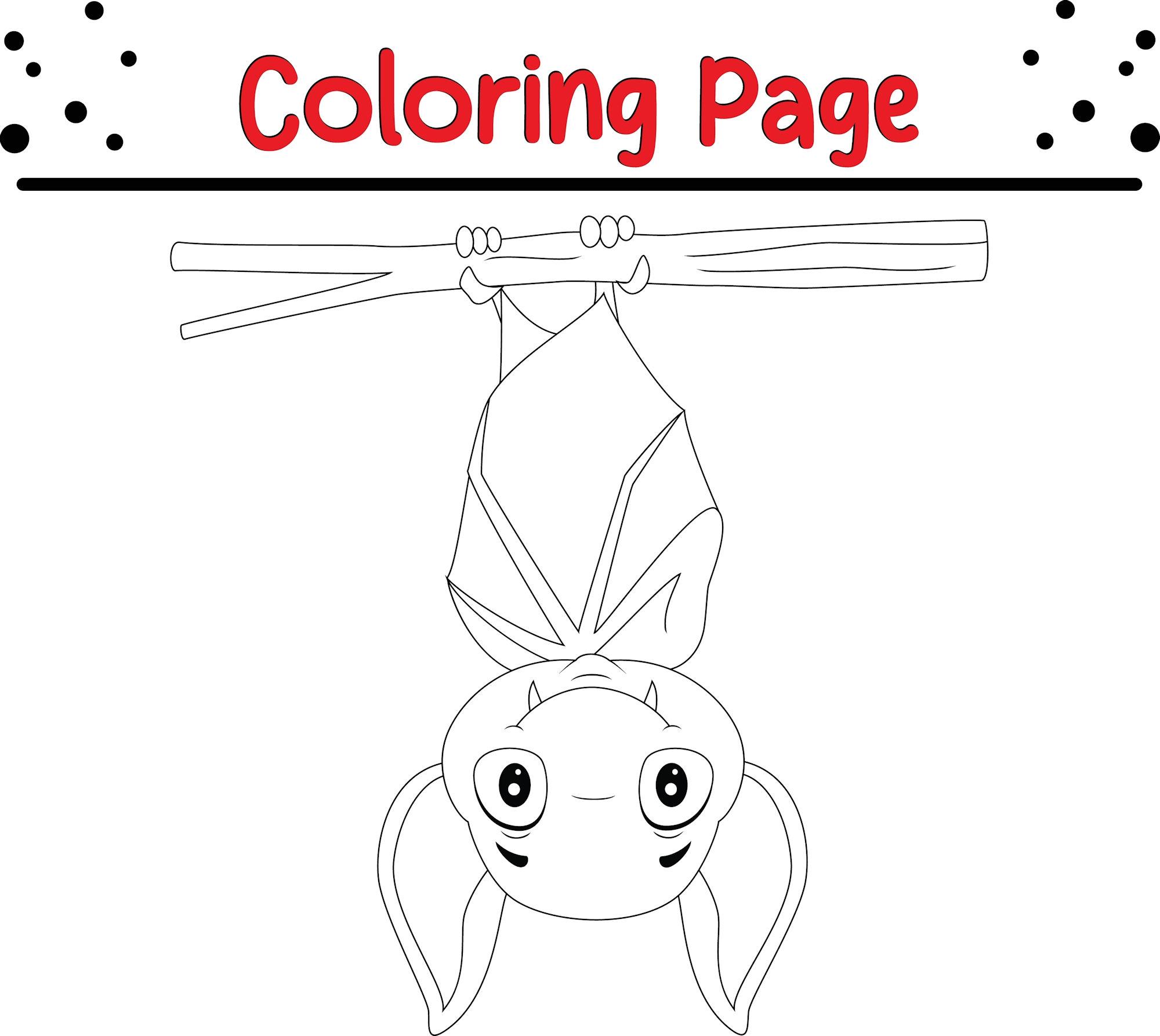
Spread your wings and get ready for a little nighttime coloring fun with our free printable bat coloring page! This adorable design features a friendly cartoon bat hanging upside down from a tree branch, complete with big expressive eyes, a sweet smile, enormous wings, and plenty of room for creative color.
Bats sometimes get a spooky reputation, especially around Halloween, but real bats are fascinating mammals that play important roles in ecosystems around the world. Some eat insects, some pollinate flowers, and others help spread seeds.
That makes this cute bat coloring page perfect for Bat Appreciation Day on April 17, a classroom animal lesson, a nature activity, Halloween coloring, or simply an afternoon of creative fun.
Color your bat in realistic brown, gray, or black—or create a pink, purple, turquoise, or completely rainbow-colored creature of the night.
Grab your crayons, markers, or colored pencils and let your bat adventure begin!
🦇 Meet Our Cute Bat Coloring Page
The star of this printable is about as far from a frightening Halloween monster as you can get.
Our little bat hangs peacefully upside down from a sturdy tree branch with its wings tucked nearby, enormous friendly eyes looking out at the world, and a cheerful expression that makes the design especially inviting for younger children.
There are plenty of different areas to color:
- Soft-looking fur
- Large ears
- Wide wings
- Tiny feet
- Tree bark
- Leaves and branches
- Background details you add yourself
Younger children can keep things simple with bold crayons, while older kids can experiment with shading, fur texture, wing membranes, moonlit backgrounds, or an entire nighttime forest.
For many more creatures to color, explore our Animal Coloring Pages.
🎨 What Color Should You Make Your Bat?
Real bats appear in plenty of natural shades, including brown, gray, reddish brown, black, and lighter tan colors.
Try combining several shades instead of making your bat one solid color.
A natural palette might include:
- Chocolate brown
- Warm tan
- Charcoal
- Soft gray
- Black
- Rusty brown
- Cream
Use a slightly lighter shade for the body and darker colors around the ears, wings, and feet.
Or forget realism entirely.
A coloring-page bat can be lavender with pink wings, turquoise with purple ears, bright orange with black spots, or covered from head to toe in rainbow stripes.
🌈 Create a Rainbow Bat
Want something especially cheerful?
Turn your bat into a rainbow creature.
Color one wing:
Red
Orange
Yellow
Green
Blue
Purple
Then repeat those colors across the other wing.
You could keep the body black or gray so the wings stand out, or continue the rainbow across the entire bat.
Add a rainbow moon, colorful stars, and bright clouds in the background.
Maybe this isn’t an ordinary bat at all. Perhaps it is a magical Rainbow Bat that only appears when the moon is full.
Give your new species a name.
💜 Try a Cute Pastel Bat
Because the bat itself has such a sweet expression, a pastel palette works especially well.
Try:
- Lavender
- Blush pink
- Mint green
- Baby blue
- Peach
- Pale yellow
Color the body pale purple and make the wing membranes pink.
Give the bat turquoise ears and rosy cheeks.
Then add little stars, hearts, or clouds around it.
For even more adorable animals and characters, visit our Cute Coloring Pages.
🌙 Create a Moonlit Bat Scene
Bats and nighttime naturally belong together.
Turn the blank space around your bat into a moonlit forest.
Add:
- A full moon
- Stars
- Clouds
- Tree silhouettes
- Fireflies
- Mountains
- An old barn
- A forest
- Other bats flying in the distance
Color the sky navy, dark blue, purple, or black.
Then make the moon pale yellow, silver, or white.
Use lighter colors around the edges of the bat to create the impression that moonlight is shining across its fur and wings.
⭐ Fill the Sky With Stars
A nighttime bat picture offers plenty of room for stars.
Draw tiny stars all across the sky or create several large decorative ones.
Try gold and yellow for a classic nighttime look.
Or make every star a different color.
Older children can look up a familiar constellation and try adding its pattern to the background.
You might even create an imaginary constellation shaped like a bat.
Give it a name such as The Great Flying Bat or The Midnight Wings.
🌳 Add a Nighttime Forest
Since our bat is already hanging from a tree branch, why not give it an entire forest?
Draw tree trunks behind the bat and add leaves, branches, mushrooms, rocks, and grasses below.
At night, the forest could use:
- Deep green
- Navy
- Dark purple
- Brown
- Gray
- Black
Then use small touches of lighter color for moonlit leaves.
Maybe another animal is hiding nearby.
Add an owl perched on a branch, a fox walking beneath the trees, or tiny insects flying through the air.
🙃 Why Do Bats Hang Upside Down?
The upside-down pose shown in this coloring page isn’t just an artistic choice.
Many bats really do spend resting periods hanging upside down from their feet.
This roosting position works well with their specialized bodies and makes it possible for them to rest in protected places such as caves, trees, buildings, bridges, and other sheltered spaces.
Different bat species choose different types of roosts, so there isn’t one single place where every bat lives.
Some spend time inside caves.
Others use hollow trees or loose bark.
Some species find shelter in buildings or human-made structures.
The little bat on this page seems perfectly happy with its tree branch.
🏠 Design a Home for Your Bat
Where does your coloring-page bat live when it isn’t hanging from this particular branch?
Draw its home around the picture.
Maybe it lives inside:
- A hollow tree
- A cave
- A forest
- An old barn
- A rocky cliff
- A bat house
- A magical castle
Then decide whether your bat lives alone or has an entire group of bat friends nearby.
Draw several tiny bats hanging from another branch or flying beneath the moon.
🪽 Look Closely at Bat Wings
Bat wings are one of the most fascinating parts of the animal.
Bats are mammals, but their forelimbs have evolved into wings. Long finger bones help support a thin wing membrane, giving bats the ability to perform true powered flight.
That makes a bat wing very different from a bird wing.
Bird wings are covered with feathers.
Bat wings have flexible membranes supported by elongated bones.
Look closely at your coloring page and notice the lines running through the wings.
You can use slightly darker shades along these sections and lighter shades between them to give the wing more dimension.
🖍️ Add Shading to the Wings
Bat wings are especially fun for practicing shading.
Begin with a light gray, brown, purple, or another base color.
Then add a darker shade:
- Along the wing edges
- Near the body
- Around the supporting lines
- Beneath folded sections
Keep some areas lighter to create highlights.
Colored pencils work particularly well because you can gradually layer one shade over another.
For a fantasy bat, try blending blue into purple or pink into orange.
🧸 Make the Fur Look Soft
The body of the bat provides a completely different coloring challenge.
Instead of filling it with one solid block of brown or gray, try lots of short pencil strokes.
Follow the direction you imagine the fur growing.
Start with a light shade, then layer darker strokes around the edges of the body, ears, and face.
This can make the little cartoon bat look surprisingly fluffy.
Younger kids do not need to worry about texture at all. A big brown, purple, or rainbow crayon section works just as well.
🐾 Bats Are Mammals
A bat may fly through the sky like a bird, but it isn’t a bird.
Bats are mammals.
They have fur, are warm-blooded, and mothers nurse their young with milk.
What makes bats especially unusual is that they are the only mammals capable of true sustained flight.
Other mammals sometimes described as “flying,” such as flying squirrels, actually glide rather than flying under their own power.
That makes the little creature on this coloring page a pretty remarkable animal.
🌎 There Are Many Different Bats
Bats aren’t all alike.
More than 1,300 bat species occur around the world, ranging from tiny bats weighing only a few grams to much larger flying foxes.
Different species have different:
- Sizes
- Ear shapes
- Faces
- Wing shapes
- Diets
- Habitats
- Roosting habits
Some have enormous ears.
Others have unusual noses.
Some eat insects.
Others eat fruit or nectar.
That diversity means kids could print the same bat page several times and create a completely different imaginary species with every copy.
👂 Give Your Bat Enormous Ears
Some real bats have spectacularly large ears.
Our cute cartoon bat already has noticeable ears, but you can exaggerate them even more by drawing your own bat on another sheet of paper.
Start with a round head.
Add two huge ears.
Then draw a small furry body and enormous wings.
Give the character a name like Big-Ears, Echo, Radar, or Floppy.
Compare your drawing with photographs of bats such as Townsend’s big-eared bat and see how wonderfully unusual real bat faces can be.
📡 What Is Echolocation?
Many bats use an incredible ability called echolocation to navigate and find food.
They produce high-frequency sounds, many of which are above the range of human hearing.
Those sounds travel outward and bounce off objects.
The returning echoes give the bat information about what is around it.
A bat hunting insects can use these echoes to help locate moving prey in the darkness.
Echolocation isn’t exactly the same as ordinary vision, but it gives bats another powerful way to gather information about their surroundings.
〰️ Draw Echolocation Waves
Turn that science idea into part of the coloring page.
Draw several curved lines coming away from the bat’s head.
Pretend they represent the sound waves moving outward.
Then draw:
- A moth
- A beetle
- A tree
- A rock
- Another bat
Add curved lines coming back toward the bat to represent echoes.
Older children can label the picture echolocation and explain in one sentence how it works.
🦟 Bats and Insects
Many bats eat insects.
Depending on the species and habitat, insect-eating bats may hunt moths, beetles, mosquitoes, and many other small flying insects.
They can therefore play an important ecological role as predators.
That gives us another fun detail to add to the coloring page.
Draw several tiny moths or beetles flying through the night sky.
Perhaps our cute bat has just woken up and is heading out to look for dinner.
🦋 Draw the Bat’s Dinner
Add several nighttime insects to the picture.
Try drawing:
- Moths
- Beetles
- Mosquitoes
- Tiny flying insects
Then give each one a different color.
Moths could be brown, cream, gray, purple, or patterned.
Beetles might be green, blue, black, or metallic-looking.
This creates a whole nighttime food-web scene around the bat.
🌺 Some Bats Visit Flowers
Not every bat eats insects.
Some bat species feed on nectar and pollen from flowers.
As they move between blossoms, these bats can help pollinate certain plants.
In parts of the Americas, nectar-feeding bats are important pollinators of plants such as agaves and some cacti.
That means a bat coloring picture doesn’t have to take place only in a dark cave.
You could put your bat in a moonlit desert filled with enormous cactus flowers.
🌵 Create a Desert Bat Scene
Imagine your bat flying across the desert at night.
Draw:
- Tall saguaros
- Agave plants
- Cactus flowers
- Mountains
- Stars
- A giant moon
Use sandy tan and rust for the desert, several greens for the cacti, and dark blue or purple for the night sky.
Make the cactus flowers pale cream, pink, yellow, or white so they appear to glow beneath the moon.
This gives the same bat page a completely different habitat.
🍌 Some Bats Eat Fruit
Other bats eat fruit and can help disperse seeds when they travel.
This is another reminder that the word bat describes a remarkably diverse group of animals.
Turn that idea into a silly coloring activity.
Draw a fruit buffet for your imaginary bat.
Add:
- Bananas
- Mangoes
- Berries
- Figs
- Melon
- Other tropical fruit
Then decide whether your coloring-page bat is an insect eater, nectar feeder, fruit eater—or a completely invented fantasy bat that prefers cupcakes.
🌱 Why Bats Matter
Different bat species perform different roles within ecosystems.
Insect-eating bats help control insect populations.
Nectar-feeding species can pollinate plants.
Fruit-eating bats can move seeds across landscapes.
Bats themselves are also part of food webs and cave ecosystems.
In other words, bats aren’t simply mysterious animals flying through the night.
They are participants in complex natural communities.
That makes Bat Appreciation Day an especially good opportunity to replace spooky myths with curiosity.
💚 Celebrate Bat Appreciation Day on April 17
Bat Appreciation Day is observed on April 17.
It’s a perfect excuse to learn something new about these unusual mammals.
A simple celebration could include:
- Coloring this bat page
- Reading a book about bats
- Learning about a local species
- Watching for bats around dusk with an adult
- Drawing a bat habitat
- Learning about echolocation
- Visiting a nature center
- Creating a bat fact sheet
Children don’t need to become bat experts.
Learning even one or two new facts is enough to make the coloring activity more meaningful.
🔍 Look for Bats Around Dusk
Many bats are active around dusk and during the night.
With an adult, find a safe outdoor place and watch the evening sky.
You may see bats flying quickly overhead as they search for food.
Observe them without trying to approach, catch, or touch them.
Notice how they move.
Do they fly in straight lines?
Do they make sudden turns?
Are they flying near trees, lights, or water?
You can return to the coloring page afterward and draw the kind of sky you observed.
✋ Enjoy Wild Bats From a Distance
Wild bats should be admired without handling them.
If you find a bat resting somewhere unusual or lying on the ground, don’t pick it up with bare hands. Adults can contact an appropriate local wildlife professional or public-health authority if assistance is needed.
For children, the simple rule is easy:
Look, don’t touch.
The best way to appreciate wild bats is to let them remain wild.
🏡 Draw a Bat House
Bat houses are human-made structures designed to provide roosting space for certain bats.
Draw an imaginary one on a tree or pole beside your coloring-page bat.
Give it a little roof and narrow entrance underneath.
You can even add a sign:
BAT HOTEL
NIGHT FLYERS WELCOME
THE UPSIDE-DOWN INN
Children can imagine how many bats live inside and what happens when they all emerge at sunset.
📖 Write a Bat Adventure
The friendly expression on this bat makes it perfect for storytelling.
Try one of these beginnings:
One evening, the little bat woke up and discovered…
The moon disappeared, so the bat decided to…
While hanging from its favorite branch, the bat heard…
The youngest bat in the colony wanted to learn how to…
A tiny bat flew into a magical forest and found…
Younger children can tell their story aloud.
Older kids can write several paragraphs and use the finished coloring page as the first illustration.
💬 Give the Bat a Speech Bubble
What would this smiling little bat say?
Add a speech bubble above its head.
Maybe:
“Good evening!”
“Time to fly!”
“I’m not spooky!”
“Where are the moths?”
“I love hanging around!”
Or make up your own bat joke.
The character’s big eyes and friendly face make it especially easy to turn into a comic.
😂 Give Your Bat a Name
Every cute bat deserves a name.
Try:
- Echo
- Luna
- Midnight
- Pip
- Shadow
- Coco
- Flappy
- Moonbeam
- Pepper
- Buttons
- Biscuit
- Berry
Write the name underneath the picture.
Then invent three facts about your character.
Where does it live?
What does it eat?
What is its favorite thing to do?
🖤 Create a Realistic Bat Palette
Want your coloring page to feel more natural?
Try a woodland palette.
Use:
- Warm brown
- Dark brown
- Tan
- Charcoal
- Gray
- Black
- Cream
Keep the fur lighter and make the wing membranes darker.
Color the branch with several shades of brown and use deep green for any surrounding leaves.
Add a navy sky and pale moon behind everything.
🧡 Create a Halloween Bat Palette
Bats are also strongly associated with Halloween imagery, making this page easy to reuse in October.
Try:
- Black
- Orange
- Purple
- Slime green
- Dark red
- Silver
Draw pumpkins beneath the branch and place a full moon behind the bat.
Add a friendly ghost, a few stars, or a crooked old house in the distance.
Then continue your spooky coloring with our Coloring Pages of Halloween.
👻 Turn the Bat Into a Creepy-Cute Character
The existing bat is already much more cute than creepy, which makes it perfect for a kawaii Halloween makeover.
Give it:
- Rosy cheeks
- A tiny witch hat
- A bow tie
- A miniature pumpkin
- Star patterns on its wings
- A little cape
Add pastel purple, pink, orange, mint, and black for a spooky-but-sweet palette.
If that style is your favorite, try our Creepy Cute Coloring Page for World Goth Day next.
🎃 Add the Bat to an October Scene
Halloween isn’t the only reason bats fit nicely with fall coloring.
A moonlit bat can look wonderful flying above autumn trees.
Draw orange, red, yellow, and brown leaves around the branch.
Add pumpkins beneath the tree and a cloudy October sky behind it.
Our October Coloring Page is a natural companion for more pumpkins, leaves, acorns, and autumn colors.
🧛 Create a Fantasy Bat
Want to move completely beyond nature?
Turn the bat into a magical creature.
Perhaps it has:
- Dragon wings
- A unicorn horn
- Star-covered fur
- A crown
- Glowing eyes
- Rainbow ears
- A magical necklace
Maybe it guards a castle hidden in the mountains.
Perhaps it delivers secret messages between wizards after dark.
A real animal can become the starting point for an entire fantasy world.
🎲 Play a Bat Roll-and-Color Game
Grab a six-sided die.
Assign each number a color:
1 — Black
2 — Purple
3 — Orange
4 — Blue
5 — Green
6 — Your choice
Roll the die and color one section of the bat using the corresponding color.
Continue until the picture is complete.
Because the color decisions are random, you may end up with a bat you never would have designed yourself.
🔤 B Is for Bat
This page also works beautifully for early alphabet practice.
Write a large B beside the bat.
Then practice:
B is for Bat
Think of more B words:
- Bird
- Bear
- Bee
- Book
- Ball
- Boat
- Banana
- Butterfly
Children can draw one or two of those objects around the bat or simply practice saying the beginning sound.
For more learning activities, explore our Educational Coloring Pages & Activities.
🔢 Count the Bat’s Features
Younger children can also turn the page into a simple counting activity.
Count:
- 2 wings
- 2 ears
- 2 eyes
- 2 feet
Then add your own objects.
Draw three stars.
Add four clouds.
Create five little insects.
Put six leaves on the tree.
The coloring page becomes an easy counting activity without losing any of the fun.
🏫 Bat Coloring Page for the Classroom
This printable can fit into several classroom themes.
Teachers might use it for:
- Animal units
- Mammal lessons
- Nocturnal-animal lessons
- Echolocation activities
- Bat Appreciation Day
- Halloween
- October science
- Early finishers
- Art centers
- Creative writing
Students can color the bat and then write one new thing they learned underneath it.
Display the finished pictures together under a title such as We’re Batty About Bats!
🧠 Make a Bat Fact Card
Older children can choose a real bat species and research a few simple facts.
Find:
- Common name
- Where it lives
- What it eats
- Approximate size
- Roosting habitat
- One unusual feature
Then use those facts to inspire the coloring.
A child studying a reddish-brown species might choose rusty colors, while someone researching a big-eared bat could draw larger ears onto the cartoon design.
📓 Start a Nocturnal Animal Notebook
Use the finished bat page as the cover of a nighttime-animal notebook.
Inside, add pages for animals such as:
- Owls
- Moths
- Raccoons
- Foxes
- Some frogs
- Other bats
Draw each animal and write one or two observations about when it is active.
This can become a fun companion to an animal or nature unit.
🌿 Connect Bat Coloring With Nature
Bats may be most visible at night, but they are still part of the larger natural world.
Connect this page with our Nature Coloring Pages and explore birds, butterflies, flowers, gardens, mountains, ocean life, and other outdoor themes.
Kids can imagine where each animal belongs and draw its habitat around the coloring page.
The bat might need a nighttime forest.
A hummingbird belongs among flowers.
A dolphin needs an ocean.
Thinking about habitat makes animal coloring even more interesting.
🐾 Explore More Animal Coloring Pages
Once you’ve finished your bat, choose another animal.
Our Animal Coloring Pages include pets, farm animals, zoo animals, wildlife, birds, sea creatures, and dinosaurs.
Try comparing animals as you color.
Which have fur?
Which have feathers?
Which live in water?
Which can fly?
Which are mammals?
That turns a pile of coloring pages into a simple animal-learning collection.
✂️ Turn Your Bat Into a Craft
A finished bat coloring page can become:
- Bedroom wall art
- Classroom decoration
- Halloween décor
- A greeting card
- A notebook cover
- A story illustration
- A nature-journal page
- A Bat Appreciation Day poster
You can also cut out the bat with age-appropriate supervision and glue it onto construction paper.
Create a full moon from yellow paper and a dark blue nighttime sky behind it.
Add paper stars and several smaller bats to make a layered night scene.
🧵 Make a Hanging Bat Decoration
Since the bat in the picture is already hanging upside down, it makes a natural paper decoration.
Color the bat and carefully cut around it.
Attach a string or ribbon near the feet and hang the finished picture upside down.
Make several copies and color each one differently.
A whole group of rainbow, brown, black, purple, and orange bats can become a fun classroom display or Halloween decoration.
🌕 Create a Bat Silhouette Picture
Try another simple art project.
Color or paint a background in sunset colors:
Yellow
Orange
Pink
Purple
Dark blue
Then cut out the bat and color it completely black.
Place the dark bat over the colorful sunset background.
The strong silhouette creates a very different effect from the original cute coloring page.
🖍️ Best Supplies for This Bat Coloring Page
Crayons work well for younger children and larger areas such as the wings and background.
Colored pencils are especially useful for:
- Fur texture
- Wing shading
- Small facial details
- Tree bark
- Moonlit highlights
Markers create bold fantasy bats and dramatic Halloween colors. Slightly heavier paper may help if markers tend to bleed through standard printer paper.
Gel pens can add stars, wing patterns, eye highlights, or magical details once the main coloring is complete.
🖨️ How to Use This Free Bat Coloring Page
Print your bat coloring sheet and gather your favorite supplies.
Then choose which kind of bat you want to create.
Maybe it will be a realistic little brown bat resting beneath a moonlit sky.
Perhaps it is a purple-and-orange Halloween bat.
Maybe you want a pastel kawaii bat covered in stars.
Or perhaps today’s bat has rainbow wings, golden ears, and magical powers.
Color the bat first, then add the habitat, night sky, food, friends, and story around it.
The original picture is only the beginning.
🦇 Go Batty for Creativity
This free printable bat coloring page combines an adorable character with one of nature’s most fascinating groups of mammals.
Color the bat realistically, give it rainbow wings, add a moonlit forest, explore echolocation, learn how different bats find food, create a Halloween scene, or celebrate Bat Appreciation Day on April 17.
Whether you’re using the page at home, in a classroom, during a nature lesson, or at a Halloween coloring table, there are plenty of ways to make this little upside-down bat your own.
Grab your colors, spread your creative wings, and have a bat-tastic time!
🔗 Related Articles
- Animal Coloring Pages
- Nature Coloring Pages
- Cute Coloring Pages
- Coloring Pages of Halloween
- Creepy Cute Coloring Page for World Goth Day
- October Coloring Page
- Educational Coloring Pages & Activities
📚 Sources
- National Park Service — April Is Connected Conservation Month: Bat Appreciation Day
- National Park Service — 20 Reasons to Appreciate Bats
- National Park Service — Echolocation
- National Park Service — Benefits of Bats
- National Park Service — Discover the Secret Lives of Bats
- U.S. Geological Survey — White-Nose Syndrome