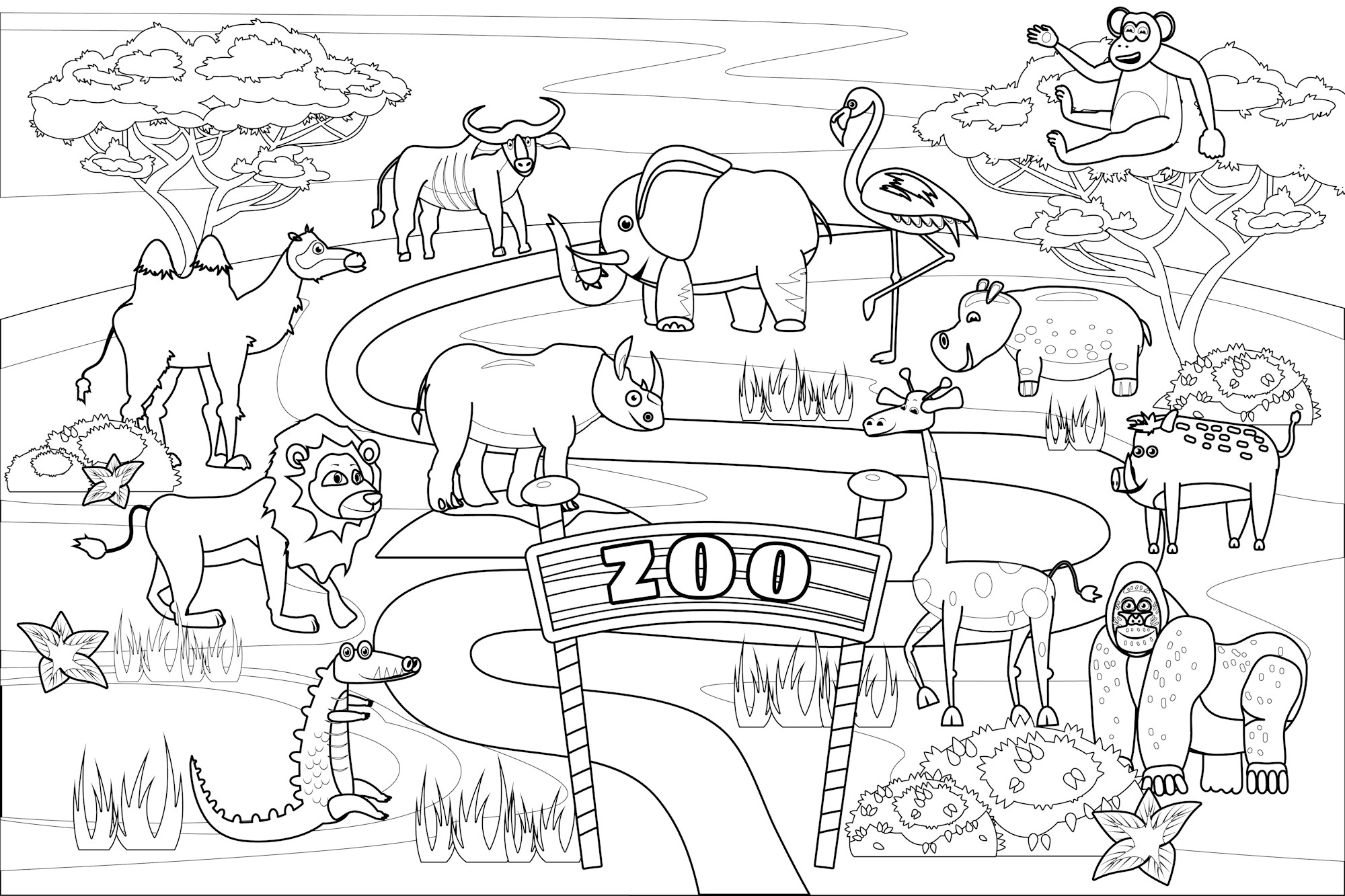
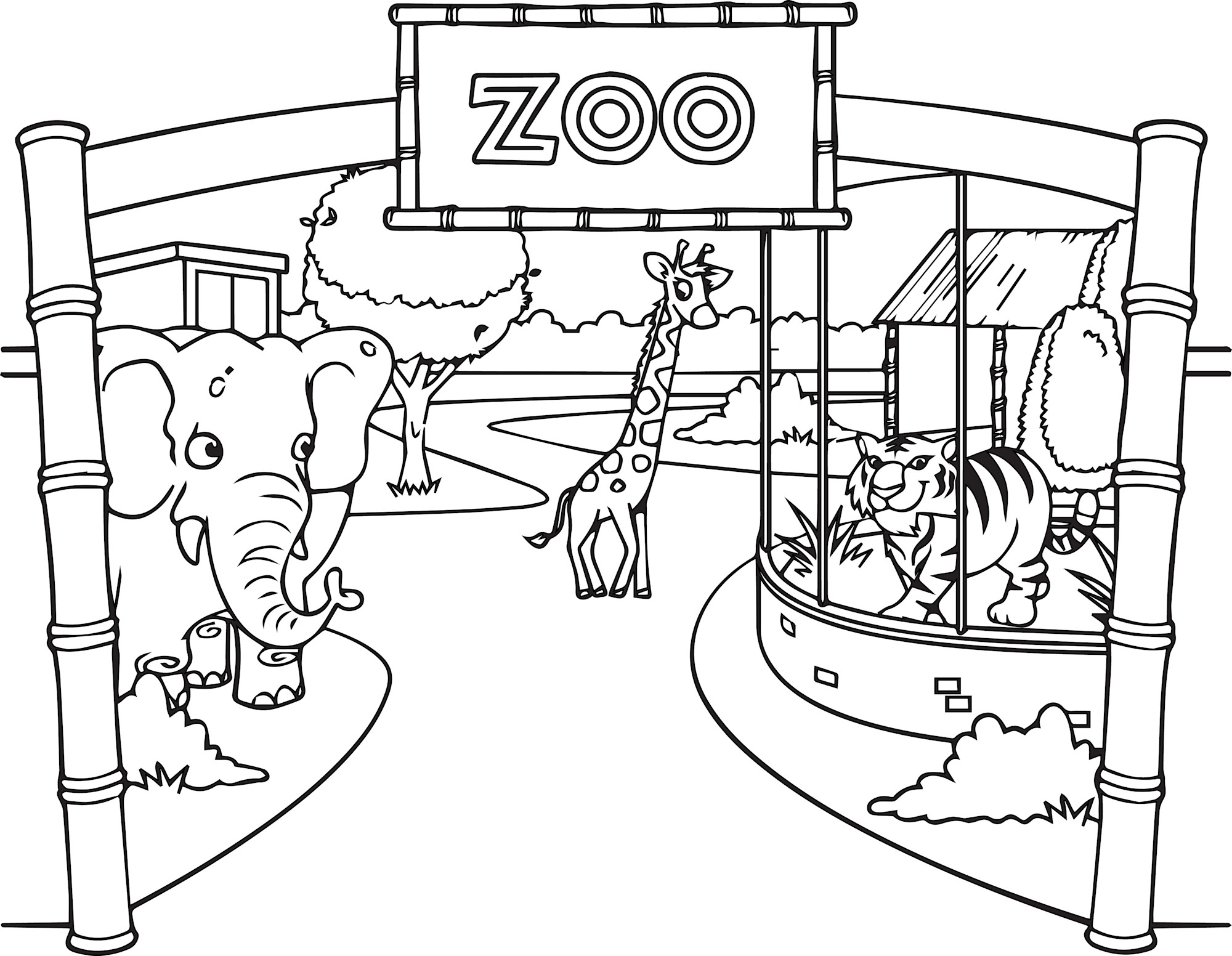
A trip to the zoo can feel like a journey around the world in a single afternoon. One path might lead past towering giraffes and powerful rhinoceroses, while another brings you face-to-face with elephants, gorillas, monkeys, crocodiles, hippos, tigers, and lions. For children who love animals, zoo scenes provide plenty to look at—and plenty to color.
Our Coloring Pages of the Zoo bring several familiar zoo animals together in lively scenes. The collection includes designs featuring lions, crocodiles, monkeys, elephants, camels, rhinoceroses, gorillas, hippopotamuses, giraffes, and tigers, giving kids a chance to experiment with animal colors while imagining a day spent exploring different zoo habitats.
These pages can be enjoyed simply as animal coloring sheets, but they also work well for classroom and homeschool activities about habitats, animal classification, geography, observation, and wildlife. Children can color the animals realistically, create a completely imaginative rainbow zoo, design their own zoo map, or use the pictures as the beginning of an animal story.
Grab your crayons, markers, or colored pencils and get ready for a colorful trip around the zoo.
🦁 Meet the Animals at the Zoo
One of the most appealing things about a zoo coloring scene is the variety. Instead of concentrating on a single species, children may find animals from several very different parts of the world on the same page.
A lion might inspire sandy gold, tan, brown, and cream, while a tiger invites orange, black, and white. Elephants and rhinoceroses can be shaded with gray, brown-gray, or dusty earth tones. Giraffes offer warm yellows, tans, oranges, and browns, while gorillas can be built from black, charcoal, brown, and gray.
Then there are animals that add completely different shapes and textures to the scene. A crocodile can use olive, green, gray, and brown. Hippos may appear gray-brown or muted purple-gray, while camels work beautifully with warm tan, caramel, cream, and sandy brown.
Monkeys provide plenty of possibilities depending on the species represented. Since a general zoo coloring page may not show enough detail to identify an exact species, children can simply choose colors that suit the illustration rather than worrying about scientific precision.
That variety is what makes a group zoo page interesting. One picture can move through stripes, spots, scales, fur, enormous ears, horns, long necks, and powerful jaws.
🐘 Color the Elephants, Giraffes, and Rhinoceroses
Some of the largest animals in zoo collections also provide the biggest spaces to color.
Elephants may look plain gray at first, but using several shades can make the picture much more interesting. Try pale gray across most of the body, then add darker charcoal or brown-gray around folds, ears, legs, and areas that would naturally fall into shadow. A small amount of dusty brown can suggest mud or earth on the skin.
For even more elephant artwork, visit our Coloring Pages of Elephants, where you can explore individual elephants, family groups, floral designs, and more detailed illustrations.
Giraffes naturally bring pattern into the picture. A golden-yellow or tan base works well with darker orange-brown or chestnut patches. The mane, hooves, and tail can be darker still. Rather than trying to make every patch identical, let the irregular shapes give the animal its distinctive appearance.
Rhinoceroses can be colored in cool gray, warm gray, brown-gray, or even subtle olive tones. Add darker shading beneath the belly and around the legs, then leave small lighter areas along the back to suggest sunlight.
If you’re creating a fantasy zoo rather than a realistic one, none of those rules apply. A lavender elephant beside a turquoise giraffe and a pink rhinoceros might be exactly what the page needs.
🐅 Add Stripes to Tigers and Color the Lions
The tiger and lion provide two very different big-cat coloring experiences.
Tigers are famous for their stripes, so take your time with the pattern. Begin with a warm orange or burnt-orange body, leave lighter cream or white areas where the illustration allows, and then carefully fill the stripes with black or dark brown. If the spaces are small, a sharpened colored pencil may be easier to control than a thick crayon.
The lion can use a simpler golden palette. Try sandy yellow or tan across the body and deepen the color around the legs and underside. If the drawing shows an adult male with a mane, experiment with gold, chestnut, dark brown, or even nearly black sections to create texture.
In nature, lions and tigers do not share the same wild habitat. Lions are primarily associated with parts of sub-Saharan Africa, with a small remaining population of Asiatic lions in India, while wild tigers live in parts of Asia. A zoo scene may place them close together for artistic convenience, but a habitat activity can help children discover where each species actually comes from.
Our Coloring Pages of Zoo Animals include another cute lion and a tiger in a forest setting if you want to continue the big-cat theme.
🦍 Color the Gorillas and Monkeys
Primates add expressive faces and interesting poses to zoo coloring pages. A gorilla can be built from black, charcoal gray, brown-black, and lighter gray highlights. Rather than filling the entire animal with one solid dark shade, leave subtle variations so the arms, shoulders, face, and body remain distinct.
Monkey colors vary enormously between species, so a general monkey illustration gives children plenty of flexibility. Brown, tan, golden, gray, black, and cream can all work. Some real primates even have unexpectedly bright facial or body colors, so colorful choices are not necessarily as unrealistic as they might seem.
The surrounding habitat can add even more interest. Draw climbing structures, ropes, branches, rocks, foliage, or platforms if the page leaves open space.
Children can also imagine what the animal is doing. Is the monkey looking for food? Is the gorilla resting, climbing, observing visitors, or interacting with another animal?
That question leads naturally into animal behavior. At real zoos, visitors can spend several minutes quietly watching one animal and recording what it does. Smithsonian’s National Zoo even uses animal-behavior observation activities with students, encouraging them to notice patterns rather than simply move quickly from exhibit to exhibit.
A coloring page can introduce the same idea in a playful way: look carefully before deciding what story the animal’s pose might tell.
🐊 Color Crocodiles and Hippos Near the Water
Crocodiles and hippos fit naturally into water-themed sections of a zoo picture.
Crocodiles can use olive green, dark green, brown, gray, and tan. Use slightly lighter shades along raised scales and darker colors beneath the body or around the legs. The water can be blue, turquoise, blue-green, or muddy brown depending on the scene you want to create.
Hippos are often imagined as gray, but their skin can appear gray-brown, brownish, or even slightly pinkish in certain areas. Use muted gray, mauve-gray, brown, and soft pink around the ears or muzzle if you want more variation.
Children might be surprised to learn that hippos spend a great deal of time in and around water even though they are mammals. That makes them a good starting point for talking about how animals can depend on environments containing both land and water.
A zoo coloring picture doesn’t need to reproduce an actual habitat precisely, but adding reeds, rocks, shaded banks, logs, or water plants can make the scene feel much more complete.
🐪 Give the Camel a Desert-Inspired Palette
Camels immediately suggest a very different environment.
Warm sandy colors work beautifully here: beige, tan, caramel, golden brown, and cream. Use darker brown around the knees, hooves, face, and shadowed areas.
Then add a desert-inspired background. Pale gold, terracotta, dusty orange, muted blue, and sage can create a landscape that feels dry and sunlit.
Depending on the camel depicted, it may have one hump or two. Dromedary camels have one hump, while domestic Bactrian camels have two. If the line drawing makes that feature clear, older children can use it as a clue when learning more about the animal.
That kind of small observation turns coloring into an opportunity for curiosity. Children don’t need an entire zoology lesson every time they pick up a crayon, but noticing something unusual and asking a question is a wonderful place to begin.
🌍 Connect Zoo Animals With Their Natural Habitats
One of the best educational extensions for these pages is to think beyond the zoo and ask where the animals would live in the wild.
Zoos bring species from many regions into one facility, but those animals evolved in very different environments. Lions are strongly associated with African savannas and grasslands. Giraffes also live in African savannas, woodlands, and open habitats. Tigers are native to Asia and can occupy forests, grasslands, mangrove areas, and other environments depending on the population.
Gorillas live in African forests, while hippos are associated with rivers, lakes, and nearby grasslands in sub-Saharan Africa. Crocodilian species occur in a variety of tropical and subtropical wetlands, rivers, lakes, and coastal areas around the world.
Instead of trying to memorize all of those details at once, children can start by sorting the animals into broad habitat ideas such as forest, grassland, wetland, or desert.
Print another copy of the zoo page and color the background around each animal according to its natural environment. A camel can receive warm desert colors, while a gorilla gets dense green forest vegetation.
San Diego Zoo Wildlife Alliance organizes its animal information around habitats including deserts, mountains, rivers and lakes, savannas, tropical rainforests, wetlands, and other ecosystems, making habitat a useful way to think about why animals look and behave as they do.
🗺️ Put the Zoo Animals on a World Map
The same animals can also become a geography activity.
Pair the coloring page with our World Map Coloring Pages and locate the continents where different animals occur naturally.
Children might place a lion, giraffe, gorilla, and hippo in Africa, then locate Asia for tigers. Camels can lead to a broader conversation because different camel species and domestic populations are associated with regions across Africa and Asia.
The goal isn’t to pretend each animal belongs to only one tiny point on a map. Instead, children begin to make the bigger connection that wildlife has geography.
Animals live in real regions with particular climates, vegetation, water sources, food, and other environmental conditions.
A zoo may allow visitors to see species from several continents in a single day, but a world map shows just how far apart their wild habitats may actually be.
🏞️ What Makes an Animal Habitat?
A habitat isn’t simply a pretty backdrop behind an animal. It is the environment in which an organism lives and finds the resources it needs.
Depending on the species, those needs can include appropriate food, water, shelter, space, temperature, vegetation, climbing opportunities, places to hide, social companions, or other environmental features.
This idea can become a simple drawing activity.
Choose one animal from the coloring page and design an appropriate habitat around it. A giraffe scene might include tall vegetation and open space. A primate environment could contain climbing structures, branches, and several levels. A hippo scene needs plenty of water along with land.
For a fantasy version, children can intentionally design the worst possible habitat and explain what is wrong with it. Would a camel enjoy an icy pond? Should a crocodile live on top of a dry tree? Why wouldn’t a giraffe fit comfortably inside a tiny cave?
The silly examples can make the real habitat needs easier to understand.
🏗️ Design Your Own Zoo Habitat
Older children can take the habitat idea one step further and pretend they are zoo designers.
Choose an animal and draw an exhibit that would provide appropriate space and features while also allowing visitors to observe without disturbing the animal unnecessarily.
Think about where the animal might:
- Eat
- Drink
- Rest
- Hide
- Climb or swim
- Explore
- Spend time with other animals when appropriate
Smithsonian’s National Zoo uses a similar idea in its educational activities, asking students to research the needs of river otters and design a habitat providing food, water, shelter, and space.
The coloring page can serve as the animal illustration while a second sheet becomes the habitat plan.
Kids can even label different sections and invent a name for the exhibit.
🐾 Zoos Are Not All the Same
The original version of this page described zoos very broadly as places where animals automatically find safe homes and receive excellent care. The reality is more complicated.
Animal-care standards, facilities, conservation programs, education, staffing, and welfare practices can differ significantly between institutions. That’s why accreditation can be useful when families are evaluating zoos and aquariums.
In the United States, the Association of Zoos and Aquariums (AZA) operates an accreditation program that examines areas including animal welfare, veterinary care, living environments, nutrition, conservation, education, safety, staffing, and facility operations. Accredited institutions undergo detailed reviews and on-site inspections rather than receiving accreditation simply because they display animals.
That doesn’t mean children need a long discussion about accreditation before enjoying a lion coloring page. It simply gives adults and educators a more accurate way to talk about zoos.
Instead of saying, “All zoos protect animals,” a better statement is that some accredited zoos participate in conservation, research, education, and carefully regulated animal-care programs.
🔬 Learn About Zoo Careers
Zoo scenes can also introduce children to the many people working behind the exhibits.
A modern zoo can involve:
- Animal keepers
- Veterinarians
- Veterinary technicians
- Nutrition specialists
- Conservation scientists
- Educators
- Researchers
- Horticulture staff
- Exhibit designers
- Operations and maintenance teams
That means a zoo coloring activity doesn’t have to focus only on animals.
Ask children to add a person working somewhere in the scene. Maybe a keeper is preparing food, a veterinarian is examining an animal, or a scientist is taking notes.
Older children can choose one zoo career and research what kind of education or training it requires.
Smithsonian’s National Zoo includes career resources alongside its animal, habitat, conservation, and science activities, reflecting just how many different kinds of work go into operating a large zoological institution.
🔎 Become a Zoo Animal Observer
If a real zoo visit is coming up, turn one of the coloring pages into an observation sheet.
Before visiting, choose an animal pictured on the page. Color it based on what you think it will look like.
At the zoo, observe the real animal for several minutes.
Notice its:
- Color
- Size
- Movement
- Resting behavior
- Food
- Habitat features
Afterward, compare the colored picture with what you observed.
Was the real animal darker than you expected? Did it move more or less? Was it climbing, swimming, resting, or interacting with another animal?
This approach encourages children to spend a little longer observing instead of simply checking an animal off a list.
They can also write one question they still have. Questions are often more valuable than trying to collect dozens of disconnected animal facts.
🦓 Compare Zoo Scenes With Individual Animal Pages
Our separate Coloring Pages of Zoo Animals collection focuses more heavily on individual cute and kawaii animals, including a bear, fox and baby, lion, alpaca, elephant, hippo family, tiger, panda, and monkey.
That makes the two collections useful companions without needing to serve exactly the same purpose.
Use Coloring Pages of the Zoo when you want group scenes, zoo exploration, animal variety, habitats, and zoo-themed activities. Choose Coloring Pages of Zoo Animals when you’d rather concentrate on one adorable animal at a time.
Children can even pair one animal from each collection.
Color the elephant in the zoo scene first, then move to our Coloring Pages of Elephants and explore how the animal looks in a more detailed individual illustration.
The same idea works with our Coloring Pages of Zebras if you’d like to add another classic zoo animal to your homemade collection.
🎨 Try Realistic and Imaginative Zoo Color Palettes
A zoo page works equally well with realistic colors or pure fantasy.
For a savanna-inspired palette, try golden yellow, tan, rust, olive, brown, and pale blue. A tropical zoo palette can combine emerald, leaf green, turquoise, yellow, orange, and pink. For a softer kawaii zoo, use lavender, mint, peach, pale yellow, pink, and baby blue.
An earthy animal palette might contain charcoal, warm gray, brown, cream, sage, and rust. If children want something much brighter, give them permission to make a rainbow zoo filled with purple elephants, pink giraffes, blue lions, and striped green hippos.
Another fun approach is to print the same page twice. Color one version using nature-inspired shades and another without using any realistic animal colors at all.
Display them side by side.
The comparison shows how strongly color alone can change the mood of exactly the same drawing.
🖍️ Use Patterns, Spots, Stripes, and Texture
Zoo animals provide plenty of natural patterns to observe.
A tiger has stripes, while a giraffe has irregular patches. Crocodiles have textured scales, lions may have thick manes, and primates can have very different kinds of fur.
Colored pencils are especially useful for creating those textures. Short strokes can suggest fur, while small overlapping marks can create rougher skin. Giraffe patches can use several browns instead of one solid color, and tiger stripes can vary slightly in width.
Younger children don’t need to reproduce every pattern accurately. Simply noticing that different animals have different coverings is useful.
Ask:
Does this animal have fur?
Scales?
Smooth-looking skin?
Stripes?
Spots?
The coloring page becomes an easy visual classification activity without turning into a worksheet.
🧠 Sort the Animals Into Groups
Zoo animals can also introduce basic animal classification.
The lion, monkey, elephant, camel, rhinoceros, gorilla, hippo, giraffe, and tiger are all mammals. They share important characteristics, including having hair at some point in their lives and feeding their young with milk.
The crocodile belongs to the reptile group.
That alone gives children an easy sorting challenge.
Circle mammals in one color and reptiles in another, or create a simple chart on separate paper.
As the site grows, children can add animals from other coloring collections and create categories for birds, fish, amphibians, insects, and more.
Smithsonian’s National Zoo uses animal classification activities with elementary students, including exercises that ask children to sort zoo animals into groups and display their findings.
📖 Turn the Zoo Page Into a Story
A busy animal scene practically invites storytelling.
Ask what happens after the zoo closes.
Perhaps the monkey sneaks over to visit the giraffe. Maybe the elephant discovers that the crocodile has lost something. The lion could be trying desperately to sleep while every other animal decides to have a party.
Children can choose three animals from the coloring page and create a story connecting them.
Another approach is to imagine a child’s visit to the zoo. Which animal do they see first? Which one becomes their favorite? What unexpected thing happens during the trip?
The story can be told aloud, written beneath the coloring page, or illustrated on additional sheets.
For younger children, adults can write down the story exactly as the child tells it.
🗺️ Design a Zoo Map
A zoo is an excellent setting for introducing basic map skills.
On another sheet of paper, draw the entrance and then add several animal areas. Use paths to connect them.
Your imaginary zoo might include:
Big Cats
Elephants
African Savanna
Primates
Reptiles
Hippo River
Then add symbols for restrooms, food, water fountains, and picnic areas.
Create a map key showing what each symbol means.
Older children can think about how visitors would move through the zoo. Should the path form a loop? Where would you put a bridge? Which exhibits should be close together?
Smithsonian’s National Zoo even provides educational map-skills activities that ask children to practice reading symbols, using a key, and following directions around the zoo.
🎟️ Make a Pretend Zoo Ticket and Guide
Once the zoo map is complete, create admission tickets and a visitor guide.
Give the imaginary zoo a name such as Rainbow Wildlife Park, Wild World Zoo, or Adventure Animal Gardens.
A simple guide could include opening hours, a map, several featured animals, and a list of activities.
Children can draw a logo on the cover.
Then pretend to be the visitor, keeper, or guide.
One child can lead the tour while another asks questions about the animals.
The activity combines coloring, writing, mapmaking, pretend play, and animal interests without requiring complicated supplies.
✋ Coloring and Fine Motor Practice
For younger children, zoo pages also provide opportunities to practice controlling crayons, pencils, and markers across spaces of different sizes.
Large elephants, hippos, and lions offer broad areas for beginning colorists, while tiger stripes, giraffe patches, crocodile scales, facial details, and background elements provide more precise spaces for children ready for them.
There is no need to insist that young children stay perfectly inside every line. Handling art tools develops gradually, and exploring marks, colors, and pressure is part of that process.
Crayons are usually easiest for broad animal shapes. Markers produce bright, bold colors, while colored pencils work especially well for patterns and smaller details.
If markers are being used on printed pages, placing a spare sheet underneath can help protect the table from bleed-through.
🏫 Zoo Coloring Activities for Classrooms and Homeschool
These pages fit naturally into animal, habitat, geography, and life-science themes. They can also be used as early-finisher activities, indoor-recess pages, library-program printables, homeschool art, or preparation for a real zoo visit.
One week, children might simply color the animals. Another day, the same page can become a habitat activity. Later, pair it with a world map or use it to practice animal classification.
A class could also create a large collaborative zoo display. Give each student a different animal coloring page and then place the finished animals into paper habitats around the room.
Add labels showing the species and broad natural habitat.
Older students can include a few carefully researched facts without overwhelming the artwork.
The key is to let the coloring remain enjoyable while using curiosity about the animals to lead into other learning.
🐾 Explore More Animal Coloring Pages
If your favorite part of this collection is meeting lots of different creatures, continue with our Coloring Pages of Zoo Animals for a collection focused on individual cute animals.
Elephant fans can explore Coloring Pages of Elephants, while striped-animal lovers can visit our Coloring Pages of Zebras.
You can also browse all of our Animal Coloring Pages to build a much larger wildlife coloring book.
Pair the animal pages with World Map Coloring Pages and the collection can gradually become a colorful introduction to animals from around the world.
🌍 Take a Colorful Trip Around the Zoo
These Coloring Pages of the Zoo bring a whole group of memorable animals together in one collection. Color lions and tigers, add patches to giraffes, shade elephants and rhinoceroses, fill the primate area with gorillas and monkeys, and create watery surroundings for crocodiles and hippos.
Keep the colors realistic or invent an entirely new zoo. Add habitats, plants, water, climbing structures, paths, keepers, and visitors. Turn the page into a world-map activity, design your own exhibit, sort the animals into groups, or draw a map showing how your imaginary zoo is arranged.
Most importantly, let the animals inspire questions.
Where would this creature live in the wild? What does it eat? Does it climb, swim, run, or rest during the day? What features would an appropriate managed habitat need? How can visitors tell whether a zoo follows rigorous animal-care and welfare standards?
A coloring page cannot answer all of those questions, but it can provide a colorful place to begin asking them.
Choose your first animal, reach for your favorite crayon, and start your trip through the zoo.
Happy coloring!
🔗 Related Coloring Pages
- Coloring Pages of Zoo Animals
- Coloring Pages of Elephants
- Coloring Pages of Zebras
- World Map Coloring Pages
- Coloring Pages of Games
- Animal Coloring Pages
- Educational Coloring Pages & Activities
- Nature Coloring Pages
📚 Sources
- Smithsonian’s National Zoo — Animals
- Smithsonian’s National Zoo — Field Trip & Classroom Activities
- Smithsonian’s National Zoo — Habitats at the National Zoo
- Association of Zoos & Aquariums — Accreditation
- Association of Zoos & Aquariums — Accreditation Basics
- San Diego Zoo Wildlife Alliance — Habitats