🖍️Shop Alice in Wonderland Coloring Books –>
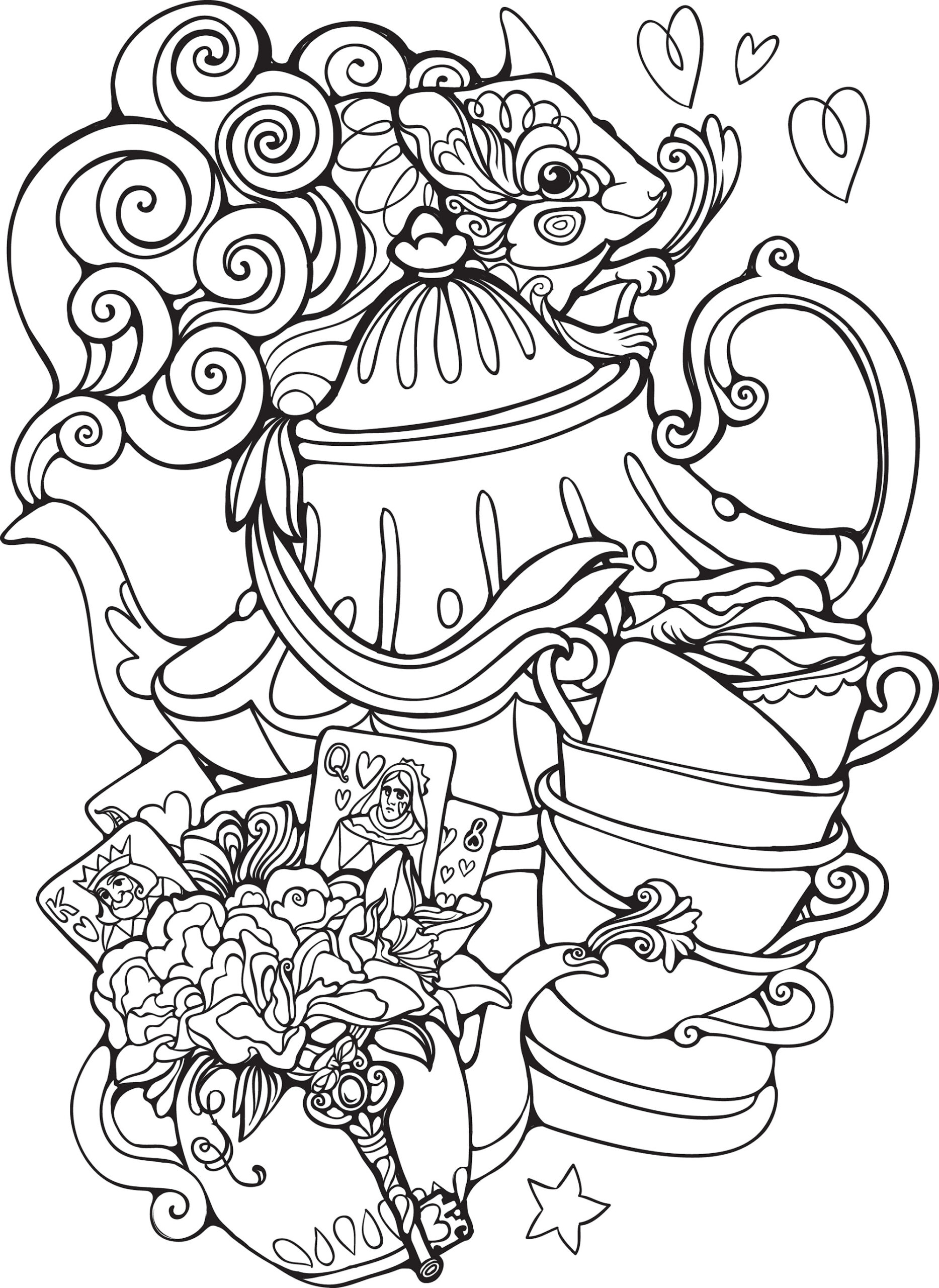
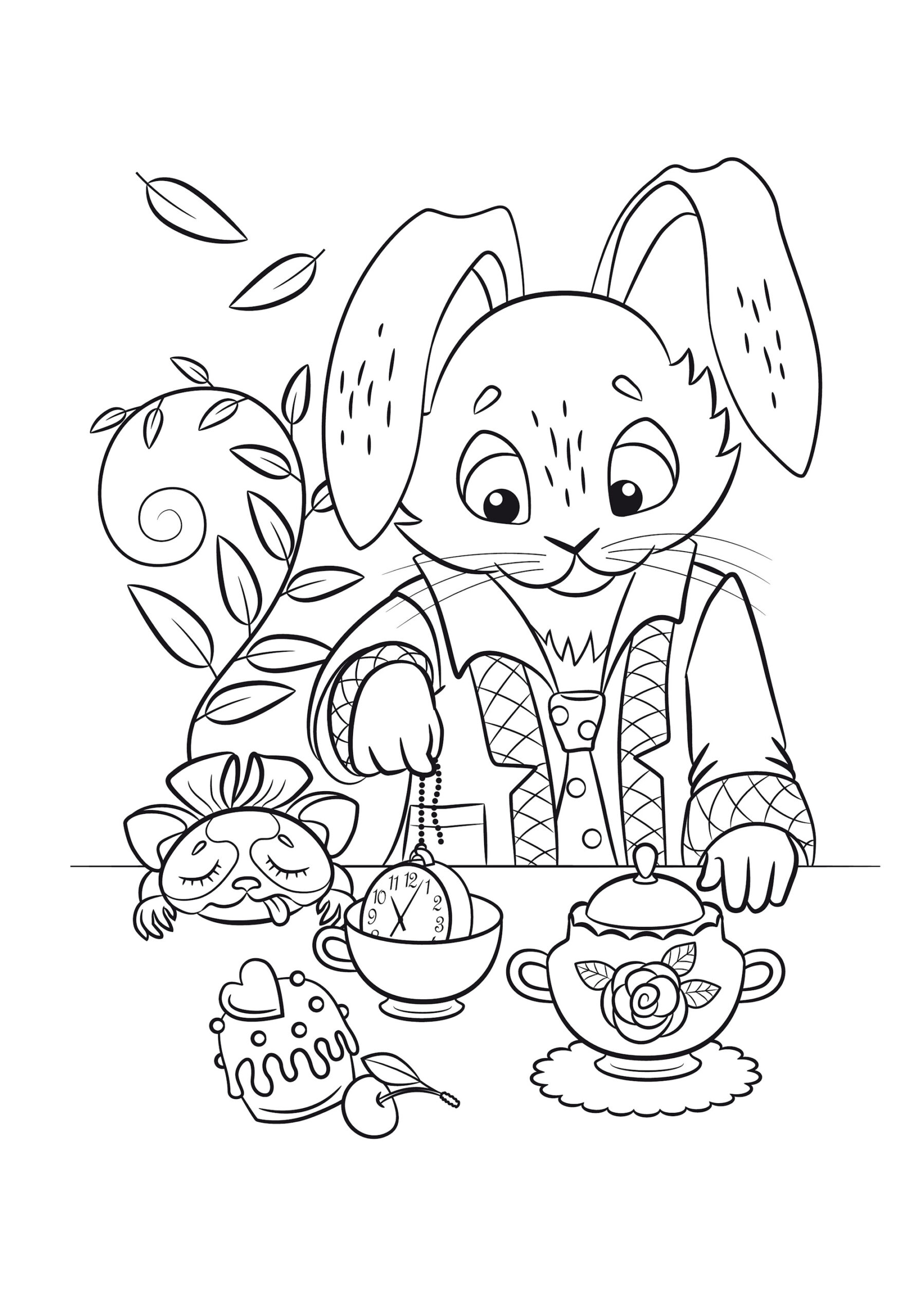
Alice follows a hurried White Rabbit, meets a grinning cat, attends an absurd tea party, encounters talking animals and playing cards, changes size more than once, and tries to make sense of a world where ordinary rules seem to have disappeared. More than 160 years after Alice’s Adventures in Wonderland was first published, that wonderfully strange world remains almost perfectly suited to coloring.
Our Coloring Pages of Alice in Wonderland bring together a large collection of characters and scenes inspired by Lewis Carroll’s famous stories. You’ll find Alice, the White Rabbit, Cheshire Cat, the Queen and King of Hearts, playing cards, the Hatter, Dormouse, Caterpillar, tea-party scenes, a Wonderland maze, Alice with a mouse, and other whimsical illustrations. The collection also ventures through the looking glass with Tweedledee and Tweedledum and chess-inspired Alice imagery from Carroll’s later book.
Some pages are playful and easy to color, while others include enough detail for older children and adults. You can follow traditional storybook colors, look to John Tenniel’s original black-and-white illustrations for inspiration, or invent a Wonderland filled with turquoise rabbits, purple mushrooms, rainbow playing cards, and an emerald-green Cheshire Cat.
Grab your crayons, markers, or colored pencils. The rabbit hole is just ahead.
🐇 Follow Alice and the White Rabbit Into Wonderland
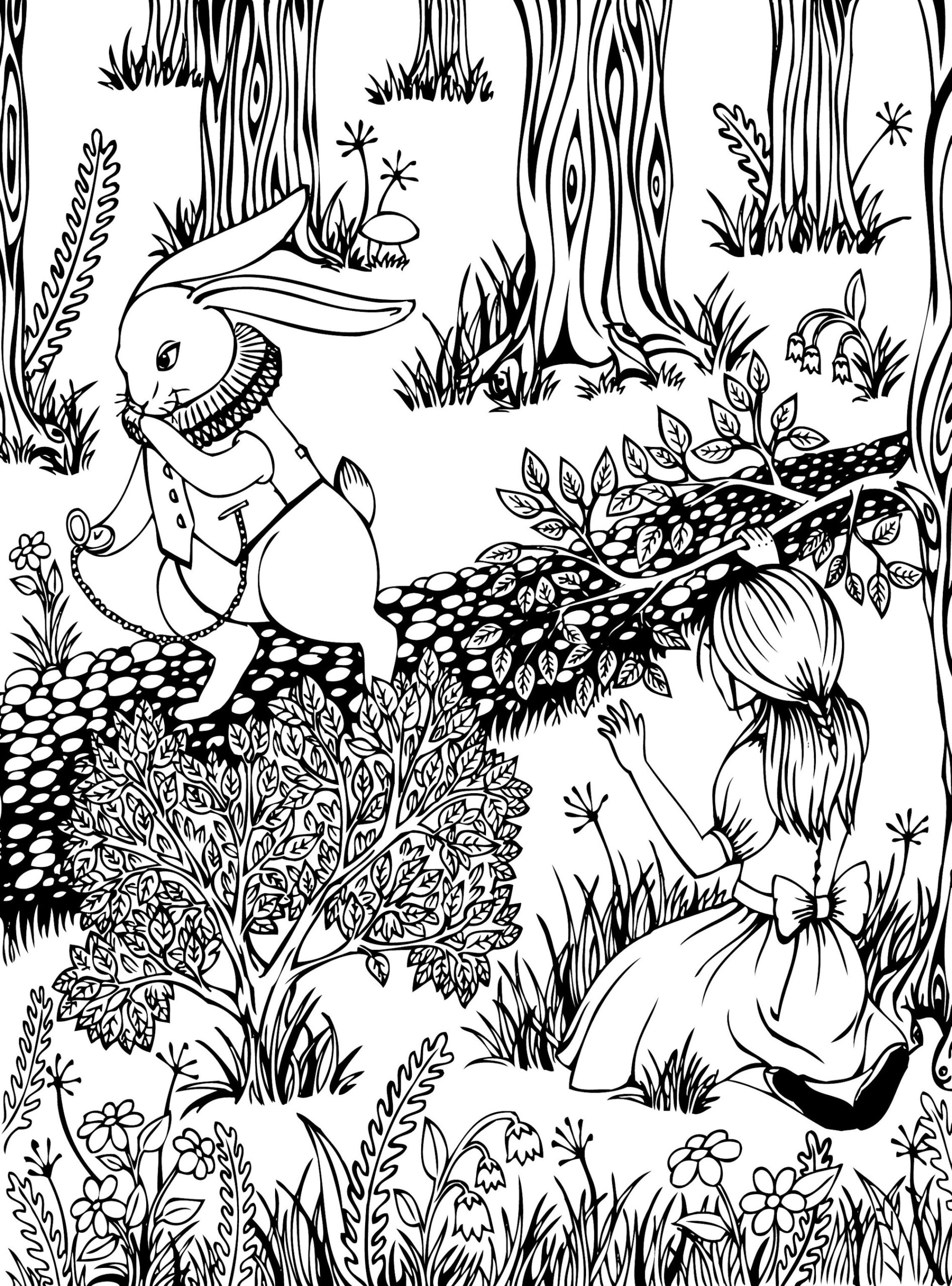
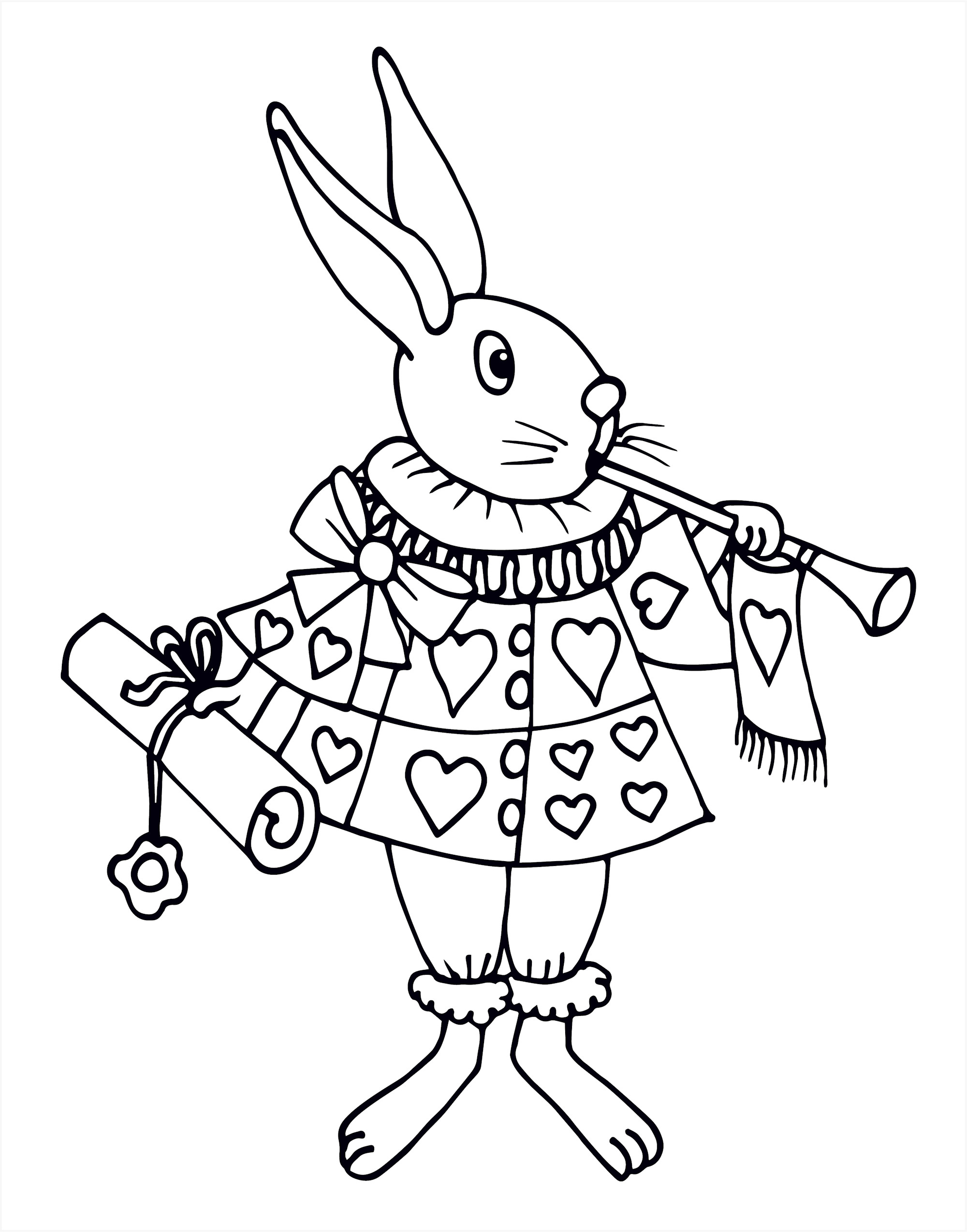
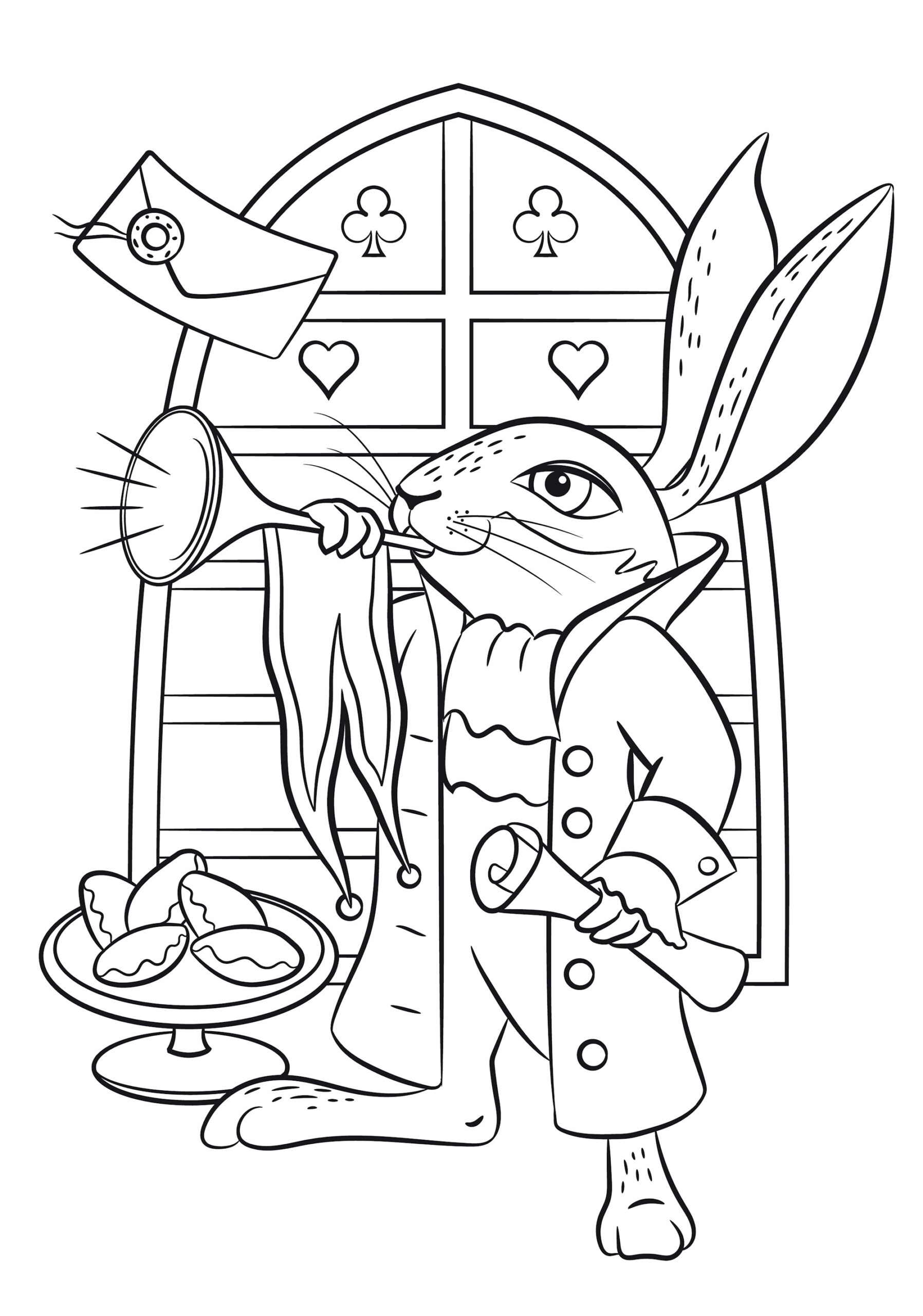
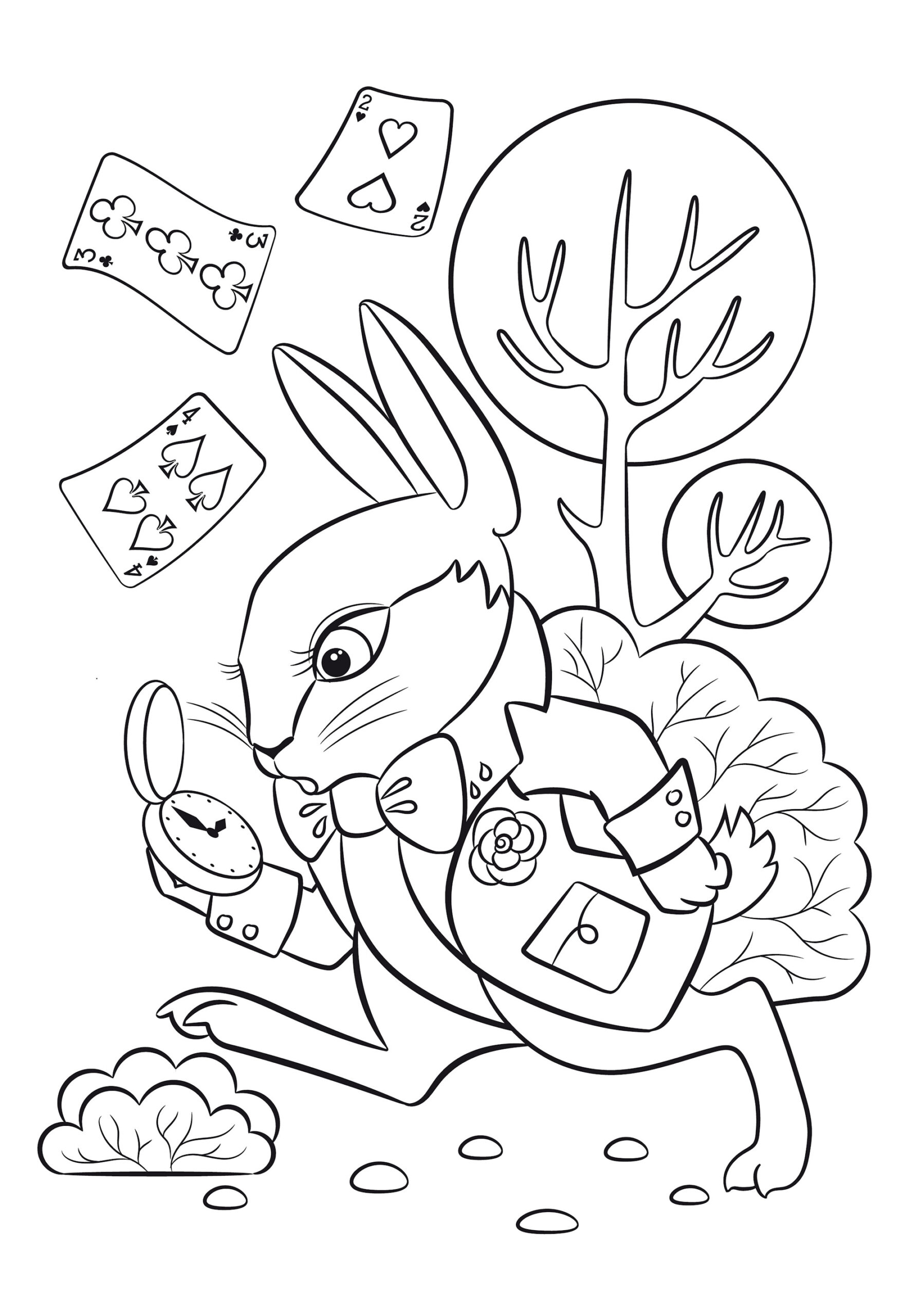
The White Rabbit sets the entire adventure in motion. Alice notices an unusual rabbit dressed in clothing and carrying a watch, follows him, and soon finds herself tumbling into a world where very little behaves the way she expects.
Several pages in this collection feature Alice and the White Rabbit, giving you plenty of opportunities to imagine the beginning of that journey. For a traditional storybook look, Alice can wear soft blues, white, cream, or other Victorian-inspired shades, while the rabbit’s fur can remain white with pale gray or blue-gray shadows. His clothing provides an easy place to introduce brighter reds, burgundies, greens, golds, or blues.
The watch can become one of the smallest but most interesting details. Try gold and brown for an antique appearance, silver-gray for something cooler, or make it completely magical with purple and turquoise.
You can also extend the background. Draw the entrance to the rabbit hole, wildflowers, trees, a tiny door, a key, or a winding path that disappears somewhere beyond the printed picture. Then decide where the White Rabbit is going and why Alice is determined to follow.
One of Wonderland’s greatest strengths as a coloring theme is that the scenery never needs to behave sensibly.
👧 Give Alice Your Own Storybook Style
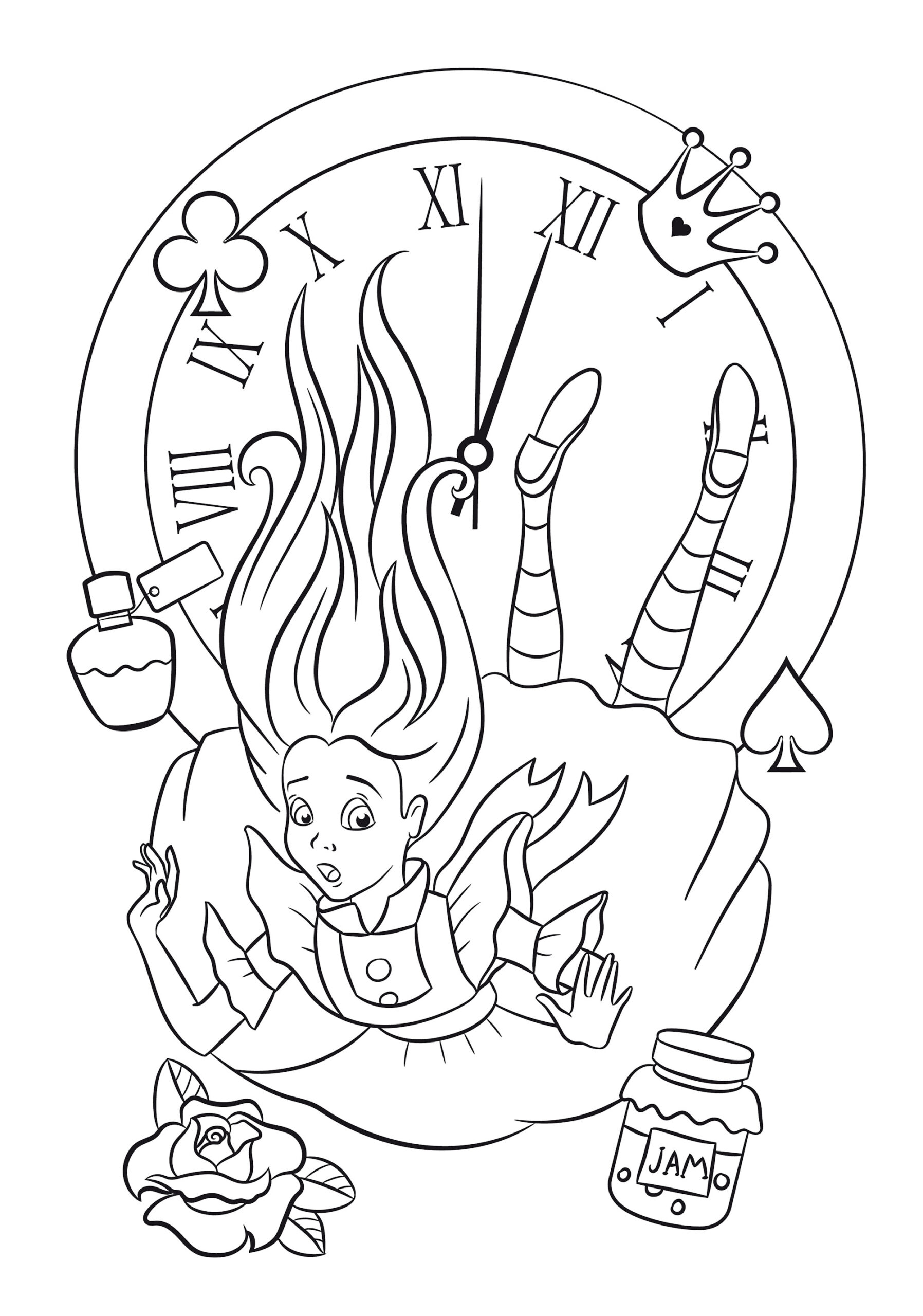
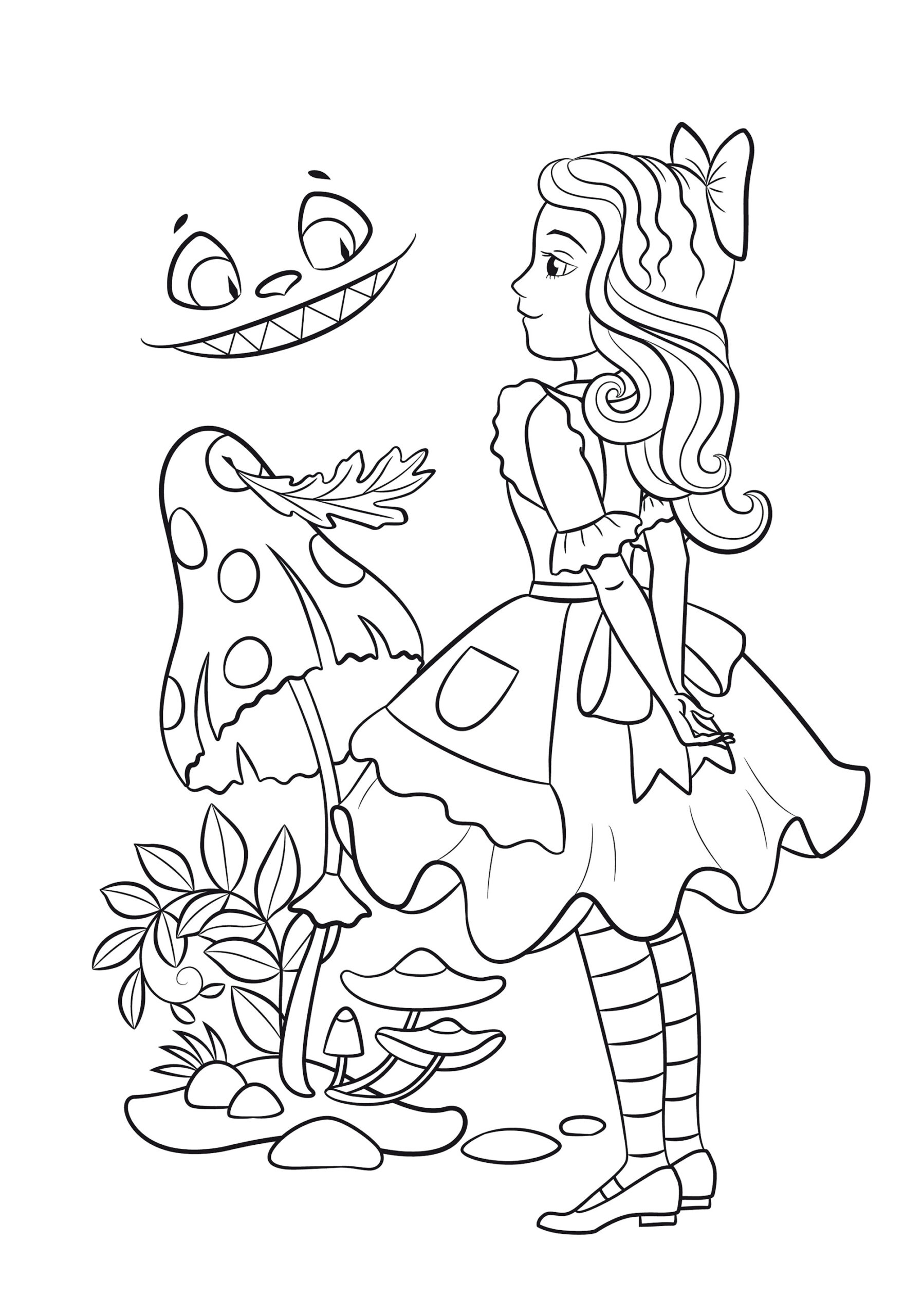
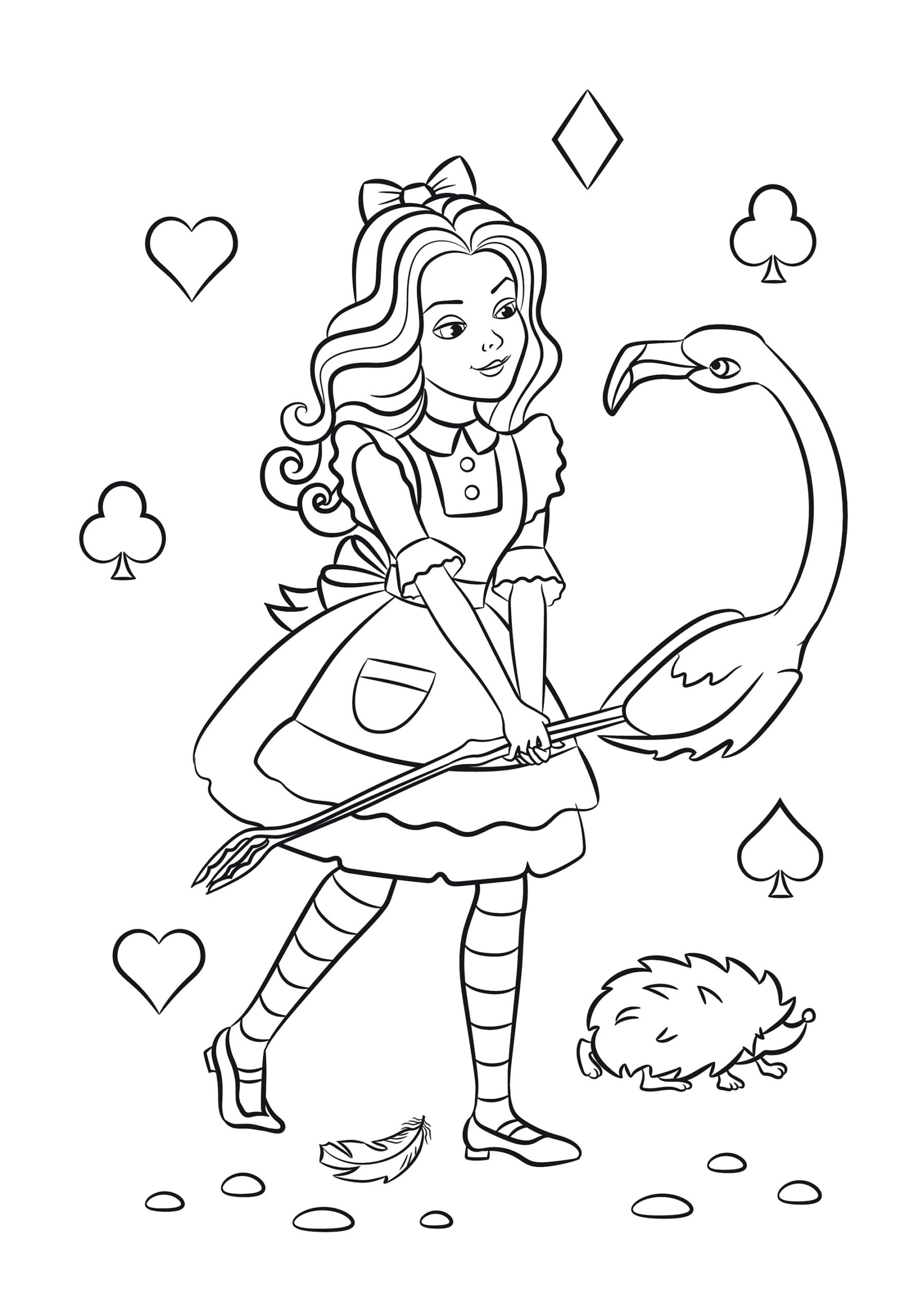
Alice herself appears in several designs throughout the collection. Because John Tenniel’s famous original illustrations were published in black and white, generations of later artists and readers have imagined their own colors for her clothing, hair, surroundings, and Wonderland companions.
That gives you tremendous freedom.
A familiar Alice-inspired palette might combine blue, white, black, and golden yellow, but nothing requires you to follow it. Try lavender with cream, pale pink with mint, navy with gold, or an entire rainbow outfit.
Older colorists can experiment with fabric shading by making folds slightly darker than the surrounding areas. Hair can use several related pencils rather than one flat color, while stockings, shoes, bows, and other small clothing details provide opportunities for patterns.
You might also color the same Alice page twice. Create one soft, traditional storybook version and another in dramatic fantasy colors. A black-and-purple Wonderland can feel mysterious, while peach, mint, lavender, and pale blue create an entirely different dreamlike atmosphere.
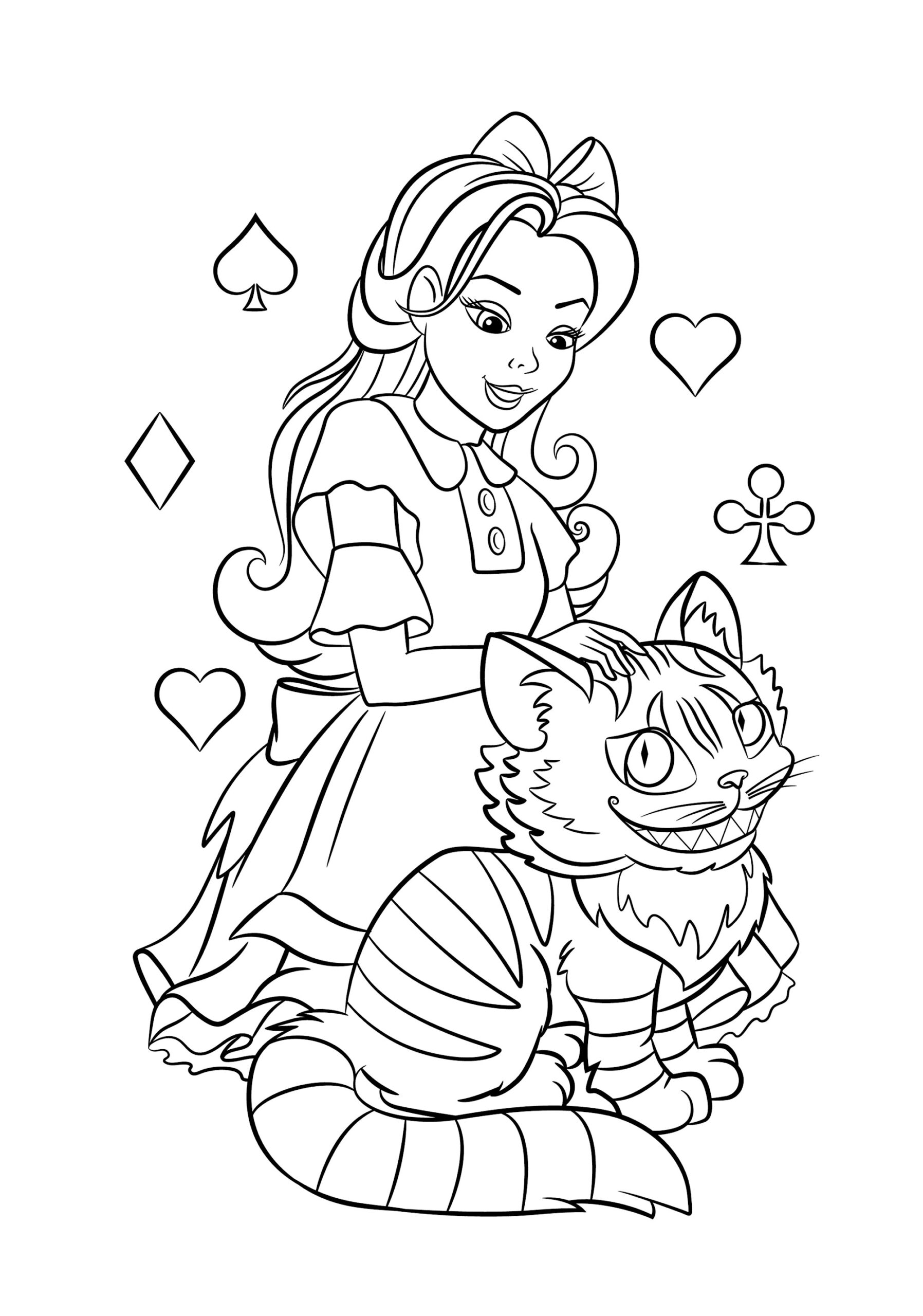
😸 Color the Cheshire Cat and His Famous Grin
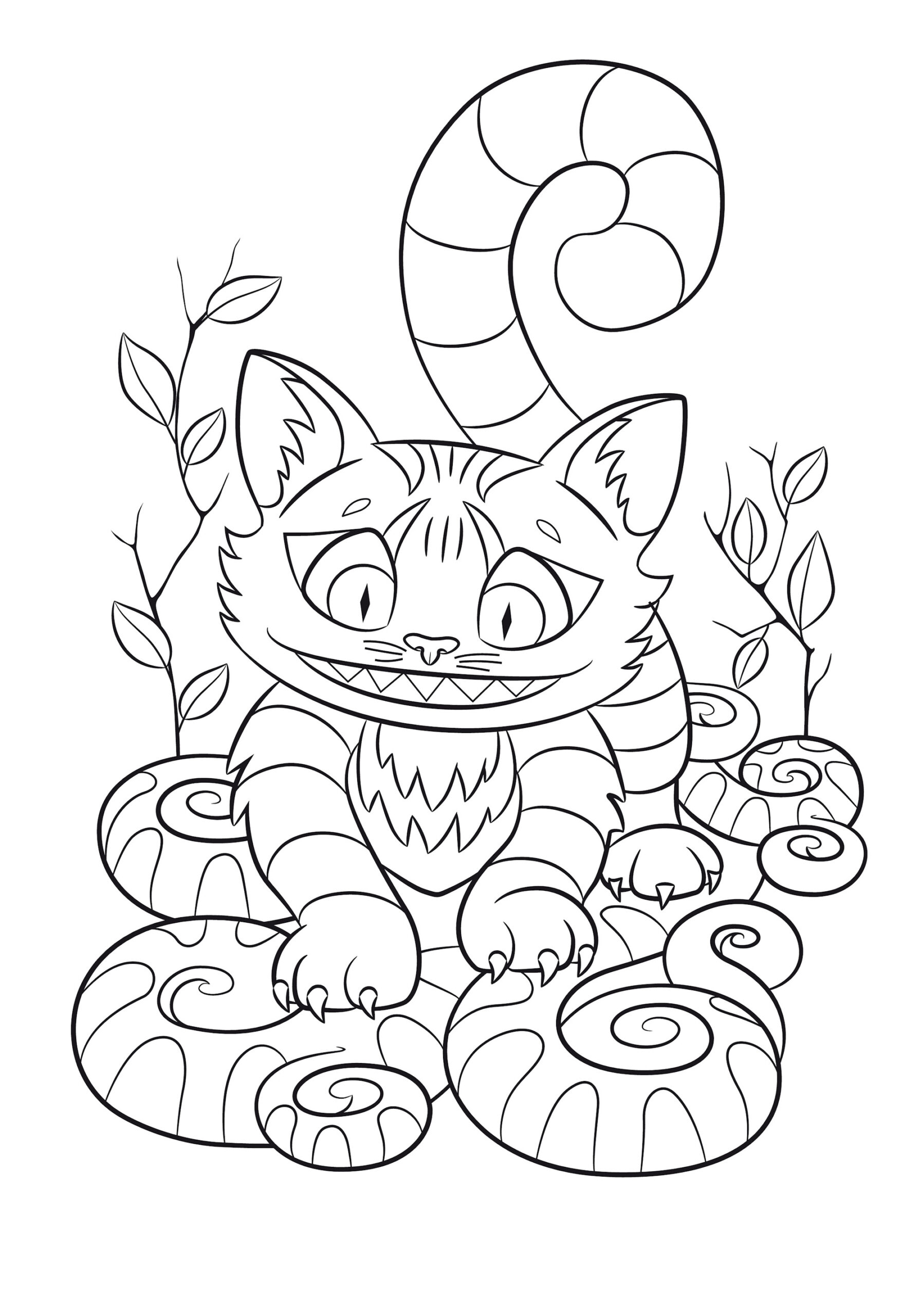
Few Wonderland characters invite imaginative coloring quite like the Cheshire Cat. The cat’s strange ability to appear and disappear—and sometimes leave only its grin behind—makes it one of the story’s most memorable creations.
Since this is Wonderland, an ordinary cat palette is only one option. Gray, brown, cream, black, or orange can work if you want something more natural, but fantasy colors suit the character beautifully.
Try purple with lavender stripes, turquoise with dark blue markings, or hot pink paired with violet. A rainbow-striped Cheshire Cat can be especially fun because the character already feels as though it belongs outside the rules of ordinary nature.
If the page has open background space, add a crooked tree branch, oversized flowers, stars, swirls, or disappearing sections of the cat. You could color parts of the body increasingly pale as though the character is slowly fading away.
Cat lovers can continue with our Purr-fectly Playful Coloring Pages for Cat Lovers, although Wonderland cats are admittedly much less predictable than the average kitten.
🎩 Join the Hatter and Dormouse for a Very Strange Tea Party
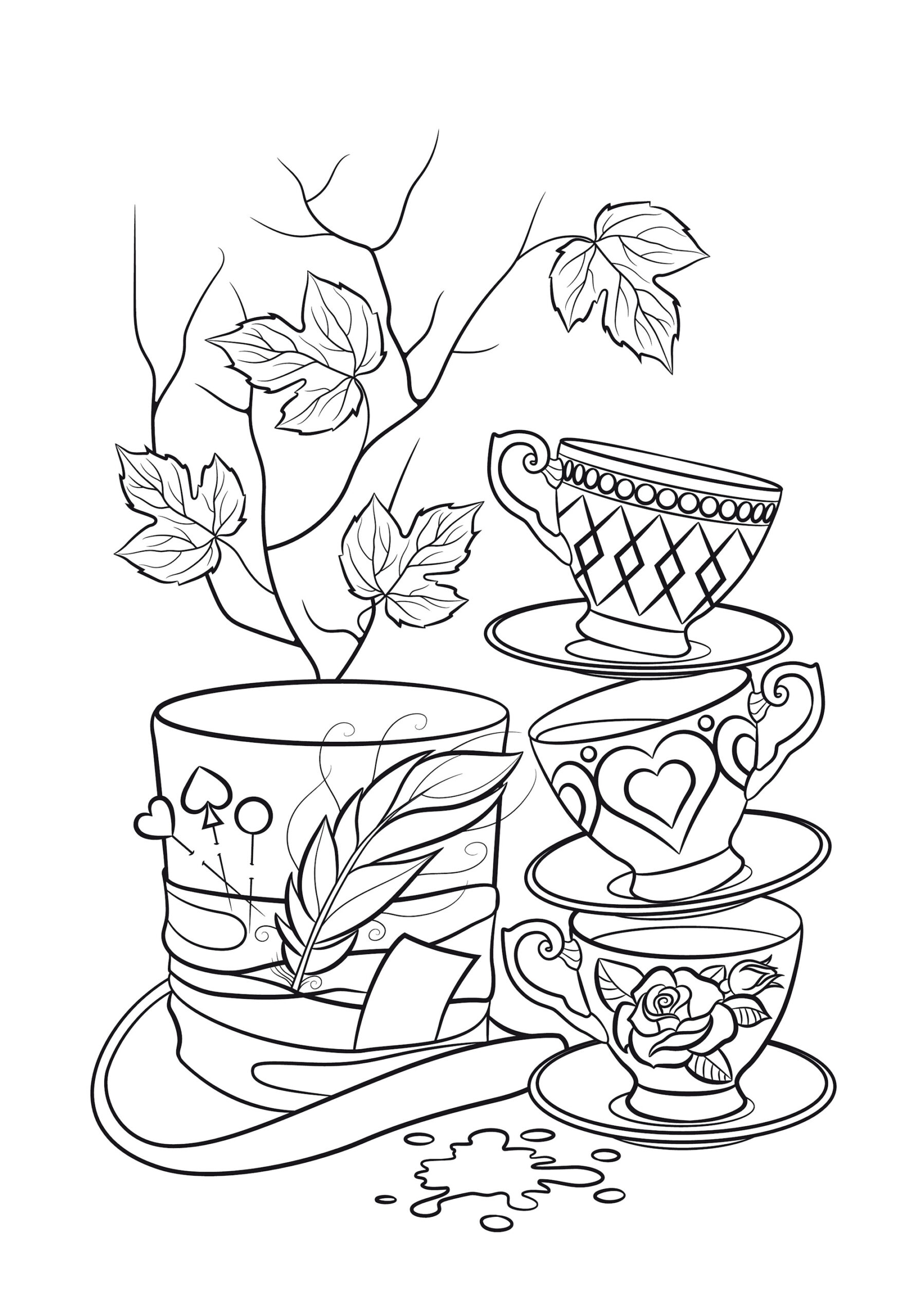
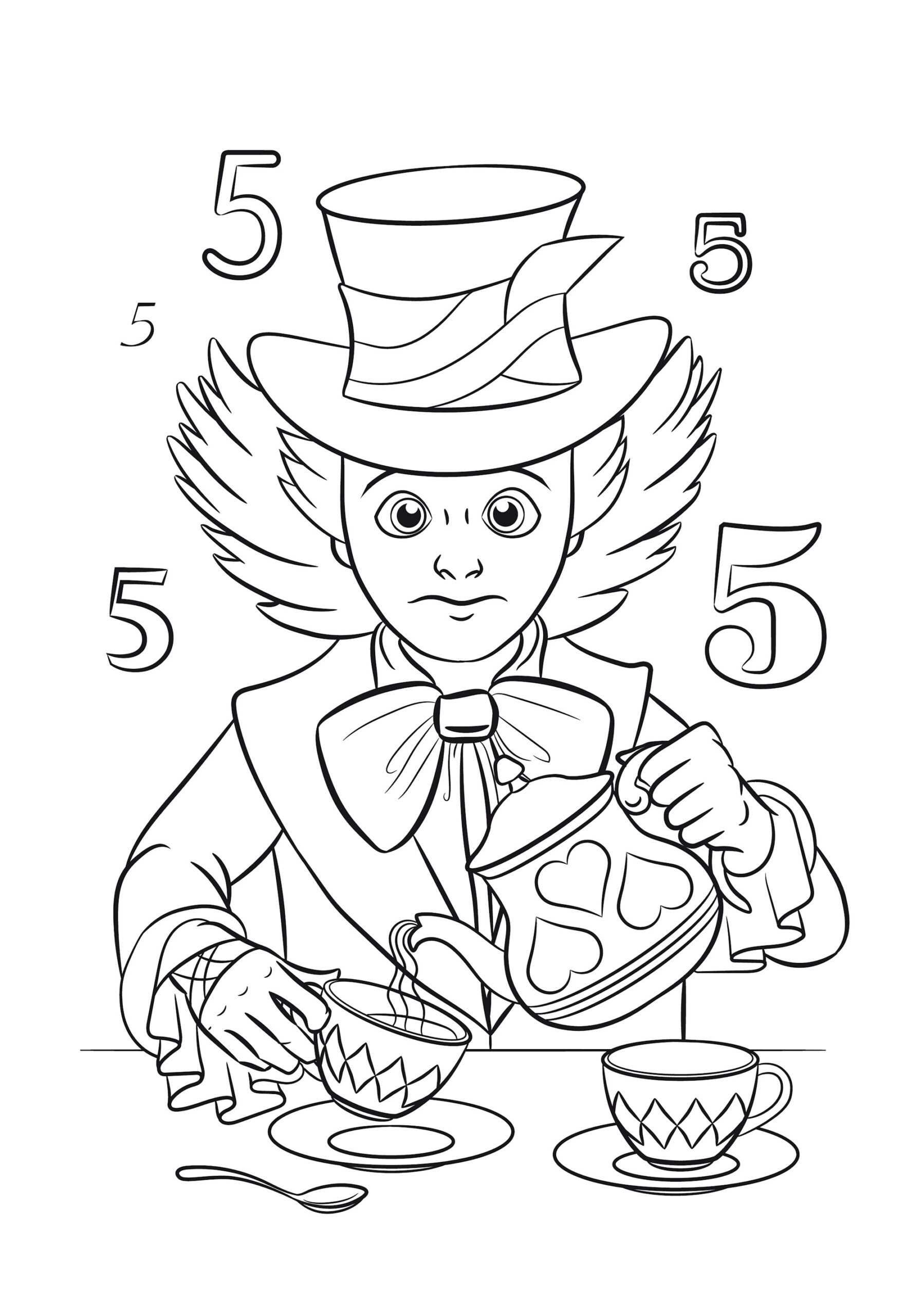
The tea-party scenes are some of the busiest and most entertaining pictures in the collection. The Hatter, Dormouse, teacups, teapots, plates, food, and other table details provide enough little areas to keep colorists occupied for quite a while.
Instead of trying to plan the entire scene at once, start with the tea set. Every cup can have a different pattern. Try floral designs, stripes, dots, hearts, stars, or mismatched colors. The teapot might be turquoise with pink flowers while one cup is yellow and another purple.
Next, color the characters. The Hatter’s clothing can be as flamboyant as you like. Deep green, burgundy, purple, mustard, navy, and brown can create an eccentric old-fashioned palette, while rainbow colors push the scene further into fantasy.
The Dormouse can use warm browns and cream or become a tiny lavender tea-party guest.
Then add the tablecloth, treats, chairs, and background. A scene with so many objects benefits from repeating a few colors throughout the page rather than introducing an entirely new shade in every little space.
For another collection devoted to teacups and wonderfully whimsical gatherings, visit our Whimsical Tea Time Coloring Pages.
☕ Design Your Own Wonderland Tea Set
The tea party also makes a fun design activity. Instead of coloring every cup randomly, create a coordinated Wonderland tea collection.
You might use Queen of Hearts colors with red, black, white, and gold. A Cheshire Cat tea set could be purple, pink, and lavender, while a garden tea set might feature sage, pale blue, yellow, and floral patterns.
Kids can draw extra cups on another sheet of paper and design them from scratch. Give each Wonderland character a cup that matches their personality. The White Rabbit might need a clock-covered mug, the Queen of Hearts could have crowns and hearts, and the Cheshire Cat might get one covered in mysterious grins.
The activity connects naturally with storytelling too. What would be served at a Wonderland tea party? Ordinary sandwiches seem almost too sensible. Perhaps there are checkerboard cookies, mushroom cupcakes, heart-shaped cakes, rainbow tea, and desserts that mysteriously change size.
❤️ Enter the Court of the Queen and King of Hearts
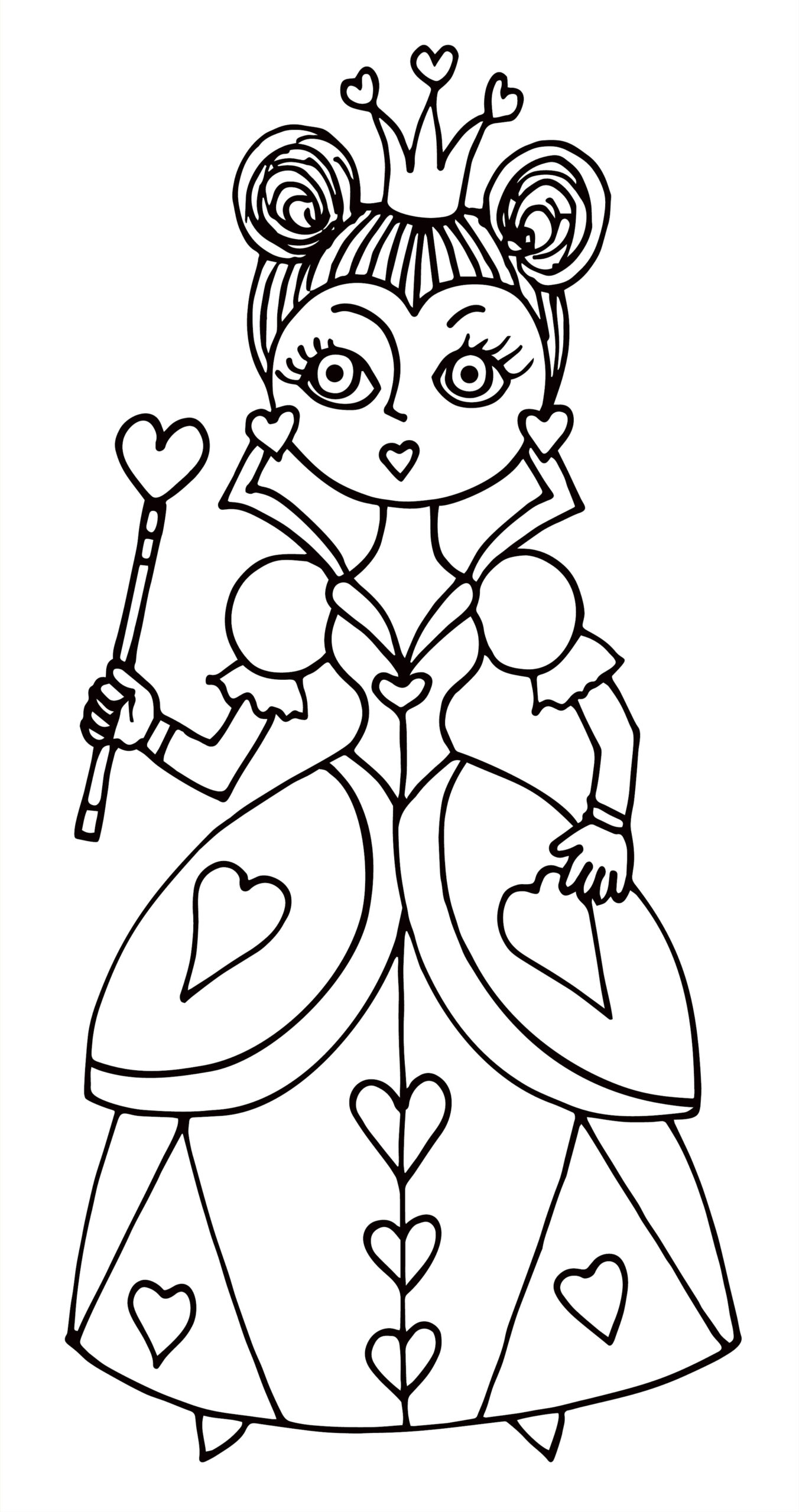
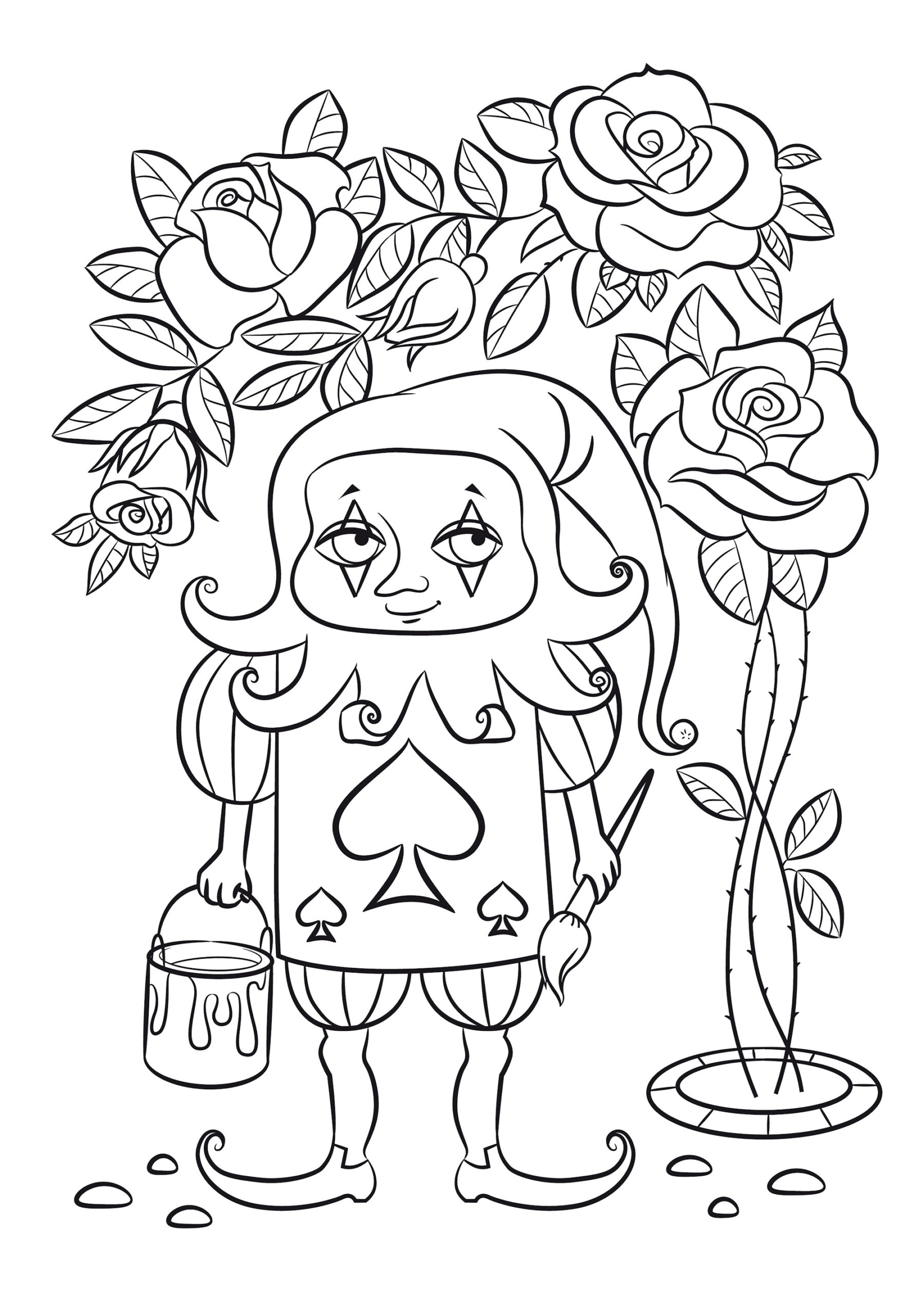
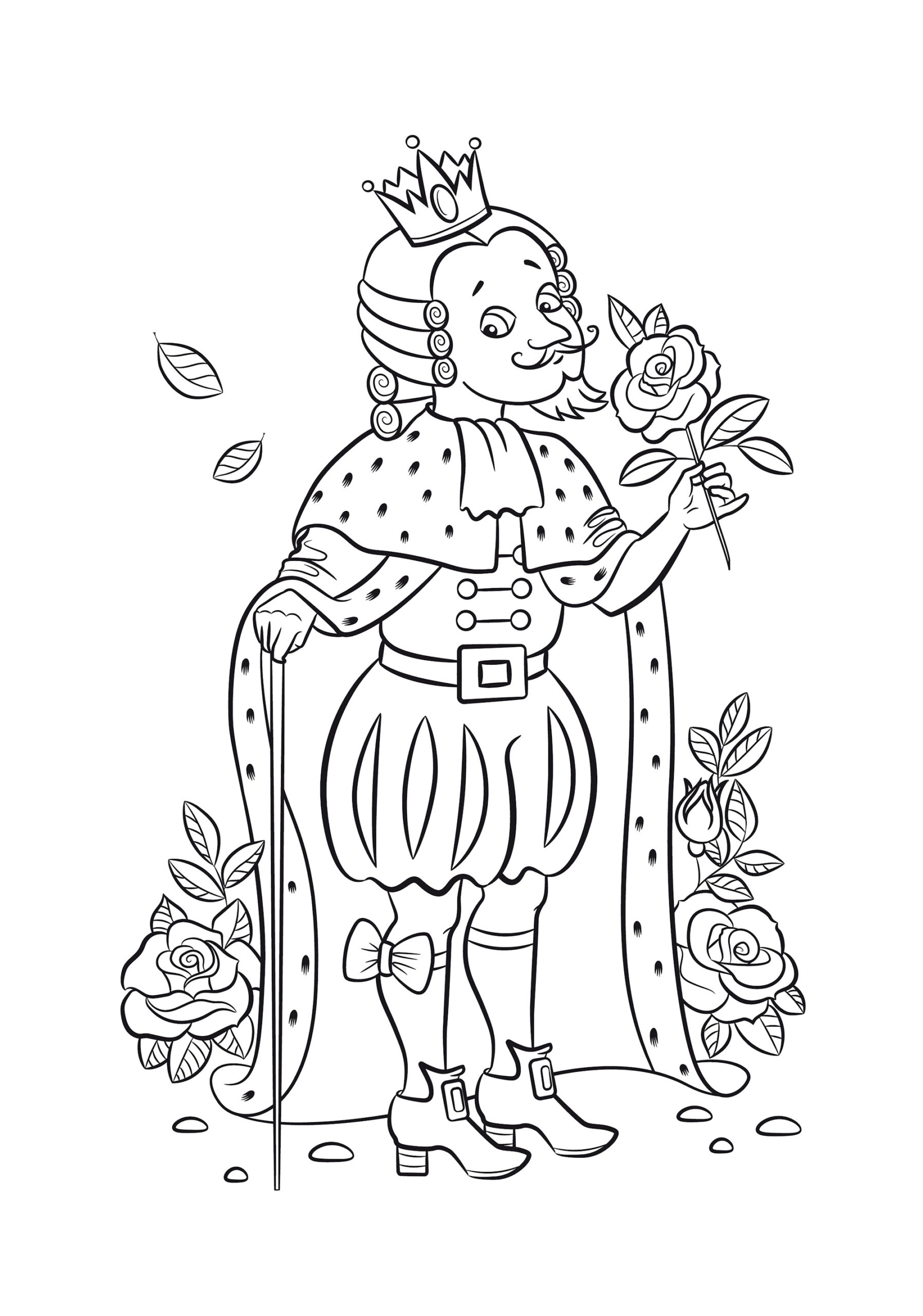
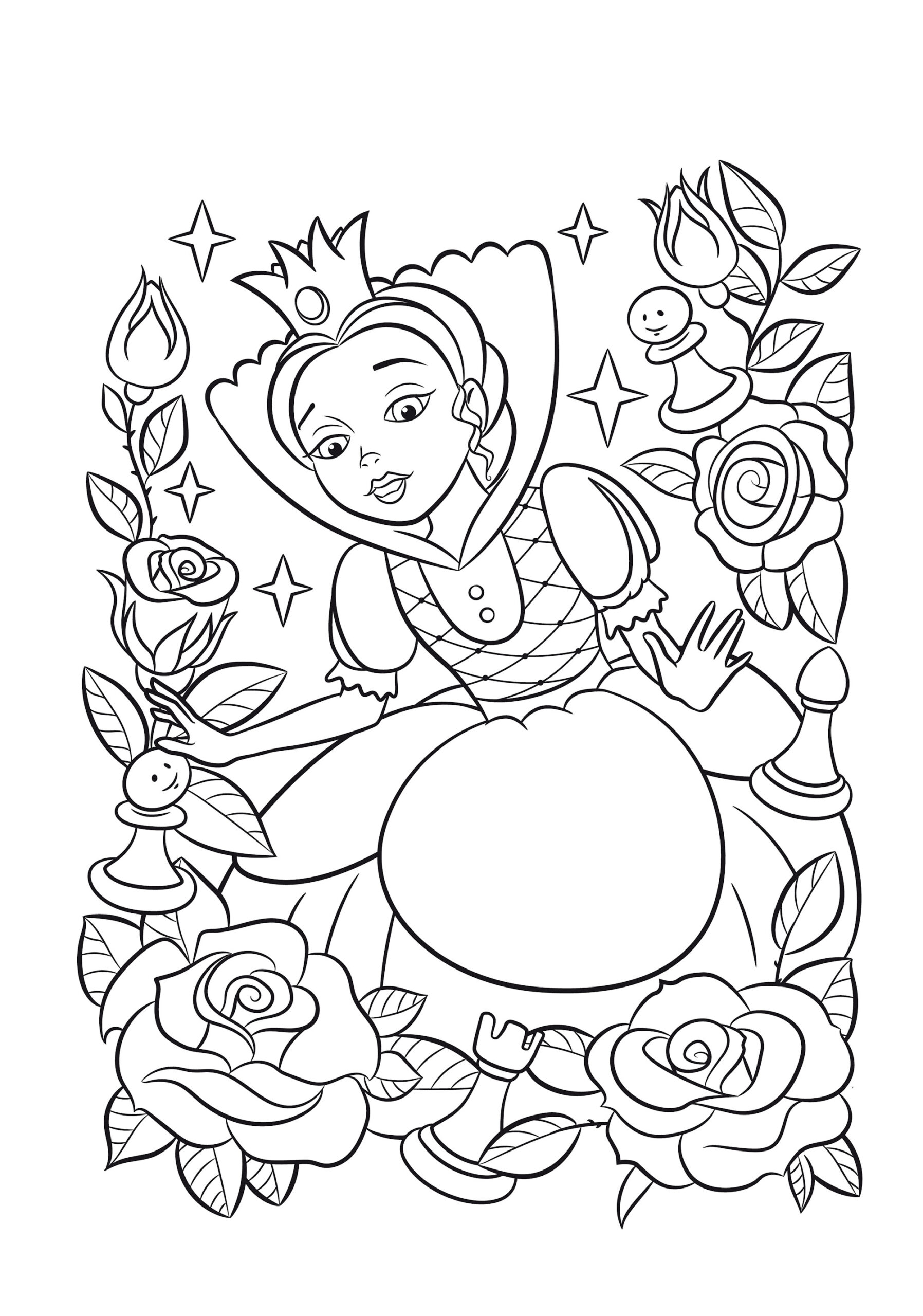
The Queen of Hearts, King of Hearts, and playing-card characters give several pages a bold visual theme. Red, black, white, and gold create an instantly recognizable card-inspired palette, but there is still plenty of room for variation.
The Queen’s clothing can combine several reds, from bright scarlet to burgundy. Black outlines and gold details can make the costume feel especially dramatic. Add white or cream where you want contrast, and use green around any garden scenery.
The King can coordinate with the Queen while still having a different palette. Perhaps his clothing is mostly black and gold with red details.
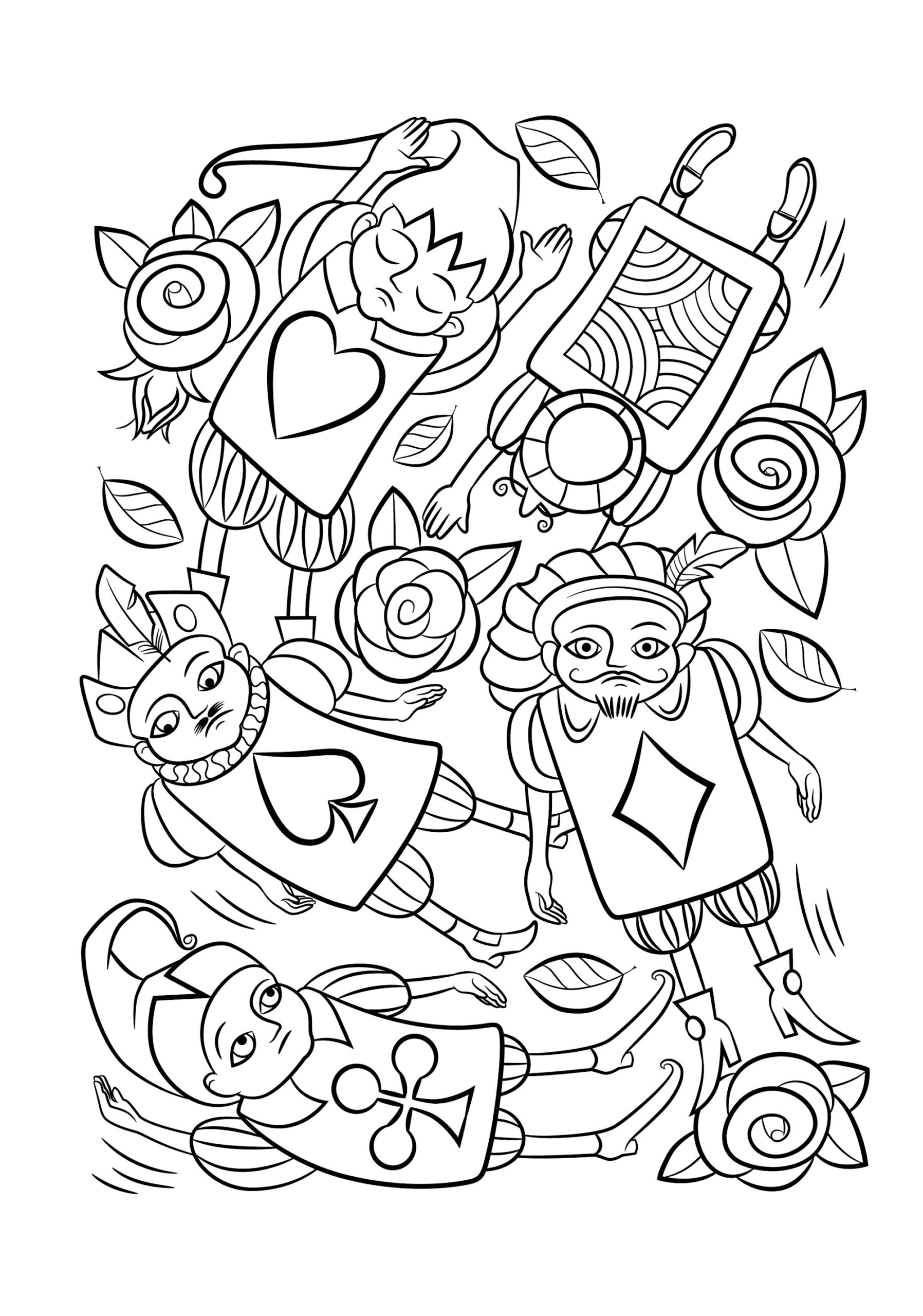
Playing-card characters are especially fun because their simple shapes lend themselves to patterns. One card can follow traditional red-and-black suits while another becomes purple, turquoise, or rainbow-colored.
If you’re coloring with a group, give each person a different card character and then display them together like an enormous Wonderland deck.
🃏 Make the Playing Cards Come Alive
A deck of cards is already full of strong shapes and symbols, so the Wonderland playing-card pages can easily become a larger art activity.
Start with the familiar suits—hearts, diamonds, clubs, and spades—and use traditional red and black if you’d like. Then create a second version with completely new colors. Hearts could be pink, diamonds turquoise, clubs green, and spades purple.
Children can also design their own Wonderland playing card on blank paper. Give it a number, suit, face, and personality. Maybe it works in the Queen’s garden painting roses, guards a castle gate, or secretly wishes it could escape the royal court.
Older kids could create several cards and invent a simple game with them.
The playing-card theme connects naturally with our Coloring Pages of Games, where you’ll find mazes, I Spy activities, dot-to-dot pictures, and other printable challenges.
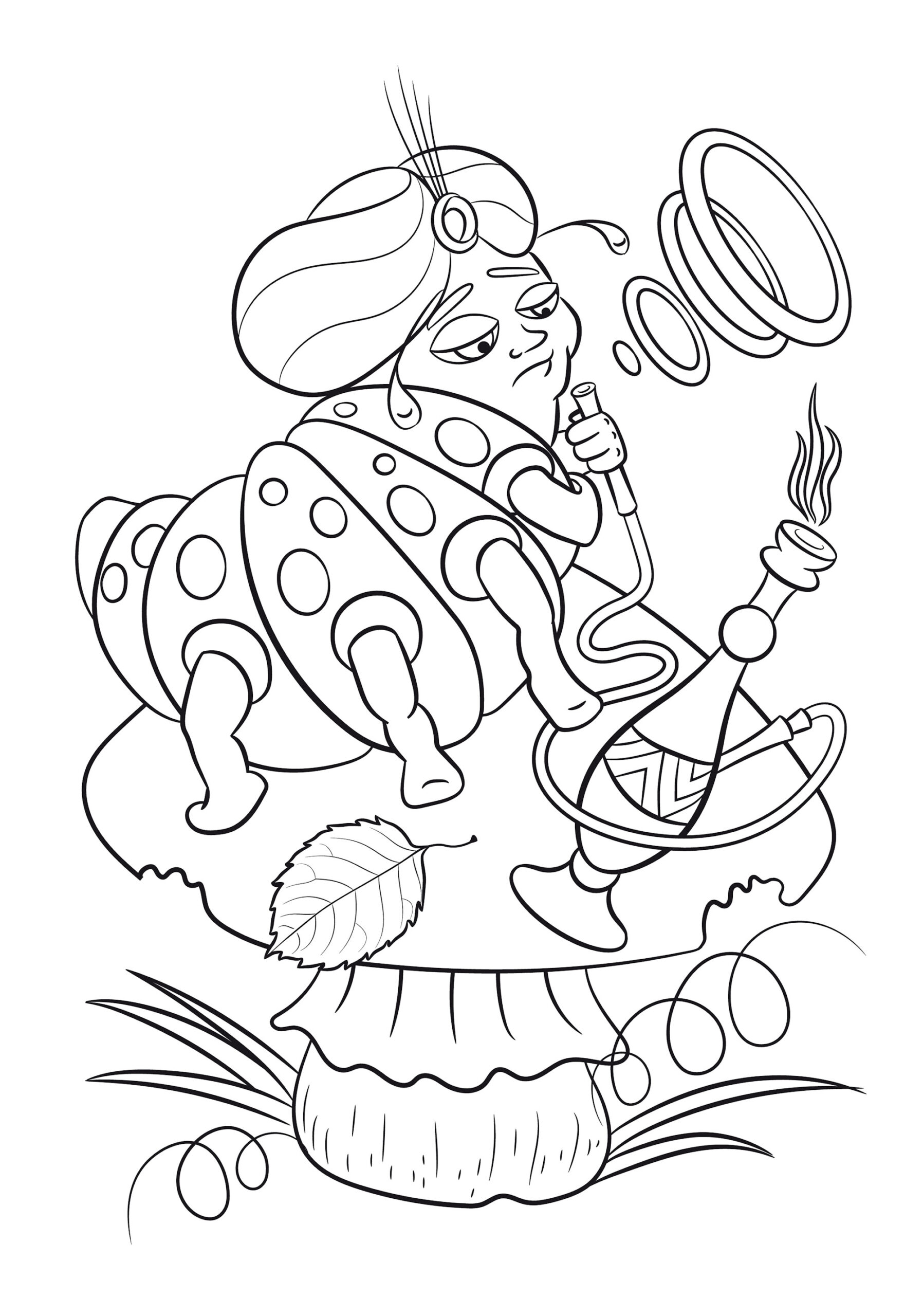
🐛 Meet the Caterpillar on the Mushroom
The Caterpillar is another unmistakably Wonderland character, usually associated with a large mushroom and one of Alice’s strangest conversations.
A mushroom scene can be colored with natural woodland shades—brown, cream, rust, red, and green—or turned completely fantastical. Try a purple mushroom with turquoise spots, a pink-and-yellow cap, or a rainbow mushroom surrounded by blue leaves.
The Caterpillar can be green, blue, turquoise, purple, or almost anything else. Using a gradient from darker shades near the head to lighter colors along the body can create extra depth.
Then turn the surrounding area into a strange Wonderland forest. Add oversized flowers, curling vines, smaller mushrooms, hidden faces, or impossible plants.
Mushrooms are perfect for fantasy coloring because even a simple cap and stem can become an entire pattern. Add stars, hearts, stripes, circles, or tiny checkerboards and the ordinary woodland quickly becomes something much stranger.
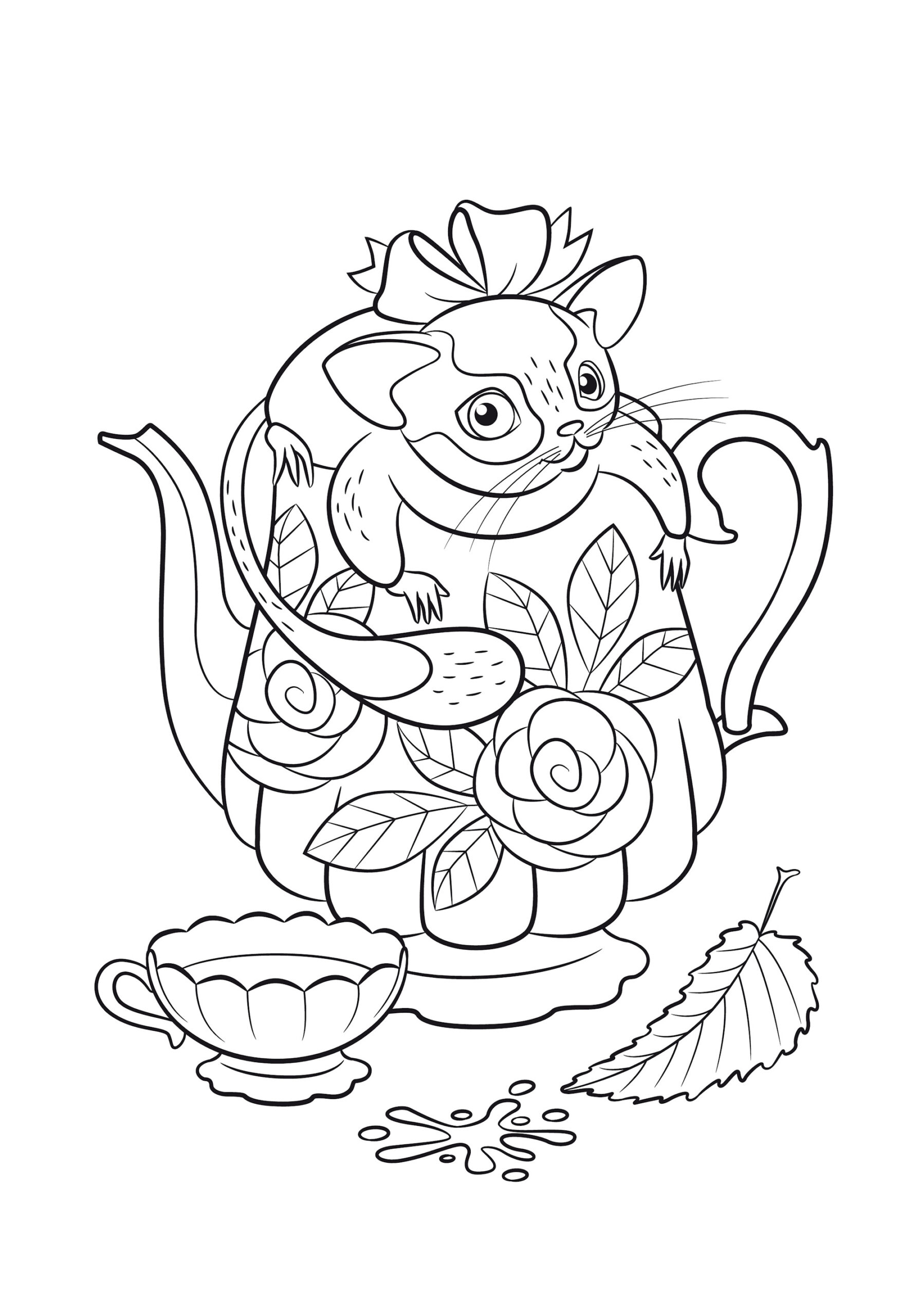
🐭 Color Alice and the Mouse
The collection also includes mouse imagery connected with Alice’s early Wonderland adventures. A little mouse may seem less dramatic than a disappearing cat or furious queen, but these quieter characters help make Wonderland feel populated by animals who behave in very un-animal-like ways.
For a natural mouse, try warm gray, soft brown, tan, or cream. Add pale pink inside the ears and around the nose.
Or give the mouse a proper Wonderland makeover with lavender fur, a bright blue tail, or a tiny patterned outfit.
Children can imagine what happens after the printed scene. Perhaps the mouse attends the tea party, meets the Dormouse, gets lost in the card garden, or ends up riding in the White Rabbit’s pocket watch.
A few simple additions can connect characters who never actually meet in the original story, creating an entirely new Wonderland adventure.
👑 Color the Queen’s Garden
The Queen of Hearts is strongly associated with a garden and roses, giving colorists another chance to combine fantasy characters with flowers.
Red roses are an obvious choice, especially given the role roses play in the story, but the garden doesn’t have to stop there. Add pink, yellow, lavender, blue, and orange flowers around the royal characters.
Dark green leaves will make red blossoms stand out strongly. For something more whimsical, use mint or turquoise foliage instead.
You could even deliberately leave some roses white and color others red, turning the garden into a visual reference to the story.
For more floral coloring after you’ve escaped the Queen’s court, explore our Coloring Pages of Flowers.
🌀 Find Your Way Through the Alice in Wonderland Maze
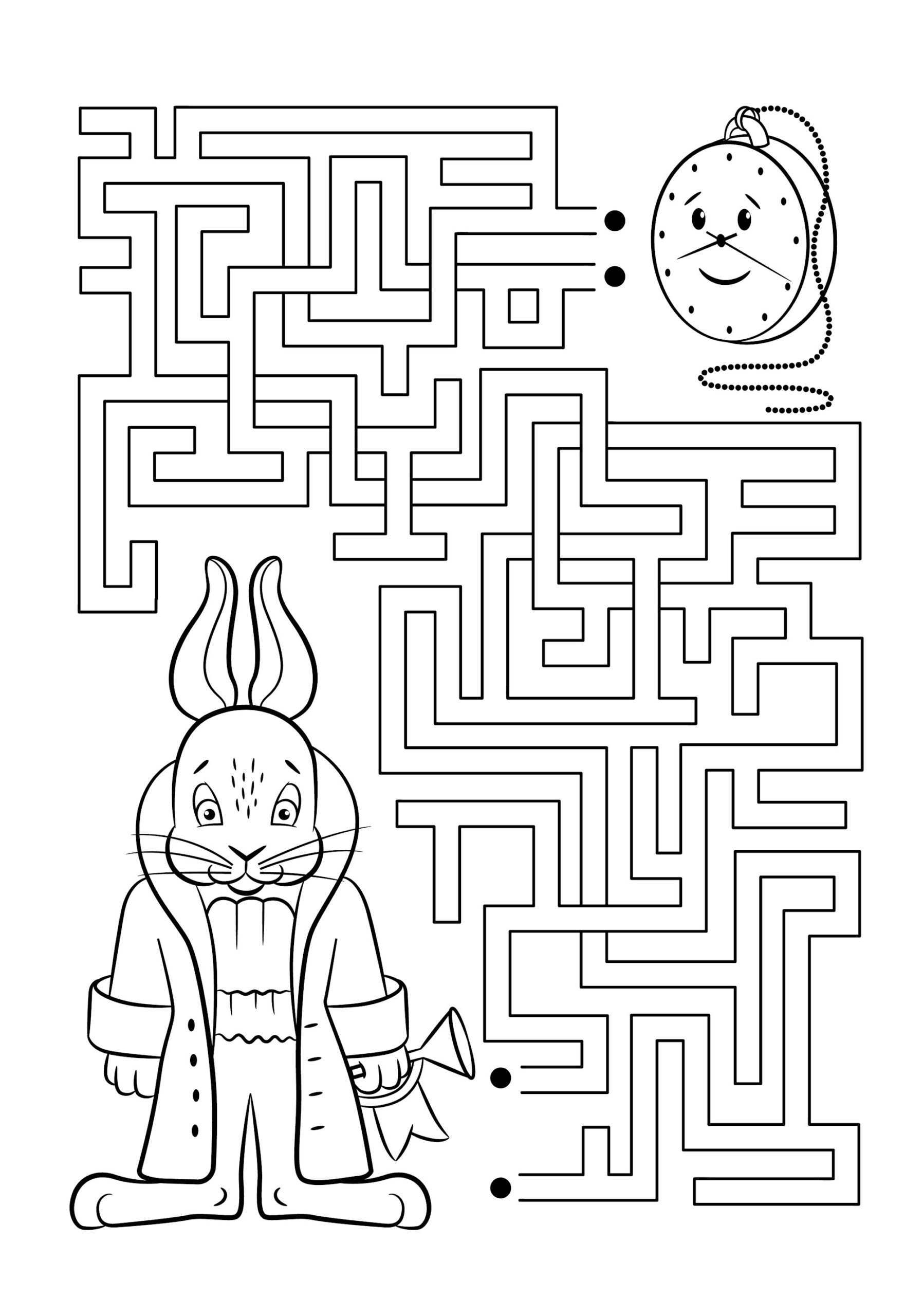
One of the collection’s pages turns Wonderland into an actual maze game, which feels especially appropriate for a story filled with confusing paths, doors, riddles, and changing directions.
Use pencil first so mistakes can be erased. Trace possible routes with a finger before committing to a line, or try beginning at the finish and working backward if the route seems difficult.
Once you’ve solved the maze, trace the correct path with a bright colored pencil or marker. Red, purple, turquoise, or rainbow colors can make the solution stand out.
Then go back and color the surrounding Wonderland imagery.
Children can also invent a story explaining the maze. Maybe Alice is trying to find the tea party before the White Rabbit arrives. Perhaps she needs to escape the Queen of Hearts or reach a tiny door before she changes size again.
For even more printable puzzles, head to our Coloring Pages of Games.
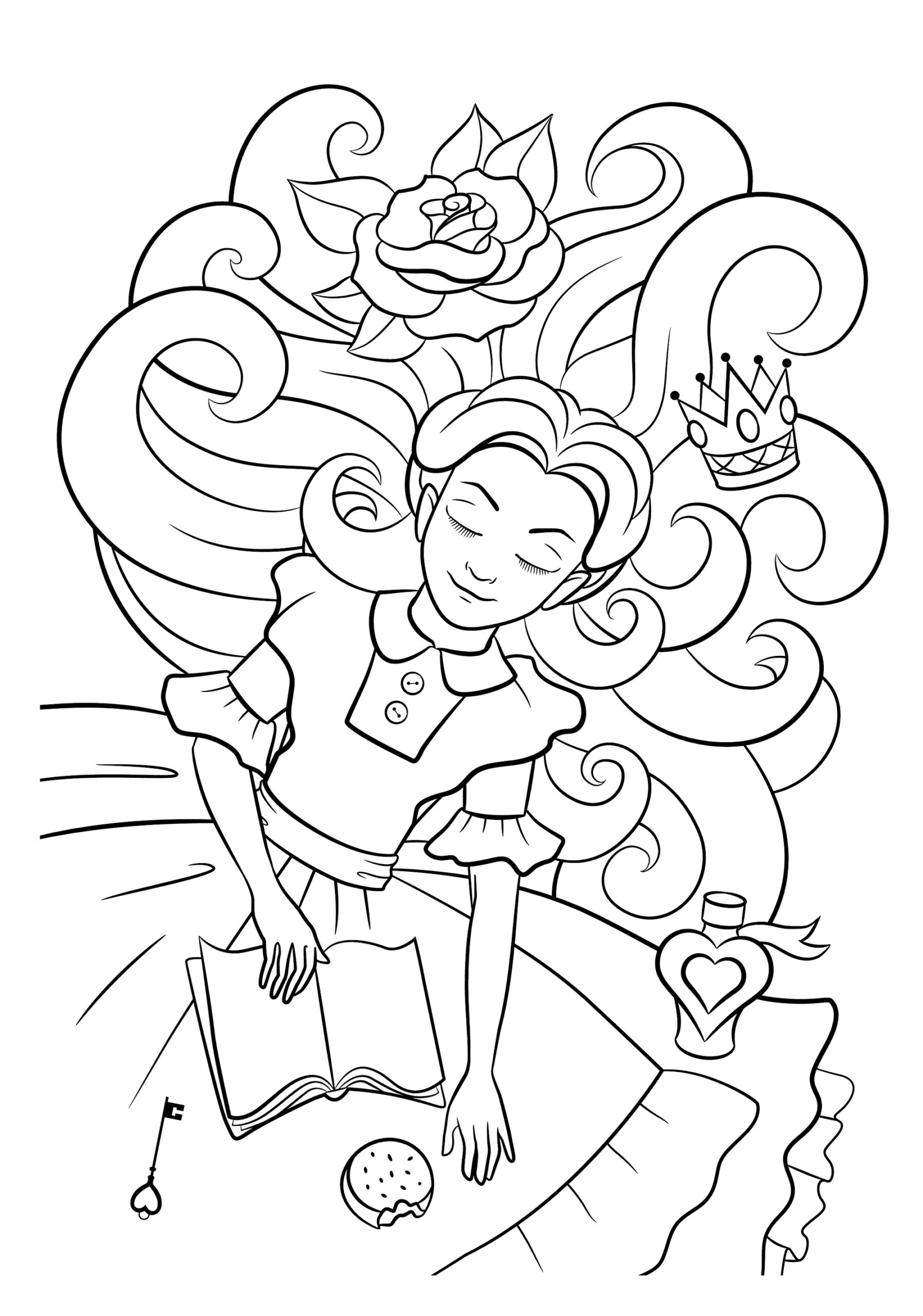
😴 Imagine What Sleeping Alice Is Dreaming
The sleeping Alice page adds another interesting layer because Alice’s Adventures in Wonderland itself plays with the boundary between ordinary experience and dreamlike imagination.
A sleeping scene works beautifully with softer colors. Try pale blue, lavender, cream, dusty pink, and mint for a dreamy palette.
Then add details around Alice representing what she might be imagining: a White Rabbit, floating teacups, playing cards, mushrooms, clocks, stars, or a tiny Cheshire Cat grin.
Older colorists might divide the background between the ordinary world and Wonderland. One side can use realistic greens, browns, and blues, while the other gradually transforms into violet skies, oversized flowers, and impossible objects.
The contrast can visually capture one of the things readers have enjoyed about Alice for generations—the sense that Wonderland is both extraordinarily strange and somehow connected with familiar everyday life.
🪞 Wonderland and Through the Looking-Glass Are Two Different Books
The collection uses “Alice in Wonderland” in the broad popular sense, but it actually includes imagery connected with two Lewis Carroll books.
Alice’s Adventures in Wonderland was published in 1865. It contains the White Rabbit, Cheshire Cat, Hatter, March Hare, Dormouse, Caterpillar, Queen of Hearts, King of Hearts, and playing-card court.
Carroll later published Through the Looking-Glass, and What Alice Found There in 1871. That book uses a chess-game structure and introduces characters such as Tweedledee and Tweedledum, along with the Red Queen and White Queen.
That distinction makes the collection even more interesting. One group of coloring pages belongs to a world shaped largely by playing cards, while another draws from a world structured around chess.
Older children who are reading the stories can sort the characters by book. Younger kids can simply enjoy the fact that Alice apparently has more than one extremely unusual world to explore.
♟️ Color the Looking-Glass Chess World
Chess imagery provides a very different palette from the playing-card court.
A traditional chessboard uses alternating dark and light squares, but a Wonderland board could be red and white, purple and lavender, blue and gold, or entirely rainbow-colored.
If Alice appears as a chess piece or queen, give her clothing colors that contrast with the board so she remains easy to see.
You can also add your own oversized chess pieces in the background. Pawns can become little characters, rooks might turn into actual castle towers, and knights can resemble horses from a fantasy story.
This is another area where the logic of a familiar game and the nonsense of Wonderland fit surprisingly well together.
👬 Meet Tweedledee and Tweedledum
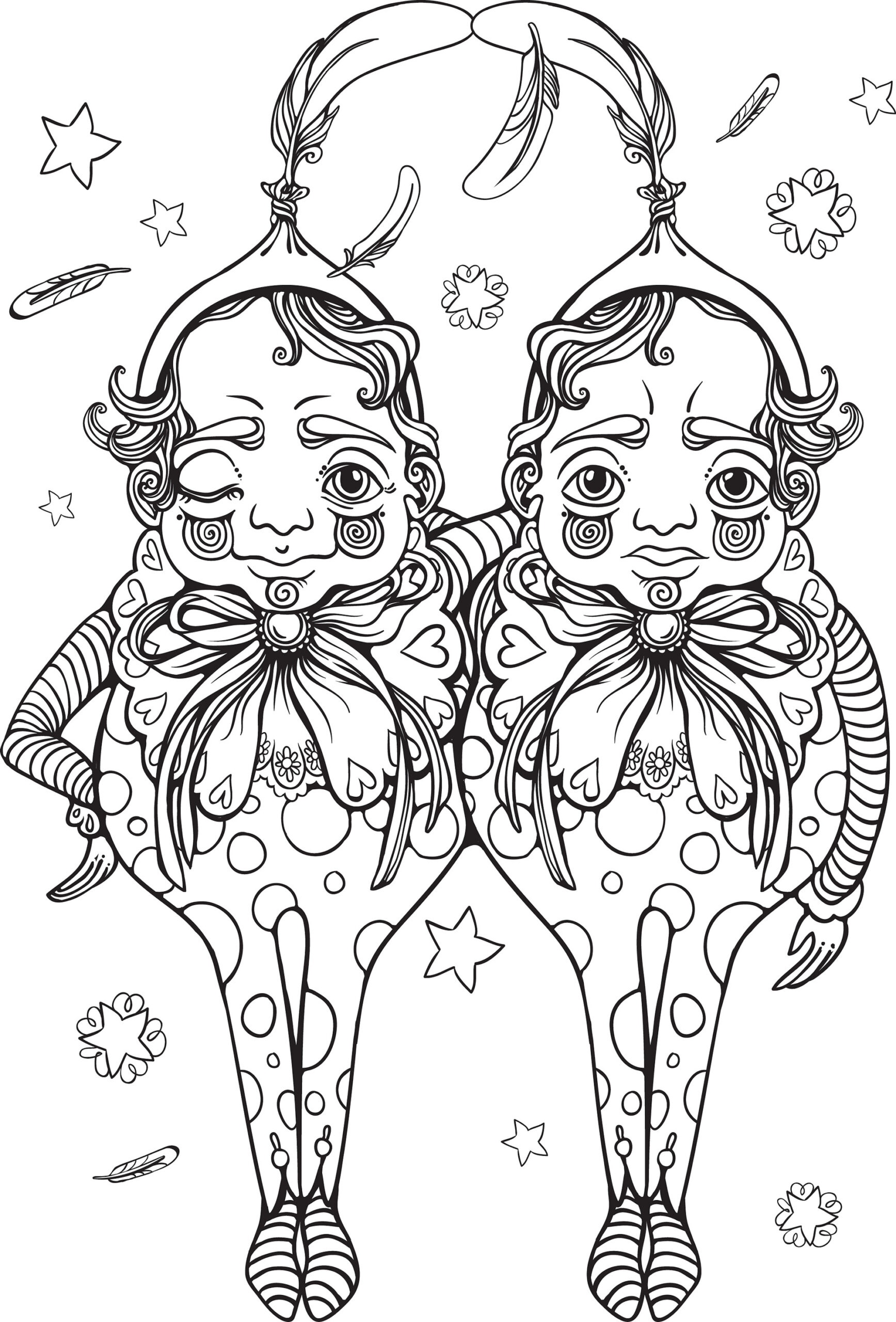
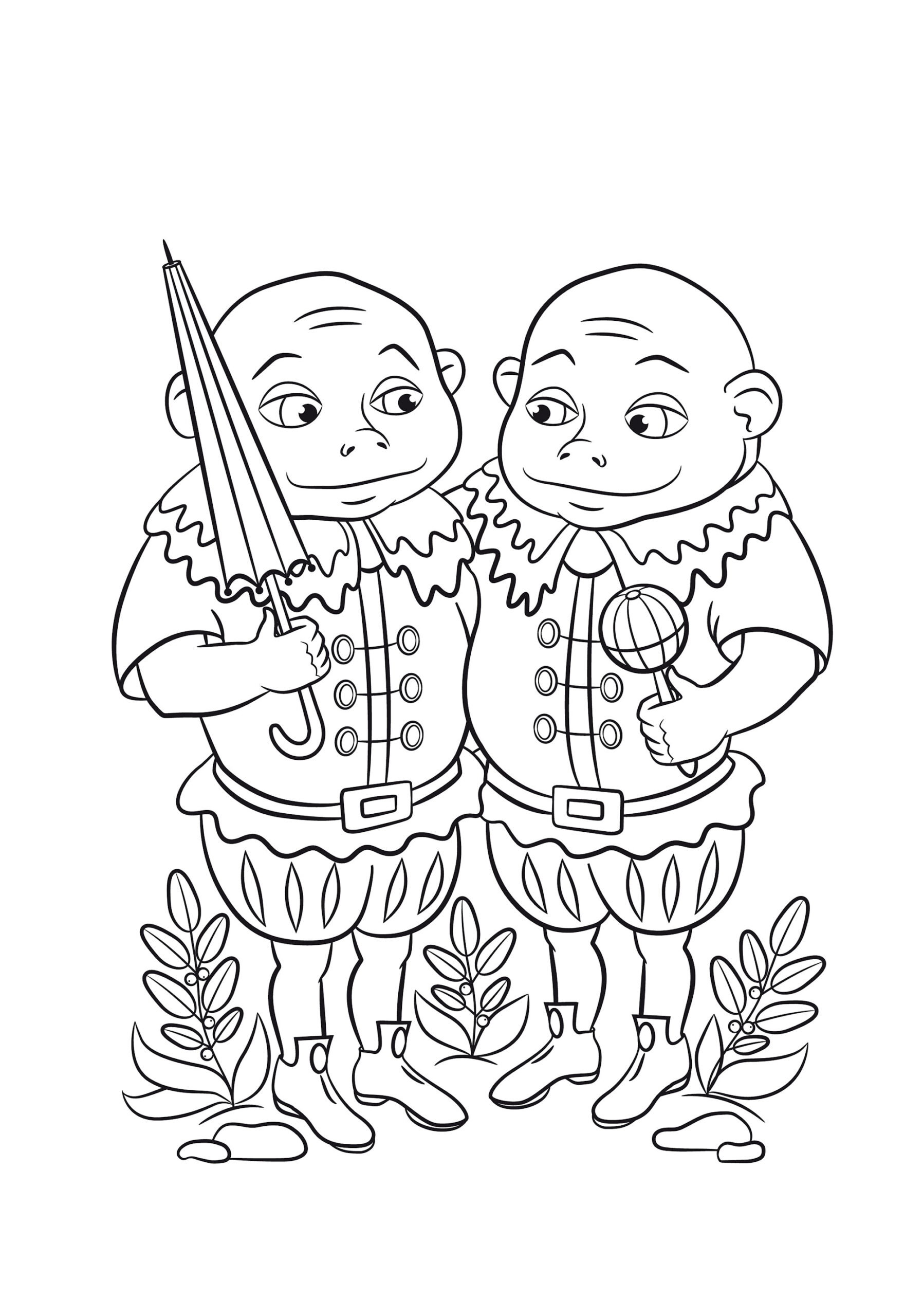
Tweedledee and Tweedledum belong to Through the Looking-Glass, even though they’re now often grouped with Wonderland characters in broader Alice collections.
Because the two characters are famously paired, their page is perfect for experimenting with matching and contrasting colors.
Give both characters the same general outfit but reverse the colors. One could wear a red shirt with blue accents while the other wears blue with red. Another version might use yellow and purple or green and orange.
You can also give them nearly identical outfits and hide several differences between them. That turns the coloring page into a homemade find-the-differences challenge once you’re finished.
Kids can ask someone else to spot which details don’t match.
🎨 Create a Wonderland Color Palette
With so many characters and scenes, choosing a small palette first can prevent the collection from feeling overwhelming.
A classic Wonderland palette might use blue, white, red, black, green, and gold. For a Queen of Hearts palette, concentrate on scarlet, burgundy, black, white, and gold. A Cheshire Cat palette can use purple, lavender, pink, and turquoise, while a Mad Tea Party palette might combine mustard, emerald, burgundy, purple, and cream.
For something softer, create a pastel Wonderland with dusty pink, lavender, mint, pale yellow, baby blue, and peach. A darker version could use navy, black, deep purple, burgundy, and forest green.
Repeating several colors across different characters can make a group of completed pages feel like one coordinated collection.
You can also deliberately make every page different. Wonderland certainly doesn’t require consistency.
📚 The Story Behind Alice’s Adventures in Wonderland
The author known as Lewis Carroll was actually Charles Lutwidge Dodgson, a mathematician at Christ Church, Oxford, who also became an accomplished photographer and writer.
The story that developed into Alice’s Adventures in Wonderland is famously connected with a boating excursion on the Thames in 1862 involving Dodgson, the Liddell sisters, and the Reverend Robinson Duckworth. Alice Liddell asked Dodgson to write down the story he had told, and he eventually produced a handwritten manuscript called Alice’s Adventures Under Ground.
An expanded version became Alice’s Adventures in Wonderland. The publication history is unusually interesting: an 1865 printing was withdrawn after illustrator John Tenniel objected to the quality with which his pictures had been reproduced. An improved edition followed, bearing an 1866 title-page date.
The story went on to become one of the most enduring works of children’s literature.
That history makes these coloring pages especially interesting because illustration has been part of Alice’s world almost from the beginning.
✒️ John Tenniel Helped Shape the Wonderland We Imagine
Lewis Carroll originally drew his own illustrations for the handwritten Alice’s Adventures Under Ground, but professional artist John Tenniel was selected to illustrate the published Alice’s Adventures in Wonderland.
Tenniel created 42 illustrations for the first book, and his drawings helped establish the appearances of characters such as Alice, the White Rabbit, Cheshire Cat, Caterpillar, Hatter, and Queen of Hearts.
Those original pictures were black-and-white line illustrations, which means they are fascinating references for colorists. Instead of telling us exactly what every character must look like in color, they leave plenty of room for interpretation.
Look at a few original Tenniel illustrations and notice the details: patterned clothing, facial expressions, elaborate hats, strange animals, playing-card characters, and dense crosshatched shadows.
Then return to the coloring pages and decide which details you want to emphasize.
In a way, adding your own colors continues a process readers and illustrators have been participating in for generations.
📖 Read a Chapter and Color a Character
These pages can work particularly well alongside the book itself.
Choose a chapter or scene, then find a coloring page connected with it. After reading about the White Rabbit, color one of the rabbit designs. Read the tea-party chapter and move on to the Hatter and Dormouse. When the Queen of Hearts arrives, choose a royal or playing-card page.
Children can talk about how the illustration compares with what they imagined while listening to the story.
Did they picture the character differently? What colors did they imagine? Which part of the chapter would they draw if they were creating their own illustration?
Older children can compare modern coloring artwork with Tenniel’s original illustrations and discuss how different artists interpret the same text.
Because Alice’s Adventures in Wonderland is in the public domain, digitized editions are also available through collections such as the Library of Congress.
🖍️ Crayons, Markers, or Colored Pencils?
The large number of designs in this collection means different tools may work better for different pages. Crayons are easy for younger children and for larger character areas, while markers make strong colors stand out beautifully in playing cards, tea sets, mushrooms, and fantasy backgrounds.
Colored pencils give more control over detailed clothing, facial features, flowers, chessboards, and tea-party objects. They’re also helpful if you want to create shadows without covering the original line work.
A particularly detailed page can be completed slowly over several sessions. There is no need to finish the whole tea party or Queen’s court in one afternoon.
Mixing supplies is perfectly fine too. Use markers for large bold objects, pencils for shading, and crayons for broad backgrounds.
If markers are being used, placing another sheet of paper beneath the printable can help protect the surface below.
🏫 Alice in Wonderland Activities for Kids and Classrooms
Because these pages connect so naturally with a classic book, they’re useful for more than ordinary coloring time. They can accompany literature lessons, read-alouds, library programs, book clubs, theater units, fantasy themes, creative-writing activities, or discussions of Victorian children’s literature.
Children might choose a favorite character and write a short description underneath the picture. Another activity is to invent a new Wonderland character and explain where Alice meets it.
The maze page provides a puzzle break, while the tea-party illustrations can inspire pretend menus or invitations. Playing-card pages can lead to simple game activities, and older kids can distinguish characters from Alice’s Adventures in Wonderland and Through the Looking-Glass.
You can also create a classroom Wonderland display. Let students color different characters, then arrange them around a large paper rabbit hole or giant keyhole.
Add signs pointing in contradictory directions.
In Wonderland, confusing the visitors is practically part of the decoration.
✂️ Turn Finished Pages Into Wonderland Crafts
Finished Alice pages can become cards, bookmarks, journal covers, storybook illustrations, party decorations, or pieces of a larger collage.
Cut out a White Rabbit and place it beside a paper clock. Surround the Cheshire Cat with construction-paper branches. Build a tea-party table from several colored character pages, or use playing cards to create a decorative border.
For a simple bookmark, choose a narrow section featuring Alice, the White Rabbit, a teacup, mushroom, or playing-card symbol and mount it on cardstock.
A group project can become an entire Wonderland mural. Add oversized mushrooms, flowers, clocks, keys, teapots, cards, and checkerboards between the colored characters.
Kids can even invent their own doorways throughout the display. Some might be normal size, others extremely tiny, and one could open upside down.
☕ Continue the Whimsical Tea-Party Theme
Anyone who particularly enjoys the Hatter, Dormouse, and tea-party designs may want to continue with our Whimsical Tea Time Coloring Pages.
That collection moves away from Wonderland itself but keeps the imaginative tea-party atmosphere, with kawaii ghosts, cats, tiny garden characters, teapots, cozy mugs, and other playful scenes.
You could color one Wonderland tea party and one cozy modern tea scene using the same palette.
The comparison is fun: one table might be completely chaotic while the other looks like somewhere you’d actually want to sit for an afternoon.
🐈 Explore More Cute and Fantastical Characters
If the Cheshire Cat, Dormouse, and White Rabbit are your favorite parts of the collection, our 24 Adorable Coloring Pages offer even more whimsical animals and tiny storybook scenes.
For an even broader journey into imaginary worlds, browse our Fantasy Coloring Pages and Fairy Tale Coloring Pages.
Alice isn’t technically a traditional fairy tale, but it shares many of the qualities that make fantasy coloring so much fun: talking animals, impossible places, magical transformations, peculiar rules, and the constant feeling that something unexpected might appear on the next page.
🗝️ Create Your Own Trip Through Wonderland
These Coloring Pages of Alice in Wonderland offer an unusually large cast of characters and scenes, making it possible to build an entire coloring adventure rather than finish only one isolated picture.
Follow the White Rabbit into Wonderland, color Alice as she encounters increasingly strange situations, disappear into the trees with the Cheshire Cat, join the Hatter and Dormouse for tea, meet the Caterpillar on his mushroom, face the Queen and King of Hearts, and surround yourself with an entire court of playing cards.
Then step through the looking glass and meet Tweedledee and Tweedledum or explore a world inspired by chess.
Keep the colors traditional if you’d like, or reinvent everything. Give the Queen purple roses, turn the White Rabbit turquoise, create a rainbow chessboard, or fill the tea table with cups that don’t match at all.
More than a century and a half after Lewis Carroll and John Tenniel first introduced readers to this extraordinary world, Alice continues to inspire new illustrations and interpretations.
Your coloring page can be one more.
Choose a character, pick a color, and see where the rabbit hole leads.
Happy coloring!
🔗 Related Coloring Pages & Activities
- Whimsical Tea Time Coloring Pages
- Coloring Pages of Games
- Purr-fectly Playful Coloring Pages for Cat Lovers
- 24 Adorable Coloring Pages
- Coloring Pages of Flowers
- Fantasy Coloring Pages
- Fairy Tale Coloring Pages
- Coloring Pages for Kids
📚 Sources
- Oxford History of Science Museum — Lewis Carroll and Alice
- Oxford University Museum of Natural History — Lewis Carroll, Alice, and Oxford
- Christ Church, Oxford — Highlights of the Lewis Carroll Collection
- Bodleian Libraries — Christ Church Oxford and the Bodleian Libraries Secure a Unique Copy of Alice’s Adventures in Wonderland
- Library of Congress — Alice’s Adventures in Wonderland
- Library of Congress — Alice’s Adventures in Wonderland and Through the Looking-Glass
🖍️Shop Alice in Wonderland Coloring Books –>