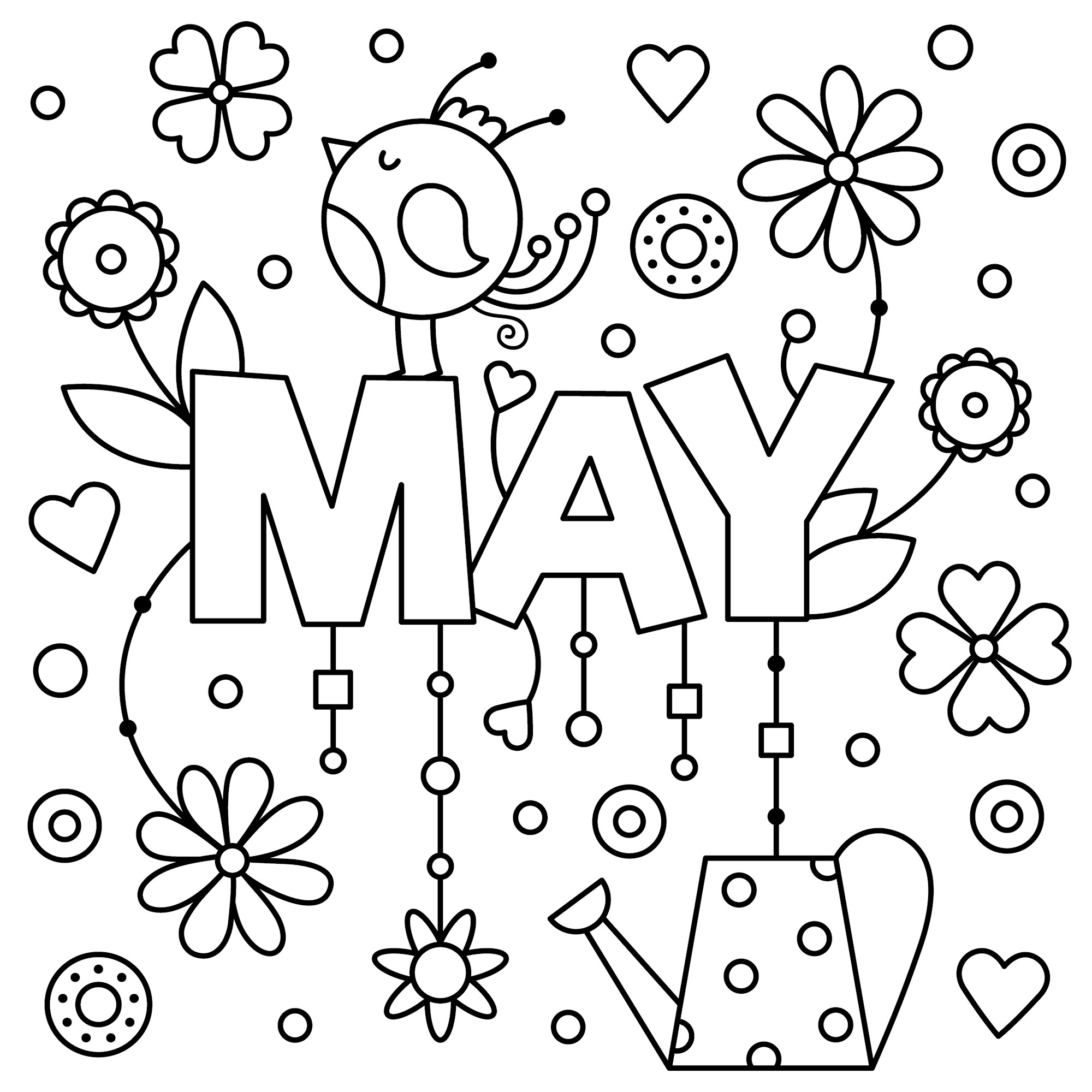
Welcome, May! Celebrate one of spring’s most colorful months with our free printable May coloring page, featuring a cheerful garden filled with daisies, leaves, a sweet little bird, a watering can, and plenty of whimsical details waiting for your favorite colors.
May can feel like the moment when spring really settles in. Gardens become greener, flowers are blooming in many places, birds fill the outdoors with movement and song, and warmer days make it easier to spend time outside exploring.
This printable captures that fresh spring feeling in one charming design. Color the daisies in traditional white and yellow, make the bird bright blue or red, decorate the watering can with patterns, or forget realistic colors entirely and create the most imaginative May garden you can dream up.
Grab your crayons, markers, or colored pencils and let your creativity bloom.
🌸 Explore Our May Coloring Page
The May coloring page brings several classic springtime details together in one garden-inspired design.
Cheerful daisies fill the scene, while a little bird adds a touch of wildlife. A watering can hints that someone has been tending the garden, and leaves and decorative patterns fill the remaining spaces with plenty of small details to color.
That combination makes the page especially versatile. Younger children can focus on the larger flowers and simple objects, while older kids can add shading, patterns, backgrounds, and extra garden details.
If you love outdoor coloring scenes like this one, our Nature Coloring Pages are filled with even more flowers, birds, butterflies, gardens, plants, beaches, and other parts of the natural world.
🌼 Color the May Daisies
The daisies are some of the brightest features in this May design.
A familiar daisy look combines white petals with sunny yellow centers, but coloring pages give you the freedom to change everything.
Try flowers with:
- Pink petals
- Lavender petals
- Pale blue petals
- Peach petals
- Rainbow petals
- Yellow petals
- Purple centers
- Striped petals
- Polka-dot petals
You could color every flower differently or choose two or three shades and repeat them throughout the picture.
For a softer spring look, try pastels such as blush pink, lavender, mint, pale yellow, and baby blue. For something bolder, use bright red, orange, turquoise, purple, and sunny yellow.
🌈 Create Rainbow Daisies
If choosing realistic flower colors feels too limiting, make every daisy into its own rainbow.
Color one petal red, the next orange, then yellow, green, blue, and purple.
Another flower could use only warm colors such as red, orange, pink, and yellow, while a third could use cool blues, greens, and purples.
Children can also experiment with repeating patterns around the petals.
One flower might alternate pink and purple.
Another could alternate yellow and orange.
Coloring several similar flowers in different ways is an easy way to show how many possibilities can come from the same basic shape.
For even more floral inspiration, explore our Coloring Pages of Flowers.
🐦 Meet the Little May Bird
A friendly bird perches among the springtime details in the picture, giving kids another chance to reach for bright colors.
For a natural woodland look, try combinations of brown, tan, gray, cream, black, or soft reddish shades.
Or imagine that the bird is a colorful spring visitor.
Give it:
- A blue back
- A yellow chest
- Red wings
- A turquoise tail
- A purple head
- Rainbow feathers
There is no need to identify the bird as a specific species. The fun is deciding what kind of feathered visitor belongs in your May garden.
For an entire collection devoted to birds, visit our Coloring Pages of Birds.
🎶 Imagine the Bird’s Spring Song
Once you’ve colored the bird, imagine what it sounds like.
Is it singing a cheerful morning song?
Calling to another bird hidden in a nearby tree?
Perhaps it has just arrived after a long spring journey and discovered this flower-filled garden.
Children can add musical notes around the bird and invent their own bird song.
Younger children might simply imitate the sounds they hear outdoors. Older kids could write a few lines describing what the bird’s song sounds like or what they imagine it is saying.
🧭 May Is an Exciting Month for Bird Watching
Spring can be an especially interesting time to watch birds in much of North America because many migratory species are moving toward their breeding grounds.
Migration timing varies considerably by region, but April and May are important months for observing many spring migrants.
That makes the little bird in the May picture a perfect excuse to look outside.
Spend a few minutes watching a backyard, schoolyard, neighborhood park, or garden.
How many birds can you spot?
What colors do they have?
Are they on the ground, in trees, or flying overhead?
Then return to the coloring page and use something you observed as inspiration.
💦 Color the Watering Can
The watering can is another charming part of the illustration.
A traditional galvanized watering can might be gray or silver, but a spring garden deserves something more colorful if you want it.
Try:
- Bright yellow
- Cherry red
- Turquoise
- Lavender
- Mint green
- Coral
- Sky blue
Then decorate it.
Add flowers, stripes, hearts, butterflies, ladybugs, stars, or polka dots.
You could even write a name across the side and imagine that the watering can belongs to the child who takes care of this special May garden.
🌱 What Do Plants Need to Grow?
The watering can can also introduce a very simple plant lesson.
Plants need water, light, air, nutrients, and suitable growing conditions. Roots take up water and nutrients, while leaves capture light that plants use during photosynthesis.
Younger children don’t need all the scientific details.
Simply ask:
What happens if a plant never gets water?
Why do plants have roots?
Where do leaves grow?
What part of the plant becomes a flower?
Then look at a real plant and compare its parts with the flowers and leaves on the coloring page.
🌻 Design Your Dream May Garden
The existing illustration can become the starting point for a much larger spring garden.
Add more plants around the edges.
Draw:
- Tulips
- Daffodils
- Roses
- Pansies
- Wildflowers
- Flowering bushes
- Vines
- Trees
- Grass
Then add a path winding between the flowers.
Perhaps there is a little bench where someone can sit and watch the birds. Maybe a birdbath stands nearby, or a tiny garden gate opens onto another secret part of the yard.
There is no limit to how large the imaginary garden can become.
For more detailed outdoor scenes, continue with our Garden Coloring Pages.
🪴 Create a Tiny Container Garden
Not everyone has a large garden, and your coloring page doesn’t need one either.
Draw several flowerpots around the May design.
Each pot can contain a different imaginary plant.
One might have bright yellow flowers.
Another could hold trailing purple vines.
A third might contain an enormous sunflower.
Decorate the pots with stripes, dots, faces, rainbows, or patterns.
Children can even design a tiny balcony or windowsill garden and decide what they would grow there.
🐝 Add Bees to the Flowers
A flower-filled May garden is also a good place for a few busy pollinators.
Draw tiny bees flying between the daisies.
Simple bees are easy to make: draw an oval body, add black and yellow stripes, two wings, and little antennae.
Then imagine the bee visiting several flowers.
As bees and other pollinators move between blossoms, they can transfer pollen, helping many flowering plants reproduce.
Spring-flowering plants can provide important pollen and nectar resources for bees and other pollinators, making May gardens lively places to observe insects as well as flowers.
🦋 Add Butterflies to the Garden
Butterflies are another easy spring addition.
Draw one hovering above the flowers or resting near the watering can.
Butterfly wings are perfect for patterns.
Try:
- Dots
- Stripes
- Hearts
- Swirls
- Rainbow sections
- Matching symmetrical designs
Give every butterfly a different palette.
Then print our Butterflies Coloring Page and create an entire spring butterfly garden.
🌿 Create a Pollinator Garden
Older kids can take the bee-and-butterfly idea a little further by designing an imaginary pollinator garden.
Draw several kinds of flowers that bloom at different times and include plenty of variation in color and shape.
A real pollinator-friendly garden works best when plants are suited to the local climate and provide flowers across different parts of the growing season. Native plants can be particularly valuable because local insects and other wildlife have longstanding relationships with them.
Children can research a few native flowers from their region and draw them around the May coloring page.
The picture then becomes both an art project and a simple nature-planning activity.
🌷 May Is a Wonderful Month for Garden Watching
What blooms during May depends heavily on location, elevation, climate, and the particular year.
In some places, spring flowers are already abundant. In colder or higher-elevation areas, plants may just be beginning to emerge.
That variation makes May a great month to look closely at what is actually happening outside rather than assuming every spring looks the same.
Take a walk and ask:
Which plants are flowering?
Which are still only leaves?
Are there buds waiting to open?
Which insects are visiting the flowers?
Can you hear birds?
Then add some of those real May observations to the coloring page.
🔍 Go on a May Nature Hunt
Turn the coloring page into inspiration for an outdoor scavenger hunt.
Look for:
- A flower
- A bird
- An insect
- Something yellow
- Something green
- A leaf with an interesting shape
- A flower bud
- Something growing
- A cloud
- Something that smells good
There is no need to pick or collect anything.
Simply observing each item is enough.
When you return indoors, draw one or two things you discovered around the May picture.
📓 Start a May Nature Journal
The finished coloring sheet can also become the cover of a simple May nature journal.
Staple a few blank pages behind it and record observations throughout the month.
Children might draw:
- Birds
- Flowers
- Insects
- Clouds
- Leaves
- Garden plants
- Rainy days
- Sunny days
Add the date beside each drawing.
Older children can write a sentence explaining what they saw or where they found it.
By the end of the month, the journal becomes a little record of how spring changed from the beginning of May to the end.
🌦️ Color a Sunny May Day
For a cheerful spring scene, add a bright blue sky around the garden.
Draw a large yellow sun overhead and a few fluffy white clouds.
Use fresh greens for the leaves and grass and plenty of pinks, yellows, blues, and purples for the flowers.
The bird can become one of the brightest parts of the picture.
A sunny palette works particularly well if you want the page to feel like spring is moving toward summer.
🌧️ Turn It Into a Rainy Spring Garden
May doesn’t have to mean constant sunshine.
Spring rain can be an important part of the growing season, and a rainy-day version of the picture can be just as colorful.
Add raindrops around the flowers, draw puddles beneath the watering can, and color the sky pale gray, blue-gray, or lavender.
Then add a bright umbrella or rain boots to the scene.
The flowers can remain vivid so they stand out against the softer sky.
Finish with a rainbow if you like.
🌈 Add a Rainbow After the Rain
A garden and a rainbow make a wonderfully colorful combination.
Use the familiar sequence of red, orange, yellow, green, blue, and purple—or invent a pastel rainbow with peach, pink, mint, baby blue, and lavender.
You can even coordinate the daisies with the rainbow.
Make one flower mostly red and orange, another yellow and green, and another blue and purple.
For even more colorful skies, visit our Coloring Pages of Rainbows.
🎨 Try a Classic Spring Color Palette
May is especially well suited to fresh, cheerful color combinations.
A classic spring palette could include:
- Fresh green
- Pale pink
- Lavender
- Sunny yellow
- Sky blue
- Peach
- White
Use green for leaves, soft colors for flowers, yellow for flower centers, and blue for the sky.
A few darker greens can provide contrast and keep the softer colors from blending together.
🌺 Try a Bold May Garden Palette
Spring doesn’t always have to be pastel.
For something more energetic, use:
- Hot pink
- Orange
- Bright yellow
- Turquoise
- Purple
- Lime green
Turn the watering can turquoise, make the flowers vivid pink and orange, and give the bird brilliant purple wings.
This approach makes the page feel almost tropical while still keeping its cheerful garden theme.
🧚 Turn May Into a Magical Garden
The flowers and whimsical details can easily become the beginning of a fantasy world.
Maybe tiny fairies live beneath the daisies.
Perhaps the bird can talk.
The watering can could pour sparkling rainbow water that makes magical flowers grow overnight.
Add:
- Fairy doors
- Tiny mushrooms
- Stars
- Sparkles
- Miniature houses
- Butterflies
- Friendly insects
- Secret pathways
Children can create an entire story explaining what happens in the garden after everyone goes to sleep.
✏️ Write a May Garden Story
The illustration can also become a creative-writing prompt.
Try:
The little bird discovered something hidden beneath the flowers…
One morning, the watering can began to sparkle…
The May garden grew a flower nobody had ever seen before…
A tiny butterfly landed beside the bird and said…
Behind the daisies was a secret door that led to…
Younger children can tell the story aloud while an adult writes it down.
Older kids can write several paragraphs and use the finished coloring page as the story illustration.
🐦 Imagine a Conversation With the Bird
Give the little bird a personality.
What is its name?
Where does it live?
What does it eat?
Does it visit the garden every morning?
What is its favorite flower?
Children could draw a speech bubble and write something the bird might say.
Maybe it is welcoming everyone to May.
Perhaps it is asking the gardener to refill a birdbath.
Or maybe it knows the location of a secret garden treasure.
📅 Make a May Calendar
A completed coloring page can make a cheerful cover for a homemade May calendar.
Create a calendar grid beneath it and mark important dates.
Add:
- Birthdays
- School activities
- Family outings
- Sports
- Garden days
- Weekend plans
- Holidays
- Nature walks
Use small symbols to make the calendar more colorful.
A flower could represent a garden day.
A bird might mark a nature walk.
A cake means birthday.
Children can add something to the calendar as the month goes along.
🧺 Make a May Bucket List
May is also a nice time for a simple spring bucket list.
Ideas might include:
- Have a picnic
- Plant a flower
- Watch birds
- Look for butterflies
- Take a nature walk
- Draw outside
- Visit a park
- Read outdoors
- Make flower art
- Look for shapes in clouds
- Help water plants
- Eat lunch outside
Children can check off each activity they complete before June arrives.
The colored May picture makes a perfect cover for the list.
🌱 Plant Something in May
The watering can might inspire children to grow something themselves.
Planting possibilities depend on local climate and frost dates, so adults should choose plants appropriate for the region and time of year.
Even a small pot can become a gardening experiment.
Children can help fill it with soil, plant suitable seeds or a young plant, and keep track of changes.
Measure growth every week or draw what the plant looks like.
The real plant and the May coloring page can become part of the same spring nature project.
💧 Practice Helping in the Garden
Young children can also participate in simple gardening tasks with adult guidance.
They might help water containers, look for new flowers, gather garden tools, or observe insects.
The watering-can illustration is a fun reminder that gardens change because someone is paying attention to them.
Ask children what they think would happen to the garden in the picture if nobody cared for it.
Then talk about what plants need and how gardeners help provide suitable conditions.
📷 Photograph Your May Garden
If you have flowers growing nearby, take a photograph at the beginning of May and another at the end.
Compare them.
Are more flowers open?
Have the plants grown taller?
Are the leaves larger?
Do you see different insects?
Children can place the photographs beside their completed coloring page and create a simple May in Our Garden scrapbook page.
🌷 Follow Spring From April to June
May sits beautifully between the early-spring feeling of April and the approach of summer in June.
Start with our April Coloring Page, then color this May garden, and finish with our June Coloring Pages.
Displaying the three together creates a simple visual journey through spring.
April brings early flowers and spring celebrations.
May feels increasingly green and garden-filled.
June begins introducing summer sunshine and end-of-school excitement.
☀️ Get Ready for June
As May moves toward its final days, summer begins feeling closer in much of the Northern Hemisphere.
Our June Coloring Pages continue the seasonal journey with June-themed artwork, a Last Day of School page, and a detailed seasonal doodle.
Color May and June side by side and compare them.
Which colors did you use in both?
Which details feel more like spring?
Which make you think about summer?
Following the months through coloring is an easy way for children to notice how themes and seasons gradually change.
📚 Follow the Year With Seasonal Coloring Pages
Monthly pages can become a year-long project.
Print one at the beginning of each month and keep the finished designs in a binder.
Write the child’s name, age, month, and year on the back.
Over time, the collection becomes both a record of the seasons and a record of the child’s artwork.
Our Seasonal Coloring Pages bring together monthly printables as well as spring, summer, fall, and winter collections.
🏫 May Coloring Page for the Classroom
This May printable fits naturally into spring classroom activities.
Teachers might use it for:
- Morning work
- Early finishers
- Spring units
- Plant lessons
- Bird lessons
- Art centers
- Nature studies
- May bulletin boards
- Indoor recess
- Writing prompts
Students can color the same picture and then add one spring observation beneath it.
Display all the finished pages together and see how differently everyone imagined the same May garden.
🌼 Create a May Bulletin Board
The design could also become part of a larger classroom garden.
Let each student color a May page or create an individual paper flower.
Arrange all the artwork on a bulletin board beneath a title such as:
Our Creativity Is Blooming
Welcome, May!
Spring Into Color
Watch Our Garden Grow
Add paper butterflies, birds, leaves, and watering cans around the display.
The result becomes a colorful student-made spring garden.
🏠 May Coloring at Home
At home, the page works well as an easy spring activity requiring almost no preparation.
Print it for a rainy afternoon, quiet time, a playdate, or a weekend morning.
You could set the coloring supplies near a window so children can look outside while they work and compare the picture with real spring scenery.
If the weather is pleasant, take crayons and clipboards outdoors and color in the garden, on the porch, or at a park.
✂️ Turn Your May Coloring Page Into a Craft
A finished May coloring sheet doesn’t have to remain a flat piece of paper.
Use it to create:
- A spring scrapbook page
- A May calendar cover
- A greeting card
- A nature-journal cover
- Classroom wall art
- A notebook cover
- A seasonal collage
- A spring poster
Children can also cut out individual flowers, leaves, or the watering can and glue them onto construction paper.
Add extra paper flowers and butterflies to make a layered garden collage.
💐 Make a Homemade Spring Card
The flower-filled design makes an especially nice greeting card.
After coloring, mount the picture on folded cardstock or construction paper.
Write a message inside for a parent, grandparent, teacher, friend, or another special person.
The card doesn’t need a holiday.
A simple Happy Spring!, Thinking of You, or Have a Beautiful Day works perfectly with the cheerful garden picture.
🎁 Create a May Gift for Someone Special
The finished picture can also become a small handmade gift.
Write the date and child’s name on the back, then place it in a simple frame.
A personalized garden picture can make a sweet gift for someone who loves flowers, birds, spring, or children’s artwork.
Children could also write a sentence explaining why they chose particular colors.
Those small personal details often make handmade artwork especially memorable.
🖍️ Best Supplies for Your May Coloring Page
Crayons are a great choice for younger children and larger spaces.
Colored pencils are particularly useful for flower petals, leaves, bird feathers, and other smaller details. They also make it easier to combine light and dark shades.
Markers create brilliant garden colors, although slightly heavier paper can be useful if ink tends to bleed through regular printer paper.
Gel pens can add tiny finishing touches to the watering can, flower centers, or decorative patterns.
Try mixing several materials rather than choosing only one.
🖨️ How to Use This May Coloring Page
Print the May coloring sheet and gather your favorite art supplies.
Then decide what kind of garden you want to create.
Maybe it is a realistic spring garden filled with white daisies, fresh green leaves, and a little brown bird.
Perhaps it is a pastel garden with lavender flowers, mint leaves, and a pink watering can.
Or maybe May exists in a magical world where rainbow daisies bloom, turquoise birds sing, and a golden watering can helps flowers grow overnight.
There is no wrong choice.
The picture provides the garden. Your colors decide what grows there.
🌸 Let Your Creativity Bloom This May
May is a wonderful month for noticing flowers, birds, gardens, warmer days, and all the small changes happening outdoors.
Our free printable May coloring page brings that springtime feeling to the coloring table with cheerful daisies, a sweet little bird, a watering can, leaves, and plenty of room for imagination.
Color it as a simple May activity, use it for a classroom nature lesson, turn it into a journal cover, or let it inspire a real outdoor adventure.
Grab your favorite colors and let your creativity grow right alongside the May garden.
🔗 Related Articles
- April Coloring Page
- June Coloring Pages
- Coloring Pages of Flowers
- Garden Coloring Pages
- Coloring Pages of Birds
- Butterflies Coloring Page
- Nature Coloring Pages
- Seasonal Coloring Pages
- Educational Coloring Pages & Activities
📚 Sources
- University of Minnesota Extension — May Garden Checklist
- Cornell Lab of Ornithology — When Will Spring Bird Migration Hit Its Peak?
- U.S. Forest Service — Working Trees for Pollinators
- U.S. Forest Service — Plant Ecology
- National Park Service — Discover Wildflowers
🖍️Shop Spring Coloring Books –>