🖍️Shop Winnie the Pooh Coloring Books –>
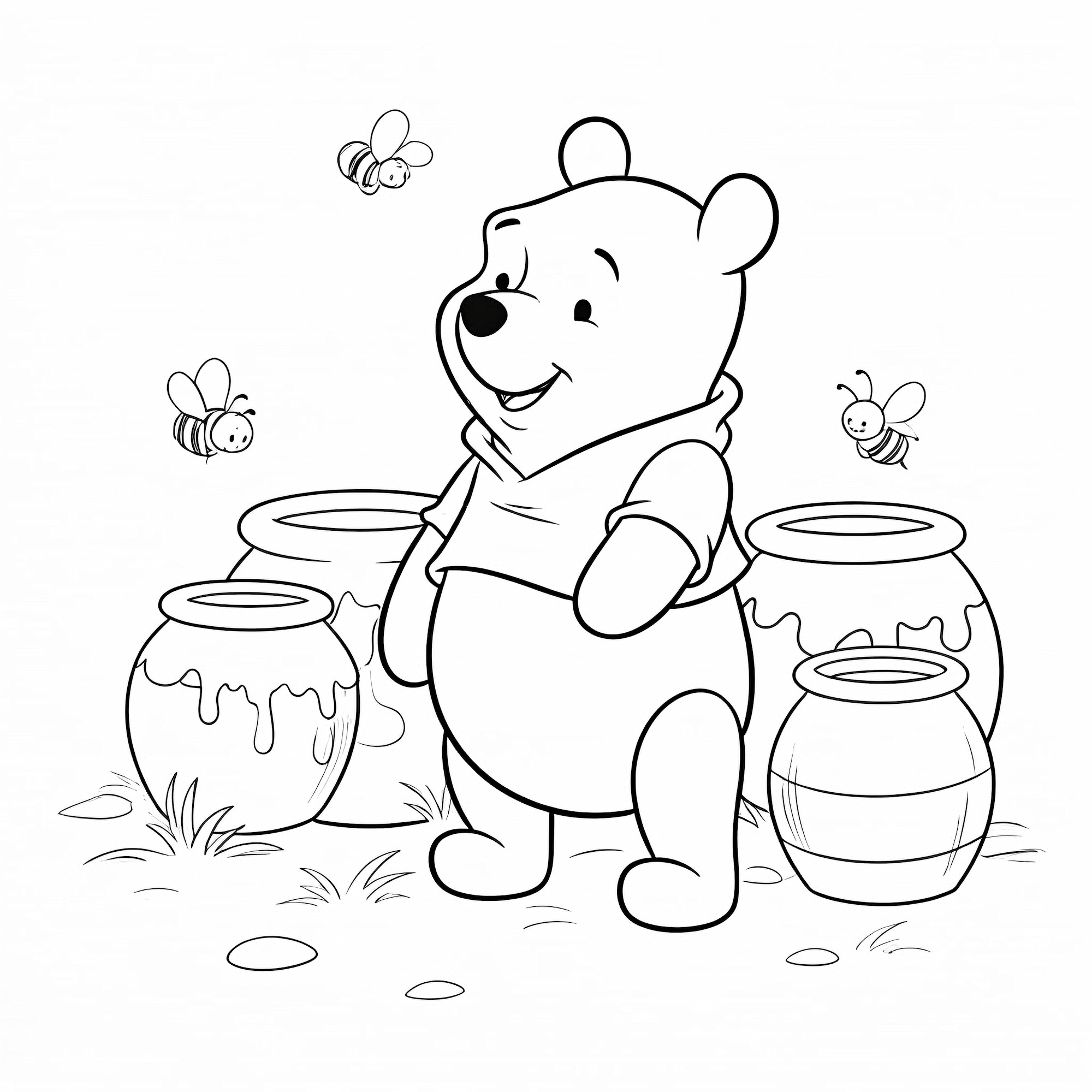
Step into the Hundred Acre Wood with this sweet Winnie-the-Pooh coloring page, featuring Pooh Bear surrounded by one of his favorite things: pots and pots of honey.
Pooh is a wonderfully inviting character for a coloring activity because his world is built around simple pleasures—friends, walks through the woods, thoughtful conversations, small adventures, and, of course, finding something delicious to eat. This printable captures that cozy feeling with Pooh surrounded by honey pots just waiting for golden yellows, warm browns, and whatever imaginative colors you want to add.
Young children can keep the page simple with crayons and broad areas of color, while older kids can add shading to the honey pots, create a woodland background, draw buzzing bees, or turn every jar into a different decorative design.
Grab your crayons, markers, or colored pencils and get ready for a honey-sweet coloring adventure.
🖍️ Shop Winnie-the-Pooh Coloring Books
🍯 Winnie-the-Pooh and His Honey Pots
The star of this printable is Winnie-the-Pooh surrounded by honey pots, making honey the obvious place to start.
Instead of using one flat yellow, try combining several warm shades:
- Pale yellow
- Golden yellow
- Amber
- Honey brown
- Orange-gold
- Cream
Leave a few lighter areas along the edges of the honey to make it look shiny.
The pots themselves can be traditional brown pottery, but they do not have to match. One might be red, another blue, and another covered with little bees.
You could even write HUNNY on a few of the jars for a playful storybook touch.
🐻 Coloring Pooh Bear
Pooh is often imagined in warm golden-yellow shades, which makes him especially cheerful against earthy woodland colors.
Try using:
- Pale gold
- Warm yellow
- Honey yellow
- Soft ochre
- Light brown
Use slightly deeper colors around shaded areas such as beneath the arms, around the legs, and near the edges of the face.
For a completely imaginative version, color Pooh lavender, blue, pink, or rainbow-colored.
A coloring page does not have to recreate one familiar version of a character exactly. It can become your own interpretation.
🌈 Create a Rainbow Pooh Bear
Print the page again and forget traditional colors.
Perhaps Pooh has rainbow fur.
Try moving from:
Red → Orange → Yellow → Green → Blue → Purple
across his body.
Or create a pastel Pooh using peach, pink, lavender, mint, and pale blue.
The honey pots can coordinate with him or become completely different.
Maybe every pot contains a different imaginary kind of honey:
Strawberry Honey — pink
Blueberry Honey — blue
Rainbow Honey — every color
Moonlight Honey — silver
Magic Forest Honey — green and gold
Coloring is much more fun when a familiar scene is allowed to become a little ridiculous.
🫙 Design the Honey Pots
The honey pots provide a perfect pattern activity.
Instead of coloring each jar one solid shade, decorate them with:
- Stripes
- Polka dots
- Hearts
- Stars
- Flowers
- Bees
- Zigzags
- Swirls
Give every pot a different design.
Older children can create labels such as:
Spring Honey
Forest Honey
Wildflower Honey
Secret Honey
or
Pooh’s Emergency Honey
Then decide which jar Pooh would choose first.
🐝 Add Some Busy Bees
Honey naturally brings bees to mind, so add a few buzzing around Pooh.
Draw simple bees using oval bodies with black and yellow stripes.
Add two wings and tiny antennae.
You might draw:
- 1 bee above Pooh
- 2 bees near a honey pot
- 3 bees flying through flowers
Then count all six.
For a larger bee-themed activity, visit our Bee Happy Coloring Page.
🌼 Where Does Honey Come From?
Honey begins with bees gathering nectar from flowers.
Honey bees carry nectar back to their colony, where it is processed and stored in the honeycomb.
For young children, the basic idea can stay simple:
Flowers → Bees → Honey
Draw a few flowers beside Pooh and connect them to a bee with a dotted flight path.
Then connect the bee to the honey pots.
The coloring page becomes a simple visual sequence without losing its playful storybook feeling.
🌸 Create a Wildflower Meadow
Pooh’s honey pots can inspire a whole field of flowers.
Draw:
- Daisies
- Sunflowers
- Clover
- Lavender
- Wildflowers
Use pink, yellow, orange, purple, blue, and red across the blossoms.
Then add green stems and leaves.
Imagine that the bees gathering nectar from these flowers eventually helped make the honey Pooh is enjoying.
For even more floral coloring, explore our Coloring Pages of Flowers.
🌳 Build the Hundred Acre Wood Around Pooh
The original Pooh stories take place in a woodland world inspired by the countryside that A. A. Milne and his family knew in southern England.
Turn the empty space around Pooh into your own version of the Hundred Acre Wood.
Add:
- Tall trees
- Bushes
- Mushrooms
- Flowers
- Fallen leaves
- Logs
- Butterflies
- A winding path
Use several greens and browns rather than one color throughout the forest.
Maybe there is even a tiny sign pointing toward Piglet’s house or a bridge hidden behind the trees.
🍂 Make an Autumn Pooh Scene
A woodland Pooh picture works especially well with autumn colors.
Use:
- Pumpkin orange
- Golden yellow
- Rust
- Burgundy
- Chestnut
- Olive green
Draw falling leaves around Pooh and add acorns or mushrooms along the forest floor.
The honey can remain bright gold, making it stand out against the deeper fall colors.
For more seasonal coloring, explore our Seasonal Coloring Pages.
❄️ Create a Winter Pooh Adventure
The same page can become a winter scene.
Add falling snowflakes and snow along the tops of the honey pots.
Use pale blue, silver, lavender, and gray around the background while keeping Pooh warm and golden.
Perhaps he has gathered plenty of honey for a cozy winter afternoon.
Draw a scarf around him or add a little hat.
The forest behind him could have bare branches and snow-covered evergreens.
🌷 Make It Spring in the Hundred Acre Wood
For a spring version, surround Pooh with fresh green grass, flower buds, butterflies, and buzzing bees.
Try pastel colors such as:
- Pink
- Lavender
- Pale yellow
- Mint
- Sky blue
- Peach
Add small blossoms around the honey pots.
Perhaps Pooh has wandered into a meadow on the first warm day of spring and discovered that the bees are already busy.
☀️ Create a Sunny Summer Scene
A summer Pooh page can be bright and cheerful.
Draw a large yellow sun, blue sky, green leaves, and colorful wildflowers.
Add butterflies or birds among the trees.
Perhaps Pooh is planning a picnic.
You could draw a blanket beside him with sandwiches, fruit, and—naturally—another pot of honey.
📖 Meet Winnie-the-Pooh
Winnie-the-Pooh was created by English author A. A. Milne and appeared in the 1926 book Winnie-the-Pooh, illustrated by Ernest H. Shepard.
The stories grew from the imaginative world surrounding Milne’s son, Christopher Robin, and several of his stuffed animals.
Pooh’s adventures are generally gentle rather than grand. He visits friends, searches for honey, follows mysterious tracks, celebrates birthdays, gets stuck in inconvenient places, and often tries to solve problems in his own wonderfully Pooh-like way.
That quiet charm is part of what has helped the stories remain favorites for generations.
🧸 Pooh Began With a Teddy Bear
Before Winnie-the-Pooh became a literary character, there was a real stuffed bear.
Christopher Robin Milne received the teddy bear for his first birthday in 1921. The bear was originally called Edward Bear before becoming associated with the name Winnie-the-Pooh.
Several of Christopher Robin’s other stuffed animals also inspired familiar characters.
The surviving original toys include:
- Winnie-the-Pooh
- Piglet
- Eeyore
- Kanga
- Tigger
They eventually became part of the collection of The New York Public Library.
That means one of the world’s most famous fictional bears began with something very ordinary: a child’s well-loved toy.
🇨🇦 Where Did the Name Winnie Come From?
The name Winnie has an interesting real-world story behind it.
Christopher Robin knew about a black bear named Winnie at the London Zoo. That bear had originally been connected with a Canadian soldier and was named for Winnipeg, Canada.
Christopher Robin also used the name Pooh for a swan.
The two names eventually came together as Winnie-the-Pooh.
It is an unexpectedly complicated history for such a simple-sounding bear.
🧸 Draw Your Favorite Teddy Bear
Because Pooh began with a real child’s teddy bear, use the coloring page as inspiration to draw your own favorite stuffed animal.
Look carefully at its:
- Ears
- Eyes
- Paws
- Nose
- Fur color
- Shape
Then draw a simple version on paper.
Your teddy does not need to look perfect.
Give it a name and imagine that it lives in the Hundred Acre Wood too.
What would its favorite food be?
Who would its best friend be?
💕 Pooh and Friendship
One of the most enduring parts of the Pooh stories is the group of very different friends living around the Hundred Acre Wood.
They do not all think, act, or feel the same way.
Some are energetic.
Some are nervous.
Some are gloomy.
Some like to organize things.
And Pooh often seems most interested in friendship and finding something to eat.
That gives the coloring page a simple storytelling theme:
What makes someone a good friend?
Children might suggest:
- Being kind
- Helping
- Listening
- Sharing
- Playing together
- Staying with someone when they are sad
Write one idea beside the finished picture.
🐷 Draw Piglet Beside Pooh
Pooh’s friend Piglet can become an easy drawing extension.
Start with a small oval body and round head.
Add:
- Pointed ears
- Little arms
- Short legs
- A smiling face
Color the character in soft pink or whichever colors you prefer.
Then imagine Pooh and Piglet trying to decide what to do with all those honey pots.
Perhaps they are preparing a picnic.
Maybe they are counting them.
Or perhaps Pooh has absolutely no intention of sharing.
🐯 Add a Bouncy Friend
Create another character inspired by an energetic woodland friend.
Draw a tiger-like animal with a long tail and plenty of stripes.
Use orange and black for a familiar tiger palette or make the character blue, purple, or rainbow-colored.
Add movement lines around it to show bouncing.
Then ask:
What happens when a very energetic friend arrives while Pooh is quietly eating honey?
That sounds like the beginning of a story.
🫏 Create a Gloomy Donkey Friend
Not every character in a story has to be cheerful all the time.
Draw a gray or blue-gray donkey beside Pooh.
Give it long ears and a slow expression.
Then add something to cheer it up.
Maybe Pooh offers a flower.
Perhaps Piglet arrives with a balloon.
Children can imagine how friends might help someone who is feeling sad without insisting that everyone has to feel happy all the time.
🌳 Who Lives in Your Hundred Acre Wood?
Instead of copying familiar characters, invent completely new woodland friends.
Maybe Pooh meets:
- A shy fox
- A singing bird
- A sleepy mouse
- A rabbit who paints
- A hedgehog who loves books
- A bear who dislikes honey
Give each one a name.
Draw them around the coloring page or create separate character cards.
Soon your version of the Hundred Acre Wood will have its own cast.
🍯 Count the Honey Pots
The honey-filled scene naturally becomes a counting activity.
Count every pot in the picture.
Then add more.
Try:
“Draw one tiny honey pot.”
“Add two large honey pots.”
“Put three bees above them.”
“Draw four flowers.”
Older children can create simple addition problems.
If Pooh has three pots and finds two more, how many does he have altogether?
The answer is probably still not enough honey for Pooh.
🔢 Create a Honey Pot Number Game
Draw six honey pots on blank paper and write a number inside each one:
1 2 3 4 5 6
Then roll a die.
Color the matching pot.
Continue until every pot has been colored.
You can also assign colors:
1 — Red
2 — Orange
3 — Yellow
4 — Green
5 — Blue
6 — Purple
The result becomes a rainbow honey collection.
🔤 P Is for Pooh
For preschool learners, connect the page with the letter:
P p
Practice saying:
P is for Pooh.
Think of more P words:
- Piglet
- Pot
- Pink
- Purple
- Picnic
- Pencil
Children can draw some of those things around the coloring page.
Maybe Pooh has a purple pencil beside a pink picnic basket.
For the whole alphabet, explore our Alphabet Letter Coloring Pages.
🔤 H Is for Honey
The page also works perfectly for:
H h
H is for honey.
Other H words include:
- Hat
- House
- Horse
- Heart
- Hill
Write a large H beside the honey pot and decorate it with yellow and gold stripes.
Children could even draw tiny bees around the letter.
🟡 Practice Yellow and Gold
Pooh and honey both make this a natural page for exploring warm colors.
Put out several yellowish crayons:
- Lemon yellow
- Golden yellow
- Orange
- Ochre
- Tan
- Brown
Let children compare them.
Which one looks most like honey?
Which is brightest?
Which is darkest?
Then use several shades throughout the picture rather than only one yellow.
🔵 Add a Blue Balloon
Balloons play a memorable role in the original Pooh stories, so add one floating above the scene.
Draw a large balloon and color it bright blue.
Then add a string leading down toward Pooh.
Print the page again and make the balloon another color.
Which version do you like better?
You can also draw several balloons and practice counting or color patterns.
🎈 Design a Balloon Bouquet
Draw six balloons above Pooh.
Color them:
- Red
- Orange
- Yellow
- Green
- Blue
- Purple
Then connect all the strings.
Add dots, stars, hearts, or stripes to each balloon.
Perhaps Pooh is taking the balloons to a birthday party in the Hundred Acre Wood.
Who is celebrating?
🎂 Plan a Hundred Acre Wood Birthday Party
Imagine Pooh and his friends are preparing a birthday party.
What would they need?
Draw:
- Cake
- Balloons
- Presents
- Party hats
- Flowers
- Honey
- Picnic blanket
Then decide who the party is for.
Children can design a birthday invitation on another piece of paper.
This turns one coloring sheet into a larger pretend-play activity.
🧺 Plan a Pooh Bear Picnic
Pooh naturally belongs at a picnic.
Draw a blanket beside the honey pots and fill it with imaginary foods.
Add:
- Sandwiches
- Apples
- Berries
- Cookies
- Carrots
- Cupcakes
- Honey
Then decide which woodland friend brings each item.
The picnic blanket itself can become a pattern project with checks, stripes, flowers, or rainbow squares.
🍎 What Would You Pack?
Turn the picnic into a simple choice activity.
Ask children to choose five foods they would pack for a woodland picnic.
Draw or write them around the page.
Then ask:
Would Pooh choose the same foods?
Probably not if there is no honey.
🗺️ Draw a Map of the Hundred Acre Wood
Create an imaginary woodland map.
Include:
- Pooh’s house
- Piglet’s house
- A bridge
- A stream
- Trees
- A meadow
- A honey-tree
- A picnic spot
Draw paths connecting everything.
Children can then trace a route.
“Start at Pooh’s house.”
“Walk to the bridge.”
“Visit Piglet.”
“Finish at the honey-tree.”
Maps can turn imaginary worlds into simple spatial-thinking activities.
🌉 Play Poohsticks on Paper
One famous game associated with the Pooh stories involves dropping sticks into flowing water and seeing which appears first on the other side of a bridge.
Create a paper version.
Draw a bridge across a stream.
Add several colored sticks upstream.
Then draw their paths underneath.
Which stick reaches the other side first?
Children can assign a different stick to each character and invent the winner.
🍃 Create a Woodland Scavenger Hunt
Use the coloring page as inspiration for an outdoor nature hunt.
Look for:
- A leaf
- A stick
- A flower
- A bird
- Something yellow
- Something brown
- Something shaped like a circle
Do not collect anything that should remain in nature.
Simply point, photograph, or draw what you find.
Then return home and add some of those discoveries to Pooh’s woodland background.
📖 Read and Color Together
One lovely way to use this page is alongside an age-appropriate Pooh story.
Children can color while listening or finish the picture afterward.
Then ask:
“Who was in the story?”
“What happened?”
“What was your favorite part?”
“What would you have done?”
Coloring can give children something quiet to do with their hands while a story is read aloud.
📝 Turn the Picture Into a Story Prompt
Why does Pooh have so many honey pots?
Maybe he discovered a hidden honey cupboard.
Perhaps every friend gave him a jar for his birthday.
Maybe Pooh is opening a honey shop.
Or perhaps he plans to eat every single pot before dinner.
Ask children:
What happened before this picture?
and
What happens next?
There is no correct answer.
The funniest explanation might be the best one.
✏️ Write One Sentence About Pooh
Beginning writers can add a sentence beneath the finished picture.
Try:
Pooh loves honey.
Pooh found a honey pot.
The bees are buzzing.
Pooh is having a picnic.
Older children can write an entire paragraph describing the scene.
📕 Make a Pooh-Inspired Storybook
Use the finished coloring page as the cover or first illustration of a homemade storybook.
Add blank pages and create your own woodland adventure.
Perhaps the story begins:
Pooh has too much honey.
Then something unexpected happens.
Maybe one pot disappears.
Perhaps a trail of sticky footprints leads through the woods.
Children can draw each new scene and eventually create a complete illustrated story.
🧸 Pooh and the Original Toys
Pooh’s literary world was inspired in part by Christopher Robin Milne’s real stuffed animals.
The original Pooh, Piglet, Eeyore, Kanga, and Tigger eventually became treasured objects in The New York Public Library’s collection.
Their worn appearance is part of their charm. These were not originally museum pieces created to sit untouched behind glass. They were toys loved and played with by a child.
That makes a nice creative prompt:
What favorite toy of yours could become a story character?
✨ Turn Your Toy Into a Character
Choose a stuffed animal, doll, toy car, dinosaur, or other favorite object.
Give it:
- A name
- A personality
- A favorite food
- A best friend
- A home
- A problem to solve
Then draw it beside Pooh.
Perhaps your character has just arrived in the Hundred Acre Wood.
What happens when they meet?
🧠 A Bear With His Own Way of Thinking
Part of Pooh’s charm comes from the way he approaches problems.
His ideas are not always sensible, but he keeps thinking, wondering, and trying.
That makes the picture a fun starting point for silly problem-solving.
Ask:
Pooh has ten honey pots but no spoon. What could he do?
Children can invent answers.
Some may be practical.
Some may be wonderfully ridiculous.
Both are useful forms of creative thinking.
🌟 Practice Kindness With Pooh
Create a simple kindness activity.
Draw five honey pots on blank paper.
Inside each pot, write or draw one kind action:
- Help someone
- Share
- Say thank you
- Invite someone to play
- Give a compliment
Color each pot after completing the action.
The activity connects the cozy friendship feeling of Pooh’s world with everyday kindness.
😀 Talk About Feelings
The Pooh stories include characters with very different personalities and moods, making them useful for gentle conversations about feelings.
Draw simple faces beside the page:
😀 Happy
😟 Worried
😢 Sad
😴 Tired
🤩 Excited
Ask children how Pooh might feel when he finds honey.
How might he feel if the pot is empty?
How would a good friend respond?
The discussion can stay light and playful.
🧸 Winnie-the-Pooh Coloring for Preschoolers
This single-character page can work especially well for young children because Pooh is easy to recognize and the honey pots provide repeated shapes to color.
Preschool activities might include:
- Naming colors
- Counting honey pots
- Drawing bees
- Practicing P for Pooh
- Practicing H for Honey
- Making patterns
- Telling a simple story
For more easy designs created with younger artists in mind, visit our Preschool Coloring Pages.
🏫 Winnie-the-Pooh Coloring for the Classroom
Teachers and homeschool families can use this page for:
- Character-themed coloring
- Storytime
- Letter P practice
- Letter H practice
- Counting
- Pattern activities
- Creative writing
- Friendship discussions
- Early-finisher work
- Book-themed activities
The page works particularly well as a simple literature extension because children can color Pooh while learning a little about where the character originally came from.
For more learning-focused printables, explore our Educational Coloring Pages & Activities.
🎨 Coloring Tips for the Honey
Honey looks especially good when several warm colors are layered together.
Begin with pale yellow.
Add golden yellow and amber around the darker edges.
Use a little orange or light brown near the deepest shadows.
Leave small areas almost white to create highlights.
For an imaginary jar, use pink, purple, turquoise, or rainbow shades instead.
Maybe Pooh has finally discovered magical honey.
🖍️ Coloring Tips for Pooh
If you want a warm storybook look, begin with a light golden-yellow base.
Add slightly darker gold around:
- Arms
- Legs
- Ears
- Sides of the body
Keep the center of the face lighter.
Colored pencils make gentle shading easy, while crayons are perfect for younger children who prefer larger blocks of color.
For a bold cartoon look, markers can provide strong, even areas of color.
✂️ Winnie-the-Pooh Coloring Page Crafts
Once the page is finished, turn it into something new.
Try making:
- A honey-pot counting game
- A storybook cover
- A bookmark
- A character poster
- A classroom display
- A birthday card
- A woodland collage
Children can also cut out Pooh and the honey pots with age-appropriate supervision and glue them onto a larger sheet of paper.
Then build an entire forest around them.
🍯 Make a Paper Honey Pot
Draw a large pot shape on brown construction paper.
Cut it out and add a yellow paper rim representing honey.
Write:
HUNNY
or simply:
HONEY
across the front.
Decorate the pot with bees, flowers, hearts, or stripes.
Several honey pots can become a classroom display or counting activity.
🐝 Make a Bee-and-Honey Collage
Use yellow and black paper to create simple bees.
Add wings from white paper and draw dotted paths showing where the bees are flying.
Glue Pooh’s finished coloring page in the center and surround him with the bees, flowers, and paper honey pots.
The original printable becomes part of a much larger art project.
🖨️ How to Use Your Winnie-the-Pooh Coloring Page
Print the page and gather crayons, markers, or colored pencils.
Regular printer paper works well for everyday coloring. Heavier paper may be useful if you plan to add paint, glue, paper flowers, stickers, or other craft materials.
Then decide what kind of Pooh adventure you want to create.
You can keep the familiar warm honey-and-woodland palette, turn every honey pot into a different pattern, add the Hundred Acre Wood around him, or create a completely new version filled with rainbow colors.
The picture may start with Pooh and his honey, but everything around them is up to you.
🍯 Have a Honey-Sweet Coloring Adventure
With Winnie-the-Pooh surrounded by honey pots, this printable gives children a simple character page with plenty of room for coloring, storytelling, counting, drawing, and imaginative play.
Fill the honey with warm golds, decorate every pot, add buzzing bees and wildflowers, create your own Hundred Acre Wood, plan a teddy-bear picnic, or invent an entirely new friend for Pooh.
Then use the finished picture as the beginning of a story.
After all, a bear, several pots of honey, and a little imagination are more than enough to start an adventure.
🖍️ Shop Winnie-the-Pooh Coloring Books
🔗 Related Articles
- Disney Coloring Pages
- Characters Coloring Pages
- Cute Coloring Pages
- Coloring Pages of Bears
- Coloring Pages of Mickey Mouse
- Coloring Pages of Lilo and Stitch
- Coloring Pages of Elsa
- Coloring Pages of Disney Princesses
- My Melody Coloring Page
- Preschool Coloring Pages
- Educational Coloring Pages & Activities
📚 Sources
- Project Gutenberg — Winnie-the-Pooh by A. A. Milne
- New York Public Library — The Adventures of the REAL Winnie-the-Pooh
- New York Public Library — Winnie-the-Pooh and Friends: The Original Toys
- New York Public Library — Winnie-the-Pooh and Friends
- Smithsonian Magazine — How Winnie-the-Pooh Became a Household Name