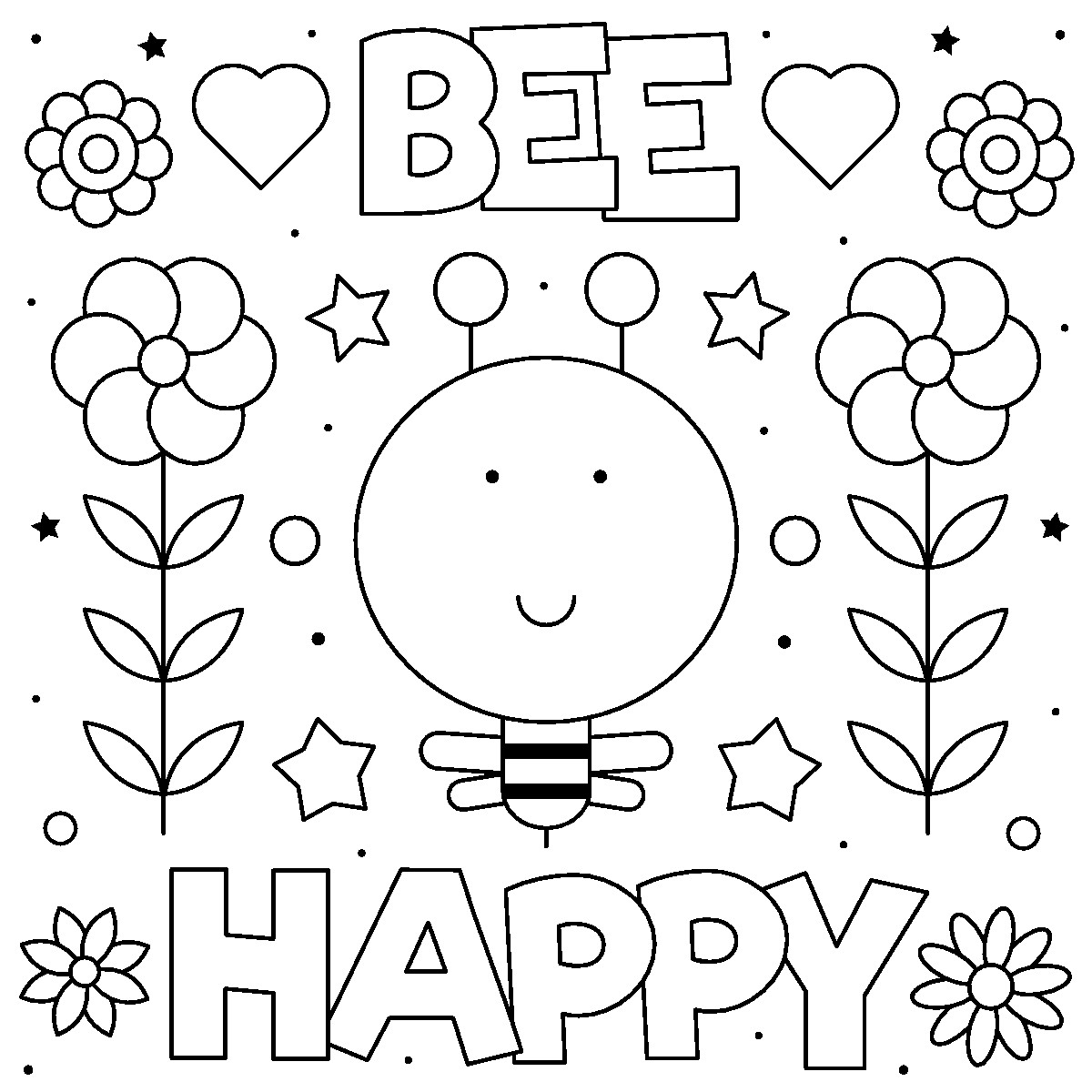
Buzz into a little creativity with this adorable “Bee Happy” coloring page for World Bee Day! 🐝🌼
Featuring a sweet bee surrounded by a cheerful garden scene, this free printable is a fun way for kids to celebrate one of nature’s busiest little helpers. Color the bee in sunny yellows and deep blacks, fill the flowers with every shade in the crayon box, or forget realistic colors entirely and create a rainbow bee in a magical garden.
World Bee Day is celebrated every year on May 20, making this printable an easy activity for families, teachers, homeschoolers, libraries, and nature clubs looking for a creative way to learn a little more about bees and other pollinators.
Grab your crayons, colored pencils, or markers and get ready to bee happy!
🐝 Free Printable Bee Happy Coloring Page
This cheerful coloring page combines two things kids tend to love: cute animals and colorful flowers.
The friendly bee is perfect for younger colorists, while the surrounding garden details give children plenty of opportunities to experiment with different colors and patterns.
Try using:
- Yellow and black for a classic bee
- Pink, purple, yellow, and blue flowers
- Several shades of green for leaves and grass
- Pale blue for the sky
- Rainbow colors for a completely imaginary garden
Or give the bee an entirely unexpected makeover.
A lavender bee with turquoise stripes?
Absolutely.
For even more adorable designs, explore our Cute Coloring Pages.
🌼 Celebrate World Bee Day on May 20
World Bee Day is observed each year on May 20 to raise awareness of the importance of bees and other pollinators and the challenges they face.
The United Nations proclaimed World Bee Day in 2017, with the first observance taking place in 2018. May 20 was chosen because it is the birthday of Anton Janša, an 18th-century Slovenian pioneer of modern beekeeping.
A coloring activity is a simple way to introduce the day to children without turning it into a complicated lesson.
While kids color, you can talk about how bees visit flowers, how pollination works, and why gardens filled with different plants can be valuable places for insects.
🌸 Color a Beautiful Bee Garden
The garden surrounding the bee gives young artists almost unlimited color choices.
Try filling the flowers with:
- Sunny yellow
- Rose pink
- Lavender
- Coral
- Bright red
- Sky blue
- Deep purple
- Cream
- Orange
Then use several shades of green for stems and leaves.
Children can also add flowers of their own around the original drawing.
Draw tiny daisies, giant sunflowers, tulips, clover, wildflowers, or completely imaginary blooms.
For more botanical coloring fun, visit our Coloring Pages of Flowers and Coloring Pages of Gardens.
🎨 Design Your Own Bee
Most people immediately picture yellow and black when they think of a bee, but a coloring page doesn’t have to follow real-world rules.
Try creating:
Rainbow Bee
Use a different color for every stripe.
Pastel Bee
Combine pale yellow, lavender, mint, pink, and baby blue.
Garden Bee
Use greens, yellows, oranges, and floral pinks.
Sunset Bee
Try orange, coral, red, purple, and gold.
Bee Happy Bee
Simply use whichever colors make you smile.
Kids can add spots, hearts, stars, zigzags, or other patterns to the bee’s body and wings too.
🌈 Decorate the Bee’s Wings
Bee wings are another fun place to experiment.
Instead of leaving them plain, try adding:
- Tiny dots
- Swirls
- Sparkles
- Hearts
- Rainbow lines
- Floral patterns
- Shading
- Glittery-looking details
Older kids can use pale blues, grays, and purples to create translucent-looking wings.
Younger children can simply choose their favorite bright color.
🌻 Why Are Bees Important?
Bees are important pollinators.
When bees visit flowers to collect nectar and pollen, pollen can be transferred between flowers. That process helps many plants reproduce.
Pollinators support both natural ecosystems and agriculture. They contribute to the production of many fruits, vegetables, nuts, seeds, and other foods people enjoy.
That makes a cute bee coloring page a natural starting point for talking about the relationship between insects, flowers, food, and healthy ecosystems.
🍓 What Foods Depend on Pollinators?
Kids may be surprised to learn how closely pollinators are connected to many foods they recognize.
Instead of making this a complicated science lesson, turn it into a simple conversation.
Ask children which foods they think grow on flowering plants.
Think about fruits, berries, vegetables, nuts, and seeds.
Then ask:
What would our grocery stores look like if there were fewer pollinators?
It’s an easy way to show that tiny creatures can play surprisingly large roles in nature.
🌺 Follow a Bee From Flower to Flower
Turn the coloring page into a little learning game.
Imagine the bee has just landed in the garden.
Which flower will it visit first?
Then where will it go?
Kids can draw a dotted flight path around the page, moving the bee from one flower to another.
Add:
- Loops
- Spirals
- Zigzags
- Curves
- Little hearts
The final picture will look even more playful while helping children think about how bees move around a garden.
🐞 Discover More Insects
Bees aren’t the only tiny creatures worth noticing.
Explore our Coloring Pages of Insects for even more crawling, buzzing, and fluttering subjects.
You can also print our Coloring Pages of Ladybugs or Butterflies Coloring Page.
Put several pages together and create your own garden insect coloring book.
Kids can decide which creatures belong in the same garden and draw flowers and plants around all of them.
🦋 Bees and Butterflies
Bees and butterflies often appear together in children’s garden pictures, and both are pollinators.
After coloring your bee, try our Butterflies Coloring Page and compare the two insects.
Ask children:
How many wings can you see?
Do their bodies look alike?
How are they different?
What kinds of flowers might they visit?
Then let creativity take over and design a giant garden filled with both.
🌿 Turn It Into a Nature Activity
This page also fits beautifully into our Nature Coloring Pages collection.
After coloring indoors, head outside and look for signs of pollinators in action.
You might notice:
- Bees visiting flowers
- Butterflies flying between plants
- Other insects around blossoms
- Different flower shapes
- Pollen on flowers
- Tiny holes or nesting areas
- Birds visiting flowering plants
Children don’t need to touch insects or get close to them. Observation from a comfortable distance is enough.
🔎 Go on a Bee-Friendly Garden Hunt
If you have access to a garden, park, or other planted space, turn your outing into a simple scavenger hunt.
Can you find:
- A yellow flower
- A purple flower
- A white flower
- A bee
- A butterfly
- A flower with a strong smell
- A very tiny flower
- A flower larger than your hand
- An insect sitting on a plant
- Three different kinds of leaves
Come back inside afterward and add some of your discoveries to the coloring page.
🪻 Create an Imaginary Pollinator Garden
Kids can also design the garden they wish existed.
Give them a blank sheet of paper and ask them to draw a giant garden for the “Bee Happy” bee.
Their garden might include:
- Sunflowers
- Lavender
- Daisies
- Clover
- Herbs
- Wildflowers
- Trees
- Flowering shrubs
- A tiny pond
- Rocks
- Butterflies
- Ladybugs
There is no requirement for botanical accuracy.
A six-foot rainbow flower is perfectly acceptable in an imaginary bee garden.
🌱 Learn About Plants Through Coloring
Bees and plants belong together, making this page a useful bridge into plant-themed activities.
Explore our Coloring Pages of Plants and talk about the different parts children see.
Look for:
- Flowers
- Leaves
- Stems
- Seeds
- Roots
Older children might research why flowers have different shapes, colors, and scents.
Younger children can simply practice naming plant parts while they color.
🌍 Simple Ways to Help Pollinators
World Bee Day can also be a chance to introduce children to practical ways people can make outdoor spaces friendlier to pollinators.
Depending on where you live and what is appropriate for your yard or community, families can consider planting a variety of pollinator-friendly flowers, providing flowering plants across different parts of the growing season, and reducing unnecessary use of chemicals that can harm pollinators.
Kids can participate by helping choose flowers, watering plants, observing insects, or keeping a little nature journal.
Even learning to appreciate bees rather than automatically fearing them is a good beginning.
🌼 Plant Something for the Bees
Turn the coloring page into the beginning of a longer activity.
After coloring, plant a flower or herb.
Children can help:
- Fill a pot with soil.
- Plant appropriate seeds or a small plant.
- Add water.
- Put it somewhere suitable for that plant.
- Watch it grow.
- Look for pollinators when it flowers.
Choose plants that are appropriate for your location and growing conditions.
Kids could also decorate the plant pot with a little “Bee Happy” sign.
📓 Start a Bee Observation Journal
Older children might enjoy keeping a simple pollinator journal.
Each time they see a bee, butterfly, or other pollinator, they can record:
Date:
Weather:
Flower visited:
Pollinator spotted:
What I noticed:
They can add drawings alongside the observations.
Over time, children may begin noticing that different insects visit different flowers or appear at different times.
🧠 World Bee Day Learning Activity
Want to turn the page into a small educational project?
After coloring, ask kids to investigate one question:
What is pollination?
What does a bee collect from flowers?
Where do bees live?
Are all bees honey bees?
What kinds of bees live where we live?
What plants do local bees visit?
Children can write one interesting fact beneath their completed picture.
For more learning printables, visit our Educational Coloring Pages & Activities.
🏫 World Bee Day Classroom Activity
This printable is an easy addition to a classroom or homeschool World Bee Day lesson.
A simple activity could look like this:
- Talk briefly about World Bee Day.
- Color the “Bee Happy” page.
- Learn what pollination means.
- Name a few pollinators.
- Draw another flower in the garden.
- Write one bee fact.
- Display the finished pages together.
Put everyone’s pictures on a classroom wall and create a big World Bee Day garden.
Each child can color their bee and flowers differently.
🧒 Bee Coloring for Preschoolers
The cute bee theme works especially well for younger children.
Preschoolers can practice:
- Color recognition
- Crayon control
- Fine motor skills
- Naming insects
- Naming flowers
- Simple counting
- Observation
Ask easy questions while they color:
“How many flowers can you see?”
“Where are the bee’s wings?”
“What color would you like the bee to be?”
“Can you find a leaf?”
The learning can happen naturally without making the activity feel like a worksheet.
🔢 Add a Little Counting Practice
Turn the picture into an easy math activity.
Ask kids to count:
- Flowers
- Leaves
- Bee stripes
- Wings
- Petals
Then try simple challenges:
“Color three flowers pink.”
“Make two flowers yellow.”
“Draw five little stars.”
“Add four more leaves.”
This gives younger children a little number practice while they create.
📖 Tell a Bee Happy Story
Give the little bee a name and turn the picture into a story.
Ask:
Where is the bee going?
Which flower is its favorite?
Does it have bee friends nearby?
What happened earlier that morning?
Why is this bee so happy?
Maybe the bee has discovered the biggest flower garden in the world.
Maybe it’s searching for a special rainbow blossom.
Maybe all the insects are preparing for a garden party.
Kids can tell the story aloud or write it underneath their picture.
😊 What Makes You “Bee Happy”?
The cheerful Bee Happy message also makes this an easy social-emotional activity.
Ask children:
What makes you happy?
They might say:
- Playing outside
- Family
- Friends
- Pets
- Drawing
- Music
- Flowers
- Favorite foods
- Reading
Have kids draw some of those happy things around the bee.
Now the coloring page becomes a personal “Things That Make Me Happy” picture too.
✂️ Turn Your Bee Into a Craft
After coloring, turn the finished artwork into something new.
Ideas include:
- A World Bee Day poster
- A classroom decoration
- A greeting card
- A bookmark
- A garden sign
- A scrapbook page
- A nature-journal cover
- A refrigerator display
You can also cut the bee out and place it onto another background filled with handmade flowers.
Younger children may need help with scissors.
💌 Make a “Bee Happy” Card
The positive message makes this page perfect for a homemade card.
Color the bee and cut out part of the design, then attach it to folded construction paper.
Add a message such as:
Bee Happy!
You’re the bee’s knees!
Have a bee-utiful day!
It could make a sweet card for a friend, teacher, parent, or grandparent.
🐝 Create a Bee Headband
Want another easy World Bee Day craft?
Cut a long strip of yellow construction paper to fit around the child’s head.
Decorate it with black stripes.
Then add two paper antennae.
Kids can wear their bee crowns while coloring or learning about pollinators.
It’s simple, silly, and especially fun for younger children.
🎨 Try a Limited-Color Challenge
Print an extra copy and see what happens when you limit the palette.
Try:
Sunshine Palette
Yellow, orange, green, and blue.
Garden Palette
Green, pink, lavender, yellow, and white.
Pastel Bee Palette
Pale yellow, mint, pink, lavender, and baby blue.
Three-Color Challenge
Choose only three crayons for the entire page.
Rainbow Challenge
Use every color somewhere.
The same coloring page can look completely different each time.
🌷 Perfect for a Spring Coloring Activity
World Bee Day falls in May, when spring is well underway in much of the Northern Hemisphere.
That makes this page a natural companion to our Spring Coloring Pages.
Pair your bee with:
- Flowers
- Butterflies
- Gardens
- Rainbows
- Birds
- Plants
You could create an entire spring coloring folder filled with nature-themed designs.
For year-round activities, explore our Seasonal Coloring Pages.
🖍️ Bee Coloring for Older Kids
Older kids can add more detail to the original design.
Try:
- Shading the bee
- Blending several yellows
- Adding texture to flower petals
- Creating shadows beneath leaves
- Drawing a detailed background
- Adding tiny patterns to the wings
Colored pencils are particularly useful for creating subtle changes in color.
Kids can also research a real bee species and use photographs as inspiration for their color choices.
🖨️ How to Print Your Bee Happy Coloring Page
Getting started is easy:
- Open the “Bee Happy” coloring page.
- Print it using your home, classroom, or library printer.
- Gather crayons, colored pencils, or markers.
- Choose your bee and garden colors.
- Start creating!
Regular printer paper works well for everyday coloring.
If you’re planning to add paint, glue, stickers, or other craft materials, slightly heavier paper can be helpful.
💛 Bee Happy and Keep Exploring
World Bee Day is a wonderful reminder that even some of the smallest creatures around us can have an important role in the natural world.
Color your adorable bee, fill its garden with flowers, invent a pollinator story, plant something beautiful, or simply enjoy a quiet creative activity.
Then keep exploring with our Coloring Pages of Insects, Nature Coloring Pages, Cute Coloring Pages, and Educational Coloring Pages & Activities.
Grab your colors, make the garden bloom, and bee happy! 🐝
🔗 Related Articles
- Insect Coloring Pages: Free Printable Bees, Butterflies, Ladybugs, Beetles & More
- Nature Coloring Pages
- Coloring Pages of Flowers
- Garden Coloring Pages
- Cute Coloring Pages
- Educational Coloring Pages & Activities
- Animal Coloring Pages
📚 Sources
- Food and Agriculture Organization of the United Nations — World Bee Day
- United Nations — World Bee Day: Background
- Food and Agriculture Organization of the United Nations — Global Action on Pollination Services for Sustainable Agriculture
- FAO — Why Bees Matter: The Importance of Bees and Other Pollinators for Food and Agriculture