🖍️Shop Landscape Coloring Books –>
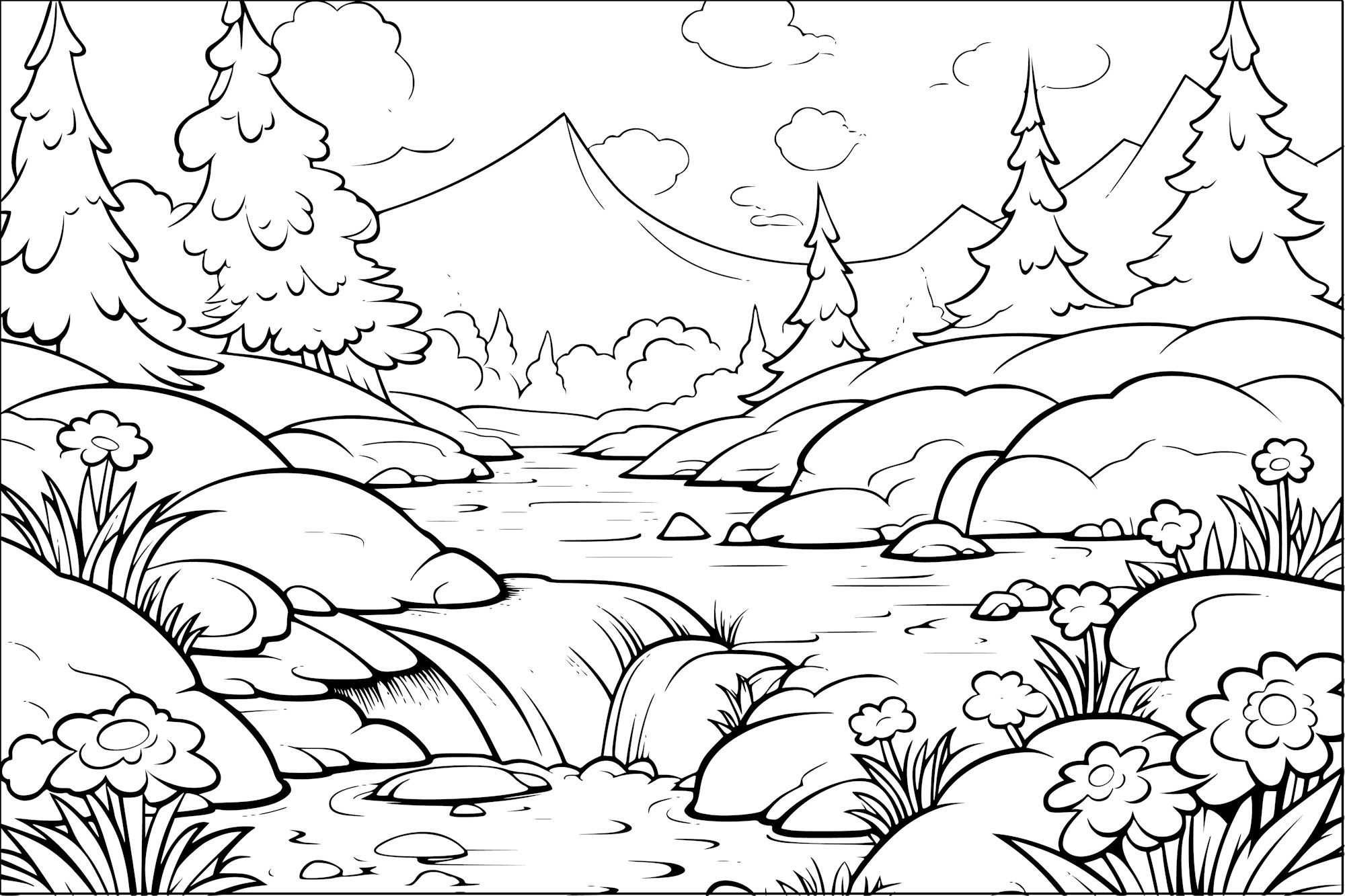
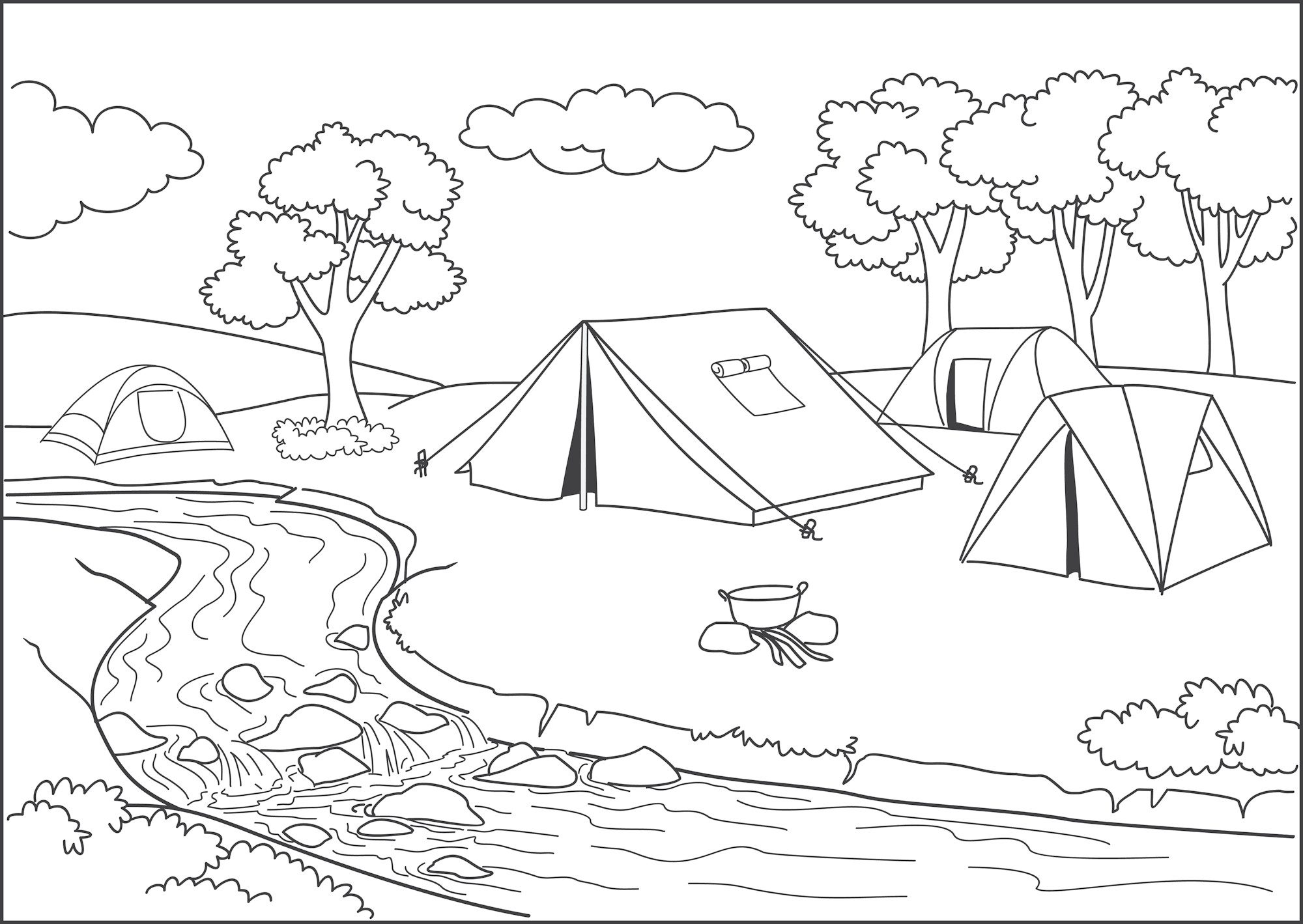
Mountains rising beneath big skies, rivers winding through meadows, wildflowers blooming beside country roads, waves rolling toward tropical shores, and tents tucked beside peaceful water—landscapes give us an entire world to color.
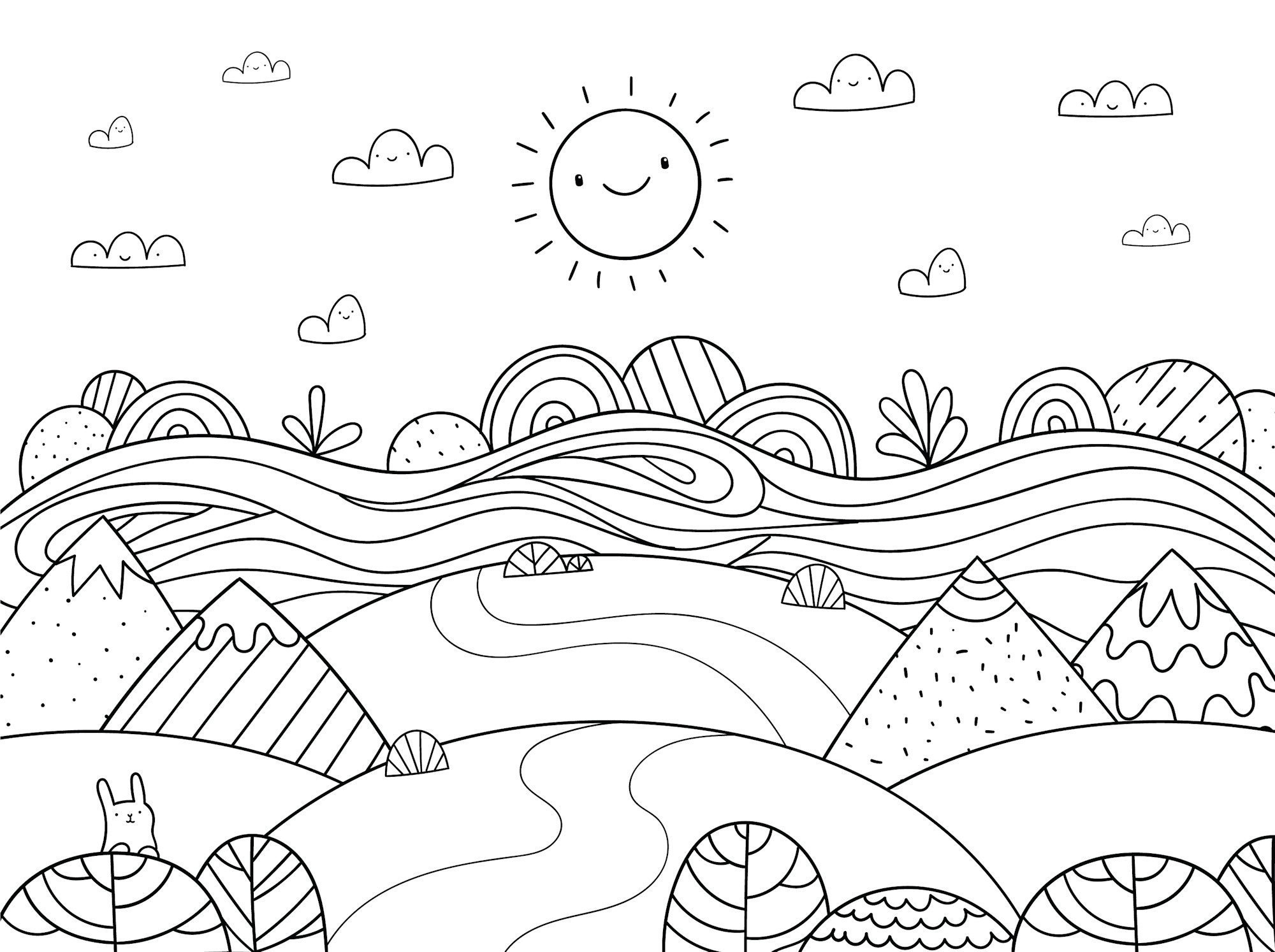
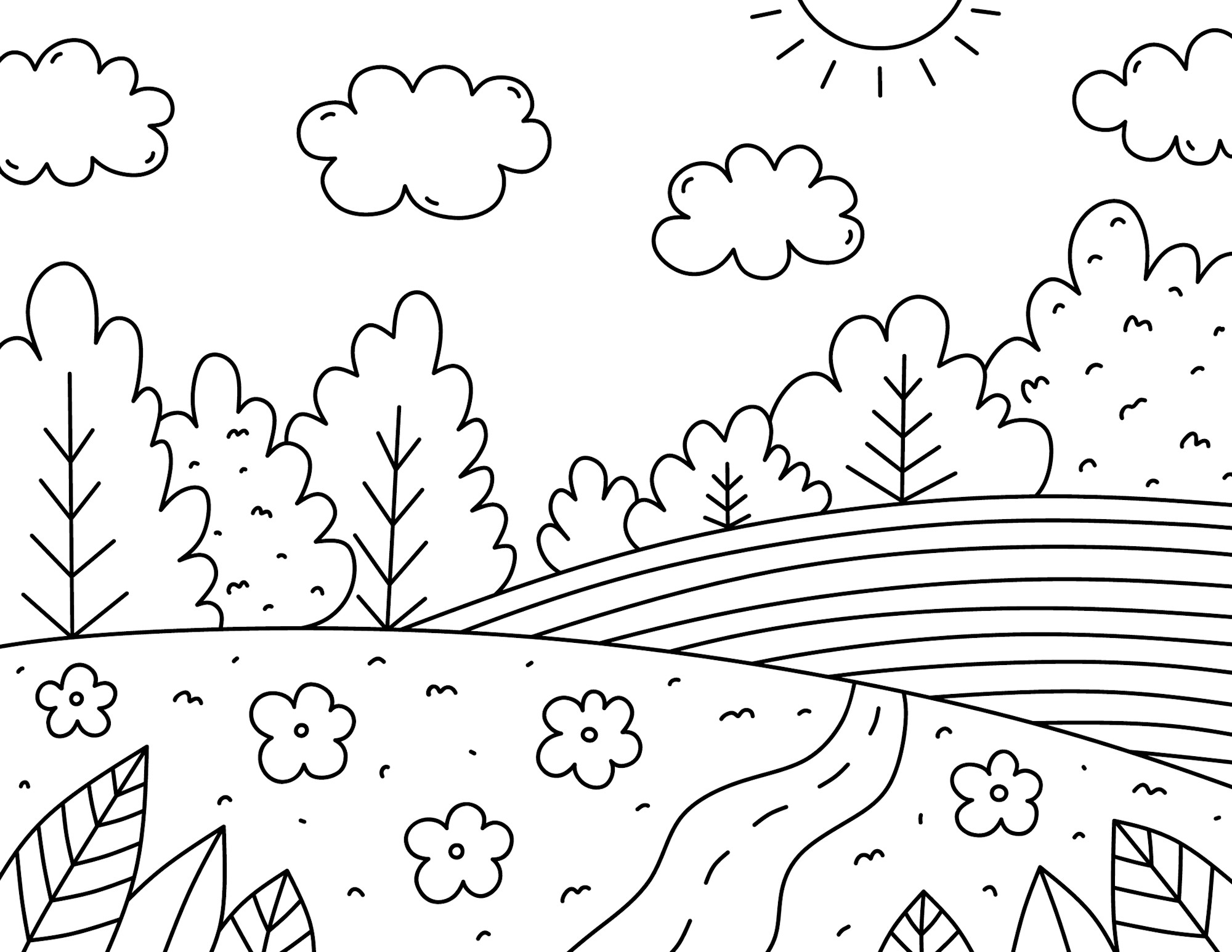
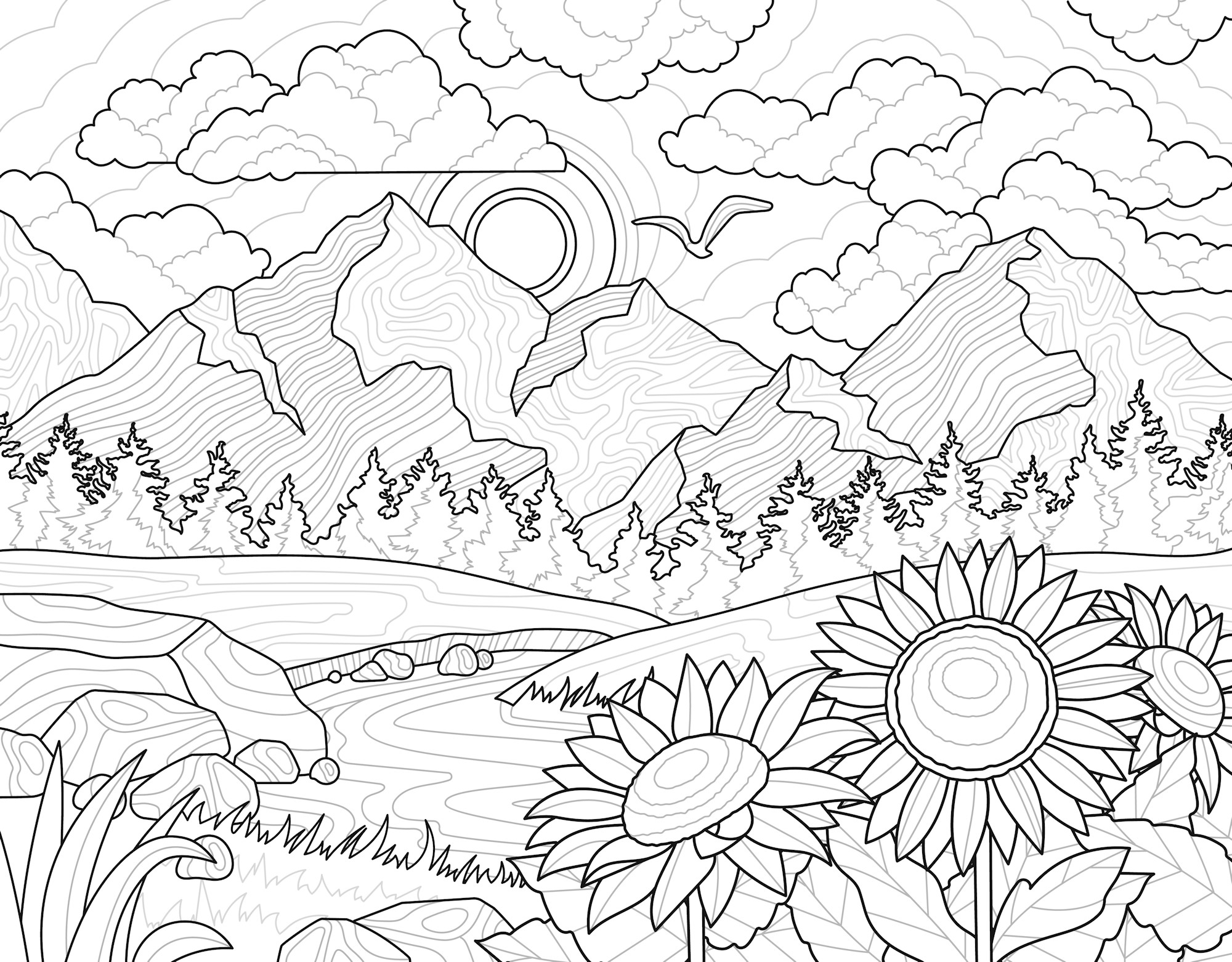
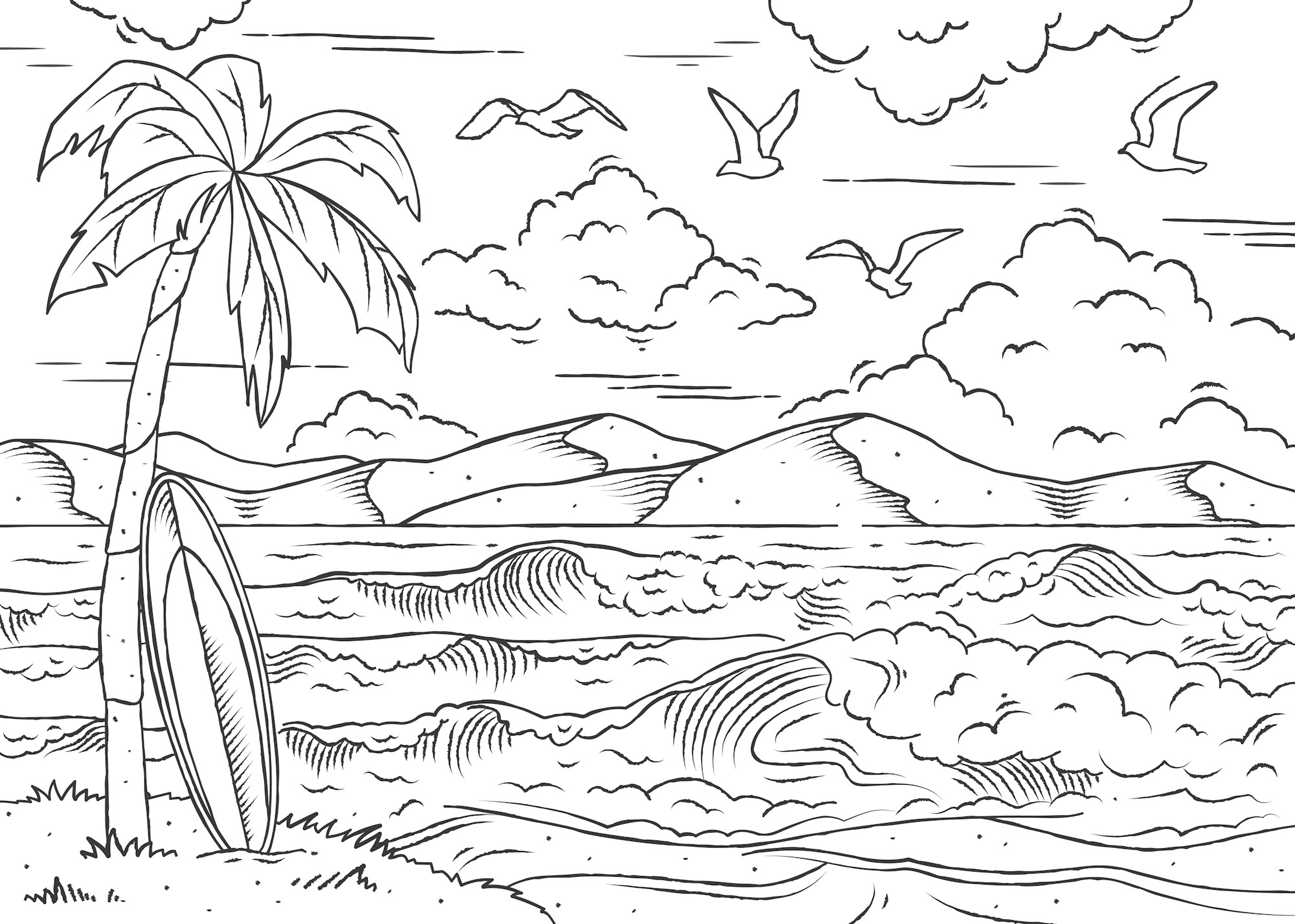
Our Coloring Pages of Landscapes collection brings together beautiful outdoor scenes for kids, adults, families, classrooms, and anyone who enjoys nature-inspired coloring. The printable designs include a meadow and river, mountains with an adorable bunny, a countryside road surrounded by fields and trees, chamomile flowers beneath mountain peaks, a tropical beach with a palm tree and surfboard, and a riverside camping scene.
Some pages are simple enough for younger artists, while others offer plenty of scenery and smaller details for older children and adults. You can recreate colors you’ve seen in nature or completely reinvent the view with purple mountains, pink rivers, golden trees, and rainbow skies.
Grab your crayons, markers, or colored pencils and see where the landscape takes you.
🌄 What Is a Landscape?
A landscape is the part of Earth’s surface that can be seen from a particular place. Landscapes may include natural features such as mountains, hills, rivers, lakes, forests, fields, coastlines, and vegetation, along with human-made features such as roads, farms, buildings, or campsites.
That makes landscape coloring wonderfully varied.
One picture might be mostly mountains and sky, while another contains flowers, trees, winding roads, water, wildlife, or a tiny campsite. Every section gives you another choice to make.
Will the mountains be gray or purple?
Is the river bright blue or reflecting a pink sunset?
Are the fields spring green or autumn gold?
Coloring a landscape is a little like creating your own version of a place that might exist somewhere in the world—or only in your imagination.
🌿 Color a Peaceful Meadow and River
One of the landscape pages features a beautiful meadow with a gently winding river.
This type of scene is perfect for experimenting with several greens. Instead of using one crayon across the entire meadow, combine shades such as:
- Pale green
- Yellow-green
- Leaf green
- Olive
- Forest green
Use brighter greens for areas that seem closer and softer or darker greens farther away.
Then color the river.
Blue is the obvious choice, but rivers can reflect the colors of the sky, surrounding trees, and sunlight. Try pale blue with touches of green or gray, or create a sunset river with streaks of gold, peach, pink, and lavender.
Wildflowers scattered through the meadow can provide little bursts of color against all that green.
💧 Make the River Reflect the Landscape
Water gives you a wonderful opportunity to repeat colors already used elsewhere in the picture.
If the sky is pale blue, add a little pale blue to the river.
If dark green trees grow beside the water, add small green reflections beneath them.
A sunset sky can create yellow, orange, pink, and purple streaks across the surface.
You don’t have to fill the water completely. Leaving narrow white spaces between horizontal pencil strokes can create the impression of light shimmering across the river.
Younger children can simply choose their favorite blue and enjoy filling the water.
Both approaches work.
🏔️ Visit the Mountains With a Little Bunny
Another adorable landscape places a bunny in a meadow beneath mountain peaks.
The bunny gives the picture a storybook feeling while the surrounding mountains provide plenty of room for landscape coloring.
Start with the animal.
A nature-inspired rabbit might be:
- Gray
- Brown
- Cream
- White
- Tawny
- Reddish brown
Or make your mountain bunny pale pink, lavender, turquoise, or any other color you like.
Then work outward into the landscape.
Use green and yellow for the meadow, darker greens for trees, gray or brown for rocky mountains, and blue for the sky.
For a softer scene, color the distant mountains blue-gray or lavender so they seem farther away.
🐇 Invent a Mountain Bunny Adventure
Once you’ve colored the bunny, decide what it’s doing in the landscape.
Perhaps it lives in a burrow beneath the meadow.
Maybe it’s exploring the wildflowers for the first time.
It could be watching clouds gather around the mountains or waiting for another rabbit to appear.
Children can add more details around the scene:
- Another bunny
- Butterflies
- Birds
- Flowers
- Mushrooms
- A tiny stream
- Clouds
- A rainbow
Then write or tell a story explaining what happens next.
A landscape coloring page can easily become the opening illustration of an outdoor adventure.
🛣️ Follow the Country Road
The countryside landscape features clouds, trees, bushes, flowers, fields, and a road stretching through the scene.
Roads are wonderful elements in landscape artwork because they seem to lead somewhere beyond the page.
Begin by deciding where this one goes.
Maybe it leads to:
- A farmhouse
- A mountain village
- A forest
- A lake
- A hidden garden
- A campground
- A beach
- A tiny cottage
Color the road warm tan, brown, gray, or dusty orange.
Then use different greens, yellows, and earthy shades across the fields and vegetation.
Adding darker colors in the foreground and softer ones in the distance can make the road seem to stretch even farther away.
🌳 Fill the Countryside With Trees
Trees can make a landscape feel lush and full without requiring dozens of completely different colors.
Start with several greens.
Color some leaves olive, others forest green, and some bright spring green.
Tree trunks can range from pale tan to chocolate brown or charcoal gray.
If you’d rather create an autumn landscape, replace much of the green with:
- Golden yellow
- Orange
- Rust
- Burgundy
- Red
- Brown
The exact same countryside page can become spring, summer, or fall simply by changing the trees.
For more autumn scenery, explore our 54 Coloring Sheets for Autumn.
🌸 Color Chamomile Beneath the Mountains
Another striking landscape combines delicate chamomile-style flowers in the foreground with mountains rising behind them.
This picture is especially useful for practicing the difference between objects that are close and those that are far away.
The flowers in front can be bright and detailed.
Use white or cream petals with sunny yellow centers, or turn them into fantasy flowers in pink, blue, lavender, and orange.
Make the leaves and stems rich green.
Then soften the mountains in the distance with gray, slate blue, dusty purple, or muted brown.
The contrast between detailed flowers and quieter distant mountains can create a wonderful feeling of depth.
For more blossoms to color, explore our Coloring Pages of Flowers.
🌼 Turn the Meadow Into a Wildflower Field
Chamomile doesn’t have to be the only flower growing there.
Add your own wildflowers throughout the foreground.
Try:
- Daisies
- Poppies
- Lupines
- Buttercups
- Tiny purple flowers
- Pink blossoms
- Blue fantasy flowers
Children don’t need to identify every species. Simple dots, circles, and petal shapes are enough to create a colorful meadow.
Make flowers larger near the bottom of the page and smaller as they move toward the mountains.
That simple trick can help create the impression that the field stretches far into the distance.
🌊 Escape to a Tropical Seascape
The tropical landscape in this collection changes the scenery completely.
Instead of green meadows and rivers, this page features a palm tree, surfboard, waves, shoreline, and mountains.
Start with the water.
A tropical sea can contain:
- Turquoise
- Aqua
- Pale blue
- Deep blue
- Sea green
Add white spaces along the waves to suggest foam.
Then color the sand cream, tan, pale gold, or peach.
The palm leaves can be deep green while the trunk uses warm browns.
Finally, give the surfboard the brightest colors on the whole page.
Stripes, flowers, sunsets, geometric patterns, or rainbow colors can turn it into a miniature piece of art.
For many more seaside scenes, visit our Coloring Pages of the Beach.
🏄 Design Your Dream Surfboard
A surfboard is essentially a blank canvas inside the coloring page.
Instead of filling it with one color, design a pattern.
Try:
Sunset Surfboard
Yellow, orange, coral, pink, and purple.
Ocean Surfboard
Turquoise, teal, navy, and white.
Tropical Surfboard
Green, yellow, orange, pink, and turquoise.
Rainbow Surfboard
Red, orange, yellow, green, blue, and purple.
Add flowers, waves, palm trees, stars, stripes, or even a tiny shark.
Kids can invent a pretend surf shop and design several different boards on another piece of paper.
🌴 Imagine a Hawaiian Landscape
Palm trees, mountains, surfboards, and ocean waves naturally bring tropical islands to mind.
For another collection filled with island-inspired scenery, visit our Coloring Pages of Hawaii.
That collection includes a tropical seascape along with surfboards, flowers, island scenery, and other Hawaii-inspired designs.
Pair one Hawaiian coloring page with this landscape scene and experiment with the same tropical palette across both.
Try emerald mountains, turquoise water, golden sand, bright flowers, and a sky fading from blue into peach.
⛺ Camp Beside the River
The camping landscape features tents beside a river, combining scenery with outdoor adventure.
Start by choosing colors for the tents.
Traditional camping colors might include:
- Forest green
- Tan
- Orange
- Red
- Blue
Or turn the campsite into something much brighter.
One tent can be pink, another turquoise, and another striped like a rainbow.
Then color the river, surrounding grasses, trees, and distant landscape.
Imagine what time of day it is.
A bright blue sky creates a sunny afternoon, while a golden-orange sky suggests evening.
For a nighttime camping scene, use dark blue and purple around the tents and fill the sky with stars.
🔥 Add a Campfire
If there is room beside the tents, draw a campfire.
Start with bright yellow near the middle of the flame, add orange around it, and finish with touches of red.
Logs can be brown or dark gray.
Then imagine everyone gathered around the fire.
What are they doing?
Maybe they’re roasting marshmallows, telling stories, watching stars, or listening to the river nearby.
Add a few camping accessories if you’d like:
- Lantern
- Backpack
- Sleeping bag
- Picnic table
- Hiking boots
- Mug of cocoa
- Marshmallow sticks
These little additions can turn the original landscape into your own campsite.
🌙 Turn the Camping Scene Into Night
Landscape coloring pages don’t always have to show bright daytime skies.
Create an evening camping picture with:
- Navy
- Indigo
- Deep purple
- Silver-gray
- Pale yellow
Make the tents slightly darker and add a glowing lantern or campfire.
Draw a crescent moon or full moon above the mountains.
Tiny white or yellow dots can become stars.
The river might reflect the moonlight with pale blue and silver-colored strokes.
Changing only the sky and lighting can give the same landscape an entirely new atmosphere.
☀️ Create a Bright Summer Landscape
For a summery scene, choose clear, cheerful colors.
Use bright blue skies, fresh green trees, golden sunlight, and colorful flowers.
The river or ocean can be turquoise, and mountains can use warm grays and browns.
A tropical page might feature especially bright colors:
- Aqua
- Lime green
- Coral
- Yellow
- Orange
- Hot pink
Summer landscapes can feel energetic and sunlit, particularly when lighter colors dominate the page.
🍂 Create an Autumn Landscape
The exact same line drawing can become fall with a different palette.
Replace green leaves with:
- Rust
- Orange
- Golden yellow
- Burgundy
- Brown
Color grasses with muted gold and tan.
Use a pale blue or cloudy gray sky.
Mountain slopes can become deep brown, purple-gray, or evergreen.
A little color choice can turn a summer meadow into an October landscape without changing any of the lines.
Continue your fall coloring with our Coloring Pictures for Fall.
❄️ Imagine the Landscape in Winter
Try transforming a mountain or river page into winter.
Leave large portions of the ground white and add pale blue or lavender shadows.
Dark evergreen trees can stand out dramatically against snow.
Mountain peaks can use:
- White
- Light gray
- Blue-gray
- Lavender
Make the sky a cold pale blue or dramatic winter gray.
You can even add falling snow with small dots throughout the picture.
The bunny scene is especially easy to turn into a snowy mountain landscape.
🌷 Create a Spring Landscape
Spring calls for a completely different palette.
Use fresh green, pale yellow, pink, lavender, and sky blue.
Fill the meadow with flowers and add budding leaves to the trees.
Rain clouds or rainbows can bring even more spring weather into the scene.
For another nature-inspired activity, browse our Nature Coloring Pages, where you’ll find flowers, gardens, plants, rainbows, wildlife, beaches, volcanoes, and much more.
🌅 Color a Spectacular Sunset
Any landscape can become more dramatic with a sunset.
Begin near the horizon with pale yellow.
Then gradually move through:
Yellow → Orange → Coral → Pink → Purple
You can add deep blue higher in the sky for a later evening scene.
Repeat some of those colors in the water if the picture contains a river, lake, or ocean.
Mountains and trees can become darker as the sky becomes brighter, creating a strong silhouette effect.
You don’t need to blend everything perfectly. Even separate bands of color can create a beautiful sunset.
🌄 Try a Sunrise Instead
Sunrise can use many of the same colors but often feels softer.
Try:
- Pale yellow
- Peach
- Soft pink
- Lavender
- Baby blue
Keep the landscape itself lighter and use gentle shadows.
A sunrise camping scene could show the tents just beginning to catch the morning light.
A meadow might glow pale gold while mountains remain blue-gray in the distance.
Imagine what the world looks like before everyone else wakes up.
☁️ Don’t Leave the Sky Empty
Large skies provide plenty of opportunities for creativity.
Instead of simply using blue, experiment with:
- Pale blue morning
- Bright blue afternoon
- Gray storm clouds
- Pink sunset
- Orange sunset
- Purple evening
- Navy night sky
Clouds can remain mostly white with pale gray or blue along their edges.
For a dramatic storm, make the clouds charcoal and blue-gray.
For a fantasy landscape, create pink clouds beneath a turquoise sky.
There is no rule saying the sky has to look like today’s weather.
🌈 Add a Rainbow to the Landscape
A rainbow can brighten almost any landscape scene.
Place it above the meadow, mountains, river, or tropical coast.
A familiar sequence is:
Red
Orange
Yellow
Green
Blue
Purple
Or create your own combination.
Pastel rainbows work beautifully with mountain scenery, while bold rainbow colors can make a simple children’s landscape especially cheerful.
For more rainbow designs, explore our Coloring Pages of Rainbows.
🎨 Landscape Color Palette Ideas
Sometimes choosing a palette first makes a complicated scene much easier.
🌲 Mountain Forest
Forest green, slate blue, gray, brown, and cream.
🌷 Spring Meadow
Leaf green, pink, lavender, yellow, and sky blue.
☀️ Summer Countryside
Bright green, golden yellow, blue, orange, and brown.
🍂 Autumn Valley
Rust, burgundy, mustard, brown, and evergreen.
❄️ Winter Mountains
White, pale blue, lavender, gray, and dark green.
🌴 Tropical Coast
Turquoise, aqua, coral, yellow, green, and tan.
🌅 Sunset Landscape
Gold, orange, coral, pink, purple, and navy.
🌙 Moonlit Landscape
Navy, indigo, violet, charcoal, and silver-gray.
🍬 Fantasy Landscape
Pink, turquoise, lavender, mint, and pale yellow.
Try using one palette across several different pictures and see how it changes the mood of each landscape.
🖍️ Crayons, Markers, or Colored Pencils?
Landscape pictures work well with almost any coloring medium.
Crayons make it easy for younger children to fill large skies, fields, and mountains.
Markers create bold colors that can look fantastic in sunsets, flowers, surfboards, tents, and tropical scenery.
Colored pencils offer more control for detailed trees, water reflections, wildflowers, and mountain shading.
You can also combine them.
Use crayons for a broad sky, pencils for detailed trees and flowers, and markers for a brightly colored tent or surfboard.
If you’re using markers on printed pages, placing another sheet of paper underneath can help protect the surface below.
🎨 Start With the Background or Foreground?
There is no one correct way to color a landscape.
Some people like to begin with the sky and work forward.
Others start with the largest object in the foreground.
One easy order is:
- Sky
- Distant mountains
- Trees and hills
- Water
- Foreground grass and flowers
- Small details
Working from the distance toward the foreground can make a complicated landscape feel easier to organize.
But if the bunny or surfboard is the part you’re excited about, start there instead.
Coloring is supposed to be enjoyable, not a rigid procedure.
🏔️ Make Distant Mountains Look Far Away
One useful landscape technique is to give distant features softer colors.
Imagine mountain ranges layered one behind another.
The closest mountain might be dark gray or deep green.
The next can be medium blue-gray.
The farthest mountains can be pale blue or lavender.
This creates the impression that some peaks are much farther away even though everything is drawn on one flat piece of paper.
The same trick works with trees.
Dark, detailed trees feel closer, while pale trees can appear more distant.
🌿 Add Texture to Grass and Fields
Instead of filling a meadow with one solid green shape, add short pencil strokes to suggest grass.
Use several greens and a little yellow or brown.
In fields, you can draw lines following the direction of the land.
For a wild meadow, scatter tiny flowers throughout.
For late summer, use more gold.
For autumn, introduce orange and rust.
For spring, bring back bright green and colorful blossoms.
A few small marks can make a broad empty field much more interesting.
🪨 Color Rocks and Mountains With Several Shades
Mountains don’t have to be one flat gray.
Try combining:
- Charcoal
- Medium gray
- Light gray
- Brown
- Tan
- Blue-gray
- Lavender-gray
Darken cracks and shaded sides while leaving sunlit areas lighter.
Add white to high peaks if you want snow.
For a sunrise or sunset, mountains can even catch touches of pink, peach, or purple.
Look at photographs of mountain scenery sometime and notice how many colors appear in what initially looks like “gray rock.”
🌊 Color Water Without Using Only Blue
Rivers, lakes, and oceans reflect their surroundings, so your water palette can borrow from the rest of the page.
Try:
Forest River
Blue, green, gray, and brown reflections.
Sunset Lake
Pink, orange, gold, purple, and blue.
Mountain Lake
Turquoise, slate blue, gray, and evergreen.
Tropical Ocean
Aqua, turquoise, cobalt, and sea green.
Night River
Navy, violet, silver-gray, and pale blue.
Horizontal strokes usually work well for calm water, while curved or wavy lines can suggest movement.
👀 Look Outside for Inspiration
One of the easiest ways to choose landscape colors is to study a real landscape.
Look out a window or take a short walk.
Notice:
- The color of the sky
- Shapes of clouds
- Different greens in trees
- Tree bark
- Shadows
- Flowers
- Grass
- Water
- Distant hills
You may discover that nature uses far more shades than you expected.
A tree that seemed simply green might contain yellow-green leaves, dark green shadows, brown branches, and blue-gray areas reflecting the sky.
Then return to the coloring page and use those observations—or ignore them and create something completely imaginary.
Both kinds of art are worthwhile.
🔎 Turn Coloring Into a Landscape Scavenger Hunt
Before you begin, see how many natural features you can find in the collection.
Can you spot:
- Mountains
- River
- Meadow
- Flowers
- Trees
- Ocean
- Beach
- Clouds
- Bunny
- Palm tree
- Road
- Campsite
Then add something missing from each picture.
A mountain page might need a bird.
The river could use a fish.
The campground could have a squirrel.
The beach might need a seashell.
The scenery becomes increasingly personal as you add your own discoveries.
✏️ Coloring and Fine Motor Practice
Landscape coloring also gives young children opportunities to work with crayons, pencils, and markers in many different kinds of spaces.
Large skies, rivers, mountains, and fields offer broad areas for younger children, while small flowers, tree branches, tents, and other details provide more precise challenges.
The National Association for the Education of Young Children includes drawing, scribbling, and writing with crayons, pencils, and markers among activities that give children opportunities to practice fine motor skills.
There’s no need for a young child to stay perfectly inside every mountain or flower.
Exploring the tools and enjoying the picture matter more than creating a flawless landscape.
📖 Turn a Landscape Into a Story
A landscape can become a story even when very few people or characters appear.
Ask:
- Where does the river go?
- What lives in the mountains?
- Where is the bunny headed?
- What is at the end of the road?
- Who owns the surfboard?
- Who is camping beside the river?
- What happens after sunset?
- What is hidden beyond the distant mountains?
Children can tell the story aloud or write it beneath the picture.
One road might lead to an enchanted village.
The bunny could be searching for a hidden meadow.
The campers might wake up and discover enormous animal tracks beside the river.
The landscape provides the setting; imagination supplies the adventure.
🗺️ Turn the Landscape Into a Map
Older kids can even imagine that the picture shows part of a much larger place.
Draw a simple map that includes:
- Mountain range
- River
- Forest
- Meadow
- Road
- Campsite
- Beach
- Village
Then give everything names.
Maybe the mountains become Blueberry Peaks, the river is Silver River, and the forest is Rabbit Woods.
Pair the activity with our World Map Coloring Pages for more geography-inspired coloring.
🏫 Easy Landscape Activities for Classrooms
These printable landscape coloring pages fit naturally into art, nature, geography, seasons, and outdoor themes.
Use them for:
- Art centers
- Early-finisher activities
- Indoor recess
- Nature units
- Geography discussions
- Season activities
- Camping themes
- Story-writing prompts
- Color-mixing lessons
- Homeschool art
- Classroom displays
Give several students the same landscape and let everyone choose completely different colors.
One mountain meadow might become summer.
Another could become autumn.
A third may turn into an imaginary rainbow world.
Displaying them together shows just how many different interpretations can begin with the same lines.
🖼️ Create a Four Seasons Landscape Gallery
Print the same landscape four times.
Color one for each season.
🌷 Spring
Fresh green, pink, lavender, pale yellow, and rainy blue.
☀️ Summer
Deep green, bright blue, golden yellow, and colorful flowers.
🍂 Fall
Orange, burgundy, mustard, brown, and evergreen.
❄️ Winter
White, gray, pale blue, lavender, and dark pine green.
Place the finished pictures beside each other.
This is an easy way to explore how color alone can transform the mood and season of a landscape.
✂️ Turn Finished Landscapes Into Wall Art
Landscape pages can look especially nice displayed after coloring.
Mount a finished picture onto cardstock or construction paper in a coordinating shade.
Several landscapes colored with similar palettes can become a small gallery.
For example:
- Mountain meadow
- Countryside
- Chamomile mountains
- Riverside campsite
Color all four with sage green, dusty blue, cream, brown, and lavender to create a coordinated collection.
Adults and older kids can also experiment with more sophisticated palettes before framing their favorites.
📔 Make a Nature Coloring Journal
Combine landscape coloring with writing or nature observations.
Place a finished landscape on one page and use the facing page for:
- Weather notes
- Nature observations
- A short story
- Favorite colors
- A poem
- A list of animals that might live there
- Notes from a hike or vacation
You could even color a landscape that reminds you of a real place you’ve visited and write about the memory beside it.
Over time, the pages become part coloring book and part nature journal.
🌿 Explore More Nature Coloring Pages
Landscapes are only one way to explore nature through art.
Our Nature Coloring Pages collection brings together flowers, plants, gardens, animals, rainbows, beaches, oceans, volcanoes, and other subjects inspired by the natural world.
If you particularly love the tropical landscape, head to our Coloring Pages of the Beach or Coloring Pages of Hawaii.
And if the water is your favorite part of these landscapes, dive beneath the surface with our Under the Sea Coloring Pages.
🎨 Create Your Own Landscape
After coloring several printed pictures, try drawing one from scratch.
Begin with a horizon line.
Then add any combination of:
- Mountains
- Hills
- River
- Lake
- Ocean
- Trees
- Flowers
- Road
- Cabin
- Tent
- Animals
- Clouds
- Sun or moon
Don’t worry about perfect perspective.
Start with simple shapes and gradually add details.
You can copy ideas from the coloring pages or invent a completely new place.
Perhaps your landscape has towering purple mountains around a turquoise lake, a field filled with enormous flowers, and a tiny cabin under a rainbow.
The best landscape may be one nobody has ever seen before.
🌄 Explore the World One Landscape at a Time
These Coloring Pages of Landscapes celebrate many different sides of the outdoors, from mountain meadows and winding rivers to countryside roads, wildflowers, tropical beaches, and riverside campsites.
Color a quiet meadow, follow the road toward the mountains, give the little bunny an adventure, fill a chamomile field with blossoms, design a tropical surfboard, or pitch a brightly colored tent beside the river.
Then change the weather.
Turn day into night.
Transform summer into autumn.
Make distant mountains disappear into lavender haze or fill the sky with the most dramatic sunset you can imagine.
Landscape coloring gives you more than individual objects to fill with color. It gives you an entire place to create.
Real nature can provide the inspiration, but once the crayons come out, the scenery belongs to you.
Happy coloring and happy exploring!
🔗 Related Coloring Pages
- Nature Coloring Pages
- Coloring Pages of Hawaii
- Coloring Pages of the Beach
- Under the Sea Coloring Pages
- World Map Coloring Pages
- Coloring Pages of Flowers
- Coloring Pictures for Fall
- 54 Coloring Sheets for Autumn
📚 Sources
🖍️Shop Landscape Coloring Books –>