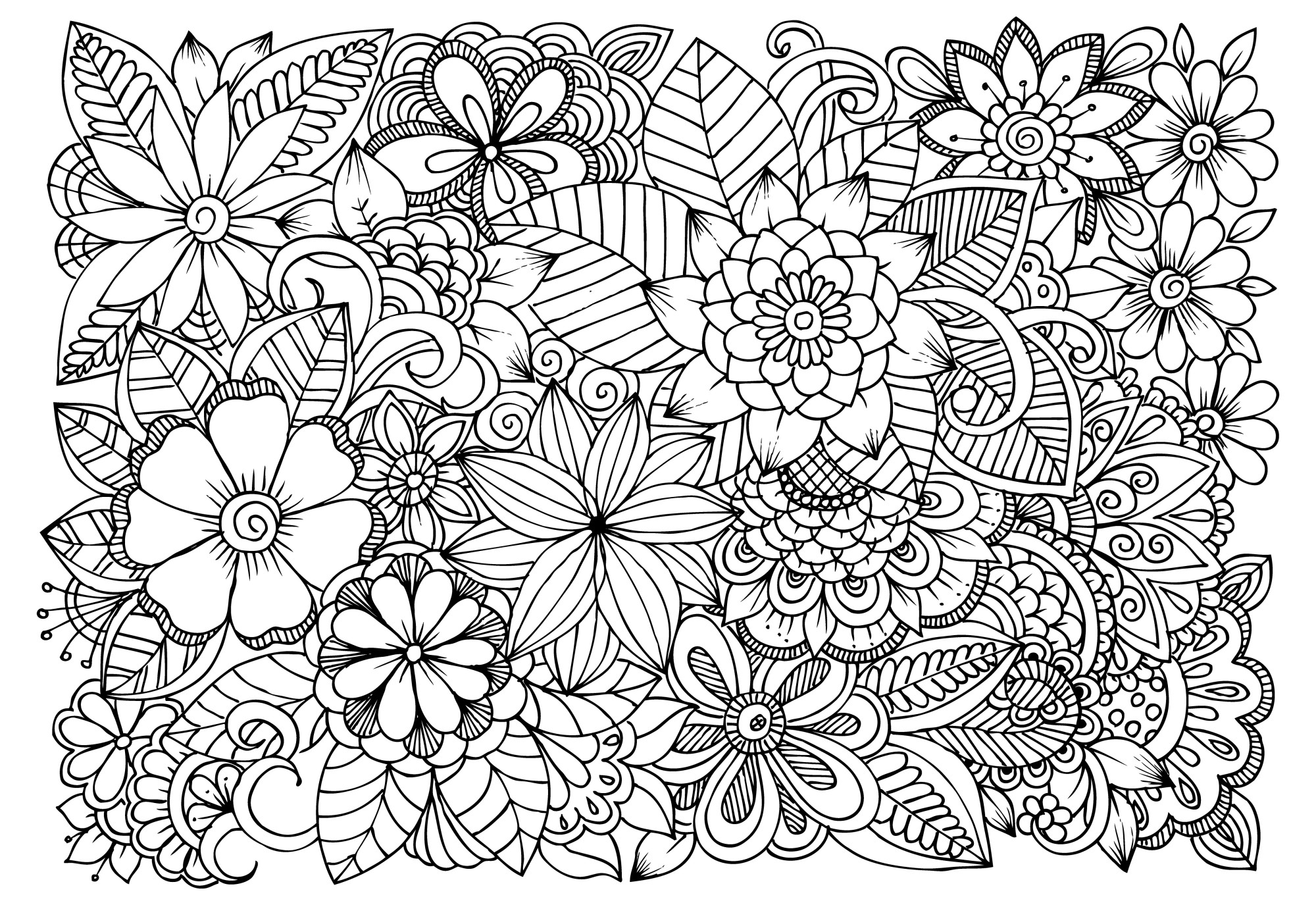
Slow down and explore color one petal at a time with this Intricate Flower Pattern Coloring Page, a detailed botanical design filled with flowers, leaves, repeating shapes, and plenty of smaller spaces to bring to life.
Unlike a simple single-flower outline, this page gives you an entire pattern to explore. You can coordinate every blossom, make each flower completely different, build a sophisticated limited palette, experiment with gradients and shading, or turn the whole design into a rainbow garden.
The amount of detail makes this printable especially appealing to teens and adults, although older children who enjoy more intricate artwork can certainly join in too.
There is no need to finish the page in one sitting. Choose a flower, pick a few colors, and work through the pattern at whatever pace feels enjoyable.
🌸 Explore the Intricate Floral Pattern
The main attraction of this coloring page is the repetition of flowers and botanical shapes across the design.
Instead of one central object surrounded by large blank spaces, there are details almost everywhere you look.
That gives you several choices.
You can treat every flower as an individual miniature artwork, or think about the page as one complete pattern and repeat the same colors throughout.
A carefully planned palette can make all the different flowers feel connected.
A more spontaneous approach can turn the page into an overflowing fantasy garden.
Neither method is better.
The fun comes from seeing how dramatically the same black-and-white pattern changes depending on your choices.
🎨 Choose Your Palette Before You Begin
An intricate coloring page can feel easier to approach when you choose a handful of colors first.
You do not need twenty pencils.
Four or five shades can be enough.
Try:
Botanical Garden
Sage, dusty pink, lavender, cream, forest green
Jewel Garden
Emerald, sapphire, ruby, amethyst, gold
Summer Flowers
Coral, yellow, turquoise, pink, grass green
Vintage Floral
Mustard, rust, olive, burgundy, cream
Cool Garden
Blue, teal, lavender, mint, silver-gray
Repeating the same colors throughout the pattern can help even the tiniest details feel like part of one finished design.
🌺 Make Every Flower Different
If carefully coordinated palettes are not your style, do the opposite.
Make every blossom unique.
One might be bright pink.
Another could be violet with a yellow center.
The next might have turquoise petals.
Try red, orange, yellow, green, blue, purple, peach, cream, and whatever other colors appeal to you.
You could even make some flowers realistic and others completely imaginary.
The result can resemble a wild garden where dozens of different blooms are growing together.
For even more floral inspiration, explore our Coloring Pages of Flowers.
🩷 Create a Pink Floral Pattern
A monochromatic pink page does not have to look repetitive.
Use several variations:
- Blush
- Rose
- Raspberry
- Coral pink
- Magenta
- Burgundy
Keep some flowers pale and make others much darker.
Use cream or white in selected areas for breathing room.
Leaves can remain green or continue the monochrome theme with pink, burgundy, and plum foliage.
The result can feel romantic and botanical without requiring a huge selection of colors.
💜 Try Lavender, Plum & Violet
Purple shades work beautifully with detailed flowers.
Begin with pale lavender in larger petals.
Use violet for medium-sized details and plum or deep purple in smaller sections.
Add yellow or gold flower centers for contrast.
Sage or blue-green leaves can balance the purple flowers nicely.
Another option is to make the foliage purple too and use cream throughout the background.
The same design can move from natural to completely decorative simply through color choice.
❤️ Build a Red & Burgundy Garden
For a stronger palette, combine red, crimson, burgundy, and deep wine shades.
Keep selected flowers pale pink or cream so the darkest colors have something to contrast against.
Leaves can be forest green, olive, or nearly black-green.
Add small touches of gold or yellow to flower centers.
A red-and-burgundy design can feel especially dramatic when the page contains lots of tightly packed flowers.
💙 Create a Blue Botanical Pattern
Flowers do not need to follow nature.
Try filling the entire page with blue.
Use:
- Pale blue
- Cornflower
- Turquoise
- Teal
- Royal blue
- Navy
Add lavender or silver-gray details.
Leaves can stay green or become teal and blue-green.
Keep a few flower centers yellow for contrast.
A blue-dominated floral pattern can feel surprisingly calm and almost tile-like once complete.
🌈 Create a Rainbow Flower Pattern
For maximum color, organize the page around a rainbow.
Begin in one corner with red and orange.
Move gradually through yellow and green.
Continue into blue, purple, and pink.
The pattern itself stays the same while the colors travel across it.
You could also create separate rainbow flowers by giving each petal a different shade.
Another option is to alternate warm and cool blossoms throughout the design.
There are nearly endless ways to organize rainbow color on a repeating floral page.
🌿 Give the Leaves More Than One Green
Botanical coloring becomes much more interesting when green is treated as a whole family of colors rather than one crayon.
Try:
- Mint
- Lime
- Sage
- Olive
- Grass green
- Emerald
- Forest green
- Blue-green
Use light shades for smaller or imagined newer leaves.
Add darker green where foliage overlaps.
You can also blend two colors on a single leaf.
For example, begin with yellow-green near the tip and deepen toward forest green at the base.
For more leafy artwork, explore our Coloring Pages of Plants.
🍂 Create an Autumn Flower Pattern
Floral coloring does not have to look like spring.
Use a warm autumn palette:
- Rust
- Burnt orange
- Mustard
- Burgundy
- Olive
- Brown
- Cream
Turn some flowers golden yellow and others deep red.
Use olive and brown-green on the foliage.
Add dark burgundy to tiny decorative areas.
The same flower pattern can suddenly feel like a September or October textile instead of a spring garden.
🌷 Create a Soft Spring Palette
For something lighter, choose:
- Blush pink
- Lavender
- Mint
- Pale yellow
- Peach
- Baby blue
Keep the colors gentle and allow some areas to stay white.
The pattern will feel airy despite the amount of detail.
A pastel version pairs especially well with our Spring Coloring Pages if you are creating a larger seasonal collection.
☀️ Make It Bright and Summery
Summer calls for stronger colors.
Try coral, hot pink, sunflower yellow, turquoise, lime, and bright purple.
Make each blossom stand out from the leaves.
Use a strong blue or aqua in small background details.
The page can become an overflowing summer garden filled with energetic color.
If the intricate design starts to feel visually busy, repeat the same five or six colors rather than adding new ones.
💎 Try Jewel Tones
Detailed patterns are particularly well suited to jewel colors.
Use:
- Ruby red
- Sapphire blue
- Emerald green
- Amethyst purple
- Garnet
- Turquoise
- Gold
Keep the colors rich and saturated.
Repeat them throughout the page like decorative stones set into a larger pattern.
Dark jewel tones can make the finished coloring page resemble fabric, stained glass, or ornamental tile.
🖤 Try Black, White & One Accent Color
For an entirely different approach, limit yourself to black, white, gray, and one strong accent.
Try:
Black + White + Red
or:
Black + White + Turquoise
or:
Black + White + Gold
Color selected petals and leaves with the accent shade while leaving others white.
Use gray sparingly for shading.
A restrained palette can make a complicated floral pattern feel graphic and modern.
✨ Add Gold-Looking Details
You do not need metallic supplies to suggest gold.
Use pale yellow as a base.
Add golden yellow or ochre along one side.
Use small amounts of orange or brown in darker areas.
Leave a tiny pale highlight.
Gold-colored details work especially well in:
- Flower centers
- Tiny petals
- Borders
- Leaves
- Decorative shapes
Pair gold with burgundy, navy, emerald, or deep purple for a rich palette.
🖍️ Use Colored Pencils for Small Details
Intricate floral patterns are especially suited to colored pencils because the sharpened tips make it easier to reach smaller spaces.
Pencils also let you build color gradually.
Start lightly.
Add another layer.
Deepen shadows only where you want them.
You can use one pencil very softly for a pale section and press more firmly for a darker version of the same shade.
That means even a small pencil set can create a surprisingly wide range of color.
🖊️ Use Fine-Tip Markers for Bold Color
Markers can give the pattern a much brighter look.
Use fine tips for the smallest shapes and wider tips only where there is enough space.
One strategy is to use markers on selected flowers and colored pencils on the rest.
The contrast between bold flat color and softer pencil shading can create an interesting finished page.
If your markers tend to bleed through paper, place a blank sheet underneath before you begin.
🖍️ Mix Art Supplies
There is no reason to stick with one material.
Try:
- Colored pencils for flowers
- Markers for leaves
- Gel pens for tiny accents
- Crayons for larger background shapes
Metallic pens can highlight selected flower centers or decorative edges.
White gel pen can be used on darker areas for dots and tiny highlights.
Mixing materials can make an intricate page feel more textured and layered.
🌺 Blend Two Colors in Every Flower
Pick two related colors for each blossom.
Try:
Pink + Purple
Yellow + Orange
Blue + Violet
Peach + Rose
Turquoise + Green
Begin with one color near the flower center and gradually move into the second toward the petal tips.
If smooth blending is difficult, overlap the colors lightly where they meet.
The transition does not have to be perfect.
A visible shift from one shade to another can be part of the design.
🌸 Try Light-to-Dark Petals
Choose one flower.
Use the lightest shade near the outside edges.
Gradually deepen the color toward the center.
For a pink flower:
Blush → Rose → Raspberry.
For blue:
Pale blue → Cornflower → Navy.
For purple:
Lavender → Violet → Plum.
Repeat the same approach across several flowers to make the whole page feel coordinated.
✏️ Add Petal Veins
Once the base colors are finished, use a sharpened pencil to add tiny lines to selected petals.
Make the lines slightly darker than the petal itself.
Draw them outward from the flower center.
Do not add the same number to every petal.
A little variation helps the pattern feel less mechanical.
Fine details like these are especially satisfying on pages already filled with complex botanical shapes.
🌿 Add Leaf Veins
Leaves can receive the same treatment.
Draw one central vein down each larger leaf.
Add smaller diagonal lines extending outward.
Use dark green on pale foliage or blue-green on emerald leaves.
For fantasy colors, choose contrasting veins.
A purple leaf might have turquoise lines.
A pink leaf could have gold-colored veins.
The botanical theme is only a starting point.
🌈 Make Every Petal a Pattern
Instead of shading, fill petals with decorative designs.
Try:
- Stripes
- Polka dots
- Zigzags
- Tiny hearts
- Stars
- Checkerboards
- Spirals
- Mini flowers
One flower might be entirely striped.
Another could alternate solid and dotted petals.
The page then becomes a pattern inside a pattern.
Older colorists who enjoy tiny details can spend a long time experimenting with variations.
🌀 Use Repetition to Organize the Page
Intricate patterns can feel overwhelming when every small shape seems to require a new decision.
Repetition solves that problem.
Choose one color for all similar flower centers.
Use another shade on one repeating leaf shape.
Whenever that shape appears again, use the same color.
Gradually the page begins organizing itself.
You do not need to plan every detail at the beginning.
Simply establish a few repeating rules and let them guide you.
🌺 Color From the Center Outward
One way to tackle a complicated pattern is to choose a starting point and move gradually outward.
Finish the central flowers first.
Then color the surrounding leaves.
Continue toward the edges one section at a time.
This approach gives the picture a sense of progress and prevents you from jumping constantly between distant areas.
You can also change shades slightly as you move outward.
Perhaps the center begins dark and the outer areas gradually become lighter.
🌿 Work From the Outside In
If the outer border attracts your attention first, begin there instead.
Color the leaves and flowers around the edge.
Then work toward the center.
This can create an interesting framing effect.
Use darker colors around the outside and brighter shades toward the middle if you want the central area to appear illuminated.
There is no correct starting point.
Begin wherever your eye naturally lands.
🌈 Try a Color Gradient Across the Whole Page
Instead of shading individual flowers, make the entire picture one enormous gradient.
Start with pink on the left.
Move through purple and blue.
Finish with turquoise or green on the right.
Or begin with warm yellow at the top and gradually deepen into red and burgundy toward the bottom.
The repeating floral shapes stay constant while the palette shifts across them.
This technique can turn a traditional flower pattern into something much more graphic.
🌅 Create a Sunset Flower Pattern
Use a sunset palette across the page:
- Yellow
- Peach
- Orange
- Coral
- Pink
- Purple
Start with pale yellow in one area and gradually move toward deep purple.
Leaves do not have to stay green.
Color them in the same sunset shades so the entire design feels unified.
The finished page can look less like a garden and more like an abstract field of color.
🌊 Create an Ocean Floral Pattern
Flowers and ocean colors can work surprisingly well together.
Try:
- Aqua
- Turquoise
- Sea green
- Deep blue
- Navy
- Lavender
Add tiny touches of coral for contrast.
Make some flowers appear almost like underwater blooms.
Turn leaves into blue-green seaweed.
You could even add tiny bubbles in open spaces.
The floral pattern becomes an imaginary underwater garden.
🌌 Create a Galaxy Floral Pattern
For a dramatic fantasy version, use:
- Navy
- Purple
- Magenta
- Turquoise
- Black
Add tiny white dots to selected darker areas as stars.
Keep some flower centers pale yellow or silver-gray.
A few petals can shift from dark blue to bright violet.
The repeated botanical pattern can begin to resemble a field of celestial flowers floating through space.
🌙 Try a Midnight Garden
A midnight garden is similar but more botanical.
Keep the leaves dark forest green, teal, or blue-green.
Color the flowers lavender, pale pink, white, blue, and cream.
Use navy or charcoal in selected background areas.
Add tiny moonlit highlights to petal edges.
Imagine that the flowers open only after sunset.
The same floral page now tells a completely different visual story.
🦋 Hide Butterflies in the Pattern
Look for areas where you can add tiny butterfly shapes.
Draw one between two flowers.
Hide another among the leaves.
Use colors already present in the page.
Perhaps the butterfly wings mimic nearby flower petals so they almost disappear.
This can transform the finished picture into a subtle I Spy activity.
🐝 Add Tiny Bees
Draw a few small bees among the flowers.
Keep them simple with yellow and dark brown stripes.
Add tiny pale wings.
Perhaps one bee is tucked into a flower center.
Another might be flying toward the edge.
Small additions like these can make the repeating floral pattern feel like a living garden rather than purely decorative artwork.
🐞 Add Ladybugs
Ladybugs are easy to hide in leafy patterns.
Draw a tiny red oval.
Add black spots.
Place one on a leaf and another between two flowers.
For a fantasy garden, make them blue, pink, or purple instead.
You could even hide one completely rainbow-colored ladybug somewhere in the page and challenge someone to find it.
🔎 Use Real Flowers for Color Inspiration
When you are unsure which shades work together, look at real flowers.
Visit a garden, flower shop, park, or even a houseplant display and notice how many colors appear in one plant.
A petal may be pale near the edge and darker toward the center.
Leaves can contain yellow-green, blue-green, gray-green, and deep forest shades on the same plant.
Smithsonian Gardens’ online Plant Explorer is another useful place to browse real plant images when you want botanical color inspiration.
Then return to the coloring page and borrow a palette you noticed.
🌼 Let Nature Inspire You—But Not Limit You
Nature can offer wonderful ideas, but there is no obligation to reproduce it accurately.
A flower can be turquoise.
A leaf can be pink.
The entire garden can be purple and gold.
Some coloring sessions may be about observing real botanical colors closely.
Others may be purely decorative.
Both approaches work.
The floral shapes provide the structure.
You decide what world they belong to.
🧘 Take the Pattern One Section at a Time
Intricate pages do not have to be finished quickly.
Color one flower.
Then one leaf.
Stop if you feel like stopping.
Return tomorrow or next week.
Detailed coloring is often most enjoyable when it is treated as something you can dip into rather than a project you must complete.
Some people enjoy structured coloring as a quiet creative break, and researchers have studied possible effects of mandala and patterned coloring on anxiety. Findings across studies are mixed, so there is no need to treat coloring as therapy or expect a particular outcome.
It can simply be something enjoyable to do with color.
☕ Create a Cozy Coloring Session
Set up a comfortable spot with your preferred supplies.
Choose several pencils before you start.
Add music, an audiobook, or a cup of tea if that makes the activity more enjoyable.
Work on one small area rather than looking at everything that remains unfinished.
Detailed pages are particularly good for this kind of gradual approach because every completed flower feels like a small finished piece of art inside the larger pattern.
🎯 Try a Three-Color Challenge
Choose only three colors.
For example:
Pink + Purple + Green
or:
Blue + Turquoise + Gold
or:
Rust + Olive + Cream
Now use only those colors throughout the entire page.
Create variety by pressing lightly or heavily, blending two shades, and leaving some spaces white.
A three-color challenge can make an intricate design easier to plan and surprisingly elegant.
🎨 Try a Five-Color Challenge
If three feels too restrictive, choose five.
Try:
Sage + Lavender + Blush + Cream + Gold
or:
Turquoise + Navy + Coral + Yellow + Green
or:
Burgundy + Rust + Mustard + Olive + Brown
Repeat them throughout the pattern.
The limited palette creates visual unity while still giving you plenty of choices.
🎲 Let Chance Choose the Colors
For a playful approach, use a six-sided die.
Assign:
1 — Red
2 — Orange
3 — Yellow
4 — Green
5 — Blue
6 — Purple
Roll for each new flower.
Use the matching color as its main shade.
You can then add a lighter or darker version if you want.
Random choices can push you toward combinations you might never choose intentionally.
🌺 Color Similar Flowers in Families
Another way to organize the page is to create flower families.
Color one repeated blossom in shades of pink every time it appears.
Another flower shape might always be purple.
A third could be yellow.
Leaves can follow their own repeating green pattern.
This gives the design structure without requiring every flower to look exactly the same.
🌈 Alternate Warm and Cool Colors
Divide the palette into two groups.
Warm:
- Red
- Orange
- Yellow
- Pink
Cool:
- Blue
- Green
- Purple
- Turquoise
Color one flower with warm shades and the next with cool shades.
Continue alternating throughout the pattern.
The contrast can make individual blossoms easier to distinguish while creating a strong rhythm across the page.
🎨 Experiment With Complementary Colors
Opposite colors can create especially strong contrast.
Try combinations such as:
Purple + Yellow
Blue + Orange
Red + Green
Turquoise + Coral
Use one color for petals and its contrast in the center.
Or alternate complementary flowers throughout the pattern.
A page full of repeated floral shapes is a great place to experiment because you can try a different color relationship on each blossom.
🖼️ Turn the Finished Page Into Wall Art
Once the pattern is complete, consider displaying it.
Mount it onto cardstock in a color that appears in your palette.
A dusty-pink-and-sage page might look beautiful against cream.
A jewel-tone page could work well with black or navy.
A rainbow design may need only a simple white border.
Frame it or pin it to a bulletin board, craft room wall, office, bedroom, or coloring corner.
A detailed coloring page can become decorative art once enough color is added.
💌 Turn Part of the Pattern Into a Card
You do not have to use the entire page.
Choose your favorite finished section.
Scan or copy it at a smaller size, or carefully trim a duplicate printout.
Attach the floral design to folded cardstock.
Add:
Happy Birthday
Thank You
Thinking of You
Just for You
or:
Have a Beautiful Day
The intricate flower pattern already provides most of the decoration.
🏷️ Create Floral Gift Tags
Smaller sections can also become gift tags.
Choose one particularly colorful flower cluster.
Cut or print it at a smaller size and mount it onto sturdy paper.
Add:
To:
and:
From:
on the back.
Punch a small hole and attach ribbon.
Several different sections of the same coloring page can become a matching collection of handmade floral tags.
📓 Add the Pattern to a Journal
Intricate floral coloring can also become part of a journal or scrapbook.
Trim the finished artwork to fit a page.
Use one portion as a border or divider.
Add the date and note which colors you used.
You could even create a series of pages where the same floral pattern is colored differently every time.
One version might be pastel.
Another could use autumn tones.
A third may be completely monochrome.
The repeated design becomes a record of different color experiments.
📚 Create an Adult Coloring Binder
If detailed designs are your favorite, create a binder or folder specifically for them.
Include this flower pattern along with pages from our Mandala Coloring Pages, Coloring Pages of Plants, and other designs from our Coloring Pages for Adults.
Organize them by theme:
- Floral
- Botanical
- Mandala
- Nature
- Inspirational
- Geometric
You do not need to color them in order.
Choose whichever pattern fits your mood or the palette you want to try.
🌀 Explore Mandala Coloring Pages
If the repetition and detail are what you enjoy most about this floral pattern, our Mandala Coloring Pages are a natural next step.
Those designs use floral forms, circular arrangements, repeating geometry, and hand-drawn decorative details.
Try using the same palette on one floral pattern and one mandala.
Then compare the finished pages.
The colors remain identical, but the different structures can produce completely different effects.
🌿 Explore More Plant Coloring Pages
If you prefer recognizable botanical subjects, visit our Coloring Pages of Plants.
That collection includes flowers, leaves, potted plants, botanical artwork, autumn foliage, and detailed plant-inspired patterns.
You can follow natural colors closely or continue experimenting with the fantasy palettes from this page.
Turquoise leaves and purple flowers are just as welcome on a coloring page as realistic greens and pinks.
🌹 Explore Rose Coloring Pages
Roses offer a different kind of floral challenge.
Their layered petals provide lots of opportunities for gradients and shading.
Our Rose Coloring Pages include bouquets and individual roses along with more detailed floral designs.
Try applying one technique from this flower pattern to a rose.
Perhaps use a limited jewel-tone palette or blend two colors across every petal.
🌻 Explore More Flower Coloring Pages
If flowers are the main attraction, continue with our complete Coloring Pages of Flowers.
You can move from abstract floral patterns to recognizable roses, sunflowers, tulips, orchids, cherry blossoms, and other botanical designs.
Our Top 10 Coloring Pages of Flowers also brings together several styles, including butterflies, bouquets, floral landscapes, and detailed adult-oriented pages.
Use them to test new palettes before returning to this intricate pattern.
🌳 Explore More Nature Coloring Pages
The floral design also fits naturally into a larger nature collection.
Browse our Nature Coloring Pages for plants, gardens, butterflies, birds, mushrooms, landscapes, rainbows, and other outdoor subjects.
After working on a tightly packed pattern, it can be refreshing to switch to a larger landscape or simpler botanical scene.
Then return to detail whenever you feel like it.
✨ Explore Inspirational Coloring Pages
If you enjoy the combination of detailed flowers and decorative design, try our Inspirational Coloring Pages.
Those printables combine floral artwork, lettering, encouraging words, plants, and other decorative elements.
They also work well for cards, journals, gifts, and wall displays.
Color the lettering boldly and use a quieter botanical palette around it—or reverse the idea and make the flowers the most colorful part.
🌸 Let the Pattern Bloom
This Intricate Flower Pattern Coloring Page gives you much more than a collection of petals waiting to be filled.
It can become a pastel garden, an autumn textile, a jewel-toned pattern, a rainbow explosion, a midnight floral scene, or a carefully coordinated botanical design.
Color every flower differently or repeat the same few shades throughout. Add petal veins, patterns, gradients, metallic-looking details, butterflies, bees, or tiny hidden surprises. Finish the entire picture in one long coloring session or return to it one flower at a time.
When you are done, frame it, turn part of it into a card, add it to a journal, or simply keep it as a record of an afternoon spent experimenting with color.
There are plenty of details to explore, but no rules about how they should look.
Choose a flower, choose a color, and let the pattern grow from there.
Happy coloring! 🌸🎨
🔗 Related Articles
- Coloring Pages of Flowers
- Mandala Coloring Pages
- Coloring Pages of Plants
- Rose Coloring Pages
- Garden Coloring Pages
- Explore the Beauty of Nature with Our Top 10 Coloring Pages of Flowers
- Inspirational Coloring Pages
- Nature Coloring Pages
- Coloring Pages for Adults
📚 Sources
- Smithsonian Gardens — Plant Explorer
- Smithsonian Gardens — Living Plant Collections
- PubMed — The Effect of Adult Coloring (Mandala Pattern) on Pain and Anxiety Associated With Dressing Changes in Burn Patients
- Art Therapy — The Effect of Mandala Coloring on State Anxiety: A Systematic Review and Meta-Analysis