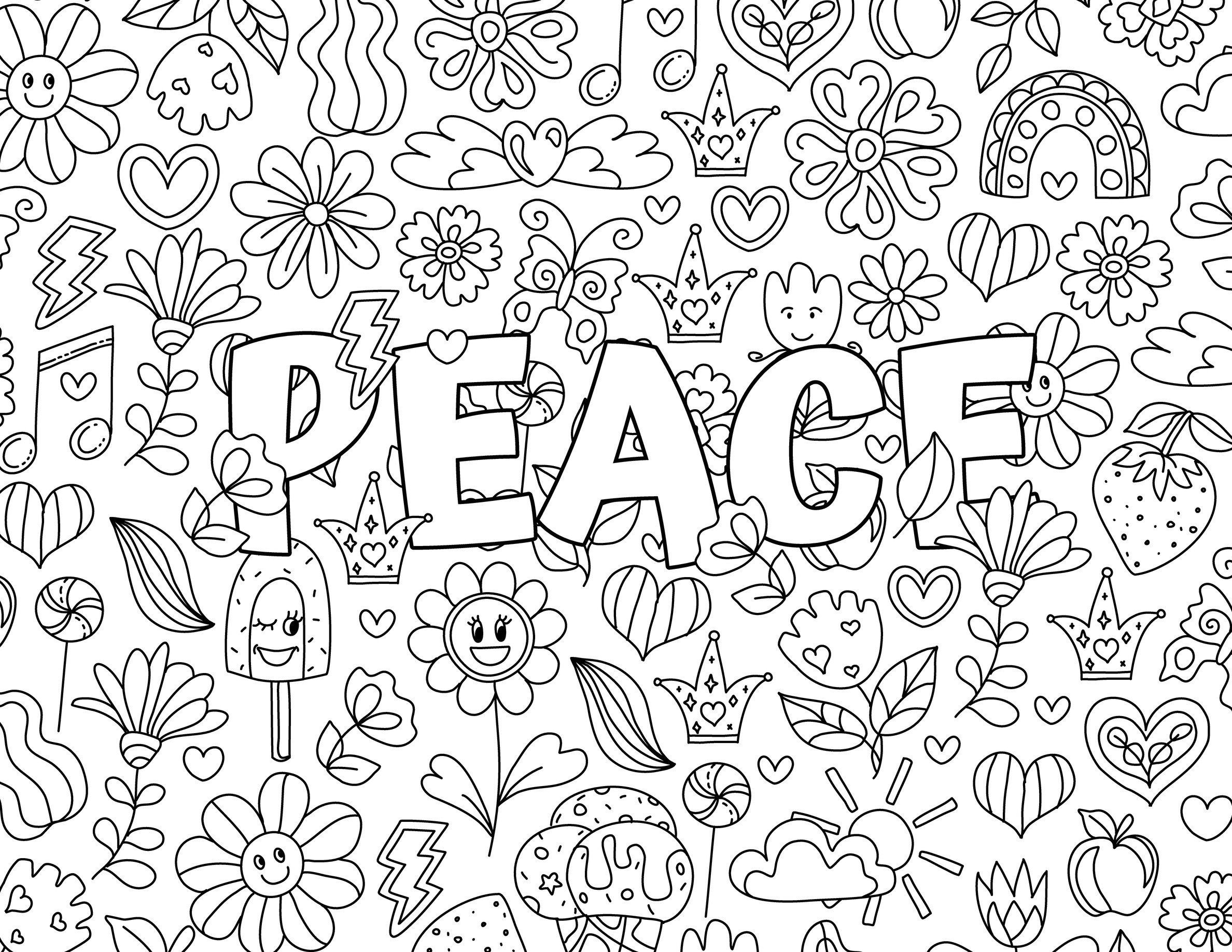
Peace Coloring Page for Day of Living Together in Peace

Peace Coloring Page | Christina Designs

Color a little kindness into the world with this free printable peace coloring page for the International Day of Living Together in Peace.

Observed each year on May 16, the International Day of Living Together in Peace encourages people to think about peace, understanding, inclusion, respect, and cooperation. For kids, those big ideas can begin with very simple things: listening to someone else, including a new friend, using kind words, sharing, helping, and learning to solve disagreements without hurting one another.

This printable offers an easy creative way to introduce those ideas at home, in a classroom, homeschool setting, library, or community group.

Grab your crayons, markers, or colored pencils and create your own colorful picture of peace.

โ˜ฎ๏ธ Free Printable Peace Coloring Page

Peace can be a difficult idea to explain because it isn’t something we can hold in our hands.

Art gives children another way to explore it.

As kids color this page, talk about what peace means to them.

They might say peace feels like:

  • People getting along
  • Friends helping each other
  • Feeling safe
  • Listening instead of shouting
  • Sharing
  • Being kind
  • Helping someone who feels left out
  • Respecting differences
  • Solving problems together

There isn’t one perfect answer.

The goal is simply to start thinking and talking.

For more positive and encouraging designs, explore our Inspirational Coloring Pages.

๐Ÿ•Š๏ธ What Is the International Day of Living Together in Peace?

The International Day of Living Together in Peace is observed on May 16.

The United Nations General Assembly established the international day in 2017 as an opportunity to promote values including peace, tolerance, inclusion, understanding, and solidarity.

The idea behind the day is larger than simply avoiding conflict. Living together peacefully also involves listening to others, respecting differences, cooperating, and finding constructive ways to work through disagreements.

Those themes can be introduced to children in very simple and age-appropriate ways.

๐ŸŒŽ What Does โ€œLiving Together in Peaceโ€ Mean for Kids?

For children, peace doesn’t have to begin with complicated world events.

It can begin on the playground, around the dinner table, or in the classroom.

Living peacefully together might mean:

  • Inviting someone to play
  • Taking turns
  • Listening when someone else is speaking
  • Apologizing after hurting someone’s feelings
  • Accepting that people can like different things
  • Helping a classmate
  • Sharing supplies
  • Using words to solve a disagreement
  • Making room for someone new
  • Treating people fairly

Little choices help children understand a much bigger idea.

๐ŸŽจ Choose Your Colors for Peace

What colors make you think of peace?

There are no required colors for this page, which makes it a fun question to ask before coloring begins.

Try a calming palette with:

Peaceful Sky

  • Pale blue
  • Lavender
  • White
  • Soft gray
  • Mint green

Or something warmer:

Kindness Garden

  • Pink
  • Yellow
  • Peach
  • Green
  • Sky blue

Or go bright:

Peaceful Rainbow

  • Red
  • Orange
  • Yellow
  • Green
  • Blue
  • Purple

Kids can also choose colors based entirely on what makes them feel happy and peaceful.

๐ŸŒˆ Make a Rainbow of Peace

Rainbows work beautifully with peace-themed artwork because every color can be different while still belonging to one complete design.

Ask children to choose a color for ideas such as:

  • Kindness
  • Friendship
  • Patience
  • Respect
  • Helping
  • Listening
  • Cooperation

For example:

Red = kindness
Orange = friendship
Yellow = happiness
Green = helping
Blue = listening
Purple = respect

Then use those colors throughout the picture.

For more rainbow fun, visit our Coloring Pages of Rainbows.

๐Ÿ’• Add Hearts for Kindness

Hearts are an easy symbol children can add around a peace picture.

Draw large hearts, tiny hearts, patterned hearts, or a whole border of hearts around the finished page.

Inside each heart, older kids could write a peaceful word such as:

  • Love
  • Listen
  • Help
  • Share
  • Respect
  • Welcome
  • Friend
  • Kind
  • Together

For more heart-filled artwork, explore our Coloring Pages of Hearts.

๐Ÿ•Š๏ธ Draw a Dove of Peace

A dove is widely recognized as a symbol associated with peace.

Kids can add a flying dove to the background of the coloring page or draw one on a separate sheet of paper.

Try giving the bird:

  • White feathers
  • Pale gray shading
  • A leafy branch
  • A blue sky
  • Rainbow-colored wings

Or create an entirely imaginary peace bird covered in every color of the rainbow.

The point isn’t artistic perfection. It’s using pictures to represent an idea.

๐ŸŒฟ Add an Olive Branch

Another traditional peace symbol is the olive branch.

Children can draw a simple branch with small green leaves and add it somewhere around the picture.

Older children might investigate why doves and olive branches have become familiar symbols of peace in art and culture.

Younger children can simply draw a leafy branch and talk about what it represents.

โœ‹ Create a โ€œHands of Peaceโ€ Picture

Here’s a fun companion activity.

Have each child trace one hand onto a separate sheet of paper.

Inside the hand, write or draw one thing they can do to help create peace.

Ideas include:

  • Help someone
  • Share
  • Listen
  • Be kind
  • Say sorry
  • Invite someone to play
  • Use gentle words

Color and cut out the hands, then arrange them around the peace coloring page.

A classroom could combine everyone’s handprints to make a giant Hands of Peace bulletin board.

๐ŸŒ Everyone Belongs

One important part of living peacefully together is recognizing that people don’t have to be exactly alike.

People may come from different places, speak different languages, enjoy different traditions, have different abilities, or see the world differently.

Those differences can make communities interesting.

A simple activity is to ask children:

What is something that makes you unique?

Then ask:

What is something you have in common with your friends?

Both answers matter.

๐Ÿ—บ๏ธ Explore the World While Talking About Peace

Peace is a global idea, so this page pairs naturally with geography activities.

Print one of our World Map Coloring Pages and let children color different continents.

You can talk about how children all over the world may:

  • Play games
  • Go to school
  • Spend time with family
  • Make friends
  • Celebrate special occasions
  • Draw and create

The details of their lives may differ, but people everywhere share many common hopes and experiences.

For more learning activities, visit our Educational Coloring Pages & Activities.

๐Ÿค What Does Cooperation Look Like?

Peace isn’t always about agreeing.

Sometimes it means finding a way to work together even when people want different things.

Give kids a few simple scenarios:

Two children both want the same crayon. What could they do?

Someone new arrives at school and doesn’t know anyone. How could you help?

Two friends want to play different games. Is there a solution?

Someone accidentally knocks down another child’s block tower. What could happen next?

There may be several good answers.

Talking through everyday situations can make an abstract idea like peaceful cooperation much easier to understand.

๐Ÿ‘‚ Practice Peaceful Listening

Listening is an important part of getting along.

Try a simple partner activity.

One person talks for 30 seconds about something they enjoy.

The other person’s job is simply to listen.

Then switch.

Afterward, ask:

  • Was it hard not to interrupt?
  • How did it feel when someone listened to you?
  • Did you learn something new?

You can keep the conversation light and fun. Favorite foods, pets, hobbies, or colors work perfectly.

๐Ÿ’ฌ Kind Words Activity

While children color, ask them to brainstorm words that make people feel welcome and respected.

Examples might include:

  • Please
  • Thank you
  • Welcome
  • Can I help?
  • Would you like to play?
  • I’m sorry
  • Are you okay?
  • Good job
  • You can join us

Write the words around the coloring page like a border.

Now the finished artwork becomes a peace and kindness poster.

๐ŸŒผ Grow a Garden of Kindness

Turn the peace page into a flower-themed activity.

Draw flowers around the original design.

Inside each flower, write one peaceful action.

For example:

๐ŸŒธ Listen

๐ŸŒผ Share

๐ŸŒท Help

๐ŸŒป Include

๐ŸŒบ Respect

Kids can color each flower differently.

For more floral artwork, visit our Coloring Pages of Flowers or explore our Nature Coloring Pages.

๐Ÿง’ Peace Coloring Activity for Younger Kids

Preschoolers and younger elementary students don’t need a complicated lesson about international cooperation.

Keep the idea close to their everyday experience.

Ask questions such as:

  • What does being kind look like?
  • How can we help a friend?
  • What can we do when someone feels sad?
  • How can two people share one toy?
  • What words make people feel good?

Then let them color.

The discussion doesn’t need to continue for the entire activity. A few simple questions can be enough.

๐Ÿซ Peace Coloring Page for the Classroom

This printable works especially well as part of a classroom activity for May 16.

A simple lesson could include:

  1. Introduce the International Day of Living Together in Peace.
  2. Ask what the word peace means.
  3. Brainstorm peaceful actions.
  4. Color the printable.
  5. Add one peaceful word or sentence.
  6. Display everyone’s pictures together.

Create a bulletin-board heading such as:

Together in Peace

or

Our Classroom Chooses Kindness

Because every child will use different colors and ideas, the display itself becomes a nice visual reminder that different creations can belong together.

๐Ÿ  Peace Activity for Families

Families can use the coloring page too.

Print copies for everyone and color together.

While you’re working, talk about questions such as:

  • What makes our home feel peaceful?
  • What can we do when we disagree?
  • How can we make someone feel listened to?
  • What does kindness look like in our family?
  • How can we help someone this week?

Children may have surprisingly thoughtful answers when the conversation happens casually during an art activity.

๐Ÿ“– Write a Peaceful Story

Turn the picture into a creative writing prompt.

Ask kids to imagine a place called Peace Town.

In Peace Town:

  • How do people solve problems?
  • What do neighbors do for one another?
  • What happens when someone feels left out?
  • What does the school look like?
  • What rules does the town have?
  • What would its flag look like?

Children can write a story, dictate one to an adult, or draw their answers.

๐Ÿณ๏ธ Design a Flag for Peace

Give kids a blank piece of paper and ask them to create a peace flag.

They can choose:

  • Colors
  • Symbols
  • Patterns
  • Words
  • Animals
  • Plants
  • Stars
  • Hearts

Then ask them to explain the design.

Perhaps blue represents calm, green represents nature, and yellow represents friendship.

There is no official answerโ€”the activity is about expressing an idea visually.

๐Ÿ‘ซ Make a Friendship Chain

Cut strips of colorful paper.

On each strip, write one action that helps people live together peacefully.

Examples:

Share

Listen

Help

Include

Respect

Be patient

Use kind words

Connect the strips into a paper chain.

A classroom can keep adding links throughout the week whenever someone thinks of another example.

๐Ÿ˜Š Create a โ€œPeace Feels Likeโ€ฆโ€ Page

After coloring, complete the sentence:

Peace feels like __________.

Children might write:

  • Sitting somewhere quiet
  • Playing with friends
  • Being safe
  • Helping someone
  • My family together
  • Everyone getting along

Younger children can draw the answer instead.

This turns the coloring sheet into a personal reflection activity without making it overly complicated.

๐ŸŽจ Peace Coloring for Older Kids and Adults

Peace-themed coloring doesn’t have to be limited to younger children.

Older kids and adults can experiment with:

  • Detailed patterns
  • Shading
  • Color gradients
  • Repeating motifs
  • Limited palettes
  • Symbolic color choices

You might choose cool blues and greens for a calm design, warm sunset colors for hope, or a full rainbow to represent people coming together.

For more positive designs, browse our Inspirational Coloring Pages.

๐Ÿง˜ Create a Quiet Coloring Moment

A peace-themed page is also a good excuse to make the activity itself peaceful.

Turn off unnecessary screens.

Choose a comfortable place.

Put out a few favorite coloring supplies.

Add quiet music if you like.

Then simply color.

There doesn’t need to be an educational exercise attached to every minute. Sometimes enjoying a calm creative activity together fits the theme perfectly on its own.

โœ‚๏ธ Turn the Finished Page Into a Peace Poster

When the picture is complete, mount it onto colorful paper and turn it into a poster.

Add a heading such as:

Choose Peace

Be Kind

Together Is Better

Listen โ€ข Understand โ€ข Respect

Peace Begins With Us

Hang it in a classroom, bedroom, library, homeschool space, or community room.

๐Ÿ’Œ Make a Kindness Card

A peace coloring page can also inspire a card for someone who could use encouragement.

Color part of the design, cut it out, and attach it to folded cardstock.

Inside, write something simple:

Thinking of you.

I’m glad we’re friends.

You matter.

Thank you for being kind.

It’s an easy way to turn the idea of peace into a small act of kindness.

๐ŸŽฒ Peaceful Choices Game

Write several everyday situations on small pieces of paper.

For example:

  • Someone cuts in line.
  • Your friend disagrees with you.
  • Someone is sitting alone.
  • Two people want the same toy.
  • A classmate makes a mistake.
  • Someone says something unkind.

Draw one scenario at a time and ask:

What’s a peaceful way to respond?

Kids can offer more than one solution.

The aim isn’t to find a single perfect answer. It’s to practice thinking before reacting.

๐ŸŒŸ Create a Peace Word Wall

Start with the word PEACE in the center of a poster.

Around it, add related words:

  • Kindness
  • Friendship
  • Respect
  • Cooperation
  • Patience
  • Understanding
  • Welcome
  • Listening
  • Helping
  • Together

Let kids decorate every word.

The completed poster can stay on display long after May 16.

๐Ÿ–จ๏ธ How to Print Your Peace Coloring Page

Getting started is easy:

  1. Open the peace coloring page.
  2. Print it using your home, classroom, or library printer.
  3. Choose crayons, colored pencils, or markers.
  4. Pick colors that represent peace to you.
  5. Start creating.

Regular printer paper works well for coloring.

If you’re turning the picture into a poster, card, or craft, slightly heavier paper may be helpful.

โ˜ฎ๏ธ Color, Create and Choose Kindness

The International Day of Living Together in Peace is a reminder that peace can begin with ordinary choices: listening, helping, respecting, including, and treating other people with kindness.

A coloring page won’t solve every disagreement, of course. But it can create a simple moment for children to think about the kind of classroom, family, neighborhood, and world they would like to help create.

Color your peace picture, add your own symbols and words, and turn the finished artwork into a reminder that small acts of kindness matter.

Then continue creating with our Inspirational Coloring Pages, Educational Coloring Pages & Activities, Coloring Pages of Hearts, World Map Coloring Pages, and Nature Coloring Pages.

Grab your favorite colors and create your own picture of peace.

๐Ÿ”— Related Articles

๐Ÿ“š Sources