Roll, color, learn, and discover some of the incredible plants and animals that need our help!
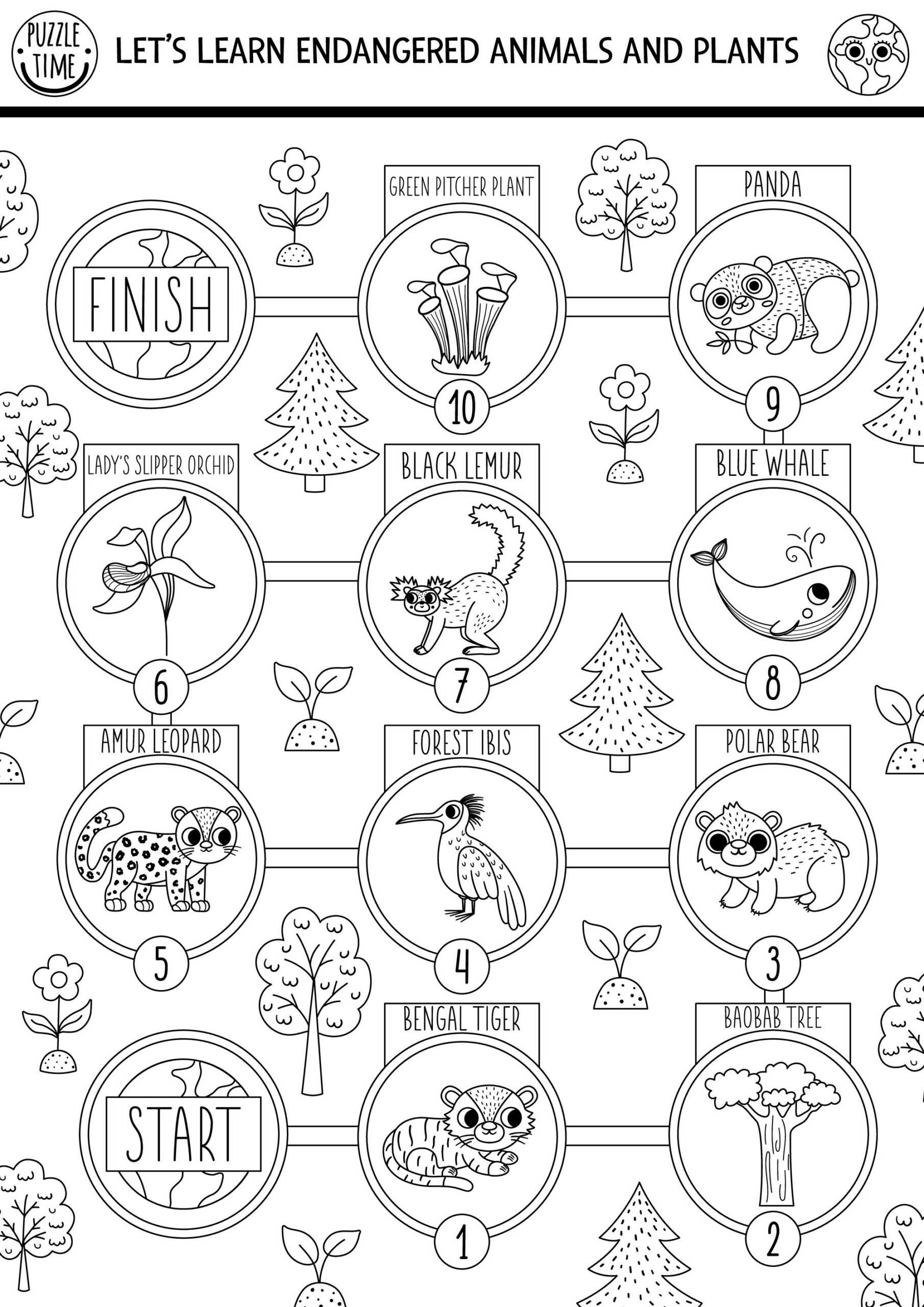
Our free printable Endangered Species Day dice game and coloring page combines creativity with a simple hands-on activity for kids. Instead of just coloring a picture, children can roll the dice, interact with the printable, and use the activity as a starting point for learning about endangered wildlife, habitats, biodiversity, and conservation.
Endangered Species Day is observed on the third Friday in May, making this a fun printable for classrooms, homeschool lessons, libraries, nature clubs, families, and anyone looking for an educational wildlife activity.
Grab a die, some crayons or colored pencils, and get ready to explore the amazing diversity of life on our planet.
🎲 Free Printable Endangered Species Dice Game
The dice-game element makes this printable a little different from an ordinary coloring page.
Kids can roll a die and use the number to guide what they color or explore next. Follow the prompts included with the printable, or create your own rules to make the activity different each time you play.
You could play individually, with a partner, or as a small group.
A simple game turns coloring into something interactive—and gives children another reason to look closely at the animals and plants featured on the page.
🐼 What Is Endangered Species Day?
Endangered Species Day is held each year on the third Friday in May.
The observance began in the United States in 2006 and has grown into an opportunity for schools, zoos, aquariums, wildlife refuges, conservation organizations, families, and communities to learn about threatened and endangered species and the habitats they depend on.
It’s also a day to celebrate conservation success stories.
Protecting wildlife isn’t only about animals that are struggling today. Conservation work can help populations recover so that species have a better chance of surviving into the future.
🌎 What Does “Endangered” Mean?
When a species is endangered, it is at serious risk of disappearing from all or a significant portion of its range.
Under the U.S. Endangered Species Act, species can be classified as endangered or threatened.
In simple terms:
Endangered species face a high risk of extinction.
Threatened species are likely to become endangered in the foreseeable future.
Plants can be endangered too. Conservation isn’t only about pandas, turtles, whales, and tigers—it includes everything from tiny insects and freshwater species to flowers and other plants.
🐾 Meet Amazing Endangered Animals
Endangered and threatened wildlife can be found in habitats around the world.
Children may already recognize animals such as:
- Sea turtles
- Tigers
- Rhinoceroses
- Elephants
- Gorillas
- Red pandas
- Penguins
- Whales
- Wolves
- Many birds, fish, amphibians, and insects
The exact conservation status of an animal can vary by species and population, so older children can choose one animal from the activity and research its current status.
For lots more wildlife to color, explore our Animal Coloring Pages.
🎨 Color the Animals and Their Habitats
Don’t stop with the animals themselves.
Think about where each creature lives and use the background to create its habitat.
An animal might belong in:
- A tropical rainforest
- Grassland
- Forest
- Wetland
- Desert
- Mountain habitat
- Coral reef
- Open ocean
- River
- Arctic environment
Kids can draw plants, rocks, water, trees, clouds, or other animals around the original picture.
This is a simple way to introduce an important idea: protecting wildlife often means protecting habitat too.
🌿 Why Habitats Matter
Animals and plants depend on places that provide the things they need to survive.
Depending on the species, that can include:
- Food
- Water
- Shelter
- Space
- Nesting areas
- Breeding grounds
- Migration routes
When habitat is damaged, fragmented, or lost, wildlife may struggle even when the animals themselves aren’t being directly harmed.
Ask children:
What would happen if this animal had nowhere safe to live?
Then have them design the healthiest habitat they can imagine around their coloring page.
🐢 Learn About Sea Turtles
Sea turtles are wonderful animals to include in an endangered-species lesson because they connect wildlife conservation with oceans and beaches.
After the dice game, visit our Coloring Pages of Turtles or print our Cute Turtle Coloring Page for World Turtle Day.
Kids can create an underwater habitat with:
- Coral
- Sea grass
- Fish
- Seashells
- Bubbles
- Sandy ocean floor
Then explore even more marine life in our Ocean Coloring Pages.
🐅 Discover Tigers
Tigers are another animal that can inspire conversations about wildlife and habitat.
Our Coloring Pages of Tigers give kids plenty of room to experiment with those famous stripes.
After coloring, ask:
- Where do tigers live?
- What do they eat?
- Why are stripes useful?
- What kind of habitat does a tiger need?
- Are all tigers part of one single population?
Older children can research a particular tiger subspecies and add facts to their finished picture.
🐘 Explore Elephants
Elephants are among the world’s most recognizable animals.
Visit our Coloring Pages of Elephants after finishing the dice game.
Kids might research questions like:
- Where do elephants live?
- Are African and Asian elephants the same?
- What do elephants eat?
- Why are large connected habitats important to them?
- How do elephant families live together?
Learning one or two facts about a familiar animal can make wildlife conservation feel much more concrete.
🐧 Learn About Penguins
Not every penguin species has the same conservation status, which makes penguins an interesting subject for older children to investigate.
Start with our Cute Kawaii Penguin and Baby Coloring Page.
Then choose a penguin species and find out:
- Where it lives
- What it eats
- How large it grows
- Whether its population is stable or declining
- What challenges it faces
Kids can write their favorite fact underneath the finished picture.
🦓 Visit the Coloring-Page Zoo
Another way to extend the activity is to create your own wildlife collection.
Our Coloring Pages of Zoo Animals include a variety of popular species.
Print several animals and let kids sort them by:
- Continent
- Habitat
- Diet
- Mammal, bird, reptile, or another group
- Conservation status
For younger children, simply identifying and naming the animals is plenty.
🎲 Try a Roll-and-Research Game
Once you’ve played the original printable, use a die to create a second endangered-species activity.
Choose an animal and roll.
1 — Habitat
Find out where the animal lives.
2 — Food
Discover what it eats.
3 — Size
Find out how large it can grow.
4 — Adaptation
Learn something that helps it survive.
5 — Threat
Discover one challenge facing the species.
6 — Conservation
Find one way people are working to protect it.
Kids can write one sentence or simply tell someone the answer.
🖍️ Try a Roll-and-Color Game
Want to keep the activity purely creative?
Assign each number a color:
1 — Red
2 — Orange
3 — Yellow
4 — Green
5 — Blue
6 — Purple
Roll the die and use that color somewhere on the page.
Keep rolling until the picture is complete.
The resulting endangered animal may look nothing like its real counterpart—and that’s okay. This version is about creativity and play.
🌈 Try a Habitat Color Challenge
You can also make the dice determine which habitat kids create.
1 — Rainforest
2 — Ocean
3 — Grassland
4 — Forest
5 — Wetland
6 — Make up your own habitat
Then draw the background.
This can become delightfully silly if the chosen habitat doesn’t match the real animal.
Afterward, ask children to research the animal’s actual habitat and compare the two.
🔎 Become an Endangered Species Detective
Turn kids into wildlife detectives.
Choose one animal from the page and investigate:
Species name: __________
Where does it live? __________
What does it eat? __________
What makes it special? __________
What threatens it? __________
How are people helping? __________
My favorite fact: __________
Add the completed information beside the colored animal.
For more learning-focused printables, explore our Educational Coloring Pages & Activities.
🗺️ Put Endangered Species on the Map
Wildlife conservation can become a geography lesson too.
Print one of our World Map Coloring Pages.
Then choose several endangered animals and find out where they live.
Mark the approximate locations on the map.
Kids might discover wildlife living in:
- North America
- South America
- Africa
- Europe
- Asia
- Australia
- Islands
- Polar regions
- Oceans around the world
Add tiny animal drawings or symbols to the map.
The finished project becomes an Endangered Species Around the World poster.
🌳 Build a Healthy Habitat
Give kids a blank sheet of paper and ask them to create the perfect habitat for one animal.
Their drawing should include everything the species needs.
Think about:
- Food
- Water
- Plants
- Shelter
- Space
- Other animals
- Safe nesting areas
Then ask:
What could make this habitat unsafe?
It’s an easy way to move from simply recognizing an animal to thinking about ecosystems.
🌿 Explore Nature Through Coloring
Endangered species are part of larger ecosystems, making this printable a natural companion to our Nature Coloring Pages.
Kids can continue exploring:
- Flowers
- Plants
- Insects
- Birds
- Wildlife
- Gardens
- Oceans
- Seasonal changes
One species rarely exists completely on its own.
Plants, animals, water, soil, weather, and habitats are all connected.
🐝 Don’t Forget the Little Creatures
When people hear “endangered species,” it’s easy to imagine only large animals.
But small creatures matter too.
Insects and other invertebrates can have important roles in ecosystems.
Visit our Coloring Pages of Insects or celebrate pollinators with our Bee Happy Coloring Page for World Bee Day.
Kids can talk about the different roles animals play in nature, whether they’re enormous elephants or tiny insects.
🌸 Plants Can Be Endangered Too
Endangered species aren’t all animals.
Plants can also become rare or endangered when populations decline or habitats change.
That makes our Coloring Pages of Plants and Coloring Pages of Flowers useful additions to an endangered-species lesson.
Ask children:
What animals might depend on this plant?
Perhaps insects visit its flowers.
Birds might eat its seeds.
Other animals may use it for shelter.
Suddenly a plant doesn’t seem separate from wildlife at all.
🧠 What Can Put a Species at Risk?
There isn’t one single reason species become endangered.
Depending on the species, pressures can include things such as:
- Habitat destruction or degradation
- Overuse or exploitation
- Disease
- Predation
- Pollution
- Invasive species
- Climate-related changes
- Other natural or human-caused pressures
Different species face different combinations of challenges.
For children, the important takeaway is that conservation works best when people understand why a population is struggling.
💚 Conservation Can Work
Endangered Species Day shouldn’t be only about animals in trouble.
It’s also an opportunity to talk about recovery.
Scientists, wildlife agencies, conservation organizations, landowners, communities, zoos, aquariums, and many other people work to restore habitats and help vulnerable populations recover.
Some species that once faced severe declines have made important comebacks because of sustained conservation efforts.
That’s a hopeful message for kids:
Protecting wildlife can make a difference.
🇺🇸 What Is the Endangered Species Act?
In the United States, the Endangered Species Act of 1973 provides a framework for protecting and recovering species listed as endangered or threatened and conserving the ecosystems they depend on.
The U.S. Fish and Wildlife Service and NOAA Fisheries share major responsibilities for administering the law, depending on the species involved.
Younger children don’t need the legal details.
A simple explanation works:
It’s a law designed to help protect plants and animals that are in danger of disappearing.
Older students can investigate how species are listed and how recovery plans work.
🌎 Simple Ways Kids Can Care About Wildlife
Children don’t need to become wildlife biologists overnight.
Small actions can help them develop an appreciation for nature.
Families can encourage kids to:
- Observe wild animals without disturbing them.
- Leave wild animals in their habitats.
- Keep parks and outdoor spaces clean.
- Learn about local wildlife.
- Grow appropriate native plants where possible.
- Reduce unnecessary waste.
- Participate in supervised habitat cleanups.
- Visit reputable nature centers, parks, zoos, aquariums, or wildlife refuges.
- Share what they learn about endangered species.
One of the most useful first steps is simply becoming curious about the natural world.
🔍 Discover Endangered Species Near You
Endangered wildlife isn’t necessarily somewhere far away.
There may be threatened or endangered plants and animals in your own state or region.
Older kids can use an official wildlife resource to find endangered or threatened species where they live.
Choose one local species and make a mini project:
- Draw or color it.
- Find its habitat.
- Learn one threat.
- Discover one conservation effort.
- Add it to a local wildlife poster.
This makes conservation much more personal than only studying animals on another continent.
🏫 Endangered Species Day Classroom Activity
This printable is especially useful for teachers because it combines a game, coloring, science, and discussion.
A simple classroom activity could be:
- Introduce Endangered Species Day.
- Explain endangered and threatened species.
- Play the dice game.
- Color the printable.
- Assign each student an animal or plant.
- Research one fact.
- Share the facts with the class.
Finish by displaying the artwork together under a heading such as:
Protect Wildlife
or
Every Species Matters
🏠 Endangered Species Activity for Families
Families can play together too.
Print a copy for everyone and grab one die.
Take turns rolling and completing part of the activity.
While coloring, choose an animal you’d like to know more about.
Then spend a few minutes learning about it together.
It doesn’t need to become a formal lesson.
A simple question such as “Where does this animal live?” can lead to an entire conversation.
📚 Create an Endangered Animals Book
Want a larger project?
Make a homemade wildlife book.
Each page can feature one species.
Include:
Animal:
Habitat:
Continent:
Food:
Conservation status:
Interesting fact:
How people are helping:
Add a colored picture or drawing.
Staple all the pages together to create your own Amazing Endangered Species book.
🎨 Create a Wildlife Conservation Poster
After completing the coloring page, make a poster.
Choose a simple message such as:
Protect Wildlife
Save Their Habitats
Wildlife Needs Wild Places
Every Species Matters
Protect Our Planet
Decorate it with drawings of animals, plants, forests, mountains, rivers, and oceans.
A classroom could create one giant poster together.
📖 Tell an Animal’s Story
Coloring can also inspire creative writing.
Ask kids to imagine they are the animal featured in their picture.
Write or tell a story beginning with:
“My name is __________, and I live in __________.”
What does the animal see every day?
Where does it find food?
What other animals live nearby?
What danger does it encounter?
Who helps?
Combining facts with imagination can make wildlife learning much more memorable.
🎭 Pretend to Be a Wildlife Scientist
Give kids a clipboard or notebook and turn them into wildlife researchers.
Their mission:
- Choose a species.
- Observe a picture of it.
- Record what they notice.
- Research its habitat.
- Draw its footprints or food.
- Write one question they still have.
Kids can even make pretend binoculars from cardboard tubes.
The goal is to encourage observation and curiosity.
🎲 Make Your Own Wildlife Dice Game
Once you’ve tried the original game, create another one.
Assign an activity to every roll:
1 — Draw an animal.
2 — Name an animal habitat.
3 — Act like an animal.
4 — Name something animals need to survive.
5 — Share a wildlife fact.
6 — Choose another player to answer.
This works well with siblings, classroom groups, or family game nights.
🧒 Endangered Species Activities for Younger Kids
For preschoolers and early elementary students, keep everything simple.
Focus on:
- Recognizing animals
- Naming colors
- Counting
- Matching animals to habitats
- Talking about nature
- Practicing kindness toward wildlife
You don’t need to explain extinction in frightening terms.
A child-friendly idea is enough:
Some plants and animals have become rare, and people are working to help protect them.
Then get back to coloring.
🧑🎓 Challenge Older Kids
Older students can go deeper.
Ask them to research:
- Population trends
- Geographic range
- Habitat
- Threats
- Conservation programs
- Recovery efforts
- Whether populations are increasing or decreasing
They could compare two species and ask why their conservation challenges differ.
This turns the same printable into an activity that can work across several age levels.
✂️ Turn the Coloring Page Into a Craft
Finished artwork can become:
- A wildlife poster
- A classroom display
- A scrapbook page
- A science notebook cover
- An animal fact sheet
- A bookmark
- A conservation collage
- A nature-journal page
Children can also cut out wildlife pictures and arrange them around a hand-drawn globe.
🌍 Make a Biodiversity Collage
Biodiversity simply describes the variety of life around us.
Create a collage showing as much life as possible.
Add:
- Mammals
- Birds
- Reptiles
- Amphibians
- Fish
- Insects
- Flowers
- Trees
- Fungi
- Ocean life
Use pages from our Animal Coloring Pages and Nature Coloring Pages for inspiration.
The busier the ecosystem becomes, the better.
🖨️ How to Use the Endangered Species Day Printable
Getting started is easy:
- Print the dice game and coloring page.
- Find a standard six-sided die.
- Gather crayons, markers, or colored pencils.
- Follow the printable’s game directions.
- Color as you play.
- Choose a species you’d like to learn more about.
- Keep exploring!
Regular printer paper works well for everyday use.
For classroom displays or crafts, slightly heavier paper can make the finished project more durable.
🐾 Roll, Color and Help Kids Discover Wildlife
Endangered Species Day is ultimately about paying attention to the incredible living things that share our planet.
A simple dice game won’t teach children everything about conservation—and it doesn’t need to. It can spark the first question.
What animal is that?
Where does it live?
Why is it endangered?
Can people help?
Those questions are where learning begins.
Print the activity, roll the dice, fill the page with color, and then keep exploring with our Animal Coloring Pages, Nature Coloring Pages, Educational Coloring Pages & Activities, and Ocean Coloring Pages.
Every creature has a story worth discovering.
🔗 Related Articles
- Animal Coloring Pages
- Educational Coloring Pages & Activities
- Nature Coloring Pages
- Ocean Coloring Pages
- Cute Turtle Coloring Page for World Turtle Day
- Coloring Pages of Turtles
- Coloring Pages of Tigers
- Coloring Pages of Elephants
- Coloring Pages of Zoo Animals
- Bee Happy Coloring Page for World Bee Day
- World Map Coloring Pages
📚 Sources
- Endangered Species Coalition — Endangered Species Day
- Endangered Species Coalition — About Endangered Species Day
- National Wildlife Federation — Endangered Species Day
- U.S. Fish & Wildlife Service — About the Endangered Species Act
- U.S. Fish & Wildlife Service — Endangered Species Program
- NOAA Fisheries — Endangered Species Day