
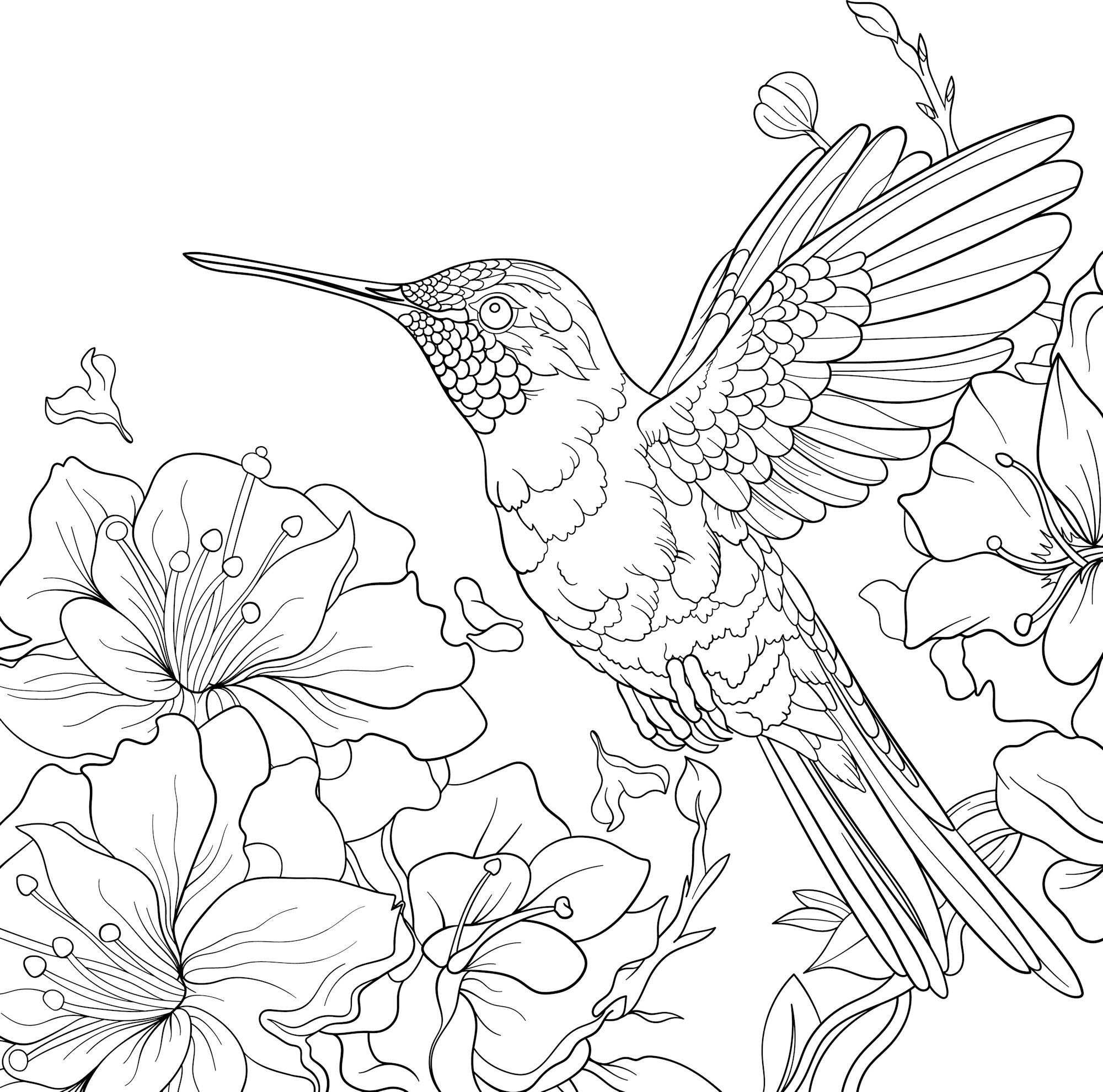


Let your creativity take flight with our hummingbird coloring pages, a beautiful collection of free printable designs inspired by one of nature’s tiniest and most colorful birds.
Hummingbirds are wonderful coloring subjects because there is no need to settle for a single shade. Their feathers can shimmer with greens, reds, blues, purples, and other jewel-like colors, while the flowers surrounding them give you even more opportunities to reach for the brightest crayons in the box.
These pages are especially fun for National Hummingbird Day, celebrated on the first Saturday in September, but there is no reason to wait for a special occasion. Print a favorite hummingbird whenever you feel like adding a little nature, color, and creativity to your day.
🐦 Explore Our Hummingbird Coloring Pages
The hummingbird designs in this collection capture these tiny birds in graceful poses, often surrounded by the flowers and natural details that suit them so perfectly.
Some designs leave plenty of open space for experimenting with bold feather colors, while others offer more intricate details for older kids and adults who enjoy taking their time with colored pencils or fine-tip markers.
The combination of delicate wings, long bills, feathers, leaves, stems, and blossoms makes hummingbirds especially versatile coloring subjects. You can aim for something inspired by a real bird or invent a completely new species in your favorite colors.
For even more feathered friends, explore our Bird Coloring Pages.
💎 Try Jewel-Toned Hummingbird Colors
Real hummingbirds are famous for feathers that can appear almost metallic when the light catches them. That makes jewel tones a wonderful starting point for these coloring pages.
Emerald green, ruby red, sapphire blue, turquoise, violet, and deep teal can all work beautifully. Instead of filling the entire bird with one shade, layer several related colors together. A green hummingbird might include touches of turquoise and blue along its wings, while a red throat could blend from crimson into bright ruby.
Colored pencils are especially useful for this effect because you can gradually layer one shade over another instead of creating a single flat block of color.
You do not need to copy a particular species. Think of real hummingbirds as inspiration and then create the bird you would most like to discover in your own garden.
❤️ Color a Ruby-Throated Hummingbird
One of the best-known hummingbirds in North America is the Ruby-throated Hummingbird. Males are especially striking, with metallic green upperparts and a brilliant red throat that can look dramatically different depending on the light.
That combination is easy to recreate on a coloring page. Begin with several shades of green over the head, back, wings, and tail. Keep the underside lighter, then make the throat the brightest red area in the picture.
Try layering crimson, cherry red, and a touch of dark burgundy to make the throat appear richer.
Of course, you can print the same design again and make your next hummingbird purple, gold, or rainbow-colored. Coloring pages are a perfect place to mix nature study with imagination.
🌺 Color Hummingbirds and Flowers
Hummingbirds and flowers naturally belong together.
These tiny birds feed from flowers by hovering nearby and reaching into blossoms with their long bills and tongues. Their flower-filled world also makes hummingbird coloring pages particularly colorful.
Try pairing a green hummingbird with brilliant red flowers, a blue-and-purple bird with pink blossoms, or a ruby-colored bird with sunny yellow and orange flowers.
If your page has empty space, add even more blossoms around the bird. Trumpet-shaped flowers are especially appropriate, but your imaginary hummingbird garden can contain anything you like.
Continue the botanical theme with our Coloring Pages of Flowers or step into a larger outdoor scene with our Garden Coloring Pages.
🌈 You Don’t Have to Use Realistic Colors
Hummingbirds are already so colorful that imaginary versions don’t seem very far-fetched.
Try a hummingbird with rainbow wings, a pink and lavender body, a golden throat, or feathers that change color from turquoise to purple.
A few fun color themes to try include Tropical Jewel, with emerald, turquoise, violet, and ruby; Sunset, with yellow, orange, coral, red, and purple; Pastel Garden, with mint, lavender, blush pink, peach, and pale blue; or Rainbow, using every bright color you can find.
You can coordinate the flowers with the bird or deliberately choose contrasting shades so the hummingbird stands out.
🪽 Capture the Feeling of Hummingbird Wings
One of the most remarkable things about watching a hummingbird is how quickly its wings move.
When hovering, the wings can become little more than a blur to our eyes. On a coloring page, you can create a similar feeling with shading.
Use a darker color where the wing meets the body and gradually lighten the shade toward the tips. You might also use several thin pencil strokes rather than filling the wing completely.
For a whimsical version, give the wings a translucent look with pale blues, lavenders, or silvers.
Fine-tip colored pencils are especially helpful if the feathers contain intricate lines or patterns.
🌸 Design a Hummingbird Garden
Once you’ve colored the bird, don’t forget about its surroundings.
Turn the page into a complete garden by adding flowers, leaves, vines, sunshine, clouds, butterflies, and other tiny creatures. A few extra details can make the hummingbird look as though it belongs to an entire living habitat rather than floating on an empty page.
You could even design your dream hummingbird garden.
Maybe it has towering red flowers, a little fountain, flowering vines, shady trees, and butterflies fluttering nearby. Perhaps it is an imaginary tropical garden where the plants come in blue, pink, and rainbow colors.
Our Butterflies Coloring Page makes a lovely companion activity if you want to fill your coloring table with more garden visitors.
🌼 Why Do Hummingbirds Visit Flowers?
Flowers offer hummingbirds an important source of nectar.
As hummingbirds move from blossom to blossom, they can also transfer pollen between flowers, making them part of the fascinating relationship between flowering plants and their pollinators.
Hummingbirds don’t live on nectar alone. They also eat tiny insects and spiders, which provide nutrients that sugary nectar does not.
That makes a hummingbird picture an easy way to introduce children to several connected nature topics, including birds, flowers, pollination, food webs, habitats, and migration.
⚡ Tiny Birds With Amazing Flying Skills
Hummingbirds may be small, but their flying abilities are extraordinary.
They can hover almost motionless in front of a flower and maneuver in ways that most other birds cannot. Their specialized flight is one reason they are so captivating to watch.
Ruby-throated Hummingbirds can beat their wings more than 50 times per second during hovering flight. Despite their tiny size, they are also impressive migrants, and some make a long nonstop crossing of the Gulf of Mexico during migration.
Those facts can turn a coloring page into the beginning of a larger bird lesson.
Ask children to imagine where the hummingbird in their picture is flying. Is it heading toward another flower, traveling through a garden, beginning a migration, or simply looking for a safe place to perch?
🗓️ Celebrate National Hummingbird Day
National Hummingbird Day is observed on the first Saturday in September, making early September a great time to learn more about these remarkable birds.
You can celebrate simply by coloring a hummingbird picture and learning a few new facts, or make an entire nature day out of it.
Spend some time outdoors looking for birds and flowers, read about hummingbirds, draw a garden, or start a small bird journal.
In 2026, National Hummingbird Day falls on September 5, so these pages also fit beautifully with other beginning-of-September activities.
Our September Coloring Page is a natural companion for celebrating the start of the month.
🔍 Look Closely at a Hummingbird
A coloring page can encourage children to notice details they might otherwise overlook.
Before starting, look at the hummingbird’s shape. Notice its long narrow bill, tiny feet, compact body, long wings, and tail feathers.
Then look at photographs of real hummingbirds and compare them.
Where are the brightest feathers?
Is the bird’s underside the same color as its back?
Are the wings darker?
What shape is the tail?
Young children can simply point out colors and body parts. Older kids can compare different hummingbird species and discover how varied the family really is.
🎨 Add Shading to the Feathers
Hummingbirds are particularly good subjects for practicing shading because their plumage often looks different depending on how light strikes it.
Begin with a light layer of your main color. Add darker shades where feathers overlap or where the body would naturally be in shadow.
Then add small highlights with a lighter pencil.
You might combine green with turquoise, blue with violet, red with orange, or purple with magenta.
The goal does not have to be perfect realism. Experimenting with several shades can simply make the bird more interesting to look at.
☀️ Create a Sunny Garden Background
If your hummingbird is surrounded by flowers, continue the scene into the background.
A pale blue sky creates a cheerful daytime picture, while deeper blues and purples can turn the same design into an evening garden.
Add soft green leaves behind brightly colored flowers so the blossoms remain the focus.
Children can also draw a sun, fluffy clouds, trees, fences, flowerpots, or a garden path in any open areas.
For more outdoor inspiration, browse our Nature Coloring Pages.
🦋 Add Other Pollinators
A hummingbird doesn’t have to be the only garden visitor on the page.
Draw butterflies fluttering near the flowers, bees visiting blossoms, or tiny insects hiding among the leaves.
This can open up a conversation about the many animals that interact with flowering plants.
Kids can even create an imaginary pollinator garden where hummingbirds, butterflies, bees, and other creatures all have plenty of flowers to visit.
Make every species a different color and see how lively the finished page becomes.
📚 Turn Hummingbird Coloring Into a Nature Lesson
These coloring pages are easy to use in a classroom or homeschool nature unit.
Children can color their hummingbird and then research a species to create a simple fact card. They might record its name, colors, habitat, food, range, and one surprising fact.
Another option is to compare hummingbirds with other birds.
How is a hummingbird’s bill different from a duck’s? Why might those different bill shapes be useful? How does a hummingbird feed compared with a bird that eats seeds?
Our Educational Coloring Pages & Activities offer more ways to combine creativity and learning.
✏️ Write a Hummingbird Story
The picture can also become a creative-writing prompt.
Imagine that the hummingbird has just arrived in a garden for the first time. What does it see? Which flower does it visit first? Does it meet another hummingbird?
Perhaps the bird is beginning a long migration or searching for a magical flower that blooms only once a year.
Younger children can tell the story aloud while an adult writes it down. Older kids can create a short story themselves and use the finished coloring page as the illustration.
📓 Start a Backyard Bird Journal
National Hummingbird Day is also a great excuse to begin paying closer attention to backyard birds.
Create a simple journal and record birds you see outside. Add the date, location, weather, and a quick drawing or description.
You might not see a hummingbird every day, but sparrows, robins, cardinals, finches, doves, and other common birds can all become part of the project.
When a hummingbird finally appears, the sighting can get its own special page.
Our larger Bird Coloring Pages collection can help illustrate a homemade bird notebook.
🌱 Help Make a Garden Friendlier to Hummingbirds
One meaningful way to celebrate hummingbirds is to learn about the plants and habitats they use.
Native flowering plants can provide nectar for hummingbirds and other pollinators while also supporting the broader local ecosystem. Different plants bloom at different times, so a garden containing several native flowering species can provide resources over a longer part of the season.
Adults can help children discover which native plants grow well in their particular region.
The coloring activity can then become a garden-planning project: draw the flowers you would plant and imagine where the hummingbirds might visit.
🖍️ Best Supplies for Hummingbird Coloring Pages
Hummingbird pictures can work with almost any coloring supplies, but colored pencils are especially useful when a design contains detailed feathers, flowers, and leaves.
Crayons are a good choice for younger children and larger open spaces, while markers produce the brilliant jewel tones that suit hummingbirds beautifully.
Gel pens can be fun for tiny decorative highlights, particularly metallic or glittery details that mimic the shimmering appearance of hummingbird feathers.
You can also combine materials. Use markers for bright flowers, colored pencils for feather shading, and a metallic gel pen for a few sparkling accents.
✂️ What to Do With Finished Hummingbird Pages
A finished hummingbird picture can become more than something to tuck into a drawer. Turn it into nature-themed wall art, a homemade card, a notebook cover, a scrapbook page, a classroom display, a bird journal illustration, or part of a homemade nature book.
You could also color several hummingbirds using different palettes and display them together.
One might look inspired by a real Ruby-throated Hummingbird, another could use tropical blues and greens, and a third could be completely rainbow-colored.
Seeing all three together is a great reminder that one outline can inspire countless different pieces of artwork.
🖨️ How to Use These Hummingbird Coloring Pages
Choose your favorite hummingbird design and print the page you’d like to color.
Regular printer paper works well with crayons and colored pencils. If you plan to use markers, gel pens, or craft materials, slightly heavier paper may be more convenient.
Then choose your approach.
You might recreate the brilliant green and ruby colors of a real hummingbird, select a coordinated jewel-tone palette, create a soft pastel garden, or invent a species that has never existed outside your imagination.
Color the flowers, add a background, and make the entire scene your own.
💚 Let Your Creativity Take Flight
With their tiny bodies, rapidly moving wings, long bills, shimmering feathers, and close connection with flowers, hummingbirds are wonderful subjects for nature-inspired coloring.
These free printable hummingbird coloring pages can be used to celebrate National Hummingbird Day, accompany a bird or pollinator lesson, inspire a backyard nature project, or simply provide a peaceful afternoon of coloring.
Choose a hummingbird, gather your brightest colors, and let your creativity hover, flutter, and soar across the page.
🔗 Related Articles
- Bird Coloring Pages
- Nature Coloring Pages
- Coloring Pages of Flowers
- Garden Coloring Pages
- Butterflies Coloring Page
- September Coloring Page
- Educational Coloring Pages & Activities
📚 Sources
- Smithsonian’s National Zoo — Hummingbirds
- Smithsonian’s National Zoo — Ruby-throated Hummingbird
- Cornell Lab of Ornithology — Ruby-throated Hummingbird
- Cornell Lab of Ornithology — Ruby-throated Hummingbird Life History
- Audubon — Ruby-throated Hummingbird
- Audubon Society of Omaha — Celebrate National Hummingbird Day
🖍️Shop Hummingbird Coloring Books –>