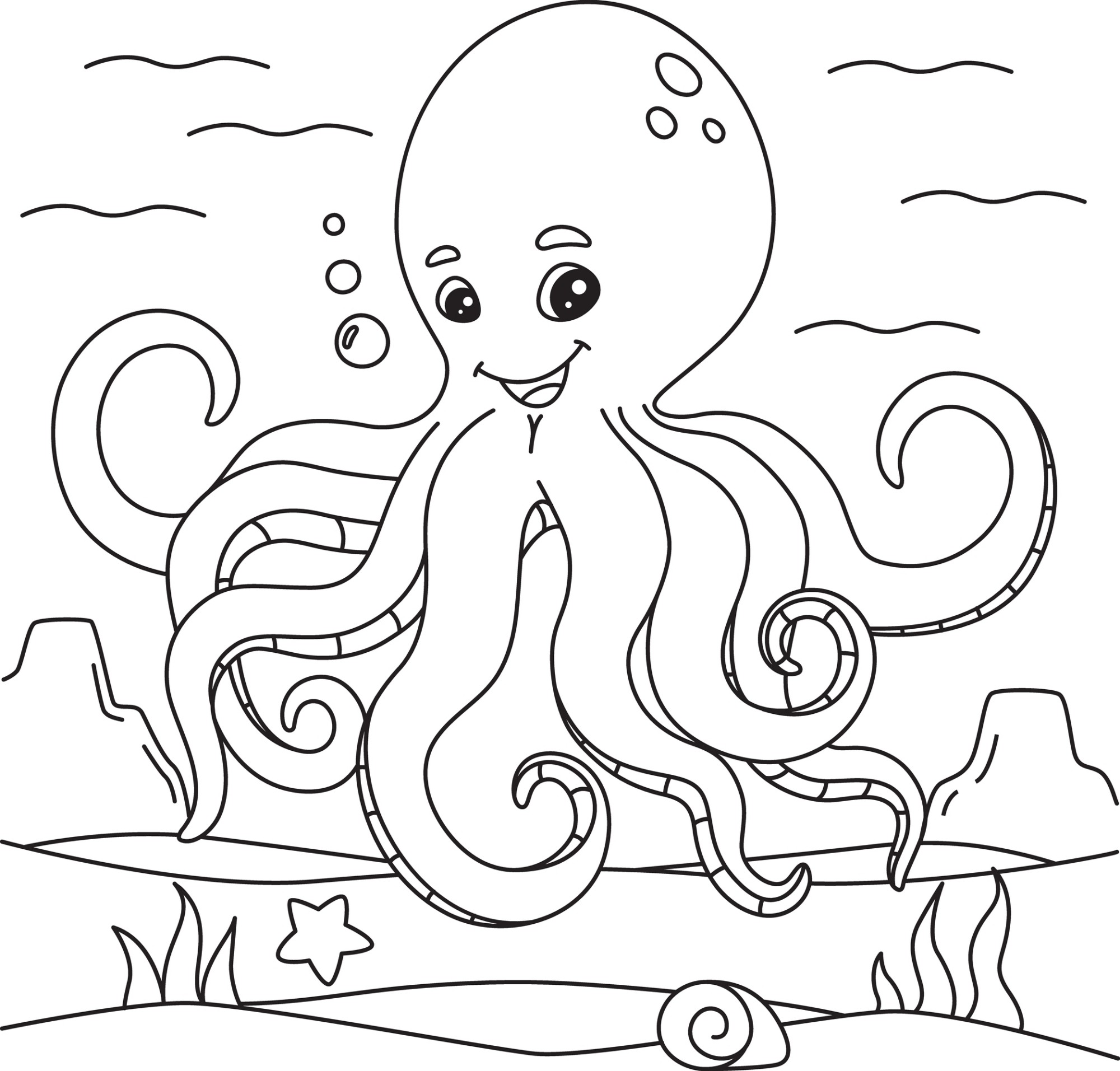
Dive beneath the waves with our free printable octopus coloring page for kids, featuring one of the ocean’s most unusual and fascinating animals.
An octopus is especially fun to color because there is no single color you have to choose. Real octopuses can appear in shades of red, orange, brown, cream, gray, and other colors, while many species can rapidly change their appearance. On a coloring page, the possibilities become even bigger.
Create an orange octopus hiding among rocks, a purple octopus exploring a coral reef, a blue creature swimming through deep water, or a rainbow octopus with a different color on every arm.
Then complete the underwater world with fish, bubbles, seaweed, shells, rocks, treasure, or an imaginary sunken ship.
Grab your crayons, colored pencils, or markers and get ready for an eight-armed ocean adventure.
🐙 Meet Our Octopus Coloring Page
This printable features a single octopus design, making the animal the clear center of the page.
That gives kids plenty of room to experiment with:
- Eight different arms
- Suckers
- Patterns
- Spots
- Stripes
- Ocean backgrounds
- Camouflage colors
- Fantasy colors
Keep the picture simple for younger children or add an entire underwater habitat around the octopus.
For a much bigger collection of marine animals, waves, reefs, boats, and underwater scenery, visit our Ocean Coloring Pages.
🧡 Color an Orange Octopus
Orange and reddish-brown shades make a beautiful starting palette.
Try:
- Pumpkin orange
- Burnt orange
- Rust
- Red-brown
Use lighter orange across the raised areas of the body.
Add deeper rust around folds and underneath the arms.
Color the suckers pale cream, pink, or peach.
Against turquoise or blue water, an orange octopus can stand out beautifully.
❤️ Create a Red Octopus
Try:
- Scarlet
- Crimson
- Burgundy
- Rust
Blend several reds instead of using one solid color.
Make the underside of the arms lighter.
Add darker shadows near the body.
Surround the octopus with green seaweed and pale sand for plenty of contrast.
🤎 Create a Brown & Cream Octopus
For a more natural, rocky-seafloor-inspired palette, use:
- Chocolate brown
- Tan
- Cream
- Gray
- Rust
Add spots and mottled patches rather than coloring the body uniformly.
An octopus that matches rocks and sand can become the beginning of a camouflage activity.
💜 Create a Purple Octopus
Purple is a perfect fantasy-ocean color.
Try:
Body: Violet
Arms: Purple and lavender
Suckers: Pale pink
Add turquoise water and lime-green plants.
Maybe this octopus lives in a magical reef where every sea creature has unusual colors.
💙 Create a Blue Octopus
Use several blues:
- Sky blue
- Turquoise
- Royal blue
- Navy
Make the body darker and gradually lighten the arms.
Or reverse the pattern.
Color the animal pale aqua and surround it with deep navy water.
A blue octopus might almost disappear into your imaginary ocean.
🌈 Create a Rainbow Octopus
Eight arms give you plenty of room for color.
Try:
Arm 1: Red
Arm 2: Orange
Arm 3: Yellow
Arm 4: Green
Arm 5: Turquoise
Arm 6: Blue
Arm 7: Purple
Arm 8: Pink
Keep the body one color or blend the whole rainbow together.
Add rainbow bubbles around the animal.
🎨 Give Every Arm a Different Pattern
Instead of changing only the colors, change the patterns too.
Try:
- Polka dots
- Stripes
- Zigzags
- Stars
- Hearts
- Waves
- Spirals
- Checkerboard
Give each of the eight arms its own design.
The finished octopus can become a walking—or swimming—pattern collection.
🔢 Count the Eight Arms
An octopus has eight arms.
Count them:
1
2
3
4
5
6
7
8
Then give each one a different color.
You can also number the arms on a separate drawing.
This makes the octopus an easy animal to pair with simple counting practice.
🐙 Arms, Not Tentacles
People often call an octopus’s limbs tentacles, but biologists normally refer to them as arms.
Octopuses have eight arms lined with suckers.
Squid and cuttlefish are different: they have eight arms plus two longer specialized feeding tentacles.
So when coloring this octopus, you can practice saying:
An octopus has eight arms.
🔵 Add Color to the Suckers
Look along the undersides of the arms.
Octopus suckers can inspire lots of tiny coloring details.
Try:
- Cream
- Pale pink
- Peach
- Lavender
Or make every sucker a different bright color.
You could even create a repeating pattern:
Pink → Purple → Blue → Pink → Purple → Blue
Continue along an entire arm.
✋ What Do Octopus Suckers Do?
Octopus suckers are much more than simple suction cups.
They help the animal:
- Grip rocks
- Hold prey
- Explore objects
- Move across surfaces
The suckers also contain sensory receptors that allow the octopus to detect chemical information when it touches something.
You can think of it loosely as tasting by touch.
That is a little different from saying every sucker “smells” the way a nose does.
🪨 Create a Camouflaged Octopus
Many octopuses are remarkable camouflage artists.
Create a rocky habitat around your animal.
Use:
- Gray
- Brown
- Rust
- Green
Then repeat those colors across the octopus.
Add spots and irregular patches.
The goal is to make the animal harder to notice.
Ask someone else:
How quickly can you find the octopus?
🎨 How Do Octopuses Change Color?
Many octopuses have specialized pigment cells called chromatophores in their skin.
Muscles can expand and contract these tiny pigment-filled structures, changing how much color is visible.
Other reflective structures in the skin can contribute additional effects.
Together, these systems allow many cephalopods to change their appearance extremely quickly.
They may use color changes for camouflage, communication, or defensive displays.
That makes an octopus one of the rare animals where changing colors on a coloring page is surprisingly appropriate.
🪨 Octopuses Can Change Texture Too
Color is not the whole disguise.
Many octopuses can also alter the texture of their skin.
They may appear:
- Smooth
- Bumpy
- Rough
depending on their surroundings.
That can help an octopus resemble rocks, coral, algae, or other parts of its habitat.
Try drawing little bumps across one side of your coloring-page octopus.
Leave the other side smooth.
🔍 Play Hide the Octopus
Turn the page into an I Spy challenge.
First color the octopus.
Then create a background using many of the same colors.
Add:
- Rocks
- Seaweed
- Coral
- Sand
Try to make the animal blend in.
Show the finished picture to someone.
Can they spot the octopus immediately?
🌊 Build an Underwater World
The octopus does not have to float against a blank background.
Add:
- Ocean water
- Rocks
- Seaweed
- Shells
- Fish
- Bubbles
Use several shades of blue in the water.
Make the upper water pale turquoise.
Gradually move toward deeper blue near the bottom.
For a complete collection of underwater scenes, continue with our Under the Sea Coloring Pages.
🪨 Add a Rocky Den
Many octopuses spend time in sheltered dens.
Draw:
- Large rocks
- Crevice
- Cave entrance
Maybe only part of the octopus is visible.
Add shells near the entrance.
Perhaps the octopus has collected interesting objects around its home.
🐚 Add Seashells
Scatter shells across the sea floor.
Try:
- Spiral shells
- Clam shapes
- Fan shapes
Use natural:
- Cream
- Tan
- Pink
- Gray
or make them bright purple and blue.
Hide one shell behind an octopus arm.
🌿 Add Seaweed
Draw long wavy plants around the animal.
Use:
- Olive
- Forest green
- Yellow-green
- Brown
Add several different shapes.
Maybe some plants are tall and ribbon-like while others form tiny bushes along the rocks.
A moving ocean current can make all the plants bend in one direction.
🫧 Add Bubbles
Draw circles of different sizes.
Make some tiny and others large.
Use pale blue around the edges.
Leave the center white.
Draw a trail of bubbles rising toward the surface.
Count them when you are finished.
🐠 Add Colorful Fish
Draw tiny fish swimming around the octopus.
Give each one a different palette.
Try:
- Yellow and blue
- Orange and purple
- Pink and turquoise
Maybe the fish are curious.
Perhaps they have learned that the camouflaged octopus is hiding among the rocks.
🪼 Add a Jellyfish
Draw a jellyfish drifting above the octopus.
Use:
- Lavender
- Pink
- Turquoise
- Pale blue
Keep the body light against darker water.
Add flowing tentacles beneath it.
Then continue with our Coloring Pages of Jellyfish.
🐢 Add a Sea Turtle
Draw a turtle gliding overhead.
Use olive, green, brown, and cream for a realistic-inspired palette.
Or create a rainbow shell.
A turtle and an octopus may both live in marine environments, but they belong to very different animal groups.
The turtle is a reptile.
The octopus is a mollusk.
Explore more with our Coloring Pages of Turtles.
🐬 Add a Dolphin
Draw a dolphin swimming closer to the water’s surface.
Use:
- Gray
- Blue-gray
- Pale blue
Keep the underside lighter.
Then compare the two animals.
A dolphin has bones and is a mammal.
An octopus has no backbone and is an invertebrate.
For more, visit our Coloring Pages of Dolphins.
🦈 Add a Shark in the Distance
Draw a small shark far behind the octopus.
Use gray or blue-gray.
Keep it smaller than the foreground animal to make it appear farther away.
Maybe the octopus is using camouflage to avoid being noticed.
Continue the ocean-animal collection with our Coloring Pages of Sharks.
🏴☠️ Add a Sunken Treasure Chest
Draw a chest on the sea floor.
Fill it with:
- Coins
- Jewels
- Crown
- Mysterious key
Maybe the octopus has been guarding the treasure for hundreds of years.
Use gold, red, green, purple, and blue across the treasure.
Add a few coins scattered between the rocks.
🚢 Add a Sunken Ship
Draw the outline of an old shipwreck behind the octopus.
Add:
- Broken mast
- Wooden planks
- Anchor
- Holes in the hull
Cover parts of it with seaweed.
Maybe the octopus has made its den inside.
Turn the picture into a whole underwater adventure.
⚓ Add an Anchor
Draw a large anchor resting on the sand.
Use:
- Charcoal
- Gray
- Rust brown
Wrap one octopus arm around it.
Maybe the anchor has been underwater so long that tiny plants and shells have begun growing around it.
🌙 Create a Deep-Sea Octopus
Use dark water colors:
- Navy
- Indigo
- Violet
- Black-blue
Make the octopus lighter so it stands out.
Add tiny glowing-looking creatures around it.
Not all octopuses live on bright tropical reefs. Octopods occur in habitats ranging from shallow coasts to very deep ocean environments.
Some deep-sea species look dramatically different from the familiar shallow-water octopus.
🩷 Create a Glowing Fantasy Octopus
Use:
- Neon-inspired pink
- Turquoise
- Purple
- Pale blue
Color the surrounding water dark navy.
Draw a light halo around the body.
Real octopuses do not all glow like this, but fantasy coloring does not have to follow biology.
Maybe this creature lights up the deepest part of your imaginary ocean.
🐙 Octopuses Are Mollusks
An octopus may not look much like a snail or clam, but they are relatives.
Octopuses belong to the animal group Mollusca.
Within the mollusks, they belong to a group called cephalopods.
Other cephalopods include:
- Squid
- Cuttlefish
- Nautiluses
Unlike many familiar mollusks, most modern octopuses do not have a hard external shell.
Their soft bodies allow them to move through surprisingly tight spaces.
🧠 Are Octopuses Intelligent?
Octopuses have complex nervous systems and have demonstrated impressive behaviors in scientific and aquarium settings.
Some can:
- Solve puzzles
- Open containers
- Learn from experience
- Manipulate objects
Giant Pacific octopuses, for example, have been observed opening jars and interacting with enrichment objects in aquariums.
It is fine to call octopuses intelligent animals, but there is no need to compare them directly with humans or claim they think exactly as we do.
Their nervous systems evolved along a very different path.
🫙 Draw the Octopus Opening a Jar
Imagine your octopus finds a mysterious jar on the ocean floor.
What is inside?
Maybe:
- Crab
- Shell
- Treasure map
- Magical pearl
Draw the jar.
Color the lid silver.
Wrap one or two octopus arms around it.
Write a story explaining how the animal gets it open.
🥥 The Coconut Octopus Uses Objects
One particularly famous example of octopus behavior comes from the coconut octopus.
Scientists have observed these octopuses carrying pieces of coconut shell and later arranging them as shelter.
That behavior is often discussed as a form of tool use.
Draw your octopus carrying two shell halves.
Maybe it is building the smallest underwater house in the ocean.
🏠 Design an Octopus Den
What would an octopus choose for a home in your imaginary world?
Maybe:
- Rocky cave
- Giant shell
- Sunken teapot
- Treasure chest
- Old boot
Draw the entrance.
Add eight little spaces—one for every arm.
Give the den a sign:
OCTOPUS HOME
💙 Octopuses Have Blue Blood
Humans have red blood because our oxygen-carrying molecule contains iron.
Octopus blood uses a copper-containing molecule called hemocyanin to transport oxygen.
This gives the blood a bluish appearance.
You do not need to add blood to the coloring page, of course.
It is simply one more unusual thing about these animals.
❤️ Octopuses Have Three Hearts
Another remarkable octopus fact is that they have three hearts.
Two help move blood through the gills.
Another pumps blood to the rest of the body.
Draw three little hearts around your octopus.
Color them:
- Blue
- Purple
- Turquoise
Then count:
1, 2, 3
🫀 Three-Heart Counting Activity
Draw:
3 hearts
8 arms
10 bubbles
Now count all three groups.
Older children can make their own octopus number puzzle.
For example:
Draw 8 arms and put 2 stars on each arm.
How many stars are there altogether?
💨 How Does an Octopus Swim?
Octopuses can crawl along the sea floor using their arms.
They can also move more quickly through the water using jet propulsion.
Water enters the mantle area and is forced out through a funnel called a siphon.
The animal moves in the opposite direction.
Draw curved lines behind your octopus to show it zooming away.
🏃 Create an Octopus Race
Draw two octopuses.
One crawls along the bottom.
One jets through the water.
Add:
START
and:
FINISH
Who wins your imaginary race?
Color each animal differently so it is easy to follow.
🌫️ Add an Ink Cloud
Many octopuses can release ink when threatened.
The dark cloud can help confuse a predator while the octopus escapes.
Draw a black or purple cloud behind the animal.
Then show the octopus swimming quickly in another direction.
Keep this as an animal-defense scene rather than making the octopus into a scary monster.
🔤 O Is for Octopus
Write a large:
O
Practice:
O is for Octopus.
Think of more O words:
- Ocean
- Orange
- Owl
- Otter
Decorate the O with eight tiny arms.
Or turn the entire letter into an underwater scene filled with bubbles.
For more alphabet fun, explore our Coloring Pages of Letters.
🌊 O Is for Ocean Too
Write:
OCEAN
Circle the first O.
Color it blue.
Then draw an octopus underneath.
This one animal gives you two easy O words:
O is for Octopus.
O is for Ocean.
8️⃣ Eight Is for Octopus
Draw a large number:
8
Give it eight tiny arms.
Color every arm differently.
Then write:
An octopus has 8 arms.
Pair the animal page with other number activities in our Educational Coloring Pages & Activities.
🎲 Play Octopus Roll-and-Color
Grab one six-sided die.
Assign:
1 — Orange
2 — Red
3 — Purple
4 — Blue
5 — Green
6 — Your choice
Roll.
Color one section or arm with the matching shade.
Keep going until the octopus is finished.
The result may look realistic—or completely fantastical.
🎯 Try an Eight-Color Challenge
Choose exactly eight colors.
Use each one on one arm.
Then repeat those colors elsewhere in the background.
For example, if one arm is purple, make one fish purple too.
If another is yellow, add a yellow shell.
The repeated colors can make the entire scene feel connected.
🔍 Create an Octopus I Spy Game
Hide:
- 8 bubbles
- 5 shells
- 4 fish
- 3 stars
- 2 crabs
- 1 treasure chest
around the picture.
Color everything.
Then let someone else search for all the hidden objects.
📖 Write an Octopus Adventure
Try one of these story starters:
The octopus found a mysterious key beneath the sand and…
Nobody had ever seen an octopus change into this color before…
Eight arms were useful when the octopus needed to…
Inside the underwater cave was…
The animal can become the main character of an entire ocean story.
🗝️ The Lost Treasure Mystery
An octopus finds a key.
What does it unlock?
Maybe:
- Treasure chest
- Sunken ship cabin
- Underwater castle
- Tiny door in a rock
Draw the destination on another page.
Color both pictures with the same ocean palette.
🌈 The Octopus That Couldn’t Choose a Color
Imagine an octopus that changes color every few minutes.
First orange.
Then purple.
Then green.
Why can’t it decide?
Maybe it is:
- Practicing camouflage
- Preparing for a party
- Copying every fish it meets
Write the ending.
🧑🎨 The Eight-Armed Artist
Imagine an octopus can paint with all eight arms at once.
What could it create?
Draw eight paintbrushes.
Give each one a different color.
Maybe the octopus paints a giant mural across the wall of a sunken ship.
🎵 The Eight-Armed Musician
Give each arm a musical instrument.
Maybe:
- Drum
- Bell
- Guitar
- Tambourine
You do not even need eight different real instruments.
Invent some.
Perhaps underwater music sounds completely different.
👨🍳 The Eight-Armed Chef
Imagine how many tasks an octopus chef could do at once.
Draw an imaginary underwater kitchen.
Maybe it is preparing:
- Seaweed salad
- Coral-colored cupcakes
- Bubble soup
Give each arm something silly to hold.
👑 Create an Octopus King or Queen
Add:
- Crown
- Cape
- Jewels
Maybe the octopus rules an underwater kingdom.
Draw a castle behind it.
Use gold, purple, turquoise, and blue.
Add fish carrying tiny flags.
🏰 Build an Underwater Castle
Draw towers behind the octopus.
Decorate them with:
- Shells
- Pearls
- Coral
- Seaweed
Maybe mermaids live there.
Or perhaps it belongs entirely to octopuses.
For more fantasy-ocean coloring, explore our Coloring Pages of Mermaids.
🏫 Octopus Coloring Page for the Classroom
This printable can fit naturally into:
- Ocean units
- Marine-animal lessons
- Invertebrate studies
- Early finishers
- Summer themes
- Art centers
- Creative writing
- Counting activities
- Camouflage lessons
The page can stay a simple coloring activity or become the beginning of a short science exploration.
Kids might color the octopus, learn three facts, and draw an appropriate habitat around it.
🐙 Create an Octopus Fact Card
Write:
Animal: Octopus
Animal Group: Mollusk / Cephalopod
Arms: 8
Habitat: Ocean
Then add one favorite fact.
Maybe:
Octopuses can use jet propulsion.
or:
Many octopuses can change color.
Display the fact card beside the finished coloring page.
🌊 Build a Classroom Ocean Wall
Combine the octopus with other marine pages.
Add:
- Dolphins
- Turtles
- Sharks
- Jellyfish
- Fish
Arrange everything on blue paper.
Draw:
- Coral
- Seaweed
- Bubbles
across the background.
The class can gradually build one enormous underwater world.
📓 Make an Ocean Animal Coloring Book
Combine this octopus page with:
Create a cover:
My Ocean Animal Book
Write one fact under each colored animal.
Staple the pages together.
🗺️ Find the Oceans on a Map
Octopods occur throughout the world’s oceans, from coastal habitats to the deep sea.
Use a world map to locate the five commonly recognized named oceans:
- Pacific
- Atlantic
- Indian
- Arctic
- Southern
Then choose one.
Imagine your octopus lives there.
Older kids can investigate which octopus species actually occur in that region.
🌎 Real Ocean or Fantasy Ocean?
Divide a sheet of paper into two sides.
Label:
REAL
and:
FANTASY
On the real side, draw:
- Octopus
- Fish
- Shark
- Turtle
- Jellyfish
On the fantasy side, draw:
- Mermaid
- Sea dragon
- Talking octopus
- Underwater castle
Some coloring pictures can combine both worlds.
🌱 Caring for Ocean Animals
A real octopus belongs in its natural marine habitat, not in a child’s hands.
When exploring beaches, rocky shores, or tide pools, observe wildlife without unnecessarily disturbing it.
Simple ways to care for coastal environments include:
- Putting trash where it belongs
- Leaving living animals where you find them
- Following local tide-pool rules
- Avoiding damage to habitat
- Learning more about marine wildlife
The octopus on a coloring page can be picked up, decorated, and moved anywhere you like.
Real wild animals deserve space.
🐙 See a Real Octopus at an Aquarium
Aquariums can provide opportunities to observe octopuses without disturbing wild animals.
Look carefully.
Can you see:
- Eight arms
- Suckers
- Mantle
- Eyes
Watch how the animal moves.
Notice its color.
If it is hiding, that can be interesting too.
A well-camouflaged octopus may require some searching.
Use those observations later when coloring your printable.
🎨 Compare a Cartoon Octopus With a Real One
This page is a child-friendly illustration, so its features may be simplified.
Look at a photograph of a real octopus.
Compare:
- Body shape
- Eyes
- Arms
- Suckers
- Skin texture
Which features did the artist keep?
Which were simplified?
Cartoon art does not need to be anatomically perfect, but comparing the two can make you notice details you might otherwise miss.
🖍️ Best Supplies for This Octopus Coloring Page
Crayons work especially well for younger children and the larger body and arm areas.
Colored pencils are useful for:
- Shading
- Spots
- Suckers
- Camouflage patterns
- Ocean details
Markers create strong purple, orange, turquoise, and blue colors. Slightly heavier paper may help if marker ink tends to bleed through ordinary printer paper.
You can also combine supplies.
Use markers for the octopus and colored pencils for the underwater background.
🖨️ How to Use This Free Octopus Coloring Page
Print the octopus and choose your supplies.
Start with the animal.
Maybe it will be:
- Orange
- Red
- Brown
- Purple
- Blue
- Rainbow
Give every arm a different color or pattern.
Then build the habitat.
Add:
- Water
- Rocks
- Seaweed
- Fish
- Bubbles
- Shells
For a realistic-inspired challenge, create camouflage.
For fantasy fun, add treasure, mermaids, a sunken ship, or an underwater castle.
Write one octopus fact underneath or turn the entire picture into the first page of a story.
🐙 Dive Into an Eight-Armed Coloring Adventure
With eight flexible arms, rows of suckers, remarkable camouflage abilities, and one of the most unusual body plans in the ocean, an octopus makes a perfect subject for a colorful underwater adventure.
Keep your octopus rusty orange and brown, blend it into a rocky habitat, make every arm a different rainbow color, add spots and stripes, draw a treasure chest, build an underwater castle, or hide the animal so well among rocks that someone else has to search for it.
Along the way, kids can discover that octopuses are mollusks, that they have eight arms rather than eight tentacles, that many species can rapidly change color and skin texture, and that their suckers do much more than simply hold onto things.
They also have some wonderfully strange anatomy—including three hearts and blue blood.
The real ocean is fascinating enough without exaggerating it.
Start with one octopus.
Add a few colors.
Then see how big the underwater world becomes.
Happy coloring!
🔗 Related Articles
- Ocean Coloring Pages
- Coloring Pages of the Ocean
- Under the Sea Coloring Pages
- Coloring Pages of Jellyfish
- Coloring Pages of Turtles
- Coloring Pages of Dolphins
- Coloring Pages of Sharks
- Coloring Pages of Mermaids
- Animal Coloring Pages
- Coloring Pages of Letters
- Educational Coloring Pages & Activities
📚 Sources
- Smithsonian Ocean — Octopuses, Squids and Relatives
- Smithsonian Ocean — How Octopuses and Squids Change Color
- Smithsonian Ocean — Camouflaged Octopus Blends In
- Monterey Bay Aquarium — Giant Pacific Octopus
- Monterey Bay Aquarium — Pacific Octopus Coloring Page
- NOAA Flower Garden Banks National Marine Sanctuary — Invertebrate Videos