
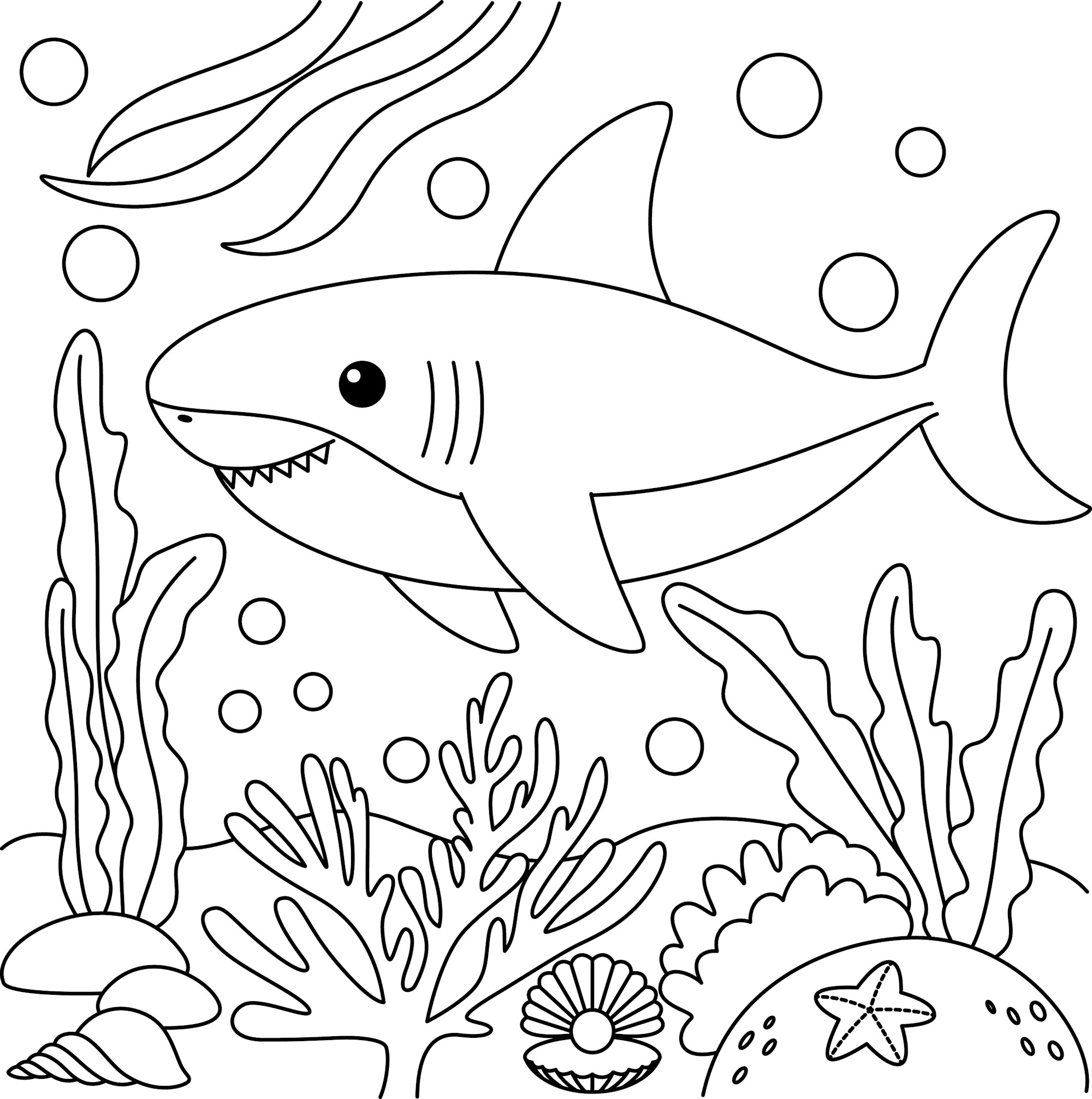
Dive beneath the waves with our collection of shark coloring pages, featuring cute kawaii sharks, hammerheads, lemon sharks, nurse sharks, great whites, blue sharks, bull sharks, tiger sharks, wobbegongs, whale sharks, underwater adventures, treasure chests, pirate ships, and intricate zentangle designs.
Sharks are especially exciting coloring subjects because there is no single “shark look.” Some species are sleek and built for swimming through the open ocean, while others spend much of their time close to the seafloor. Hammerheads have unmistakably wide heads, whale sharks are covered with beautiful spots and lines, tiger sharks have dark markings, and wobbegongs can be so elaborately patterned that they nearly disappear against the ocean bottom.
Our collection includes simple designs for younger children as well as detailed underwater scenes for older kids and adults. You can create a realistic gray-and-white great white, decorate a whale shark with hundreds of spots, turn a zentangle shark into a rainbow, or color a completely ridiculous shark riding a wave on a surfboard.
Choose your favorite printable, grab your crayons, markers, or colored pencils, and get ready to explore the fascinating world of sharks.
🦈 Explore Our Shark Coloring Pages
This collection introduces colorists to an impressive variety of sharks.
You’ll find a cute kawaii shark, plus kid-friendly illustrations of a hammerhead shark, lemon shark, nurse shark, great white shark, blue shark, bull shark, tiger shark, wobbegong, and whale shark.
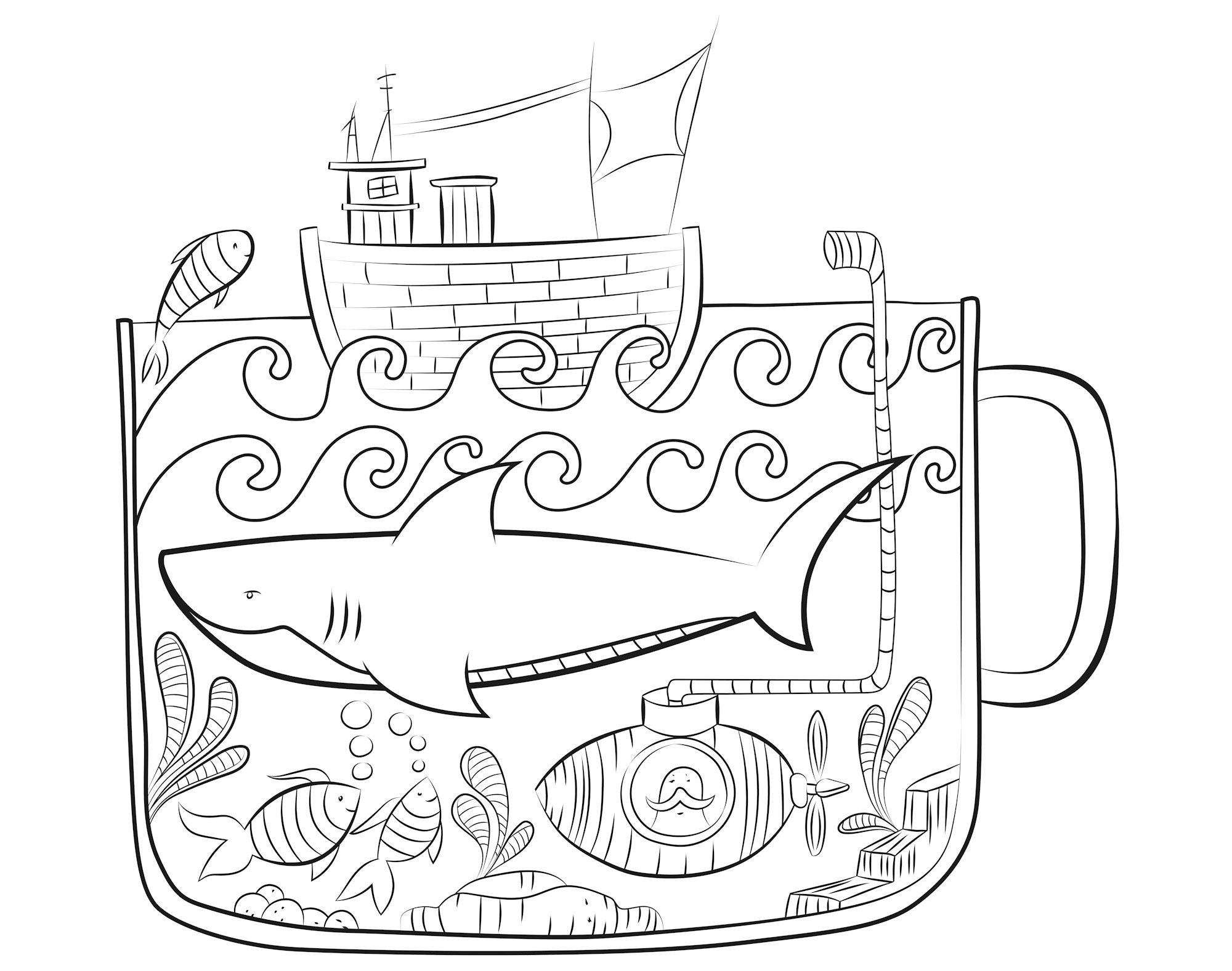
There are imaginative pages too. One shark catches a wave on a surfboard, while another design places an entire little ocean inside a cup. Other pages feature several sharks swimming together, dramatic ocean waves, fish-filled underwater scenes, treasure chests, seaweed, and pirate ships.
Older colorists can choose detailed shark mandalas and zentangle artwork filled with smaller patterns.
That gives you everything from a quick shark coloring activity to an elaborate underwater project that might take several coloring sessions to finish.
For even more marine adventures, explore our Ocean Coloring Pages.
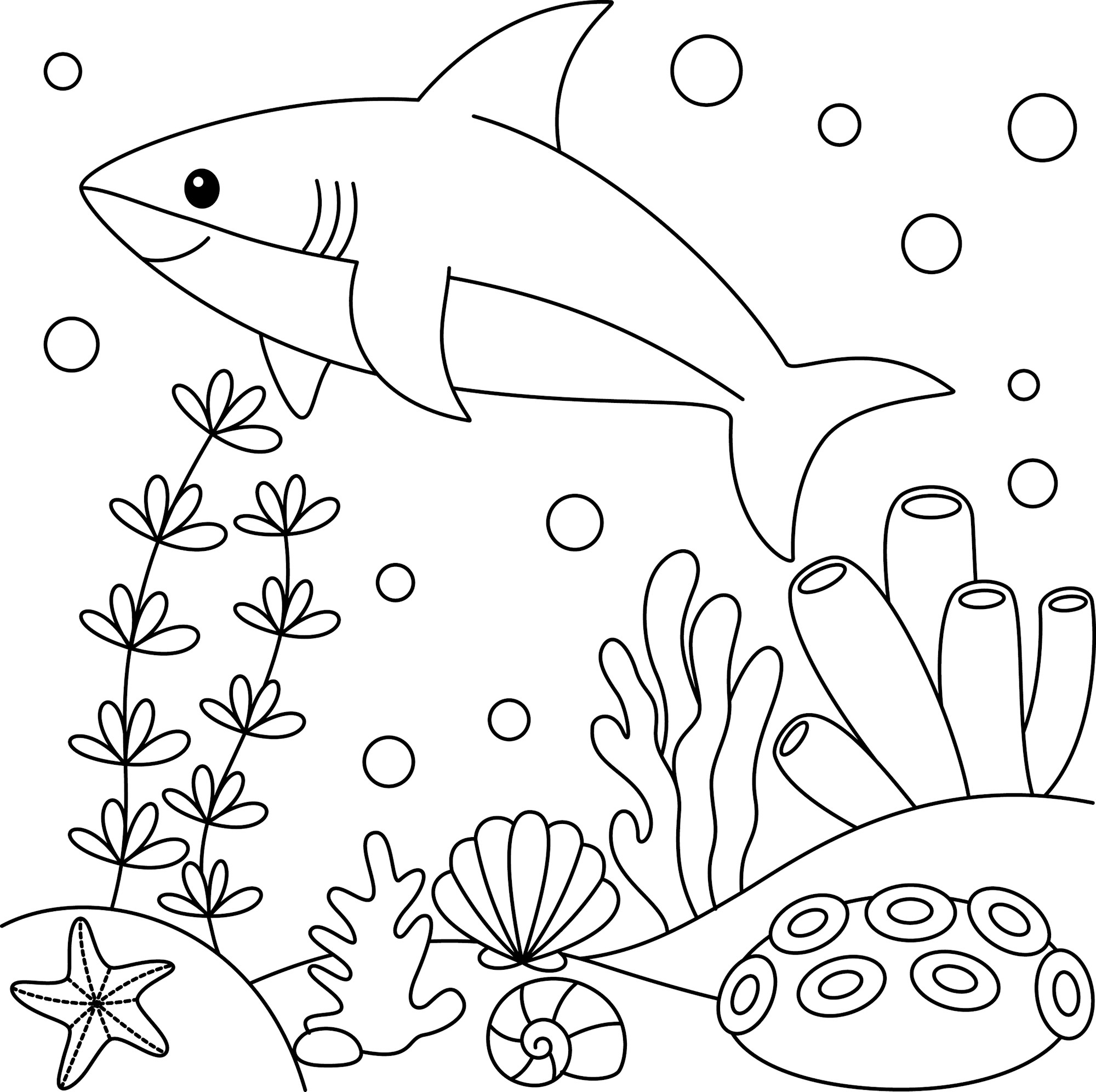
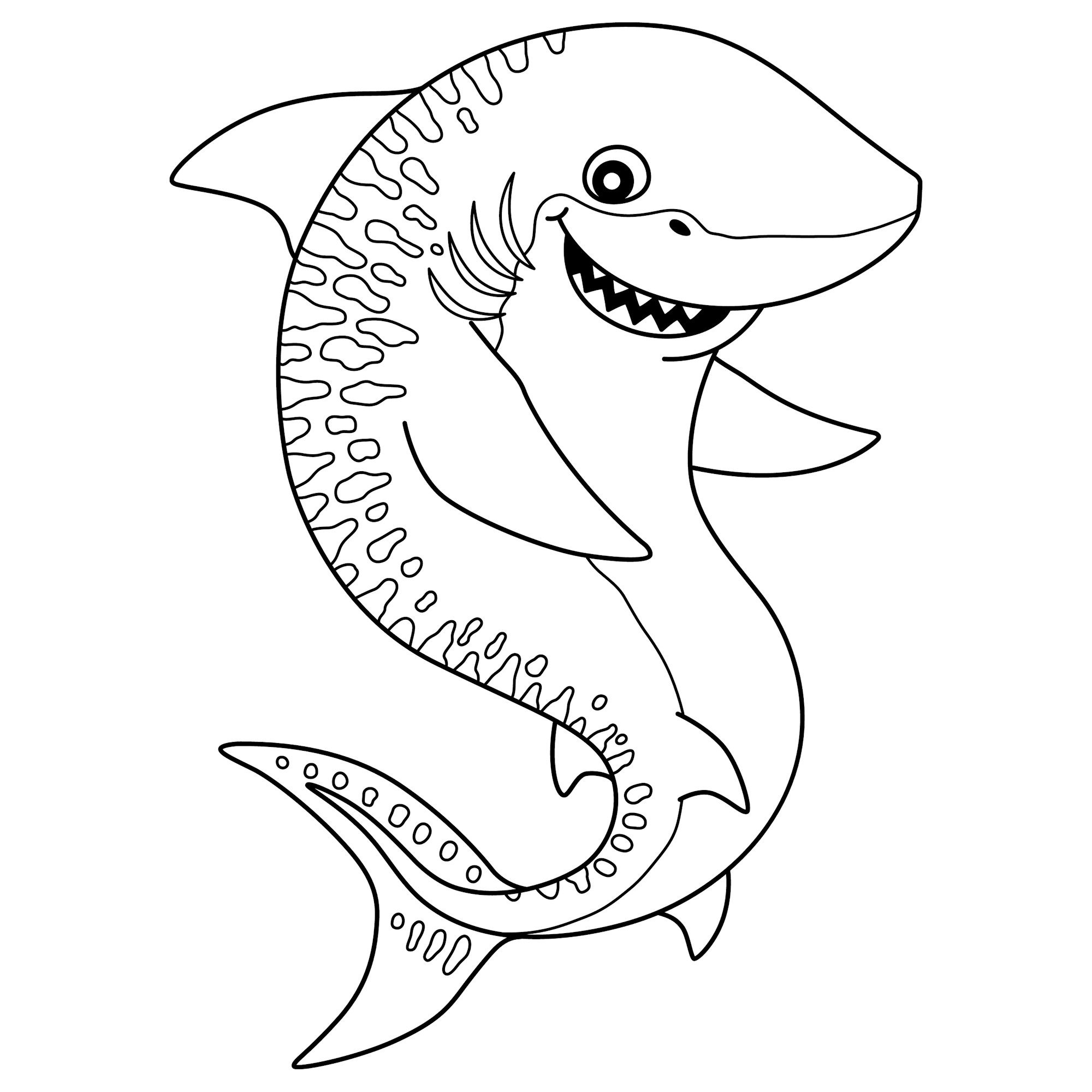
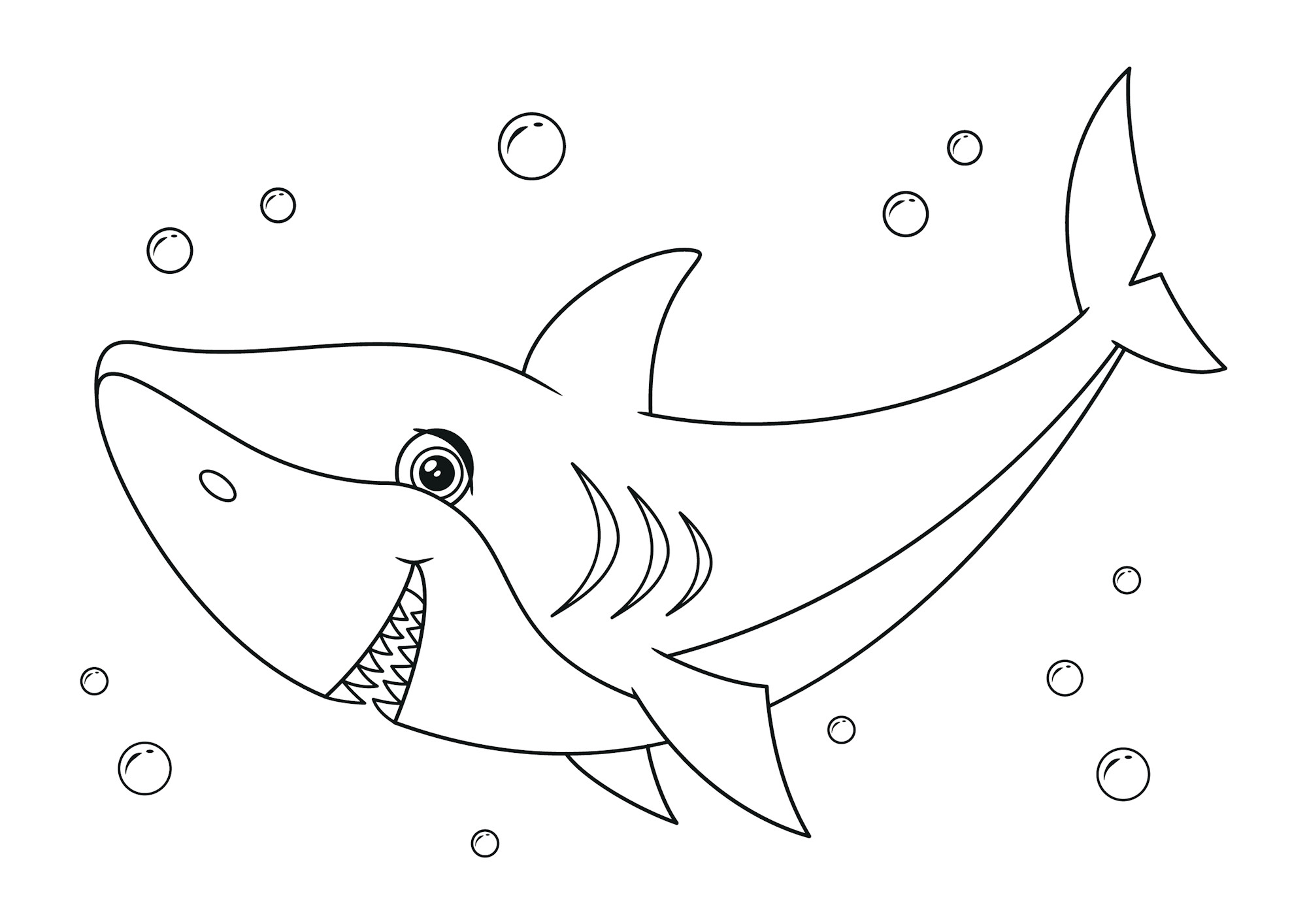
💕 Cute Kawaii Shark Coloring Page
The cute kawaii shark is a friendly place to begin, especially for younger children who might find realistic sharks a little intimidating.
Try a traditional shark palette with blue-gray across the back and pale cream or white underneath.
Or forget about realism altogether.
Make your shark:
- Pink
- Lavender
- Turquoise
- Mint
- Rainbow-colored
- Covered with polka dots
Draw bubbles, little fish, coral, shells, or seaweed around it.
Then give your shark a name.
Perhaps it is Sally Shark, Captain Chomp, Bubbles, or Finley.
For even more adorable designs, explore our Cute Coloring Pages.
🎨 What Colors Are Sharks?
Sharks come in more colors and patterns than the classic gray shark seen in cartoons.
Depending on the species, their bodies may include:
- Gray
- Blue
- Brown
- Bronze
- Olive
- Yellowish brown
- Black
- White
- Spots
- Stripes
- Mottled patterns
Many open-water sharks have darker upper bodies and lighter undersides. This pattern, called countershading, can help make an animal less obvious when viewed from above or below.
Other sharks rely on more elaborate camouflage.
Whale sharks have pale spots and stripes, young tiger sharks have strong dark markings, and wobbegongs can look almost like patterned pieces of the seafloor.
That variety gives colorists plenty to work with.
⚪ Try Shark Countershading
A realistic shark does not need to be one flat gray.
Try coloring the back:
- Dark gray
- Blue-gray
- Charcoal
- Slate blue
Then gradually lighten the sides.
Keep the underside:
- White
- Cream
- Pale gray
- Very light blue
Blend the colors together gently rather than creating one hard dividing line.
This simple technique works especially well for great whites, blue sharks, and several of the other streamlined species in the collection.
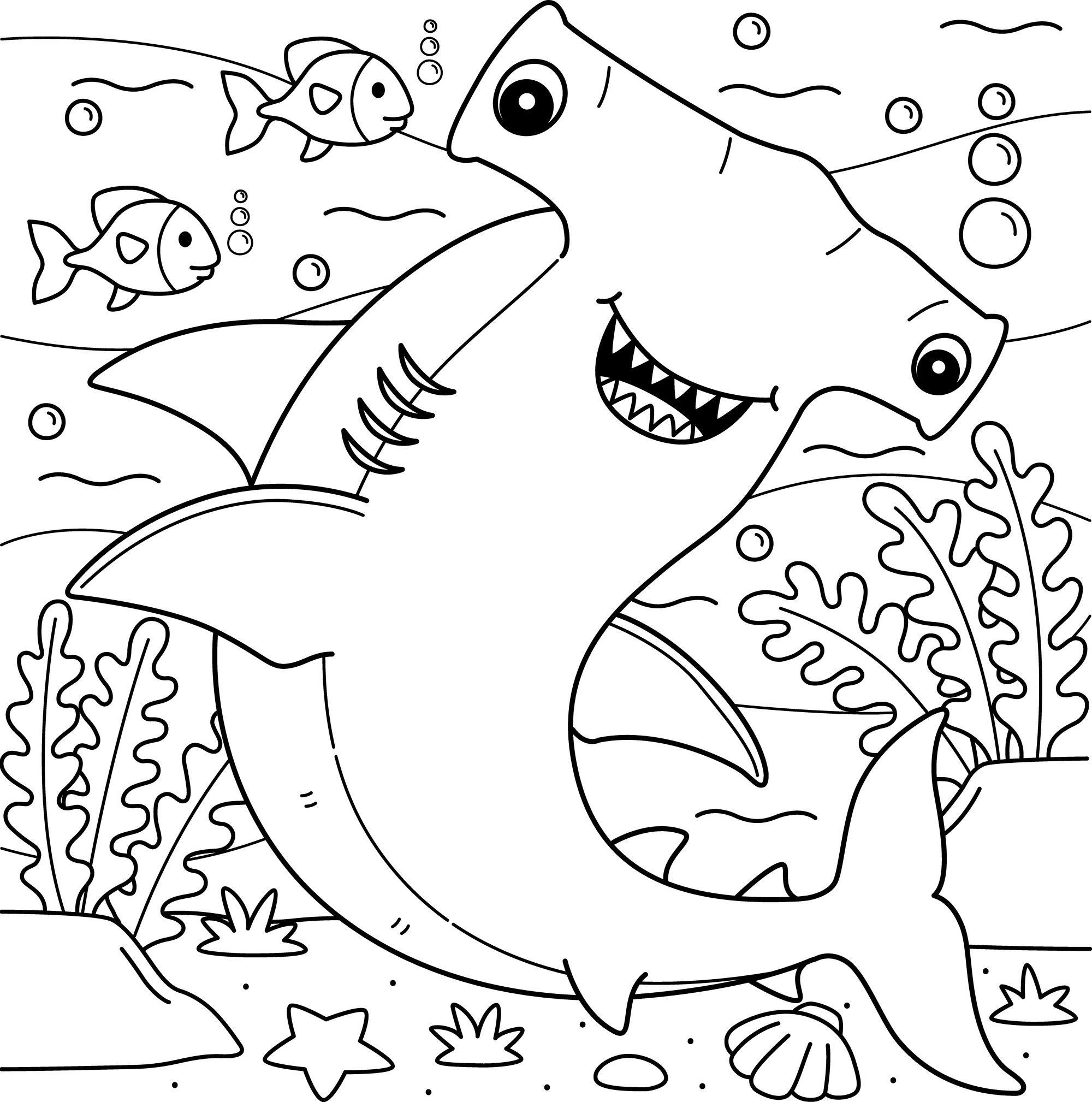
🔨 Hammerhead Shark Coloring Page
Few animals are easier to recognize than a hammerhead shark.
Its unusual head extends outward on both sides, creating the distinctive hammer-like shape that gives the group its name.
Try gray, bronze, olive-gray, or blue-gray across the upper body and keep the underside pale.
Then surround your hammerhead with a coral reef, sandy seafloor, or open ocean.
You could also add several smaller hammerheads in the distance.
Some hammerhead species are known to gather together, making a whole school of hammerheads an exciting underwater scene.
👀 Why Do Hammerheads Have Such Wide Heads?
The unusual head of a hammerhead is called a cephalofoil.
The eyes sit near the ends of the extended head, while sensory structures are spread across it as well.
Like other sharks, hammerheads use several senses to understand their surroundings, including vision, smell, the lateral line system, and sensitivity to weak electrical fields.
The wide head makes an especially interesting observation activity.
Compare a hammerhead with a great white.
How are their heads different?
Where are the eyes?
How does the mouth compare?
Children can color one of each and place them side by side.
🍋 Lemon Shark Coloring Page
Despite its name, a lemon shark is not bright lemon yellow.
Its coloration is generally more subtle, with yellowish-brown, olive, tan, or gray-brown shades that can blend well with sandy coastal environments.
Try:
- Sandy tan
- Olive
- Golden brown
- Gray-brown
- Cream
Keep the underside lighter.
Then add shallow blue-green water and a sandy bottom.
The result can show how natural colors help an animal blend into its habitat.
🌴 Create a Shallow Coastal Shark Scene
Lemon sharks are a great inspiration for a warm, shallow-water landscape.
Draw:
- Sandy bottom
- Seagrass
- Mangrove roots
- Small fish
- Sunlight
- Clear turquoise water
Use pale aqua near the surface and gradually deepen it into turquoise and teal.
Keep the shark in warm tan or olive shades so it remains visible while still looking at home in the environment.
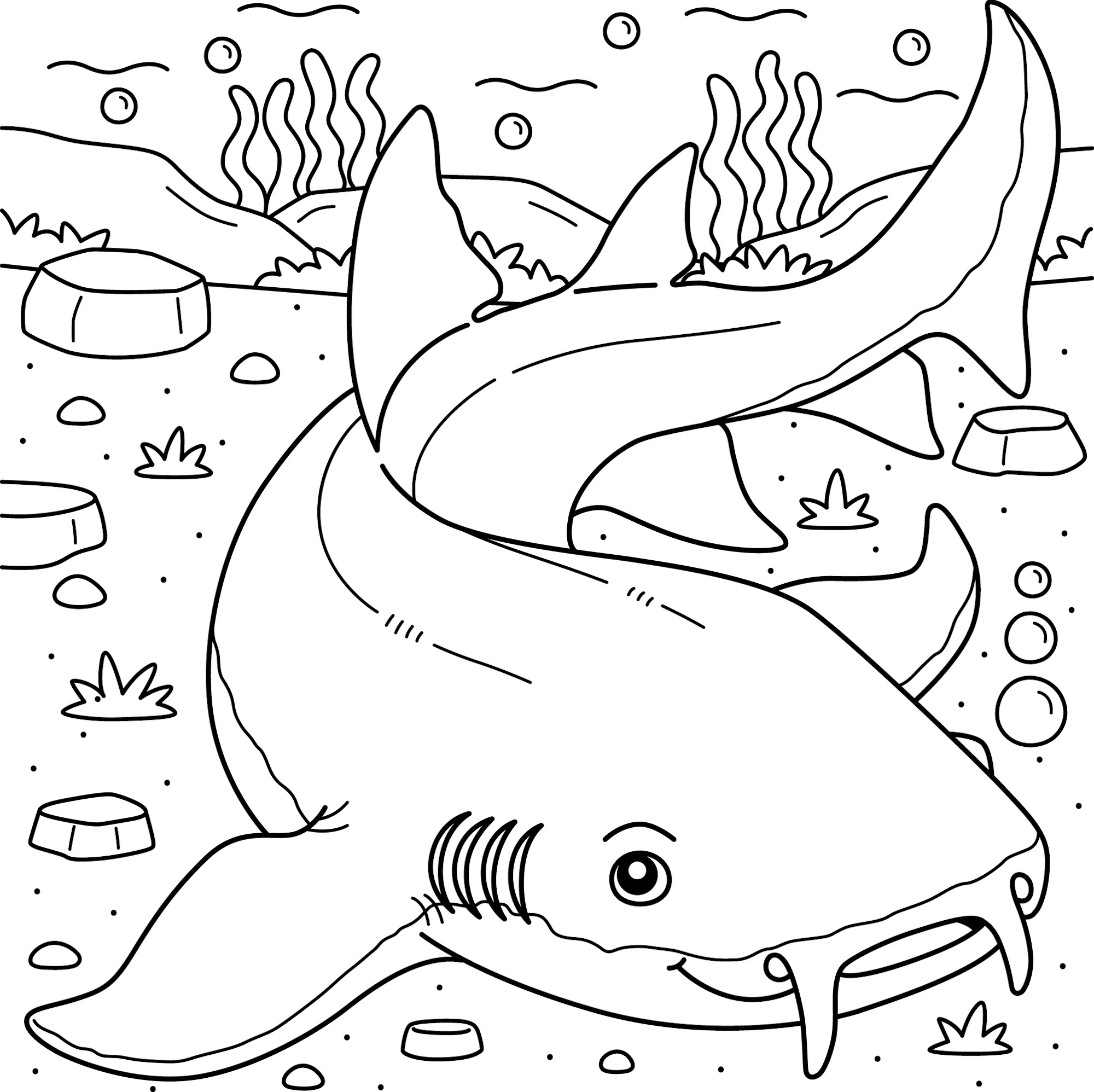
😴 Nurse Shark Coloring Page
The nurse shark has a very different appearance from the classic pointed-nosed great white.
Nurse sharks have broad heads and are often associated with warm coastal waters and the seafloor.
A nature-inspired nurse shark can use:
- Brown
- Yellow-brown
- Gray-brown
- Olive-brown
- Tan
Draw it close to the ocean bottom rather than racing through open water.
Add coral, rocks, sand, shells, and small fish around the shark.
🏖️ Create a Sandy Seafloor
The nurse shark page gives children an opportunity to color an ocean habitat that is not simply blue water.
Create a sandy seafloor with:
- Cream
- Tan
- Golden brown
- Pale gray
Add rocks and coral in brighter colors.
Sea plants might use olive, emerald, teal, or brown.
Then add shafts of pale sunlight reaching down from the surface.
A shark near the bottom can feel completely different from one swimming through deep open water.
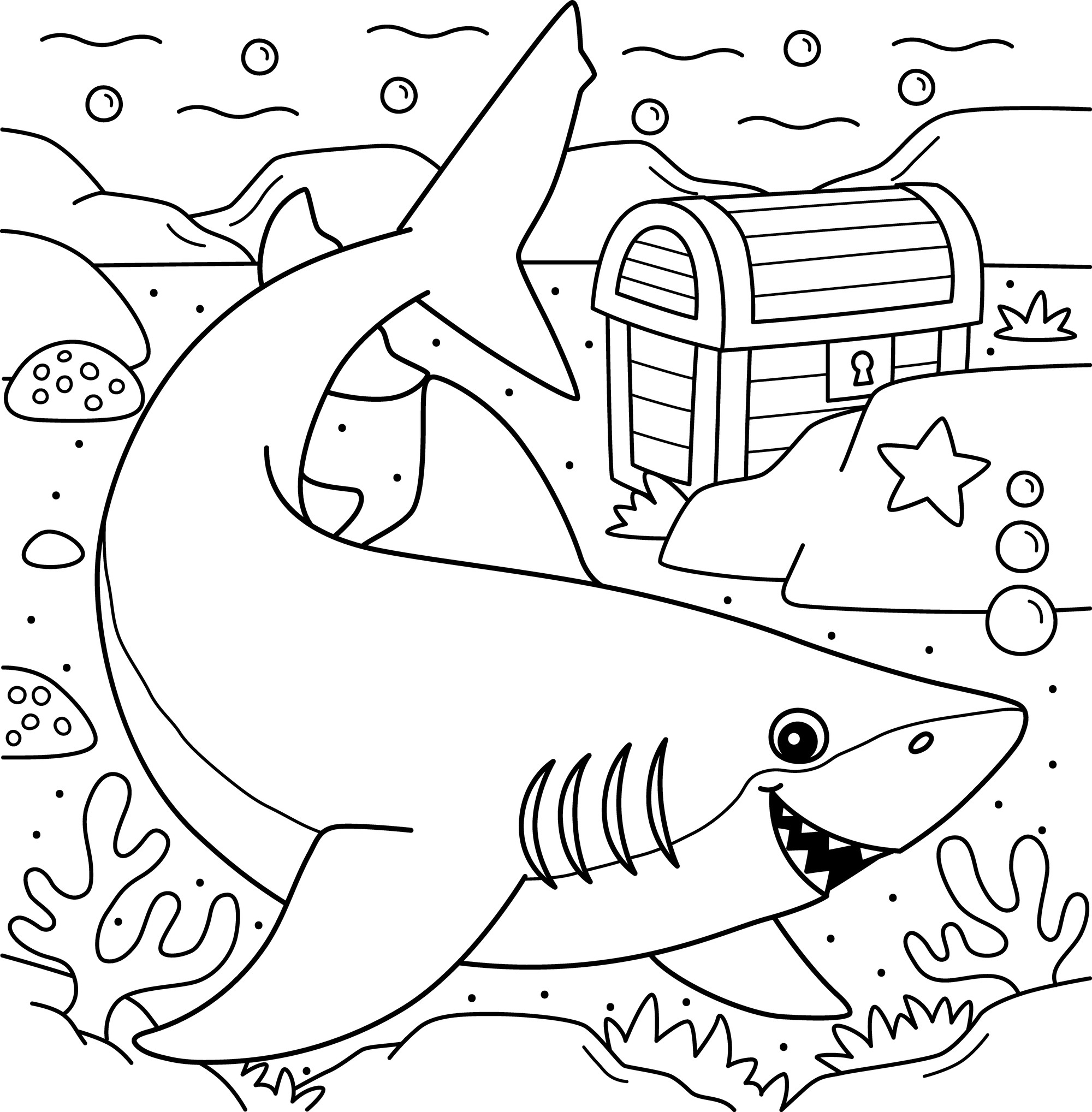
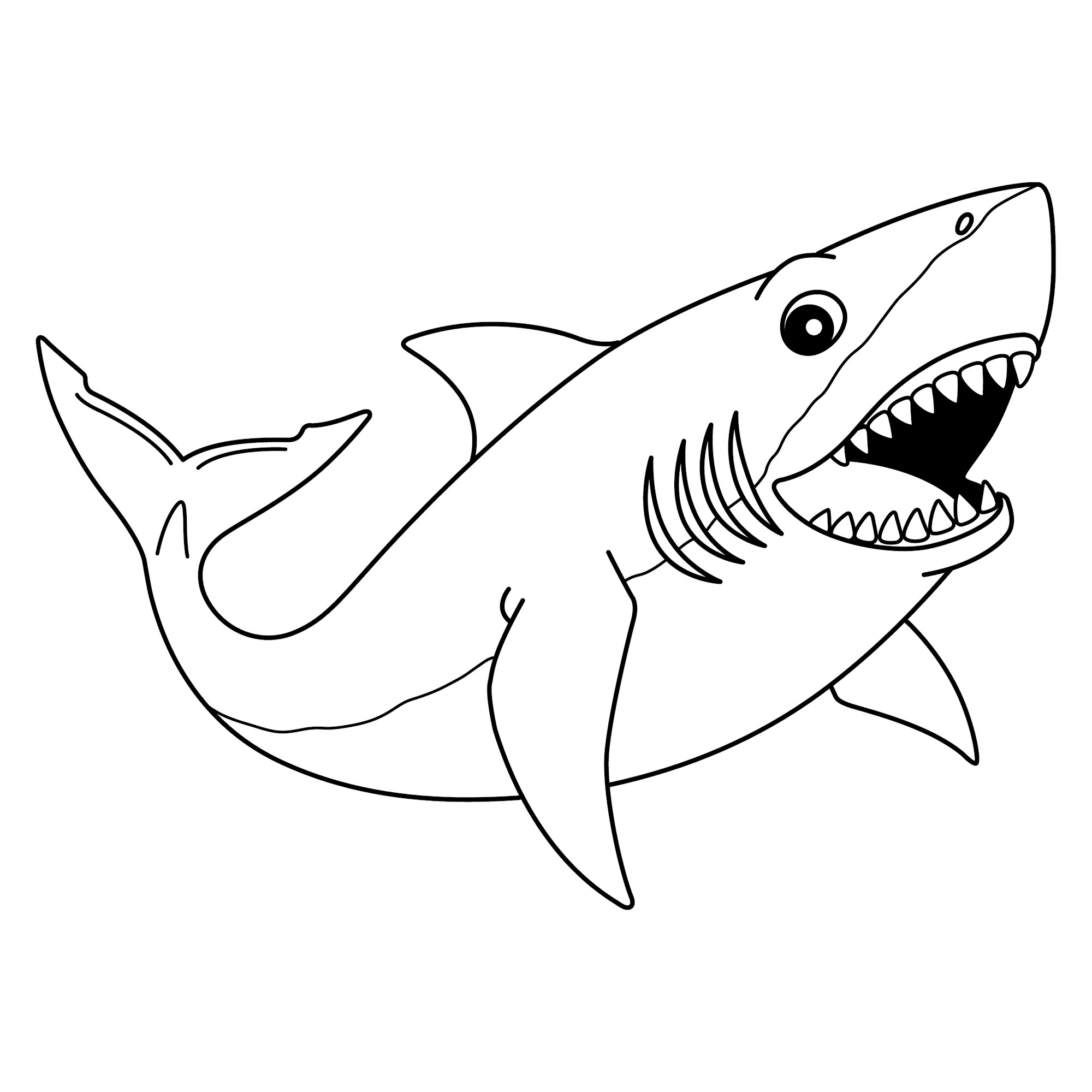
🦷 Great White Shark Coloring Page
The great white shark is perhaps the most famous shark in the world.
A realistic great white has a darker upper body that may appear gray, brown-gray, or blue-gray, with a striking pale underside.
Try:
Back: slate gray or blue-gray
Sides: medium gray
Belly: cream or white
Fins: gray with darker shading
Leave the teeth pale and use dark charcoal inside the mouth for contrast.
Then create a wide-open ocean around the shark.
Great whites have powerful, streamlined bodies, so long flowing water lines can help give the picture a sense of movement.
🦷 Color the Great White’s Teeth
Great white teeth are broad and triangular with serrated edges.
Rather than coloring them bright yellow, keep them pale cream, ivory, or white.
Then use darker shading around the gums and inside the mouth.
Children can also count the visible teeth on the coloring page.
Sharks have something particularly interesting going on with their teeth: throughout their lives, teeth can be lost and replaced by new ones.
That means the teeth visible today are not necessarily the same ones the shark will have later.
🔄 Sharks Replace Their Teeth
Shark teeth are continually replaced.
New teeth develop in rows and can move forward as older teeth are lost.
Different shark species have differently shaped teeth adapted to the foods they eat.
A great white has broad, serrated teeth suited to cutting, while other sharks may have narrow pointed teeth or flatter crushing teeth.
Turn this into a design activity.
Draw three imaginary shark teeth:
- Long and pointed
- Wide and triangular
- Flat and rounded
Then invent a shark that would use each type.
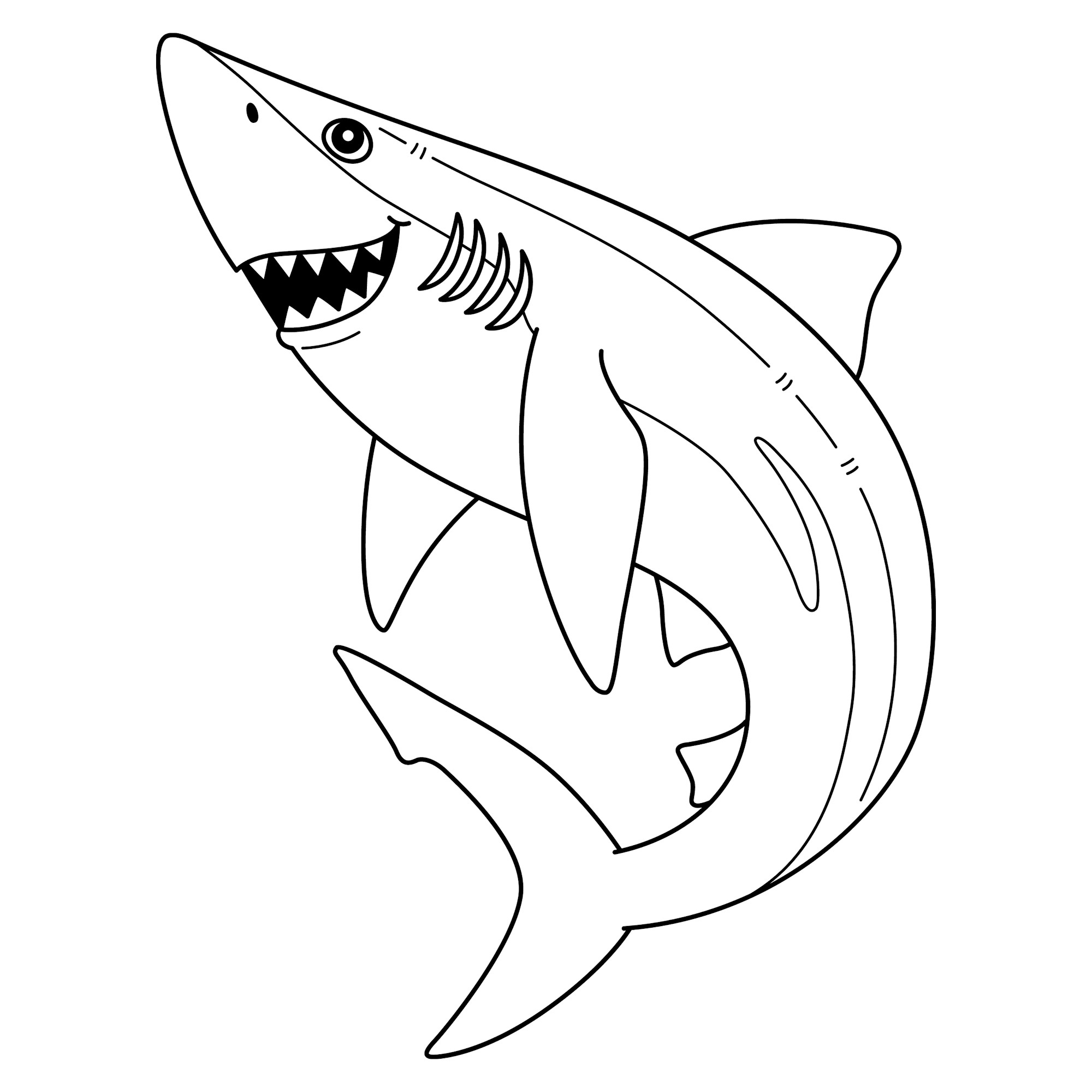
🔵 Blue Shark Coloring Page
The blue shark deserves its name more literally than the lemon shark does.
Blue sharks can display beautiful deep-blue coloration along their upper bodies, fading to lighter blue along the sides and white underneath.
Try:
- Navy
- Cobalt
- Royal blue
- Blue-gray
- Pale blue
- White
Blue sharks also have long, narrow bodies and especially long pectoral fins.
That streamlined appearance makes them wonderful for open-ocean scenes.
Add deep blue water rather than a coral reef and imagine your shark traveling across a vast stretch of sea.
🌊 Create a Deep-Blue Ocean
Try building the entire page from blue shades.
Begin near the surface with:
Aqua
Then move through:
Turquoise
Royal blue
Cobalt
Navy
Keep the deepest part of the scene darkest.
Add pale bubbles and shafts of light from above.
The shark can remain medium blue-gray so its outline is still easy to see.
This monochromatic approach can create a surprisingly dramatic finished picture.
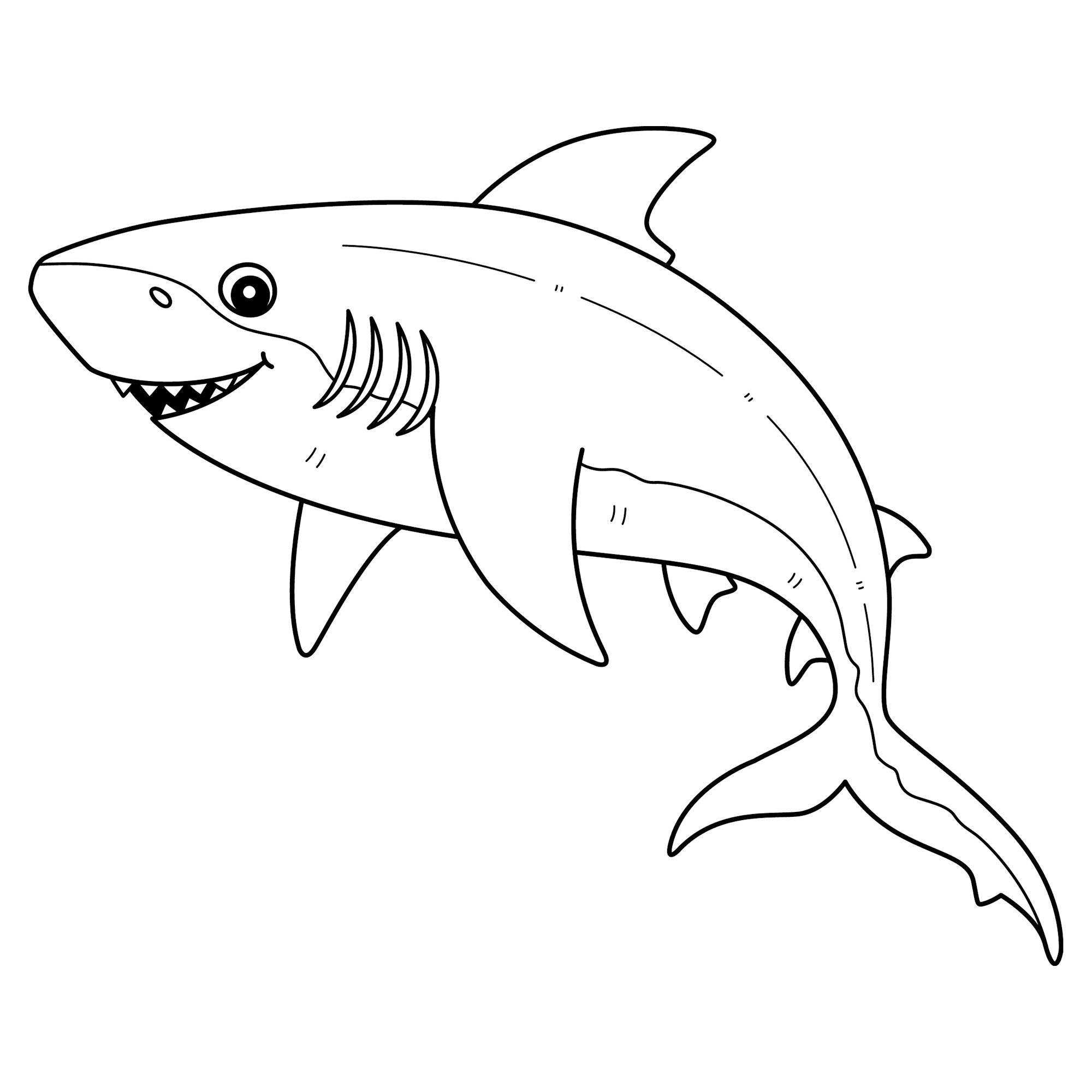
💪 Bull Shark Coloring Page
The bull shark has a stockier appearance than many other sharks.
Try gray, bronze-gray, or blue-gray across the upper body with a light underside.
Bull sharks are especially fascinating because they can tolerate much lower salinity than most sharks and may enter rivers and other brackish or freshwater environments.
That gives you an unusual background option.
Instead of an ocean reef, imagine the shark moving through murkier coastal or river water.
Use olive-green, teal, brown-green, and gray-blue shades to create a very different aquatic environment.
🌊 Sharks in Fresh Water?
Most sharks are marine animals, but the bull shark is famous for its ability to tolerate fresh and brackish water.
Special physiological adaptations allow it to regulate the salts and water inside its body as surrounding salinity changes.
For a simple comparison activity, draw two boxes:
Ocean
and
River
Draw a bull shark in both.
Then add typical surroundings to each habitat.
The ocean might have waves and coral, while the river could have muddy banks, plants, and overhanging trees.
🐯 Tiger Shark Coloring Page
The tiger shark gets its name from the dark markings across its body.
These patterns tend to be especially noticeable on younger animals.
Start with a gray, gray-brown, or bluish body.
Then add darker stripes or blotches along the back and sides.
Try:
- Charcoal
- Dark gray
- Brown-black
Keep the underside lighter.
The markings make this shark especially fun to color because you can exaggerate them for a dramatic picture or turn them into a completely fantasy pattern.
🌈 Design a Rainbow Tiger Shark
Tiger sharks already have stripes, so why not make them colorful?
Try:
Body: Pale turquoise
Stripe 1: Purple
Stripe 2: Blue
Stripe 3: Green
Stripe 4: Yellow
Stripe 5: Orange
Or use a dark navy shark with glowing silver stripes.
Children can invent a species name such as:
Rainbow Reef Tiger Shark
or
Midnight Striped Shark
Then decide where the imaginary species lives.
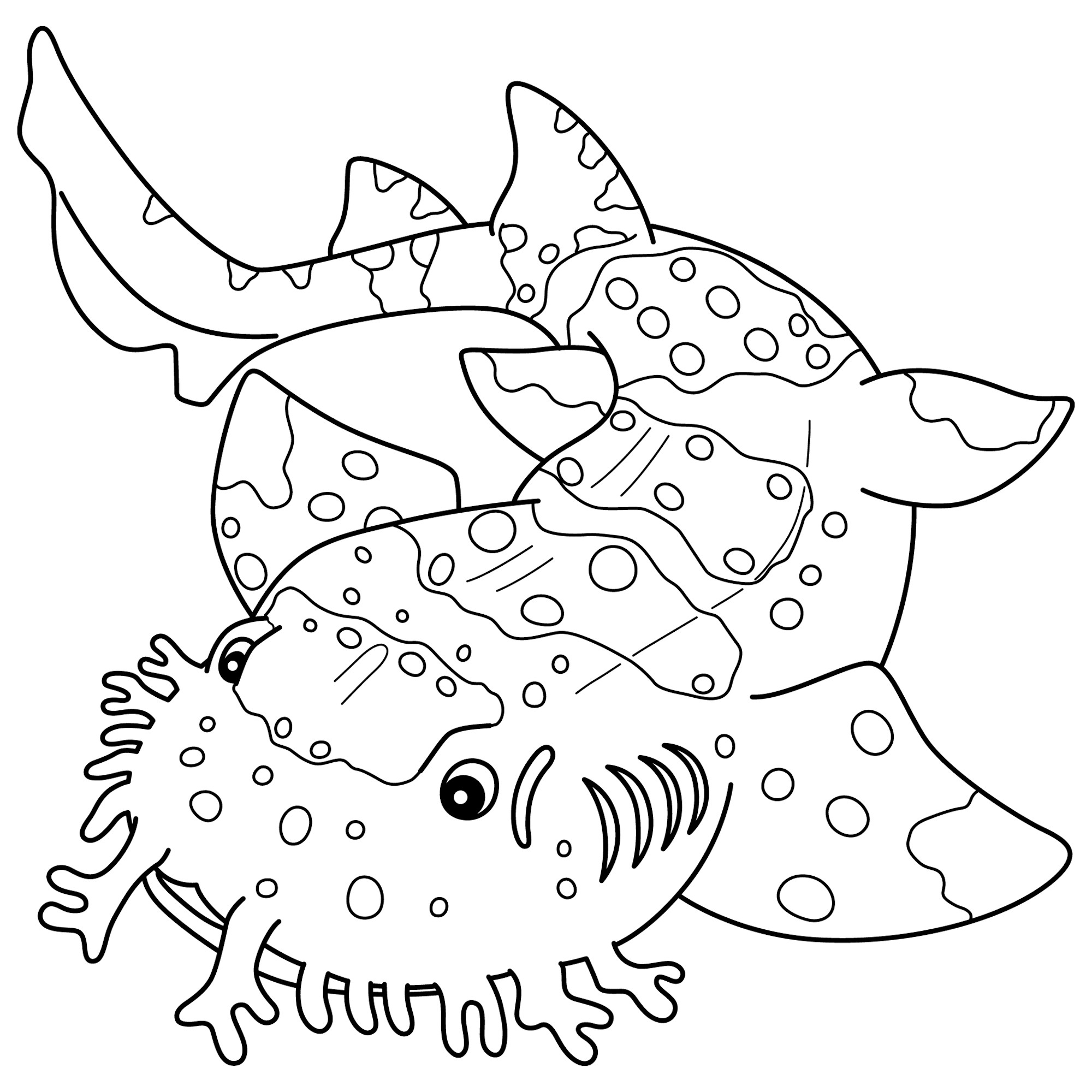
🪨 Wobbegong Shark Coloring Page
The wobbegong is one of the most unusual sharks in the collection.
Wobbegongs are members of a group often called carpet sharks, and their broad, flattened bodies and complicated patterns can help them blend into the seafloor.
This is the perfect shark for a camouflage challenge.
Use:
- Brown
- Tan
- Cream
- Rust
- Olive
- Gray
Then create rocks, coral, sand, and sea plants using many of the same shades.
The goal is to make the shark slightly difficult to spot.
👀 Can You Hide the Wobbegong?
Turn the page into an art experiment.
First color the wobbegong.
Then build the background using matching colors and patterns.
If the shark is brown and cream, use brown and cream rocks.
If it has olive markings, add olive seaweed.
When you are finished, show someone the picture from across the room.
How quickly can they find the shark?
The activity demonstrates how camouflage can make an animal less noticeable in its surroundings.
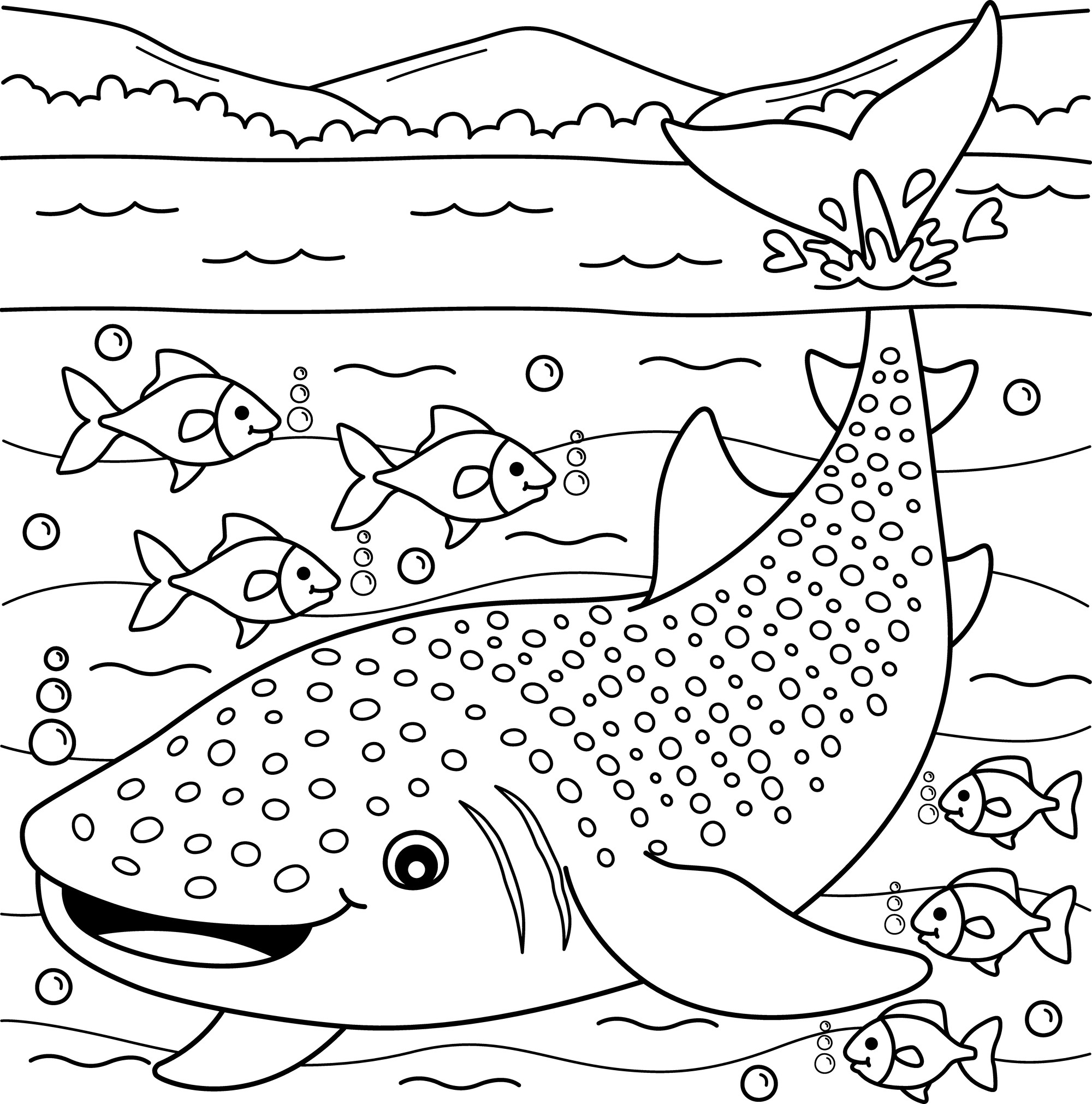
⚪ Whale Shark Coloring Page
The whale shark is one of the most striking designs in the collection.
Despite its name, it is not a whale.
It is a shark—and the largest living fish.
Whale sharks have dark bodies covered with beautiful pale spots and lines.
Try:
- Blue-gray
- Slate
- Brown-gray
- Deep blue
- White or cream spots
Take your time with the pattern.
The spots can remain pale while the surrounding body becomes darker, producing a wonderful contrast.
🐋 Is a Whale Shark a Whale?
No.
A whale shark is a fish, not a marine mammal.
Like other sharks, it has a skeleton primarily made of cartilage rather than bone and breathes using gills.
Whales, by contrast, are mammals. They breathe air using lungs and must regularly come to the surface.
Color a whale shark and a whale on separate sheets and compare them.
Whale Shark
- Fish
- Gills
- Cartilage skeleton
Whale
- Mammal
- Lungs
- Breathes air
Two enormous ocean animals can be very different biologically.
🥄 Whale Sharks Are Filter Feeders
The enormous whale shark may look intimidating simply because of its size, but it feeds very differently from a great white.
Whale sharks are filter feeders.
They take in water containing small organisms and food such as plankton, fish eggs, and other tiny prey, then separate the food from the water.
That creates an interesting contrast:
Great white: active predator
Whale shark: filter feeder
Children can draw tiny dots around the whale shark to represent plankton.
📏 The Largest Fish in the Ocean
Whale sharks are the largest living fish.
That makes them perfect for a size-comparison activity.
Draw:
- Small tropical fish
- Dolphin
- Human swimmer
- Whale shark
Place them side by side.
You do not need an exact scale for younger children. The main idea is simply that sharks come in dramatically different sizes.
Some are relatively small.
Others are enormous.
There is no single standard shark shape or size.
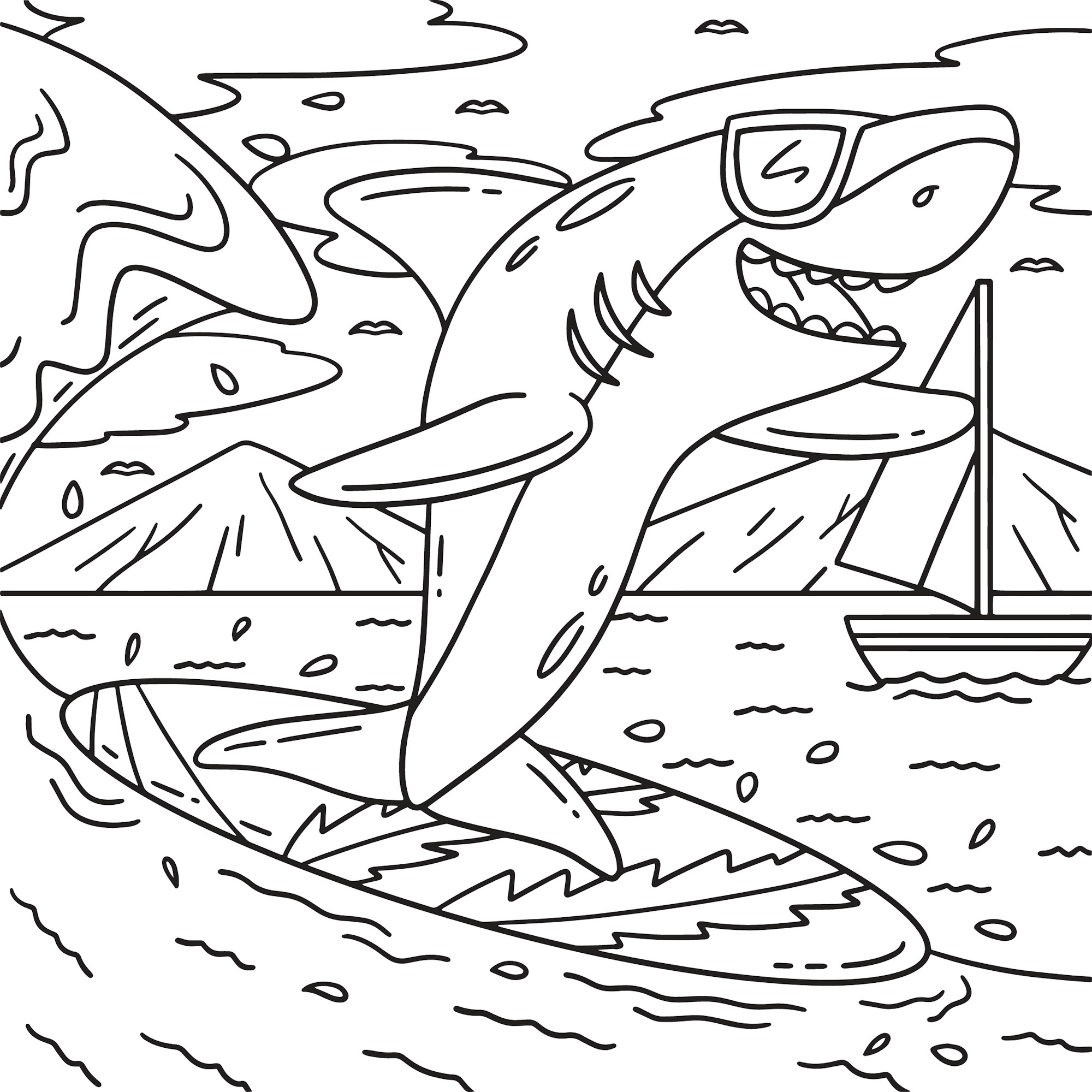
🏄 Surfing Shark Coloring Page
One of the funniest pictures in the collection shows a shark surfing on a wave.
Real sharks obviously do not grab surfboards, which means this page can be as colorful as you want.
Give the shark sunglasses.
Color the board:
- Red
- Yellow
- Turquoise
- Purple
- Rainbow
Add huge curling blue waves behind it.
Perhaps the shark is competing in the Annual Underwater Surf Championship.
Give it a number and invent a score.
🌊 Color a Giant Ocean Wave
The surfing-shark page is a perfect opportunity to experiment with water.
Do not use just one blue.
Try layering:
- Pale aqua
- Turquoise
- Sky blue
- Royal blue
- Navy
Keep the foamy crest white with pale blue shadows.
Use curved lines that follow the movement of the wave.
A little variation in blue can make the water feel much more energetic.
☕ Ocean in a Cup Coloring Page
One of the most imaginative designs is an entire ocean contained inside a cup.
This page invites fantasy coloring.
Maybe the cup contains:
- Sharks
- Waves
- Fish
- Coral
- Tiny islands
- Treasure
Decorate the outside of the cup too.
Try seashells, stars, waves, anchors, or shark fins.
Then imagine how the ocean got inside.
Is it a magical cup?
Does it contain a portal?
Can someone shrink down and swim inside?
A coloring page this strange practically demands a story.
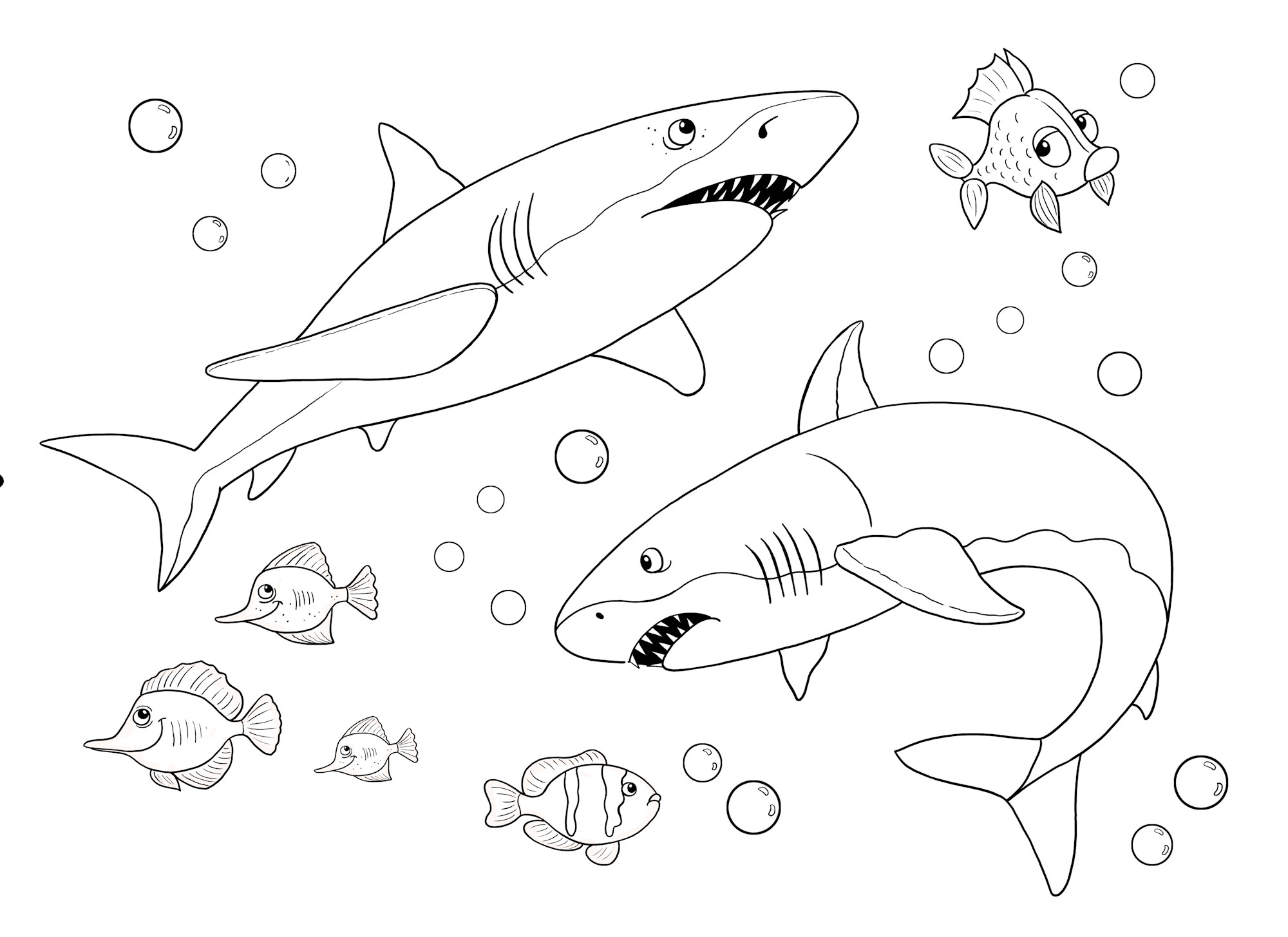
🦈 Sharks Swimming Together
Several illustrations show multiple sharks swimming through the ocean, allowing you to create more elaborate marine scenes.
Do not make every shark identical.
Color one blue-gray.
Make another charcoal.
Give another bronze tones.
Add a lighter shark farther in the distance.
Using slightly different colors can help separate the animals visually.
You can also use lighter blues for distant sharks and stronger contrasts for those closest to the viewer.
🌊 Ocean Waves and Swimming Sharks
The sharks among oceanic waves design combines powerful animals with equally dramatic water.
Choose whether the scene takes place near the sunny surface or beneath stormy waves.
For a bright version, use turquoise, aqua, and blue.
For something dramatic, try slate blue, navy, gray, and purple.
Add white foam along the waves.
Keep the sharks darker beneath the surface so they appear to emerge from the blue water.
🐠 Shark and Fish Coloring Page
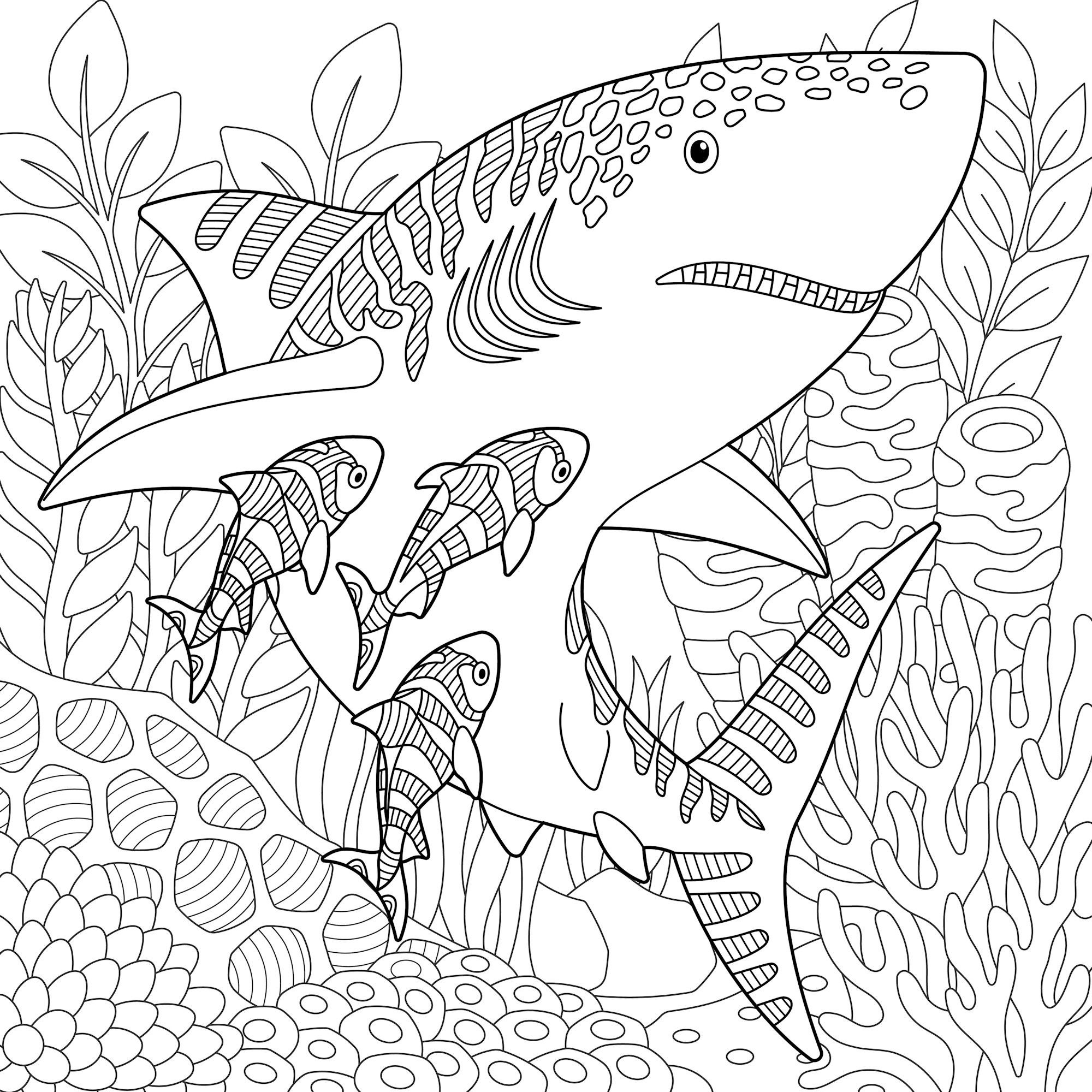
One detailed adult coloring page places a shark among smaller fish.
This gives you a chance to contrast a relatively neutral shark with brightly colored tropical fish.
Keep the shark:
- Gray
- Blue-gray
- Brown-gray
Then use bright:
- Yellow
- Orange
- Pink
- Turquoise
- Purple
- Green
on the surrounding fish.
The shark will remain the visual focus without requiring every part of the page to use the same subdued palette.
🪸 Create a Coral Reef
A shark coloring page with open space can become a whole reef.
Add:
- Coral
- Sea fans
- Tropical fish
- Seaweed
- Crabs
- Sea stars
- Shells
- Rocks
Try bright colors such as coral pink, orange, purple, yellow, turquoise, and lime.
Some sharks regularly occur around reef habitats, so a reef can be a natural setting for several species.
For a bigger underwater scene, visit our Under the Sea Coloring Pages.
💰 Shark and Treasure Chest Coloring Page
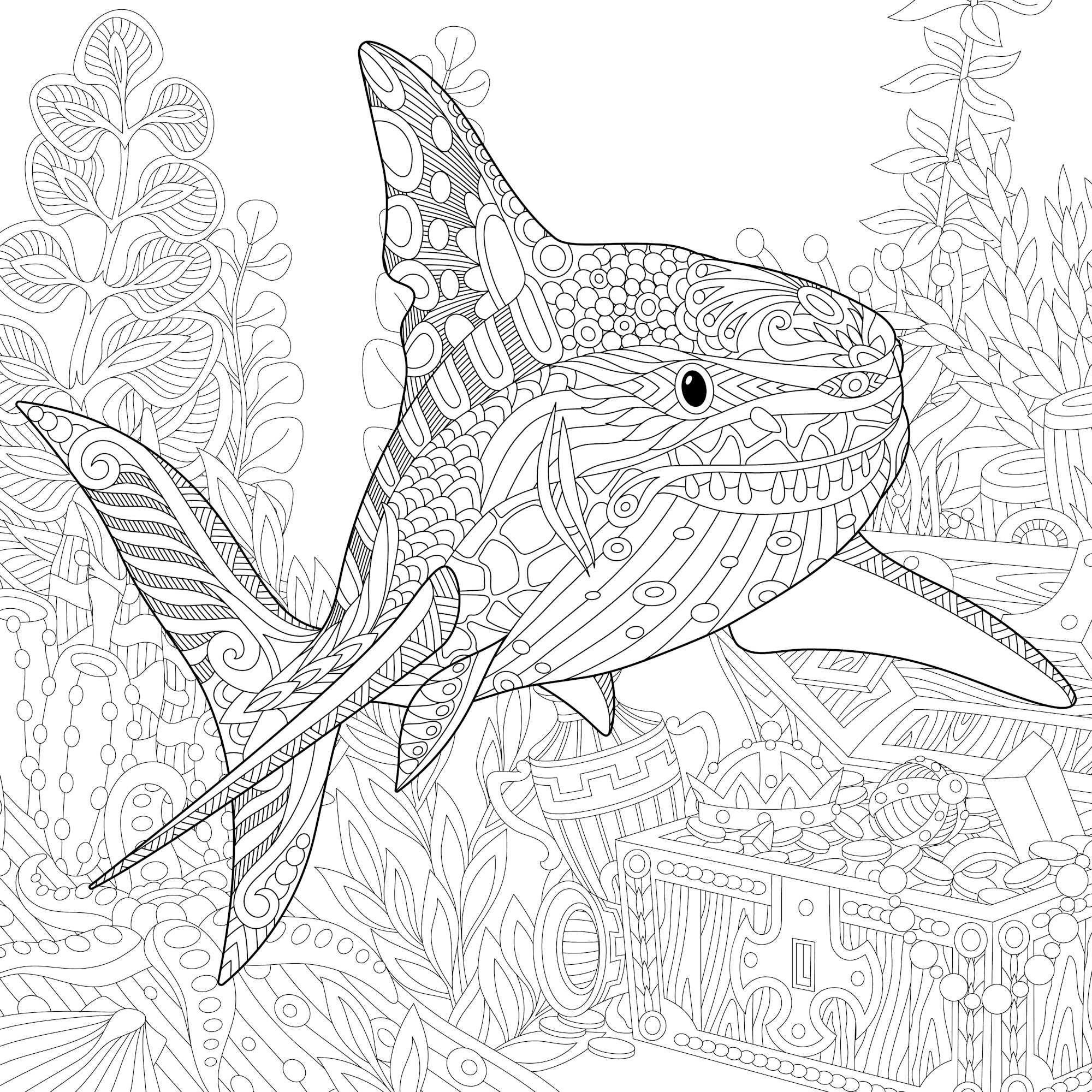
One elaborate design features a shark swimming among seaweed beside a treasure chest overflowing with gold.
This is perfect for deep-ocean adventure colors.
Make the shark blue-gray or charcoal.
Then use:
Treasure chest: brown and gold
Coins: golden yellow
Seaweed: green, olive, teal
Water: dark blue and turquoise
Add gemstones in ruby red, emerald green, sapphire blue, and purple.
The treasure immediately creates a mystery.
Who left it there?
How long has it been underwater?
And is the shark guarding it?
🏴☠️ Pirate Ship and Shark Coloring Scene
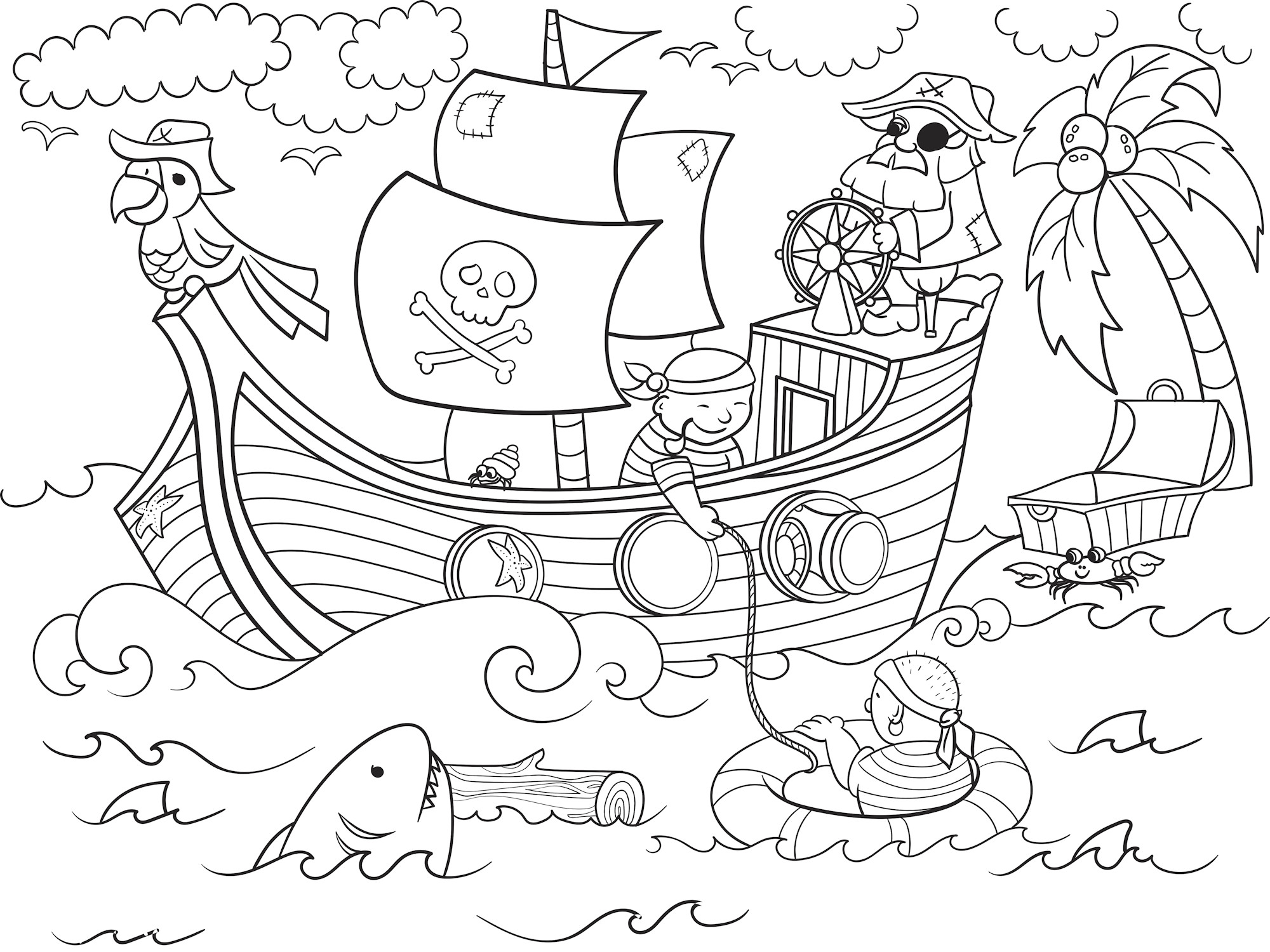
Another detailed design brings pirate ships and the sea into the shark collection.
Color wooden ships in chestnut, tan, and dark brown, then add black, red, or striped sails.
The ocean can use several blues and greens.
Add golden sunset colors to the horizon if you want a dramatic adventure scene.
Then imagine the story.
Perhaps the crew is searching for the same treasure chest seen on another coloring page.
Maybe the shark knows exactly where it is hidden.
Several different printables can become illustrations for one long pirate-and-shark adventure.
📖 Write a Shark Treasure Story
Start with:
A shark discovered a treasure chest at the bottom of the sea…
Then decide what happens.
Perhaps the chest contains:
- Gold coins
- A mysterious map
- A magical pearl
- A tiny crown
- A message in a bottle
- Nothing but seashells
Younger children can tell the story aloud.
Older kids can write several paragraphs.
Use the finished treasure coloring page as the illustration.
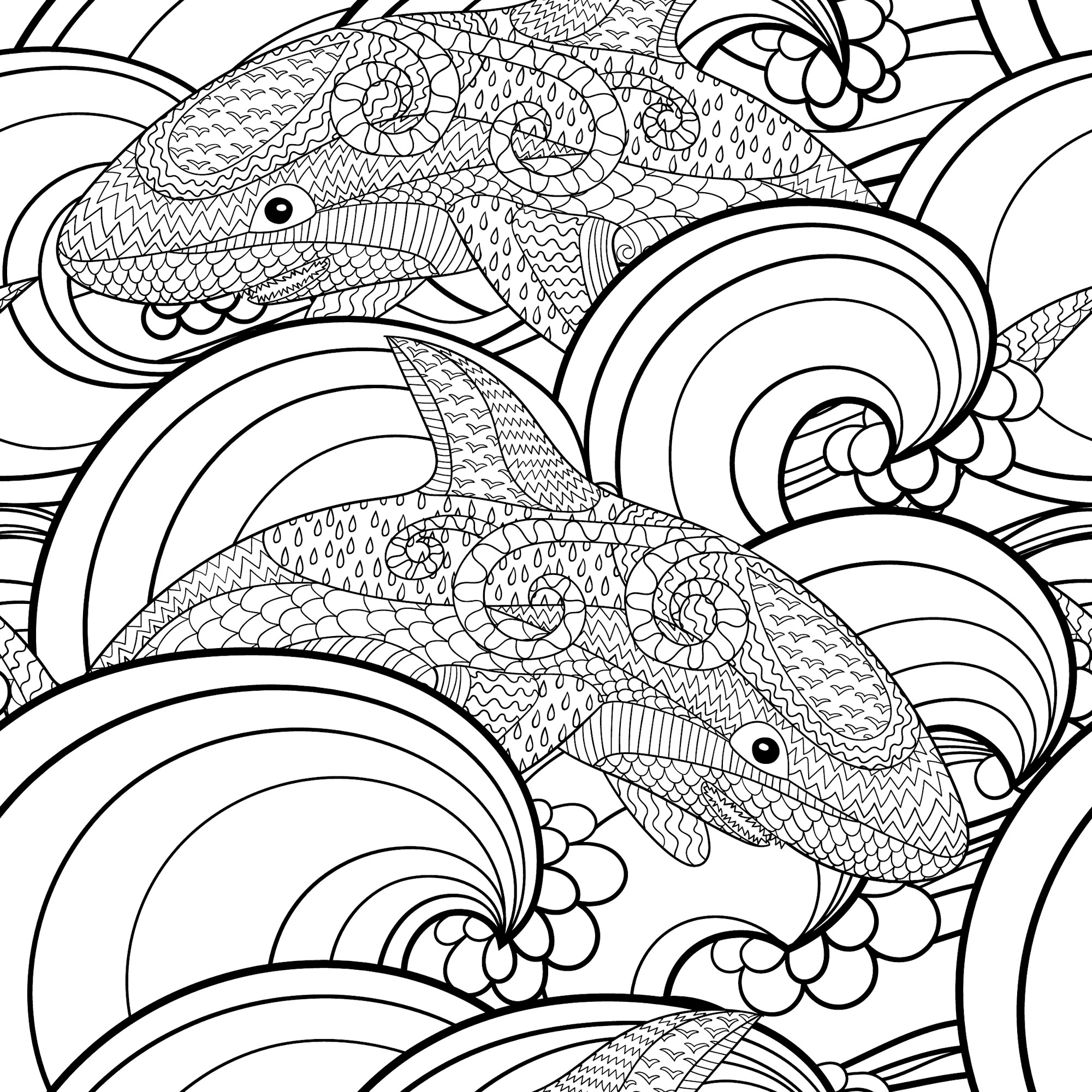
🌀 Shark Zentangle Mandala
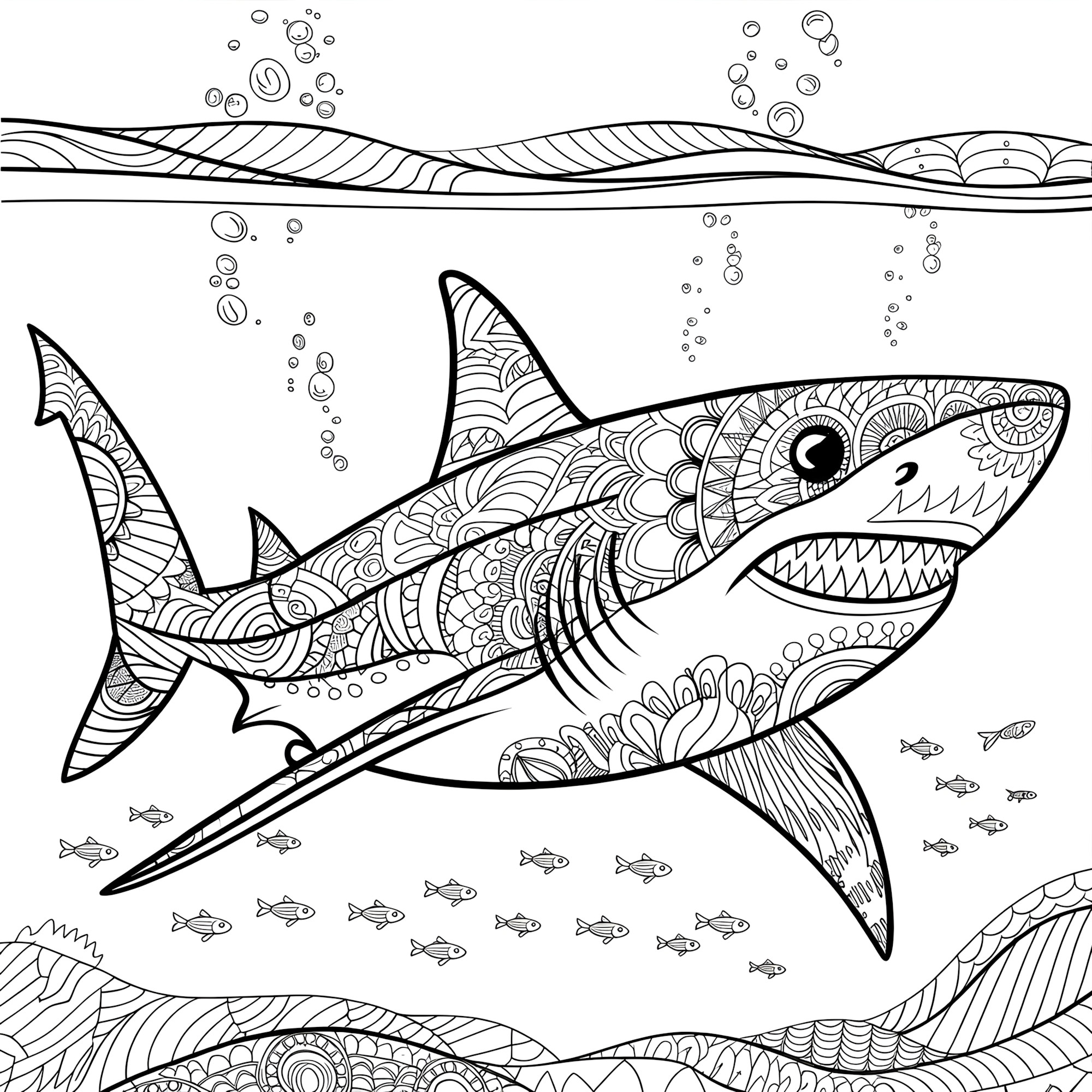
The shark in zentangle-style mandala patterns is ideal for older kids, teens, and adults.
Realistic shark colors are unnecessary here.
Treat each section as a miniature design.
Try:
Deep Ocean Palette
Navy, turquoise, teal, purple, silver
Tropical Palette
Coral, yellow, turquoise, lime, violet
Fire Shark
Red, orange, yellow, burgundy, black
Galaxy Shark
Navy, purple, blue, silver, black
Rainbow Shark
Red, orange, yellow, green, blue, purple
Fine-tip markers or sharpened colored pencils work particularly well with the smaller details.
🌈 Create a Fantasy Shark Species
After coloring the realistic sharks, invent one that has never existed.
Maybe it is a:
Rainbow Shark — multicolored stripes from nose to tail.
Moon Shark — navy with glowing silver spots.
Fire Shark — orange, red, and gold.
Coral Shark — pink and purple with reef-like patterns.
Ice Shark — pale blue, white, and silver.
Galaxy Shark — dark purple with tiny stars.
Give your species a name.
Then decide:
Where does it live?
What does it eat?
How large does it grow?
Does it live alone or with other sharks?
🧠 What Makes a Shark a Shark?
Sharks are fish, but they belong to a different major group from familiar bony fish such as tuna or goldfish.
A shark’s skeleton is made primarily from cartilage rather than bone.
Cartilage is also found in parts of the human body, including the nose and ears.
Sharks also have several visible gill openings along the sides of the head.
Look at one of the realistic coloring pages and find:
- Dorsal fin
- Pectoral fins
- Tail
- Gills
- Eyes
- Mouth
Older children can label the parts after coloring.
🦴 Sharks Do Not Have Bony Skeletons
The skeletons of sharks and rays are built primarily from cartilage.
That makes sharks part of the fish class Chondrichthyes, a group that also includes rays and skates.
Create a simple comparison:
Shark
Cartilage skeleton
Typical Bony Fish
Bone-based skeleton
Children could draw one of each and compare their body shapes.
The difference is inside the animal, so it may not be obvious just from looking at a coloring page.
🫁 How Do Sharks Breathe?
Sharks take oxygen from water using gills.
Look behind the shark’s head and find the gill openings.
Most familiar shark species have five pairs of gill slits, although some sharks have six or seven.
Water passes over the gills, allowing oxygen to move into the bloodstream.
This is very different from dolphins and whales, which have lungs and must surface to breathe air.
That makes shark and dolphin coloring pages useful for comparing fish and mammals.
👃 Sharks Have Remarkable Senses
Sharks use several senses to explore their environment.
These include:
- Smell
- Vision
- Hearing
- Touch
- Lateral-line sensing
- Electroreception
The lateral line helps detect movement and pressure changes in surrounding water.
Sharks also have special sensory organs called the ampullae of Lorenzini, which can detect weak electrical fields.
These sensory systems help sharks locate and understand things happening around them—even when visibility is poor.
⚡ Sharks Can Detect Electrical Fields
Living animals produce tiny electrical signals through muscle and nerve activity.
Sharks and their close relatives have specialized sensory structures that allow them to detect very weak electric fields at close range.
This can help a shark locate prey even when an animal is partly hidden in sand.
Turn this into an imaginary activity.
Draw a fish hidden beneath the seafloor.
Then draw dotted “electric signal” lines toward the shark’s head.
It is almost like giving the shark a special underwater sense.
👃 Can Sharks Smell?
Yes, smell is another important shark sense.
But the familiar claim that every shark can detect one tiny drop of blood from miles away is an oversimplified myth.
Different smells, currents, concentrations, shark species, and environmental conditions all matter.
For kids, the useful idea is simple:
Sharks have highly developed senses that help them find food and navigate their environment.
That is already impressive enough without exaggeration.
✋ Shark Skin Is Not Smooth Like Dolphin Skin
A shark’s skin is covered with tiny structures called dermal denticles.
These tooth-like scales can make the skin feel rough when rubbed in one direction.
Dermal denticles also help manage the flow of water across the body.
Try adding tiny repeating marks to a detailed shark coloring page.
You do not need to draw every denticle—there would be far too many.
A little texture can simply suggest that shark skin is not plain and smooth.
🐬 Shark vs. Dolphin
Sharks and dolphins may have superficially similar streamlined bodies, but they belong to completely different animal groups.
Shark
- Fish
- Gills
- Cartilage skeleton
- Does not need to surface for air
Dolphin
- Mammal
- Lungs
- Bone skeleton
- Must surface to breathe
Their tails move differently too.
A shark’s tail fin is primarily vertical, while a dolphin’s tail flukes extend horizontally.
Color one of each and see how many differences you can find.
Continue with our Coloring Pages of Dolphins.
🐢 Shark vs. Sea Turtle
Both sharks and sea turtles can travel through the ocean, but they belong to completely different groups.
A shark is a fish.
A sea turtle is a reptile.
The turtle has lungs and must surface to breathe, while the shark extracts oxygen from water through its gills.
The turtle has a shell and flippers.
The shark has fins and a streamlined body.
Color one of each and create a simple comparison chart.
Then explore our Coloring Pages of Turtles.
🪼 Sharks and Jellyfish
A shark and jellyfish may share the ocean, but their body structures could hardly be more different.
The shark is a vertebrate with an internal cartilage skeleton.
A jellyfish is an invertebrate with no backbone.
One is built for powerful swimming.
The other may drift with currents while also swimming through pulsing body movements.
Put one of each in an underwater scene and compare their shapes.
Visit our Coloring Pages of Jellyfish for more drifting sea creatures.
🐙 Build an Ocean Animal Collection
Sharks can become one part of a much larger homemade marine-life book.
Add:
- Coloring Pages of Dolphins
- Coloring Pages of Turtles
- Coloring Pages of Jellyfish
- Octopus Coloring Page for Kids
Write each animal’s name at the top.
Older children can add:
- Animal group
- Habitat
- Diet
- One interesting fact
Staple everything together and design an ocean-themed cover.
🌎 Where Do Sharks Live?
Sharks occupy marine environments around the world.
Depending on the species, they can be found in:
- Coastal waters
- Coral reefs
- Open ocean
- Deep sea
- Sandy seafloors
- Temperate seas
- Tropical seas
A few species can also tolerate brackish or freshwater conditions.
That means the background should depend on the shark.
A wobbegong might rest near the bottom.
A blue shark suits the open ocean.
A whale shark can cruise through warm surface waters.
Choosing a species before drawing the habitat can make the page more interesting.
🗺️ Find the World’s Oceans
Turn shark coloring into a geography activity.
Find the five commonly recognized oceans on a world map:
- Pacific Ocean
- Atlantic Ocean
- Indian Ocean
- Southern Ocean
- Arctic Ocean
Then choose one for your imaginary shark adventure.
Older children can research a particular species and mark where it actually occurs.
This works especially well with the site’s broader Ocean Coloring Pages collection.
🥚 How Are Baby Sharks Born?
Shark reproduction is remarkably varied.
Some sharks lay egg cases.
Others retain developing young internally and give birth to live pups.
Different species use different reproductive strategies.
A baby shark is commonly called a pup.
Draw:
Adult shark → Baby shark pup
For an egg-laying species, you can also draw an egg case attached to underwater vegetation or resting safely in the environment.
Older children can research which shark species use which reproductive strategy.
👶 Baby Sharks Are Called Pups
A young shark is called a pup.
Unlike many mammals, shark pups do not generally receive long-term parental care after birth or hatching.
Young sharks must begin navigating their environment independently.
Draw a little shark beside the adult coloring page and make it a smaller version.
Give the pup slightly lighter colors or a different pattern.
Then imagine where a safe nursery habitat might be.
🐟 What Do Sharks Eat?
There is no single shark diet.
Different shark species eat very different foods.
Depending on the species, sharks may feed on:
- Fish
- Squid
- Crustaceans
- Mollusks
- Rays
- Other sharks
- Marine mammals
- Plankton
- Fish eggs
A whale shark filtering tiny food from water has a dramatically different feeding style from a great white hunting larger prey.
This is another reminder that “shark” describes an enormous and varied group of animals.
👑 Are All Sharks Apex Predators?
No.
People often describe sharks as apex predators, but that is too broad.
Some species, including large great whites, can occupy very high positions in marine food webs.
Other sharks are smaller predators, and giant whale sharks are filter feeders.
Even sharks themselves may be preyed upon by larger animals.
Instead of thinking of every shark as “the top predator,” think of sharks as filling many different ecological roles.
🌊 Why Sharks Matter
Predatory sharks can influence marine food webs through the animals they eat and even through the way prey species change their behavior in response to predators.
Different species play different roles, so there is no one simple ecological story that applies to every shark.
For children, the key idea can remain straightforward:
Sharks are part of ocean ecosystems.
Healthy oceans contain many interconnected species, from tiny plankton to huge predators.
Draw a complete food web around one of the sharks to show that it does not live by itself.
🧩 Make a Simple Ocean Food Web
Draw:
- Tiny plankton
- Small fish
- Larger fish
- Shark
Then connect them with arrows to show feeding relationships.
For a whale shark version, draw plankton and tiny drifting food instead.
For a reef shark, include reef fish and other animals.
Older children can research a specific shark before making a more accurate food web.
🦈 Sharks Are Ancient Animals
Sharks and their ancient relatives have been part of Earth’s oceans for hundreds of millions of years.
Their evolutionary history stretches far back before humans—and before many familiar groups of modern animals appeared.
Turn that into a prehistoric-ocean picture.
Draw your shark among:
- Ancient-looking fish
- Ammonites
- Underwater plants
- Rocky seafloor
You can even invent a prehistoric species with enormous fins and unusual teeth.
🦖 Sharks Lived Before Dinosaurs
The shark lineage reaches farther back in geological time than dinosaurs.
That makes sharks feel almost prehistoric even though hundreds of species are alive today.
Children who enjoy dinosaurs can create a timeline with:
Ancient sharks
then
Dinosaurs
then
Humans
The exact evolutionary story is much more complicated, but the broad comparison shows just how deep shark history runs.
🔤 S Is for Shark
Shark coloring pages fit naturally into alphabet practice.
Write:
S s
Then say:
S is for shark.
Think of more S words:
- Sea
- Sand
- Sun
- Star
- Shell
- Swim
Draw several around the shark.
Perhaps a shark swims through the sea beneath the sun beside a star-shaped sea creature and a shell.
For a full alphabet collection, visit our Coloring Pages of Letters.
🔢 Count the Sharks
Pages with several sharks make easy counting activities.
Ask:
“How many sharks can you find?”
Then add:
- 2 fish
- 3 bubbles
- 4 shells
- 5 pieces of seaweed
Younger children can count aloud.
Older children can create simple addition questions.
2 sharks + 3 sharks = ?
Coloring and basic math can fit together without turning the whole activity into a worksheet.
📏 Compare Shark Sizes
Sharks range tremendously in size.
Draw three imaginary sharks:
Small
Medium
Huge
Then choose species to investigate.
A whale shark belongs at the enormous end of the scale, while many shark species remain far smaller.
Children can line up paper shark cutouts from smallest to largest.
This provides an easy introduction to measurement and comparison words such as:
- Longer
- Shorter
- Largest
- Smallest
🔍 Shark Identification Challenge
The current collection is particularly useful because it includes so many named species.
After coloring, mix the pages together and see whether children can recognize:
- Hammerhead
- Lemon shark
- Nurse shark
- Great white
- Blue shark
- Bull shark
- Tiger shark
- Wobbegong
- Whale shark
Look for distinctive clues.
Hammerheads have wide heads.
Whale sharks have spots.
Tiger sharks have dark markings.
Wobbegongs have flattened, patterned bodies.
Species identification becomes a visual puzzle.
🏫 Shark Coloring Pages for the Classroom
Shark printables work especially well with ocean, fish, marine-science, habitat, adaptation, and animal-classification units.
Teachers and homeschool families can use them for:
- Ocean studies
- Fish lessons
- Shark species identification
- Habitat projects
- Predator-and-prey discussions
- Animal adaptations
- Letter S practice
- Counting
- Measurement
- Creative writing
- Geography
- Marine conservation
- Early-finisher activities
Each student could choose a different shark species and create a fact card.
Combine the finished pages into a classroom display called:
Sharks of the World
For more learning-oriented printables, explore our Educational Coloring Pages & Activities.
🏷️ Create a Shark Fact Card
Choose one species and turn the finished picture into a wildlife card.
For example:
Animal: Great White Shark
Scientific name: Carcharodon carcharias
Animal group: Fish
Skeleton: Cartilage
Habitat: Coastal and open ocean
Special feature: Large triangular serrated teeth
Or create a whale shark card:
Animal: Whale Shark
Animal group: Fish
Diet style: Filter feeder
Special feature: Spotted pattern
Fun fact: Largest living fish
Make several cards and build your own shark guide.
📖 Turn Your Shark Into a Story
The imaginative pages are full of story possibilities.
Why is the shark surfing?
How did an ocean get inside a cup?
Who buried the treasure chest?
Where is the pirate ship going?
Why are several sharks gathering beneath the waves?
Give your main shark a name and write about its adventure.
Perhaps the surfing shark discovers a secret island.
Maybe the treasure-guarding shark must solve a mystery.
Younger children can tell the story aloud while an adult writes down their words.
✏️ Draw Your Own Shark
A simple cartoon shark can be created from basic shapes.
Start with a long oval or football-shaped body.
Add:
- Pointed snout
- Tail
- Dorsal fin
- Two pectoral fins
- Eye
- Mouth
- Gill slits
Then decide which species it resembles.
Make the head wide for a hammerhead.
Add spots for a whale shark.
Add stripes for a tiger shark.
Flatten the body and add patterns for a wobbegong.
You have just turned one basic shape into several species.
✂️ Shark Coloring Page Crafts
Finished shark pages can become:
- Ocean collages
- Animal fact cards
- Classroom displays
- Shark puppets
- Homemade books
- Bookmarks
- Pirate decorations
- Treasure maps
- Ocean murals
- Mobile decorations
Children can cut out several colored sharks with age-appropriate supervision and glue them onto blue construction paper.
Add fish, coral, turtles, jellyfish, seaweed, and bubbles to create one giant underwater ecosystem.
🌊 Create a Giant Underwater Mural
Combine several pages from the ocean collection.
Put a whale shark near the surface.
Add a hammerhead farther below.
Place a turtle beside the reef.
Let a dolphin swim above.
Add jellyfish drifting in open water and an octopus hiding near rocks.
Children can work together on the background.
A collection of individual coloring sheets becomes one huge ocean world.
🌎 Learning About Shark Conservation
Shark conservation is complicated because different species have very different population trends and levels of protection.
Some shark populations are relatively stable, while others have experienced serious declines.
Threats can include:
- Overfishing
- Accidental capture as bycatch
- International trade
- Habitat changes
- Slow reproduction in some species
Many sharks grow relatively slowly and produce fewer young than highly productive fish species, which can make depleted populations slow to recover.
Rather than assuming every shark is endangered, it is better to learn about individual species.
🐋 Protecting Whale Sharks
Whale sharks face threats despite their enormous size.
Because they frequently spend time near the surface, they can be vulnerable to collisions with vessels.
Fishing interactions and other human pressures can also affect them.
Scientists use techniques such as satellite tagging to learn where whale sharks travel and which habitats they use.
Turn the coloring page into a research poster.
Draw a little tag on the shark and a map showing its imaginary journey across the ocean.
🦈 Protecting Great White Sharks
Great white sharks have received legal protection in many places, including significant protections in U.S. waters.
Although their fearsome reputation receives plenty of attention, great whites grow slowly and mature relatively late, biological characteristics that can make populations vulnerable to human impacts.
For kids, the larger lesson is useful:
Being a powerful predator does not mean an animal is invulnerable.
Wildlife conservation depends on understanding how species actually live and reproduce.
🌱 Create a Protect Sharks Poster
Turn your favorite shark page into a conservation poster.
Add a message such as:
Protect Sharks
Healthy Oceans Need Wildlife
Learn About Sharks
Keep Our Oceans Healthy
or
Sharks Belong in the Sea
Draw clean water, fish, coral, and other marine life around the shark.
Older children can add one researched fact about their chosen species beneath the picture.
🧹 Help Keep Ocean Habitats Clean
Shark conservation is not something children can solve with one coloring page, but ocean activities can introduce simple ways to care for marine environments.
Age-appropriate ideas include:
- Put trash where it belongs
- Reduce unnecessary litter
- Respect wild marine animals
- Leave ocean creatures where they live
- Join supervised beach cleanups
- Learn about marine wildlife
- Follow local rules when visiting coastal habitats
The most important part is understanding that real sharks belong in functioning ecosystems—not simply in scary stories.
😱 Sharks Are More Than Movie Monsters
Sharks have frequently been portrayed as frightening villains in movies and popular culture.
Real shark behavior is much more complicated.
There are hundreds of shark species with very different bodies, habitats, diets, sizes, and behaviors.
A whale shark filtering plankton and a patterned wobbegong resting near the seafloor have very little in common with the stereotype of a giant shark endlessly chasing people.
Coloring several species side by side is a simple way to show that diversity.
🌟 Choose Curiosity Over Fear
Sharks deserve the same kind of curiosity we bring to lions, wolves, bears, and other predators.
They are wild animals and should be treated with appropriate caution and respect, but they are also fascinating parts of marine ecosystems.
Learning to identify different sharks can replace the vague idea of “a scary shark” with real animals:
Hammerhead
Whale shark
Wobbegong
Nurse shark
Tiger shark
Great white
Every species has its own story.
🖍️ Coloring Tips for Realistic Sharks
Begin with a light base color.
For gray sharks, use pale gray first and gradually add slate or charcoal along the back.
For blue sharks, layer medium blue, blue-gray, and navy.
For wobbegongs, combine tan, brown, cream, and olive into irregular patterns.
For tiger sharks, add darker stripes over a lighter body.
For whale sharks, work on the dark body first and leave the spots lighter.
Colored pencils are particularly useful because they allow gradual layering without covering all the line details.
🌊 Coloring Tips for Ocean Water
Ocean water does not need to be one flat blue.
Try using:
Near surface: Pale aqua
Midwater: Turquoise and royal blue
Deeper water: Navy and indigo
Leave pale areas where sunlight enters from above.
Add white or very light blue bubbles.
Around reefs, introduce green and turquoise.
For stormy pirate scenes, mix gray and navy into the waves.
For fantasy oceans, ignore reality entirely and use pink, purple, or rainbow water.
🖨️ How to Use Your Shark Coloring Pages
Choose a favorite shark, print the page, and gather crayons, markers, colored pencils, or other art supplies.
Regular printer paper works well for everyday coloring. Heavier paper may be helpful for markers, paint, glue, or craft projects.
Then decide what kind of shark world you want to create.
Perhaps a great white cruises through cool blue water.
Maybe a whale shark glides through warm seas surrounded by tiny fish.
A wobbegong can disappear against a patterned reef.
A hammerhead might swim beside an entire school.
Or your surfing shark can catch the largest rainbow-colored wave ever seen.
Realistic or ridiculous, every page offers a different way to explore the ocean.
🦈 Dive Into a Shark Coloring Adventure
From cute kawaii sharks and kid-friendly species pages to great whites, hammerheads, lemon sharks, nurse sharks, blue sharks, bull sharks, tiger sharks, wobbegongs, whale sharks, surfing sharks, treasure scenes, pirate ships, and detailed zentangle artwork, this collection has an impressive variety of sharks to discover.
Experiment with countershading, design tiger-shark stripes, hide a wobbegong against the reef, decorate a whale shark with spots, learn how shark senses work, compare sharks with dolphins and turtles, build a giant ocean mural, or invent a completely new species.
Choose your favorite printable, gather your colors, and dive into one of the ocean’s most fascinating groups of fish.
🔗 Related Articles
- Ocean Coloring Pages
- Animal Coloring Pages
- Under the Sea Coloring Pages
- Coloring Pages of Dolphins
- Coloring Pages of Turtles
- Coloring Pages of Jellyfish
- Coloring Pages of the Ocean
- Octopus Coloring Page for Kids
- Nature Coloring Pages
- Educational Coloring Pages & Activities
📚 Sources
- NOAA Fisheries — Fascinating Shark Facts
- NOAA Fisheries — White Shark
- NOAA Fisheries — Scalloped Hammerhead Shark
- NOAA Fisheries — Shark Identification: Cooperative Shark Tagging Program
- NOAA Fisheries — A Year in the Life of Larry the Whale Shark
- Florida Museum — Shark Biology