

Take a colorful trip through several very different animal worlds with our free printable animal scene coloring pages, featuring an owl, a busy farm landscape, a mixed wildlife safari-style scene, and a cheerful crab beneath the sea.
This small collection is all about variety. One page takes you into the world of birds, another brings together barnyard animals and a country landscape, a third is packed with large and small wild animals, and the final page heads underwater with a cartoon crab.
That means you can experiment with completely different palettes without leaving the collection. Try warm browns and golds for the owl, greens and barn-red shades on the farm, earthy wildlife colors for the safari-style page, and turquoise, coral, orange, and blue beneath the ocean.
Or forget realistic colors completely.
Create a purple owl, rainbow farm animals, a turquoise lion, or a pink crab.
Print one favorite or color all four as a miniature tour through the animal world.
🐾 Explore Our Animal Scene Coloring Pages
This collection currently includes four designs:
- An owl
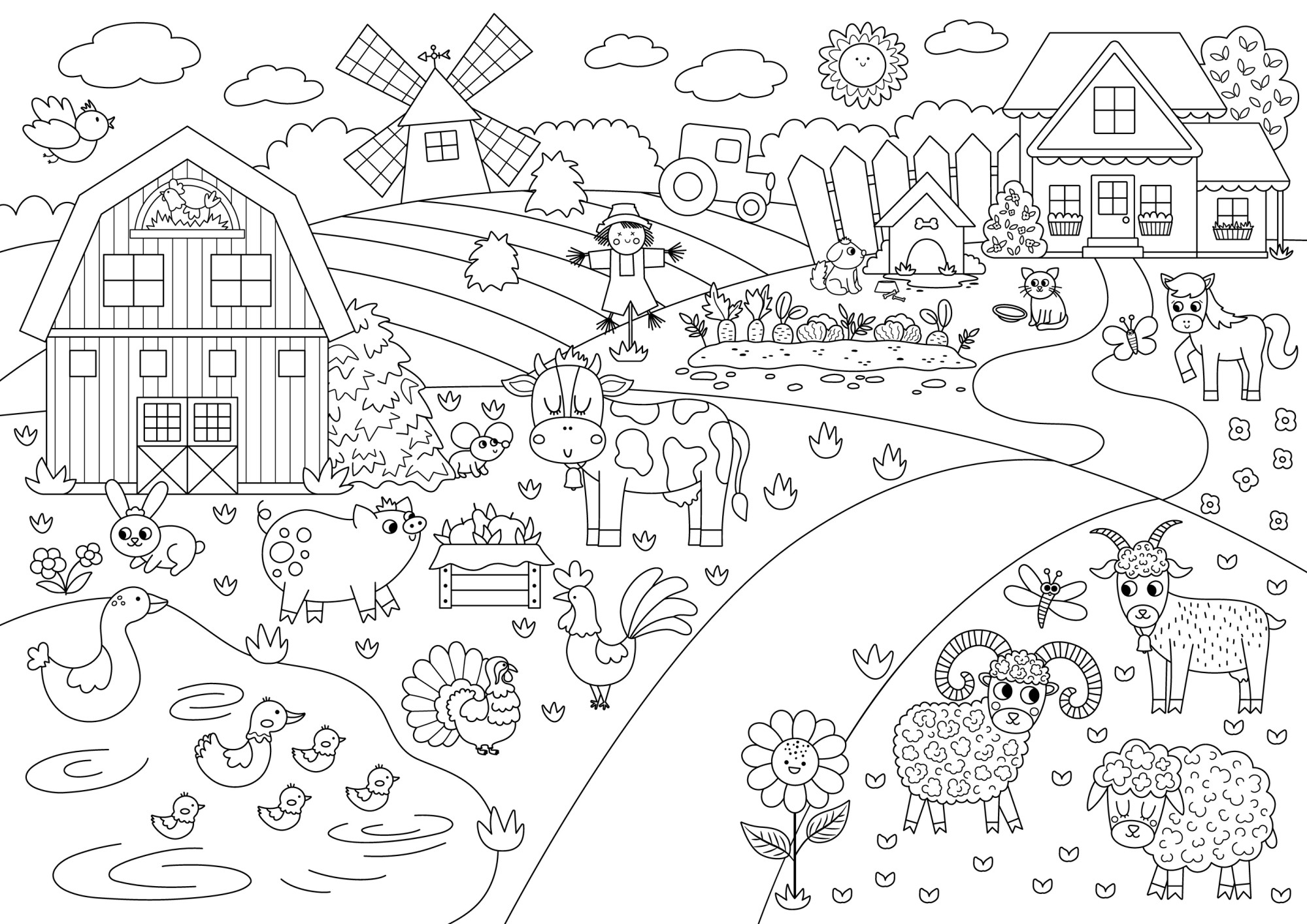
- A farm landscape with animals, a barn, pond, meadow, and garden
- A mixed safari-style wildlife scene with animals including a lion, elephant, sloth, turtle, giraffe, crocodile, and chameleon
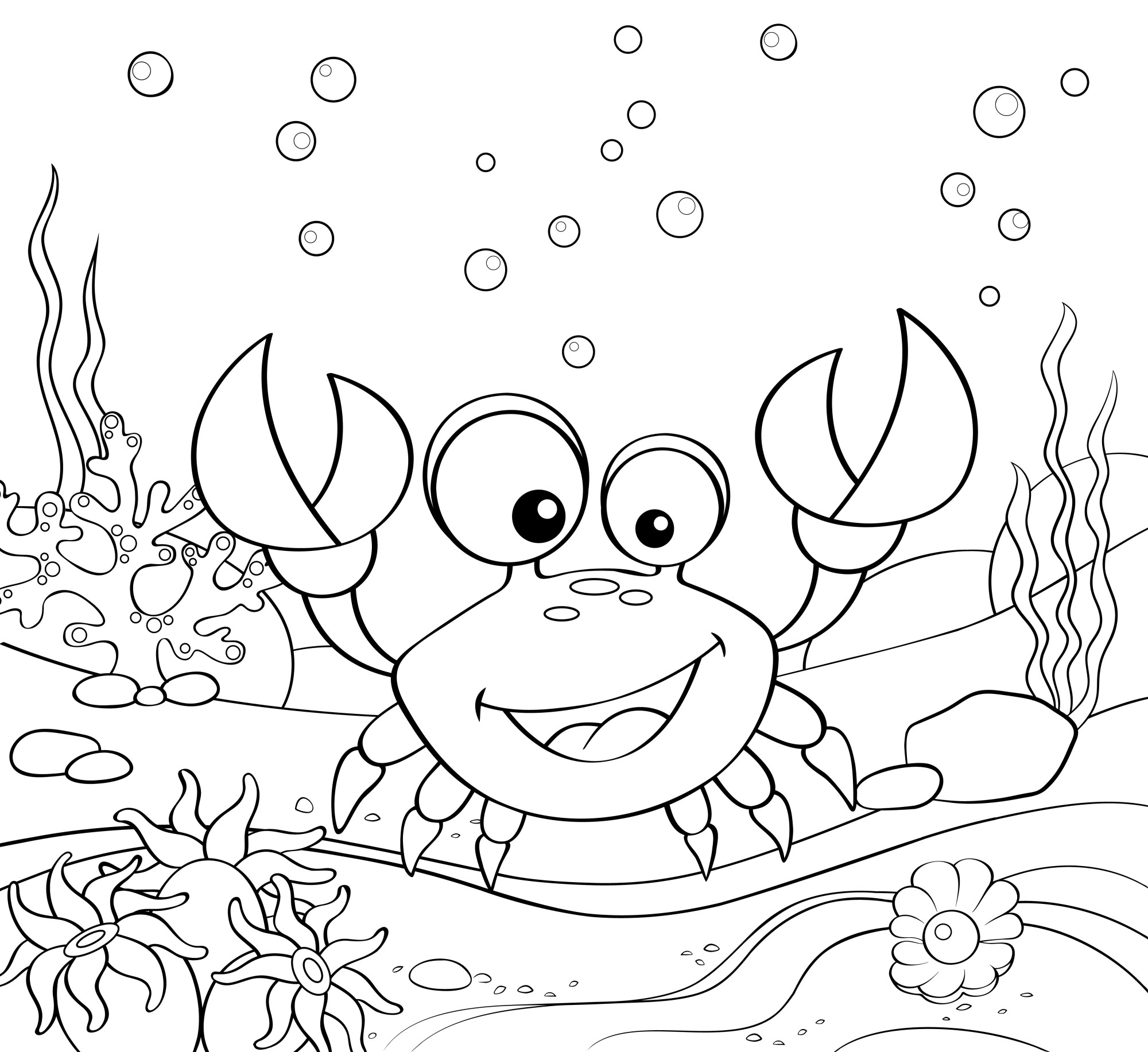
- A cartoon crab in an underwater scene
Because these pages are so different, this collection works best as a mixed animal-scene gallery rather than a complete animal hub.
If you are looking for specific animals such as dogs, horses, lions, elephants, giraffes, turtles, dolphins, sharks, or dinosaurs, start with our much larger Animal Coloring Pages guide.
Here, the fun is choosing between four complete scenes and adding your own habitats, colors, stories, and details.
🦉 Color the Owl
The owl page puts one of the most recognizable birds in the spotlight.
A nature-inspired owl palette might include:
- Brown
- Tan
- Cream
- Gray
- Rust
- Black
Use several shades throughout the feathers instead of filling the entire bird with one brown.
Keep some facial areas lighter.
Add deeper brown or gray along the wings and body.
The eyes can become a strong focal point with gold, yellow, orange, brown, or another color that suits your design.
🤎 Create a Brown Woodland Owl
Try:
Head: Tan and chestnut
Wings: Brown and dark brown
Chest: Cream with brown markings
Branch: Gray-brown
Add forest green leaves around the owl.
Color the background pale blue for daytime or deep navy for night.
A few related earth tones can make a simple owl feel much richer.
🩶 Create a Gray Owl
Use:
- Pale gray
- Medium gray
- Charcoal
- Cream
Add dark markings across the wings.
Keep the face lighter.
Place the bird on a snow-covered branch or in a misty forest.
A gray palette can work especially well for a winter scene.
🧡 Create a Rusty Autumn Owl
Try:
- Cinnamon
- Rust
- Burnt orange
- Chestnut
- Cream
Surround the owl with fall leaves.
Use:
- Gold
- Burgundy
- Orange
- Brown
Maybe the bird is perched above an autumn woodland just before sunset.
💜 Create a Fantasy Owl
Owls do not have to be brown.
Try:
Body: Lavender
Wings: Purple
Face: Pale pink
Eyes: Gold
Add tiny stars to the feathers.
Maybe this owl delivers messages across a magical kingdom after dark.
🌈 Give the Owl Rainbow Feathers
Divide the wings into color sections.
Use:
Red
Orange
Yellow
Green
Blue
Purple
Keep the chest pale or make that rainbow too.
Add colorful leaves around the branch.
Perhaps every feather changes color when moonlight touches it.
🌙 Create a Nighttime Owl Scene
Owls are commonly associated with nighttime, and many owl species are nocturnal or most active around dusk and night.
Turn the background into:
- Navy
- Indigo
- Purple
Add:
- Moon
- Stars
- Clouds
Keep the owl slightly lighter so it stands out.
Use silver-gray on the branch.
Maybe a few fireflies glow beneath it.
☀️ Owls Aren’t All Strictly Nocturnal
It is tempting to say that all owls only come out at night, but owl activity varies by species.
Many are nocturnal.
Some are active around dawn and dusk.
Others may hunt during daylight too.
So your coloring-page owl can live beneath a moon—or a bright afternoon sky.
Choose whichever scene you enjoy most.
👀 Look at an Owl’s Face
Owls have distinctive faces with large forward-facing eyes and feathers arranged around the face.
Color the facial area separately from the wings.
Try lighter cream or tan in the center and darker brown around the outside.
That contrast can make the face stand out dramatically.
Then add a tiny highlight inside each eye.
🪶 Add Feather Patterns
Instead of using flat color, add:
- Spots
- Bars
- Stripes
- Speckles
Use short pencil strokes to suggest overlapping feathers.
Keep the wing feathers slightly darker than the chest.
For a fantasy version, fill them with:
- Hearts
- Stars
- Swirls
Your owl can become almost like a feathered mandala.
🌳 Draw an Owl Habitat
Add:
- Tree branches
- Leaves
- Hollow tree
- Forest
- Moon
Maybe the owl sits high above the ground.
Draw a tiny mouse far below if you want a realistic food-web detail, or make the forest purely peaceful and decorative.
Add another owl on a nearby branch.
🦉 O Is for Owl
Write:
O is for Owl.
Think of more O words:
- Ocean
- Orange
- Octopus
- Olive
Decorate a giant letter O with feathers.
For another animal beginning with O, continue with our Octopus Coloring Page for Kids.
🌾 Color the Farm Animal Scene
The second printable expands far beyond one animal.
It is a complete farm landscape, with animals, a barn, pond, meadow, garden, and country scenery.
That gives you many different areas to color.
Start with the largest objects first:
- Sky
- Grass
- Barn
- Water
Then move into:
- Animals
- Fence
- Plants
- Flowers
The finished page can become a whole miniature countryside.
🟥 Color the Barn
A classic coloring-book farm can use a bright red barn.
Try:
- Brick red
- Scarlet
- Burgundy
Color the roof:
- Gray
- Brown
- Black
Add white or cream around doors and trim.
Or forget the classic red.
Create a:
- Blue barn
- Green barn
- Yellow barn
Maybe your imaginary farmer likes extremely colorful buildings.
🌱 Color the Meadow
Avoid using only one green.
Try:
- Yellow-green
- Leaf green
- Emerald
- Olive
Add darker green beneath trees or beside the barn.
Use lighter shades in open sunny areas.
Draw extra flowers throughout the meadow for spots of pink, yellow, white, and purple.
🌊 Color the Farm Pond
Use:
- Pale blue
- Aqua
- Blue-green
Add darker blue near the center.
Draw reeds around the edges.
Maybe ducks swim across the pond.
Add ripples around them.
You can even reflect a little green from surrounding grass into the water.
🌻 Add a Farm Garden
The scene already includes garden details, so expand them.
Draw rows of:
- Tomatoes
- Carrots
- Lettuce
- Flowers
- Pumpkins
Use rich greens throughout.
Add a watering can.
Maybe the farm grows both food and flowers.
For larger outdoor growing scenes, continue with our Garden Coloring Pages.
🐄 Add More Cows
Cows are among the most recognizable farm animals.
A Holstein-inspired cow can use:
- Black
- White
But cows come in many other natural colors.
Try:
- Red-brown
- Golden brown
- Cream
- Black
- Gray
Or create a pink cow covered in hearts.
For many more designs, visit our Cow Coloring Pages.
🐴 Add Horses
Draw a horse beside the fence.
Try:
- Chestnut
- Bay brown
- Black
- Gray
- Cream
Add a darker mane and tail.
Maybe the horse is grazing.
Perhaps another stands beside the barn.
Continue with our Horse Coloring Pages.
🐷 Add a Pig
Draw a pig near the barn.
Use pale pink for a familiar cartoon version.
Or try black, white, brown, or spotted coloring.
Maybe the pig has discovered the muddiest puddle on the entire farm.
For another dedicated printable, visit our Cute Pig Coloring Page.
🐑 Add Sheep
Draw fluffy sheep in the meadow.
Keep the fleece:
- White
- Cream
- Pale gray
Use darker gray around the face and legs.
Or create rainbow sheep.
Maybe each one has a different pastel fleece.
🐐 Add Goats
Give a goat:
- Cream
- Brown
- Black
- Gray
fur.
Add a small beard.
Maybe it is standing on something it is absolutely not supposed to climb.
Draw a bucket or hay bale nearby.
🐔 Add Chickens
Draw several chickens near the barn.
Use:
- White
- Brown
- Red
- Gold
- Black
Make the comb bright red.
Add tiny chicks.
Color them pale yellow or tan.
Maybe the chickens are searching for food along the path.
🦆 Add Ducks to the Pond
Draw ducks swimming across the water.
You can use:
- Brown
- Cream
- Gray
- Green
for nature-inspired colors.
Or make every duck yellow like a cartoon duckling.
Add little V-shaped ripples behind each one.
☀️ Create a Sunny Farm
Use:
Sky: Bright blue
Grass: Green
Barn: Red
Sun: Yellow
Add white clouds.
Color flowers in bright spring or summer shades.
This creates the classic cheerful farm scene.
🍂 Create an Autumn Farm
Change the whole palette.
Use:
- Gold
- Rust
- Burgundy
- Brown
- Olive
Add pumpkins near the barn.
Turn the trees orange and yellow.
Maybe the garden is ready for harvest.
Draw baskets filled with apples or squash.
❄️ Create a Winter Farm
Use pale blues and grays.
Add snow across:
- Barn roof
- Fence
- Meadow
Keep the animals near the shelter.
Make the pond look icy.
Add smoke rising from a farmhouse chimney in the distance.
🌅 Create a Farm at Sunset
Use:
Yellow → Orange → Pink → Purple
across the sky.
Make the barn deeper red.
Color distant trees as dark silhouettes.
Add golden highlights across the meadow.
The peaceful farm can look completely different after daylight begins to fade.
🧺 Create a Farm Story
Ask:
- Who lives here?
- What animals do they care for?
- What grows in the garden?
- What happened this morning?
Maybe a goat escaped.
Perhaps a duck wandered into the barn.
Maybe the farmer is preparing for a fall festival.
Use the page as the first illustration in your story.
🦁 Color the Mixed Safari-Style Animal Scene
The third printable is packed with wildlife.
It includes animals such as:
- Lion
- Elephant
- Sloth
- Turtle
- Giraffe
- Crocodile
- Chameleon
That makes it visually similar to a safari or zoo-style animal scene.
There is one important thing to remember, though:
These animals do not all naturally live together in Africa.
Lions, African elephants, and giraffes can occur in Africa, but sloths are native to tropical parts of Central and South America.
So treat this page as a fun mixed-wildlife illustration, not a scientifically accurate African habitat.
🦁 Color the Lion
For a nature-inspired lion, try:
- Golden tan
- Cream
- Caramel
- Brown
If the illustration shows a mane, use darker browns or rust.
Lions have yellow-gold coats, while male manes can range from blond through reddish brown to very dark shades.
Or make the mane rainbow-colored.
Continue with our Lion Coloring Pages.
🌈 Give the Lion a Rainbow Mane
Use:
Red
Orange
Yellow
Green
Blue
Purple
around the mane.
Keep the body gold or tan.
The contrast makes the rainbow stand out.
Maybe this lion belongs to an imaginary world where every big cat has a different magical mane.
🐘 Color the Elephant
Try:
- Gray
- Blue-gray
- Warm gray
Use lighter gray across the forehead and ears.
Add darker gray beneath the belly and around legs.
Real elephant skin can appear gray, and mud, dirt, and dust may change its visible color.
For a fantasy elephant, use lavender or pale blue.
Continue with our Elephant Coloring Pages.
👂 Look at the Elephant’s Ears
Large ears are one of the elephant’s most obvious features.
Asian and African elephants differ in several ways, including ear shape and size.
You do not need to identify the cartoon elephant to species unless the drawing clearly provides enough detail.
Simply color the animal as an elephant rather than attaching a precise species name to simplified artwork.
That is often the safest approach with generic cartoon wildlife.
🦒 Color the Giraffe
Use:
- Golden yellow
- Tan
- Brown
throughout the coat.
Keep the spaces between markings lighter.
Make the mane dark brown.
Add dark details around the hooves.
Then create a completely imaginary version with:
- Purple patches
- Pink body
- Blue mane
For more towering animals, explore our Giraffe Coloring Pages.
🟫 Design Giraffe Patterns
A giraffe’s patterned coat is perfect for a coloring challenge.
Instead of traditional brown patches, try:
- Rainbow
- Hearts
- Stars
- Checkerboard
Maybe every patch is a different color.
Or create a gradient from yellow at the head to purple at the feet.
🦥 Color the Sloth
Use:
- Brown
- Gray-brown
- Cream
Add darker shading along the arms and body.
Some sloths can take on a greenish cast because algae grows within grooves in their fur.
Try adding a tiny hint of olive green.
Place the sloth in a leafy tree.
Unlike the African animals elsewhere in the scene, real sloths belong to Central and South American tropical forests.
🌿 Give the Sloth Its Own Rainforest
If you want to make the mixed illustration more educational, draw a separate habitat box for the sloth.
Add:
- Dense leaves
- Tree canopy
- Vines
- Rain
Write:
Sloths — Central & South America
This lets the original fun design remain intact while correcting the geographical mix.
🐢 Color the Turtle
A turtle can use:
- Olive
- Green
- Brown
- Tan
Add a darker shell pattern.
Because the illustration is stylized and the exact species may be unclear, avoid assuming whether it is a land, freshwater, or marine turtle.
Instead, simply enjoy the shell pattern.
For many more options, visit our Turtle Coloring Pages.
🐊 Color the Crocodile
Try:
- Olive green
- Gray-green
- Brown
- Dark green
Keep the underside lighter.
Add darker markings across the back and tail.
Crocodiles are reptiles with armored-looking scales and powerful tails.
Different species live in different parts of the world, so a generic coloring-page crocodile should not automatically be assigned to one exact country or habitat.
🦎 Color the Chameleon
A chameleon gives you an excellent excuse to use bright colors.
Try:
- Green
- Yellow
- Turquoise
- Orange
- Purple
Some chameleons can change aspects of their coloration, although the idea that they simply match any background perfectly is an oversimplification.
On a coloring page, however, your chameleon can be absolutely anything.
Make it rainbow-colored if you want.
🌈 Create a Wild Rainbow Safari
Give every animal a different fantasy palette.
Lion: Purple
Elephant: Blue
Giraffe: Pink and yellow
Sloth: Turquoise
Crocodile: Orange
Chameleon: Rainbow
Maybe this is not Earth at all.
Perhaps it is Color Safari Planet, where every animal evolved in impossible colors.
Give the planet a name.
🗺️ Sort the Wildlife by Region
The mixed-wildlife page can become a geography activity precisely because the animals do not all belong together.
Create two headings:
AFRICA
and
CENTRAL/SOUTH AMERICA
Place:
- Lion → Africa
- Giraffe → Africa
- African elephant → Africa
- Sloth → Central/South America
For the generic turtle, crocodile, and chameleon, research the specific species first before trying to place them.
Many different species exist across broad regions.
🌍 Create an Animals Around the World Map
Choose animals from the page.
Find broad regions on a globe.
Add drawings or labels.
You might include:
Lion — Africa, plus Asiatic lions in India
Giraffe — Africa
Sloth — Central and South America
Then choose additional animals from your other coloring pages.
Maybe:
Kangaroo — Australia
Giant panda — China
Polar bear — Arctic
The mixed gallery can become the beginning of a much larger world-animal project.
🦁 Build an African Wildlife Collection
Choose the truly African animals from the page, then add more dedicated printables.
Try:
- Lion Coloring Pages
- Elephant Coloring Pages
- Giraffe Coloring Pages
- Zebra Coloring Pages
- Rhino Coloring Pages
Color each animal.
Add its name and one researched fact.
Staple everything together as an African wildlife book.
🦓 Add a Zebra
Draw a zebra beside the giraffe.
Use black and white stripes for a familiar look.
Or create rainbow stripes.
Zebra patterns are especially fun because the contrast is already dramatic before you add any color.
🦏 Add a Rhino
Draw a heavy-bodied rhinoceros.
Use:
- Gray
- Brown-gray
Add grassland behind it.
Keep the animal distinct from the elephant by emphasizing the horn and body shape.
🐒 Add a Monkey
Draw a monkey swinging from a branch.
Use:
- Brown
- Tan
- Black
- Gray
Monkey species occur across parts of Africa, Asia, and the Americas, so do not automatically label a generic cartoon monkey as African without knowing which species it represents.
🦁 Make a Pretend Safari Poster
Color the wildlife page.
Add:
WILDLIFE ADVENTURE
at the top.
Then label the animals.
For accuracy, call it a mixed wildlife or animal adventure poster rather than presenting the whole group as species that naturally share one habitat.
The artwork can stay playful while the labels stay accurate.
🦀 Color the Underwater Crab
The fourth design takes you into a completely different world.
This printable features a cartoon crab in an underwater setting.
Try a familiar bright crab palette:
- Red
- Orange
- Coral
Use darker red around the claws and shell edges.
Color the legs slightly lighter.
Then fill the surrounding water with turquoise and blue.
❤️ Create a Red Crab
Try:
- Scarlet
- Crimson
- Coral
Add orange highlights.
Keep the underside pale peach.
Use blue water behind it to create strong warm-versus-cool contrast.
The crab can become the brightest object in the underwater scene.
🧡 Create an Orange Crab
Use:
- Tangerine
- Pumpkin orange
- Rust
Add yellow-orange highlights.
Color nearby seaweed green and rocks gray.
Maybe the crab is hiding between stones on the seafloor.
💜 Create a Purple Crab
Fantasy time.
Try:
- Lavender
- Violet
- Plum
Give the claws turquoise tips.
Add pink bubbles.
Maybe this crab lives in a magical mermaid kingdom rather than a real ocean.
🌈 Create a Rainbow Crab
Color each leg differently.
Try:
Red
Orange
Yellow
Green
Blue
Purple
Keep the main shell turquoise or pink.
Add rainbow spots to the claws.
A cartoon crab is perfect for colors that nature never intended.
🦀 Crabs Are Crustaceans
Crabs belong to a large animal group called crustaceans.
Many true crabs are decapods, a name connected with having ten limbs.
The front pair is modified into claws rather than ordinary walking legs.
Crabs also have a hard outer covering called an exoskeleton.
Unlike a skeleton inside the body, this protective structure is on the outside.
🦀 Count the Crab’s Limbs
Look at your cartoon crab.
Does the artist show the full set of limbs clearly?
A typical true crab has five pairs of limbs, with the front pair forming claws.
Cartoon illustrations sometimes simplify anatomy, so do not worry if your printable does not show every feature perfectly.
Instead, compare it with a photograph of a real crab.
What did the artist simplify?
🛡️ How Does a Crab Grow?
A hard exoskeleton cannot simply stretch forever as the animal grows.
Crabs periodically molt, shedding the old exoskeleton.
A new softer shell underneath expands before hardening.
That is why finding an empty crab-shaped shell does not necessarily mean you have found a dead crab—it could be a molt.
Draw:
Old Shell → Soft New Crab → Hardened Shell
as a simple sequence.
🦀 Why Do Crabs Have Claws?
Crab claws can be used for tasks such as:
- Handling food
- Defense
- Displays
Different species have dramatically different claw shapes and sizes.
Color one claw red and one orange.
Then imagine your cartoon crab using them to open a treasure chest.
🌊 Build the Underwater Scene
Add:
- Seaweed
- Fish
- Bubbles
- Shells
- Rocks
Use several blues in the water.
Keep water near the top pale.
Make deeper sections darker.
Draw sandy or rocky bottom beneath the crab.
For a much larger marine collection, continue with our Ocean Coloring Pages.
🐚 Add Shells Around the Crab
Draw:
- Spiral shells
- Fan-shaped shells
- Small clam shells
Use:
- Cream
- Pink
- Peach
- Lavender
Hide one behind the crab.
Maybe it contains a tiny pearl.
🪸 Create a Colorful Reef
Add reef-inspired shapes in:
- Orange
- Pink
- Purple
- Yellow
- Green
Draw small fish between them.
Remember that real coral is made by living animals, not simply colorful underwater rock.
Your fantasy reef can still use every shade in the crayon box.
🐙 Add an Octopus
Draw an octopus nearby.
Give it eight arms.
Use orange, red, brown, purple, blue, or rainbow colors.
Maybe the crab and octopus are neighbors.
Continue with our Octopus Coloring Page for Kids.
🐢 Add an Ocean Turtle
Draw a turtle swimming above the crab.
If you want a marine scene, make sure the turtle looks like a sea turtle rather than simply labeling any generic turtle as one.
Use:
- Olive
- Brown
- Green
for a nature-inspired palette.
Or create a rainbow shell.
🐬 Add a Dolphin
Place a dolphin closer to the surface.
Use gray or blue-gray.
Add bubbles.
A dolphin is a mammal rather than a fish, even though it lives in the ocean.
Continue with our Dolphin Coloring Pages.
🦈 Add a Shark
Draw a small shark in the distance.
Use:
- Gray
- Blue-gray
Keep it much smaller than the foreground crab to make it appear far away.
Maybe it is simply passing through.
For more, visit our Shark Coloring Pages.
🏴☠️ Give the Crab a Treasure Chest
Draw:
- Wooden chest
- Gold coins
- Jewels
- Key
Maybe the crab guards the treasure.
Or perhaps it just discovered it.
Write:
The crab opened the old chest and found…
Finish the story.
🏰 Build a Crab Castle
Imagine crabs have their own underwater city.
Create:
- Shell houses
- Rock towers
- Seaweed gardens
Maybe the crab is king or queen.
Give it a tiny crown.
Add flags made from sea grass.
🌍 Four Pages, Four Habitats
These four animal designs can become a simple habitat comparison.
Owl
Forest or woodland
Farm Animals
Human-managed farmland
Mixed Wildlife
Several habitats and world regions represented together
Crab
Marine or coastal environment, depending on the species
Write each habitat underneath its page.
Then draw one extra thing each animal might find there.
🌳 Forest, Farm, Wild & Ocean
Arrange the completed pages under four headings:
FOREST
FARM
WILDLIFE
OCEAN
The categories are broad rather than scientific, but they give younger children a simple way to organize the pictures.
Older students can go further and research the actual habitat of one animal.
🧩 Sort Animals Into Groups
Choose animals from the pages and sort them.
Mammals
Lion
Elephant
Sloth
Giraffe
Many farm animals
Birds
Owl
Chickens
Ducks
Reptiles
Turtle
Crocodile
Chameleon
Crustaceans
Crab
The exact farm animals depend on what appears clearly in the picture.
Use a real-animal reference if any cartoon character is difficult to identify.
🦉 Which Animals Have Feathers?
Owl.
Perhaps farm birds too.
Write:
Birds have feathers.
Then compare the owl with a mammal.
A lion has fur.
A turtle has scales and a shell.
A crab has an exoskeleton.
The four pictures contain several very different body coverings.
🐾 Fur, Feathers, Scales or Shell?
Create four headings:
FUR
FEATHERS
SCALES
EXOSKELETON
Sort some of the animals.
Examples:
Owl → Feathers
Lion → Fur
Crocodile → Scales
Crab → Exoskeleton
Ask where a turtle belongs.
It has scales and a shell, which shows that animal categories are not always as simple as one-word labels.
🍃 What Do the Animals Eat?
Choose one animal at a time.
Research whether it is primarily:
- Herbivore
- Carnivore
- Omnivore
Do not assume every animal in one picture eats the same things.
For example, a lion is a carnivore, while a giraffe primarily eats plant material.
Different diets are one reason animals fill different ecological roles.
🗺️ Create an Animal World Map
Choose:
- Owl
- Lion
- Elephant
- Sloth
- Giraffe
- Crocodile
- Chameleon
- Crab
For each, identify a species first.
Then find its real range on a map.
This is important because broad labels such as “owl,” “crocodile,” and “crab” include many species living in very different parts of the world.
A species-specific map is much more accurate than claiming every owl or crab lives in one place.
🔤 A Is for Animal
Write a large:
A
Practice:
A is for Animal.
Think of more A words:
- Ant
- Apple
- Alligator
- Acorn
Decorate the A with animal spots, stripes, feathers, and scales.
For more alphabet practice, explore our Coloring Pages of Letters.
🦉 O Is for Owl
Write:
OWL
Circle the O.
Add feathers around the word.
Maybe the O becomes the owl’s face.
🦁 L Is for Lion
Write:
LION
Circle L.
Color the word gold.
Add a large mane around the L.
🦀 C Is for Crab
Write:
CRAB
Circle C.
Turn the C into a claw shape.
Add bubbles around the letters.
🔢 Count the Animals
The busier farm and wildlife pages give you plenty to count.
Ask:
- How many animals?
- How many legs can you see?
- How many trees?
- How many birds?
- How many water animals?
The answer will depend on the details visible in the printable.
Children can also draw more animals and count again.
🔍 Create an Animal I Spy Game
Hide additional objects around a page.
Find:
- 5 leaves
- 4 stars
- 3 flowers
- 2 paw prints
- 1 tiny heart
Or customize the list to match the habitat.
For the ocean page:
- Shells
- Bubbles
- Fish
For the farm:
- Apples
- Pumpkins
- Chickens
🎲 Play Animal Roll-and-Color
Grab one six-sided die.
Assign:
1 — Brown
2 — Green
3 — Blue
4 — Orange
5 — Purple
6 — Your choice
Roll.
Choose one small section and use the matching color.
Continue until the scene is finished.
The result may be realistic—or extremely colorful.
🎯 Try a Nature-Color Challenge
For one copy, use only colors you might reasonably see on the actual animals and habitats.
Look at reliable photographs before coloring.
Then print another copy.
Use completely fantasy colors.
Compare:
Nature-Inspired
versus
Imagination-Inspired
Neither has to be the “better” picture.
They simply have different goals.
📖 Turn the Four Pages Into a Story
Imagine all four scenes are connected.
Maybe:
Page 1
The owl discovers a mysterious map.
Page 2
The map leads to a farm.
Page 3
The farm animals send the owl toward a strange wildlife reserve.
Page 4
The final clue lies beneath the ocean with a crab.
What is the treasure?
Write one paragraph for every picture.
🦉 The Owl’s Journey
Try:
The owl had never left the forest until one evening…
Maybe it flies over the farm.
Then it sees animals it has never encountered before.
Eventually it reaches the coast.
How does it meet the crab?
Create the adventure.
🚜 The Farm Animal Mystery
Something has disappeared from the barn.
Maybe:
- Basket of apples
- Farmer’s hat
- Bell
- Bag of seeds
Draw clues.
Which animal saw what happened?
Write the solution.
🦁 The Mixed-Wildlife Meeting
The animals on the safari-style page come from different places.
Imagine they are meeting at an international animal conference.
Why have they gathered?
Maybe they are trying to protect habitats.
Perhaps they are planning the world’s strangest birthday party.
Give every animal a speaking role.
🦀 The Crab’s Underwater Treasure
The crab finds an old key.
It opens:
- Treasure chest
- Shipwreck door
- Mermaid palace
- Underwater library
Draw what is inside.
Maybe the object connects all four animal scenes.
📕 Make a Four-Habitat Animal Book
Print all four pages.
Create a cover:
My Animal Adventure Book
Add sections:
Forest
Farm
Wildlife Around the World
Ocean
Color each page.
Write one or two facts beneath it.
For the mixed wildlife page, choose one animal and research its real habitat rather than treating the full illustration as a single ecosystem.
🏫 Animal Scene Coloring Pages for the Classroom
These pages can work with:
- Animal units
- Habitat lessons
- Farm themes
- Bird studies
- Ocean lessons
- Geography
- Classification
- Creative writing
- Early finishers
- Indoor recess
Because there are only four designs, the collection is especially manageable for a small activity.
One group could color the owl.
Another takes the farm.
A third works on mixed wildlife.
The fourth builds the underwater world.
🌎 Create a Classroom Habitat Wall
Divide a bulletin board into areas.
Try:
WOODLAND
FARM
GRASSLAND
RAINFOREST
OCEAN
Then place animal drawings where they really belong.
The mixed safari-style page is especially useful because students can separate the animals instead of assuming they all share one habitat.
Place the sloth in a tropical American rainforest section rather than an African grassland.
🏷️ Create Animal Fact Cards
For each animal, write:
Name: ______
Animal group: ______
Habitat: ______
Food: ______
One fact: ______
Use a reliable zoo, museum, government wildlife agency, or conservation source.
Keep the facts short.
The coloring page should remain the centerpiece.
🦁 Create a Pretend Zoo
These four pages can also inspire a larger zoo project.
Add:
- Lions
- Elephants
- Giraffes
- Monkeys
- Rhinos
- Bears
Give every species its own appropriate habitat sign.
Our Zoo Animal Coloring Pages provide many more choices.
🐰 Explore Cute Animal Coloring Pages
If cheerful cartoon animals are your favorite, visit our Cute Animal Coloring Pages.
That much larger collection includes dogs, mice, kangaroos, ducks, sheep, deer, cats, turtles, goats, pandas, lions, dolphins, polar bears, foxes, and many parent-and-baby designs.
Use this four-page collection when you want complete mixed scenes.
Use Cute Animals when you want a much larger gallery of adorable individual animals and families.
🐾 Explore the Main Animal Coloring Pages Hub
For the complete animal collection, head to our Animal Coloring Pages.
That is the best starting point if you want a particular species or animal group.
You’ll find links to:
- Dogs
- Kittens
- Horses
- Rabbits
- Elephants
- Tigers
- Lions
- Bears
- Giraffes
- Zebras
- Monkeys
- Cows
- Wolves
- Turtles
- Dolphins
- Sharks
- Dinosaurs
Think of that page as the main animal directory.
This page is the smaller mixed-scene collection featuring the owl, farm, wildlife group, and crab.
🌿 Explore Nature Coloring Pages
Animals are closely connected with the places they live.
Continue with our Nature Coloring Pages for:
- Plants
- Flowers
- Gardens
- Birds
- Insects
- Beaches
- Landscapes
- Other outdoor themes
Add more environmental details around your animal scenes.
Maybe the owl gets a forest filled with mushrooms.
The farm receives a giant garden.
The crab explores a rocky coast.
🌊 Explore Ocean Coloring Pages
If the crab is your favorite, dive into our Ocean Coloring Pages.
Explore:
- Octopuses
- Dolphins
- Sharks
- Turtles
- Jellyfish
- Mermaids
- Underwater scenes
Color several pages and combine them into one giant ocean mural.
🖍️ Best Supplies for Animal Scene Coloring Pages
Crayons work well for younger children and large areas such as skies, grass, water, and barns.
Colored pencils are especially useful for:
- Owl feathers
- Animal fur
- Giraffe markings
- Elephant shading
- Crab details
- Trees and plants
Markers create bold colors in cartoon scenes. Slightly heavier paper may help if marker ink tends to bleed through ordinary printer paper.
You can also mix materials.
Use colored pencils on animals and crayons across larger backgrounds.
🖨️ How to Use These Free Animal Scene Coloring Pages
Choose one of the four designs and print it.
Decide whether you want a:
- Nature-inspired scene
- Rainbow scene
- Storybook scene
- Habitat project
Color the main animals first.
Then move outward into:
- Trees
- Grass
- Barn
- Water
- Sky
- Plants
Add extra animals if you want.
Finally, write one animal fact, give the characters names, or invent a short story.
The four printables may be very different, but that variety is exactly what makes this little collection fun.
🐾 Travel Through Four Animal Worlds
With an owl, a complete farm landscape, a mixed group of wild animals, and an underwater crab, these free printable animal scene coloring pages travel from branches and barns to wildlife adventures and the ocean floor.
Color a realistic brown owl or give it rainbow feathers. Turn the farm into a golden autumn landscape. Fill the wildlife page with lions, elephants, giraffes, reptiles, and a wonderfully purple sloth. Make the underwater crab scarlet, orange, turquoise, or every color at once.
Along the way, you can compare mammals, birds, reptiles, and crustaceans; create habitats; find animals on a map; make fact cards; build a pretend zoo; or connect all four pictures into one enormous story.
Just remember that a fun coloring-page scene does not always represent a real ecosystem. The mixed wildlife design, for example, includes African animals alongside a sloth, whose real relatives live in Central and South America.
Art can mix anything together.
Learning where the real animals actually live makes the collection even more interesting.
Choose a page, grab your colors, and begin your journey through the animal world.
🔗 Related Articles
- Animal Coloring Pages
- Cute Animal Coloring Pages
- Lion Coloring Pages
- Elephant Coloring Pages
- Giraffe Coloring Pages
- Cow Coloring Pages
- Turtle Coloring Pages
- Zoo Animal Coloring Pages
- Ocean Coloring Pages
- Nature Coloring Pages
📚 Sources
- Smithsonian’s National Zoo — Barred Owl
- Smithsonian’s National Zoo — Lion
- Smithsonian’s National Zoo — Asian Elephant
- Smithsonian’s National Zoo — Two-Toed Sloth
- Smithsonian’s National Zoo — Cuban Crocodile
- NOAA Fisheries — Alaska Shellfish Growth Research
- NOAA Fisheries — Red King Crab
🖍️Shop Animal Coloring Books –>