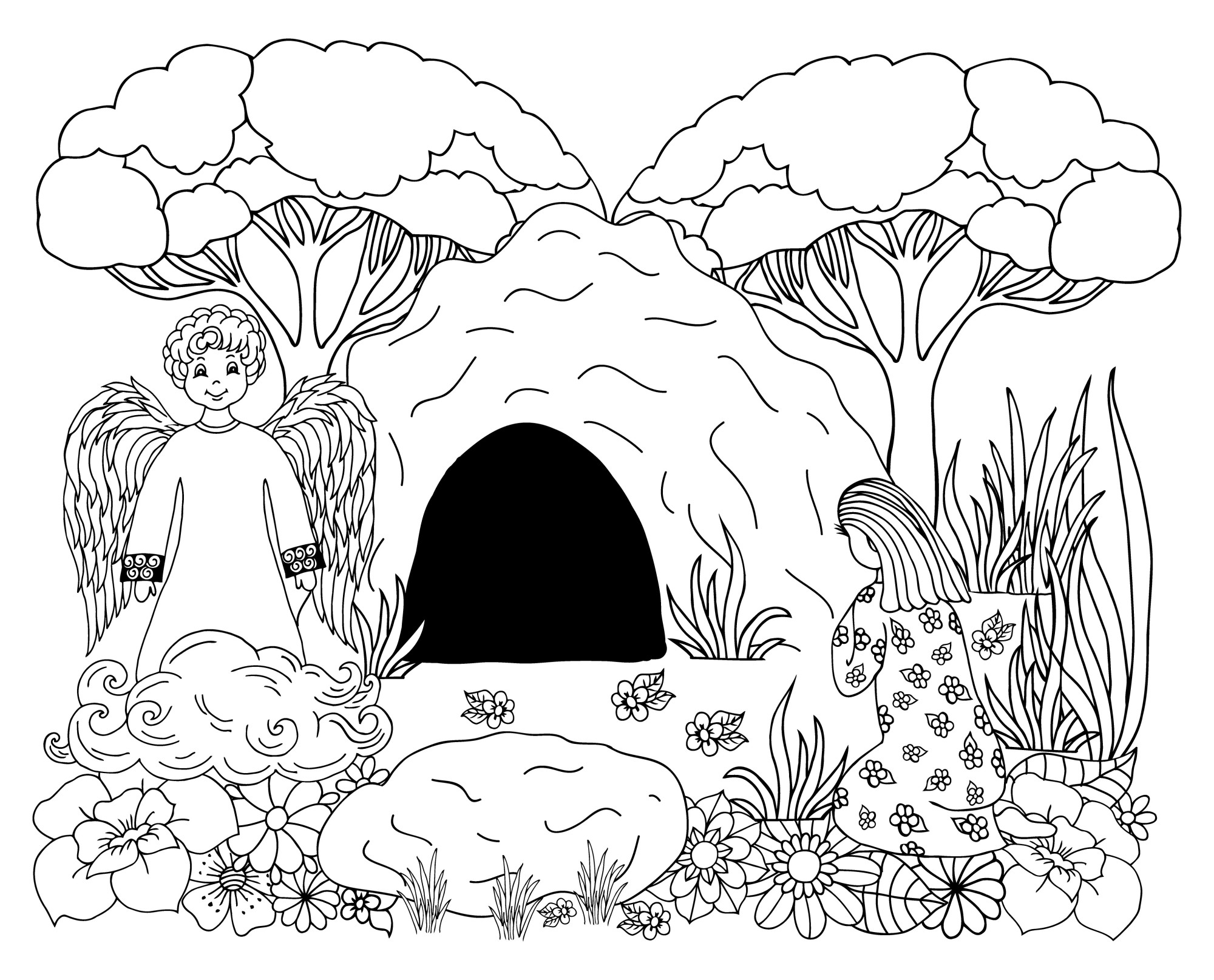
Explore one of the central scenes of the Christian Easter story with this Angel at Jesus’ Empty Tomb Coloring Page, depicting Mary at the tomb where Jesus had been laid and an angelic messenger connected with the news of the Resurrection.
The scene offers children a thoughtful way to engage creatively with the Easter story. They can color the angel’s robes, imagine the early morning sky, shade the stone and tomb, add flowers to the garden, or create rays of sunrise spreading across the background.
This printable can be used during Sunday school, Christian homeschool lessons, church Easter activities, family Bible reading, or simply as a quiet coloring project during Holy Week and Easter.
Grab your crayons, colored pencils, or markers and bring this meaningful Easter scene to life.
✝️ What Story Does This Coloring Page Show?
The illustration is inspired by the Gospel accounts of the discovery of Jesus’ empty tomb after the Crucifixion.
Mary Magdalene plays an important role in those accounts. Early on the first day of the week, she and, in some Gospel accounts, other women went to the tomb and discovered that the stone had been moved and Jesus’ body was no longer there.
Angelic or heavenly messengers appear in each account, although the details vary.
In Matthew 28, Mary Magdalene and “the other Mary” encounter an angel who announces that Jesus has risen.
Mark 16 describes Mary Magdalene, Mary the mother of James, and Salome entering the tomb and seeing a young man dressed in white.
Luke 24 describes a group of women encountering two men in dazzling clothing.
John 20 focuses particularly closely on Mary Magdalene. After Peter and another disciple leave the empty tomb, Mary remains outside weeping and sees two angels inside before encountering the risen Jesus himself.
For that reason, this coloring picture is best understood as an artistic representation of the Easter empty-tomb story, rather than an exact illustration of every detail from one Gospel.
🌅 Color an Easter Morning Sky
The empty tomb was discovered early in the morning, making sunrise colors a beautiful choice for the background.
Try blending:
- Pale yellow
- Peach
- Soft orange
- Pink
- Lavender
- Light blue
Begin with yellow near the horizon and gradually introduce pink, peach, and blue higher in the sky.
You could also draw rays of sunlight spreading across the scene.
The transition from darkness toward morning can visually reinforce the movement from sorrow to hope that is central to the Easter story.
👼 Color the Angel
Christian art has represented angels in many different ways over the centuries, and the Bible does not give a fixed color palette for this particular illustration.
White is an especially natural choice because several Resurrection accounts describe heavenly messengers wearing white or dazzling clothing.
Try:
- White with pale blue shadows
- Cream with gold accents
- Pale yellow
- Soft lavender
- Silver-gray
- Light blue
If the angel has wings, keep them mostly white and add very pale blue, lavender, gray, or gold around individual feathers.
You can also leave areas of the wings completely uncolored to create bright highlights.
✨ Make the Angel’s Clothing Look Radiant
Instead of filling the angel’s robe with one solid color, use light shading.
Begin with white or cream and add pale blue or gray wherever fabric folds overlap.
Use a little yellow or gold around the outer edges if you want to suggest morning light.
Older children can experiment with keeping the parts facing the sunrise lighter and shading the opposite side slightly darker.
The effect does not need to be complicated. A few subtle changes can make white clothing much more interesting to color.
👩 Color Mary’s Clothing
The Gospels do not specify the exact colors Mary Magdalene wore at the tomb, so there is plenty of room for creativity.
Try earth-inspired shades such as:
- Rust
- Burgundy
- Brown
- Cream
- Olive
- Dusty blue
- Plum
- Tan
You can also use brighter colors if you prefer.
Rather than presenting any one robe color as historically certain, let the clothing become another creative part of the picture.
A muted blue robe with a cream covering can create a peaceful palette, while burgundy and gold produce a warmer, more dramatic scene.
🪨 Give the Empty Tomb Texture
Stone can contain far more color than plain gray.
Try combining:
- Pale gray
- Charcoal
- Warm brown
- Tan
- Beige
- Cream
- Dusty orange
Use lighter shades on surfaces facing the imaginary morning light and darker colors inside cracks or beneath stones.
Short irregular pencil marks can suggest a rough rocky texture.
The tomb opening itself can remain much darker, creating strong contrast with the bright outdoor scene and the angel.
🌿 Create a Garden Around the Tomb
John’s Gospel places Jesus’ burial tomb in a garden, giving you a natural opportunity to add plants around the scene.
Draw:
- Grass
- Small flowers
- Shrubs
- Vines
- Trees
- Stones
- Tiny leaves
Use several greens instead of just one.
Mint, sage, olive, grass green, emerald, and forest green can all work together.
The garden can be simple and realistic or completely imaginative.
Perhaps flowers are just beginning to open as the sun rises.
🌸 Add Easter Morning Flowers
Flowers can add color to the earth-toned tomb scene.
Try:
- White
- Yellow
- Pink
- Purple
- Blue
- Peach
Add small blossoms near the stones or along a path.
You do not need to identify a specific historical flower species. These additions can simply be part of your artistic interpretation of the garden.
For more botanical coloring, explore our Coloring Pages of Flowers.
☀️ Add Rays of Light
Sunlight can become one of the most expressive parts of the picture.
Draw long rays emerging from behind the tomb or across the sky.
Use pale yellow, gold, cream, or peach.
Leave plenty of white between the rays so the background does not become too crowded.
Younger children can draw simple straight lines, while older children can blend the yellow gradually into the surrounding sky.
🎨 Try an Easter Color Palette
If you are unsure where to start, choose a small group of colors before coloring.
Sunrise Easter
Gold, peach, lavender, pale blue, cream
Garden Easter
Sage, forest green, yellow, pink, sky blue
Biblical Earth Tones
Tan, brown, ochre, rust, cream, muted blue
Bright Easter
Purple, turquoise, yellow, pink, green
Quiet Morning
Soft blue, cream, gray, sage, pale gold
Repeating the same few shades throughout the clothing, sky, rocks, and plants can help the scene feel unified.
💜 Try a Purple-and-Gold Easter Palette
Purple and gold are often associated with Christian religious art and church observances, and they can create a striking coloring-page palette.
Use purple, plum, or lavender for some clothing details.
Add golden yellow to the sunrise and small decorative areas.
Keep the angel mostly white or cream and use muted brown and gray for the tomb.
Green plants around the scene can keep the picture grounded in its garden setting.
🌈 Let Kids Choose Their Own Colors
A Bible coloring page does not need to function as a historical reconstruction.
If a child wants to make the angel’s wings rainbow-colored or Mary’s clothing bright turquoise, that creativity does not change the story being explored.
The biblical texts rarely give detailed color descriptions for clothing or landscapes in scenes like this one.
Children can therefore enjoy experimenting while adults focus the accompanying lesson on the people, events, and meaning of the story.
📖 Read the Empty-Tomb Story Together
Coloring becomes especially useful when paired with reading or storytelling.
Families and teachers can choose one of the Gospel accounts and read it while children color.
Try:
Matthew 28:1–10
Mark 16:1–8
Luke 24:1–12
John 20:1–18
Older children may find it interesting to read more than one version.
Instead of treating the differences as something to hide, encourage them to notice what each Gospel emphasizes.
Who comes to the tomb?
Who speaks?
What message is given?
What happens afterward?
Comparing the accounts can become a simple introduction to careful Bible reading.
👩 Who Was Mary Magdalene?
Mary Magdalene was one of Jesus’ followers and appears several times in the Gospel accounts.
She is especially prominent in the Resurrection narratives.
All four canonical Gospels name Mary Magdalene in connection with the empty tomb or Easter morning, although each tells the events somewhat differently.
John gives her a particularly prominent role. After she encounters the risen Jesus, she goes to the disciples and tells them that she has seen the Lord.
That makes Mary Magdalene an especially important figure in the Easter story.
❓ Was This Mary the Mother of Jesus?
The Mary associated most prominently with the empty-tomb scene is Mary Magdalene, not Mary the mother of Jesus.
Several women named Mary appear in the New Testament, which can sometimes make the stories confusing for younger readers.
Matthew mentions Mary Magdalene and “the other Mary” at the tomb.
Mark names Mary Magdalene, Mary the mother of James, and Salome.
Luke names Mary Magdalene, Joanna, Mary the mother of James, and other women.
John begins the empty-tomb account by focusing on Mary Magdalene.
Adding Mary Magdalene beneath the finished coloring page can help children remember which Mary appears in this part of the story.
🪽 Learn About Angels as Messengers
The English word angel is closely connected with the idea of a messenger.
Throughout the Bible, angels appear in stories where messages from God are delivered to people.
That makes the angelic figures at the empty tomb particularly significant.
Their role is not simply decorative. They help announce and explain that Jesus is no longer in the tomb.
Children can look for other Bible stories involving angels and compare the situations.
They may remember angels appearing in stories connected with:
- Mary and the birth of Jesus
- Joseph
- Shepherds near Bethlehem
- The Resurrection
- Other Old and New Testament events
For more faith-based designs, explore our Bible Coloring Pages.
✝️ Talk About Why the Tomb Is Empty
For Christians, Easter celebrates the Resurrection of Jesus.
The empty tomb therefore becomes one of the most recognizable images associated with the holiday.
A simple explanation for younger children might be:
Jesus had died and was placed in a tomb. When his followers returned, they discovered that the tomb was empty. The Easter story continues with the news that Jesus had risen.
Older children can read the Gospel accounts themselves and talk about how the event is described.
The coloring page can provide a visual focus for that conversation.
🧩 Put Holy Week in Order
Use the picture as part of a simple sequencing activity.
Children can arrange major events such as:
- Jesus enters Jerusalem on Palm Sunday.
- Jesus shares the Last Supper with his disciples.
- Jesus is crucified.
- Jesus is placed in a tomb.
- His followers discover the empty tomb.
- The risen Jesus appears to his followers.
The amount of detail can be adjusted depending on the child’s age and the tradition or lesson being taught.
If you have other Bible coloring pages, place them in sequence and create a visual Holy Week story.
🌴 Connect the Scene With Palm Sunday
The events of Easter morning are part of a larger story that begins before the empty tomb.
Earlier in Holy Week, the Gospels describe Jesus entering Jerusalem as crowds welcome him.
Children can color a Palm Sunday picture first and then move toward the cross and empty-tomb scenes.
Our Bible Coloring Pages collection includes a Palm Sunday design along with other scenes from the life of Jesus.
Using several pages together helps children see that Easter morning is connected with events that came before it.
✝️ Connect the Cross and Empty Tomb
Another printable in our Bible collection features a Christian cross draped with fabric.
Pairing the cross with the empty-tomb picture can create a simple two-page Easter project.
On one page, children can explore the Crucifixion as part of the Good Friday story.
On the second, they can color the empty tomb as part of Easter morning.
The contrast between the two pictures can help visually distinguish the different parts of Holy Week.
📝 Add a Story Title
Once the picture is colored, write a title across the top or bottom.
Try:
The Empty Tomb
Jesus Is Risen
Easter Morning
Mary Magdalene at the Tomb
The Resurrection
Use bubble letters or block letters and add color.
Decorate the words with small flowers, rays of sunlight, or simple crosses.
✏️ Write a Short Easter Caption
Younger writers can add one sentence beneath the picture.
Examples include:
Mary went to the tomb.
The tomb was empty.
It was Easter morning.
Mary saw angels at the tomb.
Older children can write a short paragraph explaining what happens in the Gospel passage they read.
This turns a coloring page into a simple reading-comprehension activity.
🔎 Find the Important Parts of the Picture
Before coloring, turn the illustration into an observation activity.
Ask children to identify:
- Mary
- The angel
- The tomb
- The stone
- The entrance
- Clothing
- Rocks
- Plants
Then ask what each element might have to do with the story.
This encourages children to examine the illustration before immediately beginning to color it.
🔢 Make a Simple Counting Activity
Younger children can practice counting while working on the page.
Count visible:
- People
- Wings
- Stones
- Plants
- Clothing pieces
Then add your own details.
Draw:
- 2 flowers
- 3 clouds
- 4 small stones
- 5 rays of sunlight
Once everything is finished, count the new objects again.
🌅 Draw What Happened Next
The coloring page captures only one moment.
What happens afterward?
John 20 describes Mary Magdalene turning and encountering Jesus, initially without realizing who he is. When Jesus calls her by name, she recognizes him.
Children can draw a second picture showing the next part of the story.
Older children can read the passage first and choose which moment they want to illustrate.
Two pictures placed side by side can become a simple Easter story sequence.
🖼️ Create an Easter Story Display
Use several finished Bible coloring pages to make a church, Sunday school, homeschool, or family Easter display.
Place them in story order.
You might include:
- Palm Sunday
- The cross
- The empty tomb
- Angel imagery
Add printed or handwritten Bible references underneath each picture.
The display does not need elaborate decorations. The children’s artwork can provide most of the color.
📘 Make a Holy Week Coloring Book
Staple several completed pages together to create a homemade Holy Week or Easter book.
Add a cover that says:
My Easter Bible Storybook
Inside, arrange the pictures in approximate story order.
Children can write one sentence beneath each illustration.
Leave a blank page at the end for them to draw their own picture of the part of the Easter story they remember best.
🏫 Use the Coloring Page for Sunday School
This printable can work well as a visual companion to an Easter Sunday school lesson.
Children can color while listening to the story, complete the picture after the Bible reading, or take it home afterward.
It can also work as:
- An early-arrival activity
- A story-review page
- A Holy Week project
- A take-home sheet
- A church bulletin-board picture
- A Bible-story sequencing activity
For younger groups, keep the lesson simple and focus on the main story.
Older children can compare Gospel passages and notice how the accounts differ.
🏠 Use It for Christian Homeschool Lessons
Homeschool families can place the finished sheet in a Bible notebook.
Add:
Story: The Empty Tomb
Bible: Matthew 28, Mark 16, Luke 24, John 20
Children can then write or dictate what they remember.
Older students might choose one Gospel account and summarize it in their own words.
They can also compare the four accounts and create a chart showing who visits the tomb, which messengers appear, and what happens afterward.
👨👩👧 Use It During Family Bible Time
The page can also be used at home during Easter week.
Read one of the Resurrection accounts aloud while everyone colors.
Then talk about the story naturally.
Questions might include:
What did Mary expect to find at the tomb?
What surprised her?
What message did the angelic figures give?
What happened after Mary encountered Jesus?
There is no need to turn family coloring into a quiz. The picture can simply provide a relaxed way to talk about the story together.
🧒 Let Younger Children Retell the Picture
After coloring, ask a younger child to explain what is happening.
Prompts can be simple:
Who is this?
Where are they?
What happened to the stone?
Why is the tomb important?
What happened next?
The child does not need to remember every detail.
The goal is to help connect the visual scene with the story they heard.
🎨 Create a Stained-Glass Version
For a completely different art project, use the coloring page as inspiration for a stained-glass effect.
Choose bright jewel tones such as:
- Blue
- Purple
- Red
- Emerald
- Gold
- Turquoise
Color individual sections strongly and leave dark outlines between them.
You can even draw extra geometric lines across the sky and clothing to divide larger spaces into smaller shapes.
The finished page can resemble a simplified stained-glass window.
✨ Try a Gold-and-White Resurrection Palette
For a bright Easter interpretation, keep much of the angel white and use gold throughout the rest of the scene.
Try gold or yellow for:
- Sunrise rays
- Clothing trim
- Small highlights
- Flowers
- Decorative lettering
Add cream, pale blue, sage, and warm brown elsewhere.
The limited palette can give the page a peaceful, luminous appearance.
🌷 Combine Christian and Spring Easter Coloring Pages
Easter coloring collections often include both biblical scenes and familiar seasonal imagery such as flowers, eggs, chicks, baskets, and rabbits.
Families can enjoy both while being clear about which pictures represent the Christian Resurrection story and which belong to broader modern Easter traditions.
Explore our Coloring Pages of Easter for a larger collection of springtime Easter designs.
You can also browse Coloring Sheets for Easter for more printable holiday activities.
📖 Explore More Bible Coloring Pages
If children enjoy coloring the empty tomb, continue exploring biblical stories with our Bible Coloring Pages.
The collection includes scenes and characters such as:
- Noah’s Ark
- Moses and the burning bush
- The Ten Commandments
- Joseph and his coat
- David and Goliath
- Baby Jesus
- Mary and Joseph
- The Wise Men
- Jesus feeding the 5,000
- Jesus the Good Shepherd
- Palm Sunday
- Angels
- The Christian cross
Color several pages and arrange them into a homemade Bible storybook.
🙏 Explore More Religious Coloring Pages
This Easter printable is also part of our broader Religious Coloring Pages collection.
Religious coloring pages can be used as creative companions to stories, traditions, art, and faith-based learning.
When coloring sacred subjects, encourage creativity while also treating the people, stories, and symbols being represented with respect.
For children, that does not need to be complicated. It simply means remembering that this picture represents a story that is deeply meaningful to Christians around the world.
🌅 Color the Hope of Easter Morning
This Angel at Jesus’ Empty Tomb Coloring Page captures a powerful moment from the Christian Easter story: the discovery that the tomb where Jesus had been placed was empty and the announcement of the Resurrection.
Color the dawn sky in gold and pink, give the garden fresh spring greens, shade the tomb with rocky earth tones, keep the angel bright and luminous, or choose an entirely different palette of your own.
Then use the finished picture to retell the story, compare the Gospel accounts, create an Easter display, add it to a Bible notebook, or build a homemade Holy Week coloring book.
Most of all, let the artwork provide a creative way to explore a story of hope that lies at the heart of Christian Easter.
Happy coloring! ✝️🌅
🔗 Related Articles
- Bible Coloring Pages: Free Printable Jesus, Noah, Moses, David & More
- Coloring Pages of Easter
- Coloring Sheets for Easter
- Easter Coloring Pages
- Religious Coloring Pages
- Holiday Coloring Pages
- Coloring Pages of Flowers
- Spring Coloring Pages
📚 Sources
- Bible Gateway — Matthew 28:1–10
- Bible Gateway — Mark 16:1–8
- Bible Gateway — Luke 24:1–12
- Bible Gateway — John 20:1–18