
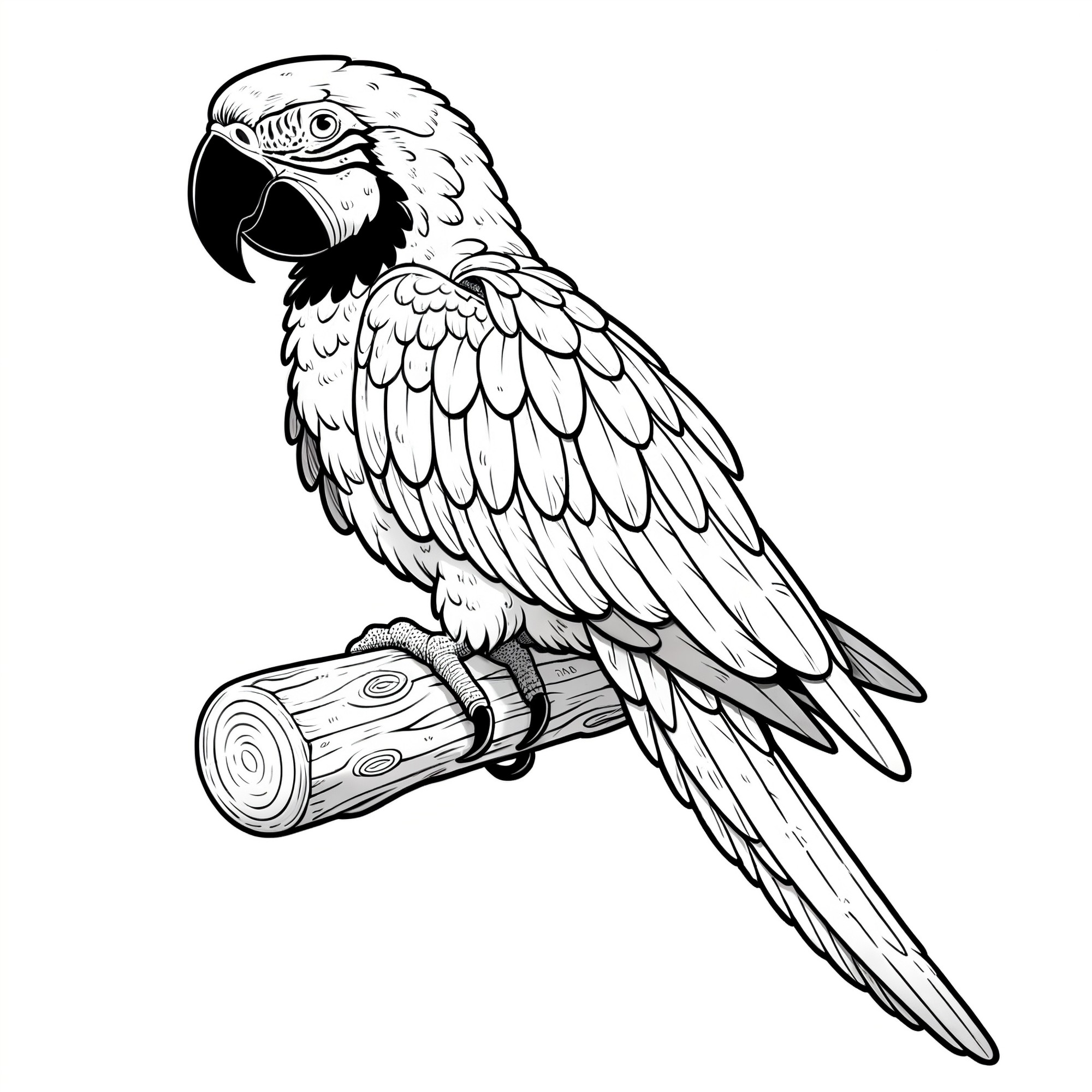
Bring some of the brightest colors in the bird world to your coloring table with our free printable macaw coloring page, featuring one of the most spectacular members of the parrot family.
Macaws are famous for long tails, large curved beaks, expressive faces, and brilliantly colored feathers. Depending on the species, real macaws can combine scarlet red, cobalt blue, golden yellow, emerald green, turquoise, black, white, and other shades that already look almost too colorful to be real.
That makes a macaw a wonderful subject when you want to experiment with bold color.
Recreate the fiery reds, yellows, and blues of a scarlet-macaw-inspired bird, try the brilliant blue and gold of a blue-and-yellow macaw, create an almost entirely cobalt-blue hyacinth-inspired macaw, or forget real species completely and invent a pink, purple, turquoise, or rainbow tropical parrot.
Then build the world around your bird with rainforest leaves, branches, flowers, fruit, vines, distant mountains, or an entire imaginary jungle.
Grab your brightest crayons, colored pencils, or markers and let this tropical bird take flight.
🦜 Meet Our Macaw Coloring Page
This page contains a single macaw illustration, giving the bird itself plenty of room to become the focus.
Rather than trying to squeeze many species onto one page, you can spend time choosing colors for the:
- Head and face
- Wings
- Long tail
- Chest
- Beak
- Feet
Then decide where your macaw lives.
Perhaps it is perched in a humid tropical forest surrounded by green leaves and ripe fruit. Maybe it is flying above a river. Or perhaps your rainbow macaw belongs in a completely imaginary world where purple trees grow beside turquoise waterfalls.
For a much larger collection of feathered friends, continue with our Bird Coloring Pages.
🎨 Choose a Macaw Color Palette
Macaws are an unusual coloring subject because realistic colors can be every bit as exciting as fantasy colors.
Try a fiery tropical palette with:
- Scarlet red
- Orange
- Golden yellow
- Royal blue
- Green
For something cooler, choose:
- Cobalt
- Turquoise
- Navy
- Yellow
- Green
A rainforest palette might combine emerald, lime, turquoise, gold, and red.
Or create a fantasy bird with lavender, pink, aqua, silver, and purple.
You can also print the same design more than once and turn every copy into a different imaginary species.
❤️ Create a Scarlet-Macaw-Inspired Bird
Scarlet macaws are among the world’s most recognizable parrots.
For a scarlet-inspired palette, try:
Body: Bright red
Wing accents: Yellow and blue
Tail: Red and blue
Face: Pale or white
Beak: Cream and dark gray or black
Use several reds rather than one flat shade.
Try scarlet on brighter areas, crimson in the middle, and burgundy where you want deeper shadows.
Then make the blue feathers especially rich so they contrast against the warm red body.
💙 Create a Blue-and-Yellow Macaw
One of the most dramatic natural macaw color schemes uses brilliant blue and golden yellow.
Try:
Back and wings: Cobalt and royal blue
Chest: Golden yellow
Forehead: Green
Beak: Black
Facial area: Pale cream or white
This combination almost looks like a coloring-book invention, but real blue-and-yellow macaws genuinely display striking blue upperparts and brilliant yellow underparts.
Use several blues through the feathers to make the bird look more layered.
💛 Make the Golden Chest Glow
Start with pale yellow.
Add golden yellow across most of the chest.
Use a small amount of orange-yellow in shadowed areas.
Keep a few patches lighter.
The warm chest will stand out strongly against blue wings.
Repeat a little yellow elsewhere in the background, perhaps in tropical flowers or fruit, to tie the page together.
💙 Create a Hyacinth-Inspired Macaw
The hyacinth macaw is famous for its extraordinary deep-blue plumage.
Try:
- Cobalt
- Royal blue
- Navy
- Violet-blue
Use slightly lighter blue where light might strike the feathers.
Add yellow around small facial details for contrast.
A nearly all-blue bird gives you a great opportunity to experiment with shading rather than constantly changing colors.
💚 Create a Green-Winged-Macaw-Inspired Bird
Despite the name, a green-winged macaw is predominantly red.
Its wings add darker green and blue.
Try:
Body: Scarlet and crimson
Wing area: Green
Wing and tail accents: Blue
Beak: Cream and black
Smithsonian describes the real green-winged macaw as having red plumage with green wing coverts and blue across parts of the wings, back, rump, and tail.
That natural combination can produce an especially dramatic coloring page.
🌈 Create a Rainbow Macaw
Macaws already look like living rainbows, so taking the idea one step further feels perfectly natural.
Color the feathers in order:
Red
Orange
Yellow
Green
Blue
Purple
Or divide the wings into different color zones.
Maybe one wing uses warm colors and the other uses cool colors.
Keep the beak black, cream, or gray so the rainbow feathers remain the center of attention.
💜 Create a Purple Macaw
Try:
Head: Lavender
Chest: Violet
Wings: Plum and turquoise
Tail: Purple and blue
Add a gold-colored beak.
Perhaps this macaw lives in a magical rainforest that appears only after sunset.
Draw purple flowers and tiny stars around it.
🩷 Create a Pink Tropical Macaw
Use:
- Blush
- Coral
- Raspberry
- Magenta
through the bird.
Add turquoise and lime-green wing accents.
Make the tail a gradient from pink into purple.
The bright tropical background gives you plenty of room to continue the color experiment.
🌌 Create a Galaxy Macaw
Turn every feather into a piece of the night sky.
Use:
- Navy
- Indigo
- Violet
- Magenta
- Turquoise
Add tiny pale dots resembling stars.
Keep the beak charcoal or black.
Perhaps the long tail contains a streak of silver like a comet.
This version does not belong to any real macaw species—and that is exactly the point.
🪶 Use Several Shades on the Feathers
Feathers become much more interesting when they contain more than one shade.
For a blue area, try:
- Sky blue
- Turquoise
- Royal blue
- Navy
For red:
- Coral
- Scarlet
- Crimson
- Burgundy
Work in strokes that follow the direction of the feathers rather than scribbling across them randomly.
The small color changes can suggest overlapping plumage.
🪽 Color the Wings in Layers
Macaw wings contain many feathers arranged over one another.
Instead of coloring the whole wing one color, alternate nearby shades.
For a blue wing:
Feather row 1: Turquoise
Feather row 2: Cobalt
Feather row 3: Royal blue
Feather row 4: Navy
For a rainbow version, gradually shift from one color to the next.
The printed feather shapes can become their own built-in color pattern.
🪶 Make the Long Tail Stand Out
Long tails are one of the features that make macaws so visually distinctive.
Use a gradient.
Maybe:
Red → Purple → Blue
or:
Turquoise → Cobalt → Navy
Keep some narrow highlights running lengthwise.
That helps the tail appear long and sleek rather than like one solid block of color.
🖤 Color the Powerful Beak
Macaws have large, strongly curved beaks.
Depending on the species, the beak may contain combinations of:
- Black
- Charcoal
- Cream
- Horn-colored beige
Use several shades rather than one dark area.
Add a lighter edge to suggest a smooth, hard surface.
The beak is one of the most important parts of a macaw’s anatomy.
🥜 Why Is a Macaw’s Beak So Strong?
Macaws use their strong curved beaks to handle foods such as nuts and seeds.
San Diego Zoo notes that the large beak is well suited to crushing tough foods.
The beak is also useful when climbing.
A parrot can use its beak almost like an additional gripping point as it moves among branches.
Draw a nut or piece of fruit near your macaw.
Maybe it is about to eat lunch.
🦶 Look at a Macaw’s Feet
Parrot feet are wonderfully adapted for gripping.
They have two toes pointing forward and two pointing backward, an arrangement called zygodactyl.
This helps parrots:
- Grasp branches
- Climb
- Hold food
Macaws can manipulate objects with their feet in a remarkably hand-like way.
If the feet are visible on your printable, color them gray, charcoal, brown-gray, or another shade.
Then draw a branch for the bird to grip.
✋ A Bird That Holds Food With Its Foot
Imagine eating a snack while holding it with your foot.
For a macaw, that is much less strange.
Parrots frequently use one foot to grasp food while using the beak to break pieces apart.
Draw:
- Nut
- Fruit
- Seed pod
in the macaw’s foot.
Maybe the bird has found the biggest nut in the entire rainforest.
🌴 Build a Tropical Forest Background
Macaws occur naturally in parts of Mexico, Central America, and South America, depending on the species.
Many are associated with tropical and subtropical forests.
Create a lush background with:
- Tall trees
- Vines
- Broad leaves
- Fruit
- Flowers
Use many greens.
Try mint, lime, leaf green, emerald, olive, and forest green.
A colorful macaw can still stand out even against a very busy forest.
🌿 Use More Than One Green
A rainforest should not become one giant green block.
Try:
Young leaves: Yellow-green
Bright leaves: Leaf green
Shadow leaves: Emerald
Deep background: Forest green
Add blue-green to some foliage.
The variation creates a sense of depth and gives the brightly colored bird a richer setting.
🌺 Add Tropical Flowers
Draw blossoms in:
- Pink
- Red
- Orange
- Yellow
- Purple
Place some near the macaw.
Keep others farther away.
You do not need to identify every decorative blossom as a specific tropical plant.
They can simply become part of your imaginary rainforest.
🍊 Add Fruit to the Trees
Macaws eat a varied diet that can include fruits, nuts, seeds, flowers, leaves, and other plant material, depending on species and location.
Draw colorful fruit.
Try:
- Orange
- Yellow
- Red
- Purple
Maybe your imaginary tree produces a fruit with three colors at once.
Give it a name.
🥜 Add Nuts & Seeds
Draw several large nuts near the bird.
Maybe the macaw is using its beak to crack one.
Color:
- Tan
- Brown
- Golden brown
Hide several among the leaves.
Turn the page into a small food-finding activity.
🧱 Why Do Some Macaws Visit Clay Licks?
In parts of South America, macaws and other parrots gather at exposed clay banks.
Scientists have studied why they do this.
The clay may help birds obtain nutrients such as sodium, and some research has also considered whether certain clays can bind plant chemicals.
The explanation is more complicated than simply saying that macaws eat clay because it “provides essential minerals.”
Draw a riverbank beside your rainforest.
Add several colorful macaws gathering on the exposed earth.
🌊 Create a Rainforest River
Draw a winding river beneath the trees.
Use:
- Pale blue
- Aqua
- Turquoise
- Deep blue
Add reflections of the forest.
Maybe another macaw flies across the water.
Draw distant hills.
The single-bird printable can become a complete tropical landscape.
🌅 Create a Rainforest Sunset
Use:
Yellow → Orange → Pink → Purple
across the sky.
Turn distant trees into dark silhouettes.
Keep the macaw brightly colored.
A red bird may blend somewhat with the warm sky, so add strong blue and green feathers for contrast.
🌧️ Create a Rainy Tropical Forest
Draw heavy leaves and gray-blue clouds.
Add raindrops.
Use deeper greens throughout the forest.
Color the macaw with especially bright red, yellow, and blue so it stands out.
Maybe the bird waits beneath large leaves until the storm passes.
🌈 Add a Rainbow Over the Forest
A colorful macaw and a rainbow are a perfect match.
Draw:
Red
Orange
Yellow
Green
Blue
Purple
across the sky.
Then decide whether the bird should match the rainbow or contrast with it.
Maybe your macaw is almost entirely blue while the rainbow provides the warmer colors.
🦜 Macaws Are Parrots
Macaws belong to the parrot family.
Like other parrots, they share traits such as:
- Strong hooked bills
- Grasping feet
- Social behavior
- Vocal communication
Macaws are generally distinguished by features such as relatively large size and long tails.
There are multiple macaw species and several genera, ranging from smaller macaws to the enormous hyacinth macaw.
📏 Macaws Come in Different Sizes
Not every macaw is equally large.
San Diego Zoo identifies the hyacinth macaw as the largest in its macaw overview, reaching about 100 centimeters in length, while smaller macaws are dramatically shorter.
So “macaw” does not refer to one single size, color, or species.
That diversity is one reason you can use the same coloring page as inspiration for several different birds.
Print it more than once and create your own macaw collection.
🎨 Design Three Macaw Species
Create three versions of the same printable.
Macaw 1 — Fire Macaw
Red, orange, yellow
Macaw 2 — Ocean Macaw
Blue, turquoise, green
Macaw 3 — Night Macaw
Purple, navy, silver
Give each one:
- Name
- Habitat
- Favorite food
- Special call
Now you have created a tiny imaginary field guide.
📣 Macaws Are Loud Birds
Macaws communicate using loud calls.
In dense forests, vocal communication helps birds stay in contact even when vegetation makes it difficult to see one another.
Draw sound lines around the bird.
Maybe:
SCREEECH!
or invent a completely imaginary bird call.
Use large colorful letters.
🎵 Draw the Macaw’s Call
Turn sound into a visual pattern.
Try:
Red line = loud
Yellow line = medium
Blue line = quiet
Draw the lines spreading through the forest.
Maybe another macaw answers from across the page.
🦜 Macaws Can Be Social
Macaws may be seen in pairs, family groups, or flocks, depending on species and circumstances.
Draw another macaw next to the first.
Give it different colors.
Maybe they are a pair.
Or draw several tiny birds flying above the trees.
A single printable can become the start of an entire flock.
🪹 Where Do Macaws Nest?
Many macaws use cavities in trees for nesting, although nesting habits vary among species.
Draw a large tree trunk.
Add a hollow.
Maybe a macaw is peeking out.
Keep some distance between the nest and the ground to show that the cavity is high in the tree.
🥚 Create a Macaw Nest Scene
Draw:
- Tree cavity
- Adult macaw
- Eggs or chicks
Research the species you want to represent before adding exact clutch sizes or breeding details, because those vary.
For a simple coloring activity, focus on the idea that many macaws depend on suitable mature trees with nesting cavities.
🌳 Old Trees Can Matter
Large old trees can provide more than shade.
They may contain cavities suitable for nesting birds.
When forests are cleared or heavily altered, birds that depend on those structures can lose potential nesting sites.
That is one way habitat conservation connects directly with macaw survival.
Draw a giant old rainforest tree behind your bird.
Fill it with:
- Vines
- Moss-inspired patterns
- Epiphyte-inspired plants
- Nest hole
🌎 Macaws Live in the Americas
Wild macaw species are native to the Americas, particularly tropical and subtropical regions of Mexico, Central America, and South America.
Find:
- Mexico
- Central America
- South America
on a map.
Then choose one particular macaw species and research its actual range.
Do not color the entire tropical Americas as though every macaw species lives everywhere.
Different species have different distributions.
🗺️ Create a Macaw Range Activity
Choose one real species.
Maybe:
- Scarlet macaw
- Blue-and-yellow macaw
- Green-winged macaw
- Great green macaw
Research where it occurs.
Shade that approximate area on a blank map.
Then color the bird using that species’ plumage as inspiration.
🌱 Macaws & Forest Ecology
Parrots can interact with forests in several ways.
They eat fruits, seeds, and other plant material, and some parrots can disperse seeds.
Their feeding may also destroy some seeds rather than disperse them successfully.
Ecological roles differ among species, foods, and habitats.
So it is better to avoid saying that every macaw is simply a “vital seed disperser” in exactly the same way.
Real forest relationships are more complicated—and more interesting.
⚠️ Macaw Conservation Is Not One Simple Story
Different macaw species have very different conservation situations.
Some remain relatively widespread.
Others face serious threats.
Problems affecting macaws can include:
- Habitat loss
- Forest fragmentation
- Capture for illegal wildlife trade
- Loss of nesting trees
Conservation status should therefore be discussed species by species, rather than saying all macaws are endangered.
💚 The Great Green Macaw
The great green macaw is one example of a macaw facing serious conservation pressure.
BirdLife identifies it as Critically Endangered.
Its remaining populations occur in fragmented forest areas in Central and South America.
Protecting habitat and reducing illegal capture are important parts of conservation efforts.
If you want a nature-study extension, choose the great green macaw and research its real colors and range.
💙 The Spix’s Macaw Story Has Changed
The Spix’s macaw is an especially important example of why wildlife articles need updating.
The species disappeared from the wild around the beginning of the twenty-first century and became famous as a bird surviving only through managed populations.
But that is no longer the whole story.
Conservationists began releasing captive-bred Spix’s macaws into Brazil’s Caatinga in 2022.
Reintroduction is a long and difficult process, and establishing a secure wild population takes much more than opening a cage.
So describing the Spix’s macaw simply as “extinct in the wild” without mentioning reintroduction efforts can now be misleading.
🌿 Create a Conservation Poster
Color the macaw.
Add:
PROTECT WILD MACAWS
Then draw:
- Forest
- Nest tree
- Fruit
- Flying flock
Keep the message simple.
Maybe:
Wild Birds Belong in Wild Habitats
or:
Forests Give Macaws a Home
Use your brightest colors to make the bird the centerpiece.
🐦 Wild Macaws Aren’t Decorations
Their brilliant feathers have made parrots highly desirable in the wildlife trade.
But a wild macaw is not simply a colorful object.
It is part of a complex ecosystem and has specialized social, dietary, and environmental needs.
Wildlife should never be captured or purchased illegally.
If learning about parrots inspires interest in keeping one as a companion animal, families should research carefully because large parrots can require highly specialized care and very long-term commitments.
🖍️ Compare a Macaw With Other Birds
Color the macaw and another bird.
Try:
Macaw
Large curved beak
Long tail
Strong grasping feet
Hummingbird
Long slender bill
Tiny body
Specialized hovering flight
The contrast shows how dramatically different birds can become when adapted to different lifestyles.
Continue with our Hummingbird Coloring Pages.
🐦 Compare a Macaw With a Toucan
Both can appear in tropical American forests, but they are very different birds.
A toucan is famous for its enormous lightweight bill.
A macaw has a powerful hooked parrot beak.
Draw one of each.
Compare:
- Bill shape
- Tail
- Feet
- Colors
Avoid assuming that every tropical bird is closely related simply because they share a colorful habitat.
🪶 Create a Tropical Bird Collection
Combine your macaw with pages from our Bird Coloring Pages.
Choose:
- Parrot
- Toucan
- Hummingbird
- Peacock-inspired decorative bird
Color each differently.
Then create a cover:
My Colorful Birds Book
🔤 M Is for Macaw
Write a large:
M
Practice:
M is for Macaw.
Think of more M words:
- Moon
- Monkey
- Mango
- Mountain
Decorate the M with brightly colored feathers.
For more simple learning activities, explore our Educational Coloring Pages & Activities.
🦜 P Is for Parrot
Write:
P is for Parrot.
Think of:
- Pink
- Purple
- Plant
Color each P differently.
Add a curved beak to the side of the letter.
🪶 F Is for Feather
Write:
F is for Feather.
Draw several feathers.
Color them:
- Red
- Yellow
- Blue
- Green
Arrange them in a rainbow.
🔢 Count the Feather Colors
Choose five colors.
For example:
- 3 red feathers
- 4 blue feathers
- 2 yellow feathers
Count the total.
Or create a pattern:
Red → Yellow → Blue → Red → Yellow → Blue
Continue down the tail.
🔍 Create a Macaw I Spy Page
Hide around the rainforest:
- 6 leaves
- 5 flowers
- 4 fruits
- 3 nuts
- 2 macaws
- 1 tiny frog
Color everything.
Then challenge someone else to find the entire list.
🎲 Play Macaw Roll-and-Color
Use a six-sided die.
Assign:
1 — Red
2 — Yellow
3 — Blue
4 — Green
5 — Purple
6 — Your choice
Roll.
Color one feather or background detail using the matching color.
Continue until the page is finished.
The final bird might resemble a real macaw—or something completely new.
🎯 Try a Five-Color Tropical Challenge
Choose only:
- Red
- Yellow
- Blue
- Green
- Black
Use those shades across the bird and forest.
Create lighter or darker versions by changing pressure.
Then print another page using only pastels.
Compare the results.
🚫 Try a No-Red Macaw Challenge
Many people picture a red macaw first.
So avoid red completely.
Try:
- Blue
- Green
- Yellow
- Purple
- Turquoise
Can the bird still look spectacular?
Absolutely.
Some real macaws already prove that red is not required.
📖 Write a Macaw Rainforest Story
Try:
The macaw flew farther from its favorite tree than ever before and discovered…
or:
Every bird in the forest was calling except one macaw because…
or:
Hidden inside the enormous old tree was…
Finish the adventure.
Use the coloring page as the first illustration.
🥜 The Missing Nut Mystery
The macaw has hidden its favorite nut.
Now it is gone.
Possible clues:
- Broken shell
- Footprints
- Feather
- Leaf
Who found it?
Maybe another bird.
Perhaps a monkey.
Or maybe the macaw forgot where it put it.
Write the solution.
🌈 The Rainbow Feather
A macaw discovers one feather that changes color.
Whenever it becomes:
Blue — rain begins.
Yellow — sun shines.
Purple — stars appear.
What happens when the feather turns red?
Finish the story.
🌳 The Ancient Rainforest Tree
The macaw has always slept in the same enormous tree.
One morning, it discovers a tiny door in the trunk.
Where does it lead?
Maybe:
- Underground forest
- Hidden bird city
- Library
- Secret garden
Draw the next scene.
🦜 The Lost Flock
A young macaw cannot find its family group.
It listens for their calls.
Along the way, it meets:
- Toucan
- Hummingbird
- Frog
- Monkey
Who helps?
Write a simple rainforest adventure.
📕 Make a Macaw Mini Book
Create four pages.
Page 1
Colorful macaw.
Page 2
Macaw eating fruit.
Page 3
Macaw climbing a branch.
Page 4
Macaw flying above the forest.
Add a cover:
My Macaw Book
Write one accurate sentence beneath each picture.
🏫 Macaw Coloring Page for the Classroom
This printable can work naturally with:
- Bird units
- Rainforest themes
- South and Central America studies
- Animal adaptations
- Habitats
- Conservation
- Creative writing
- Color-pattern activities
Children can simply enjoy coloring a bright bird, while older students can research an individual macaw species.
That species-specific approach is especially useful because macaws differ in color, range, size, habitat, and conservation status.
🪶 Create a Macaw Fact Card
Write:
Animal: Macaw
Group: Bird
Family: Parrot family
Feet: Two toes forward, two backward
Beak: Strong and curved
Then choose one particular macaw species and add:
Species: ______
Range: ______
Colors: ______
Conservation status: ______
Use a current wildlife source for the species-specific information.
🌎 Create a Rainforest Classroom Display
Place the macaw among:
- Tropical leaves
- Vines
- Fruit
- Flowers
Add other animals only after researching where they live.
Not every “rainforest animal” shares the same continent.
A jaguar can fit a tropical American scene.
A tiger cannot—it is native to Asia.
That distinction can turn a colorful mural into a geography lesson too.
🦜 Create a Macaw Color Gallery
Print several copies.
Try:
Scarlet-inspired: Red, yellow, blue
Blue-and-yellow-inspired: Blue, gold, green
Hyacinth-inspired: Deep blue
Fantasy: Pink, turquoise, purple
Display them together.
Write:
MACAWS: COLOR IN THE CANOPY
above the gallery.
🌿 Explore More Bird Coloring Pages
Our Bird Coloring Pages are the best next stop when you want more feathered subjects.
The larger collection includes:
- Parrots
- Hummingbirds
- Peacocks
- Owls
- Flamingos
- Toucans
- Doves
- Chicks
- Seabirds
Use this page when you specifically want a macaw.
Use the Bird hub when you want to explore the diversity of birds more broadly.
💎 Explore Hummingbird Coloring Pages
For another extremely colorful bird, continue with our Hummingbird Coloring Pages.
Macaws and hummingbirds could hardly be more different in size and lifestyle, but both are fantastic coloring subjects because real feathers can already include brilliant jewel-like colors.
Color one of each.
Compare the beaks and body shapes.
🐾 Explore More Animal Coloring Pages
Continue through the animal world with our Animal Coloring Pages.
You’ll find mammals, reptiles, birds, ocean animals, farm animals, and many other creatures.
Choose one from a completely different habitat and compare it with the macaw.
🌿 Explore Nature Coloring Pages
For more outdoor subjects, visit our Nature Coloring Pages.
Explore:
- Birds
- Flowers
- Plants
- Insects
- Animals
- Landscapes
- Beaches
Use the macaw as the centerpiece of a colorful tropical nature collection.
🖍️ Best Supplies for This Macaw Coloring Page
Crayons work well for large feather areas and younger colorists.
Colored pencils are especially useful for:
- Individual feathers
- Beak shading
- Feet
- Tail gradients
- Leaves
Markers are excellent for the brilliant reds, yellows, blues, and greens associated with macaws. Slightly heavier paper may help if marker ink tends to bleed through ordinary printer paper.
You can also combine materials.
Try markers on the brightest feathers and colored pencils on smaller details and the rainforest background.
🖨️ How to Use This Free Macaw Coloring Page
Print the page and decide whether you want a nature-inspired or imaginary bird.
For a scarlet-inspired palette, gather:
- Red
- Yellow
- Blue
For a blue-and-yellow-inspired version:
- Blue
- Gold
- Green
For a fantasy macaw:
- Pink
- Purple
- Turquoise
Color the bird first.
Then add:
- Branches
- Leaves
- Fruit
- Flowers
- Rainforest river
- Another macaw
Give your bird a name.
If it represents a real species, research where that species actually lives.
If it is imaginary, invent an entire habitat to match.
🦜 Let Your Macaw Fill the Rainforest With Color
With one spectacular tropical parrot ready for your brightest colors, this free printable Macaw Coloring Page is a natural choice for anyone who loves birds, rainforests, and bold color combinations.
Create a scarlet-inspired macaw in blazing red, yellow, and blue. Try the blue-and-gold brilliance of a blue-and-yellow macaw. Fill a hyacinth-inspired bird with deep cobalt shades. Or invent a pink-and-purple macaw whose feathers glow beneath a rainbow.
Along the way, notice some of the adaptations that make real macaws remarkable: powerful curved beaks for handling tough foods, zygodactyl feet with two toes facing forward and two backward, long tails, loud social calls, and the ability to manipulate food with their feet.
Macaws also remind us why species-specific wildlife information matters.
Different macaw species live in different places and face different conservation situations. The great green macaw faces severe conservation pressure, while the Spix’s macaw—once gone from the wild—has become the focus of ambitious reintroduction work in Brazil.
So start with the colors.
Then look a little closer at the real birds behind them.
Choose your brightest shades, build a forest around the page, and let your macaw bring the canopy to life.
Happy coloring!
🔗 Related Articles
- Bird Coloring Pages
- Hummingbird Coloring Pages
- Animal Coloring Pages
- Nature Coloring Pages
- Coloring Pages of the Zoo
- Educational Coloring Pages & Activities
📚 Sources
- San Diego Zoo — Macaw
- Smithsonian’s National Zoo — Green-Winged Macaw
- BirdLife International — Everything You Need to Know About Parrots
- BirdLife International — Species Champions
- BirdLife International — Targeted Conservation and the Spix’s Macaw Reintroduction