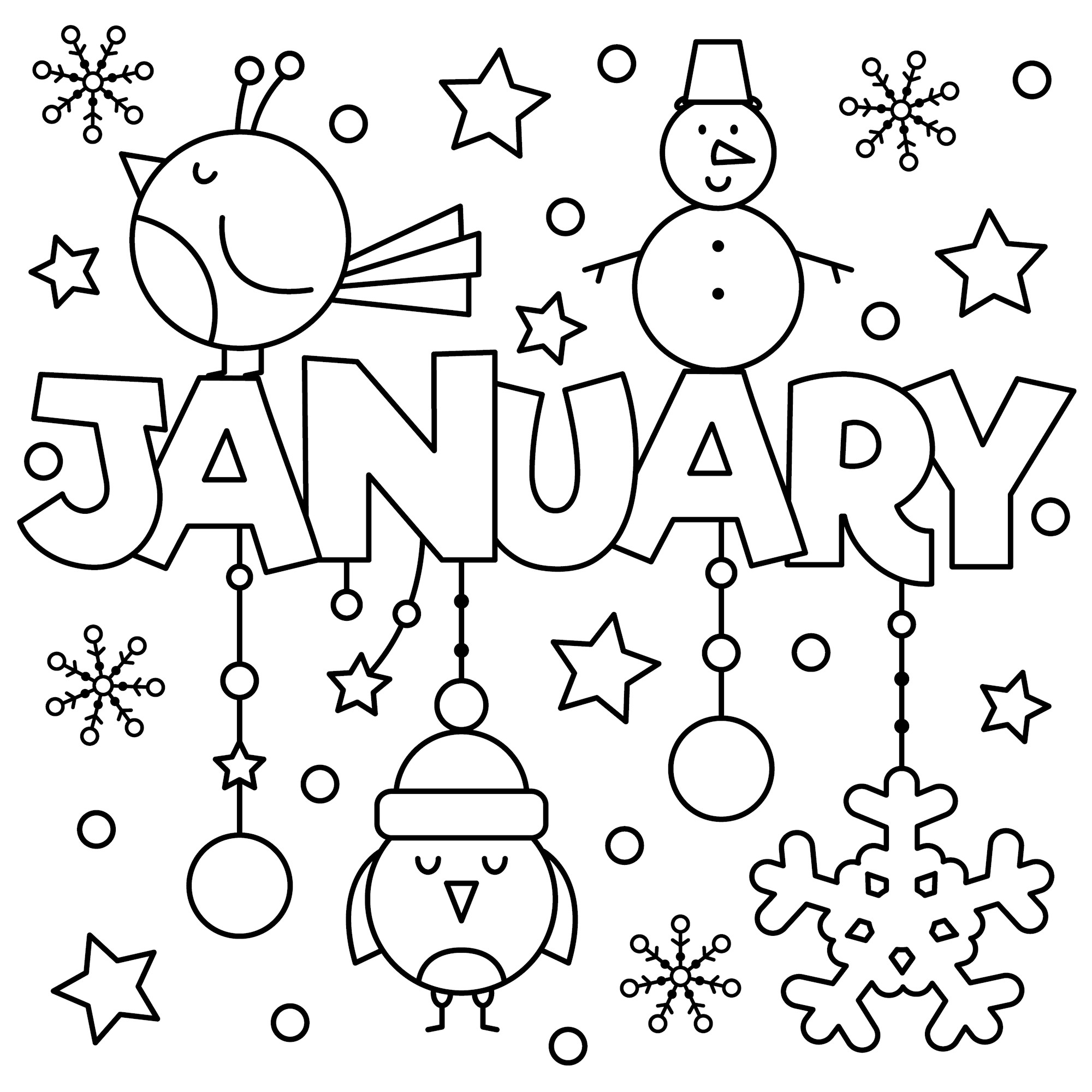
Hello, January! Start a brand-new month and a brand-new year with our free printable January coloring page, filled with snowy winter fun, snowflakes, snowman-building adventures, chilly-weather details, and winter birds.
January often feels like the heart of winter in the Northern Hemisphere. Depending on where you live, the month might bring deep snow, icy mornings, bare trees, winter birds, cold sunshine, or simply cooler weather. That makes January a wonderful month for experimenting with icy blues, snowy whites, silvers, purples, cozy reds, and every other color in the box.
This printable is perfect for a snow day, classroom January activity, winter art center, homeschool lesson, New Year celebration, or quiet afternoon indoors.
Color the snowy scene realistically, create a pink-and-purple winter wonderland, give the snowman a rainbow scarf, or turn January into an imaginary world where every snowflake is a different color.
Grab your crayons, colored pencils, or markers and let the first month of the year begin!
❄️ Explore Our January Coloring Page
This January design captures some of the most familiar images of winter, including snowy scenery, snowflakes, snowman-building fun, and birds enjoying the chilly landscape.
That gives kids plenty of different details to explore.
You can color:
- Snow
- Snowflakes
- A snowman
- Winter clothing
- Birds
- Trees and outdoor scenery
- The winter sky
Younger children can enjoy large areas of blue, white, and bright color, while older kids can add shading to snow, detailed snowflake patterns, realistic bird colors, shadows, and an entire winter landscape around the original illustration.
🎨 Choose a January Color Palette
January doesn’t have to mean only blue and white.
Try one of these palettes.
Icy Winter
- Pale blue
- Navy
- White
- Silver
- Lavender
Cozy January
- Burgundy
- Forest green
- Brown
- Cream
- Gold
Pastel Winter
- Blush pink
- Baby blue
- Mint
- Lavender
- Pale yellow
Snowy Sunset
- Peach
- Pink
- Purple
- Blue
- Gold
Or use every color you like.
A snowman wearing a rainbow scarf can look just as wonderful as one dressed in traditional winter colors.
💙 Create an Icy Blue January
For a classic winter look, gather several shades of blue.
Try:
- Powder blue
- Sky blue
- Turquoise
- Blue-gray
- Navy
Use lighter blues in the snow shadows and darker shades in the sky or distant landscape.
Add lavender and silver details for extra depth.
Leave plenty of white space so the snowy parts of the picture still look bright.
🌈 Create a Rainbow Winter Wonderland
Winter does not have to be colorless.
Give every snowflake a different color.
Make the snowman’s scarf rainbow-striped.
Color the birds pink, purple, yellow, and blue.
Turn the sky into a pastel sunset.
You could even make the snow beneath the characters sparkle with pale pink, blue, and lavender shadows.
A coloring page gives you permission to invent the brightest January anyone has ever seen.
⛄ Color the January Snowman
A snowman is one of the most recognizable winter characters.
Keep most of the body white and add very pale blue or gray shading around the edges.
Then concentrate your brightest colors on the accessories.
Try:
Hat: Black, red, purple, or blue
Scarf: Rainbow stripes
Nose: Orange
Buttons: Black or colorful
Arms: Brown
You can also add mittens, earmuffs, a bow tie, or any other details the snowman needs.
🥕 Give the Snowman a Carrot Nose
An orange carrot is the classic choice.
Start with yellow-orange near the base and deepen the color toward the tip.
Add a few small lines for texture.
Or forget tradition and create:
- Purple carrot
- Rainbow carrot
- Golden carrot
- Candy-cane nose
Perhaps this particular snowman has a completely different sense of style.
🧣 Design a Snowman Scarf
The scarf is one of the easiest places to add patterns.
Try:
- Stripes
- Polka dots
- Snowflakes
- Hearts
- Stars
- Checkerboards
- Rainbows
Maybe the hat and scarf match.
Or deliberately make them completely different.
Add tassels at the ends of the scarf and color each one separately.
🎩 Design a Snowman Hat
A traditional snowman might wear a black top hat, but there are plenty of other possibilities.
Try:
- Red knit hat
- Purple beanie
- Green winter cap
- Rainbow hat
- Blue hat with snowflakes
Add a pom-pom.
Draw a tiny bird sitting on top.
Or give your snowman a crown and turn it into the ruler of January.
😊 Give Your Snowman a Personality
What kind of snowman did you build?
Maybe it is:
- Cheerful
- Silly
- Sleepy
- Surprised
- Fancy
- Adventurous
Give it a name.
Try:
Frosty
Snowball
Flurry
January Jack
Chilly
Marshmallow
Write the name beneath the finished page.
✏️ Draw Another Snowman
Use the coloring page as inspiration to draw your own.
Start with three circles:
Large circle on the bottom.
Medium circle in the middle.
Small circle on top.
Add a face, arms, hat, scarf, and buttons.
Then change the formula.
Draw a two-ball snowman.
Make an enormous four-ball snowman.
Create a tiny snow family.
🔵 Learn With Snowman Shapes
Snowmen are naturally useful for a simple shape activity.
Look for:
- Circles
- Triangles
- Rectangles
- Lines
The body is made from circles.
A carrot nose can look like a triangle.
A scarf may contain rectangles.
Buttons are small circles.
Younger children can identify the shapes before coloring them.
🔢 Count the Snowballs
How many large round sections make up your snowman?
Count them.
Then draw:
- 1 tiny snowball
- 2 medium snowballs
- 3 large snowballs
You can also create a simple number activity using buttons.
Draw five buttons and color each one differently.
❄️ Color the January Snowflakes
Snowflakes are one of the most beautiful details in a winter coloring page.
Real snow crystals form with sixfold symmetry, which means their basic structure is organized around six sides or branches.
For coloring, though, you can use any colors you want.
Try:
- Pale blue
- Silver
- Lavender
- Turquoise
- Pink
- Gold
Leave some white while adding color near the edges.
This can make the flakes look especially delicate.
✨ Why Do Snowflakes Have Six Sides?
Snow crystals develop their six-sided structure because of the way water molecules arrange themselves as ice forms.
As a crystal travels through a cloud, changes in temperature and moisture affect how it grows.
That is why snowflakes can develop different shapes and branches while still maintaining their basic sixfold structure.
For kids, the fun version is simple:
Snowflakes can look incredibly different, but their ice-crystal structure is built around six sides.
🪞 Create a Symmetrical Snowflake
Draw six lines radiating from one point.
Add the same small shape to each branch.
Try:
- Diamonds
- Tiny lines
- Hearts
- Dots
- Triangles
Repeat the decoration six times.
Then color matching sections alike.
This is a fun symmetry challenge for older children.
🌈 Make Rainbow Snowflakes
Real snow is made from ice, but paper snowflakes can be anything you want.
Color one:
Red and orange.
Another:
Blue and purple.
Another:
Green and yellow.
Then create one with all six rainbow colors.
Add a dark blue background to make the flakes stand out.
✂️ Make Paper Snowflakes
A January coloring activity can easily lead into a simple winter craft.
Fold white paper and, with age-appropriate help, cut small shapes along the edges.
Open the paper to reveal a repeating snowflake-like design.
Then decorate it with:
- Crayons
- Colored pencils
- Stickers
- Glitter glue
Hang several together near your finished January picture.
🌨️ How Does Snow Form?
Snow begins in clouds as ice crystals.
Water vapor contributes to the growth of those crystals under cold cloud conditions. As the crystals grow and combine, they can eventually become the snowflakes that fall toward the ground.
Snow doesn’t fall everywhere during January, of course.
Local temperature, moisture, elevation, latitude, and weather patterns all matter.
That means your January may look very different from someone else’s.
🌍 January Doesn’t Look the Same Everywhere
A snowy January coloring page may feel familiar in parts of the northern United States, Canada, or northern Europe.
But January can look very different elsewhere.
Some places have mild winter weather.
Some rarely see snow.
And January occurs during summer in the Southern Hemisphere.
Draw two small scenes.
Northern Hemisphere January: Snowman and winter coat.
Southern Hemisphere January: Sunshine and summer scene.
This is a simple way to explore how seasons differ around the world.
❄️ January Is Part of Meteorological Winter
In the Northern Hemisphere, meteorological winter includes December, January, and February.
That makes January the middle month of meteorological winter.
Astronomical winter begins around the December solstice and continues until the March equinox.
Younger children don’t need all the terminology.
The simple idea is enough:
January is usually considered a winter month in the Northern Hemisphere.
🗓️ Compare December, January & February
Color your way through the winter months.
Start with the December Coloring Page.
Continue with January.
Then finish with the February Coloring Page.
Display all three together.
December might look festive and Christmas-inspired.
January can become the snowiest winter scene.
February brings hearts, warm drinks, cupcakes, and Valentine colors.
Together they create a complete winter coloring sequence.
🐦 Color the Winter Birds
Birds add life to the January scene.
Instead of assuming all birds leave when the weather turns cold, look outside.
Many species remain in cold regions throughout winter, while others move into an area specifically for the colder season.
Use natural bird colors such as:
- Brown
- Gray
- Black
- White
- Red
- Blue
- Yellow
Or create tiny rainbow birds.
🪶 How Do Birds Handle Winter?
Birds use a variety of adaptations and behaviors to survive cold conditions.
Feathers provide insulation, and access to enough food is especially important because maintaining body temperature requires energy.
Different species use different strategies.
Some migrate.
Others remain in cold areas all winter.
A January bird-watching activity can show just how active winter wildlife can be.
🔍 Go on a January Bird Watch
Look through a window or take a short outdoor walk with an adult.
Watch for birds.
Notice:
- Size
- Color
- Beak shape
- How they move
- What they eat
- Where they perch
You don’t need to know every species.
Simply paying attention is enough.
When you return, add one bird you noticed to the January coloring page.
For even more feathered designs, explore our Coloring Pages of Birds.
🌲 Add Evergreen Trees
Evergreen trees are perfect additions to a winter scene.
Use several greens:
- Pine green
- Forest green
- Blue-green
- Olive
Add snow resting on the branches.
Leave the snow white and use pale blue underneath for shadow.
Maybe a bird is perched between the needles.
🌳 Add Bare Winter Trees
Not every tree stays green.
Draw a few bare deciduous trees in the background.
Use:
- Brown
- Gray
- Tan
Add snow to the branches.
Perhaps a bird nest remains visible high in the tree.
This can make the scene feel more like a real winter landscape.
🌅 Create a January Sunrise
Winter mornings can inspire beautiful coloring palettes.
Try:
- Pale yellow
- Peach
- Pink
- Lavender
- Light blue
Blend the colors across the sky.
Keep the snowy ground pale blue and white.
The warm sky against the cool snow can make the picture especially dramatic.
🌇 Create a Pink Winter Sunset
Try the opposite time of day.
Color the sky:
- Orange
- Pink
- Purple
- Deep blue
Add dark silhouettes of trees.
Keep the snow pale.
Perhaps the snowman is watching the final sunlight disappear.
🌙 Create a January Night Scene
Turn the whole picture into nighttime.
Use:
- Navy
- Indigo
- Purple
Add:
- Moon
- Stars
- Glowing windows
- Snowflakes
Use yellow around windows or lanterns to create warm contrast.
The snowman might look especially bright beneath moonlight.
⭐ Add a Winter Starry Sky
Draw several stars overhead.
Make some tiny and others large.
Use:
- White
- Yellow
- Silver
- Pale blue
Add a crescent moon or full moon.
Perhaps the snowman is making a wish.
What would a snowman wish for?
Maybe colder weather.
🧤 Design Winter Mittens
Add a pair of mittens to your January scene.
Decorate them with:
- Snowflakes
- Stripes
- Hearts
- Stars
- Animals
Make them match the snowman’s scarf.
Or deliberately create two mismatched mittens.
Maybe one is red and one is purple.
🧣 Design the Perfect Winter Outfit
Draw:
- Hat
- Scarf
- Coat
- Mittens
- Boots
Choose a coordinated palette.
Try:
Classic Winter: Red, navy, white.
Pastel Winter: Lavender, pink, baby blue.
Rainbow Winter: Every color.
Add patterns to each item.
🥶 Dress for Cold Weather
If you’re heading outdoors during very cold winter weather, dressing appropriately matters.
Layers, warm clothing, hats, mittens or gloves, and protection for exposed skin can help reduce cold-weather risks.
Children should rely on adults to decide when conditions are safe for outdoor play.
Winter coloring can be a fun indoor activity when temperatures or weather make outdoor time unsafe.
🏠 Create a Cozy Indoor January Scene
Not every January adventure has to happen outside.
Draw a house or cabin in the background.
Add:
- Fireplace
- Blanket
- Warm drink
- Books
- Pet
- Window showing snow outside
Maybe everyone has finished building the snowman and is heading indoors to warm up.
☕ Draw a Warm Winter Drink
What would you like after playing in snow?
Draw a mug of:
- Hot chocolate
- Tea
- Warm cider
Add steam.
Maybe the steam forms little snowflakes or hearts.
Top hot chocolate with marshmallows for an extra cozy January detail.
📚 Create a January Reading Corner
Imagine the perfect snow-day reading spot.
Add:
- Books
- Pillows
- Blanket
- Warm socks
- Mug
Write tiny book titles on the covers.
Perhaps one is called:
The Snowman’s Secret
January Adventures
The Bird in the Blizzard
🎉 Celebrate New Year’s Day
January begins with New Year’s Day on January 1 in the Gregorian calendar.
That makes the January coloring page easy to connect with New Year celebrations.
Add:
- Fireworks
- Confetti
- Stars
- Balloons
- Party hats
Write:
HAPPY NEW YEAR!
across the background.
For a dedicated celebration page, visit our Happy New Year Coloring Page for Kids.
🎆 Add New Year Fireworks
Turn the January sky into a celebration.
Draw fireworks using:
- Red
- Yellow
- Blue
- Purple
- Green
- Pink
Make them explode above the snowy landscape.
The contrast between colorful fireworks and white snow can create a wonderful picture.
🥳 Add a New Year’s Party Hat
Draw a party hat on one of the characters—or even on the snowman.
Add:
- Stripes
- Stars
- Dots
- Current year
Make a matching version with our New Years Eve Party Hat Coloring Page for Kids.
✨ Start the Year With a Wish
Instead of a formal resolution, younger children can choose something fun they hope to do during the new year.
Finish:
This year I would like to…
Maybe:
- Read more books
- Draw more pictures
- Learn something new
- Visit a park
- Help someone
- Try a new activity
Draw a small picture beside the wish.
🎯 Create a January Goals Page
Older children can divide a paper into four sections.
Write:
Something I Want to Learn
Something I Want to Make
Something I Want to Try
Something Kind I Can Do
Add tiny winter illustrations around the answers.
The January coloring page can become the cover.
📅 January Is Month Number One
January is the first month of the year in the Gregorian calendar.
Turn that into a simple counting activity.
Draw:
- 1 snowman
- 1 bird
- 1 moon
- 1 giant snowflake
Write a large number 1 beside the picture.
Then practice:
January = Month 1
🔤 J Is for January
Write a large J.
Practice:
J is for January.
Think of other J words:
- Jam
- Jacket
- Jump
- Jelly
- Jet
Decorate the letter with snowflakes.
For more alphabet and learning activities, explore our Educational Coloring Pages & Activities.
🗓️ Make a January Calendar
Turn your finished coloring sheet into calendar art.
Draw a January calendar beneath it.
Add:
- Birthdays
- School days
- Family plans
- Winter activities
- New Year’s Day
- Special events
Use tiny symbols.
A snowflake might represent a winter outing.
A book can mark a library day.
A cake shows a birthday.
✅ Make a January Bucket List
Create a short list of winter activities that fit your location and weather.
Ideas include:
- Build a snowman, if snow is available
- Look for winter birds
- Read a winter story
- Make paper snowflakes
- Draw a snowy landscape
- Drink something warm
- Take a winter walk
- Watch the clouds
- Start a new coloring book
Choose only activities that make sense for your climate and family.
🔍 Go on a January Nature Hunt
Even in winter, there can be plenty to notice outdoors.
Look for:
- Evergreen tree
- Bare branch
- Bird
- Animal track
- Cloud
- Ice
- Snow, if present
- Something green
- Something brown
You don’t need to collect anything.
Observe and draw.
Then add one discovery to the January coloring page.
🐾 Look for Tracks in the Snow
Fresh snow can sometimes reveal signs of animals that passed by.
Look for tracks with an adult.
You might notice patterns left by:
- Birds
- Dogs
- Cats
- Rabbits
- Squirrels
Do not follow tracks toward wildlife or disturb animals.
Instead, draw the track shapes you noticed.
Add an imaginary trail around your snowman.
📓 Start a January Nature Journal
Use the finished page as the cover of a winter notebook.
Throughout January, record:
- Weather
- Birds
- Snow
- Ice
- Trees
- Animal tracks
- Sunsets
Add dates.
Younger children can make pictures.
Older kids can include a few sentences.
At the end of the month, compare the first observation with the last.
🌡️ Keep a January Weather Chart
Create a calendar and mark the weather each day.
Use:
☀️ Sunny
☁️ Cloudy
🌧️ Rainy
❄️ Snowy
🌬️ Windy
At the end of January, count each symbol.
Which type of weather occurred most often?
Your answer will depend entirely on where you live.
🌍 Compare January Weather Around the Country
January in Alaska can look very different from January in Florida.
Choose two U.S. locations.
Draw a January scene for each.
One might have:
- Snow
- Heavy coats
- Frozen lakes
Another might have:
- Green plants
- Mild temperatures
- Sunshine
This helps show that even within one country, winter can vary enormously.
🎨 Create a Warm vs. Cool January
Print the coloring page twice.
Cool Version
Use:
- Blue
- Green
- Purple
- Silver
Warm Version
Use:
- Red
- Orange
- Yellow
- Pink
Compare them.
Which feels colder?
Which feels cozier?
Which version makes the snowman stand out most?
🎲 Play January Roll-and-Color
Grab one six-sided die.
Assign each number a color:
1 — Blue
2 — Purple
3 — Red
4 — Green
5 — Yellow
6 — Your choice
Roll the die and color one part of the page.
Keep rolling until the scene is complete.
The random colors may create a winter world unlike anything you planned.
📖 Write a January Story
Use the coloring page as a story starter.
Try:
On the first snowy morning of January…
The snowman opened its eyes and…
The bird landed on the snowman’s hat and whispered…
One snowflake was completely different from the others because…
At midnight on January 1…
Younger children can tell the story aloud.
Older kids can write several paragraphs.
⛄ The Snowman Comes Alive
Imagine the snowman suddenly starts walking.
Where does it go?
Maybe:
- Into the forest
- To school
- To a New Year’s party
- Looking for other snowmen
Draw the next scene.
Perhaps the winter birds become its guides.
🐦 Write a Winter Bird Adventure
Pick one bird from the picture.
Give it a name.
Maybe it is trying to find:
- Food
- Shelter
- Its flock
- A hidden winter garden
Write a few sentences about its January day.
The bird may even become friends with the snowman.
🕵️ Solve the Missing Scarf Mystery
The snowman’s scarf is gone.
Who took it?
Possible suspects:
- Bird
- Rabbit
- Wind
- Squirrel
- Another snowman
Draw clues around the page.
Maybe there are tiny tracks in the snow.
Write the ending to the mystery.
🏫 January Coloring Page for the Classroom
This printable can work throughout the month for:
- Morning work
- Early finishers
- Winter units
- January calendars
- Weather activities
- Snow lessons
- Bird lessons
- Creative writing
- Art centers
- Indoor recess
Students can color the same picture but create entirely different winter palettes.
Display the results together to show how many interpretations can come from one page.
❄️ Create a January Classroom Bulletin Board
Combine student pages with paper:
- Snowflakes
- Snowmen
- Birds
- Mittens
- Evergreen trees
Possible headings include:
Snow Much Creativity!
January Is Cool
A Flurry of Great Work
Welcome, January!
Each child can decorate one paper snowflake differently.
📚 Create a Winter Reading Challenge
Draw a row of snowflakes.
Color one every time a book is read.
Choose a realistic goal.
Maybe:
5 Books in January
or
10 Reading Sessions
Use the January coloring page as the cover of the reading chart.
⛄ Build a Classroom Snowman Without Snow
Cut three white paper circles.
Stack them into a snowman.
Let students add:
- Paper hat
- Scarf
- Buttons
- Carrot nose
Each student can contribute one decoration.
Now the classroom gets a snowman even if there is no snow outside.
🏠 January Coloring at Home
This page makes an easy activity for:
- Snow days
- Weekends
- New Year’s Day
- Quiet time
- Playdates
- Family coloring sessions
Set out several types of art supplies.
Someone might create a realistic winter scene.
Another person can make a rainbow January.
Compare the finished pages at the end.
✂️ Turn the January Page Into a Craft
A finished January page can become:
- Winter wall art
- Calendar cover
- Nature-journal cover
- New Year decoration
- Classroom display
- Scrapbook page
- Greeting card
Mount it onto dark blue construction paper and add white paper snowflakes around the border.
💌 Make a Winter Greeting Card
Turn the finished page into a card.
Write:
Happy New Year!
Warm Winter Wishes
Have a Snow Much Fun!
Thinking of You
Give it to a friend, grandparent, teacher, or neighbor.
Winter greetings don’t need a specific holiday.
🧵 Make a Snowflake Garland
Create several paper snowflakes.
Color them:
- Blue
- White
- Lavender
- Silver
- Rainbow
Attach them to string.
Hang the garland above your January coloring page.
Add small birds or snowmen between the flakes.
🖼️ Create a January Memory Page
At the end of the month, pair the coloring page with a photograph or drawing from January.
Maybe it shows:
- Snow
- New Year’s Day
- A winter walk
- A birthday
- Birds
- Family activity
Write the date and a short sentence.
Save it with February and March pages.
➡️ Move From January to February
When January ends, continue with our February Coloring Page.
February remains part of meteorological winter in the Northern Hemisphere but brings its own colorful themes, including hearts, Valentine’s Day, cozy drinks, and sweet treats.
Display January and February together.
January can be icy and snow-filled.
February might bring more pink, red, and purple.
⬅️ Look Back at December
January also follows our December Coloring Page, filled with a Christmas tree, presents, stars, and a Santa hat.
Putting December, January, and February together creates a complete winter sequence.
Kids can see how holiday themes gradually give way to snowy January and then Valentine-inspired February.
🌨️ Continue With More Snowman Coloring
If building the snowman is your favorite part of this January design, print our Winter Coloring Page of a Boy and Girl in Hats Making a Snowman Together.
That page gives the snowman-building activity an entire scene of its own.
Use the same scarf, hat, and snow colors across both printables so the two pictures look connected.
🎉 Continue With New Year’s Coloring
January begins with a celebration, so pair the seasonal page with our Happy New Year Coloring Page for Kids.
Add fireworks, balloons, countdown details, and bright party colors.
For another festive activity, try the New Years Eve Party Hat Coloring Page for Kids.
Together, the pages create a small New Year coloring collection.
🌦️ Explore the Whole Year
January is only the beginning.
Our Seasonal Coloring Pages let kids follow the changing year through winter, spring, summer, and fall.
Save one monthly coloring page at a time.
By December, you can have a complete collection showing an entire year of:
- Weather
- Holidays
- Plants
- Animals
- Seasonal colors
Turn them into a binder or homemade calendar.
🖍️ Best Supplies for This January Coloring Page
Crayons work especially well for younger children and large snow, clothing, and sky areas.
Colored pencils are useful for:
- Snow shadows
- Bird feathers
- Tree bark
- Snowflake details
- Winter clothing patterns
Markers create brilliant hats, scarves, sunsets, and rainbow snowflakes. Slightly heavier paper can help if marker ink tends to bleed through ordinary printer paper.
Gel pens can add small silver, gold, or sparkling details.
🖨️ How to Use This Free January Coloring Page
Print the January coloring sheet and gather your favorite art supplies.
Start with whichever part catches your attention.
Maybe that’s the snowman.
Perhaps you want to color the birds first.
You might begin with the sky and build an icy winter palette.
Once the original scene is colored, add your own details.
Draw more snowflakes.
Add evergreen trees.
Create a winter sunset.
Include New Year’s fireworks.
Put animal tracks in the snow.
Or create the brightest rainbow winter anyone has ever seen.
January gives you the first page of a brand-new year.
Your colors get to decide what it looks like.
❄️ Start the Year With a Colorful January
This free printable January coloring page brings together some of the most recognizable parts of winter: snowflakes, snowy scenery, winter birds, and snowman-building fun.
Use icy blues and snowy whites, design colorful winter clothing, create six-sided snowflakes, watch for real birds outside, keep a weather journal, celebrate New Year’s Day, write a snowman adventure, or turn the finished picture into a January calendar or winter craft.
Then save your artwork and continue into February.
A whole new year of coloring has just begun.
🔗 Related Articles
- December Coloring Page
- February Coloring Page
- Winter Coloring Page of a Boy and Girl in Hats Making a Snowman Together
- Happy New Year Coloring Page for Kids
- New Years Eve Party Hat Coloring Page for Kids
- Coloring Pages of Birds
- Seasonal Coloring Pages
- Holiday Coloring Pages
- Educational Coloring Pages & Activities
📚 Sources
- NOAA National Centers for Environmental Information — Meteorological Versus Astronomical Seasons
- NOAA NESDIS — How Do Snowflakes Form?
- NOAA NESDIS — Ice & Snow
- National Weather Service — Winter Weather Safety
- National Weather Service — During Extremely Cold Weather
- Cornell Lab of Ornithology — How Do Birds Survive the Winter?
- Library of Congress — Today in History: January 1
- Library of Congress — Ushering in the New Year With Special Foods
🖍️Shop Winter Coloring Books –>