
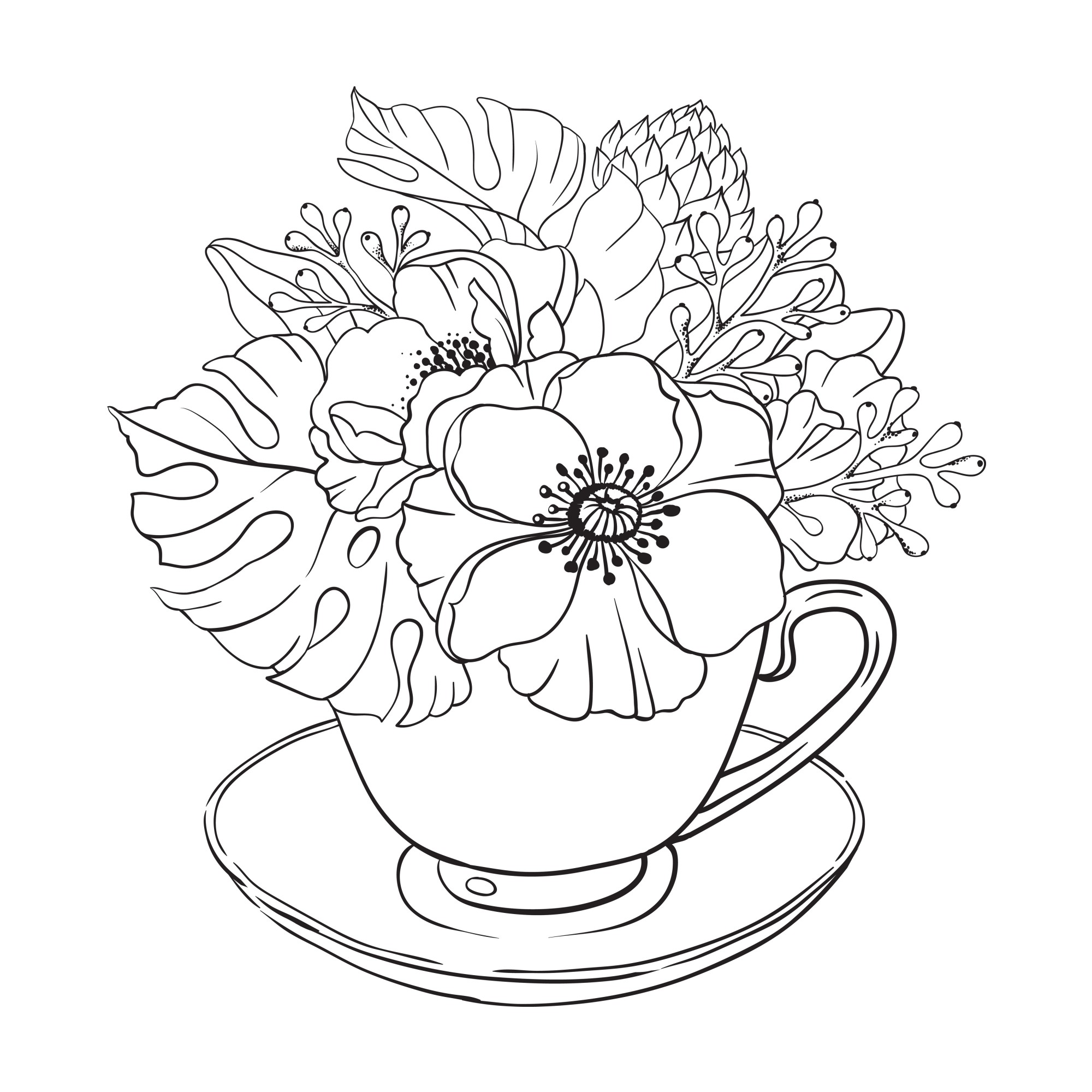
Let your creativity bloom with this beautiful Anemone Flowers Coloring Page, featuring delicate blossoms, graceful petals, detailed centers, and leafy botanical shapes waiting to be transformed with color.
Anemones are especially enjoyable flowers to color because nature already provides an incredible range of inspiration. Depending on the type, anemone flowers may appear in white, pink, red, purple, blue, and other shades, often with striking centers that contrast beautifully with the petals.
You can recreate the colors of real anemones, experiment with gentle watercolor-inspired pastels, create a dramatic red-and-black floral design, or forget realism entirely and fill every blossom with rainbow colors.
Whether you love flowers, enjoy detailed nature coloring, or simply want a relaxing botanical project, this printable gives you plenty of room to experiment.
🌸 Explore the Anemone Flower Design
The anemone artwork on this page is all about the flowers themselves.
Look closely at the shapes before you begin. The broad petals surround detailed centers, while stems and leaves provide plenty of green spaces to balance the brighter flower colors.
Instead of coloring the entire picture at once, try working blossom by blossom.
Choose one flower, finish its petals and center, then move on to the next. You can make every bloom match or treat the page like an imaginary garden filled with completely different varieties.
The detailed floral shapes also make this page a good choice for older children, teens, and adults who enjoy spending a little more time on a coloring project.
🎨 Look to Real Anemones for Color Inspiration
One of the best things about coloring anemones is how many natural colors you can use.
Spring-flowering anemones can produce blooms in shades including:
- White
- Pink
- Magenta
- Red
- Blue
- Mauve
- Purple
Some varieties have especially dramatic dark centers, while others feature bright yellow stamens surrounded by pale petals.
That gives you plenty of natural combinations to try.
Color one flower snowy white with a dark center, another rich red, another violet, and another soft blue.
The finished picture can look like an entire collection of anemones growing together.
❤️ Create Dramatic Red Anemones
Red anemones can make the flowers stand out beautifully.
Begin with a lighter red across most of each petal.
Add deeper crimson or burgundy closer to the center or along overlapping petal edges.
Then make the center dark brown, charcoal, or nearly black for dramatic contrast.
A few red blossoms surrounded by deep green leaves can create a striking botanical page without requiring many different colors.
You could even leave some flowers white so the red blooms become the focal points.
💜 Try Purple and Lavender Flowers
Purple is another beautiful choice for anemone-inspired coloring.
Use lavender for the lightest areas and gradually deepen the petals with violet, plum, or deep purple.
Keep the flower centers dark for contrast, or use yellow-gold centers for a brighter look.
Combine several purple flowers with pale pink and white blossoms to create a soft garden palette.
This color scheme works particularly well if you want the finished page to feel peaceful and elegant.
💙 Create Blue Anemones
Some anemones naturally produce beautiful blue or blue-violet flowers.
Try baby blue, cornflower blue, periwinkle, indigo, or violet-blue.
Blend two shades together on each petal, keeping the areas toward the edges lighter and deepening the color closer to the center.
Add medium and dark greens to the foliage so the cool blue petals remain the focus.
A blue-and-white anemone garden can create a wonderfully calm finished page.
🤍 Color Elegant White Anemones
White flowers can be surprisingly interesting to color.
Instead of leaving every petal completely blank, use very pale gray, lavender, cream, blue, or pink near the edges and overlaps.
Keep most of the petal white.
Then create contrast with a dark flower center and rich green leaves.
This technique can make white flowers appear dimensional while preserving their light, delicate appearance.
It is also a useful reminder that coloring does not always mean filling every space with a strong color.
🌈 Create Rainbow Anemones
Real flowers can provide inspiration, but coloring pages are also perfect places to invent something impossible.
Turn each flower into a rainbow.
Try red at the center of a petal, then blend outward through orange and yellow.
Make another flower blue, turquoise, and purple.
Or give every individual petal a completely different color.
You can even create striped, spotted, or patterned anemones.
Add rainbow-colored leaves if you want the entire botanical scene to belong to a fantasy garden.
🌷 Try a Soft Spring Palette
Anemones work beautifully with gentle spring colors.
Choose:
- Blush pink
- Lavender
- Pale blue
- Mint
- Peach
- Soft yellow
- Cream
Keep the petals light and use fresh spring greens for the stems and leaves.
The result can feel cheerful without being overly bright.
This palette also pairs naturally with our Spring Coloring Pages if you want to create a larger seasonal coloring collection.
🌿 Give the Leaves More Than One Green
The flowers may be the stars of the page, but the greenery helps everything come together.
Instead of reaching for one green crayon, try several.
Use:
- Lime
- Grass green
- Emerald
- Sage
- Olive
- Forest green
- Blue-green
Young leaves can be lighter, while shaded or overlapping leaves can be darker.
Adding several greens creates much more depth than filling every stem and leaf with exactly the same shade.
For more plant-focused designs, explore our Coloring Pages of Plants.
✏️ Add Veins and Botanical Details
Once the basic coloring is finished, go back with a sharpened colored pencil and add small details.
Draw fine veins along some petals.
Add darker lines to leaves.
Create tiny dots or short strokes around the flower centers.
These details do not need to be botanically perfect.
They simply add texture and help transform a simple colored area into something that feels more intricate.
Older kids and adults may especially enjoy this slower, more detailed stage of coloring.
🌟 Make the Flower Centers Stand Out
The centers of anemone flowers can create beautiful contrast with the petals.
If your flower is red, pink, purple, or blue, try a nearly black center.
For white flowers, dark centers can create an especially dramatic appearance.
You can also use golden yellow for the central stamens.
Instead of coloring the entire center with one solid shade, combine dark brown, black, yellow, gold, or orange in small areas.
Those tiny details can become some of the most eye-catching parts of the finished page.
🌼 Learn a Little About Anemones
Anemones belong to the buttercup family, Ranunculaceae, and the genus includes a wide variety of flowering plants.
Different kinds grow in different environments and bloom at different times of year. Some anemones flower early in spring, while others bloom much later.
Spring-flowering varieties can include woodland plants as well as Mediterranean types. Their flowers are commonly open and cup-shaped, daisy-like, or buttercup-like.
That variety is one reason anemones make such interesting coloring subjects. There is no single anemone shape or color that represents every member of the group.
🌬️ Why Are Anemones Called Windflowers?
Anemones are often known as windflowers.
The botanical name Anemone has traditionally been connected with the Greek word anemos, meaning wind.
The nickname adds another imaginative possibility to the coloring page.
Draw gentle curved lines around the flowers to suggest a breeze.
Add drifting petals or bending grasses.
Perhaps butterflies are being carried across the garden by the same wind.
You could even create a stormier version with gray clouds and flowers swaying dramatically beneath the sky.
🦋 Add Butterflies to the Garden
Flowers and butterflies belong naturally together in a coloring-page world.
Draw one or two butterflies hovering around the anemones.
Give their wings patterns that coordinate with the flowers.
A pink flower might have a pink-and-purple butterfly nearby, while a blue blossom could attract a turquoise-and-yellow visitor.
For a fantasy version, make the butterflies tiny rainbows.
Adding insects turns the page from a simple flower study into a complete garden scene.
🐝 Add Pollinating Visitors
You can also add bees or other insects visiting the blossoms.
Draw a small bee hovering near one of the flower centers.
Use yellow and dark brown or black for its body and pale blue or gray for the wings.
Then imagine the entire garden buzzing with activity.
This can be a simple way to begin talking with children about the relationships between flowers and pollinating insects while they color.
Explore more tiny creatures with our Insect Coloring Pages.
🌱 Create an Entire Anemone Garden
The original flower design can become the centerpiece of a much larger garden.
Use the open spaces to add:
- More flowers
- Grass
- Butterflies
- Bees
- Ladybugs
- Stones
- Mushrooms
- A garden path
- A watering can
- A tiny fence
- Clouds
- Sunshine
You do not need to draw complicated botanical illustrations.
Simple circles surrounded by petals are enough to create additional flowers.
Once the background is filled, your anemone coloring page can look like part of an overflowing cottage garden.
For more detailed outdoor scenes, visit our Garden Coloring Pages.
🔎 Go on a Flower Observation Walk
After coloring the page, look for flowers outdoors at a garden, park, botanical garden, or even in your own yard.
You do not have to find an anemone.
Instead, examine any flowers you see and notice:
- Petal shapes
- Petal colors
- Flower centers
- Leaf shapes
- Stems
- Patterns
- Insects visiting the flowers
How many petals can you count?
Are all the flowers on one plant exactly the same color?
Are the centers lighter or darker than the petals?
Then compare what you observed with your coloring page.
🔢 Turn Flowers Into a Counting Activity
Botanical coloring can easily become a simple early-learning activity.
Count the flowers already in the picture.
Then count the petals on individual blooms.
Add your own objects using number prompts such as:
- Draw 2 butterflies.
- Add 3 bees.
- Draw 4 tiny flowers.
- Add 5 leaves.
- Draw 6 raindrops.
Children can color each group differently and count everything again when the page is complete.
🎨 Try a Limited-Color Challenge
Choose only three or four colors and use them throughout the entire picture.
Try:
Pink + Burgundy + Sage + Cream
or:
Blue + Purple + Forest Green + Yellow
or:
Red + Black + Green + White
A limited palette can make detailed botanical coloring look especially polished.
It also encourages you to think about how lighter and darker versions of the same color can be used in different ways.
🌙 Create a Moonlit Flower Garden
Anemones do not have to grow beneath a bright daytime sky.
Turn the picture into a magical nighttime garden.
Use dark blue or purple in the background.
Color the flowers pale lavender, white, blue, or pink so they appear to glow against the darker surroundings.
Add a crescent moon and tiny stars.
Draw a moth instead of a butterfly.
The same floral line art can feel completely different simply by changing the atmosphere around it.
🧚 Make a Fairy Garden
Anemone flowers can also become enormous blossoms in a miniature fairy world.
Draw a tiny door beneath one flower.
Add a fairy resting on a petal or a miniature path winding between the stems.
Perhaps dew drops become giant sparkling pools.
A ladybug might be as large as a horse to the tiny characters living among the plants.
Use bright fantasy colors throughout the picture and add glitter-like stars or dots around the flowers.
✂️ Turn the Finished Page Into Floral Art
A finished anemone page can be displayed rather than tucked away.
Try using it as:
- Bedroom wall art
- Classroom decoration
- A nature-journal cover
- A scrapbook page
- A greeting card
- A spring decoration
- A notebook cover
- A garden-themed poster
Mount the colored picture on cardstock in a coordinating color to create a simple frame.
A pink-and-purple page could look beautiful against dark plum cardstock, while red flowers might stand out against black or forest green.
💌 Make a Handmade Flower Card
Flowers are naturally suited to greeting cards.
Color the anemones using the recipient’s favorite colors and add a short message.
Try:
Thinking of You
Have a Beautiful Day
Happy Birthday
Thank You
or simply:
For You
The intricate flowers give the card a handmade botanical feel without requiring you to draw the entire design from scratch.
📓 Start a Flower Coloring Journal
If you enjoy botanical coloring, turn this page into the beginning of a flower journal.
Color the anemones first.
Then add other flower pages behind it.
Write the flower name at the top of each page and record a few simple observations, such as common colors or the season when the plant blooms.
You could also draw flowers you notice outdoors.
Over time, the journal can become a mixture of coloring book, nature notebook, and personal art collection.
🌺 Compare Different Flowers
After finishing the anemones, choose another flower to color.
Roses are a great comparison because their tightly layered petals look very different from the more open appearance of many anemone flowers.
You can explore our Rose Coloring Pages and compare:
- Petal shapes
- Flower centers
- Leaf shapes
- Number of petals
- Natural colors
- Overall flower shape
Then create an imaginary bouquet containing both flowers.
🖍️ Explore More Flower Coloring Pages
Anemones are only one small part of the colorful world of flowers.
Our Coloring Pages of Flowers collection offers even more opportunities to experiment with petals, leaves, bouquets, and floral scenes.
You can also explore our Top 10 Coloring Pages of Flowers for butterflies with flowers, rose bouquets, tulip fields, cherry blossoms, orchids, sunflowers, and other botanical designs.
Use matching colors across several pages to create your own flower coloring collection.
🌿 Explore More Nature Coloring
If coloring plants and flowers is your favorite kind of activity, continue exploring the outdoors through art.
Our Nature Coloring Pages bring together plants, gardens, flowers, butterflies, birds, mushrooms, landscapes, rainbows, and other parts of the natural world.
You can create a homemade nature coloring book by choosing a few pages from each category.
Start with anemones, add a garden, include butterflies and plants, and gradually build your own paper version of the outdoors.
🌸 Let Your Anemones Bloom With Color
This Anemone Flowers Coloring Page gives you a beautiful botanical design with plenty of possibilities.
Follow nature with red, pink, white, purple, or blue flowers. Experiment with dramatic dark centers, blend several shades across individual petals, create a pastel spring garden, or forget realistic colors and invent rainbow anemones that could never grow anywhere except your imagination.
Add butterflies, bees, extra flowers, stars, fairy houses, or an entire garden around the original artwork.
However you choose to color the page, take your time and enjoy watching each blossom come to life.
Happy coloring! 🌸🌿
🔗 Related Articles
- Coloring Pages of Flowers
- Explore the Beauty of Nature with Our Top 10 Coloring Pages of Flowers
- Rose Coloring Pages: Free Printable Roses, Bouquets & Floral Designs
- Garden Coloring Pages: Free Printable Flowers, Secret Gardens & Gardening Scenes
- Coloring Pages of Plants
- Nature Coloring Pages
- Spring Coloring Pictures: Free Printable Cute Gardens, Animals & More
- Spring Coloring Pages
- Insect Coloring Pages: Free Printable Bees, Butterflies, Ladybugs, Beetles & More
📚 Sources
- Royal Horticultural Society — Anemone
- Royal Horticultural Society — Spring-Flowering Anemones
- Royal Horticultural Society — How to Grow Spring-Flowering Anemones
- Missouri Botanical Garden — Anemone virginiana